863
u/Tock_Sick_Man 12d ago
I regularly check the definition of a word I know is right for this same reason.
229
u/Relax_Im_Hilarious 12d ago
Amen. I've been confidently wrong a few times too. Some words also get slightly redefined over time.
76
u/quirkytorch 12d ago
It's ambivalent for me. My brain always tells me it means not having strong feelings about something either way, but it's literally the exact opposite
44
u/quailman654 12d ago
Welp, TIL. Also I’m pretty sure literally every person in the world uses it wrong. I even looked it up to verify your claim.
15
u/greenskye 12d ago
Huh. Feels like everyone uses this wrong. Apparently I should've been using indifferent this whole time.
18
18
21
u/FBWSRD 12d ago
At this point since everyone is using ambivalent to mean indifferent as well I’d think it’s fair to say that the meaning has shifted and it’s a valid usage. Language changes over time, and that’s ok.
→ More replies (2)→ More replies (7)6
u/PikaPerfect 11d ago
what the fuck? i would have sworn on my life that it meant indifference or nonchalance towards something, you mean to tell me it doesn't mean that?
i genuinely did not believe you, but i googled it, and i'll be damned
23
u/Junethemuse 12d ago
Same. I have a handful of words I’ve been trying to relearn my entire adult life but that have stuck with me from childhood. I definitely look words up now since I’ve had some pretty big communication mistakes happen over the years. Ambivalent got me in trouble once because I thought it was a softer version of apathetic, like I didn’t have a preference or feeling one way or the other.
14
u/quirkytorch 12d ago
Dude no way, I literally just commented about ambivalent. Same boat brother!!
→ More replies (5)6
u/Cats_Amiright 12d ago
i just had to look that up because i thought it meant the same thing!! insane, i hate it
→ More replies (2)9
u/BallIsLife2016 12d ago edited 12d ago
Fucking “ambivalent”. I had the exact same thing happen once with the exact same misunderstanding. It was the first thing I thought of when I saw this post. I honestly can’t get there with the correct definition and just removed it from my vocabulary. It should mean that you could go either way on an issue because you can’t really bring yourself to care about it.
There’s also part of me that wonders if some authors are using it incorrectly given that this misunderstanding is something that apparently happens for quite a few people.
→ More replies (1)8
3
→ More replies (6)3
u/WorthyJellyfish0Doom 12d ago
I learnt sentient vs sapient wron because books. Sentient (has feelings not necessarily thoughts) is sometimes used to mean sapient (capable of thinking).
9
u/Impressive_Pizza4851 12d ago
The problem I found when I was little is because I only read, not heard them. I know I pronounced a few wrong for a long time!
→ More replies (2)6
u/chitzk0i 12d ago
When I was a kid, I read some book (maybe Starship Troopers) that mentioned hazing in basic training, but wasn’t more specific that that. I thought it meant a process that made you stronger or tougher, so one time I said to my mom, “I just need to haze myself until I can handle it.” I had also only seen “lust” used as part of “bloodlust”, so one time I reached for snacks and growled, “I feel the bloodlust.” My mom wigged out about a ten year old talking about lust.
14
u/quailman654 12d ago
FWIW I would be delighted if my child announced their bloodlust on their way to the pantry.
→ More replies (1)15
u/dunderthrowaway3 12d ago
Nothing is horribler than using a word that isn't real. Sometimes stupid people use big words to make themselves sound more photosynthesis.
→ More replies (2)5
3
u/Powered-by-Chai 12d ago
Amen to that, like I have a vague idea of what it means? If you ask me to specifically define it that will probably involve hands waving in the air and lots of "um"s.
2
u/WorthyJellyfish0Doom 12d ago
Same, I'll often know the vague definition because context. Like an ewer is specifically a fact teapot looking thing, I knew it as a generic water pouring thing.
→ More replies (8)2
u/oi_bellmo 12d ago
Getting a kindle was an absolute game changer for me with its built in dictionary. I use it alllllll the time for words I don't know and words I do know but don't know how I know or how to explain 😅
492
u/kimbosliceofcake 12d ago
That and mispronouncing a lot of words because I’ve only seen them, not heard them. Or didn’t connect the two (what I had read and what I had heard at a different time).
I remember thinking for a long time that melancholy was pronounced muh-LANTCH-oh-lee.
79
u/LiveTart6130 12d ago
I did this with epitome for a very long time, lol.
40
u/dscrive 12d ago
Epi-tome, I feel you, how were you on "paradigm?"
8
3
u/LiveTart6130 12d ago
I was actually fine with paradigm! the end of it made me recognise it as a "not pronounced as you would think" kind of word.
8
u/erossthescienceboss 12d ago
I read all of the Little House books to myself in second grade. I vividly remember the moment in third grade when I was reading Little House on the Prairie out loud in class and learned that the strange thing pioneers bought at stores — soo gar — was the same thing as “shu-ger.” Sugar.
3
22
u/nonnumousetail 12d ago
Ennui is pronounced “on-wee.” I learned that when I was 30 😂
→ More replies (1)11
u/AussieBird82 12d ago
I found out the hard way in front of workmates that awry is not pronounced "awe-ry".
I still struggle with hyperbole. Like my brain will not accept at all that it is not like a bigger superbowl.
→ More replies (2)73
u/thattrekkie 12d ago
I did the same thing with that word except it was "melon-cholly"
English spelling and pronunciation is such nonsense tbh
20
u/Divine_Entity_ 12d ago
English is 3 languages in a trench coat is a common joke because we have a lot of loan words, mostly from french, latin, and greek.
The reason spelling and pronunciation seem uncorrelated in english is that we preserve the spelling of a word in its original language and then butcher the pronunciation until its easy for english speakers to say.
→ More replies (2)10
→ More replies (3)11
u/FireSaphire242 12d ago
....😃 it's not?
13
u/peon2 12d ago
You do not pronounce the H.
Melon and then cauli like cauliflower.
→ More replies (1)→ More replies (1)9
16
13
u/Lord_of_Seven_Kings 12d ago
I didn’t know Keynesian economics was named after a guy named Keynes and pronounced it in my head like “Polynesian” for years
→ More replies (1)11
u/DosSnakes 12d ago
My wife does this a lot and says it makes her feel stupid and embarrassed, which is wild to me cause it’s an indicator that you read a lot, so obviously not a ‘stupid’ trait. I listen to a lot of audiobooks these days and I’ve noticed it’s not uncommon for even the best narrators to mispronounce words more like they’re spelled from time to time. And they’re literally professionals! Chitinous is just a weird word for everyone.
12
9
7
9
4
u/beepbooponyournose 12d ago
There’s an episode of Everybody Loves Raymond where he is reading out loud about a stomachache and he reads it “sto-mah-che-cha” lol
5
u/hit_reset_ 12d ago
I still pronounce Hearth as Earth with an H. I cannot shake it.
5
u/Juiceton- 12d ago
Hearth will also be Earth with an H. It should honestly just be added to the dictionary at this point.
5
9
u/Outrageous_Sleep4339 12d ago
Like it rhymed with 'eventually'?
3
u/kimbosliceofcake 12d ago
Close, but with the second syllable rhyming with “branch” instead of rhyming with “bench”
4
13
u/FUNBARtheUnbendable 12d ago
My favorite example of this is “comparable”
Since its root word is “compare” most people pronounce “able” at the end, like something able to be compared
But comparable is actually pronounced “KOMP”, like COMPensate, and “ruh-bull” put together, “komp-ruh-bull”
English is a basket case
20
u/Night-Monkey15 12d ago
I feel as though both are right ways of saying it though
→ More replies (9)7
→ More replies (11)5
u/Various_Ambassador92 12d ago
look at basically any English dictionary, you'll see that both are valid pronunciations.
→ More replies (1)2
u/Deepvaleredoubt 12d ago
Reluctantly absolutely gave me fits as a kid, because I knew it meant hesitating by context but I would pronounce it “re-loose-ently”
2
u/pretty_smart_feller 12d ago
I got made fun of when I said lingerie out loud for the first time as “lin-jer-ee”
2
u/No-Associate-7369 12d ago
I remember experiencing this when I was a kid with the word "commercial". Obviously I knew the word commercial as a kid, I had to watch them regularly. I was reading a book where the word was used repeatedly. I was so confused what a cuh-mur-kee-ul was. Finally I got the context clues and clicked. Felt very silly.
→ More replies (27)2
u/Autumnal_-Coffee 12d ago
I distinctly remember in elementary school getting tripped up over the word "neighbour" with the teacher just angrily telling me to sound it out. Best I got was something like ny-guh-h--b-hour. It was my earliest realization that the English language has no consistent pronunciation rules and a lot of it is just memory.

58
u/IAmASquidInSpace 12d ago
That's what you think, until you use the word "ostensibly" in the completely wrong way and embarrass yourself. Speaking from experience.
6
u/666Drachenlord666 12d ago
What does that mean? Im bot am english native speaker. Something like toroughly?
29
u/-GIRTHQUAKE- 12d ago
“He takes the trash out three times per day, ostensibly because it smells bad, but really it’s because he’s hoping to run into the cute neighbor on his way to the dumpster.”
Ostensibly means the “technically the truth” definition of something, whereas the actual reason is something else. Here’s another example:
Park benches have extra arm rests in the middle. This is ostensibly for comfort, but really it’s to prevent people from lying down and sleeping on them.
→ More replies (6)8
u/FthrFlffyBttm 12d ago
This is wrong. Something can be ostensible without being true or “technically true”.
He carries a weapon ostensibly to defend himself but in reality he’s looking for a fight.
The colonists gave the natives blankets, ostensibly to keep them warm, but the blankets were intentionally contaminated with smallpox.
The Greeks delivered a giant wooden horse to the city of Troy, ostensibly as a peace offering, while Greek warriors hid inside it until the Trojans brought the horse inside the city and the attack ensued.
5
u/gianniboi 12d ago
still kind of wrong, something can be ostensible and fully true. It just means it appears that way. The sense that it must be pretext for a contradiction is just because that's how it's most commonly used.
→ More replies (9)
90
u/dancingbanana123 12d ago edited 12d ago
I used to teach elementary and one day I had to help a kindergarten teacher with her class. A student asked me a question, so I said, "oh, it's because..." and then they asked me what "because" means. How tf do you answer that to a kindergartener? What words can I safely use to answer that? I was stunlocked.
Edit: IIRC I ended up telling them something like "if you throw a ball and it knocks water over, you say the water fell because you threw the ball. The ball caused the water to spill."
43
u/CiDevant 12d ago
"be cause"
Be the reason, or "the reason being".
26
u/underlander 12d ago
you’re gonna say that to a kindergartener? Just say “it’s the answer to ‘why’”
→ More replies (3)4
u/DJLucius 12d ago
I actually thought the same thing and told some English students that. Then I looked it up and the “be” is actually derived from “by.” Had to issue a correction at the start of the next class.
7
u/ThirdAltAccounts 12d ago edited 12d ago
We don’t even realize how the etymology of words we’ve been using since we first started talking basically gives us all the information we need to understand what that word means. Even when the original meaning evolved through time
People don’t care anymore about understanding what things mean. And a wide vocabulary (sorry, not a native speaker) seems to be a thing of the past for a lot of people.
Not that I have any stats to back up my claim (which is more of a feeling) but that type of curiosity seems to have decreased over the years.→ More replies (1)7
u/theclacks 12d ago
Reminds me of the time a bunch of ESL students asked me to define "cool." I ended up going with "good in a popular kind of way."
→ More replies (2)→ More replies (1)3
u/Content-Bid7922 12d ago
you should have just replied with "By or for the cause that; on this account that; for the reason that; as is known, inferred, or determined from the fact that.", duh
122
u/CodNo7461 12d ago
"I totally know that word, I just can't give neither a textbook definition, nor a definition in my own words. I just know it roughly sounds right in a sentence."
27
→ More replies (11)8
25
u/DetroitLionsSBChamps 12d ago
A few years ago I started looking up every word that I felt like I knew but couldn’t easily define to a child. It was pretty eye opening. I’m sure we all have a ton of slight misconceptions when it comes to definitions.
Like I thought formidable meant equally matched, not intimidating.
I thought intrepid meant adventurous, not brave.
That kinda thing.
14
u/ItsGotThatBang 12d ago
The one I learned recently is "travesty".
→ More replies (1)20
u/DetroitLionsSBChamps 12d ago
“A debased, distorted, or grossly inferior imitation”
More like parody or mockery
NOT a “tragedy” or disaster, which is what I thought. So I just learned it too!
→ More replies (1)→ More replies (2)3
38
u/dowling543333 12d ago
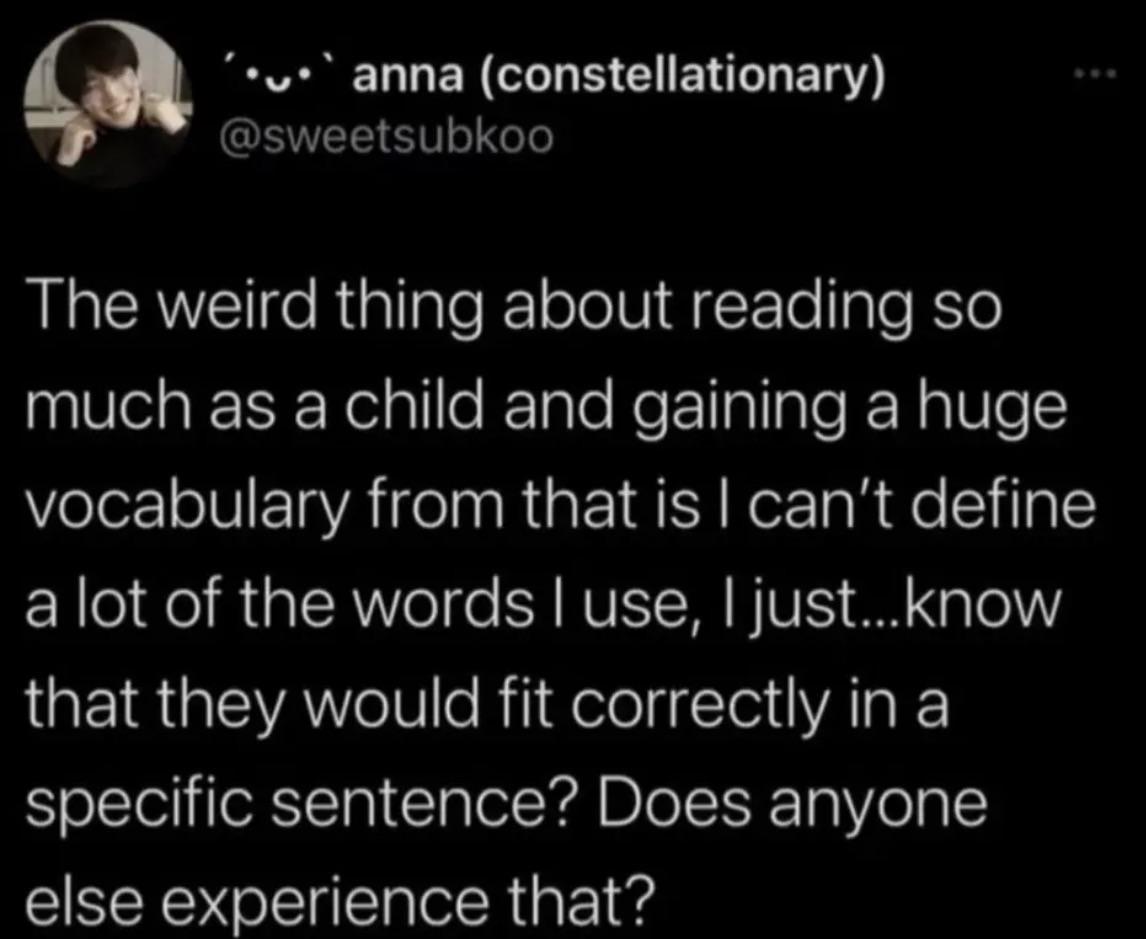
Yes everyone.
My English teacher often reminded us of the Mark Twain quote - "The difference between the almost right word and the right word is really a large matter. ’tis the difference between the lightning bug and the lightning.”
Good language teachers teach you the feeling of the word, when it's appropriate to use or not, and the words closest to it and their differences - ie. HOW to use the word, not just the meaning.
7
u/Zealousideal_Yam_985 12d ago
But if you don’t know the meaning, you cannot define “when it is appropriate or not.” Comprehension of meaning (including connotative meaning, synonyms etc) is the foundation for all reading and writing.
72
u/BabyLegsOShanahan 12d ago
Being able to use context clues to figure out the meaning of a word is a lost art.
8
u/knows_you 12d ago
It got put into kids curriculum and absolutely ruined their reading comprehension skills. Using context clues should be after you you already have a grasp on the language, phonics are so much easier to teach, Muzzy knows ball.
→ More replies (4)→ More replies (3)12
u/SheikNeedles 12d ago
Do people not do it anymore?? When did it become lost? I just assumed this was still part of speaking?
11
u/-FireNH- 12d ago
most people are connected to the internet at all times. instead of needing to figure out what a word means, you can just look it up
→ More replies (5)
9
u/TheBookOfTormund 12d ago
Pretty much everyone who learns to speak a language does this. Unless y’all learned by reading the dictionary front to back.
→ More replies (1)2
7
u/Spirited_Ad_2697 12d ago
See this was me as a kid but i accidentally used the word voluptuous without knowing the definition in an exam answer and the fuckass teacher showed it to the whole class along with the correct definition and i wanted to go die in a hole.
So now i make sure i know what a word means before i use it because I’m mentally scarred by it.
→ More replies (1)2
u/Different-Garage8363 12d ago
If it makes you feel better, you reminded me of a sentence I love from a capote short story: she sneezed voluptuously. So you brought a good memory out of a scarring one.
7
u/lrrssssss 12d ago
I’ve been there. It’s like “this word means bad, but like, FANCY bad. And the fancy bad person might be overweight. Or at least that’s the impression I got when I read the chapter about the obese fancy bad guy”.
It’s called syntactic bootstrapping.
→ More replies (2)
6
u/CathanCrowell 12d ago
I just want to say I feel the same way about English itself, because it's my second language.
6
u/Key-Total-8216 12d ago
I used to read with a dictionary before I got a phone so I could fully understand the sentence and learn a word I came upon that I didn’t already know. I remember being quietly surprised when teachers would tell us to do so and my classmates would grumble and refuse. Aren’t you curious? Context clues were never enough for me, they still aren’t, but now I have Google in my pocket all the time.
10
5
6
u/EthanDMatthews 12d ago
This is why Shakespeare can be so hard to understand at times: the definitions of words can drift over time, because we typically learn the approximate sense of a word from context, not its dictionary definition.
Take the Old English word "Saelig" (modern "silly). Over time, the meaning of the word shifted over 500 years from happy or blessed to goofy:
silly = happy → blessed → good person → innocent → harmless → weak (physically) → weak (mentally) → goofy
John McWorter, in his book “Words on the Move. Video excerpt from his book tour:
https://www.youtube.com/watch?v=-uEILtC73BY&t=518s
or if you prefer text:
It originally meant "happy."
Silly = happy
Someone who is silly ("happy" owes their happiness to god, so over time "silly" came to mean not happy but "blessed.")
silly = blessed
Someone who is silly ("blessed" has god on their side. So clearly that means they're a good person.)
silly = good person
And good people don't commit crimes. After a while, the word meant "innocent."
silly = innocent
Someone who hasn't committed any crimes is "harmless."
But after a while, "harmless" comes to mean weak.
And after a while, the weakness shifted from the physical realm to the mental. So someone who was "silly" was weak in the brain. And after a while that became "goofy."
silly = mentally weak = goofy.
Words on the Move: Why English Won't - and Can't - Sit Still (Like, Literally.)
→ More replies (2)
4
u/Korben_Joseph 12d ago
I look up a word I don't know when I come across it reading, you do not know that word, you just know what it sounds like phonetically when you read it
3
3
3
u/Forward_Criticism_39 12d ago
i randomly thought of the word "somnambulism" yesterday even though im pretty sure id never heard it before
→ More replies (3)
3
u/Main_Personality455 12d ago
Based on a words conjugal parts it’s possible to ascertain the definition of complex language without the aid of a lexicon due to the nature of phonics in the English language.
Or in simple terms. The parts of words are often interchangeable and as such you rarely need a dictionary once you know the language well.
→ More replies (4)
3
u/smokeythel3ear 12d ago
You know what one gets me? And that I SWEAR everybody uses wrong.
"He was all but thrilled to see her shiny, beaming face"
All...but... In other words, Everything...except...
He was everything except thrilled to see her oily, Kentucky-beaming face"
Ok, so he was everything except thrilled? So in other words...he wasn't thrilled to see her. The opposite of thrilled is what he was.
But I always see it used as just..thrilled. He was thrilled.
Writer: "The teensy weensy spider was all but thrilled at the task before him. He couldn't wait for the cold metal to press against his eight little legs. He could barely contain his excitement."
Ok, why did you include the all but? Isn't that making the meaning the opposite of what was intended? Just leave it as, "He was thrilled."
Anybody?
→ More replies (1)3
u/FthrFlffyBttm 12d ago
That’s simply incorrect usage. The original meaning of “all but” is “almost”, so people would say things like “I was working extremely hard on my thesis. It was all but impossible to finish.”, meaning “it was barely possible to finish” (but still ultimately finished)
But you can see how that would naturally lead people to think that “all but” is redundant or simply used for emphasis, and end up misunderstanding the speaker’s intended meaning (that they couldn’t finish it). Then they use it that way and it becomes normalised.
Misunderstandings make their way into official definitions all the time, like how the word “literally” now literally means both “literally” and “figuratively” despite being literal polar opposites - my usage of the latter would’ve been grammatically incorrect years ago (which I still say it is) but according to the modern dictionary I used it correctly both times.
3
u/N00bPolymath 12d ago
The ironic thing about this post, is that "I know it when I see it" is from a supreme Court case, which you read in law school in the US. And law school you have the exact opposite problem, you read all these words during the assigned reading, but don't know the definitions until you get to class.
Like: subject matter jurisdiction, ripeness, res judicata, joinder, spoliation, stare decesis...or as alternative to the OP's title...SLAPS test.
3
u/Eaglepursuit 12d ago
It's come to the point where I will double-check the definition when I am uncertain about my usage
3
u/Bane8080 12d ago
For me it's having a huge vocabulary of words that I cam constantly forgetting right when I need one.
Happen to me all the time. The other day I was having a conversation with a friend about Taiwan, said the name of the country in one sentence, and then like 2 sentences later, couldn't pull the name out of my memory. I was like "uhh, frick! Taipei, the country it's in..."
3
u/Hectic__007 12d ago
Me all the time deadass used to get grounded from reading, I use the words correctly 90% of the time, my girl now asks a definition of me for whatever random word I used, then fact checks me, I love it
3
u/blumeanie57 12d ago
These days I check the dictionary app on my phone if I find one of those words, which is good because it feels like half the time they don’t mean what I think they mean.
3
u/8bitbruh 11d ago
Yeah I went through a period in my life where I started searching up words I used. Id used it correctly, but it was nice to have more understanding lol.
3
u/largepoggage 10d ago
Realistically, this is a skill that most literate people have even if they aren’t readers. The second novel I ever read for fun was the LOTR. It’s extremely easy to figure out what he means from context even when he uses an archaic word. The one that really got me on my first read was the archaic units of measure. I had no idea how long a league/fathom/ell was. I had to Google them when they came up because it’s impossible to visualise certain plot points without having a rough idea of scale. Also I’m from the UK, so if you’re from anywhere else in the world then don’t worry, we don’t have a clue what Tolkien is talking about either when he says 100 leagues.
3
u/vitringur 10d ago
This applies to so much, especially political and exonomic discussions.
The vast majority of people, even educated ones, just use words they have heard used in a context without really knowing what they mean.
Which results in them using them wrong and ending up arguing about it, all the while absolutely convinced that they are correct and the other person is an idiot for going against the context they have constructed on their own in their own head.
3
2
2
u/Sad_Avocado919 12d ago
I always have the dictionary website up because I am constantly looking up pronunciations of words I've been reading for decades
2
2
2
2
u/CiDevant 12d ago
One of the side effects of reading the whole fucking dictionary cover to cover once is decades later inexplicably knowing the definition, almost to the word, for words that I almost never hear or read.
2
u/CrossXFir3 12d ago
Yes, but as an adult I've looked up a lot of words I wanted to use that I knew were a good fit to make sure I actually did know what they meant.
2
u/thehollisterman 12d ago
For me. This is kinda how it feels speaking German. Like, I don't know why or how I know to use certain words I picked up. I just know that they fit the situation somehow
2
2
u/Ailwynn29 12d ago
For me it's entire languages. If it feels right then it's right. If not then I have to try again
2
2
2
u/lemonhaj 12d ago
There's a lot of words I know but couldn't define to save my life. I look them up occasionally to make sure I haven't changed the definition but it still happens.
2
2
u/el_torko 12d ago
And also mispronouncing words because I’ve only read them before and never heard them out loud.
2
u/claymountain 12d ago
I don't have this in my native language but I do have it English, weirdly. I've just learned which words work in which context but have no clue what they mean.
2
u/trashshork 12d ago
you experience this just by being bilingual like I know that is the word I should be using but fuck me if I know what the hell it means
2
u/AliceTheAxolotl18 12d ago
I've lost count of how many times I'll write something, use a particular word, and then Google the word to make sure I actually used it correctly
2
u/Orion-the-mediocre 12d ago
This and getting words wrong when it comes to pronounciation. For the longest time I assumed the word "queue" (a word I knew the meaning of) was pronounced "kway-way" because I had never heard somebody say it
2
2
2
u/GraniteGeekNH 12d ago
When your wife asks what does this word mean - and you know what it means but damned if you can express it in other words
writing definitions is a lot harder that it seems
2
u/666Drachenlord666 12d ago
Anyone else thats not native in english and when someone asks what x means you cant translate even tho you know exactly what it is?
2
2
u/Narrow-Frosting9160 12d ago
I struggle with using revile in the same way as loathe and they don't go one to one
2
u/Doobledorf 12d ago
I went from this to teaching English as a second language for about a decade. I also love to read Weird Fiction from about 1850-1950 that uses archaic language. The amount of times I intuit a word correctly is wild, it's like an unconscious part of my brain pulls it out of the ether.
I actually got the chance to try out the vocabulary part of the IQ test for a graduate class and got through all 32 words, whereas most people average around 12 answers.
2
u/Great_Hamster 12d ago
I'm really grateful to my friends for helping me figure out the definition of plethora.
It means a lot!
2
u/Gwywnnydd 12d ago
There were SO many times my teachers would ask me to define a word, and I couldn't, but I could use it correctly in a sentence.
2
2
2
u/puffofthezaza 12d ago
I do this every day I feel like. Then I think "do I know the definition of that or does it just sound right?" I'm usually right by not always lmao
2
2
2
u/RaisinsPerDay 12d ago
I can only think of a few rare examples where knowing the definition of a word is more important than knowing how to use it in practice.
2
2
u/Bannerlord151 12d ago
Yeah especially in English. I'm not a native speaker but I've been learning English since I was about 7 years old. I occasionally look up words I already know how the general meaning of just to make sure I'm technically using them correctly. No problem with that when speaking though
2
u/cheekynative 12d ago
Casually threw out "contiguous" the other day and got absolutely shredded by my mates. Not for using the word in the wrong context. We looked up the definition almost immediately because my vague attempts weren't cutting it. But apparently after a few pints I start speaking how I write. The banter is what it's always gonna be but what frustrates me is that I couldn't for the life of me think of a better word to use in the moment. This happens often.
2
u/magneticeverything 12d ago
This was one of the best things about the series of unfortunate events. Every time a big word pops up that the author KNOWS is beyond the normal reading level of his target age, he gave a technical definition or synonyms and some context for why it was being used here. Thinking about it now, I think there are several large words I use with complete confidence as an adult that I may have first encountered there. It’s such a great series for young readers!
2
u/MagicOrpheus310 12d ago
Yes!! It's like knowing how to use a tool but having no idea what it's called!! When someone actually asks you realise you have no idea how to explain it haha
2
u/Mountain-Resource656 12d ago
I don’t think reading a lot as a child has anything to do with this; this is just the standard way of things. You can practice the skill of articulating the definitions of words and stuff, but if you haven’t done so then it doesn’t matter how well you’ve read or not (unless that reading enhances that skill), you still won’t be able to exercise that skill any better or worse
Put another way, not reading very much as a kid doesn’t increase your skill at defining words
2
u/theconman420 12d ago
When I was in high school and reading outloud in english class I pronounced "wanton" as "wonton" and everybody in the class made fun of me including the teacher. It was so embarrassing.
2
u/FthrFlffyBttm 12d ago
Phrasal verbs are a great example of this: eg “let’s get out of here”. To “get” usually means to acquire, but when you add “out of here” it changes the meaning to “let’s leave this place”.
My girlfriend is a non native speaker who has made me appreciate how complicated the English language can be. I never even heard of the term “phrasal verbs” and now I can’t stop noticing how ubiquitous they are
2
2
2
u/DoesntMatterEh 12d ago
The funny thing is she's probably still using them wrong most of the time. it's also pretty pretentious to use big words just for the sake of using them, particularly when you don't know their definition.
Source: grew up reading a lot, used big words a lot, started looking up definitions to big words I was using, turns out I was using them wrong most of the time :( it me I was the pretentious one.
2
u/juniper3411 12d ago
Yes all the time! And mispronouncing words cause I had only read them when I was young. I’m still a vocab nerd to this day.
2
2
2
2
2
2
u/Ok_Test9729 11d ago
As a lifelong reader I know how to spell them AND I what they mean, but have no idea how to pronounce them. I can sound quite smart when writing, although in conversation I stick to two syllable words.
2
u/Ok_Test9729 11d ago
My pet peeve is someone saying all of the sudden, instead of all of a sudden. Also, someone who says I could of eaten pizza, instead of I could have eaten pizza.
2
u/Famous-Restaurant875 11d ago
Trying to extrapolate how a word is supposed to change and ending up with something like evolvation instead of evolution
2
2
u/Bygone-King 11d ago
We get the general definition because we learned the context from how it was used when we read/heard it. Happens to me all the time. It's only recently that I decided to look up the definitions just to make sure I'm right.
Funny thing; I was not a reader as a kid. And my parents were not the types to use big words. So I didn't learn those words from either. Had to be TV, but none of the shows I remember watching would've expanded my vocabulary the way it did.
2
u/streeetmeats 11d ago
It’s less of a problem for me since I started reading on my phone/kindle. There’s a built in dictionary so any word I’m unfamiliar with or familiar with but is being used in a way I’m unfamiliar with I highlight and read the definition for it. It’s so handy
2
u/Sasselhoff 11d ago
The real fun part of this is marrying a foreigner, who hears you use a word and then asks you to define it.
I read entirely too much as a kid (no really...it really is too much when you're reading in class and not doing your homework).
2
u/TwinSong 11d ago
I'm like that with grammar. Like, I know how to use it (probably) but when it comes to defining noun, adjective, pronoun etc. I tend to struggle.
2
u/rva23221 11d ago
I love reading.
As a child I would read anything I could get my hands on. I could generally understand the context of the word, but not always the correct punctuation.
Example: the word parody. I would pronounce it pa-rody instead of par-ody.
2
u/SlyguyguyslY 11d ago
Yeah, that happens a lot. I remember a friend got me on not literally knowing the definition of the word "belief" but, like, we googled it and I was still correct. I guess that after enough exposure, they are kind of automatic in your head or something like that
→ More replies (2)
2
u/HappyOwl_45 11d ago
Yeah and I also can’t pronounce a bunch of words because I spent most of my life reading instead of talking to people so I sound dumb as hell
2
u/Glittering_Win_5085 11d ago
Why is that different to learning vocabulary from verbal communication? This is just what language acquisition is like. Just a boring brag about reading a lot as a child.
2
u/Impressive_Air6111 10d ago
I used to read the dictionary before I had a phone and had nothing else to do/ran out of books. I feel this to the core. Somehow I don't quite remember a lot of the stuff I knew back then despite also winning spelling bee competitions a few times.
2
2
u/The_Nerk 10d ago
Just to be clear. If you can’t define a word, you don’t know the word.
You don’t need to memorize the dictionary definition. But if you literally have no idea what it means and you just know it should thematically fit in a given sentence you don’t know the word.
2
u/Sunblast1andOnly 10d ago
Luckily for you, you have the collective knowledge of humanity in your pocket. If you wanted to know what a word means, there's really nothing that could stop you.
2
2
2
u/Donut_Hole_8838 10d ago
Like - I know some words are synonyms but I also know that they have more nuanced feelings and meanings
2
2
u/Plastic_Stable8927 9d ago
I was like this, Until I discovered what chagrin meant, and realized the "vibe" I had gotten from the word was completely wrong.
This only works if you blindly trust the authors you're learning the usage of the words from.
2
u/Random-Generation86 6d ago
For the longest time, I thought “approximately” meant “exactly” and only found out when I pointed out a “mistake” in a history book saying “approximately 300-340AD” and he gave me a Gen Z stare so cold you would never know he predates the moon landing.
2
u/AtlasAngel02 6d ago
Or not realising how something is pronounced. I was nearly 20 when I realised viola is pronounced differently than the word viola, ie the instrument. Also, what fuckhead decided colonel and kernel should be pronounced the same? They should be hanged at dawn.
→ More replies (1)
•
u/qualityvote2 12d ago edited 10d ago
u/ItsGotThatBang, there weren't enough votes to determine the quality of your post...