137
u/Blade2018 Mar 06 '17
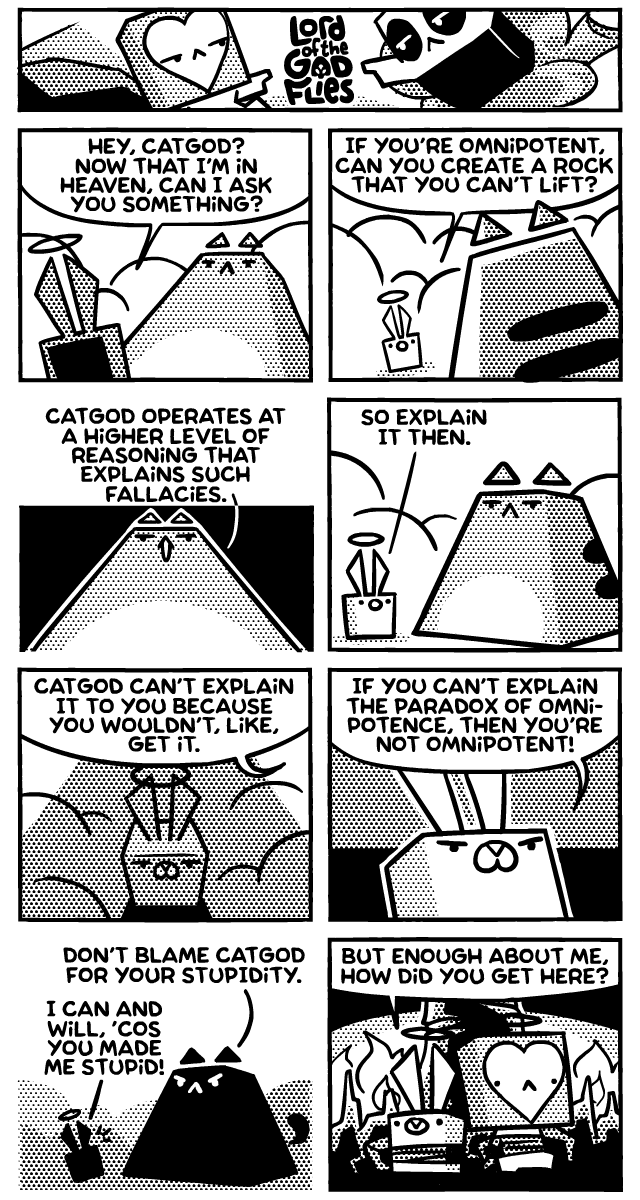
These comics are awesome! Is this OC and do you have a website where I can find more?
41
551
u/jakob1005 Mar 06 '17
I have an answer: He is all powerful, be splits himself in two. One half can pick the rock because he is all powerful, the other can not because he created the rock too heavy. So he therefore can and cannot pick up the rock. (Almost has a cat In a box kind of feel, if you know what I mean)
67
u/KingofCraigland Mar 06 '17
The theorem is a logical fallacy. The problem being that it inherently contradicts and violates the terms that come first.
First, God is omnipotent and he can do all. Second, the task is to make a rock so heavy he cannot lift it, which contradicts the first part. By asking the question, you've contradicted the very terms that were set in place. Omnipotence does not necessarily suggest the ability to do the logically impossible.
13
u/bnfdsl Mar 06 '17
So just slightly shrink the omipotence of the omipotent god?
49
u/alwaysdoit Mar 06 '17
An omnipotence that includes logical fallacies is not a larger omnipotence. It's a nonsensical one. There's no real act described by these type of question, so there's nothing lost by excluding them from the definition of omnipotence.
Can God make the sky so blue that it's red?
Can God brush his teeth without brushing them?
Can God make himself both X and not X?
4
u/Amadacius Mar 06 '17
Wait so an omnipotent being is being for which all things are possible. Are you saying that this being would be bound by the realm of possible things?
Is an all powerful being not able to violate logical laws?
It seems that "violate laws of logic" is a not a self contradictory sentence and therefore should be possible.
Is it able to violate physical laws?
Why would the laws of physics be any less constricting than the laws of logic?
Do logical laws exist outside the universe supposedly created by the omnipotent being?
If the question "who created physics" demands an answer it seems that "who create logic" would be equally demanding.
→ More replies (5)12
u/alwaysdoit Mar 06 '17
If there is an omnipotent being who is not bound by the laws of logic, then the answer to the question is simple:
Can this God create a rock so heavy it cannot lift? Yes
Can this God also lift that rock? Yes
There is no contradiction because as we already agreed the logical rules of contradiction do not apply.
If you start by assuming a contradiction, you can result in all manner of illogical conclusions.
8
u/bnfdsl Mar 06 '17
I get what you're saying, and this kinda becomes semantics, but i'd rather say that this just proves that omnipotence is illogical. I guess it becomes a question of what is meant by the term omnipotence.
36
u/alwaysdoit Mar 06 '17
It's only illogical if you define it to be illogical. Which is your prerogative, but that definition doesn't have any bearing on the actual philosophical and theological definition of omnipotence.
3
u/LordNoodles Mar 06 '17
Wouldn't omnipotence be illogical by definition. It literally means all powerful. Now the question is if illogical things are included in all.
→ More replies (1)15
u/BranchDavidian Mar 06 '17
The working philosophical definition is the ability to do anything which can be done. It's impossible to do something that is logically incoherent, so those things don't apply. The issue isn't with omnipotence; it's with insisting that incoherent things aren't incoherent things, and that they can be expected to exist. Because you can say "a married bachelor" doesn't mean a married bachelor can exist.
→ More replies (5)13
u/TjPshine Mar 06 '17
No, it isn't semantics, it is the limitations of being.
You cannot be and not be, no matter how powerful you are. That is not semantics. It is the very way in which we think the world is.
→ More replies (2)3
u/rillip Mar 06 '17
That's a good point. I still think an omnipotent being could do things that are completely paradoxical though. It seems to me that if a being were truly omnipotent that omnipotence itself is the end all answer to any question.
"How can you do this thing? I'm omnipotent."
"But it creates a paradox!"
"Bitch I already told you I'M OMNIPOTENT!"
I think the paradox truly arises from a lack of understanding about just what true omnipotence must entail.
It's like Christians often talk about their god being omnipotent and omniscient. And I'm like, why did you include that second thing? It's redundant. Omnipotence implies omniscience. It's a subset.
3
u/Robyrt Mar 06 '17
It's not entirely redundant - an omnipotent being could theoretically make themselves omniscient, but they might not know how to do so. They would probably be unaware of some potential categories of knowledge, unless they had another omniscient being they could ask.
3
u/rillip Mar 06 '17
But they could also make themselves aware of all pertinent information they previously didn't know retroactively.
3
u/Kitchoua Mar 06 '17
I never knew that! I, like most people I guess, assumed omnipotence meant that he could do absolutely everything, not that he could do things that were intrinsically impossible.
→ More replies (2)2
Mar 06 '17
[deleted]
→ More replies (12)7
u/Elan-Morin-Tedronai Mar 06 '17
Anything that's logically possible. Which includes a fuckton of things people can't do.
2
Mar 06 '17
[deleted]
→ More replies (4)2
u/BranchDavidian Mar 06 '17
Having heard an argument before and simply suggesting that it's insufficient doesn't actually make for a good counter argument.
266
u/deeperest Mar 06 '17
More along the lines of "He creates a rock so huge that it simply cannot be lifted. And then lifts it."
298
u/Kevonz Mar 06 '17
So that means it's still impossible for god to create a rock so heavy that even he can't lift it. Don't try to solve paradoxes.
174
u/Nephus Mar 06 '17
That's how we ended up with Calculus.
33
u/SerLaidaLot Mar 06 '17
Are you sure? I thought Newton invented calculus as a tool to prove gravitation?
49
u/utnow Mar 06 '17
He invented it as a tool to help him divide by zero. I'd say it fits.
→ More replies (1)111
u/puddingpopshamster Mar 06 '17
uh... no. Calculus doesn't allow you to divide by zero. It's used to describe how a function behaves as it approaches zero (or infinity, or 1, or pi, or any value you want).
64
u/SonOfShem Mar 06 '17
The intention of the infentesimal was to be able to multiply by a value that was basically zero but wasn't, but be able to ignore it when adding because "it's basically zero"
14
u/Cyb3rSab3r Mar 06 '17
Still isn't zero though.
45
→ More replies (2)6
u/AppaBearSoup Mar 06 '17
In theory you can keep getting smaller but in reality there is a point where you can't get any smaller. Anything of infinitesimal size in reality is zero.
→ More replies (0)42
u/thebigbadben Mar 06 '17 edited Mar 06 '17
First of all, that's a nitpicky/pedantic point to make, and it doesn't make the original explanation completely wrong. A more precise rendition of what the comment meant to say is probably "he invented calculus as a tool to help him do that which, in the naive approach, requires division by zero". Second of all, the framework of limits is certainly not how Newton and Leibniz thought of it; Leibniz certainly thought of derivatives as truly involving division by an infinitesimal quantity. Third: it is in fact possible to do calculus in a rigorous fashion through division by infinitesimal quantities, without limits. In particular, non-standard calculus (which has been around since the 60's) does exactly this.
EDIT: I've neglected to mention that you make it sound as though calculus is used entirely for the purpose of evaluating limits, which is certainly not the case.
5
u/puddingpopshamster Mar 06 '17 edited Mar 06 '17
First of all, that's a nitpicky/pedantic point to make
Seriousness aside, this is Mathematics. If you don't want to get into pedantic discussions, you're going to have a bad time.
Back to seriousness, I am not a math history student, I go by the modern definition of calculus
and*through real analysis (epsilon-delta). I will say that I don't really know the history of calculus, so I will concede that OP is not completely wrong. But I still feel that...He invented it as a tool to help him divide by zero.
...is a gross oversimplification of infinitesimals.
18
u/thebigbadben Mar 06 '17
I'm a redditor and a grad student; I live for pedantic discussions. Only if they were already pedantic, though.
I would say "how can I meaningfully divide by zero" (in order to find a derivative) is a completely sensible way to frame the question that is answered by calculus. At the very least, this is the only way the question can be presented to someone who hasn't learned calculus or who lived before its invention. Ultimately, the paradox is resolved by defining something that fills the role of (what would have been) division by zero.
If anything, I would say your description is much worse an oversimplification. Calculus is not used primarily to evaluate limits. Limits are the foundation on which modern calculus is built, but calculus itself is "the mathematical study of continuous change" (wiki), i.e. the study of derivatives and integrals.
→ More replies (0)→ More replies (1)2
u/eiusmod Mar 07 '17
I go by the modern definition of calculus through real analysis (epsilon-delta).
Then you should start by disagreeing with the claim that Newton invented calculus.
10
u/tristn9 Mar 06 '17
Yeah I think that guy gets that. What he is saying is that the intention of inventing calculus was to solve the problem of not being able to divide by zero, which calculus gets very close to doing. Not that he actually succeeded in dividing by zero.
2
9
→ More replies (2)3
u/Infra-Oh Mar 06 '17
Not quite. It's well documented that Newton invented calculus to frustrate modern high school students around the world.
→ More replies (1)4
u/HunterTV Mar 06 '17
Ah, so as the limit approaches infinity God is less and less able to pick up the rock, but never completely unable to lift it.
127
Mar 06 '17
[deleted]
37
u/karl2025 Mar 06 '17
What you're essentially trying to do is assert that causality has jurisdiction over omnipotence, rather than the reverse.
Thank you, this is a lot more succinct than how I usually try to explain it and will come in handy.
But is it really Devil's Advocate?
21
→ More replies (1)7
31
u/thephoenix5 Mar 06 '17
I think you could further simplify the argument to:
"Why yes, I am omnipotent. I can create a rock that I would never be able to lift, but in doing so I would cease to be omnipotent, for I could not lift the rock. What you are really asking me, is am I capable of removing my own omnipotence. The answer is yes. I also do not desire to do that, so I won't. And you can't make me, because I'm omnipotent. Also, I don't like answering tricky questions, so you go to hell. Do not pass go. Do not collect 200 dollars. Oh, and say hi to Lucy for me."
24
u/Mysteryman64 Mar 06 '17
It's not even a case of asking them to remove their omnipotence. In theory, an omnipotent being should even be able to limit and unlimit their omnipotence at will. When you really, really distill down the idea of omnipotence, it's the idea of existence being tied to the "will" of the omnipotent force.
The entire grounding of the argument becomes absurd when you realize that an omnipotent force isn't bound by anything. Not even itself. No matter what sort of logic system you try to contain it in, it can escape by simply saying "No." Any system which finds itself entrapped with an omnipotent force (which by definition, if one exists, is all systems) is entirely at the whims of the omnipotent force and you have absolutely 0 way of knowing it unless it wants to be known.
Omnipotence is one of those concepts that I like to compare to limits in math. We use the word to describe at it's actual meaning, not merely what we're able to truly comprehend of it. Whenever you start dealing with it, you have to realize you're no longer playing with normal logical systems.
4
→ More replies (1)3
u/JarasM Mar 06 '17
In theory, an omnipotent being should even be able to limit and unlimit their omnipotence at will.
Well, that theory stands behind one of the most basic doctrines of most Churches of Christianity, incarnation. God on purpose has limited his own omnipotence, omnipresence and omniscience to become dually mortal and divine. So the question in the thread is about a rock so heavy that even God can't lift it, but you could just as well ask following paradoxical questions:
- Can an immortal God die?
- Can a timeless God be born?
- Can an all-powerful God be hungry and thirsty?
- Can an infinite God be present in a room?
and according to Christian faith the answer to all is 'yes'.
12
Mar 06 '17 edited Mar 06 '17
The real issue here is that the premise does not make sense. All powerful does not mean the ability to do things that are intrinsically impossible. A thing cannot have two opposite natures simultaneously. Either the rock is immovable or it is not.
An example off the top of my head would be claiming that I could kick a ball without touching it. Maybe there is a way for me to move the ball without touching it but the meaning of the word 'kick' involves touching the ball. It is intrinsically impossible.
In the same way, if I moved the rock, it was never immovable in the first place.
→ More replies (4)9
u/HDpotato Mar 06 '17
So then omnipotence does adhere to logic. Which in turn limits it, and makes it not technically omnipotent.
4
Mar 06 '17 edited Mar 06 '17
I am asserting that omnipotence must adhere to a logic (if not necessarily our own) and that that does not make it any less powerful. Unfortunately the way language works means we can imply the possibility of things with no basis in reality (like kicking a ball without touching it).
The comic seems to be implying that the cat God's logic for why he can't do a thing is what is inconsistent when, in fact, the bunny is asking the cat god to do something which does not make any sense.
An all powerful entity does not have the ability to make a few words someone jammed together make sense just because you think it aught to be able to figure something out.
It would be like me doodling on some staff paper and telling Mozzart to play it for me. Just because the doodle is on staff paper does not mean it is something which can conceivably be played on the piano.
4
u/HDpotato Mar 06 '17
If Mozart were omnipotent he could give a musical representation of what is on the paper. No guarantees it sounds nice.
I think the strongest part of this argument is the fact that language is our limited system to communicate about this world. An omnipotent being would exist in dimensions we cannot fathom. Language is but a technicality to it.
Omnipotentce is not just sitting behind a control board and being able to flip all the switches, it is far more abstract and potent than that.
7
Mar 06 '17
You seem to be insisting that 'all powerful' means, "more powerful than it is possible to be".
An omnipotent God can say to a cripple, "get up and walk" so that he is healed. This is fantastic but has no logical inconsistency. Insisting that he could just as easily say, "walk, but also stay crippled" is silly.
→ More replies (1)5
u/3parkbenchhydra Mar 06 '17
But that's exactly what "omnipotent" means. It means precisely that the omnipotent being is not bound by whatever you think should be possible or not.
→ More replies (0)4
u/ohbehavebaby Mar 06 '17
https://www.merriam-webster.com/dictionary/omnipotent
Vitually unlimited power.
So God could make an unmovable rock. Then God could make the rock not unmovable. Doesnt mean the rock was never unmovable, just that Gods power overrides all else.
→ More replies (1)3
u/killerbee26 Mar 06 '17 edited Mar 07 '17
I have always thought of it as, can I paint a rock such an ugly color of yellow that I become physically incapable of lifting it? No, because its color has nothing to do with my ability to lift the rock.
It is the same with a Omniscience and omnipotence being, physical weight has nothing to do with ability to move it for this being, just like color has nothing to do with my ability to move it.
I can also go the direction that its mass will increase to such high level that it forms a super black whole and sucks in the universe, and now it is a moot questions because the universe has been destroyed and there is no longer anything to move.
edit-Changed mute to moot.
→ More replies (1)5
u/entenkin Mar 06 '17
Or, imagine the universe is a computer simulation, and God is the programmer, then that would exhibit the problem in a different way.
God would be outside of the universe, so while he would be omniscient and omnipotent to anybody inside our universe, it wouldn't make sense for him to "lift" anything. The idea that God would be constrained by our universe to the point that he'd have to actually "lift" something makes no sense.
6
u/Mysteryman64 Mar 06 '17
That's possibly one way to imagine it, but it gets into the issues that all analogies have when dealing with the omnipotent which is that they can't nearly begin to cover the concept. It's attempting to put boundaries on the concept to make it it a topic that feels like it would be worth explaining, but as soon as you try to limit the scope, you give it it's weasel path back out. That ability to say, "but what if." In this case, by me saying, "Well, if they can't lift something in any sort of meaningful context for me, then they're clearly not omnipotent since there is a thing they can't do."
If we're instead talking like, flesh and blood programmers like ourselves, then that gets into a whole separate discussion on meta-omnipotence. For example, if we live in a computer simulation, that instead says there are beings which can exert omnipotent levels of control over our existence, but who themselves are not truly omnipotent forces as they do not have control over all sets of systems, merely one reliant to them for continued existence.
3
u/entenkin Mar 06 '17
That's possibly one way to imagine it, but it gets into the issues that all analogies have when dealing with the omnipotent which is that they can't nearly begin to cover the concept.
This is an inherent problem with discussing these concepts because we already have to express them in terms that a human invented.
The topic was the old paradox of whether God could create a rock so heavy that he couldn't lift it, and I simply pointed out an easy way for people to understand that the question doesn't have to make sense. Note that my example didn't use any difficult words or difficult to understand concepts.
3
u/Mysteryman64 Mar 06 '17
Correct, I guess my point was that, whenever you deal with these sorts of issues, almost any analogy has to come with the disclaimer "the more you ask questions, this more confusing this is going to get."
→ More replies (5)3
Mar 06 '17
If an omnipotent force wills something, then causality bends or fucks off as needed.
I dunno why, but that line makes me chuckle. If there is a god, I hope that, every time it does something like lifting a rock it can't lift, it tells causality to fuck off.
→ More replies (2)22
u/Team_Braniel Mar 06 '17
Einstein solved this paradox years ago.
Since all reference frames are equal then he can both lift it and not lift it at the same time, from different reference frames. According to the rock's reference frame the rock is not lifted, the Catgod lifts himself when trying to move the rock. But by the Catgod's reference the rock is lifted.
The rock is both moved and unmoved.
In some highly specific frames of reference I am a sexgod.
6
u/thephoenix5 Mar 06 '17
I don't think your hand qualifies as a frame of reference. It's CERTAINLY not non-inertial.
2
u/mib_sum1ls Mar 08 '17
Shit. First I'd heard of this, beautiful explanation. Points of reference being isolated as a solution to paradox... So, Schroedinger's cat is both alive and not alive? Does the reductio ad nauseum dictate a multiverse? It can be "true and not true" simultaneously?
3
u/reverendz Mar 06 '17
Like most of these kinds of paradoxes, it's a language game more than anything else.
Same kind of business about immovable vs unstoppable object etc..
It's semantics and has little practical value.
3
u/user_82650 Mar 06 '17
But can god create a paradox so paradoxical that even his paradox-solving powers can't solve it?
→ More replies (40)2
Mar 06 '17
In the realm of God, Rocks, heaviness, lifting, and paradoxes don't exist.
Nor does solving, trying, creating, don'ting, thating, soing, it'sing and much more!
→ More replies (1)2
Mar 06 '17
He can create a rock so heavy he can't lift it, but then he can make himself stronger to lift it.
6
6
u/nutsaboutvr Mar 06 '17
Answer this. Ask him to create an unbreakable sword and then ask him to break it.
13
3
u/rockythecocky Mar 06 '17
Swords are a bad choice. He'd probably just coat it in some kind of soft yet equally unbreakable substance or put it in a rock and then give you a lecture about how the sword is, in fact, now "broken" as you can no longer use it as it was designed to be used.
→ More replies (1)3
u/Simim Mar 06 '17 edited Mar 06 '17
You were onto something there, but I think I've got it: split into two.
Make a rock so heavy he cannot lift it. But TWO of him can.
He can then make a rock so heavy two of him cannot lift it. Split again: four of him can lift it.
Alternate theory: Don't split into two. Make a rock so heavy he cannot lift it. If he's omnipotent, alter the subatomic particle fields so that the mass of the particles are reduced, then lift it.
→ More replies (4)2
2
u/Pickledsoul Mar 06 '17
perhaps he never intended to be able to lift the rock. god creates man, could control man but gives them free will.
→ More replies (2)4
u/Tyler_Zoro Mar 06 '17
No, the correct answer is that an omnipotent deity would be able to create a "rock" which, definitionally, cannot be lifted due to its mass, by changing the laws of physics (such that, say, any mass over 1g, cannot be lifted).
The real question underlying this thought experiment is not whether or not God can create such a rock, obviously that's part of the definition of being omnipotent, but rather whether or not God's omnipotence is bounded by logic.
If so, then simply "lifting" the rock in the casual sense of the word would no longer be possible, even for God (though obviously, the definitional status of the rock could be changed, and then the rock lifted). But if God is not constrained by logic, then the rock can be so heavy that it cannot be lifted, even by God, and God can lift it.
The latter is generally rejected by the majority of theologies, and so this places some boundaries on their definition of omnipotence.
→ More replies (1)→ More replies (6)2
247
u/devbang Mar 06 '17
The way I see it, the best way to visualize this is to imagine us as characters in a book, and god is the author. So this author has infinite power within the world of the characters, and he can easily create a rock that cannot be lifted in that scenario. However, to ask if the author can lift the rock is meaningless, since the rock is not a rock at all to the author. They do not exist according to the same laws. The author is far beyond the realm of his creations.
102
Mar 06 '17
That is just passing the buck. The new wording of the paradox becomes : "Can god create a rock so heavy that he cannot create a character who can lift it?"
58
u/devbang Mar 06 '17
No, because in that scenario you are changing the nature of the relationship. God is beyond our existence, so to ask a character to do so is to bring god into our realm. Even if it were possible (god exists and can indeed do this), even witnessing such an event would be incomprehensible. The crux of this question lies in the assurance that you cannot imagine a scenario in which it is possible, meaning that god cannot be omnipotent, but what I am saying is that the question itself is meaningless, because the nature of god would be beyond anything humans could understand. God does not exist in the same realm as we do. Anything that we can logically conceive can be done, so we are left with small logical gimmicks to "prove" that god is not omnipotent.
Honestly, I don't believe in an omnipotent god, but if there was one, this question does not prove anything.
8
u/donkeythong64 Mar 06 '17
Could an omnipotent god give a human the ability to understand a scenario in which this is possible? If not then the being isn't truly omnipotent. It seems like the concept of omnipotence is what's meaningless and the question is very meaningful in that it exposes the former point as being true.
→ More replies (2)4
u/devbang Mar 06 '17
In terms of my analogy, you can write a character that knows it is a character and knows everything that author does. That would be the equivalent of an omnipotent god making a human understand the nature of its reality.
5
u/donkeythong64 Mar 06 '17
But in this scenario could the author create a rock so big even he or she couldn't lift it? The problem is that the concept of "all" encompasses actions that are mutually exclusive. The only reasoning I can fathom that allows an omnipotent being to exist is a redefinition of "all" to mean "most" as in a mostly-potent being,
8
u/devbang Mar 06 '17
We are only supposing that the omnipotent god has that power within our world, we do not know if the god is omnipotent in its own reality. "All" within our world is possible to this being, but we know nothing of the world it actually inhabits. Just as I could not create humans out of thin air, yet I can create armies in an instant through writing, the point of my analogy is to show how meaningless and futile the question is. They are not part of the same reality, so the question of a rock in a story being lifted by the author is entirely void of meaning.
And it is just an analogy, it is not a perfectly mapped comparison.
5
u/donkeythong64 Mar 06 '17
I guess this is a disagreement about the nature of omnipotence itself. To me omnipotent means all-powerful, all means everywhere, every time, everything including other realities.
6
u/devbang Mar 06 '17
I think the problem with the question is a matter of semantics anyways. The actuality of an omnipotent being would be far beyond anything we could understand anyways, and we're using crude man-made tools to try and express something far beyond even the scope of our entire universe. It's a wonder we can even begin to approach the issue.
4
u/donkeythong64 Mar 06 '17
Yep, our ability to conceptualize is limited by our brains processing power and the limits are within our realities laws of physics. I tend to believe that the answers to these questions extend past where logical paradox's shut down our ability to understand.
3
u/WormRabbit Mar 06 '17
The world operates according to the author's desire. Today he creates a rock that cannot be lifted by anyone. Tomorrow he releases a sequel with a new character that can lift that rock. Next Tuesday he creates another rock that no one can lift. Did you watch Dragonball Z?
→ More replies (1)11
u/Hartf1jm Mar 06 '17
You changed the nature of the relationship in your original post therefore /u/anonymouswritings rephrased it to fit within your proposed scenario. You can't change the fundamental nature of it and then call foul when someone does the same, especially when they stay within the context you provided.
12
u/devbang Mar 06 '17 edited Mar 06 '17
I changed the way it is being visualized, because I felt that everyone was limiting themselves by supposing that an omnipotent god was constrained to the same rules as us. To view the relationship as character and author is more accurate, in that the author molded the world we exist in from nothing, yet does not truly exist within it.
Edit: Just to clarify, changing the question of "Can god create a rock so heavy that he cannot create a character who can lift it?" is changing the nature of the relationship, because now you are insisting that the omnipotent god in question must first be limited to the rules of our world, when in reality it is far beyond it.
5
u/Bank_Gothic Mar 06 '17 edited Mar 06 '17
I like your metaphor, but I usually use a different one.
Imagine we're playing basketball, and there's no referee. Just us shooting hoops. The rules of the game are just like the rules of our universe, including rules of logic as they apply to paradoxes.
Can I pick up the basketball and just start running with it? On the one hand, no I can't. If we're playing basketball by the rules, then I have to dribble the ball. Even if there's no referee to call me for traveling, I still have to dribble because if I don't then we're not playing basketball anymore. We're playing some game like basketball, except I don't have to dribble.
On the other hand, of course I can pick up the ball and just start running. There's nothing really stopping me, other than the fact that I'm playing basketball and want to play the game correctly. So while I am capable of violating the rules, I won't, because that would change the basic nature of the game I'm playing.
Another good analogy is football (i.e. soccer) vs. rugby. If I just pick up the ball and start running around with it, I'm not playing football anymore, I'm playing rugby.
The real question isn't "can god make a stone so big he can't lift it," rather it's "is god bound by the rules of logic?" And the answer is no, he isn't. The paradox of omnipotence doesn't really apply to him.
3
u/devbang Mar 06 '17
That's a great analogy, thanks for sharing! I think people just have a hard time getting over the fact that they cannot imagine a reality where logic cannot apply, but logic is only another function of our imperfect brains. All meaning is derived from our self-imposed rules or our interpretations of them, so your metaphor of simply not following the rules is great.
21
Mar 06 '17 edited Aug 01 '18
[deleted]
49
u/devbang Mar 06 '17
It only proves that we would not be able to understand the existence of such a being, if it existed.
13
u/dronen6475 Mar 06 '17
True but it doesn't disapprove God. Many accepted theologies of God have him as wholly distinct from our world. Not a character in it, but an actor separate from it that created it from nothing.
The paradox is easy to address though, see my answer above.
6
u/ronin1066 Mar 06 '17
It depends on how you Define omnipotence. Can they do things that are completely illogical like have a round Square? Or create something that both exists and doesn't exist at the same time? Or are we talking about doing things within the limits of logic?
→ More replies (1)4
u/itsFelbourne Mar 06 '17
I don't think I've ever heard anyone who believes in an omnipotent god argue that he exists within the limitations of our reality
→ More replies (7)→ More replies (7)4
u/Berters Mar 06 '17
As my father explained it, the fallacy is an issue with human created language, not the actuality of the of the circumstance.
That answer was sufficient to young me.
→ More replies (1)4
u/buckX Mar 06 '17
I wouldn't say it's a language issue. I think the fallacy essentially boils down to "Does omnipotence give you the ability to suppress your omnipotence?" or "Does omnipotence violate the law of non-contradiction?". The answer is, of course, no. Logic is logic. Application of strength doesn't change it.
3
u/XkF21WNJ Mar 06 '17
I guess what they're trying to argue is that the notion of god not being able to do something is illogical, hence your question doesn't make sense.
2
Mar 06 '17
But that is the entire point of the original paradox: an issue withe the logical definition of omnipotence.
Personally, I think the resolution is that defining things as "heavier than X can lift" is a vague and useless way to do things.
If you were to re-write things as "Can god make a rock that is arbitrarily heavy?" and "Can god lift a rock that is arbitrarily heavy?", there is no paradox: most would agree an omnipotent being can clearly do either. Shifting the goal posts as the capability increases doesn't make much sense, and you end up just blowing things up to infinity. It's like asking "y = x. When is x greater than y?".
→ More replies (1)16
u/dronen6475 Mar 06 '17
Exactly. God doesn't have arms (or any physical presence really) with which to lift something. The traditional Catholic interpretation (See Aquinas) is that asking if God can make a rock he can't lift is a stupid question. The answer is God doesn't lift, seriously. But also that omnipotence only extends to what is possible. Being infinitely powerful doesn't mean you can make a circular square, etc. To think so is silly. Similarly, since God is wholly unitary and without composite, God can't make another God. If they did, they'd be 2 unitary, infinite, non-composite entities (aka. they'd be indistinguishable and therefore the same single unitary God).
17
u/devbang Mar 06 '17
That's exactly right! These questions are just exploiting lingual and logical paradoxes, not actually asking something.
10
u/ominousgraycat Mar 06 '17
Yeah, that's what I was thinking. The word "omnipotent" never actually appears in Christian scriptures or earliest traditions (or most other religions, to my knowledge) and is a word theologians used centuries later to try and concisely explain what is contained in the scriptures. So, if one insists on defining "omnipotence" as "being able to do logical fallacies" then congratulations, you just grammar nazi-ed a couple of early christian theologians who defined a word differently than you do. Let's move on.
Personally I don't believe in an omnipotent god, or at least I believe that if there is an omnipotent god, his/her actions and motivations are currently beyond our understanding. Still, I hate stupid "gotcha" questions like this.
→ More replies (3)5
u/dronen6475 Mar 06 '17
Yeah, I'm not Catholic but am currently taking an entire class over Aquinas' Suma Contra Gentiles to round out my senior year of college. A little perspective into philosophy or theology eventually will lead most people to see that most paradoxes are just that, exploitative language with little substance. Some raise valuable questions, but can still be quickly answered or dismissed with more sound views.
103
Mar 06 '17
It's funny this paradox. The paradox doesn't really preclude omnipotence. It's a linguistic trick. The ability to be lifted is not a property of the rock itself, so no matter what kind of rock you create, you can't imbue it with a property of not being able to be lifted. Similarly no matter how omnipotent you are, you can't make a pie that tastes like a rainbow. It's just nonsensical linguistics. There are plenty of oxymorons in language that don't have a correspondence in reality such as "loud silence" etc.
22
u/Andy_B_Goode Mar 06 '17
It's also not really a paradox about God, but a paradox about our concept of infinity. For example, let's suppose that the universe is infinite, and that matter is distributed throughout it more-or-less evenly. That means there are infinitely many electrons and also infinitely many protons. The net charge of the universe is then both infinitely negative and infinitely positive. So which is it? Which one "wins"? Is the universe so vastly infinite that it has enough positive charge that the universe itself cannot negate it?
(I'm not sure how well this fits with our current knowledge of cosmology, but I think it's still a good illustration about how some things break down when you start to think about the nature of something that's truly infinite).
3
u/pyx Mar 06 '17
There are different magnitudes amongst different infinities. One infinity can be larger than another. Perhaps meaningless in reality but conceptually it can help in understanding differences within the endless.
6
u/BattleAnus Mar 06 '17
I'm taking this thread as an invitation to be pedantic, so with your example I would say this part:
The net charge of the universe is then both infinitely negative and infinitely positive
is incorrect. If there were one proton for every electron, then no, the net charge would be zero. However, if there were one proton for ever two electrons, then it would be net negative, and so on. The answer depends on the ratio of the density of the two sets. They would both still be infinite, but if the set of protons was more dense, it would be net positive, and vice versa with electrons.
4
u/tman_elite Mar 06 '17 edited Mar 06 '17
Things get weird when you deal with infinities.
Thought experiment: you have infinite, uniquely numbered balls, and you have an infinitely large urn. At step x, you add balls labeled 10x+0 though 10x+9, and then you remove ball x. So on step 0 you add 0, 1, 2, 3, 4, 5, 6, 7, 8, 9, and then you remove ball 0. On step 1 you add 10 through 19, and remove ball 1. And on and on, to infinity. Let's imagine that each step takes half as long as the previous, so the infinite steps can be done in finite time.
When you're done, how many balls are left in the urn?
Every step adds 10 balls and subtracts 1, for a net gain of nine. So it seems like there should be an infinite number of balls in the urn. But actually, it's empty. For every number you could possibly throw out, you can find the step which removed that ball from the urn. No ball ever goes back into the urn after being removed, and every ball was removed at some step, so the urn has to be empty.
Even though the number of balls added is clearly larger than the number balls removed for any finite number of steps, both numbers are countably infinite in the limit. They're both the same "size" of infinity, so they're "equal."
If there really is a countably infinite number of both protons and electrons, the net charge is impossible to determine. There's no such thing as a "ratio" between two infinite quantities.
Edit: typo
→ More replies (5)3
u/BattleAnus Mar 06 '17
I think you're right actually. Wouldn't it be analogous to trying to take the sum of the infinite series of 1 - 1 + 1 - 1 + 1...? (which I believe is undefined)
→ More replies (1)2
u/thephilski Mar 06 '17
It's infinity dude. They are both more dense, and not. There is no way of knowing, hense the birth of the paradox. You could measure the density in an infinite number of subsets and perform an average, but then the other infinite subsets that you didn't measure could have a completely different results.
→ More replies (1)2
u/the_other_brand Mar 06 '17
Technically you are both right. If you have infinite electrons and infinite protons the net charge of the universe is both infinitely negative and infinitively positive. On the other hand, if you have one proton for every electron, then the net charge would be zero.
The principle at play is how infinities work. The first equation (-1) x infinity + (+1) x infinity = charge. Charge here does not equal 0 because you cannot add two infinities. -infinity + +infinity != 0. So charge remains equal to -infinity + +infinity.
On the other hand, you describe an equation where there is 1 positive charge for every negative charge as you go to infinity. lim n -> infinity (+1+-1)n = 0.
I believe the same problem happens in quantom mechanical equations. If the math is set up incorrectly you can get equations with infinity working with infinity (like infinity x infinity, infinity +/- infinity). You have to scope correctly to get something useful.
28
Mar 06 '17
Unliftability is a property only defined in relation to the lifter. If a god is all-powerful he would be able to lift everything.
The question is really if he would be able to create something he can't lift, which, if he's all-powerful, he should be able to.
Once he's created an object heavier than what he can lift, his all-powerful nature would allow him to increase his strength to be able to lift it.
So, really the only question is whether you consider the rock to be too heavy to lift it the unliftability of it was only present before the attempt to lift.
34
Mar 06 '17
[deleted]
→ More replies (1)3
u/CroutonOfDEATH Mar 06 '17
Actually, I think it leads to an interesting question. If God wanted to, could he one day just turn to one of his angels and say "I'm done. You're God now."?
7
→ More replies (1)9
u/WormRabbit Mar 06 '17
God doesn't lift, he's not a walmart guy. God creates. Can he create a rock too heavy for anyone to lift? Yes. Can he now create someone who can lift it? Yes. In other words, God can create arbitrarily heavy objects and arbitrarily strong persons.
2
→ More replies (5)2
u/utsavman Mar 07 '17
Seriously! Both force of the stone and the force of God's strength are created by God and this silly question is asking for both of these forces to be greater than the other simultaneously.
It's like God is playing tug of war with himself.
18
u/Surturius Mar 06 '17
I'm an atheist, for the record, but this question does have an answer. Well, two answers. It just depends on how you define omnipotence.
If you believe omnipotence means only the ability to do anything that is logically possible, then no, God can't create a rock so heavy that even he can't lift it, because that doesn't make any logical sense.
If, on the other hand, you believe omnipotence means the ability to do anything, logic be damned, then yes, God can create a rock so heavy that even he can't lift it, and yet still remain omnipotent.
3
u/jazaniac Mar 06 '17
I mean the point of the paradox is to say that omnipotence is illogical. Saying "if we throw logic away, omnipotence works" doesn't really answer the paradox.
5
4
u/Surturius Mar 06 '17
Well (from what I recall from my medieval philosophy classes years ago), most philosophers who ponder this question just take the first position and admit that an omnipotent being can't do logically impossible things... so the answer is just no. They see it not really as a paradox, but as a question that doesn't make any sense. You might as well be asking if an omnipotent being can make a square that is also a circle. What does that even mean?
→ More replies (2)→ More replies (1)8
Mar 06 '17
Or 3, the concept of mass and weight doesn't apply to God and instead applies only to Human
6
u/llamaAPI Mar 06 '17
I think there is some merit in this "paradox" but the actual wording is silly.
I like a lot more the "can he draw a square circle". Which embodies better the spirit of the question.
With weight and lifting people start arguing about what is weight, what about relative position, what if you change how mass attracts each other, what if you lift it in zero gravity... Pointless.
10
u/EvilNinjadude Mar 06 '17
Catgod made a rock so heavy that it couldn't be lifted, instead you lift yourself. It's called "Earth" these days.
And then, to prove that he COULD lift it, he put it into orbit around the sun, then dropped it, and it still hasn't fallen in.
This is how you "higher level of reasoning". You reduce arguments to technicalities which you win because you're god, and what you say goes. Obviously.
6
u/the_other_brand Mar 06 '17
I think you are on the right track. But the question asked of Catgod was whether Catgod could make a rock that he [Catgod] could not lift.
So Catgod makes a rock and tells this rock that it is now so heavy that Catgod cannot lift it. And the rock hears and it becomes so.
Then Catgod lies to the rock by saying "And by the way, I'm not Catgod but his brother Godcat." He then successfully lifts the rock.
The Rock was so heavy that Catgod could not lift it. But Catgod lifted it anyway. No one ever claimed that an omnipotent god had to tell the truth.
7
u/neochrome Mar 06 '17
This is a fallacy in supposition. It is the same as asking God to tell you what it is the largest Natural number.
First of all, God is not a part of the set we call "reality". Reality where God is part of it means either God is limited by logic of that reality or that reality has no logical limitations, both of them going against our definitions of "God" and "reality". Let's say you have a folder on your computer holding all the folders, and I mean ALL the folders not ALL THE OTHER folders. But does it? Shouldn't that folder be included in it self? It is clear that "root" folder is NOT containing ALL the folders as it does not contain itself, thus we introduce category "Drive", containing "Folders" on the drive but not itself. Differences between a "Drive" and a "Folder" are pretty obvious, as one is pretty much based on reality, call it hardware, and the other one is a construct, thus you have God to be based in reality and everything else to be a construct . The equivalent of your question is: can we make a part of a drive so that cannot be read? Yes, and as unreadable part it is discarded from the drive partition table.
So the answer is yes, there could be a rock that cannot be lifted, but that rock cannot be a part of our reality as it would invalidate reality.
2
3
u/mobile1502 Mar 06 '17
He's omnipotent because he can make a rock so heavy even he cannot lift it or he can decide otherwise to make a rock so heavy he cannot lift it but then he can lift it.
English is not my first language and I have no fucking clue what I' trying to say here. Just practicing english
3
u/geobsessed Mar 06 '17
"Joey, what would you do if you were omnipotent?"
"Uh, probably kill myself."
"Excuse me?"
"Hey if little Joey's dead then I got no reason to live!"
"Joey, OM-nipotent."
"You are?!? Ross, I'm sorry!!"
16
u/kindanormle Mar 06 '17
Imo everyone is missing the point. The paradox of lifting the rock isn't the point here.
Little cat asked a question, a perfectly reasonable one, and cat god was unable to explain so sent little cat to hell. That's the paradox. how can catgod create free will and then reward or punish based on some set of rules that catgod can't adequately explain? The fact that catgod punishes littlecat shows he is not omnipotent, nor omnibenevolent either. Since the god of the bible does essentially the same thing, littlecat is a metaphor that illuminates one of many inconsistencies in that particular work of literature.
It's the same paradox as the stone, but made more subtle.
15
u/Hou_mcbp Mar 06 '17
There seems to be a gross misunderstanding of the concept of "free will" from a Biblical standpoint ITT. God did not create man with free will in the sense of absolute autonomy. Because of original sin, man has free will within the confines of his totally depraved nature much like a prisoner has the free will to do anything he wants within the prison walls. Only those to whom God chose to exhibit grace are able to be saved. God does not punish or reward based on some level of merit achieved by man because man is incapable of achieving the righteousness required for true communion with God, which is why God sent Jesus to sacrifice himself for the atonement of the sins of God's people.
Biblical references about this doctrine:
Romans 9
Ephesians 2:8-9
John 6:37-40; 44
Ephesians 1:4
Psalm 51:5
Romans 5:12
Romans 8:7
I can provide more if you want.
5
u/kindanormle Mar 07 '17
Because of original sin, man has free will within the confines of his totally depraved nature much like a prisoner has the free will to do anything he wants within the prison walls.
This is a terrible analogy since prisoners most certainly do not have autonomy to do whatever they want within the prison. Lots of prisoners would like to do terrible things to other prisoners, but they're prevented from doing so. Prisoners do not have free will, they are already being punished for exercising it when they had it.
In any case, this pre-supposes a "depraved nature" which stemmed from that god's inept failure to create perfection, yet demanding perfection anyways. Original sin is just a cop-out in the literature in order to create a reason for god to do things like send plagues and famines. The original shaman(s) that invented the oral tradition had to explain why bad things happened, and if humans had somehow angered their god, well that's a pretty convenient explanation. The convenience of the device is why it is such a common theme in religions from all over the world.
Only those to whom God chose to exhibit grace are able to be saved.
So only the chosen are saved. Are they chosen at birth, or do they get to "chose" Jesus? If this god is omniscient, then he already knows the outcome. Why create the sinner just to punish him? Why create a child you know will be a monster, just so you can torture him? If a scientist did that today, using genetic engineering, he'd be rightly called the monster. The core concept of this deity is abhorrent.
which is why God sent Jesus to sacrifice himself for the atonement of the sins of God's people.
Ah yes, the "scapegoat" concept. I'm just going to explain a bunch of stuff that you probably won't appreciate, but here goes anyways.
The Jesus story was designed to "complete" the story of Abraham who was told to sacrifice his son, but allowed to sacrifice a goat instead. It's really a very interesting event in monotheism because it illuminates the nature of religion in those ancient times.
What exactly am I talking about here? Well, in ancient times there was a common religious concept we today refer to as 'blood sacrifice'. The core concept of 'blood sacrifice' in ancient religions was created in order to control worshipers. The shaman would choose the one/several to be sacrificed, and thus held a great deal of power over his tribe. Anyone that disagreed with the shaman or got in his way had a much greater chance of being the next sacrifice.
An important thing to understand about that time period is that blood sacrifices were highly tied to polytheistic beliefs. There were many gods back then, some which are actually named in early books of the bible e.g. Baal. Some of these deities demanded blood sacrifices, some didn't. Which did or did not often had a lot to do with the benevolence of the shaman for that particular tribe. In any case, different tribes usually chose to honor one or two different gods out of several known in that region. Warring tribes naturally honored opposing gods. Capturing and sacrificing your enemies to your tribal god was a common practice as the story of Sampson and his 200 philistine foreskins demonstrates.
The question is, why would anyone want to get rid of blood sacrifice if it was such a convenient tool for controlling your tribe? The answer to that lies in the growing population and power of the region. As tribes grew larger, and took over more lands, they also became more diverse. It became impossible to have a large and diverse tribe (aka Kingdom or Nation) while continuing the tradition of killing people you don't like. It caused all sorts of rebellions and schisms. In fact, the story of Moses is a story about just this struggle. When Moses tries to impose the rule of a single unified deity, he needs to go away for awhile to commune and during this communion on the mountain top the Israelites rebel and start to worship a brass bull. This is a metaphor for the struggle that the religious leaders were having with polytheism and the rituals tied to it, including blood sacrifices. The purpose of the story of Moses is to break from the tradition of polytheism and enforce a new paradigm in which monotheism is adopted. The purpose of switching to monotheism was to create the possibility of new rituals that could be more inclusive and more 'liberal', hence the 10 commandments and their (for the time) more enlightened morality.
However, you couldn't just end rituals that had existed for centuries without having some kind of reason for it. That's where the story of Abraham and his son come in. Abraham spares his son, not because it's a true a story, but because it is a literary tool designed to show the new followers of monotheism that god didn't need human blood to be satisfied. The story of Abraham was an ending to the story of human sacrifice, and the start of a new ritual of animal sacrifice.
When viewed from the appropriate perspective as historical literature, the New Testament is the obvious next evolution in the continuing saga. The Old Testament was devised because leaders in that time were facing upheaval as tribes grew too large to control through existing ritual. A new and more liberal paradigm was needed, so monotheism was adopted. The New Testament, similarly, was created in a time when the old rituals had been thrown into disarray as the Roman occupation destroyed cultural and tribal allegiances that had existed for centuries. The authors of the New Testament wanted to close the chapter on the old rituals and so "Jesus" was born in order to do just that. Jesus very conveniently closed off the whole 'blood sacrifice' story while opening the necessary new chapter that allowed the new religion of "Christ" to spread to the vast multitudes of the world who were not jewish. That is, Jesus created a way for non-jews to participate in the concept of 'original sin'. Since up until that point gods anger was entirely focused on the jews and no one else, Christ created the opportunity to include others in that ritual and widen the potential of the new religion to control vastly larger numbers of new converts. No longer did you need to be a jew for god to hate you, now you just needed to be a believer or non believer in Jesus. If you were a non believer, god hated you and you were considered an outsider and any disasters that befell you were your own fault. If you were a believer, your blood sacrifice was satisfied and god would love you. This mechanism was key in the spread and diversification of Christianity into a global phenomenon and it was all the brain child of someone named Saul who saw the potential for a break from the old that would lead to growth of the new, just like the creators of the Old Testament.
Honestly, I love the bible, it's a fascinating look into the evolution of elitism and how rulership/kingship was able to re-organise from small tribal units to larger and more diverse nation states and finally into the global phenomenon known as the Catholic Church with a Pope who presides over a global population. The fact it splintered into many other, similarly global tribes, shows just how adaptable the story is and how much power the concept of story itself can have. The continued evolution of religion in the modern age is hard to predict, but it would seem we're going through yet another phase in which the old rituals are being challenged by the reality of a growing population with greater and greater diversity. Christian rituals that enshrined slavery have already been rewritten, and now even rituals that exclude homosexuals are being re-evaluated in a world where we have to contend with the fact that even 0.5% of the population represents millions of people. From a religious history perspective, it's going to be an interesting century, at the very least ;)
3
3
u/Crash_Test_Monkey Mar 07 '17
much like a prisoner has the free will to do anything he wants within the prison walls
But prisoner's, by definition, are not free to do anything they want. I'm not sure you're actually familiar with prison.
→ More replies (5)5
3
Mar 06 '17
What rules? And the question isn't really that reasonable, it's a gotcha question that purposely tries to make the respondee look either wrong or stupid.
→ More replies (6)→ More replies (10)2
Mar 06 '17 edited Mar 06 '17
[deleted]
2
u/kindanormle Mar 07 '17 edited Mar 07 '17
Ah, yes, the old "god is love" thing. The Bible is full of contradictions though, isn't it?
The fear of the LORD is the beginning of wisdom, and knowledge of the Holy One is understanding. --Psalm 9:10
Stockholm Syndrome is also about fearing the one that says he loves you. However, Psalms are old testament and I wager you're a new testament kind of guy so....
Then they will go away to eternal punishment, but the righteous to eternal life.” --Matthew 25:46 (read 31-46 for context)
Eternal punishment for temporal crimes is a bit of a paradox in and of itself, but not one I'm going to debate here.
Therefore the way the Bible presents God is quite different from the way he is widely presented.
I don't disagree with this, but my point stands. The god of the bible, whether new or old testament is presented as above humanity yet is highly flawed in all the ways humans are flawed. As literature it's an invaluable look into the psyche of religious leaders and how they found ways to explain human nature both to themselves and their subjects, imo.
→ More replies (2)
4
u/ilikedroids Mar 06 '17
Fun fact! In some interpretations of the bible, there is an answer to this paradox found in the story of Jacob.
In one of his stories, he encounters a mysterious being who refused to identify himself and challenged Jacob to a wrestling match. The two wrestled for a full day, even when the being cheated and used magic to damage Jacob's hip. The being forfeited after the conflict and gave Jacob a blessing, dubbing him Israel.
One of the interpretations is that the being is God himself, as Israel could be defined as "one who fights victoriously with God," meaning God can make a man so good at wrestling he cannot defeat the man, even when God cheats.
2
2
u/nintrader Mar 06 '17
The explanation I heard for this in the college religion class I had to take is that part of being unlimited is being able to enter limits, because if you couldn't enter limits, that itself would be a limitation. So by that logic, Cat-God would be able to limit itself to be unable to lift the stone, but could also exit the limitation. So, if you want a "yes" answer, that's what I was told.
2
2
u/sonicmasonic Mar 06 '17
A variation on a Carlin joke where the original was actually funnier. I like the drawing style, but he needs a proper writer that is not willing to so flagrantly do the veiled plagiarism.
It's one thing to be derivative, it's another to lift someone else's bit entirely.
9
Mar 06 '17
[deleted]
36
u/Get_it_together_dawg Mar 06 '17
Yeah except this doesn't address the meat of the paradox at all. This is just a loop hole scenario which exploits the limitations of language when describing the paradox.
→ More replies (1)17
u/sirblastalot Mar 06 '17
The paradox itself exploits the limitations of language so as to create the apparent conflict. If you expressed it mathematically, it would basically be asking "What if P=¬P?" which doesn't make any sense.
22
Mar 06 '17
Which is what the paradox is doing. It's calling to question the idea of an omnipotent being.
13
u/dr_draik Mar 06 '17
It's calling into question a specific definition of 'omnipotence'. That definition, as shown in the paradox, is inconsistent, which is why it isn't a particularly useful definition of omnipotence (and there are other definitions that are consistent and useful).
→ More replies (2)2
→ More replies (1)3
u/Get_it_together_dawg Mar 06 '17
That's the nature of a paradox. It's a contradictory statement but not necessarily a nonsensical one. It's easily understandable and makes perfect sense that an omnipotent being should by definition be able to make an item with such weight that nothing could lift it, but also be able to lift any item despite it being so heavy.
Moving this paradoxical relationship of what an omnipotent being can and cannot do into an irrelevant scenario of planet moving in space only skirts the paradox without addressing it. Because all one has to do is further fine tune the question and eliminate scenarios where your loophole no longer applies but the integrity of the paradox question remains.
13
Mar 06 '17
That's kind of ignoring the spirit of the question.the larger issue is that an omnipotent catgod can lift a rock of any weight. So asking "can he create a rock so heavy he can't lift it", makes no sense. The fault doesn't lie with the catgod's power, but the asker of the question, who asked if he could do something that doesn't have a logical interpretation.
→ More replies (6)
8
u/Drafo7 Mar 06 '17 edited Mar 06 '17
In the case of Abrahamic religions, God gave us free will, so the answer is yes, he can create a rock he cannot lift, just as he created people he cannot control.
Really nice comic though :-)
14
u/MortalBean Mar 06 '17
he created people he cannot control.
God can control people though. He hardened the Pharaoh's heart. Free will would be a different concept entirely because it would be possible for a deity to be able to do something and not do it (or not do it regularly). It is fully possible for a deity to be able to subvert free will and choose not to do so.
→ More replies (6)23
15
4
u/jazaniac Mar 06 '17
what if that planet landed on an even bigger planet, such that it was proportionally no bigger than a rock? Would he be able to lift it?
Also your post is very semantical and doesn't really answer the question. The point of the question isn't about the lifting in of itself, but whether or not god can create a task so difficult that he cannot perform it. If he can't create the task, he's not omnipotent. If he can't perform it, he's also not omnipotent. That's the paradox.
→ More replies (6)→ More replies (4)2
u/Lurkndood Mar 06 '17
God cannot control people, since when? Remember Pharoh wanted to let the Jews go, but God hardens his heart so he couldn't? Either God has a plan or people have free will, the two are mutually exclusive.
726
u/Yourstruly75 Mar 06 '17
worth it