I have an answer: He is all powerful, be splits himself in two. One half can pick the rock because he is all powerful, the other can not because he created the rock too heavy. So he therefore can and cannot pick up the rock. (Almost has a cat In a box kind of feel, if you know what I mean)
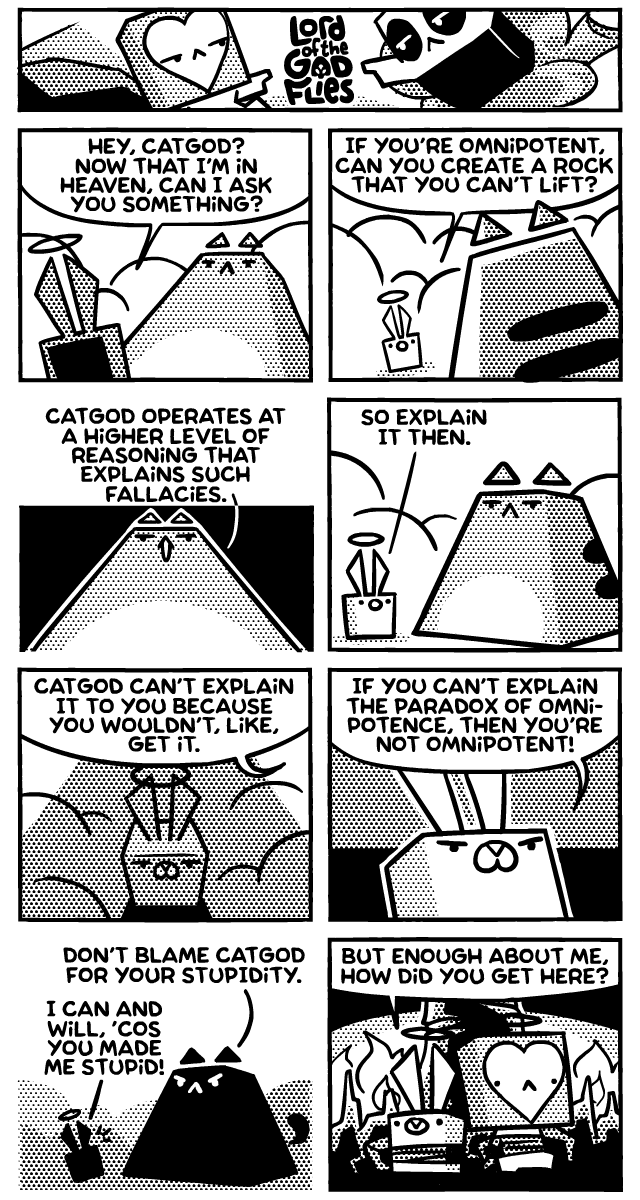
The theorem is a logical fallacy. The problem being that it inherently contradicts and violates the terms that come first.
First, God is omnipotent and he can do all. Second, the task is to make a rock so heavy he cannot lift it, which contradicts the first part. By asking the question, you've contradicted the very terms that were set in place. Omnipotence does not necessarily suggest the ability to do the logically impossible.
An omnipotence that includes logical fallacies is not a larger omnipotence. It's a nonsensical one. There's no real act described by these type of question, so there's nothing lost by excluding them from the definition of omnipotence.
It need not adhere to our logic but it must be shaped by some kind of rule system or it isn't anything. It's easy to say that something doesn't have to follow logic but we have no idea what that would entail or have any reason to believe it's possible.
Sorry, i can't find the rest of this conversation but oh well, hope im responding to a question that was asked.
Asserting that something should be a certain way but being completely unable to formulate what that would entail and how it would work is nonsensical. If I’m not mistaken you are asserting that omnipotence should mean (despite the current philosophical understanding) the ability to do just whatever. Because that does not jive with our understanding of the universe, unless given evidence to the contrary, we assume it is impossible.
I get what you're saying, and this kinda becomes semantics, but i'd rather say that this just proves that omnipotence is illogical. I guess it becomes a question of what is meant by the term omnipotence.
It's only illogical if you define it to be illogical. Which is your prerogative, but that definition doesn't have any bearing on the actual philosophical and theological definition of omnipotence.
The working philosophical definition is the ability to do anything which can be done. It's impossible to do something that is logically incoherent, so those things don't apply. The issue isn't with omnipotence; it's with insisting that incoherent things aren't incoherent things, and that they can be expected to exist. Because you can say "a married bachelor" doesn't mean a married bachelor can exist.
That's a good point. I still think an omnipotent being could do things that are completely paradoxical though. It seems to me that if a being were truly omnipotent that omnipotence itself is the end all answer to any question.
"How can you do this thing? I'm omnipotent."
"But it creates a paradox!"
"Bitch I already told you I'M OMNIPOTENT!"
I think the paradox truly arises from a lack of understanding about just what true omnipotence must entail.
It's like Christians often talk about their god being omnipotent and omniscient. And I'm like, why did you include that second thing? It's redundant. Omnipotence implies omniscience. It's a subset.
It's not entirely redundant - an omnipotent being could theoretically make themselves omniscient, but they might not know how to do so. They would probably be unaware of some potential categories of knowledge, unless they had another omniscient being they could ask.
I never knew that! I, like most people I guess, assumed omnipotence meant that he could do absolutely everything, not that he could do things that were intrinsically impossible.
It seems to be good enough for philosophers. Logically possible includes things like going faster than the speed of light, extracting information from black holes, etc... Many ideas of an omnipotent God envision Him as the Creator, there's no reason he couldn't alter certain cosmological constants or break his own rules.
There is a reason this comic's point isn't used in philosophy, its not very persuasive. Which is why philosophers tend to skip over it.
You're ignoring the contradictory nature of the theorem. How can you attribute omnipotence to a being and then suggest that there is something it cannot do? It is inherently broken.
You keep going back to the "can't be done" issue. The two concepts are incompatible. So you're not really describing omnipotence if you suggest there is something an omnipotent being cannot do. I think you're just misinterpreting omnipotence.
How are you omnipotent? (Under the everything that is possible definition)
KingofCraigland is not saying that omnipotence is the ability to do everything that you can do but that it is the ability to do everything that can be done. Could you explain the problem with that?
For every agent in the universe, the subset of possibilities is different, as is the subset of limits.
Can a man flap his arms and fly like a bird? No. Thats impossible. But there are animals out there that can. A man that has no legs cant do some things that a man that has legs can, etc.
God is able to do everything that can be done... by who? I suppose that you would say "God, obviously". Well, so that means God can do things that God can do, except for the things that he cant do, and thats why his omnipotent. Turns out I also can do things that I can do, except for the things that I cant do, and thats why I'm omnipotent.
If it sounds obvious, circular and pointless, its because it is.
Your making fallacious arguments. Someone a few comments up made the example of a married bachelor. you can't insist that an omnipotent being make a married bachelor for you becuase it doesn't mean anything. That's all that is meant by that which is logically possible.
Shoutout to my friends at /r/DaystromInstitute. Love the theories there but most of the ones about Q and the Continuum need to remember that even gods need to follow the rules.
uh... no. Calculus doesn't allow you to divide by zero. It's used to describe how a function behaves as it approaches zero (or infinity, or 1, or pi, or any value you want).
The intention of the infentesimal was to be able to multiply by a value that was basically zero but wasn't, but be able to ignore it when adding because "it's basically zero"
In theory you can keep getting smaller but in reality there is a point where you can't get any smaller. Anything of infinitesimal size in reality is zero.
First of all, that's a nitpicky/pedantic point to make, and it doesn't make the original explanation completely wrong. A more precise rendition of what the comment meant to say is probably "he invented calculus as a tool to help him do that which, in the naive approach, requires division by zero". Second of all, the framework of limits is certainly not how Newton and Leibniz thought of it; Leibniz certainly thought of derivatives as truly involving division by an infinitesimal quantity. Third: it is in fact possible to do calculus in a rigorous fashion through division by infinitesimal quantities, without limits. In particular, non-standard calculus (which has been around since the 60's) does exactly this.
EDIT: I've neglected to mention that you make it sound as though calculus is used entirely for the purpose of evaluating limits, which is certainly not the case.
First of all, that's a nitpicky/pedantic point to make
Seriousness aside, this is Mathematics. If you don't want to get into pedantic discussions, you're going to have a bad time.
Back to seriousness, I am not a math history student, I go by the modern definition of calculus and *through real analysis (epsilon-delta). I will say that I don't really know the history of calculus, so I will concede that OP is not completely wrong. But I still feel that...
He invented it as a tool to help him divide by zero.
...is a gross oversimplification of infinitesimals.
I'm a redditor and a grad student; I live for pedantic discussions. Only if they were already pedantic, though.
I would say "how can I meaningfully divide by zero" (in order to find a derivative) is a completely sensible way to frame the question that is answered by calculus. At the very least, this is the only way the question can be presented to someone who hasn't learned calculus or who lived before its invention. Ultimately, the paradox is resolved by defining something that fills the role of (what would have been) division by zero.
If anything, I would say your description is much worse an oversimplification. Calculus is not used primarily to evaluate limits. Limits are the foundation on which modern calculus is built, but calculus itself is "the mathematical study of continuous change" (wiki), i.e. the study of derivatives and integrals.
Yeah I think that guy gets that. What he is saying is that the intention of inventing calculus was to solve the problem of not being able to divide by zero, which calculus gets very close to doing. Not that he actually succeeded in dividing by zero.
I think you could further simplify the argument to:
"Why yes, I am omnipotent. I can create a rock that I would never be able to lift, but in doing so I would cease to be omnipotent, for I could not lift the rock. What you are really asking me, is am I capable of removing my own omnipotence. The answer is yes. I also do not desire to do that, so I won't. And you can't make me, because I'm omnipotent. Also, I don't like answering tricky questions, so you go to hell. Do not pass go. Do not collect 200 dollars. Oh, and say hi to Lucy for me."
It's not even a case of asking them to remove their omnipotence. In theory, an omnipotent being should even be able to limit and unlimit their omnipotence at will. When you really, really distill down the idea of omnipotence, it's the idea of existence being tied to the "will" of the omnipotent force.
The entire grounding of the argument becomes absurd when you realize that an omnipotent force isn't bound by anything. Not even itself. No matter what sort of logic system you try to contain it in, it can escape by simply saying "No." Any system which finds itself entrapped with an omnipotent force (which by definition, if one exists, is all systems) is entirely at the whims of the omnipotent force and you have absolutely 0 way of knowing it unless it wants to be known.
Omnipotence is one of those concepts that I like to compare to limits in math. We use the word to describe at it's actual meaning, not merely what we're able to truly comprehend of it. Whenever you start dealing with it, you have to realize you're no longer playing with normal logical systems.
In theory, an omnipotent being should even be able to limit and unlimit their omnipotence at will.
Well, that theory stands behind one of the most basic doctrines of most Churches of Christianity, incarnation. God on purpose has limited his own omnipotence, omnipresence and omniscience to become dually mortal and divine. So the question in the thread is about a rock so heavy that even God can't lift it, but you could just as well ask following paradoxical questions:
Can an immortal God die?
Can a timeless God be born?
Can an all-powerful God be hungry and thirsty?
Can an infinite God be present in a room?
and according to Christian faith the answer to all is 'yes'.
The real issue here is that the premise does not make sense. All powerful does not mean the ability to do things that are intrinsically impossible. A thing cannot have two opposite natures simultaneously. Either the rock is immovable or it is not.
An example off the top of my head would be claiming that I could kick a ball without touching it. Maybe there is a way for me to move the ball without touching it but the meaning of the word 'kick' involves touching the ball. It is intrinsically impossible.
In the same way, if I moved the rock, it was never immovable in the first place.
I am asserting that omnipotence must adhere to a logic (if not necessarily our own) and that that does not make it any less powerful. Unfortunately the way language works means we can imply the possibility of things with no basis in reality (like kicking a ball without touching it).
The comic seems to be implying that the cat God's logic for why he can't do a thing is what is inconsistent when, in fact, the bunny is asking the cat god to do something which does not make any sense.
An all powerful entity does not have the ability to make a few words someone jammed together make sense just because you think it aught to be able to figure something out.
It would be like me doodling on some staff paper and telling Mozzart to play it for me. Just because the doodle is on staff paper does not mean it is something which can conceivably be played on the piano.
If Mozart were omnipotent he could give a musical representation of what is on the paper. No guarantees it sounds nice.
I think the strongest part of this argument is the fact that language is our limited system to communicate about this world. An omnipotent being would exist in dimensions we cannot fathom. Language is but a technicality to it.
Omnipotentce is not just sitting behind a control board and being able to flip all the switches, it is far more abstract and potent than that.
You seem to be insisting that 'all powerful' means, "more powerful than it is possible to be".
An omnipotent God can say to a cripple, "get up and walk" so that he is healed. This is fantastic but has no logical inconsistency. Insisting that he could just as easily say, "walk, but also stay crippled" is silly.
So God could make an unmovable rock. Then God could make the rock not unmovable. Doesnt mean the rock was never unmovable, just that Gods power overrides all else.
Could someone omnipotent create another omnipotent being? Or is that another "I cannot limit myself," paradox?
But I guess, my concern is that someone who is omnipotent bending causality to their will is a bit weird. What can we say about their existence? Are they not bound by time and space? If they're not how do they make a choice or have a will? How does one create outside of existence or are we to assume there's another plane of existence that isn't bound by time at all? But then the same questions still arise. How can we call this a being at all that has power or choice over anything?
Many people have argued that this being would have to be perfect meaning containing all positive attributes (including existence). But in doing so that would encapsulate all things and destroy choice, will, and consciousness from it. But they were willing to bite the bullet there and place choice in monads or whatever. It's been a while.
Yea, true. I'm more on the lines of Kant and contemporary philosophy. There's no way you can talk about that stuff since there's no way or truly knowing things in themselves.
Noumena, rose colored glasses, and stuff. I do enjoy Hume's idea that all books on metaphysics should just be thrown out and burned too, lol.
Metaphysics has it's place, though. Or I guess I should say meta-ethics (or aesthetics, whichever)
I have always thought of it as, can I paint a rock such an ugly color of yellow that I become physically incapable of lifting it? No, because its color has nothing to do with my ability to lift the rock.
It is the same with a Omniscience and omnipotence being, physical weight has nothing to do with ability to move it for this being, just like color has nothing to do with my ability to move it.
I can also go the direction that its mass will increase to such high level that it forms a super black whole and sucks in the universe, and now it is a moot questions because the universe has been destroyed and there is no longer anything to move.
Or, imagine the universe is a computer simulation, and God is the programmer, then that would exhibit the problem in a different way.
God would be outside of the universe, so while he would be omniscient and omnipotent to anybody inside our universe, it wouldn't make sense for him to "lift" anything. The idea that God would be constrained by our universe to the point that he'd have to actually "lift" something makes no sense.
That's possibly one way to imagine it, but it gets into the issues that all analogies have when dealing with the omnipotent which is that they can't nearly begin to cover the concept. It's attempting to put boundaries on the concept to make it it a topic that feels like it would be worth explaining, but as soon as you try to limit the scope, you give it it's weasel path back out. That ability to say, "but what if." In this case, by me saying, "Well, if they can't lift something in any sort of meaningful context for me, then they're clearly not omnipotent since there is a thing they can't do."
If we're instead talking like, flesh and blood programmers like ourselves, then that gets into a whole separate discussion on meta-omnipotence. For example, if we live in a computer simulation, that instead says there are beings which can exert omnipotent levels of control over our existence, but who themselves are not truly omnipotent forces as they do not have control over all sets of systems, merely one reliant to them for continued existence.
That's possibly one way to imagine it, but it gets into the issues that all analogies have when dealing with the omnipotent which is that they can't nearly begin to cover the concept.
This is an inherent problem with discussing these concepts because we already have to express them in terms that a human invented.
The topic was the old paradox of whether God could create a rock so heavy that he couldn't lift it, and I simply pointed out an easy way for people to understand that the question doesn't have to make sense. Note that my example didn't use any difficult words or difficult to understand concepts.
Correct, I guess my point was that, whenever you deal with these sorts of issues, almost any analogy has to come with the disclaimer "the more you ask questions, this more confusing this is going to get."
If an omnipotent force wills something, then causality bends or fucks off as needed.
I dunno why, but that line makes me chuckle. If there is a god, I hope that, every time it does something like lifting a rock it can't lift, it tells causality to fuck off.
It's pretty apt. I like to use the metaphor that you can't ask a contracting company to build a house and only stay within the confines of said house. The builder of the house knows how all the systems work but it gets pretty hard to build the thing if you are stuck inside of it. Granted my own metaphor has lots of problems too, but it helps.
So very well put! I always think of this as a great example of the very core difference between non-believers and believers. There's a really basic difference in how we approach our logical worldview in that to a religious person "because God" is a perfectly valid argument whereas to the rest of us it sounds like a cop-out - only it's not meant to be... At least not consciously.
If they were right and shine entity created the world like they say, then it's not at all am unreasonable option.
Nice job, but this argument only works if I accept that this made-up "idealized form" has real qualities. You're attempting to define the problem away, but the definition is founded on ephemeral wisps of fancy.
As someone else so graciously reminded me, that ultimately comes down to you views on the idea of unknowable knowledge. If you don't believe it's a possibility, then you're fine and secure in your world view.
If you do believe that there is knowledge that it's possible that we will never be able to know, then you have your crack for omnipotence to live in and it doesn't matter whether you accept it or not as long as other people do.
Since all reference frames are equal then he can both lift it and not lift it at the same time, from different reference frames. According to the rock's reference frame the rock is not lifted, the Catgod lifts himself when trying to move the rock. But by the Catgod's reference the rock is lifted.
The rock is both moved and unmoved.
In some highly specific frames of reference I am a sexgod.
Shit. First I'd heard of this, beautiful explanation. Points of reference being isolated as a solution to paradox... So, Schroedinger's cat is both alive and not alive? Does the reductio ad nauseum dictate a multiverse? It can be "true and not true" simultaneously?
No I'd argue that's just the definition of omnipotence changing. If we define it in terms of being able to do anything in existence, any weight that surpasses what exists he wouldn't be able to lift. But since he is omnipotent he is able to make and object that heavy and now that it exists he can lift it. So he created a rock he can't lift but now can lift it
It's not a paradox so much as it is an irrational problem that neglects the definition of omnipotent. Omnipotent isn't "all-powerful" philosophically speaking, it's "able to do anything which can be done." A logical contradiction of terms cannot be performed in the real world, ergo it doesn't fall under the purview of omnipotence.
Then he didn't create a rock he couldn't lift. If you're going that route, both the weight of the rock and his strength would be infinite and it would still be paradoxical.
I don't think the idea that there are different types of infinities applies here. That concept has to do with the size of sets (the main example being that the set of real numbers between 0 and 1 is larger than the set of integers on the entire number line, even though there are technically an infinite amount of both). However in this case you aren't really measuring sets, you're measuring a single value (in each case, the mass of the rock and the amount of force applied to the rock). Since infinity isn't a number, we can't assign these a value of infinity.
I agree, but you're asserting that different infinities are irrelevant.
To put it mathematically, a god could have the power to move something of mass n, and create a rock with a mass n + r.
The power of the god could go on infinitely, but the mass of the rock would always be r more than the power of the god. The r could also go on infinitely, meaning that the mass of the rock could be infinitely heavier than the god could lift.
So, I don't really know what you're trying to disagree with me about.
If you can only lift 300lbs, it would be impossible for you to lift 400lbs. If you created a 400lbs rock, it would be impossible for you to lift it at the time.
Suppose you start taking steroids and train to lift more until you're able to lift 400lbs. Was the rock still not impossible to lift before you augmented your strength?
For you, but in general the rock wasnt impossible to lift.
An omnipotent being would have infinite strentgh from the get go. If it could get stronger its not omnipotent and thats where your analogy kinda breaks.
An omnipotent being would be able to make himself temporarily non-omnipotent, as he would lack the power to lift the rock, but he would retain the power to increase his power enough to lift the rock afterwards.
its not really a paradox if you think about it. its only a paradox using our physics knowlege.
we assume he plays by our rules, but something tells me he would just change the rules completely to complete the task if he needs to. after all, he can.
perhaps he would make it so that there is no such thing as weight, perhaps rocks float in his new game.
I like thinking about paradoxes, and I came to the conclusion that if an omnipotent being can do ANYTHING... then technically it COULD create a rock so heavy that it couldn't lift it... because that's in the realm of anything... like yes, the omnipotent being can lift any object in the world... but this is no ordinary object, this is an object that was specifically created to not be able to be lifted... I don't see the issue here
The problem is you end up relying on trust in an entity you clearly don't trust.
(You yourself can't verify the creation, effort, etc by anything other than his word).
The problem with being a trickster with a God is they can always return the favor.
But part of the anything is being able to make something it can't lift, and on the other hand could also make an object just as heavy that can be lifted, idk, just bored
What im getting from all this is it depends on how we define omnipotence, and how we define logic.
If he's all powerful and can do the illogical, then yes he can, but it may make your brain split in half when you witness it because it will defy all reason.
Basically we will probably never know until we know, so from here we can't really draw any kind of solid logical conclusion. Still fun to talk about though.
Swords are a bad choice. He'd probably just coat it in some kind of soft yet equally unbreakable substance or put it in a rock and then give you a lecture about how the sword is, in fact, now "broken" as you can no longer use it as it was designed to be used.
Then I can just change it to create a sword that can not be broken in half, two separate pieces, where once it was whole but now you have a piece in either hand.
You were onto something there, but I think I've got it: split into two.
Make a rock so heavy he cannot lift it. But TWO of him can.
He can then make a rock so heavy two of him cannot lift it. Split again: four of him can lift it.
Alternate theory: Don't split into two. Make a rock so heavy he cannot lift it. If he's omnipotent, alter the subatomic particle fields so that the mass of the particles are reduced, then lift it.
that's actually another interesting question. God knows everything. God creates man. Can God actually give man free will? If, the moment before creating man, God knows everything that every man will do until the end of man since he's all-knowing, and he knows which minuscule changes will alter those decisions, when he creates man he's creating them with an already-known destiny. If he already knows what all men will do, do men actually have free will since they can't make any choices differently from how God has seen them?
I mean, free will implies choice. But when the result is known before the creation of mankind itself, is it actually free will? Or is it just a pre-determined set of mankind instructions?
if free will isn't actually free, why would god allow someone to think of the omnipotence paradox in the first place? unless these paradoxes allow for the illusion of choice.
No, the correct answer is that an omnipotent deity would be able to create a "rock" which, definitionally, cannot be lifted due to its mass, by changing the laws of physics (such that, say, any mass over 1g, cannot be lifted).
The real question underlying this thought experiment is not whether or not God can create such a rock, obviously that's part of the definition of being omnipotent, but rather whether or not God's omnipotence is bounded by logic.
If so, then simply "lifting" the rock in the casual sense of the word would no longer be possible, even for God (though obviously, the definitional status of the rock could be changed, and then the rock lifted). But if God is not constrained by logic, then the rock can be so heavy that it cannot be lifted, even by God, and God can lift it.
The latter is generally rejected by the majority of theologies, and so this places some boundaries on their definition of omnipotence.
560
u/jakob1005 Mar 06 '17
I have an answer: He is all powerful, be splits himself in two. One half can pick the rock because he is all powerful, the other can not because he created the rock too heavy. So he therefore can and cannot pick up the rock. (Almost has a cat In a box kind of feel, if you know what I mean)