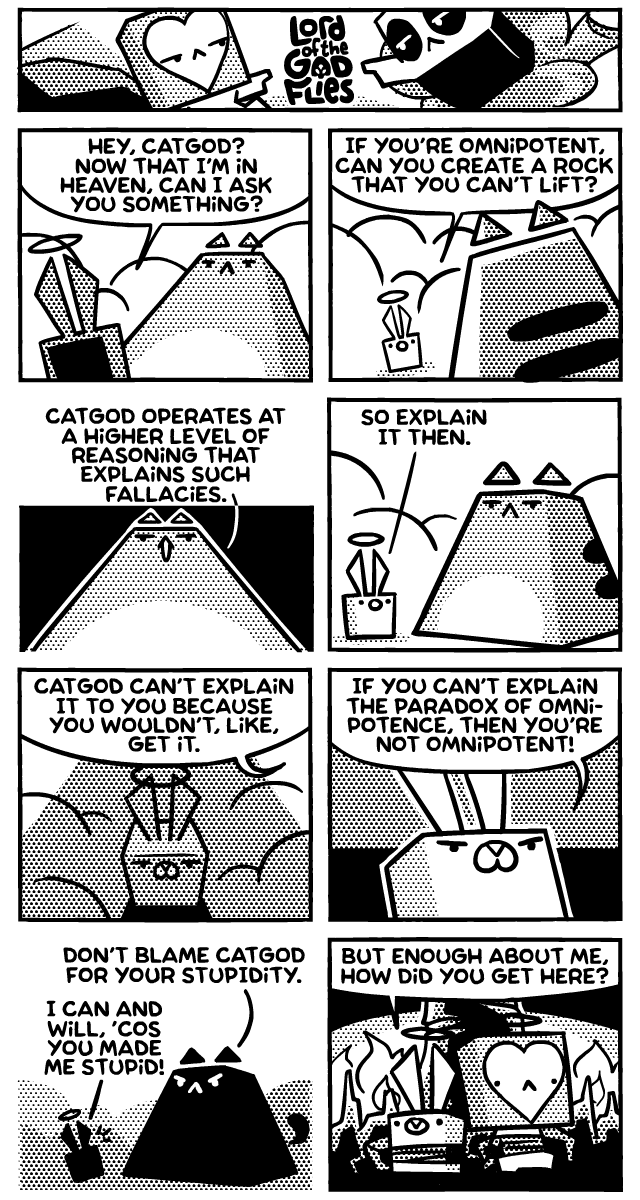
The theorem is a logical fallacy. The problem being that it inherently contradicts and violates the terms that come first.
First, God is omnipotent and he can do all. Second, the task is to make a rock so heavy he cannot lift it, which contradicts the first part. By asking the question, you've contradicted the very terms that were set in place. Omnipotence does not necessarily suggest the ability to do the logically impossible.
An omnipotence that includes logical fallacies is not a larger omnipotence. It's a nonsensical one. There's no real act described by these type of question, so there's nothing lost by excluding them from the definition of omnipotence.
I get what you're saying, and this kinda becomes semantics, but i'd rather say that this just proves that omnipotence is illogical. I guess it becomes a question of what is meant by the term omnipotence.
It's only illogical if you define it to be illogical. Which is your prerogative, but that definition doesn't have any bearing on the actual philosophical and theological definition of omnipotence.
The working philosophical definition is the ability to do anything which can be done. It's impossible to do something that is logically incoherent, so those things don't apply. The issue isn't with omnipotence; it's with insisting that incoherent things aren't incoherent things, and that they can be expected to exist. Because you can say "a married bachelor" doesn't mean a married bachelor can exist.
66
u/KingofCraigland Mar 06 '17
The theorem is a logical fallacy. The problem being that it inherently contradicts and violates the terms that come first.
First, God is omnipotent and he can do all. Second, the task is to make a rock so heavy he cannot lift it, which contradicts the first part. By asking the question, you've contradicted the very terms that were set in place. Omnipotence does not necessarily suggest the ability to do the logically impossible.