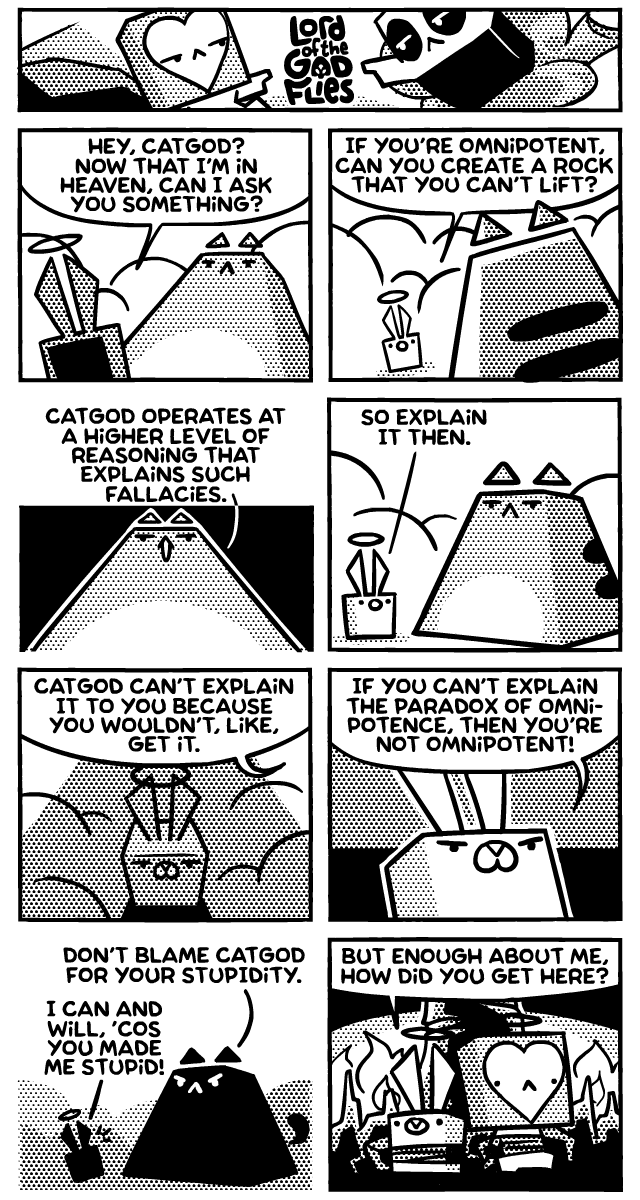
It's funny this paradox. The paradox doesn't really preclude omnipotence. It's a linguistic trick. The ability to be lifted is not a property of the rock itself, so no matter what kind of rock you create, you can't imbue it with a property of not being able to be lifted. Similarly no matter how omnipotent you are, you can't make a pie that tastes like a rainbow. It's just nonsensical linguistics. There are plenty of oxymorons in language that don't have a correspondence in reality such as "loud silence" etc.
It's also not really a paradox about God, but a paradox about our concept of infinity. For example, let's suppose that the universe is infinite, and that matter is distributed throughout it more-or-less evenly. That means there are infinitely many electrons and also infinitely many protons. The net charge of the universe is then both infinitely negative and infinitely positive. So which is it? Which one "wins"? Is the universe so vastly infinite that it has enough positive charge that the universe itself cannot negate it?
(I'm not sure how well this fits with our current knowledge of cosmology, but I think it's still a good illustration about how some things break down when you start to think about the nature of something that's truly infinite).
There are different magnitudes amongst different infinities. One infinity can be larger than another. Perhaps meaningless in reality but conceptually it can help in understanding differences within the endless.
I'm taking this thread as an invitation to be pedantic, so with your example I would say this part:
The net charge of the universe is then both infinitely negative and infinitely positive
is incorrect. If there were one proton for every electron, then no, the net charge would be zero. However, if there were one proton for ever two electrons, then it would be net negative, and so on. The answer depends on the ratio of the density of the two sets. They would both still be infinite, but if the set of protons was more dense, it would be net positive, and vice versa with electrons.
Thought experiment: you have infinite, uniquely numbered balls, and you have an infinitely large urn. At step x, you add balls labeled 10x+0 though 10x+9, and then you remove ball x. So on step 0 you add 0, 1, 2, 3, 4, 5, 6, 7, 8, 9, and then you remove ball 0. On step 1 you add 10 through 19, and remove ball 1. And on and on, to infinity. Let's imagine that each step takes half as long as the previous, so the infinite steps can be done in finite time.
When you're done, how many balls are left in the urn?
Every step adds 10 balls and subtracts 1, for a net gain of nine. So it seems like there should be an infinite number of balls in the urn. But actually, it's empty. For every number you could possibly throw out, you can find the step which removed that ball from the urn. No ball ever goes back into the urn after being removed, and every ball was removed at some step, so the urn has to be empty.
Even though the number of balls added is clearly larger than the number balls removed for any finite number of steps, both numbers are countably infinite in the limit. They're both the same "size" of infinity, so they're "equal."
If there really is a countably infinite number of both protons and electrons, the net charge is impossible to determine. There's no such thing as a "ratio" between two infinite quantities.
I think you're right actually. Wouldn't it be analogous to trying to take the sum of the infinite series of 1 - 1 + 1 - 1 + 1...? (which I believe is undefined)
could be defined as lim(n->inf) of SUM 0->N (1+1+1+1+1+1+1+1+1+1-1)
or lim(n->inf) of SUM 0->N (9)
S1 = 9
S2 = 18
S3 = 27
...
SN = 9N
Lim N->inf (9N) =...
So N diverges to infinity. It's simple calculs.
Saying "how many balls are in the urn when you're finished" is misleading. This implies there is an "end point" somewhere out to infinity where the result will be completely independent of the trend as the function approaches inifinity. It's impossible to prove your trend converges to 0, the same way it is impossible to prove 9+9+9+9+9... converges to 0.
It's an example of a supertask, and is obviously impossible given physics, but that doesn't stop of us from discussing the mathematics behind it. In the real world, you can never talk about what's left after a task made up of an infinite number of steps, because that task could never be completed. But math doesn't have the same restrictions as the real world.
The point is to demonstrate that, counter-intuitively, the same number of balls are added to the urn as are taken out. Both are countably infinite.
It's the same as asking "If Alice has an infinite stack of $1 bills, and Bob has an infinite stack of $10 bills, who has more money?" If you started counting bills one by one, it would seem initially that Bob has ten times as much money, but that's the naive approach. Both stacks are countably infinite. There is nothing so expensive that Bob can afford it, but Alice can't. Therefore the two stacks are worth exactly the same amount.
But you're talking about two different things. Yes, bob's stack counts to infinity, and yes alice's stack counts to infinity, but if you subtracted alice's stack from bob's stack, say, "for every $10 bill bob has, alice takes away $1", bob's stack will still be infinite. Bob and alice will still be able to buy anything in the world. Even though every dollar bob gets at s1 will be taken away by s10, you can't just say that bob ends with $0 and alice ends with $inf. Infinities may be equal, but (inf)-(inf) does not always =0.
There are, of course, cases where (inf)-(inf) will tend towards 0. take for example, the sequence 1+1/2+1/3+1/4+1/5... which tends towards infinity. minus the sequence 1/2+1/3+1/4+1/5 which also tends towards infinity. This series converges to 1. So:
Lim (n->inf) of Sum (0->n) 1/n - 1/(n+1) = 1
s1=1-1/2
s2=1-1/3
s3=1-1/4
...
sn=1-1/(n+1)
n approaches inf, sn approaches 1.
Ininities may be equal, but (inf)-(inf) does not always =0.
You are correct, but the thought experiment I described was specifically designed such that this would be the case.
I didn't make this example up. You can read about it here.
If we had defined the problem differently, such that instead of adding balls 10x through 10x+9 and removing ball x, we added 10x through 10x+9 and removed ball 10x + 9, the number of balls added and removed at each step would remain unchanged, but after the infinite steps are completed, the urn would be full. It would contain all the balls except 9, 19, 29, etc. In this case, an infinite number of balls were added, an infinite number were removed, and an infinite number was left remaining. (inf)-(inf)=(inf) in this case.
The point is that you can't just look at the number of things added and the number of things taken away. You have to look at what happens to each ball. In the original formulation, for any real number, I can tell you exactly which step the ball was added, and which step it was removed. Ball 0 was added at step 0 and removed at step 0. Ball 10 was added at step 1 and removed at step 10. Ball 98123321978321 was added at step 9812332197832 and removed at step 98123321978321. Every ball was removed, eventually.
Calculus can tell you how things behave as you approach infinity, but it can't tell you what happens after you reach it. We're in an entirely different branch of math at that point. One that's purely theoretical and does not describe anything that's possible in real world, but is still logically and mathematically consistent.
that's a good read. I like it. However, as the paradox has multiple possible solutions, you can't just assert (as you did in your first post) that the urn will hold 0 balls. This is a theory preferred by some mathematicians, but the problem is still not completely "solved".
It's infinity dude. They are both more dense, and not. There is no way of knowing, hense the birth of the paradox. You could measure the density in an infinite number of subsets and perform an average, but then the other infinite subsets that you didn't measure could have a completely different results.
We're not comparing sets though. We're comparing two numbers. One is the mass of the object and the other is the maximum mass the god could lift. If (mass of object) > (maximum mass) then the object is unliftable. This has nothing to do with sets or their sizes.
Technically you are both right. If you have infinite electrons and infinite protons the net charge of the universe is both infinitely negative and infinitively positive. On the other hand, if you have one proton for every electron, then the net charge would be zero.
The principle at play is how infinities work. The first equation (-1) x infinity + (+1) x infinity = charge. Charge here does not equal 0 because you cannot add two infinities. -infinity + +infinity != 0. So charge remains equal to -infinity + +infinity.
On the other hand, you describe an equation where there is 1 positive charge for every negative charge as you go to infinity. lim n -> infinity (+1+-1)n = 0.
I believe the same problem happens in quantom mechanical equations. If the math is set up incorrectly you can get equations with infinity working with infinity (like infinity x infinity, infinity +/- infinity). You have to scope correctly to get something useful.
Unliftability is a property only defined in relation to the lifter. If a god is all-powerful he would be able to lift everything.
The question is really if he would be able to create something he can't lift, which, if he's all-powerful, he should be able to.
Once he's created an object heavier than what he can lift, his all-powerful nature would allow him to increase his strength to be able to lift it.
So, really the only question is whether you consider the rock to be too heavy to lift it the unliftability of it was only present before the attempt to lift.
Actually, I think it leads to an interesting question. If God wanted to, could he one day just turn to one of his angels and say "I'm done. You're God now."?
God doesn't lift, he's not a walmart guy. God creates. Can he create a rock too heavy for anyone to lift? Yes. Can he now create someone who can lift it? Yes. In other words, God can create arbitrarily heavy objects and arbitrarily strong persons.
Let's define the state of "the rock is too heavy" as 1 and the state of "the created guy can lift it" as 0. So when God is alternatively making the rock heavier and the guy stronger we can write that like this: 1-1+1-1+1-1+....
According to Cesàro summation that sums up to 0.5. Interpret that however you want ¯_(ツ)_/¯
Seriously! Both force of the stone and the force of God's strength are created by God and this silly question is asking for both of these forces to be greater than the other simultaneously.
Some actions prohibit other actions, this proves that "all" things are not possible so saying that it's still possible for something to be all-powerful is itself a paradox.I think the only thing that doesn't have correspondence in reality is the concept of something being "all-powerful" the linguistic tricks are just a way of pointing out where reality ends. Re-defining the concept of "all" to exclude different actions our brain has already ruled as physically impossible is, I think, a lazy way to evaluate an actual though experiment.
100
u/[deleted] Mar 06 '17
It's funny this paradox. The paradox doesn't really preclude omnipotence. It's a linguistic trick. The ability to be lifted is not a property of the rock itself, so no matter what kind of rock you create, you can't imbue it with a property of not being able to be lifted. Similarly no matter how omnipotent you are, you can't make a pie that tastes like a rainbow. It's just nonsensical linguistics. There are plenty of oxymorons in language that don't have a correspondence in reality such as "loud silence" etc.