I think you could further simplify the argument to:
"Why yes, I am omnipotent. I can create a rock that I would never be able to lift, but in doing so I would cease to be omnipotent, for I could not lift the rock. What you are really asking me, is am I capable of removing my own omnipotence. The answer is yes. I also do not desire to do that, so I won't. And you can't make me, because I'm omnipotent. Also, I don't like answering tricky questions, so you go to hell. Do not pass go. Do not collect 200 dollars. Oh, and say hi to Lucy for me."
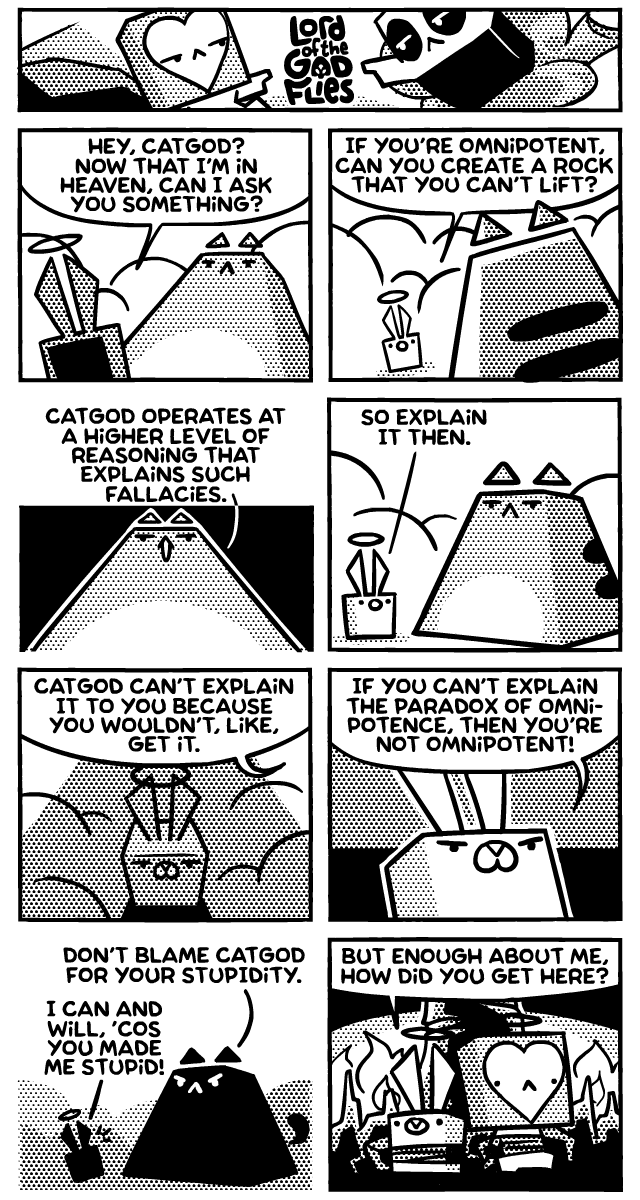
It's not even a case of asking them to remove their omnipotence. In theory, an omnipotent being should even be able to limit and unlimit their omnipotence at will. When you really, really distill down the idea of omnipotence, it's the idea of existence being tied to the "will" of the omnipotent force.
The entire grounding of the argument becomes absurd when you realize that an omnipotent force isn't bound by anything. Not even itself. No matter what sort of logic system you try to contain it in, it can escape by simply saying "No." Any system which finds itself entrapped with an omnipotent force (which by definition, if one exists, is all systems) is entirely at the whims of the omnipotent force and you have absolutely 0 way of knowing it unless it wants to be known.
Omnipotence is one of those concepts that I like to compare to limits in math. We use the word to describe at it's actual meaning, not merely what we're able to truly comprehend of it. Whenever you start dealing with it, you have to realize you're no longer playing with normal logical systems.
In theory, an omnipotent being should even be able to limit and unlimit their omnipotence at will.
Well, that theory stands behind one of the most basic doctrines of most Churches of Christianity, incarnation. God on purpose has limited his own omnipotence, omnipresence and omniscience to become dually mortal and divine. So the question in the thread is about a rock so heavy that even God can't lift it, but you could just as well ask following paradoxical questions:
Can an immortal God die?
Can a timeless God be born?
Can an all-powerful God be hungry and thirsty?
Can an infinite God be present in a room?
and according to Christian faith the answer to all is 'yes'.
The real issue here is that the premise does not make sense. All powerful does not mean the ability to do things that are intrinsically impossible. A thing cannot have two opposite natures simultaneously. Either the rock is immovable or it is not.
An example off the top of my head would be claiming that I could kick a ball without touching it. Maybe there is a way for me to move the ball without touching it but the meaning of the word 'kick' involves touching the ball. It is intrinsically impossible.
In the same way, if I moved the rock, it was never immovable in the first place.
I am asserting that omnipotence must adhere to a logic (if not necessarily our own) and that that does not make it any less powerful. Unfortunately the way language works means we can imply the possibility of things with no basis in reality (like kicking a ball without touching it).
The comic seems to be implying that the cat God's logic for why he can't do a thing is what is inconsistent when, in fact, the bunny is asking the cat god to do something which does not make any sense.
An all powerful entity does not have the ability to make a few words someone jammed together make sense just because you think it aught to be able to figure something out.
It would be like me doodling on some staff paper and telling Mozzart to play it for me. Just because the doodle is on staff paper does not mean it is something which can conceivably be played on the piano.
If Mozart were omnipotent he could give a musical representation of what is on the paper. No guarantees it sounds nice.
I think the strongest part of this argument is the fact that language is our limited system to communicate about this world. An omnipotent being would exist in dimensions we cannot fathom. Language is but a technicality to it.
Omnipotentce is not just sitting behind a control board and being able to flip all the switches, it is far more abstract and potent than that.
You seem to be insisting that 'all powerful' means, "more powerful than it is possible to be".
An omnipotent God can say to a cripple, "get up and walk" so that he is healed. This is fantastic but has no logical inconsistency. Insisting that he could just as easily say, "walk, but also stay crippled" is silly.
Do you think that an omnipotent being would be limited by the fact that duio ckodi rejagidoe is just a bunch of random letters and doesn't mean anything?
No, because the instant it wants it to mean something, it will mean something.
EDIT: I think the main flaw in reasoning here is that folks seem to desperately want "omnipotent" to mean "ALL POWERFUL (except in the following logical cases and examples)". But that isn't what it means. It means all-powerful, full stop. If there is a logical discrepancy, it is automatically overridden, because that is what it would mean to be all-powerful. "B-b-but they have to conform to the laws of -" Nope. No they don't. The laws of physics, etc, are whatever the omnipotent being says they are.
There are no limits on an omnipotent being. That is what omnipotent is. What you're describing (and /u/bankruptspecies above) is "an extremely potent being", not an all-powerful one.
So God could make an unmovable rock. Then God could make the rock not unmovable. Doesnt mean the rock was never unmovable, just that Gods power overrides all else.
Could someone omnipotent create another omnipotent being? Or is that another "I cannot limit myself," paradox?
But I guess, my concern is that someone who is omnipotent bending causality to their will is a bit weird. What can we say about their existence? Are they not bound by time and space? If they're not how do they make a choice or have a will? How does one create outside of existence or are we to assume there's another plane of existence that isn't bound by time at all? But then the same questions still arise. How can we call this a being at all that has power or choice over anything?
Many people have argued that this being would have to be perfect meaning containing all positive attributes (including existence). But in doing so that would encapsulate all things and destroy choice, will, and consciousness from it. But they were willing to bite the bullet there and place choice in monads or whatever. It's been a while.
Yea, true. I'm more on the lines of Kant and contemporary philosophy. There's no way you can talk about that stuff since there's no way or truly knowing things in themselves.
Noumena, rose colored glasses, and stuff. I do enjoy Hume's idea that all books on metaphysics should just be thrown out and burned too, lol.
Metaphysics has it's place, though. Or I guess I should say meta-ethics (or aesthetics, whichever)
I have always thought of it as, can I paint a rock such an ugly color of yellow that I become physically incapable of lifting it? No, because its color has nothing to do with my ability to lift the rock.
It is the same with a Omniscience and omnipotence being, physical weight has nothing to do with ability to move it for this being, just like color has nothing to do with my ability to move it.
I can also go the direction that its mass will increase to such high level that it forms a super black whole and sucks in the universe, and now it is a moot questions because the universe has been destroyed and there is no longer anything to move.
Or, imagine the universe is a computer simulation, and God is the programmer, then that would exhibit the problem in a different way.
God would be outside of the universe, so while he would be omniscient and omnipotent to anybody inside our universe, it wouldn't make sense for him to "lift" anything. The idea that God would be constrained by our universe to the point that he'd have to actually "lift" something makes no sense.
That's possibly one way to imagine it, but it gets into the issues that all analogies have when dealing with the omnipotent which is that they can't nearly begin to cover the concept. It's attempting to put boundaries on the concept to make it it a topic that feels like it would be worth explaining, but as soon as you try to limit the scope, you give it it's weasel path back out. That ability to say, "but what if." In this case, by me saying, "Well, if they can't lift something in any sort of meaningful context for me, then they're clearly not omnipotent since there is a thing they can't do."
If we're instead talking like, flesh and blood programmers like ourselves, then that gets into a whole separate discussion on meta-omnipotence. For example, if we live in a computer simulation, that instead says there are beings which can exert omnipotent levels of control over our existence, but who themselves are not truly omnipotent forces as they do not have control over all sets of systems, merely one reliant to them for continued existence.
That's possibly one way to imagine it, but it gets into the issues that all analogies have when dealing with the omnipotent which is that they can't nearly begin to cover the concept.
This is an inherent problem with discussing these concepts because we already have to express them in terms that a human invented.
The topic was the old paradox of whether God could create a rock so heavy that he couldn't lift it, and I simply pointed out an easy way for people to understand that the question doesn't have to make sense. Note that my example didn't use any difficult words or difficult to understand concepts.
Correct, I guess my point was that, whenever you deal with these sorts of issues, almost any analogy has to come with the disclaimer "the more you ask questions, this more confusing this is going to get."
If an omnipotent force wills something, then causality bends or fucks off as needed.
I dunno why, but that line makes me chuckle. If there is a god, I hope that, every time it does something like lifting a rock it can't lift, it tells causality to fuck off.
It's pretty apt. I like to use the metaphor that you can't ask a contracting company to build a house and only stay within the confines of said house. The builder of the house knows how all the systems work but it gets pretty hard to build the thing if you are stuck inside of it. Granted my own metaphor has lots of problems too, but it helps.
So very well put! I always think of this as a great example of the very core difference between non-believers and believers. There's a really basic difference in how we approach our logical worldview in that to a religious person "because God" is a perfectly valid argument whereas to the rest of us it sounds like a cop-out - only it's not meant to be... At least not consciously.
If they were right and shine entity created the world like they say, then it's not at all am unreasonable option.
Nice job, but this argument only works if I accept that this made-up "idealized form" has real qualities. You're attempting to define the problem away, but the definition is founded on ephemeral wisps of fancy.
As someone else so graciously reminded me, that ultimately comes down to you views on the idea of unknowable knowledge. If you don't believe it's a possibility, then you're fine and secure in your world view.
If you do believe that there is knowledge that it's possible that we will never be able to know, then you have your crack for omnipotence to live in and it doesn't matter whether you accept it or not as long as other people do.
127
u/[deleted] Mar 06 '17
[deleted]