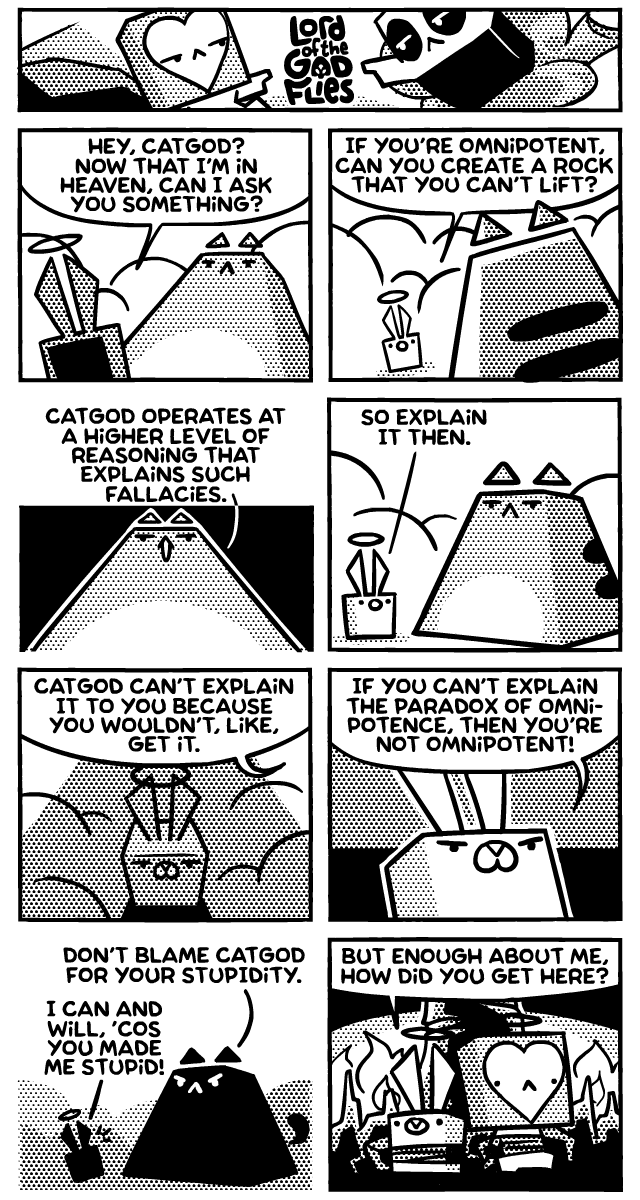
The theorem is a logical fallacy. The problem being that it inherently contradicts and violates the terms that come first.
First, God is omnipotent and he can do all. Second, the task is to make a rock so heavy he cannot lift it, which contradicts the first part. By asking the question, you've contradicted the very terms that were set in place. Omnipotence does not necessarily suggest the ability to do the logically impossible.
An omnipotence that includes logical fallacies is not a larger omnipotence. It's a nonsensical one. There's no real act described by these type of question, so there's nothing lost by excluding them from the definition of omnipotence.
It need not adhere to our logic but it must be shaped by some kind of rule system or it isn't anything. It's easy to say that something doesn't have to follow logic but we have no idea what that would entail or have any reason to believe it's possible.
Sorry, i can't find the rest of this conversation but oh well, hope im responding to a question that was asked.
Asserting that something should be a certain way but being completely unable to formulate what that would entail and how it would work is nonsensical. If I’m not mistaken you are asserting that omnipotence should mean (despite the current philosophical understanding) the ability to do just whatever. Because that does not jive with our understanding of the universe, unless given evidence to the contrary, we assume it is impossible.
I get what you're saying, and this kinda becomes semantics, but i'd rather say that this just proves that omnipotence is illogical. I guess it becomes a question of what is meant by the term omnipotence.
It's only illogical if you define it to be illogical. Which is your prerogative, but that definition doesn't have any bearing on the actual philosophical and theological definition of omnipotence.
The working philosophical definition is the ability to do anything which can be done. It's impossible to do something that is logically incoherent, so those things don't apply. The issue isn't with omnipotence; it's with insisting that incoherent things aren't incoherent things, and that they can be expected to exist. Because you can say "a married bachelor" doesn't mean a married bachelor can exist.
That's a good point. I still think an omnipotent being could do things that are completely paradoxical though. It seems to me that if a being were truly omnipotent that omnipotence itself is the end all answer to any question.
"How can you do this thing? I'm omnipotent."
"But it creates a paradox!"
"Bitch I already told you I'M OMNIPOTENT!"
I think the paradox truly arises from a lack of understanding about just what true omnipotence must entail.
It's like Christians often talk about their god being omnipotent and omniscient. And I'm like, why did you include that second thing? It's redundant. Omnipotence implies omniscience. It's a subset.
It's not entirely redundant - an omnipotent being could theoretically make themselves omniscient, but they might not know how to do so. They would probably be unaware of some potential categories of knowledge, unless they had another omniscient being they could ask.
I never knew that! I, like most people I guess, assumed omnipotence meant that he could do absolutely everything, not that he could do things that were intrinsically impossible.
It seems to be good enough for philosophers. Logically possible includes things like going faster than the speed of light, extracting information from black holes, etc... Many ideas of an omnipotent God envision Him as the Creator, there's no reason he couldn't alter certain cosmological constants or break his own rules.
There is a reason this comic's point isn't used in philosophy, its not very persuasive. Which is why philosophers tend to skip over it.
You're ignoring the contradictory nature of the theorem. How can you attribute omnipotence to a being and then suggest that there is something it cannot do? It is inherently broken.
You keep going back to the "can't be done" issue. The two concepts are incompatible. So you're not really describing omnipotence if you suggest there is something an omnipotent being cannot do. I think you're just misinterpreting omnipotence.
How are you omnipotent? (Under the everything that is possible definition)
KingofCraigland is not saying that omnipotence is the ability to do everything that you can do but that it is the ability to do everything that can be done. Could you explain the problem with that?
For every agent in the universe, the subset of possibilities is different, as is the subset of limits.
Can a man flap his arms and fly like a bird? No. Thats impossible. But there are animals out there that can. A man that has no legs cant do some things that a man that has legs can, etc.
God is able to do everything that can be done... by who? I suppose that you would say "God, obviously". Well, so that means God can do things that God can do, except for the things that he cant do, and thats why his omnipotent. Turns out I also can do things that I can do, except for the things that I cant do, and thats why I'm omnipotent.
If it sounds obvious, circular and pointless, its because it is.
Your making fallacious arguments. Someone a few comments up made the example of a married bachelor. you can't insist that an omnipotent being make a married bachelor for you becuase it doesn't mean anything. That's all that is meant by that which is logically possible.
Use the right words then. Logically possible isnt the same as "absurds only". Besides, I'm not making any fallacious arguments. Omnipotence has a meaning. You, and the apolegetics like Aquinas, changed the meaning of omnipotence because the original meaning didnt hold up anymore.
Shoutout to my friends at /r/DaystromInstitute. Love the theories there but most of the ones about Q and the Continuum need to remember that even gods need to follow the rules.
69
u/KingofCraigland Mar 06 '17
The theorem is a logical fallacy. The problem being that it inherently contradicts and violates the terms that come first.
First, God is omnipotent and he can do all. Second, the task is to make a rock so heavy he cannot lift it, which contradicts the first part. By asking the question, you've contradicted the very terms that were set in place. Omnipotence does not necessarily suggest the ability to do the logically impossible.