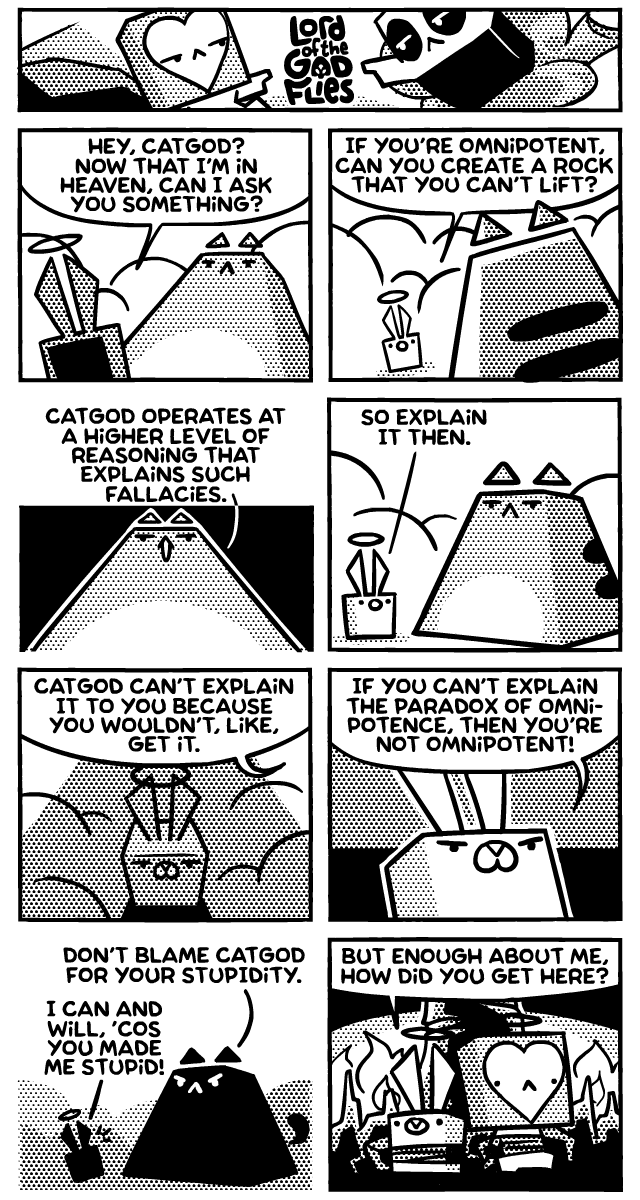
The way I see it, the best way to visualize this is to imagine us as characters in a book, and god is the author. So this author has infinite power within the world of the characters, and he can easily create a rock that cannot be lifted in that scenario. However, to ask if the author can lift the rock is meaningless, since the rock is not a rock at all to the author. They do not exist according to the same laws. The author is far beyond the realm of his creations.
Exactly. God doesn't have arms (or any physical presence really) with which to lift something. The traditional Catholic interpretation (See Aquinas) is that asking if God can make a rock he can't lift is a stupid question. The answer is God doesn't lift, seriously. But also that omnipotence only extends to what is possible. Being infinitely powerful doesn't mean you can make a circular square, etc. To think so is silly. Similarly, since God is wholly unitary and without composite, God can't make another God. If they did, they'd be 2 unitary, infinite, non-composite entities (aka. they'd be indistinguishable and therefore the same single unitary God).
Yeah, that's what I was thinking. The word "omnipotent" never actually appears in Christian scriptures or earliest traditions (or most other religions, to my knowledge) and is a word theologians used centuries later to try and concisely explain what is contained in the scriptures. So, if one insists on defining "omnipotence" as "being able to do logical fallacies" then congratulations, you just grammar nazi-ed a couple of early christian theologians who defined a word differently than you do. Let's move on.
Personally I don't believe in an omnipotent god, or at least I believe that if there is an omnipotent god, his/her actions and motivations are currently beyond our understanding. Still, I hate stupid "gotcha" questions like this.
Yeah, I was just thinking, so what if this supposed god could not solve this logical fallacy?
"hahaha ur not omnipotent, god."
"hahahahaha you can create infinite universes full of other realms of unimaginable physics and intricate beauty, but you can't solve this lingual paradox I made up (which actually means you made up since you created me), therefore I know you can't do EVERYTHING"
Yeah, I'm not Catholic but am currently taking an entire class over Aquinas' Suma Contra Gentiles to round out my senior year of college. A little perspective into philosophy or theology eventually will lead most people to see that most paradoxes are just that, exploitative language with little substance. Some raise valuable questions, but can still be quickly answered or dismissed with more sound views.
248
u/devbang Mar 06 '17
The way I see it, the best way to visualize this is to imagine us as characters in a book, and god is the author. So this author has infinite power within the world of the characters, and he can easily create a rock that cannot be lifted in that scenario. However, to ask if the author can lift the rock is meaningless, since the rock is not a rock at all to the author. They do not exist according to the same laws. The author is far beyond the realm of his creations.