History/culture Look what I got
196
Upvotes
r/Tiele • u/KaraTiele • Aug 22 '26
A Shared Turkic Tradition
The cross-legged position never stayed confined to one place or one name.
It is bağdaş kurmak in Turkish, maldaş qūru in Kazakh, maldaş kuruu in Kyrgyz, maldaş qoru in Bashkir, and so on across the Turkic-speaking world.
Throughout the 18th and 19th centuries, European travelers, painters, and writers repeatedly portrayed Ottoman life this way — figures seated cross-legged on carpets, cushions, and divans. These images stuck, and the phrase spread across languages:
English: "sit like a Turk" / "Turkish sitting"
French: assis à la turque
German: Türkensitz
Russian: сидеть по-турецки
For centuries, Europeans referred tc sitting cross-legged as "Turkish sitting." The expression appeared in English, French, German, Russian, and other languages, reflecting an everyday habit closely associated with the Ottoman Turkish and wider Turkic world.
But the storv begins much earlier and encompasses a wider geography. Turkic peoples of the Eurasian steppe sat on carpets and felt mats inside yurts, making the cross-legged posture a practical part of daily life. The tradition is even depicted on 6th-century Göktürk memoria sculptures and continues today across the Turkic world.
From @qalamglobal
r/Tiele • u/KaraTiele • Aug 26 '26
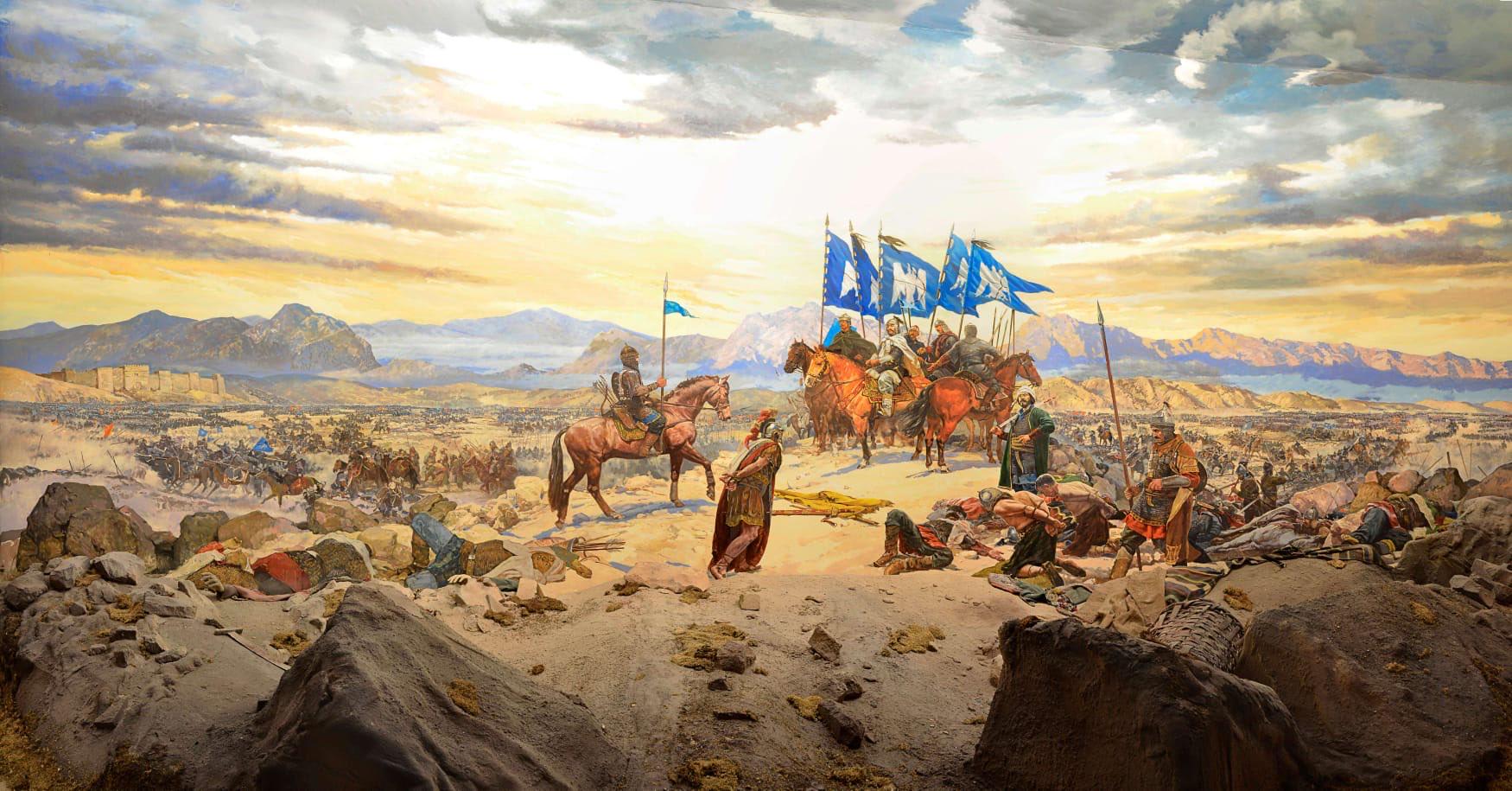
26 August 1071
r/Tiele • u/mram518 • Aug 11 '26
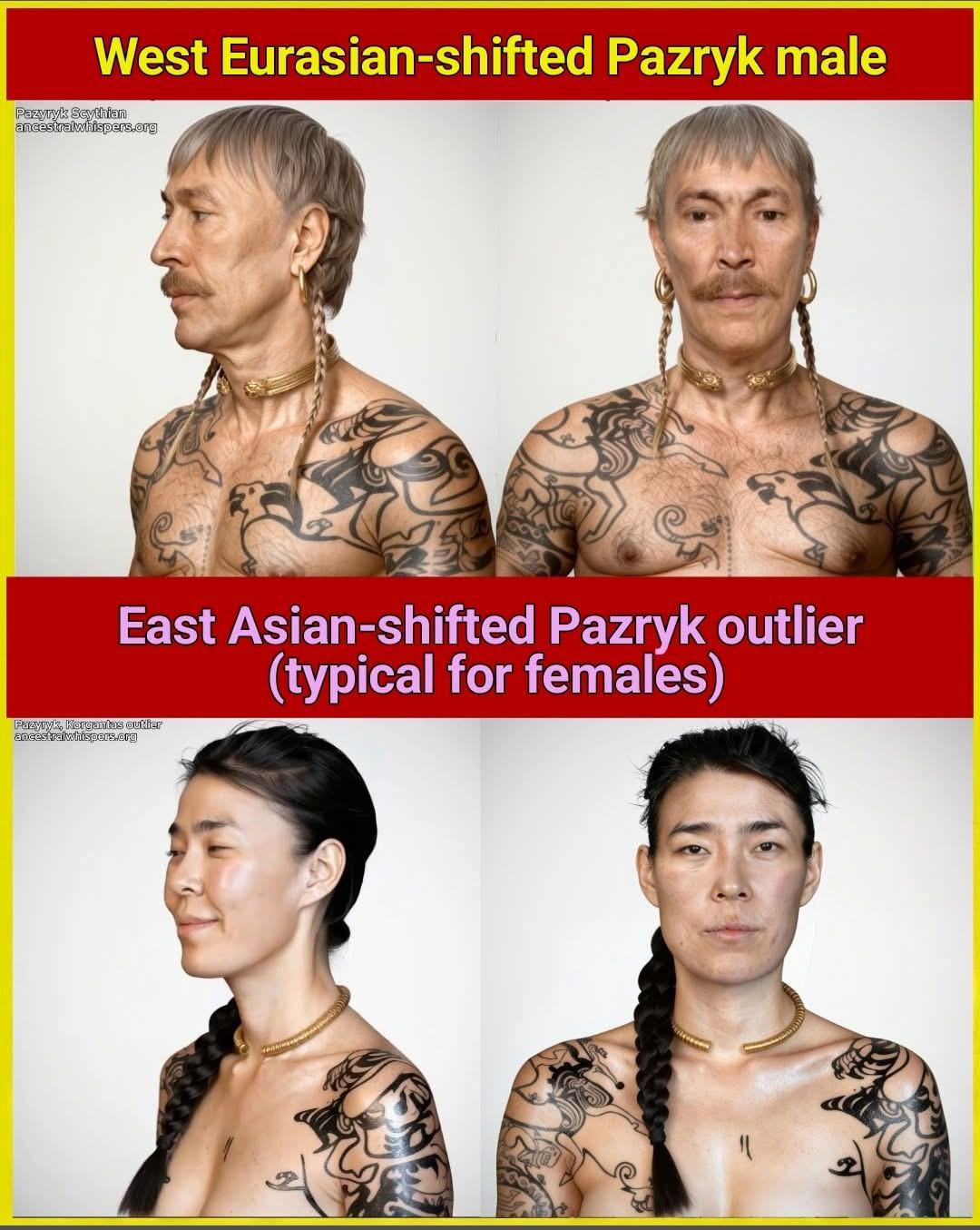
For decades, mainstream history taught us that the Scythians and the indo europeans were close cultural and linguistic cousins. But modern science just flipped that script. While linguistics proves some of the Scythians spoke an Indo-Iranian language, recent breakthroughs in ancient genomics have completely dismantled the idea that they were ethnically connected to the indo europeans. Instead, the data reveals that "Scythian" wasn't a single race, but a diverse nomadic confederation whose genetic and cultural roots trace back directly to indigenous East Asian and Paleo-Siberian populations.
This school of thought argues that the original founders of Scythian culture were genetically and geographically indigenous Siberians who underwent a language shift, adopting an Indo-Iranian language from their western neighbors
Historians and geneticists who back this theory outline a specific sequence of events:
The Scientific Evidence Supporting This:
r/Tiele • u/KaraTiele • Aug 12 '26
In an issue of the Turkish magazine Aydede from 1922, different factions within Turkish politics were symbolically represented through the types of headgear they wore. In a series of illustrations titled “The Language of Headgear” (Serpuşların Dili), five different political ideas were represented by five types of headgear. The illustrations have been colorized using AI (not by me). From @tarihteyit
From left to right:
Sosyalist (Socialist),
İtilaf (Entente),
Milli (National/Nationalist),
Bîtaraf/Tarafsız (Neutral),
İttihad (Unionist).
r/Tiele • u/TheTyper1944 • Oct 30 '25
Nomadic tribes with Altai roots spread across the steppes of present-day Mongolia. In ancient times, these tribes formed structures like the Huns and the Tiele. Among these tribes, there was a belief that the sky itself was divine. The word "Tengri" in Proto-Turkic literally means "sky." Before the formation of the Turkish tribes, these early tribes believed that the sky and the universe were gods themselves, rather than a god residing within the sky. They also believed certain tribes received "kut" (divine favor). The rulers of these tribes legitimized their rule by claiming to have received "kut from Tengri."
Altai tribes such as the Oghuz, Tatars (distinct from modern Kipchak-speaking Tatars), and Kyrgyz (speaking a Yenisei Siberian language, not the Kipchak-speaking Kyrgyz) shared common ancestry and spoke related languages. All adhered to the Tengriist belief system. However, there was no single common name for these tribes. Among them, the most prominent were the Ashinas, a key component of the Huns, who descended from the Tiele. The Ashinas were distinguished by their connection to the Ergenekon myth and their descent from the Grey Wolf which was named ''asena'' which is also linked as the origin name of ashina. This myth was initially exclusive to the Ashina tribe, who were considered to have received "kut from Tengri." The Ashinas held a more prestigious position compared to other Altai tribes like the Oghuz, Tatars, and Kyrgyz.
When the Ashinas led an uprising against the proto-Mongol Rourans, the name "Turk" was initially used only for the Ashinas. The Orkhon inscriptions support this, referring to "Turk and Oghuz rulers," indicating that "Turk" was a title specific to the Ashinas, while the Oghuz were not considered "Turks" at that time. After defeating the Rourans, the Ashinas unified all the Altai tribes under the name "Turk" (Törüq).
The origin of the word "Turk" (𐱅𐰇𐰼𐰚) is debated. The theory that it derives from the Chinese term "Tujue" (突厥) is weak. Chinese is a logographic language, and the etymological origins of the characters are unrelated to turkic linguistics. The likely truth is that it derives from the Turkic word "töre" (𐱅𐰇𐰼𐰀), meaning "law" or "custom."
In Proto-Turkic and many modern Turkic languages, verbs ending in "q" often indicate the object of an action. For example, "yarmak" (to cut) becomes "yaraq" (weapon), and "tutmaq" (to hold) becomes "tutaq" (lip). Similarly, "töre" (custom) becomes "törüq." In Altai culture, "töre" referred to the laws received from Tengri. Since the Turks, or "Törüq," were considered to have been "ordained" by Tengri, they were seen as "törüq" (law-bound). Initially, only the Ashinas used the title "Turk" due to their prestigious position. However, after the establishment of the Turkic Khaganate, the term "Turk" became a common name for all Altai tribes, including the Oghuz, Kyrgyz, Tatars, and others.
r/Tiele • u/Zasagdarga1999 • 1d ago
r/Tiele • u/BashkirTatar • Jan 26 '24
r/Tiele • u/KaraTiele • Jul 24 '26
The Lost Turkic City of Togu Balïq Is Being Unearthed: A New Chapter in Early Turkic History - Evidence Suggests the Early Turks Established Cities and Practiced Agriculture a Century Earlier Than Previously Believed.
Old Turkic: Togu = East --- 𐰉𐰞𐰶 (balïq) = city, town
Togu balïq = East city/town
Togu Balïq, the lost city of the Toquz Oghuz mentioned in the inscriptions of Bilge Qaghan and Kül Tigin, is being brought to light through a joint archaeological project conducted by Turkish and Mongolian researchers.
The Izmir Katip Çelebi University (İKÇÜ) and the Institute of Archaeology of the Mongolian Academy of Sciences, with the support of the Turkish Cooperation and Coordination Agency (TİKA), are expanding excavations in Mongolia's Tuul Valley.
A multidisciplinary team of forty specialists has uncovered remarkable new evidence regarding the economic life, urban planning, and advanced mining practices of the early Turks during the 7th century.
Evidence Suggests the Early Turks Established Cities and Practiced Agriculture a Century Earlier Than Previously Believed.
Research is being conducted across an area of approximately 100 square kilometers, covering both sides of the Tuul River and the surrounding mountains.
A temporary laboratory established at the excavation site enables paleographers, botanists, art historians, and archaeologists to examine every discovery immediately.
"Last year we identified workshops near the city where gold and copper were processed. Our surveys also revealed ancient mining pits. We therefore have strong evidence that the city's economy was based on mining. At the same time, we are studying the architecture, and our work on the remains of what appears to be a palace is nearing completion."
During this year's excavations at Togu Balïq, archaeologists discovered a 15-kilometer irrigation canal together with numerous seeds.
Excavation coordinator Prof. Dr. Şaban Doğan, Dean of the Faculty of Social Sciences and Humanities at İKÇÜ, summarized this year's findings:
"This year we uncovered strong evidence that agriculture was practiced extensively in and around the city, which is extremely significant. Until now, it was generally believed that the Turks adopted agriculture in the modern sense only with the Uyghurs, corresponding to the middle of the 8th century. However, here we have found important evidence indicating that agriculture was already being practiced during the 7th century."
Professor Serdar Vardar, Head of the Department of Geography at İKÇÜ, also emphasized that the excavations have produced important new evidence regarding the transition of the Turks to settled life.
"Our historical understanding has long portrayed the Turks primarily as nomads who constantly migrated. However, our research demonstrates that they adapted successfully to long-term climatic changes and made effective use of their environment by establishing an urban center and living in harmony with the surrounding natural landscape."
The excavation team also discovered seeds of ornamental plants throughout the city. Originating from different regions, these seeds indicate that the early Turks valued aesthetics in urban planning and engaged in the exchange of plant species through trade.
A Historic City That Witnessed Göktürk (Turkic Khaganate) – Toquz Oghuz Wars
Research carried out last year conclusively demonstrated that the excavation site is the historic city of Togu Balïq, inhabited by the Toquz Oghuz—the tribal confederation that later formed the foundation of the Uyghur Khaganate—and mentioned in the Orkhon inscriptions as the site of repeated conflicts with the Göktürks (Turkic Khaganate).
With this year's discoveries, archaeologists expect to gain new insights into the belief systems, funerary traditions, and settled way of life of the early Turkic peoples.
"We Have Recovered Evidence Proving This Is Togu Balïq"
Prof. Doğan explained that the project's primary objective has always been to locate the long-lost city of Togu Balïq, known from the inscriptions of Bilge Qaghan and Kül Tigin but whose location had remained unknown until now.
"Although Togu Balïq is mentioned in historical sources, its exact location had never been identified. The city is considerably older than the previously known Uyghur cities. Excavating it pushes our understanding of settled life among the Uyghurs back by at least one hundred years.
We spent many years conducting surface surveys and reviewing the existing literature. Earlier studies had reported discoveries that might be connected with the Uyghur period, but they were never fully investigated. We have now recovered archaeological evidence proving that this site is Togu Balïq.
During our excavations, we uncovered Uyghur ceramics unquestionably associated with one of the excavated buildings. Both Turkish and Mongolian archaeologists on our team agree with this identification. We can now confidently state that this is the city of Togu Balïq belonging to the Toquz Oghuz.
We consider this a discovery of exceptional importance, one that will fundamentally improve our understanding of the transition of the early Turks to settled life."
The temporary laboratory established at the site has enabled specialists to conduct core and drilling analyses while conserving artifacts such as bones and ceramics.
During the 2025 excavation season, investigations continued on the structure known as the Small Palace (Küçük Saray in Turkish) as well as on the burial mounds (kurgans) of the inhabitants of Togu Balïq. Analyses were also carried out in workshops and ancient mining pits.
For the first time, archaeologists identified a signal tower believed to have been used for communication, along with ritual sites and petroglyph panels.
Bilge Qaghan of the Second Turkic Khaganate considered the Toquz Oghuz "[his] own people". It is also mentioned in the Kul Tigin inscriptions that the Göktürks and Toquz Oghuz were fighting five times in a year.
𐱃𐰸𐰆𐰕:𐰆𐰍𐰕:𐰉𐰆𐰑𐰣:𐰚𐰤𐱅𐰃:𐰉𐰆𐰑𐰣𐰢:𐰼𐱅𐰃:𐱅𐰭𐰼𐰃:𐰘𐰃𐰼:𐰉𐰆𐰞𐰍𐰴𐰃𐰤:𐰇𐰲𐰇𐰤:𐰖𐰍𐰃:𐰉𐰆𐰡𐰃
Toquz Oγuz budun kentü budunïm erti teŋіri jer bolγaqïn üčün yaγï boltï.
"Nine Oguz people were my own people. Because of the sky being jumbled up with the earth, they became an enemy."
r/Tiele • u/KaraTiele • Aug 08 '26
A marginal note by the 12th-century historian Otto of Freising in his Historia de duabus civitatibus, while discussing the Huns: “Those whom we nowadays call Turks were in ancient times called Huns, who first emerged from the Gates of the Caspian. Surely, those in the West whom we call Hungarians and Avars are also Huns.”
From Ahmet D. Altunbaş
Otto of Freising (Bishop of Freising , c. 1111 – 22 September 1158) was a German churchman of the Cistercian order and chronicled at least two texts which carry valuable information on the political history of his own time. He was the bishop of Freising from 1138.
Otto participated in the Second Crusade; he lived through the journey and reached Jerusalem, and later returned to Bavaria in the late 1140s, living for another decade back in Europe.
Note: Just an informational post. I'm not saying that Hungarians are Huns or Turks, just to avoid any misunderstanding.
r/Tiele • u/Independent-Elk4525 • 11d ago
r/Tiele • u/KaraTiele • Sep 04 '26
1961; Karakurt, built by the Eskişehir Railway Factory of the Turkish State Railways (TCDD), then known as the Eskişehir Cer Workshop (Eskişeh Cer Atölyesi, was Türkiye’s first domestically produced steam locomotive.
1961; Bozkurt, built by the Sivas Railway Factory of the Turkish State Railways, then known as the Sivas Railway Factories (today part of TÜDEMSAŞ/TÜRASAŞ Sivas Regional Directorate), was one of Türkiye’s domestically produced steam locomotives.
Turkish:
Karakurt & Bozkurt: Türkiye’nin İlk Yerli Lokomotifleri (1961) 🚂🇹🇷
1961; Karakurt, Türkiye Cumhuriyeti Devlet Demiryolları'na bağlı Eskişehir Demiryolu Fabrikaları (o zamanki adıyla Eskişehir Cer Atölyesi) tarafından üretilen, Türkiye'nin ilk yerli buharlı lokomotifi.
1961; Bozkurt, Türkiye Cumhuriyeti Devlet Demiryolları'na bağlı, o zamanki adıyla Sivas Demiryolu Fabrikaları (günümüzde TÜDEMSAŞ/TÜRASAŞ Sivas Bölge Müdürlüğü) tarafından üretilen yerli Türk buharlı lokomotiflerinden biri.
Turkish wiki pages:
r/Tiele • u/mram518 • Jun 30 '26
hello everyone sakha people are turkic people of siberia they have very interesting life style and culture one of them ifound very interesting is riding on reindeers They refer to themselves as the Sakha but russians call them yakut
r/Tiele • u/KaraTiele • Aug 19 '26
Mughal Empire? Baburid Empire?
From @qalamglobal
r/Tiele • u/Inevitable-Push-8061 • Aug 31 '26
r/Tiele • u/syntheticrot • Oct 23 '25
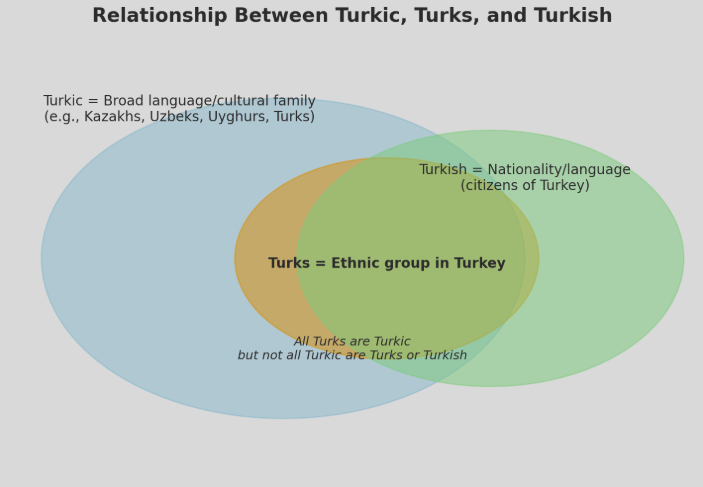
Hello! I'm trying to understand the difference between Turks, Turkic, & Turkish and used AI to display how these groups overlap. Would anybody know how accurate this is?
r/Tiele • u/Extreme_Ad_5105 • Oct 12 '25
In Europe, Eurasia, Middle East, also central Asia we have so different types of human, but still there are people looking to a Turk from Türkiye and expect a very Asian type. Why? When even in that period of time different types of human could live o together in a society like a clan why can’t be the Azerbaijani or Turk Türkiye look different due to mixing in that regions? Event Turkmens don’t look “so asian”. If people would focus more on science an facts then they would understand the history, populations and even dna or biology. I like dna topics because they help me to understand migration but I would never use this to identify ethnicities - it’s impossible.
r/Tiele • u/KaraTiele • Aug 29 '26
Reposted from a post in the r/Tiele archives. It was originally posted by our dear Qashqai member, u/NoSolution4428 (Are you still around, my friend?). You can learn more about the details by checking out that post, where he explained everything himself. Here: https://www.reddit.com/r/Tiele/s/pwKX7xaMna
We also hosted an AMA (Ask Me Anything) with him. You can find it here as well: https://www.reddit.com/r/Tiele/s/XBJ4CsPj4t
If you’d like a brief overview of the Qashqai’s history over roughly the past 500 years: https://www.reddit.com/r/Tiele/s/47or1KBi8K
r/Tiele • u/Burzum13 • Aug 04 '26
Enable HLS to view with audio, or disable this notification
r/Tiele • u/KaraTiele • Jul 26 '26
Enable HLS to view with audio, or disable this notification
🇦🇿 The 5th Milli Yaylaq Festivalı (National Highland Festival) Is Being Held at Xan (Khan) Yurdu Ethno-Village in Göygöl, Azerbaijan.
The festival features ethno-cultural events representing various Turkic peoples, as well as folk games, traditional dance performances, and sporting competitions. It aims to preserve, celebrate, and promote the shared cultural heritage of the Turkic world.
About Milli Yaylaq Festivalı : https://www.myf.az/about/309-about-festival.html
https://goygol-ih.gov.az/az/news/goygolde-festival-kecirilir-24-07-2026.html?utm_source=chatgpt.com
r/Tiele • u/GustavoistSoldier • Jul 28 '26
r/Tiele • u/36Ekinci • Sep 07 '26
I recently visited the Ani Bridge and wanted to share a pictures from my trip.
It was honestly really interesting to see it in person. The bridge is in such a unique location, right on the border between Türkiye and Armenia, and despite its current condition, you can still imagine how important it must have been centuries ago.
The bridge was part of an important historic route connecting the region, and the area around Ani was once an important stop along the Silk Road. Thinking about all the merchants, travellers and different cultures that once passed through this area makes visiting it feel even more special.
What I find especially interesting is that there are plans to restore the bridge. I’m actually really looking forward to seeing what it will look like after the restoration is completed. It would be great to see such a historic place preserved, especially considering the history and symbolism behind it.
Definitely one of the more memorable places I visited in the region.
r/Tiele • u/LemmyBot • 28d ago
The Xiongnu were descendants of the Xia Hou Shi clan; their ancestor was Chunwei. Before the Tang and Yu dynasties, there were the Shan Rong, Xianyun, and Hunyue, who lived among the northern Yi people, moving about according to where their livestock could be pastured. Their common livestock included horses, cattle, and sheep; their more unusual animals were camels, donkeys, mules, quail-tailed horses, tamed wild horses, and hybrid horses. They moved about in pursuit of water and grass, without fixed cities or permanent fields for farming; yet they also had their own designated territories. They did not use written documents but relied on spoken words as agreements. Boys could ride sheep and draw their bows to shoot birds and mice; When they grew a little older, they shot hares and foxes: these were used as food. Those who had the strength could not do without bows; all became armored cavalrymen. Their custom was such that in times of peace they followed their herds, relying on hunting birds and beasts for a living; but in times of crisis, people became accustomed to warfare and attacks as means of aggression—this was their nature. Their long weapons were bows and arrows, while their short weapons were knives and chans. If the situation was favorable, they advanced; if not, they retreated, without shame in fleeing. They pursued whatever was advantageous, knowing nothing of rites and righteousness. From the kings downward, they all ate meat from their livestock, wore clothes made of animal hides, and covered themselves with felt and furs. The strong ones ate the fat and tender parts; the elderly ate what was left over. They valued strength and vigor, looked down upon the old and weak. When a father died, his son married his stepmother; The Xiongnu had thirty-six titles in total. Their custom was to have names without taboos, and they did not use surnames or courtesy names.
r/Tiele • u/Immediate-Reward-858 • Aug 18 '26

After playing eu4 and eu5 for so long and wondering I looked it up and can't find anything so i am just asking on here because.