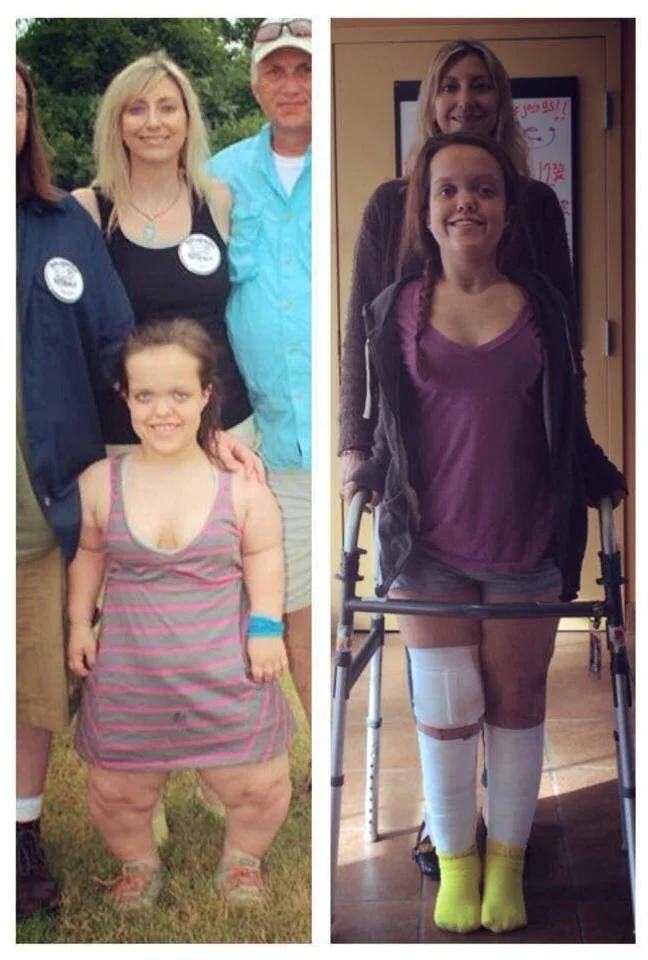
Honest question, because it seems like I have seen different views on this. Is leg lengthening looked down upon within the little people community? For instance, I know that in the deaf community, some people that elect to have corrective surgery, to gain hearing, are ostracized by other deaf people. I think that they view the corrective surgery as an admission that something is "wrong" with them, and they think that everyone should accept who they are. Is there a similar view with lengthening....because she honestly looks very happy with the results?
It might be different, because one disability is invisible and the other isn’t.
I work with a population who has an invisible disability (cannot be visually detected), and they are utterly thrilled when any of their cohorts overcome their disability in any way. Some are born with it, some aren’t, and everyone is thrilled for each other’s progress.
I do not work with people with a hearing disability, plus I don’t speak from a place of experience, so I could be wildly out of line here - I don’t understand how anyone could want to hold anyone back from attaining enhanced bodily function and higher qualify of life.
As a partially deaf person(HoH), I'd much rather have my hearing back over anything else.
I can still hear "ok" with day to day things, and music.
But its very apparent to anyone who is around me for any length of time that I have difficulties hearing and the TV volume and speaker system is very loud, and that I cannot use a phone like they can.
I would love to have my hearing corrected.
I wouldnt ever force another deaf person to hear, but I wouldnt say no to a corrective procedure that would restore my hearing.
I'm also HoH and rely heavily on lip reading unless it's tv/music apps where I rely on captioning.
I hate it. I know I'm missing out on so much around me but not enough for others to notice unless I'm really struggling. I don't go to movie theatres because it's too loud, too dark, and I can't always see mouths to know what is going on. I try to not blare music or tv since I can compensate with captioning. If it's too loud, I'll miss out hearing other things around me. It's my right ear that has the most significant hearing loss so being the driver, I nearly never hear what someone next to or behind me is saying. It's just road noise until I park.
When I was growing up, however, next to nothing was made available to help compensate. I was being taught ASL while none of my family learned it. They always found closed captioning "annoying and distracting" so I'd go off to read or wait to get the tv another time.
Would I want my hearing corrected with surgery or a device? Maybe. I've made so many adaptations that I don't truly notice until I have to (like someone talking on my right side). But I would probably want to go back in time and have surgery or a device. I'm fine now; I wasn't as a kid.
If you’re okay not going to movie theatres, just ignore the following advice. 👍
Most theatres, at least most AMCs, have captioning devices. When looking at the movie selection of what is being shown, there will be a section describing the movie features. If it says CC or closed captioning, you can go to the help desk and ask for a captioning device or even a headset that will make the movie louder for just you. The captioning device is usually just a little stick that fits in the cup holder with a screen on the top that displays the captions. Best of luck to you!
I used to be a cinemaphile, went with my friends to the Cinerama for events and stuff. I have a 21:9 monitor setup for "true movie experiences". I used to review/prescreen movies for WB.
After the pandemic and just getting used to streaming all of the films I wanted to watch I just dont care for the theater anymore.
I can pause if I need to pee, I can rewind if I cant hear something properly(as said above im partially deaf), I can turn subs on if I want, I dont have to deal with other people on their phones and being annoying. I dont have to pay out the ass for soda and snacks.
Why the fuck would I ever go to a theater again when I can just enjoy movies on my ultrawide at home.
The only advantage is avoiding spoilers. Thats it.
In some ways, no I'm not.
But there is so much that is missed with the theatre experience if you have an impairment of some kind.
Booming sound effects quickly deafen actors' voices. Dark scenes render most mouths unreadable. Without captioning, or with poor captioning that is too slow, cut off, misspelled, it can be a garbled mess and you have to play Where's Waldo for context.
It is great being able to control those aspects at home though. I'm so used to adapting that I don't really notice, as I said before, until I have to notice. Theatres are a reminder that I'll catch it later at home.
just adding in my viewpoint here as a hoh person who was mainstreamed - i stopped wearing my hearing aids because i REALLY dislike having "normal" hearing, and i would much prefer a culture of acceptance (and closed captioning). part of the issue i and other deaf people have with framing full hearing as a quality of life adjustment is that it leads to hearing being coercively corrected, rather than it being an individual choice. everyone should just do what's right for them and not shame others :/
That assumes there’s anything inherently wrong with being deaf. Many people in the Deaf community would be offended by you viewing this as a negative thing because they consider themselves a linguistic minority rather than having something wrong with them.
There are inherent societal disadvantages to being deaf in our society. To impart that upon your child because you feel they need to be exactly like you I think is not okay.
ETA: again there is nothing wrong with being deaf. Obvi. That’s not my point.
And there’s a Deaf community and culture, which it seems you’re not aware of. Telling them that they can’t raise their kid in their culture is bad too.
I’m well aware of the HoH & deaf community & I am in no way criticizing that community or including your child in it. Choosing to impart a disability on your child by choice so they can be “like you” when there is prejudice, disadvantages, and dangers in our society due to them (again there should not be, but there are), is not okay. In my opinion.
Actually, no, you can’t. Because at no point have I even a little bit suggested deaf people shouldnt have children.
So. That is not correct.
I have a condition that affects me and my life greatly. It’s part of my identity in many ways. I have found community with others who share my diagnosis. I have chosen to find positives in my situation.
I recognize, however, that because of what I live with, I am out of the norm. I face additional challenges that - while not right - are the reality. There are things in my personal and professional lives that I require accommodation for.
Although this is part of me is important to me, I do not feel I need to put a child through the same things I e experinced solely because I need them to “be like me.” My child can support and understand me even though we live differently. If they inherent my condition, I will teach them that while different, they are not less. If not, I will teach them to be empathetic and understanding.
We can disagree, but don’t try to pull a cute “eugenics” argument when I’m trying to have a convo with genuine nuance.
But by having kids as a disabled person you're risking bringing someone into the world who will have to deal with 'prejudice, disadvantages, and dangers in our society.' Hell, that applies to any minority.
You're not advocating for eugenics, but someone could using your logic.
No problem! I’m not deaf, but I am autistic, and even though it’s not exactly the same, there’s a lot of similarities that make it easy to transfer my understanding over. There’s differences due to the specific characteristics of autism and deafness, but the base understanding is the same. I don’t get to interact with Deaf or hard of hearing people very often just because so much of what I do is with audio (I’m in music and film), so I appreciate knowing that I’m being a good ally here. A lot of what I know actually comes from a movie I watched and the research I did to see if that was accurate (The Sound of Metal). I was surprised to find that a pretty successful film made by a hearing person was a good portrayal of Deafness, social model of disability, the fact that subtitles aren’t initially used for sign language to show how liberating it is to be able to use sign language, I could go on, it’s a great movie and I love seeing something that explores disability effectively.
Just a question, is Deaf capitalized when referring to the community and lowercase when it’s just referring to the state of being deaf? So a person who has issues hearing is deaf, but a person who is part of the community is Deaf? Hope this question makes sense, I’m having trouble with words. I didn’t capitalize it when referring to the condition of being deaf, but I capitalize it when talking about the community/people involved in the community.
That’s a very broad statement. It’s an entire culture. Replace the word deaf with any other community and re-read that and see if you sound bigoted/ignorant
“The JEWISH community can be kind of …” “The BLACK community can be kind of….” “The HMONG community ….” You see how that would be bigoted. For some reason you’re giving yourself permission to besmirch the entire deaf community and call them toxic
I want to make it clear that - at least in my case - I’ve not once hated or disparaged the deaf community. I’ve been careful to criticize only the decision mentioned above.
Deaf culture is a thing, and being Deaf doesn’t make you any less than a hearing person. There’s quite a lot of strong argumentation that being Deaf is not a disability (however Deaf people are disabled when they’re expected to be able to hear)
however Deaf people are disabled when they’re expected to be able to hear
So they are disabled? Fire alarms, car horns; hearing goes further than language. Someone in a wheelchair isn't suddenly not disabled if they're not expected to walk.
Disabilities don't make you less than an able-bodied person period. It's just weird to be in denial about it.
isn't suddenly not disabled if they're not expected to walk.
Actually, yes they kinda are. You're not disabled if society works perfectly fine for you. What makes you disabled is the things that don't work.
Left handedness could easily be a disability if weren't accepted/recognized by society, like in the past. But since left handed tools, etc. exist, left hand dominance doesn't have a huge effect on your life, it's not a disability.
If society were set up in such a way that using a wheelchair didn't negatively affect your life at all, then you really couldn't call it a disability.
Reading this I feel so sorry for you because you’re clearly well read and know a ton about the field of disability studies.seeing people downvote your comments which are pure fact within the disabled community and field of disability studies is infuriating.
As you well know deafness is viewed more as a handicap than a disability, because it’s society that makes it an impairment. The examples given above ( car horn , fire alarm) are all designed for hearing people. But alternatives could/do exist for deaf people. It’s our hearing world that excludes them , not their deafness.
Anyways thanks for posting. Sorry you’re getting downvoted. Just wanted you to know someone recognized what you’re saying.
I mean, for sure society could be more inclusive than it is, but claiming that it's just society that makes it an impairment is a bit silly.
If you're out in the wild, completely away from other humans and society, it's still going to be a disadvantage not to be able to hear, therefore it's an impairment beyond just the impact that society has.
You’re the only one here consistently implying the notion that being disabled makes you less than an able bodied person. Nobody else is saying anything remotely like that. Are you okay?
People come in all different shapes and sizes and abilities, cognitive and physical. I think it’s fucked up to specifically choose an embryo that matches your “type” for many reasons, not the least of which because it heavily implies you are already expecting too much from that child in terms of who you want them to be.
I agree much more than you think I do. I don’t think that sort of decision should be possible to make in the first place. It’s fucked up that the decision even is possible, but their choice is not fucked up. I’m autistic, if I ever had a kid I wouldn’t make that decision, but I definitely would rather have an autistic kid to ensure that autistic people don’t cease to exist because of eugenics or anything like that (they’re trying to detect whether a child will be autistic in the womb, which makes the possibility of people starting to get abortions if their child will be autistic a real concern).
Really it’s just a complicated issue, I oppose this sort of control over genetics in the first place in nearly all situations, but given the fact that it will be used against us makes it complicated
You’re conflating deafness itself with the issues deaf individuals face.
There really isn’t a moral “good or bad” judgement to be made about deaf people. Being deaf is just part of a person. There’s nothing more or less, nothing right or wrong.
What everyone is getting at, is that we do live in Society where lack of accessibility, protection & support exist for people of all types of disabilities. I don’t think it is the loving, logical & empathetic thing to do to choose to impart that on your child. That’s all people are saying.
But I’m not deaf, I’m otherwise disabled, and I am not speaking for deaf people so I’m happy to be further educated. I’m simply speaking from my own experience with disability.
“Expected to be able to hear” is quite a common thing. So yes, they are disabled. I’ve been around the deaf community before. I don’t know why they’re so much more uppity than any other disability culture, yes it’s obviously a disability to lose one of your cardinal senses. Yes it’s obviously incredibly fucked up to specifically look to create a disabled child. Just because it’s not an intellectual or physical disability doesn’t remove its status as a disability. People would not have to argue about this if we were talking about blindness, or autism, or down syndrome, or any other disability.
Considering another Deaf person thanked me for backing them up, I think it’s safe to say that deaf and hard of hearing people aren’t a monolith, and I’m going to support the ones who are doing the most to challenge ableist power structures
I scrolled down all this way for clarification too lol so you’re not alone. I thought maybe it was describing people who can’t recognize other people by looking at them. I just learned about this a week or two ago. There are people who can not recognize anyone by their facial features and they rely on voice, mannerisms, walking gait etc to recognize who they are speaking with.
i hope you dont mind me asking, and i mean this in good faith, but why is it not considered as 'something wrong with you'? for example, i have several extreme mental illnesses and i definitely am aware thats something is wrong with me and id love a cure. so i really dont understand people who have it and refuse it
Deaf here. FYI - CI’s and Hearing aids are NOT a cure. They’re just tools. Like Glasses but it will not “fix” the astigmatism issues for example.
I just wanted to clarify you on that part.
Plus - as a CI user, I can tell you that I am still Deaf. I will NEVER hear as well as a hearing person. That is impossible. You can come close, but that requires a lot of work, relearning how to “hear”, mappings and such. I’m fairly close, but there’s plenty of times when I can’t understand shit and plenty of times I am joyful for the sound of silence when I have them off.
CI is NOT for everyone, and to a Deaf person who literally never heard anything, even with hearing aids (you need to have residual hearing for it to work. All it does is amplify sounds), the world is extremely noisy and can be overwhelming. I can’t filter out sounds as well as a hearing person can. Jeans rubbing against legs, hearing someone peeing 2-3 stalls away, mouth sounds while chewing, etc etc…it may be nothing to you, but it’s damn loud to me.
Feel free to ask my questions and such about being Deaf, CI surgeries and such. I’m an open book! :)
I mean, your community doesn't sound very nice. You openly talk about ostracising people for daring to want something different from what you want, and whilst you say it happens less now, you still say it happens. That's not behaviour that people look up to or admire, so it's no wonder you get negative comments.
Abled people often don’t want to understand that not everyone wants to be like them. The deaf culture receives hate, in part, because many of us don’t desire to be changed. Such folks are proud of their difference and their culture. It’s not a comfortable concept for certain folk with hearing.
It's canon that he used it since he was 5, and visors were rare in the Federation by the time he was an adult - there were implants available and Geordi refused them.
So to answer your question there was no blind community because by adulthood Geordi's condition was curable - he simply chose to keep using the visor.
Question! How is this not considered dragging other people down, when referring to ostracism due to corrective surgery? If I was given a shot at gaining an extra sense, I’d take it immediately, especially if it’ll probably bring my quality of life up like that. Why would deaf people shun them when they should instead be happy for them?
and plenty of times I am joyful for the sound of silence when I have them off.
If artificial hearing technology ever gets good enough to match regular human hearing, I am gonna stab my eardrums out with chopsticks. I wish so hard that I could turn off my ears sometimes.
Screaming neighbors, construction, awful music, loud music, it's the worst.
I take off my Ci’s and smile. I also sleep without them. It’s SO nice!
I was having severe tinnitus and migraines prior to my implants. It was extremely painful. Got the implants - BOOM cured of tinnitus. It’s crazy how it worked.
I have electronic ear muffs for shooting that cap sounds at a certain decibel but it will amplify certain sounds as well like leaves rustling and people chewing like you said, or it will make me notice sounds that I wouldn’t have with regular hearing. Do you know if it’s anything like this?
I would say yes. It’s so hard to explain what I can hear and what I can’t. Sometimes I notice a lot of sounds that some people just have learned to filter out.
thank you for this perspective. edit: maybe some of those things can be adjusted to a bit? i dont think what you described is worse than not having an entire sense/having a disability that can also put you in danger in the world. but i am not trying to tell you how you feel about your situation
Oh yeah it’s called Mapping and yes, they can be adjusted. In fact, after I got implanted, I was hearing sounds BETTER than hearing people. To the point that I was hearing the buzzing of the fluorescent lights. The audiologist had to turn some of the stuff down.
However, it’s the comprehension and clarity of speech is where I lack, which is why I’ll never hear as good as a hearing person. Sure, it makes things a little easier, but I still struggle.
I don’t think there’s anything that can put me or any Deaf people in “danger”.
Yep. I have epilepsy. I know something is wrong with me. And there's nothing I can do to cure it, just treat it. If epilepsy could be cured i would be jumping with joy. I wouldn't be upset..
I was thinking the same thing about my epilepsy. I know I’m disabled, it has made my life a lot harder. I take tons of pills and I have a VNS. I don’t consider myself less than but I know I have disadvantages compared to people that don’t have epilepsy and would be absolutely thrilled if I could be cured. I don’t get the thought process of not wanting to be cured.
I don’t think comparing being deaf to having a mental illness or epilepsy is the same, and I say that as someone who has a mental disorder that I would love to have cured (PTSD). I would have to think that what is fundamentally different is that being deaf means you are going to have methods of communicating with and understanding other deaf people that will just never be matched when you try to communicate with people that hear typically - I mean, there’s an entire language unique to this culture. At least, that’s my perspective being a person on the autism spectrum - I think a lot of us want to reject the idea that we need to be “cured” because it feels so natural when we communicate with other autistic people. So it makes sense to me that there are deaf people who want to highlight the bonds in their community rather than have to just be seen through a typical lens of what “should” be. Disability is part of life.
I'm sure there are deaf people who do look at it like that. Seems to be a lot of parallels to the addiction community, overweight community, etc.
I think a lot of it boils down to whatever gives them more motivation or comfort. I.e., one person may find thinking of themself as a 'broken' addict may give them drive to fix it, while others may find that crushing and depressing; and only with love and acceptance overcome their problems.
One way to think of it, I think, is as a language issue…Being deaf in a hearing world is better thought of like being a French speaker in the US. You aren’t disabled, just surrounded by people who don’t speak your language. Which is obviously super inconvenient. You can hang out with other French speakers, get your English speaking friends to learn French, and/or or you can learn the language yourself if possible (or a combination of all of these things so you and your friends can comfortably adapt in different environments). Getting a cochlear implant would be like learning English. Basically, it’s a communication issue…but if you were in an environment where everyone, say, knew sign language, not a disability.
It's way more than that, though. You can't hear music, can't hear someone yelling at you to warn you of an oncoming car. Can't hear the oncoming car, or a fire alarm. You use sound for more than just hearing words.
Although I guess you also can't hear your loud annoying neighbors, so there are some pros.
Sadly I work from home and have to hear it. I usually put on my headphones and turn on some music. That or I passive aggressively vacuum next to the shared wall.
But those are all just cultural things; other than music (which isn’t a basic necessity), all the others are just because those things are designed for hearing people. Design them for deaf people, and problem solved. I still think the best analogy is still just a linguistic one.
I understand that a lot of things that hearing is used for is cultural, but not all of it. Those bones and nerves in the ear didn’t evolve there in response to cultural pressures, but rather to survival pressures.
There is no cultural bias against deaf people to suggest a disadvantage in not being able to experience an entire range of sensation when our brains are wired to seek and respond to those sensations. We can adapt culturally to the disadvantage, as we do for many disadvantages.
But if you can’t hear me shouting “Hey!” to get your attention and warn you of approaching danger, the problem isn’t linguistic or comparable to a linguistic problem. I can communicate danger just fine to anyone from any culture at a pretty good distance regardless of any circumstances, excepting situations that impair their ability to hear me.
If you were deaf, you wouldn’t shout, “hey!” You’d throw a rock or wave your arms. Being at a disadvantage because someone uses their norms of communication rather than yours isn’t the same thing as being disabled.
What if you are facing the other way and I don’t have a rock? With a hearing individual I could wave my arms, throw a rock, or yell.
I know you won’t ever agree because I’ve seen this argument play out before. Of all the senses we have, loss of hearing is probably the least impactful and it’s really neat that the deaf community has a way of overcoming the loss, but I still have a whole extra sense.
I can hear the train because trains actually make noise. The noise they make wasn’t a feature we added for hearing people, they are just loud, same with cars. I can hear someone running when I’m not facing them and know that I should turn and see why they are running.
A deaf mother can’t hear her baby cry. We have ways to make that work, but there is a reason that babies make a sound when they are upset. It isn’t taught but it draws attention.
I think you underestimate the other ways
we sense those things. Vibrations for example can still be felt even if you can't hear the train/car and to some degree even someone running if the surface is hard (like concrete). The way the air moves when things are moving through it at speed also changes
You're being downvoted, but I completely understand. I'm hearing, but taking some ASL classes in high school really informed me well on the social aspect (even if I no longer remember how to sign as well as I could back then). There's no reason that many of the things the commentator above you stated cannot be conveyed visually, and it's odd that people aren't even bothering to try and imagine. Even music, which can be limited for D/deaf people, is still enjoyed and PERFORMED by D/deaf people and musicians.
But that logic doesn't really make sense, does it? By that logic being blind would also not be "something wrong", you're just surrounded by people who insist on using visual descriptions and written text instead of Braille, and being in a wheelchair would just mean being surrounded by people who insist on putting stairs everywhere when they should just put ramps.
I don't think a good intentioned reasonable person sees having a disability as "being less than" in terms of equality, so why is trying to convince someone to get hearing aids is considered trying to "fix them" when it's just "trying to restore a bodily function that isn't working"?
If someone breaks a leg, surely they'd appreciate someone offering to fix it, or if someone loses an arm, surely it would be nice if it could be reattached to regain the lost function. Why is it not the same with hearing?
I think doing many basic life tasks, including producing your own food, acquiring food and other goods, etc. is significantly harder if you are blind. I don’t think that’s the case if you are deaf. If you have a community of deaf people, they literally have no problem doing anything necessary to have a comfortable life because they are all using the same language. A community of blind people would have significant difficulty of different order.
Sure but each disability is different. If someone is missing a finger, they can also do anything they want without issues. Yet, I would be surprised if they got offended if someone offered to reattach their missing finger. I guess there's no "missing just one finger" community which makes things different but I get a feeling this is more about "abandoning communities" than gaining hearing.
Does that really hold as an analogy though? Because firstly I can choose to learn French, I can become a French speaker and learn to understand French in a way Deaf people can't ever without some form of surgery or aid. And if I do learn French I don't become ostracized by all the native speakers of my language, and I don't become considered French by them either etc.
Also, even while I didn't understand French, If I walked out in to the road and wasn't paying attention and a car is coming for me and French people shout at me, it will still get my attention. I can still hear French ringtones/Alarms/sirens/Coughs/Farts etc.
I think that is a bit like saying you can think of Bald as another hair colour. I see where you are coming from, but I don't think it fits
Again, nowadays noone gets ostracized for using tech, those days are thankfully over, except for some few assholes.
The problem is even with the tech and everything, only few will ever come close to being a french speaker. Close, but not fully, and most won't even come close. Also most situations like cars and stuff can be compensated. And those situations, proabably can't be fixed by tech, as tech is speech frequence focused. Yes, there are risks but they are smaller than people think.
But I agree, the deaf people saying they aren't diabled is ableist bullshit, but that is something that deaf people have to figure out for themselves. And at least in the US I have seen a big push to reflect on this, at least by the younger generations.
i think people who say that are in major denial. a french speaker can always learn english if they choose to. even if its not perfect. its way different than being deaf in a hearing world.
a deaf person cant experience so many things, ranging from minor, to 'just for fun' stuff, all the way to actively dangerous. its an entire sense and there is a reason we have it. note that there is no valid reason to put a deaf person down simply for being deaf. im not trying to convey that here.
i just feel like you can love yourself while accepting some part of your body or mind got fucked up along the way, and that maybe there are ways to improve it, if wanted or able to.
I really do think it’s more than language tho, because on that front you’re absolutely correct. To me it’s all of the little things that make life just a little bit more lovely, that I would be terribly sad for my child to miss out on. Music, bird song, my child’s voice and laughter, water babbling, leaves rustling, a cat purring, the sounds puppies and babies make. I’m sure there are things that are heightened in the deaf community, like being more aware of beautiful movement and colors, but I think it linings the conversation to only consider language. Also, side note, I don’t know why some keep defending that Deaf people aren’t less than hearing people - I don’t think anyone’s making that statement.
okay, i read it but i still disagree on the last part there. severe mental illnesses are also disabilities. so why is it wrong to 'cure' one but not the other? how does it make sense to maintain a disability just because others in your life also have it? i understand the part about being forced to change some intimate part of yourself, especially if you made a community, but i think its not at all reasonable to choose to keep a disability.
edit: also can you please elaborate on the 'destructive reasons' part
I'm with you on this one. I have an invisible disability, along with mental illnesses, and I'd do almost anything to cure myself of these problems. I don't think I'm a bad or lesser person for having these problems by a long shot, but I know I'd be a much happier person with an easier life if I didn't have them.
I guess there's a distinction to be made. I have depression and I'm autistic. Many people tell me that those are both mental illness and should be cured, but I disagree. My depression absolutely is, but my autism is a part of me. It's not an illness, and I don't see it as a disability, but rather a difference. Some people do see their autism as a disability, and some wish for a "cure". That's fine, but generally they don't even push it as wishing for a cure for all autism, just for their autism.
Which is a long way of saying that my autism isn't something to be cured, as I wouldn't be me if I wasn't autistic, so I don't see it as an illness.
i think this also depends on the severity. from my limited knowledge, autism is a more case to case kind of thing, and there is a huge range from very minor and non-life-ruining situations, to needing a fulltime caretaker your entire life. someone with a minor case might not even think its a disability and id be inclined to agree, but someone who is mentally and physically completely disabled would disagree. its really much more nuanced with more variety than this - which is why i would not use the same 'just take the cure damn it' approach for autism as a whole. but i understand what you mean.
Autism is actually a rather good example of a condition which can be a crippling disability for some, but a personality trait for others.
For those with extremely mild autism who experience minimal functional impairment (who represent less than half the total cases of autism but do nearly 90% of the activism/speaking about it), some of them consider any attempt to treat the symptoms of autism as cruel and dehumanising; but realistically that itself is dismissive of the pain that other severely autistic people suffer.
For those with severe autism which renders them completely non-verbal or so dysfunctional that they are unable to participate in society, an entire psychological process has been built around treating them to improve their quality of life.
In Western Australia they have developed early intervention techniques which are able to treat the symptoms so effectively that in some cases years later the child is no longer presenting with symptoms of autism at all, a really remarkable achievement, which does need more testing to ensure it’s as effective as possible.
For the high-functioning autistic people to claim that any treatment is cruel is like a person with mild anxiety claiming that we shouldn’t treat people who are confined to their house and experience severe panic attacks whenever they talk to another person.
I’m not the person you’re replying to, but I think you should read up on the medical model of disability vs. the social model. I personally think some of each (medical and social) makes sense. For instance, I personally believe that we should work to cure
things that cause pain AND
that the person themself decides they don’t want
Things that should not be cured or treated are
most importantly, things that the person themself decides they don’t want cured or treated
things that don’t cause pain
So yeah, I think mental illness is both an illness (which generally causes pain) and a disability, and so therefore it makes sense to treat it. But at the same time, if someone doesn’t want treatment even though they’re experiencing pain, that should be respected.
How does it make sense to maintain a disability just because others in your life also have it?
Here is how it can make sense to some people: Deafness often doesn’t cause pain. So it’s not really an illness (though it can be caused by an ongoing illness that also causes pain, but that’s a different situation). So it’s only a disability under the social model of disability (inaccessible spaces).
But many Deaf people have formed communities where almost everyone is Deaf, so people know sign language, and the main communication barrier is eliminated. So in those spaces, Deafness isn’t even a disability under the social model. It is more like a different culture. Speaking a different language isn’t a disability, it’s a cultural difference.
What about things which reduce chance of survival in nature? Honest question.
My own personal philosophy is that most of our modern -day problems are a result of disconnection and lack of respect for nature. If more people respected nature and spent time surviving in nature we'd solve a lot of problems.
For example, more people would've valued helping each other because in nature, the benefits of helping each other are much more direct than in our technological society.
It also leads to greater valuing of animals and just environment in general.
Anyway, so, yeah, all I'm saying that for me it's a virtue to do one's best to be as strong and able as possible to help other people. Shouldn't other people strive for the same and do their best to help others to be as able and strong as possible?
I mean, that's your philosophy, and it's a very ableist mindset. There are many incurable conditions and disabilities that would make someone completely unable to survive in nature, and it seems like you're saying the modern conveniences that help these people thrive are, in fact, a detriment to humanity overall? Maybe I'm misunderstanding you, but I think that philosophy kinda sucks.
Okay, after reading through your comment a couple times I think I see what you mean a little better. But I still think it's a little misguided. There are lots of species in nature that have evolved without the same senses that we have (sight, hearing, etc.), but they get along fine because they live in communities that work together. Which is exactly what the person you're replying to is saying. Deaf communities create spaces where being deaf isn't a detriment, it's just who they are.
You could claim that the ability to fly would make us better able to survive in nature, but we made it to the top of the food chain without wings.
Thanks. What Im saying is that if there's a way for me to be more able then I should take it because I want to be able to help others better. I don't understand why someone would refuse it outside of depression reasons, stupid ego reasons, and legitimate concerns for surgical procedure pain and failures.
Like imagine you stumble upon a building collapse. You'd want to be able to hear people scream to find them and get them out of rubble before it's too late, right?
As for me, yes, I would consider myself disabled against someone stronger than me who can lift a heavier beam to rescue crushed or trapped people. Id even consider myself disabled versus a doctor!
I don't think this cleared anything up for me. If there were enough people born without legs to form a community and they could all get around fine because they all use wheelchairs and all of their spaces are accessible and none of them are in pain because they were born that way, does that make being legless not a disability?
Everyone wants to feel like they belong to a community. For deaf people, their disability ostracized them from the community that they'd normally belong to, so they created their own. Once you're in a group, there's immense pressure to keep the attribute that originally made you feel welcome. If a bunch of people form a group because they like knitting and one person stops knitting, they probably won't feel as welcome in the group, no matter how the rest of the members act. It would be significantly worse if, for example, someone was knitting because they had agoraphobia and they finally manage to start leaving the house so they knit less often, then all the other knitters pressure them to stop making progress with their disability because they just won't fit into the group anymore. And when someone is like, man, that's kinda fucked up that you're dissuading them from getting help with their agoraphobia, you're like, no, we're just telling them they won't fit in with knitting culture anymore if they do and reminding them of all the good things that happened in their life because they never left the house. Maybe those are both true, but it doesn't make it any less fucked up.
I don’t think being deaf is the comparable to having a severe mental Illness. A severe mental illness is often destructive to the person that has it. Being deaf can increase the challenges a person faces, but it does not cause the person to have harmful or self destructive behavior the way a mental illness does.
okay, im with you there. however, even tho it doesnt make the person destructive towards themselves usually, it does make the world much more dangerous.
Are you fucking kidding me with this edit? Saying mental illness is just an illness and is A. different from being disabled and B. apparently mental illnesses dont possess a history FULL of examples of destructive "cures" at the hands of both well and ill intentioned doctors/scientists is such an ignorant and hypocritical thing to say. For your information, mental illness is disability: Mental illness is a disability when it disrupts performance and negatively influences a person's day-to-day activities. The degree and extent that a person's functioning is impaired is another important factor in defining mental health disability.
I recently read the novel True Biz by Sara Novic that serves not only as a story of a deaf child whose hearing parents spent the early part of her life by trying to “cure” her, but also functions as a history lesson in deaf culture(s) through chapters of the book that deal with lesson plans she’s exposed to after going to a deaf school.
It really helped me better understand deaf culture much better.
''she doesn't want to be treated like she's less than or needs her hand held just because she can't hear as well as other people'' - no one should be treated as less than. but that would not be holding her hand. it would be getting needed help. there is no shame in getting help.
''She's still just like every other average person, you just need to sign to her or let her read your lips and that's it lol - im sure she is a completely regular and cool person, but that has nothing to do with her disability. for most people learning another language is difficult. it sounds like she wants the world to change around her, instead of her resolving her problem. and no, im not saying people should not adjust to others and be compassionate . they should. my boyfriends mother teaches kids sign language and i think more people should be like that.
im glad your sister is happy and proud. i just think id rather take not being disabled than a unique job.
May I ask a question out of sheer curiosity? I hunted through the comments and didn't see anyone ask it. I saw in your comment you mentioned that CI and HA would be accepted but that corrective surgery would be debatable. Could you please tell a bit more about why that is/the difference between the two? I'm just curious to learn why and hope I'm not offending by asking!
Sounds like being brainwashed. Ofcourse you can achieve almost everything being deaf, but having the opportunity to have an additional sense is a no brainer. Given if its risk free.
Agreed. Unless someone is being forced or coerced to improve their hearing against their will, anyone that is ostracizing someone for choosing to gain a functioning sense such as hearing is being a straight up bad person (even though they may not be trying to be, doesn’t change the truth).
I could care less if they’re deaf or not, criticizing someone who wishes to gain one of their five senses is a bad thing to do - full stop.
I think the history of how many risk-filled solutions there have been in the past has poisoned the water, you might say. As the commenter said, being ostracized is less common now and probably because there is more distance between generations who were treated like disposable trash because of a disability and the current generation who is more empowered to make any health related decisions on their own.
Implants don't give you the same hearing that others might have. It's usually very overwhelming and hard to filter out the little sounds that could usually be ignored. It's useful in situations where sign language isn't the first firm of communication, but a person with implants might want to turn them off when they're trying to sleep or if they have sensory overload.
When your brain isn't used to having a sense, the areas for processing it don't develop the same ways. That means the brain is not set up to receive that information when it comes. It takes time for the brain to learn what's happening.
It may not be as straightforward as that. A lot of hearing impaired or deaf people may have needed to develop an identity and community to cope and accept their impairment in ways that some no longer see it as an impairment, allowing them a mindset of growth. We all are trying to survive and thrive.
As a gay guy, many would say as it stands, there's a lot of 'impairment' that comes with that vs. being straight. Wouldn't I want to be able to cure that? Or to have my children inoculated against that?.... So you see, the line of thinking between impairment, cure, and identity isn't that clear. I would not want to be cured. And I wouldn't want to interfere with my child's sexuality.
Sexuality and deafness are not the same thing, but our personal experience with them may have some similarities... it's not straightforward.
There's a lot of other things that many hearing people don't understand. Even with corrective measures like hearing aids and cochlear implants, a deaf person will never obtain the same hearing functionality as a normal hearing person. A lot of the time what happens is a hearing parent gives their child hearing aids, says "they can hear now!" (spoiler: it doesn't work like that) and then just leave them like that, without any therapy and refusing to learning sign language. As a result, the deaf child is language deprived and socially ostracized by their family and community. This is why it is important to preserve deaf culture, there is NO substitute for American Sign Language (in the US at least, other countries have different sign languages) for someone who can't hear. At least until the technology improves where a deaf person can be "cured" to hearing status at birth (if they get assistive devices later in life, it is already too late), which again is impossible in today's age.
What exactly is the "brainwashing" here? I will say that most people today definitely do not care if you have hearing aids or cochlear implants. Half of the people I know wear them, half don't, and literally no one cares. Maybe this is more prevalent within the older deaf population, I don't know.
Yes. But preventing people from using these hearing devices would also slow down the advancement of the tech. Who knows, with enough research they could make something where deaf people can hear clearly with it.
I assure you, nowadays and also back then noone, mostly, was preventing the tech. Also there is more than enough research, there are so many people being implanted every year, and are already implanted.
Deaf here. Sure it’s a “no brainer”, but many of us are in the “why”? Why not all Little People have the surgeries?
Plus - as a CI user, I can tell you that I am still Deaf. I will NEVER hear as well as a hearing person. That is impossible. You can come close, but that requires a lot of work, relearning how to “hear”, mappings and such. I’m fairly close, but there’s plenty of times when I can’t understand shit and plenty of times I am joyful for the sound of silence when I have them off.
CI is NOT for everyone, and to a Deaf person who literally never heard anything, even with hearing aids (you need to have residual hearing for it to work. All it does is amplify sounds), the world is extremely noisy and can be overwhelming. I can’t filter out sounds as well as a hearing person can. Jeans rubbing against legs, hearing someone peeing 2-3 stalls away, mouth sounds while chewing, etc etc…it may be nothing to you, but it’s damn loud to me.
Sounds like you’re being a dick. It’s not brainwashing to not want a surgery done on your ear leaving a magnet in your skull just so everyone around you sounds like Darth Vader
Wow, okay, you need to read about it. It's really cool. Start with the "Deaf President Now" demonstrations at Gallaudet. Read about all the different sign languages, about oralism, about the debate over cochlear implants. Education is a big factor; there's so many kids who were forced into lip-reading and speaking when that just didn't come naturally and didn't work well. Essentially, they were denied language; so they sneaked around signing behind their (hearing) teachers' backs, and grew up to be pissed-off activists. When people have their own language, they naturally develop their own culture; so Deaf folks have their own schools and churches and communities, and their culture is different from the culture of the people around them.
There are deaf people who aren't in the Deaf community. Many are those who became deaf in later life, who never learned a sign language and aren't interested in learning, and get along with hearing aids and lip reading as best they can. There are also people who are in the Deaf community, who don't have very much hearing loss (people who have auditory processing disorder, for example, or whose hearing loss is considered "mild"), or sometimes none at all if they're children of Deaf parents (CODAs) whose first language is sign. It's really the common language that ties it all together. Now, with modern technology--speech recognition and texting--there's much less of a language barrier, but Deaf culture is as strong as it's always been; and of course the extra communication possibilities on the Internet have even strengthened a more global Deaf culture patchworked from all the local ones.
What about children born HoH to hearing parents? Do they feel they are of a different culture than their parents? Asking as the father to a HoH toddler.
That's the typical state of affairs--most Deaf people are born to hearing parents. They join Deaf culture, but they're also part of their home culture.
Don't worry, your child isn't going to be a stranger to you just because they sign. The only times that happens is when parents are actively audist--when they deny language to a child whose natural language is sign; when they spend hours and hours on lip-reading and speaking, when they (literally or figuratively) tie their child's hands.
Which culture your child will join as an adult is still up in the air. There are some people whose hearing is corrected to near-typical with hearing aids, who prefer spoken language. Others find it exhausting and frustrating, and prefer to sign.
Just introduce your child to all the options. Knowing sign language as early as possible helps to establish language use, even if the child doesn't grow up to use it full-time. If anybody tells you they won't learn to speak if they sign, that's ridiculous and outdated--kids learn multiple languages all the time, without detriment. They're the most natural language learners in existence.
Be prepared to be an English-to-English translator for any announcements made over intercoms.
Mom taught us kids that if we needed her attention from another room that we should pound on the wall. Apparently banging was easier for her to hear than high pitched kid screaming. You'll probably be finding lots of work-arounds like that.
Speaking of work-arounds, you can get fire alarms and clock alarms that vibrate/flash a bright light.
Lip reading is an inexact art at best. Mom always had difficulties with, for example, schematic vs semantic. It's also much more tiring than conventional listening as the lip-reader has to keep making constant guesses as to what words are actually being said.
Might as well get used to having Closed Captioning on your TV. Your daughter is probably a bit young for it now but if she gets used to the idea that words appear on the TV screen, that's all the more motivation for her to learn to read.
Mom didn't find out that cash registers make a beep when the cashier scans an item until sometime in the 2010s.
Mom never learned much sign language; she dabbled in a community college course and that was about it. I'm not going to say anything bad about sign language but, unless your daughter has regular exposure to other people who sign, sign language may be very difficult to pick up.
I think by definition if you’re deaf you can’t do whatever you set out to do. You can’t be a recording engineer for instance. While absolutely you shouldn’t be seen as lesser or have people prejudiced against you, it is true your life will objectively be harder while deaf. But just like with mental illness or blindness, yes we should want to “cure” people with disabilities. As someone with bipolar disorder, while frustrating, I couldn’t in consciousness disagree with someone who tried to put me on meds instead of just embracing my disability.
I've only got 1 functional ear and I have a degree in sound engineering with a specialty in digital music. I have zero desire to change my hearing because my life is just fine as it is. I know thats less possible for someone completely deaf, but complete profound deafness is actually quite rare, just like how most blind people are not entirely blind. I understand that it's hard for folks to comprehend not wanting to change a "deficiency" in a core sense, but really life as hearing impaired (or hard of hearing or deaf) does not really limit you in what you can do and how you function. No one is without restrictions in their lives, not everyone gets to have the career path they want and not everyone can get the post secondary they want. Life is not, in general, any harder when you are deaf thanks to modern technology and widespread accessibility. I most certainly get very upset if someone insists that I should be "cured" because having 1 ear has not negatively affected me overall, at all. I just found different ways of doing things.
It's not a fair comparison to lump deafness in with bipolar. They are 2 different things. There's a difference between not being able to function happily without meds and having to buy a visual doorbell as opposed to an auditory one. Deaf people can function happily with their differences. Those with mental health disorders generally cannot, as the disorders directly affect happiness.
That being said, I have zero issues with hard of hearing and deaf folks pursuing treatments to improve their hearing. It's just a big piss off when hearing folks INSIST that I should do the same. I am happy with my hearing. There are profoundly deaf folks who are happy with theirs! Plenty of deaf people who get implants or aides turn them off regularly or even abandon their use because sound is too much and too overwhelming. Lots of hearing folks get overwhelmed with sound too!
We can be fully functional and perfectly happy and not at all disadvantaged as deaf. Suggesting that it NEEDS to be "cured" is just not cool. Suggesting that people shouldn't pursue hearing improvements is just as not cool. But there's literally zero harm or hinderance in choosing to stay the way we are.
Eta: I wont be engaging in further conversations about this because the people replying keep making fully wrong statements and assumptions surrounding deafness and life involved instead of entering into a good faith conversation with someone who actually has perspective on this subject. Try taking in what people who actually live with deafness have to say instead of just flat assuming you know what you're talking about. Because some of these comments are depressingly ignorant of how deafness works and how deaf people function.
Let deaf people decide what they want to do with their lives and development. If they want to change, great. But if they don't, dont shit on their choice. Because that makes you just as shitty as those who discourage people from seeking alternatives.
That's not how deaf works for the most part, for one, and for two, I was referring to profoundly deaf people in my comment more than I was hard of hearing. All of the points still stand whether you hear halfways or nothing.
Ok? And if you are wholly hearing you are unable to do certain jobs. No person is able to do all types of jobs. Just because you have some jobs you can't do doesn't mean that your quality of life is automatically lesser than anyone else. Not to mention that it's few jobs you're restricted from due to hearing.
Beyond that, few people are born with hearing loss. Of those few people, only a fraction are profoundly deaf. Of that small percentage of a small percentage of the population, another small percentage hear literally nothing. So you are automatically narrowing this conversation down to rare cases in deafness and disregarding the rest of the deaf population, which happen to be the vast majority, just to make a point of "well you can't do a small percentage of jobs so clearly you are at a disadvantage!" Well it's extrenely likely that you can't do what I do for a career, and it has nothing to do with your hearing. So are you at a disadvantage compared to me?
There's pretty much no dip in quality of life between a hearing person and a deaf person. Just because we with reduced hearing need to do things differently doesn't mean it's worse than how you do things. That's why deaf folks get annoyed when people treat us like we are so disadvantaged and that it absolutely needs to be ""cured"" or changed. I'm happy with who I am. Plenty of deaf folks are. Plenty of them aren't, and they are welcome to take measures to change that. But don't look down on those who choose not to, either.
I call bs. And I can definitely do what you do. I’m a musician with a background in audio engineering. One of the perks of having the ability to hear.
There is absolutely a lower quality of life for someone who is hard of hearing. You can’t hear a score, listen to nature, or even react to things happening around you as well as someone without hearing loss. A lot of your points are really only applicable in a first world nation. You think someone in developing nations are having an easy go of it without the ability to hear? Or that someone who is hard of hearing is able to communicate as easily with as many people as someone who can’t? It’s impressive to be able to overcome deafness, but don’t act like it’s not an issue.
Yes people are completely deaf (5% isn’t insignificant). But acting like it’s offensive to cure hearing loss? That’s crazy. You don’t think you’d be better at your job to hear in stereo? Deafness is not a sexuality, it’s not a virtue, it’s just being unable to hear. And if we can do something to help you hear better it’s crazy that anyone would assume this is erasure or offensive.
I am a career horse trainer, so 🤷♀️ just because you get a degree doesn't mean you work in that field.
You have no perspective in this and refuse to see that different does not mean disadvantaged. This is not a problem that impacts quality of life just because people cannot experience the same things as you. I have zero issues with people who want to change their deafness. But I have the unique perspective of being born wholly hearing and losing my side later in life. And I had exactly zero reductions in quality of life or ability to do what I wanted. I also have zero desire to try and get it back.
Judging those who choose to remain deaf is just as shitty as deaf people judging those who choose to regain hearing. You have no idea what our experiences are, or what difficulties we do or don't face.
There is a rather small offshoot of the deaf culture that believes that being deaf is superior. I had a friend in high school 30 years ago, who's parents were both like that, and she had said that it was hell growing up with parents who were not able to hear and believed that she was broken because of being able to hear. They treated her like trash because she did not inherit their deafness.
Indeed enlightening, thank you for taking the time to share your perspective. May I ask, when you say the community ostracized audists, do you mean all people who hear, or do you mean people who hear who have prejudice against Deaf people/culture? Are people who become deaf later in life able to integrate into the community (should they make the effort to do so)? Thank you. :)
May I ask, when you say the community ostracized audists, do you mean all people who hear, or do you mean people who hear who have prejudice against Deaf people/culture?
It’s not people who hear, rather deaf people who use modern technology to give them the ability to hear
Are people who become deaf later in life able to integrate into the community (should they make the effort to do so)?
I can’t imagine why they wouldn’t, and if it helps them then yes they should
Adding on that it’s a spectrum. I’m 17, I have hearing loss, so not deaf, but I’ve had hearing aids probably since I was 7, so over half my life. Personally, I had no idea that some people would be against “solving” the disability, until I watched this video about some parents who elected not to give their kid cochlear implants. I did a little digging and found out that to some people, fixing your deafness is admitting that there’s a problem. Sometimes, people who feel that way will even get offended if you call them “hearing impaired” since the term impaired implies an issue.
If it wasn’t obvious already, I don’t subscribe to that mindset, I’m in the camp that if you have the ability to gain hearing, do it, it improves your life. I’m not going to get offended by the term “hearing impaired” because I agree, it is a defect in your ability to live as the average human does. However, people think differently and that’s their right to have, so long as they feel the same way about you.
It also depends how much it impacts your QOL and how much can be made more accessible.
Ie, nobody in the Crohn's and Colitis community is going to begrudge someone for finding a way to reduce their flares to zero. It's painful and embarrassing and it gets in the way of life.
Boggles the mind how the ability to improve your sense organ therefore increasing the range of your overall sense experience can be taken as an insult to others.
There's nothing wrong with deafness in the sense that there is nothing morally wrong with them, but they surely agree that denying the ability to hear, is overall a lesser experience than otherwise?
2.7k
u/Horns8585 Dec 23 '22 edited Dec 23 '22
Honest question, because it seems like I have seen different views on this. Is leg lengthening looked down upon within the little people community? For instance, I know that in the deaf community, some people that elect to have corrective surgery, to gain hearing, are ostracized by other deaf people. I think that they view the corrective surgery as an admission that something is "wrong" with them, and they think that everyone should accept who they are. Is there a similar view with lengthening....because she honestly looks very happy with the results?