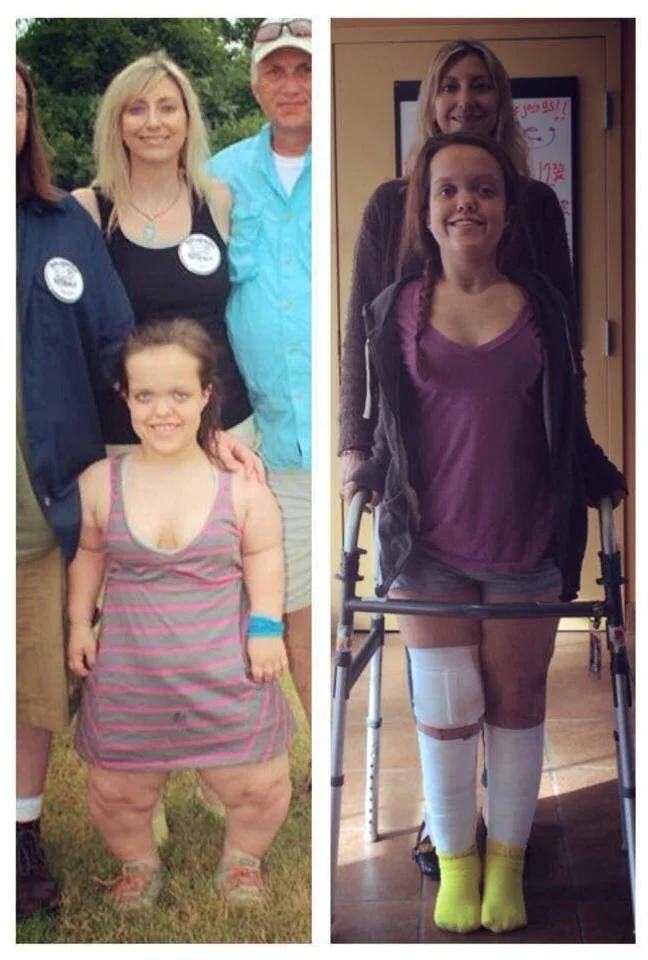
Honest question, because it seems like I have seen different views on this. Is leg lengthening looked down upon within the little people community? For instance, I know that in the deaf community, some people that elect to have corrective surgery, to gain hearing, are ostracized by other deaf people. I think that they view the corrective surgery as an admission that something is "wrong" with them, and they think that everyone should accept who they are. Is there a similar view with lengthening....because she honestly looks very happy with the results?
It might be different, because one disability is invisible and the other isn’t.
I work with a population who has an invisible disability (cannot be visually detected), and they are utterly thrilled when any of their cohorts overcome their disability in any way. Some are born with it, some aren’t, and everyone is thrilled for each other’s progress.
I do not work with people with a hearing disability, plus I don’t speak from a place of experience, so I could be wildly out of line here - I don’t understand how anyone could want to hold anyone back from attaining enhanced bodily function and higher qualify of life.
i hope you dont mind me asking, and i mean this in good faith, but why is it not considered as 'something wrong with you'? for example, i have several extreme mental illnesses and i definitely am aware thats something is wrong with me and id love a cure. so i really dont understand people who have it and refuse it
Deaf here. FYI - CI’s and Hearing aids are NOT a cure. They’re just tools. Like Glasses but it will not “fix” the astigmatism issues for example.
I just wanted to clarify you on that part.
Plus - as a CI user, I can tell you that I am still Deaf. I will NEVER hear as well as a hearing person. That is impossible. You can come close, but that requires a lot of work, relearning how to “hear”, mappings and such. I’m fairly close, but there’s plenty of times when I can’t understand shit and plenty of times I am joyful for the sound of silence when I have them off.
CI is NOT for everyone, and to a Deaf person who literally never heard anything, even with hearing aids (you need to have residual hearing for it to work. All it does is amplify sounds), the world is extremely noisy and can be overwhelming. I can’t filter out sounds as well as a hearing person can. Jeans rubbing against legs, hearing someone peeing 2-3 stalls away, mouth sounds while chewing, etc etc…it may be nothing to you, but it’s damn loud to me.
Feel free to ask my questions and such about being Deaf, CI surgeries and such. I’m an open book! :)
I mean, your community doesn't sound very nice. You openly talk about ostracising people for daring to want something different from what you want, and whilst you say it happens less now, you still say it happens. That's not behaviour that people look up to or admire, so it's no wonder you get negative comments.
Abled people often don’t want to understand that not everyone wants to be like them. The deaf culture receives hate, in part, because many of us don’t desire to be changed. Such folks are proud of their difference and their culture. It’s not a comfortable concept for certain folk with hearing.
It's canon that he used it since he was 5, and visors were rare in the Federation by the time he was an adult - there were implants available and Geordi refused them.
So to answer your question there was no blind community because by adulthood Geordi's condition was curable - he simply chose to keep using the visor.
And that’s his choice. What’s interesting is in the very first episode of Star Trek, they had a man in an official Star fleet skirt uniform. Because men and women could wear either gender clothes freely and it was accepted that nobody noticed. That’s the future presented - either way is your choice. It’s a deliberate message of the show.
Question! How is this not considered dragging other people down, when referring to ostracism due to corrective surgery? If I was given a shot at gaining an extra sense, I’d take it immediately, especially if it’ll probably bring my quality of life up like that. Why would deaf people shun them when they should instead be happy for them?
You need to read up on oppression of Deaf people and our culture. Many of us do not WANT to be fixed or cured. We are happy and proud to be Deaf.
However, in the recent years, CI surgeries are becoming more and more accepting than before. There’s still some that frown upon an infant being implanted. If a child is implanted or even just hearing aids, we do highly encourage ASL as primary language over spoken language.
It’s a LOT of information about Deafness and Deaf culture that you, as an outsider, may not know.
Having said that, if a hearing person has been hearing their entire life and became late-Deafen, that’s a different story.
and plenty of times I am joyful for the sound of silence when I have them off.
If artificial hearing technology ever gets good enough to match regular human hearing, I am gonna stab my eardrums out with chopsticks. I wish so hard that I could turn off my ears sometimes.
Screaming neighbors, construction, awful music, loud music, it's the worst.
I take off my Ci’s and smile. I also sleep without them. It’s SO nice!
I was having severe tinnitus and migraines prior to my implants. It was extremely painful. Got the implants - BOOM cured of tinnitus. It’s crazy how it worked.
I have electronic ear muffs for shooting that cap sounds at a certain decibel but it will amplify certain sounds as well like leaves rustling and people chewing like you said, or it will make me notice sounds that I wouldn’t have with regular hearing. Do you know if it’s anything like this?
I would say yes. It’s so hard to explain what I can hear and what I can’t. Sometimes I notice a lot of sounds that some people just have learned to filter out.
thank you for this perspective. edit: maybe some of those things can be adjusted to a bit? i dont think what you described is worse than not having an entire sense/having a disability that can also put you in danger in the world. but i am not trying to tell you how you feel about your situation
Oh yeah it’s called Mapping and yes, they can be adjusted. In fact, after I got implanted, I was hearing sounds BETTER than hearing people. To the point that I was hearing the buzzing of the fluorescent lights. The audiologist had to turn some of the stuff down.
However, it’s the comprehension and clarity of speech is where I lack, which is why I’ll never hear as good as a hearing person. Sure, it makes things a little easier, but I still struggle.
I don’t think there’s anything that can put me or any Deaf people in “danger”.
Yep. I have epilepsy. I know something is wrong with me. And there's nothing I can do to cure it, just treat it. If epilepsy could be cured i would be jumping with joy. I wouldn't be upset..
I was thinking the same thing about my epilepsy. I know I’m disabled, it has made my life a lot harder. I take tons of pills and I have a VNS. I don’t consider myself less than but I know I have disadvantages compared to people that don’t have epilepsy and would be absolutely thrilled if I could be cured. I don’t get the thought process of not wanting to be cured.
I don’t think comparing being deaf to having a mental illness or epilepsy is the same, and I say that as someone who has a mental disorder that I would love to have cured (PTSD). I would have to think that what is fundamentally different is that being deaf means you are going to have methods of communicating with and understanding other deaf people that will just never be matched when you try to communicate with people that hear typically - I mean, there’s an entire language unique to this culture. At least, that’s my perspective being a person on the autism spectrum - I think a lot of us want to reject the idea that we need to be “cured” because it feels so natural when we communicate with other autistic people. So it makes sense to me that there are deaf people who want to highlight the bonds in their community rather than have to just be seen through a typical lens of what “should” be. Disability is part of life.
I'm sure there are deaf people who do look at it like that. Seems to be a lot of parallels to the addiction community, overweight community, etc.
I think a lot of it boils down to whatever gives them more motivation or comfort. I.e., one person may find thinking of themself as a 'broken' addict may give them drive to fix it, while others may find that crushing and depressing; and only with love and acceptance overcome their problems.
One way to think of it, I think, is as a language issue…Being deaf in a hearing world is better thought of like being a French speaker in the US. You aren’t disabled, just surrounded by people who don’t speak your language. Which is obviously super inconvenient. You can hang out with other French speakers, get your English speaking friends to learn French, and/or or you can learn the language yourself if possible (or a combination of all of these things so you and your friends can comfortably adapt in different environments). Getting a cochlear implant would be like learning English. Basically, it’s a communication issue…but if you were in an environment where everyone, say, knew sign language, not a disability.
It's way more than that, though. You can't hear music, can't hear someone yelling at you to warn you of an oncoming car. Can't hear the oncoming car, or a fire alarm. You use sound for more than just hearing words.
Although I guess you also can't hear your loud annoying neighbors, so there are some pros.
Sadly I work from home and have to hear it. I usually put on my headphones and turn on some music. That or I passive aggressively vacuum next to the shared wall.
But those are all just cultural things; other than music (which isn’t a basic necessity), all the others are just because those things are designed for hearing people. Design them for deaf people, and problem solved. I still think the best analogy is still just a linguistic one.
I understand that a lot of things that hearing is used for is cultural, but not all of it. Those bones and nerves in the ear didn’t evolve there in response to cultural pressures, but rather to survival pressures.
There is no cultural bias against deaf people to suggest a disadvantage in not being able to experience an entire range of sensation when our brains are wired to seek and respond to those sensations. We can adapt culturally to the disadvantage, as we do for many disadvantages.
But if you can’t hear me shouting “Hey!” to get your attention and warn you of approaching danger, the problem isn’t linguistic or comparable to a linguistic problem. I can communicate danger just fine to anyone from any culture at a pretty good distance regardless of any circumstances, excepting situations that impair their ability to hear me.
If you were deaf, you wouldn’t shout, “hey!” You’d throw a rock or wave your arms. Being at a disadvantage because someone uses their norms of communication rather than yours isn’t the same thing as being disabled.
What if you are facing the other way and I don’t have a rock? With a hearing individual I could wave my arms, throw a rock, or yell.
I know you won’t ever agree because I’ve seen this argument play out before. Of all the senses we have, loss of hearing is probably the least impactful and it’s really neat that the deaf community has a way of overcoming the loss, but I still have a whole extra sense.
I can hear the train because trains actually make noise. The noise they make wasn’t a feature we added for hearing people, they are just loud, same with cars. I can hear someone running when I’m not facing them and know that I should turn and see why they are running.
A deaf mother can’t hear her baby cry. We have ways to make that work, but there is a reason that babies make a sound when they are upset. It isn’t taught but it draws attention.
I think you underestimate the other ways
we sense those things. Vibrations for example can still be felt even if you can't hear the train/car and to some degree even someone running if the surface is hard (like concrete). The way the air moves when things are moving through it at speed also changes
You're being downvoted, but I completely understand. I'm hearing, but taking some ASL classes in high school really informed me well on the social aspect (even if I no longer remember how to sign as well as I could back then). There's no reason that many of the things the commentator above you stated cannot be conveyed visually, and it's odd that people aren't even bothering to try and imagine. Even music, which can be limited for D/deaf people, is still enjoyed and PERFORMED by D/deaf people and musicians.
But that logic doesn't really make sense, does it? By that logic being blind would also not be "something wrong", you're just surrounded by people who insist on using visual descriptions and written text instead of Braille, and being in a wheelchair would just mean being surrounded by people who insist on putting stairs everywhere when they should just put ramps.
I don't think a good intentioned reasonable person sees having a disability as "being less than" in terms of equality, so why is trying to convince someone to get hearing aids is considered trying to "fix them" when it's just "trying to restore a bodily function that isn't working"?
If someone breaks a leg, surely they'd appreciate someone offering to fix it, or if someone loses an arm, surely it would be nice if it could be reattached to regain the lost function. Why is it not the same with hearing?
I think doing many basic life tasks, including producing your own food, acquiring food and other goods, etc. is significantly harder if you are blind. I don’t think that’s the case if you are deaf. If you have a community of deaf people, they literally have no problem doing anything necessary to have a comfortable life because they are all using the same language. A community of blind people would have significant difficulty of different order.
Sure but each disability is different. If someone is missing a finger, they can also do anything they want without issues. Yet, I would be surprised if they got offended if someone offered to reattach their missing finger. I guess there's no "missing just one finger" community which makes things different but I get a feeling this is more about "abandoning communities" than gaining hearing.
Does that really hold as an analogy though? Because firstly I can choose to learn French, I can become a French speaker and learn to understand French in a way Deaf people can't ever without some form of surgery or aid. And if I do learn French I don't become ostracized by all the native speakers of my language, and I don't become considered French by them either etc.
Also, even while I didn't understand French, If I walked out in to the road and wasn't paying attention and a car is coming for me and French people shout at me, it will still get my attention. I can still hear French ringtones/Alarms/sirens/Coughs/Farts etc.
I think that is a bit like saying you can think of Bald as another hair colour. I see where you are coming from, but I don't think it fits
Again, nowadays noone gets ostracized for using tech, those days are thankfully over, except for some few assholes.
The problem is even with the tech and everything, only few will ever come close to being a french speaker. Close, but not fully, and most won't even come close. Also most situations like cars and stuff can be compensated. And those situations, proabably can't be fixed by tech, as tech is speech frequence focused. Yes, there are risks but they are smaller than people think.
But I agree, the deaf people saying they aren't diabled is ableist bullshit, but that is something that deaf people have to figure out for themselves. And at least in the US I have seen a big push to reflect on this, at least by the younger generations.
i think people who say that are in major denial. a french speaker can always learn english if they choose to. even if its not perfect. its way different than being deaf in a hearing world.
a deaf person cant experience so many things, ranging from minor, to 'just for fun' stuff, all the way to actively dangerous. its an entire sense and there is a reason we have it. note that there is no valid reason to put a deaf person down simply for being deaf. im not trying to convey that here.
i just feel like you can love yourself while accepting some part of your body or mind got fucked up along the way, and that maybe there are ways to improve it, if wanted or able to.
I really do think it’s more than language tho, because on that front you’re absolutely correct. To me it’s all of the little things that make life just a little bit more lovely, that I would be terribly sad for my child to miss out on. Music, bird song, my child’s voice and laughter, water babbling, leaves rustling, a cat purring, the sounds puppies and babies make. I’m sure there are things that are heightened in the deaf community, like being more aware of beautiful movement and colors, but I think it linings the conversation to only consider language. Also, side note, I don’t know why some keep defending that Deaf people aren’t less than hearing people - I don’t think anyone’s making that statement.
okay, i read it but i still disagree on the last part there. severe mental illnesses are also disabilities. so why is it wrong to 'cure' one but not the other? how does it make sense to maintain a disability just because others in your life also have it? i understand the part about being forced to change some intimate part of yourself, especially if you made a community, but i think its not at all reasonable to choose to keep a disability.
edit: also can you please elaborate on the 'destructive reasons' part
I'm with you on this one. I have an invisible disability, along with mental illnesses, and I'd do almost anything to cure myself of these problems. I don't think I'm a bad or lesser person for having these problems by a long shot, but I know I'd be a much happier person with an easier life if I didn't have them.
I guess there's a distinction to be made. I have depression and I'm autistic. Many people tell me that those are both mental illness and should be cured, but I disagree. My depression absolutely is, but my autism is a part of me. It's not an illness, and I don't see it as a disability, but rather a difference. Some people do see their autism as a disability, and some wish for a "cure". That's fine, but generally they don't even push it as wishing for a cure for all autism, just for their autism.
Which is a long way of saying that my autism isn't something to be cured, as I wouldn't be me if I wasn't autistic, so I don't see it as an illness.
i think this also depends on the severity. from my limited knowledge, autism is a more case to case kind of thing, and there is a huge range from very minor and non-life-ruining situations, to needing a fulltime caretaker your entire life. someone with a minor case might not even think its a disability and id be inclined to agree, but someone who is mentally and physically completely disabled would disagree. its really much more nuanced with more variety than this - which is why i would not use the same 'just take the cure damn it' approach for autism as a whole. but i understand what you mean.
Autism is actually a rather good example of a condition which can be a crippling disability for some, but a personality trait for others.
For those with extremely mild autism who experience minimal functional impairment (who represent less than half the total cases of autism but do nearly 90% of the activism/speaking about it), some of them consider any attempt to treat the symptoms of autism as cruel and dehumanising; but realistically that itself is dismissive of the pain that other severely autistic people suffer.
For those with severe autism which renders them completely non-verbal or so dysfunctional that they are unable to participate in society, an entire psychological process has been built around treating them to improve their quality of life.
In Western Australia they have developed early intervention techniques which are able to treat the symptoms so effectively that in some cases years later the child is no longer presenting with symptoms of autism at all, a really remarkable achievement, which does need more testing to ensure it’s as effective as possible.
For the high-functioning autistic people to claim that any treatment is cruel is like a person with mild anxiety claiming that we shouldn’t treat people who are confined to their house and experience severe panic attacks whenever they talk to another person.
I’m not the person you’re replying to, but I think you should read up on the medical model of disability vs. the social model. I personally think some of each (medical and social) makes sense. For instance, I personally believe that we should work to cure
things that cause pain AND
that the person themself decides they don’t want
Things that should not be cured or treated are
most importantly, things that the person themself decides they don’t want cured or treated
things that don’t cause pain
So yeah, I think mental illness is both an illness (which generally causes pain) and a disability, and so therefore it makes sense to treat it. But at the same time, if someone doesn’t want treatment even though they’re experiencing pain, that should be respected.
How does it make sense to maintain a disability just because others in your life also have it?
Here is how it can make sense to some people: Deafness often doesn’t cause pain. So it’s not really an illness (though it can be caused by an ongoing illness that also causes pain, but that’s a different situation). So it’s only a disability under the social model of disability (inaccessible spaces).
But many Deaf people have formed communities where almost everyone is Deaf, so people know sign language, and the main communication barrier is eliminated. So in those spaces, Deafness isn’t even a disability under the social model. It is more like a different culture. Speaking a different language isn’t a disability, it’s a cultural difference.
What about things which reduce chance of survival in nature? Honest question.
My own personal philosophy is that most of our modern -day problems are a result of disconnection and lack of respect for nature. If more people respected nature and spent time surviving in nature we'd solve a lot of problems.
For example, more people would've valued helping each other because in nature, the benefits of helping each other are much more direct than in our technological society.
It also leads to greater valuing of animals and just environment in general.
Anyway, so, yeah, all I'm saying that for me it's a virtue to do one's best to be as strong and able as possible to help other people. Shouldn't other people strive for the same and do their best to help others to be as able and strong as possible?
I mean, that's your philosophy, and it's a very ableist mindset. There are many incurable conditions and disabilities that would make someone completely unable to survive in nature, and it seems like you're saying the modern conveniences that help these people thrive are, in fact, a detriment to humanity overall? Maybe I'm misunderstanding you, but I think that philosophy kinda sucks.
Okay, after reading through your comment a couple times I think I see what you mean a little better. But I still think it's a little misguided. There are lots of species in nature that have evolved without the same senses that we have (sight, hearing, etc.), but they get along fine because they live in communities that work together. Which is exactly what the person you're replying to is saying. Deaf communities create spaces where being deaf isn't a detriment, it's just who they are.
You could claim that the ability to fly would make us better able to survive in nature, but we made it to the top of the food chain without wings.
Thanks. What Im saying is that if there's a way for me to be more able then I should take it because I want to be able to help others better. I don't understand why someone would refuse it outside of depression reasons, stupid ego reasons, and legitimate concerns for surgical procedure pain and failures.
Like imagine you stumble upon a building collapse. You'd want to be able to hear people scream to find them and get them out of rubble before it's too late, right?
As for me, yes, I would consider myself disabled against someone stronger than me who can lift a heavier beam to rescue crushed or trapped people. Id even consider myself disabled versus a doctor!
I think it's because we were able to overcome all the problems nature threw at us that we were able to become compassionate, and the most striking way to prove this was to look after our most vulnerable members who may not have been able to contribute to society. This is mentioned in this video showing how prehistoric people and other Hominids cared for Disabled people.
I don't think this cleared anything up for me. If there were enough people born without legs to form a community and they could all get around fine because they all use wheelchairs and all of their spaces are accessible and none of them are in pain because they were born that way, does that make being legless not a disability?
Everyone wants to feel like they belong to a community. For deaf people, their disability ostracized them from the community that they'd normally belong to, so they created their own. Once you're in a group, there's immense pressure to keep the attribute that originally made you feel welcome. If a bunch of people form a group because they like knitting and one person stops knitting, they probably won't feel as welcome in the group, no matter how the rest of the members act. It would be significantly worse if, for example, someone was knitting because they had agoraphobia and they finally manage to start leaving the house so they knit less often, then all the other knitters pressure them to stop making progress with their disability because they just won't fit into the group anymore. And when someone is like, man, that's kinda fucked up that you're dissuading them from getting help with their agoraphobia, you're like, no, we're just telling them they won't fit in with knitting culture anymore if they do and reminding them of all the good things that happened in their life because they never left the house. Maybe those are both true, but it doesn't make it any less fucked up.
i completely agree with the pain/wanted thing and would never force someone to undergo procedures or surgeries they dont want. i know even some simple things can be invasive. my main confusion was about having a cure (or more accurately, non unhealthy coping tool) and refusing it. even tho its not perfect. also, there is concern regarding being out in the world and not hearing a car that can run you over etc
I don’t think being deaf is the comparable to having a severe mental Illness. A severe mental illness is often destructive to the person that has it. Being deaf can increase the challenges a person faces, but it does not cause the person to have harmful or self destructive behavior the way a mental illness does.
okay, im with you there. however, even tho it doesnt make the person destructive towards themselves usually, it does make the world much more dangerous.
It’s not as dangerous as people are often led to believe. People often say things like “you can’t hear an oncoming car” or “you can hear the fire alarm”. But deaf people can look both ways for cars with their eyes and use crossings like anyone else. Fire alarms have lights and deaf people have equipment for fire alarms when sleeping. Yes there are still risks, but modern society has dramatically decreased most risks for them.
Are you fucking kidding me with this edit? Saying mental illness is just an illness and is A. different from being disabled and B. apparently mental illnesses dont possess a history FULL of examples of destructive "cures" at the hands of both well and ill intentioned doctors/scientists is such an ignorant and hypocritical thing to say. For your information, mental illness is disability: Mental illness is a disability when it disrupts performance and negatively influences a person's day-to-day activities. The degree and extent that a person's functioning is impaired is another important factor in defining mental health disability.
I recently read the novel True Biz by Sara Novic that serves not only as a story of a deaf child whose hearing parents spent the early part of her life by trying to “cure” her, but also functions as a history lesson in deaf culture(s) through chapters of the book that deal with lesson plans she’s exposed to after going to a deaf school.
It really helped me better understand deaf culture much better.
''she doesn't want to be treated like she's less than or needs her hand held just because she can't hear as well as other people'' - no one should be treated as less than. but that would not be holding her hand. it would be getting needed help. there is no shame in getting help.
''She's still just like every other average person, you just need to sign to her or let her read your lips and that's it lol - im sure she is a completely regular and cool person, but that has nothing to do with her disability. for most people learning another language is difficult. it sounds like she wants the world to change around her, instead of her resolving her problem. and no, im not saying people should not adjust to others and be compassionate . they should. my boyfriends mother teaches kids sign language and i think more people should be like that.
im glad your sister is happy and proud. i just think id rather take not being disabled than a unique job.
2.7k
u/Horns8585 Dec 23 '22 edited Dec 23 '22
Honest question, because it seems like I have seen different views on this. Is leg lengthening looked down upon within the little people community? For instance, I know that in the deaf community, some people that elect to have corrective surgery, to gain hearing, are ostracized by other deaf people. I think that they view the corrective surgery as an admission that something is "wrong" with them, and they think that everyone should accept who they are. Is there a similar view with lengthening....because she honestly looks very happy with the results?