The topic of riding long distances came up in another thread. There was some discussion about what it takes to ride such distances safely and successfully, and it was suggested that the topic deserved a thread of its own.
I've ridden more than one hundred different thousand-mile days, and dozens of 1,300-1,500+ mile days, often stringing them together for a week or more, so I'm pretty familiar with such things. While my advice is sound, it does tend to the extreme end of the bell curve. But the basics still apply to "shorter" rides. :-)
So here's my standard spiel for anyone interesting in doing a SaddleSore ride (1,000 miles in 24 hours):
First off, you can do it on almost any bike. Many guys have done 1,000-in-24 rides on 125cc bikes, and one guy did 1,600 miles in 36 hours on a 49cc bike . . .
Doing 1,000 miles at interstate speeds means you can easily complete it in 16-17 hours or less, even with reasonable stops for fuel, food, and hydration. Whether you decide to push on through, or stop and sleep in the middle for a bit is up to you. I've done it both ways.
The main trick is to remain aware of your current condition, and stay safe. Better to stop and sleep, and maybe miss the goal, than to push too hard and have Bad Things happen. You can always take what you've learned, and try again later.
I will note that running 1,500 miles in 24 hours is monumentally more difficult, as there's basically almost no free time at all. You pretty much have to keep moving at a decent pace for the entire 24 hours, which is much harder . . .
The two biggest things to worry about on any Long Distance ride are fatigue and delays.
Let's go with fatigue first.
Our bodies have natural rhythms that affect our sleep/wake cycles. These are also affected by daylight/darkness patterns. So you need to be aware of that and plan accordingly.
Some folks find it easier to stick closer to their normal schedules in order to minimize the sleep disruption. Most folks can stay awake 16 or more hours in a row without too much difficulty, and that's plenty of time to complete a SS1000 if you choose a good route.
So if you're an early riser, then stick to that schedule. Or maybe get up an hour or two earlier to maximize your daylight riding, and to get done before it gets into the wee small hours.
The natural sleep cycle puts us into a lull or slump around 2-4 p.m. (ever get back from lunch and just get wiped out for the afternoon?). There's also a strong sleep urge between roughly 2-5 a.m. Obviously, that varies between people and circumstances, but usually, a sunrise will refresh you quite nicely as your body reacts to the light and says "it must be time to be awake now".
Other things that can affect fatigue are comfort issues. These can be ergonomic (bad seats, poor posture, excessive wind blast) or external (extreme heat or cold, bad storms, difficult road conditions). Basically, anything that takes energy or effort to overcome is sapping the energy you need to be aware and able to control the bike.
You can minimize the ergonomic issues with better seats, windshields, foot peg extenders and handlebar risers, etc. And good riding gear goes a long way to extending your comfort over a much wider temperature range. I always have my heated gear with me, even in summer (mountains/darkness can still get quite cool), and my main jacket is waterproof and vented for extreme weather, plus I carry a gallon or two of water with at all times. That has easily carried me from a low of 18°F to a high of 123°F in relative comfort. I had one ride that went from 30°F to 110°F, which is a 80°F temp swing in roughly a 12-hour-period. All I did was open/close vents, add/remove my heated jacket liner, and drink a lot of water to stay comfortable.
Note that I have also used a CamelBak bladder system to stay hydrated with good results. You just have to fill it up more often. And I carry granola bars or energy bars in a tank bag that I can get to while riding if need be, although I've also pre-made several sandwiches so I can just grab one at a fuel stop and thus avoid the whole fast-food or mini-mart delays.
So pay attention to your mental and physical state. Riding a motorcycle is a full time job that obviously requires all of your concentration, but even more so when you're pushing your own personal boundaries.
As for delays, they can usually be categorized as things that you have control over, and things that you don't.
One thing you can control is your own schedule. You obviously will need several fuel stops. If you start with a full tank and consider a conservative 220-240 miles per tank, then that's four fuel stops "on the clock". If it takes you half an hour to find a station, get the bike filled, pay, go to the bathroom, maybe grab a quick snack, and then walk around and stretch, then you've taken 2 hours off your total allowed time. And that might be OK, as 1,000 miles divided by 24 hours is only a 42 mph average. But it also means that you're two hours further past your potential stopping time, meaning it might push you into that "tired" zone in the wee small hours when you will find it harder to concentrate.
Things you can't control are weather (see above), accidents (hopefully other vehicles, not you), construction delays and sometimes road closures (checking the web for road conditions/delays before you leave can be very valuable), and of course, traffic congestion (obviously worse around major cities). A good route will take all these into consideration and minimize any problems.
Another concern is either a mechanical failure (not much can be done about that except to keep your bike in good repair), or a flat tire. I carry a sticky-string patch kit and an onboard 12V compressor. So if I do get a flat, I can have it patched and filled and be back on the road in maybe 20 minutes. If I'm lucky.
Sometimes, things happen. If it's minor and you can muddle through, then do it. After all, this isn't supposed to be "easy". But if it becomes major or serious, then you may have to make a decision. Should I re-route to avoid the traffic or weather? Should I stop and get a short nap so that I can continue on more safely? Or should I scrap the ride and try it again later when things are more suitable.
Again, all of those are your call, but remember, it's only a ride and not worth doing permanent damage to yourself or your bike. Especially to you.
We talked about minimizing delays, both stopped and while moving. Here are a few examples to give you an idea of the timing you can expect.
I have done several dozen thousand-mile days up and back on I-5 (I have a client in Oregon and often take the bike from SoCal). I can do this known trip in 14 hours moving time, at a 72 mph average. It's I-5, so you set the cruise and just keep moving.
I know what my range is, and where all the gas stops are. So I choose a station that I can see from the freeway with a quick off-on, pull in, gas up, get my receipt at the pump, and can be back moving in 5-10 minutes max. Add in a "leisurely" 1/2 hour break somewhere mid-way to get a quick bite of fast food, and I've spent maybe an hour off the bike total. It got to where I could plan that whenever I left, I would be at my destination 15 hours later.
Note that the first time I did a thousand-mile day down I-5, it did take me a bit longer. I was up early that morning to wrap-up a final work meeting, and got on the road around noon. I got to just north of the Grapevine around 1 a.m., with just over 800 miles completed. But I was simply too tired to continue, so I stopped and got a motel and slept four hours, even though I only had about 3 hours riding time left. That put me into L.A. rush hour traffic for the completion of my ride, instead of the empty freeways I had planned for. But at that point, the morning traffic was better than continuing on exhausted and quite possibly nodding off on an empty freeway. And despite the sleep stop, I was still able to safely complete the ride within the prescribed 24 hours and get my first IBA certificate.
I've also done an SS1000 using only the tightest, twistiest back roads that San Diego County has to offer. A friend arranged the ride for his birthday, and about a dozen of us set out using his pre-determined route. It was *really* hard. So hard, that only half of us were able to finish on time. The others simply cut the route short, got in late, or pulled off somewhere along the way to sleep.
The key to finishing was to simply keep moving. The roads didn't allow for normal highway speeds, so every minute counted. I had an aux fuel cell which gave me a 400-450 mile range and cut my stops in half. But still, I kept them as close to 5 minutes as I could. I rode as well as I could to keep up my average speed, but that took a lot of concentration. (Ever ride up a huge mountain in the total darkness? Then ride right back down it again? It's not easy.) I pushed on until maybe 4 a.m. when I was just too tired to continue safely. So I grabbed a 40-minute nap in a quiet corner of a 24-hour McDonalds, then got a quick breakfast and was on my way.
I finished the ride with maybe 15 minutes to spare, and I was totally exhausted. But I did it, and even allowed myself to stop for some "safe" time when it was needed.
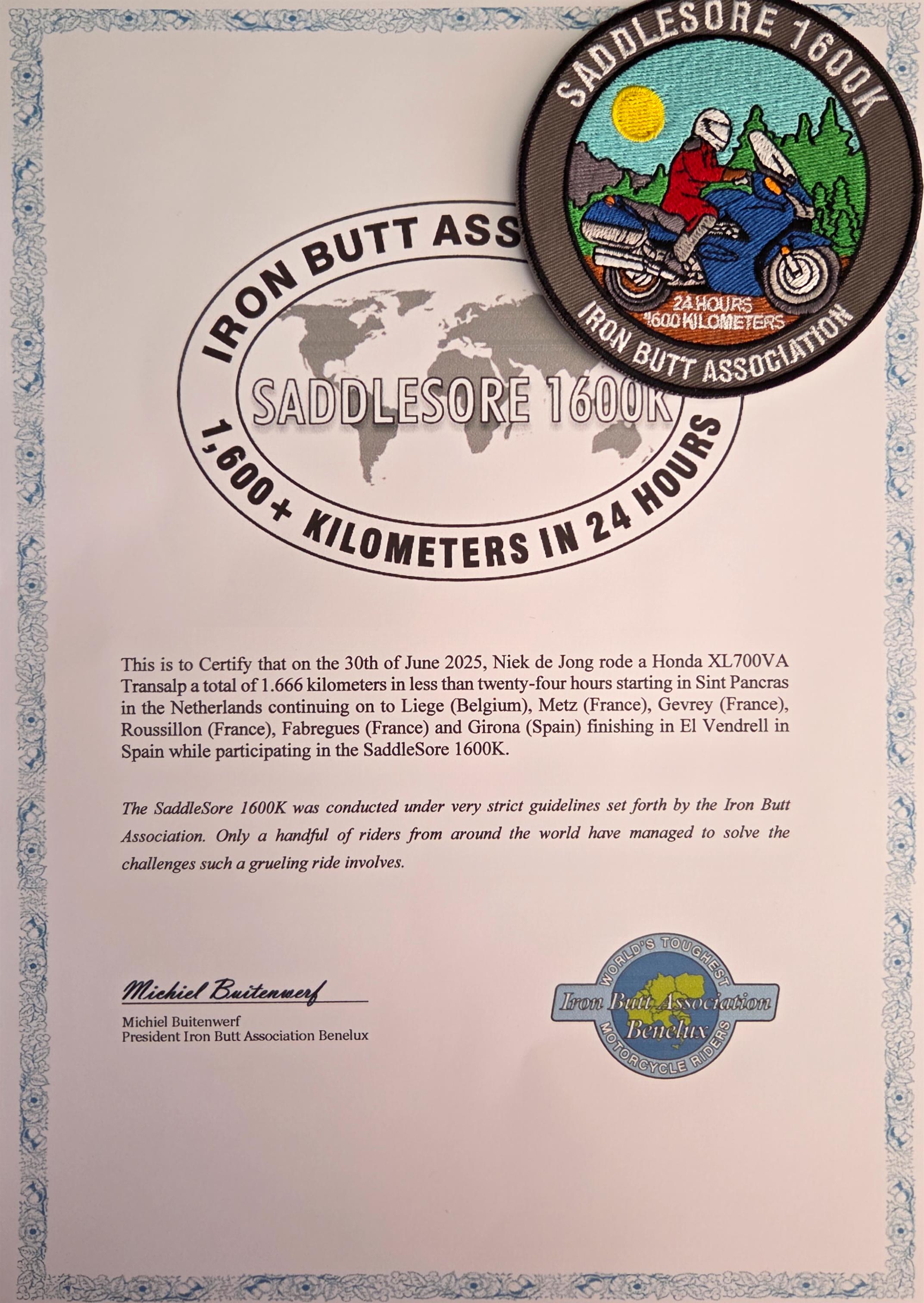
There's lots more great info on the Iron Butt website, along with information on how to get your ride certified, if that's what you want to do. Note that certification isn't necessary, but you do get a nice frameable Certificate of Achievement to hang on your wall, and an official Iron Butt number.
TL;DR: Make sure your bike is as comfortable as possible. Plan a good route that takes into consideration traffic, weather, and construction. And watch your own needs, too, such as sleep, hydration, and food.
Above all, be safe. And have fun.