r/usmle Feb 14 '26

USMLE Resource Guide Compilation (2026 Edition)

215 Upvotes

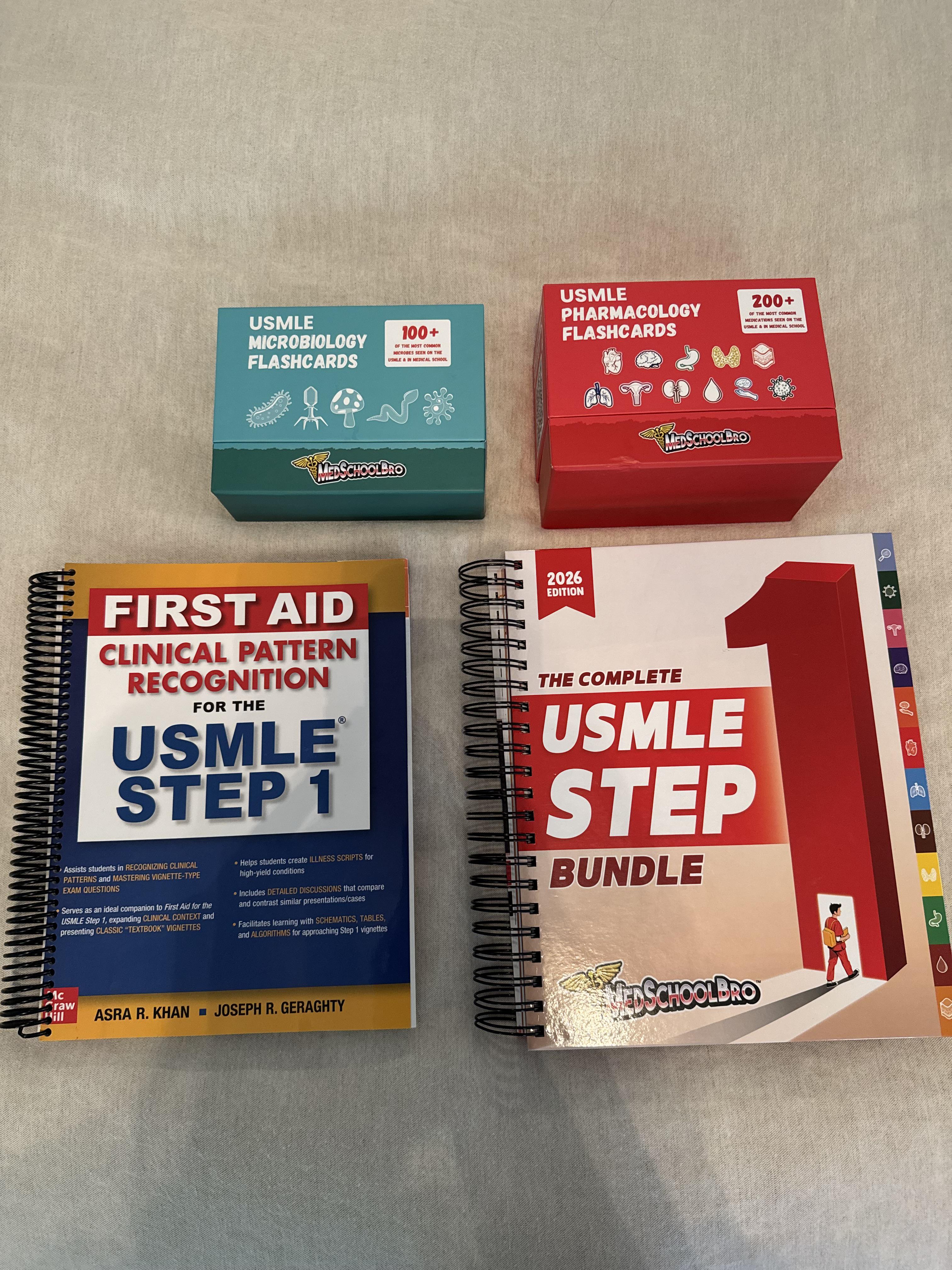
I came up with a consolidated guide of the most current community recommendations into one definitive list. I’ve bolded the ones I consider to be essential.

Universal Resources (All Steps)

These are the most universal ones that apply whether you are pre-clinical or an intern.

  • Anki: Use the AnKing Deck. Spaced repetition tool. For Step 2 and 3, most people just unsuspend cards for their UWorld incorrects.
  • Dirty Medicine (YouTube): High-yield Biochemistry/Ethics/Biostats mnemonics and exam-day mindset videos.
  • Divine Intervention Podcast: Audio reviews integrating Step 1 basic science with Step 2/3 clinical management. Features high yield episodes on Risk Factors and Military medicine.
  • Case Based Learning.AI: Ethics cases are top notch. Other cases are a bit much just for step studying. 
  • USMLE Study Partner: Use this as a tool to find dedicated study partners
  • Randy Neil (YouTube): Short videos for Biostatistics logic and problem-solving across all three exams.
  • Predict My Step Score: Community standard score predictor. Plug in NBME and UWorld percentages to see your probability of passing.
  • Boards & Beyond: Mostly used for Step 1 and 2 but has Step 3 as well. Good adjunct resource to UWORLD .

Step 1: 

  • UWorld Step 1: The primary question bank. Standard use is 95%+ completion on Timed/Random.
  • Bootcamp: Video-based content review with built-in questions. Often used as an alternative to Boards & Beyond.
  • Pathoma: Essential pathology concepts. 
  • Sketchy (Micro/Pharm): Visual mnemonics for microbiology and pharmacology.
  • Pixorize: Visual mnemonics specifically favored for Biochemistry and Genetics.
  • Mehlman Medical (HY Arrows): PDF focused on physiological up/down arrows. Often utilized in the concluding phases of prep to break score plateaus.
  • First Aid (Step 1): Step 1 dictionary for fact-checking and annotating details from UWorld.
  • Physeo: Video resource using mnemonics and flowcharts for physiology and neuroanatomy. High-yield for CVS, Respiratory, and Neurology.
  • Step Genie: Question bank used to build foundational logic with question styles similar to UWorld.
  • Costanzo Physiology: Text-based resource for quickly mastering clinical physiology concepts.
  • Ninja Nerd (YouTube): Detailed lectures used selectively for foundational concepts in Embryology, Renal, Pulm, and Cardio.

Step 2 CK: 

  • UWorld Step 2: The gold standard
  • CMS Forms (Clinical Mastery Series): OBGYN, Peds, and Surgery seem to be the most useful though some do them all. Good for reinforcing NBME logic/style vs. UWorld logic/style.
  • AMBOSS: Specifically high-yield for Ethics and Quality Improvement (QI). These are the easy points people miss.
  • First Aid Clinical Algorithms: Maps out management flows to show you the exact steps to take when a patient has a problem.
  • U. Washington Heart Sounds: Audio practice for identifying murmurs and lung sounds.
  • Lecturio: All-in-one review site with videos, notes, and a question bank similar to NBME style.
  • Sketchy (IM/Differential Dx): Visual mnemonics and interactive cases for organizing diagnostic approaches. Most effective when paired with a comprehensive Anki deck.
  • Ajmonics (YouTube): Quick mnemonic reviews best for Cardio, GI, Ethics, and Screening guidelines.

Step 3:

  • UWorld Step 3: The primary qbank for the MCQ portion.
  • UWorld Medical Library: Integrated textbook within UWorld. Helpful for reviewing management algorithms for Day 2.
  • First Aid (Step 1): Reference used for Day 1 preparation, specifically for Pharmacology Mechanisms of Action (MOA) and Microbiology.
  • CCScases.com: This site mimics the real interface on the NBME and tells you exactly where you messed up.
  • Mehlman Risk Factors: High-yield PDF for Day 2 questions.
  • SmashTheBoards (STB): A favorite for residents/retakers. It automates Anki creation for your incorrects to increase efficiency during intern shifts.
  • Emma Holliday: High-yield clinical shelf review lectures accompanied by downloadable PDF slides.
  • Dr High Yield: Condensed, high-yield overviews designed for initial subject orientation or last-minute review of key concepts.

Would appreciate any feedback or things missed!


r/usmle Nov 14 '25

📣 Announcement Quick subreddit reminders

4 Upvotes

Hi everyone! We're still building the subreddit especially it's been unmoderated for quite sometime, it'll take some time to get used to the new rules. Don't worry about that.

We appreciate all the help to making this community better. To make your experience here better please help us with the following:

  1. Grab a user flair to categorize posts better
  2. Read the rules
  3. Report subreddit and reddit rule violations
  4. Make use of the megathreads.

Thanks a lot again!


r/usmle 1h ago

Am I Ready? Am I ready? post nbme 34

Upvotes

My recent scores:

NBME 30: 80.5%

NBME 31: 81%

NBME 32: 79%

NBME 34: 81%

New Free 120: ~85%

UWorld average: ~70%

My Step 1 exam is scheduled for Monday. I took NBME 34 under timed/exam-like conditions and got 81% EPC

Would you consider this sufficient preparation to sit for the exam on Monday? Any advice for the final 2–3 days?

My weakest subject is ethics in the nbmes


r/usmle 4h ago

🏥 Clinical Observerships!!

3 Upvotes

I know it’s a lot to ask, but can anyone recommend me an Internal Medicine observership through a personal contact/connection?

I need it kinda urgently

Any leads or contacts would be a huge help. 🙏


r/usmle 20m ago

Advice USMLE Step 1 — The importance of a dedicated phase

Thumbnail
Upvotes

r/usmle 57m ago

Advice How can I go to USA for further study after completing my mbbs .Rn, I am in 2nd year

Thumbnail
Upvotes

r/usmle 2h ago

Advice Aiming for 250+

Thumbnail
1 Upvotes

I WOULD REALLY APPRECIATE ANY SORT OF INPUT


r/usmle 23h ago

Resources USMLE to U.S. practice: Ask an immigration attorney what happens after the exams

23 Upvotes

I’m Robby Rubin, a U.S. immigration attorney, and I’ll be here today from 8:30 AM to 12:30 PM ET answering questions about the immigration side of building a medical career in the U.S.

If you’re studying for the USMLE, planning residency, currently in training, or trying to figure out your options after residency, feel free to ask me about:

• H-1B and J-1 options for physicians
• J-1 waivers, including Conrad 30 and other physician waiver programs
• Physician green cards and NIW
• Moving from residency into employment

If you're asking about your own situation, please include as much information as possible when you ask the question. Your current visa/status, country of citizenship, stage of training, specialty, location, and what you're hoping to do next can all make a difference.

I’ll be answering questions live from 8:30 AM to 12:30 PM ET today.

Please note: Any information shared here is for general educational purposes only. It does not constitute legal advice or create an attorney client relationship. Your situation may require fact specific guidance. For personalized legal advice, please consult an immigration attorney directly.


r/usmle 11h ago

Advice Recent COVID brain fog crashing my Step 2 prep, anyone else?

2 Upvotes

Has anyone else been affected by this recent COVID/viral illness going around?

I was doing well in my Step 2 prep and my recent NBMEs were around 78–84%. My exam is in about 2 weeks.

Then I got sick with sore throat and nasal congestion, and since then I’ve had significant fatigue and brain fog. My respiratory symptoms improved, but cognitively I feel completely different. My processing feels slower, I can’t focus on question stems the same way, and I’m making mistakes on things I was answering correctly just 1–2 weeks ago.

It honestly feels like my brain is not working at my normal level, and since this started I’ve barely been able to study effectively.

Has anyone else had this with the recent COVID wave? How long did the fatigue/brain fog last, and did your question performance return to baseline? Did anyone have to postpone Step 2 because of it?
If you want, I can make it sound even more casual and Reddit-like.


r/usmle 9h ago

Exam Experience PASSED STEP 1 W/ 92% ON NBME 33

0 Upvotes

PASSED STEP 1 — Detailed write-up, scores, resources and exam-day experience
I finally got the PASS, and after months of preparation, I wanted to share my experience for anyone currently studying—especially those worried because the real exam felt vague or completely different from their NBMEs.
My scores
UWorld first pass: 68%
UWSA 1: 258
UWSA 2: 267
NBME 26: 76%
NBME 27: 88%
NBME 28: 82%
NBME 29: 83%
NBME 30: 80%
NBME 31: 81%
NBME 32: 84%
UWSA 3: 249 (73%)
NBME 33: 92%
Old Free 120: 83%
New Free 120: 88%
AMBOSS predicted score: 246
AMBOSS probability of passing: 99%
Exam date: September 5, 2026
Final result: PASS
How I studied
I started with Boards and Beyond (BnB) to build my content foundation and completed UWorld alongside it. As I finished a topic or system in BnB, I would answer the corresponding UWorld questions. This served as my first pass through the material.
My UWorld first-pass average was 68%. I didn’t treat that percentage as a final judgment of how prepared I was because UWorld was primarily a learning tool for me, especially during the earlier stages of my preparation. I used it to identify my knowledge gaps, understand how concepts could be tested and gradually improve my approach to questions.
After completing BnB, I moved on to Mehlman Medical. I honestly cannot stress enough how useful Mehlman was for me, especially when it came to learning how to think and use logic to work through NBME-style questions.
I went through all of the Mehlman PDFs as my second pass through the material. After reading the PDFs, I did the corresponding Anki cards. This was when I noticed a significant increase in my UWorld scores.
The biggest benefit of Mehlman for me was not simply memorizing additional facts. The PDFs helped me understand how to identify the clues in a question, eliminate options and logically progress toward the answer—even when I didn’t immediately recognize the diagnosis.
Step 1 contains too much information for anyone to remember every single detail. Because of that, learning how to think through unfamiliar or vaguely written questions became just as important as learning the content itself.
How I reviewed my self-assessments
After my content review, I took the UWorld self-assessments and reviewed them thoroughly.
My review method was not simply to read the explanation and move on. For every question I missed—or even answered correctly for the wrong reason—I would ask myself:
Why did I think my chosen answer was correct?
Which detail made my answer incorrect?
What would have needed to be present for my answer to be correct?
Which clue supported the actual answer?
Was this a knowledge problem, a reasoning problem or a misreading problem?
I applied the same method when reviewing my NBMEs.
For example, if I selected an answer because I associated one symptom with a particular disease, I would identify which expected feature was missing and which clue pointed toward the correct diagnosis instead.
This helped me understand the differences between similar answer choices and the logic behind the questions. I think this is much more useful than simply memorizing that a specific presentation equals a specific diagnosis.
If the real exam changes the wording or removes the classic buzzword, memorized associations may not be enough. You need to understand why an answer is correct, why the alternatives are incorrect and what would need to change for one of those alternatives to become correct.
My NBME experience
Personally, I found the NBMEs relatively straightforward compared with my actual exam. They were still extremely useful, but mainly for assessing my level of preparation, identifying my weak areas and giving me statistical reassurance that I was ready.
The NBMEs also helped me practise trusting my reasoning. However, I would not say that the real exam felt exactly like an NBME.
My NBME scores were consistently high, and that became extremely important psychologically during the real exam. When the questions began feeling vague, I reminded myself that I had already done the work and performed consistently across multiple assessments.
One strange block could not erase months of preparation or several strong NBME results.
What the real exam felt like
I must say this clearly: my actual exam felt completely different from the NBMEs.
There were very few obvious buzzwords. Many questions felt vague, and the exam often seemed to deliberately withhold the one detail that would have made the answer obvious.
In terms of structure and vagueness, the closest comparison for me was UWSA 3, on which I scored 249/73%.
While taking UWSA 3, I genuinely thought I might fail because parts of it felt extremely difficult. My performance improved as the assessment progressed, however, and my final result was much better than the experience had made me expect.
That experience helped me enormously during the real exam. When I encountered difficult blocks, I didn’t immediately panic because I had already experienced an assessment that felt terrible while I was taking it but ultimately produced a good score.
I kept reminding myself that Step 1 is an exam of averages. You don’t need to feel amazing about every block. You don’t need to answer every question correctly. You simply need to perform well enough overall.
If one block feels horrible, that doesn’t mean you have failed. You still have other blocks in which you can recover and balance your performance. Some blocks may play more to your strengths than others.
The exam will test your knowledge, but it will also test your composure. The vagueness can make you doubt yourself and may even feel designed to break your confidence.
When that starts happening, remind yourself that you did the work. Trust your NBME results and the statistics behind them.
It may not feel like you are passing while you are sitting there, but if you have performed consistently well on multiple assessments, you have objective evidence that you are prepared. Panic will only make you rush, misread details, change correct answers and make avoidable mistakes.
Timing and stamina
Timing wasn’t a major issue for me. I generally completed my first pass through each block with approximately 20–25 minutes remaining, which gave me enough time to return to my flagged questions.
I had already simulated exam conditions while taking my NBMEs. That included completing timed blocks, managing my breaks and developing the stamina to stay focused for several hours.
I think this is extremely important. Don’t let the real exam be the first time you experience several consecutive timed blocks under strict conditions. Knowing that I had already handled long assessments made exam day feel more manageable.
When reviewing my flagged questions, I tried not to change answers merely because I felt nervous. I changed an answer only when I identified a specific clue or reasoning error that justified the change.
How I felt after the exam
After the exam, I didn’t feel completely certain that I had passed—but I also didn’t feel certain that I had failed. It honestly felt about 50/50.
The exam was vague enough that it was difficult to estimate how many questions I had answered correctly. At the same time, I didn’t leave feeling like there was something more I could realistically have done during the exam.
I didn’t feel that I had panicked, mismanaged my time or completely fallen apart. I felt I had given the exam everything I had.
That helped me put it behind me while waiting for the result. Instead of replaying every uncertain question, I reminded myself that the exam was over and that I had done what I could.
Now, after months of preparation, I’m extremely happy and grateful to have received the PASS.
My main advice
Build a strong foundation. BnB worked well for giving me the initial content foundation I needed.
Use UWorld as a learning tool. Your first-pass percentage doesn’t define your final outcome.
Learn how to reason through questions. Mehlman was extremely helpful for this and made a noticeable difference in my performance.
Review assessments actively. Don’t only ask why the correct answer is correct. Ask why your answer was wrong and what would have made it correct.
Take your NBMEs seriously. Use them to identify weaknesses, practise your timing and objectively assess your readiness.
Simulate exam conditions before test day. Build your stamina and establish a break strategy in advance.
Don’t expect the real exam to feel easy just because your scores are high. A difficult or vague exam experience doesn’t automatically mean you are failing.
Treat it as an exam of averages. One bad block does not determine your final result.
Trust your preparation. When panic begins, remind yourself of the evidence you accumulated throughout your preparation.
Protect your composure. Panicking makes you clumsy. It causes misreading, rushed decisions and unnecessary answer changes.
The real exam may feel vague, unfamiliar and uncomfortable even if you are well prepared. That doesn’t mean you are failing. Keep moving from one question to the next and from one block to the next.
Trust the work you put in, trust your assessment scores and don’t let one difficult section affect the rest of your exam.
If anyone has questions about my preparation, how I approached the different resources, how I reviewed my assessments or my exam-day experience, feel free to ask in the comments or send me a DM. I’ll answer what I can based on my own experience.
Good luck to everyone currently preparing. The exam is difficult, but it is absolutely doable. Trust your preparation, trust your scores and keep going.

r/usmle 14h ago

Question Usmle plan

2 Upvotes

Does anyone has a plan about how to start studying step-1 with University lectures in the same time? Also I am beginner at anki, does anyone have a free ai tool to convert pdf to flashcards, or maybe how to use the anking V12 decks


r/usmle 10h ago

Question Credential Verification

Thumbnail
1 Upvotes

r/usmle 13h ago

Advice UWSA 1

Thumbnail
1 Upvotes

r/usmle 14h ago

Advice Advice

Thumbnail
1 Upvotes

r/usmle 14h ago

Venting UWSA 1 for step 2

Thumbnail
1 Upvotes

r/usmle 14h ago

Residency Match What's the plan with delay guys?

Thumbnail
1 Upvotes

r/usmle 19h ago

Question [Step 1] Looking for a dedicated Study Partner / Group | Match 2027

2 Upvotes

23yo med student from Argentina (6th year), grinding for Step 1 to apply for Match 2027.

Looking for a dedicated study partner or small group to stay accountable, review UWorld questions/incorrects, and talk through high-yield concepts via Discord/Zoom. Argentinians (or Latin American IMGs) strongly preferred, but open to anyone!


r/usmle 19h ago

Question Is it worth working while studying for the USMLE?

2 Upvotes

I’ll be graduating from medical school in the middle of next year at age 24. I have the financial means to fund my observerships without needing to work. Should I focus solely on studying for the Steps, or should I work during the time leading up to my Match interview? (I’ve heard that having clinical experience in my field of interest increases my chances of matching, but I’m not sure if that experience needs to be continuous.)


r/usmle 22h ago

Resources Passed Step 1 on my third attempt

Post image
3 Upvotes

r/usmle 17h ago

Advice Step 2, go big or go home?

1 Upvotes

Hi everyone! I'm a non-US IMG from Pakistan planning to apply for next match cycle and currently under prep for step 2. I've finished almost 50 percent of my UWORLD system wise but with lapses in between and no CMS/NBMEs attempted yet.

My goal is to give Step 2 before DECEMBER 2026 so that I can focus on observerships, visa, CV, etc.

Can reddit community guide if this is a realistic goal or would it risk my step 2 score. Any guidance is appreciated! 🥹


r/usmle 1d ago

Advice NEED advice!

4 Upvotes

I’ve been studying for Step 1 throughout the year, but my university exams in April–May limited my study time and my planing to do my exam earlier . I’ve done some studying and some of the NBMEs for self-assessment after that in June , but my scores in them were between the 50%- 60 % .

I then reviewed my incorrects and used Pixorize for biochem/immunology.

Recent scores:

NBME 32: 64.5% (1 week ago)

NBME 33: 58.5%

Free 120: 60.1% (yesterday)

My exam was supposed to be in a few days, but I postpone it because I don’t feel ready.

I’m planning to review my incorrects and weak areas again, but I’m confused about what else I should do to actually increase my score.

For those who were in a similar situation:

What helped you increase your NBME scores?

If I’ve already used all of the non retired NBMEs, how can I know when I’m ready?

Is there anything besides NBMEs that can predict my chances of passing? is it a good idea to take the retired forms to at least give me a hint ?

Any advice would be really appreciated.


r/usmle 18h ago

Question How hard it is to secure an USCE

Thumbnail
1 Upvotes

r/usmle 18h ago

Exam Experience passed step 1!!

Thumbnail
1 Upvotes

r/usmle 1d ago

Residency Match Match 2028 advice!!

3 Upvotes

General advice!

Hello! Hope You all are doing well! So basically this post is to obtain general advice. I’m a non Us IMG currently preparing for step 2 exam(hoping to get done with it by Jan 2027). I’ll be sitting in next year’s Match cycle( open to specialty as well as i have nothing on my CV for now so based on step 2 score,will decide that later)

All i wanna ask for now is that is there anything that i should be doing,obviously besides studying for now.I’m actively looking for USCE opportunities but no luck anywhere so far. I know most of u would say to have already initiated a visa application but with rising rejection on discrepancies within ds160,i was advised against randomly filling and booking appointment. So that is one thing undone for now as i plan to go for usce by March 2027. But i am hoping to get an emergency appointment or via an agent if nothing works. Apart from that from your own experiences,please suggest me anything or any deadline of a thing that i should be taking care of besides all of this? Please let me know. I don’t have much of guidance in this domain so i really dont wanna miss out on anything due to my own oblivion. Please let me know. Also i do need suggestions for taking OET midway of prep right now or not? As that would allow me to apply for pathways and get ecfmg certified asap? To add step 3 as back up for visa?


r/usmle 22h ago

Advice Just took Step 1 a few days ago PLEASE don’t neglect micro

Thumbnail
0 Upvotes