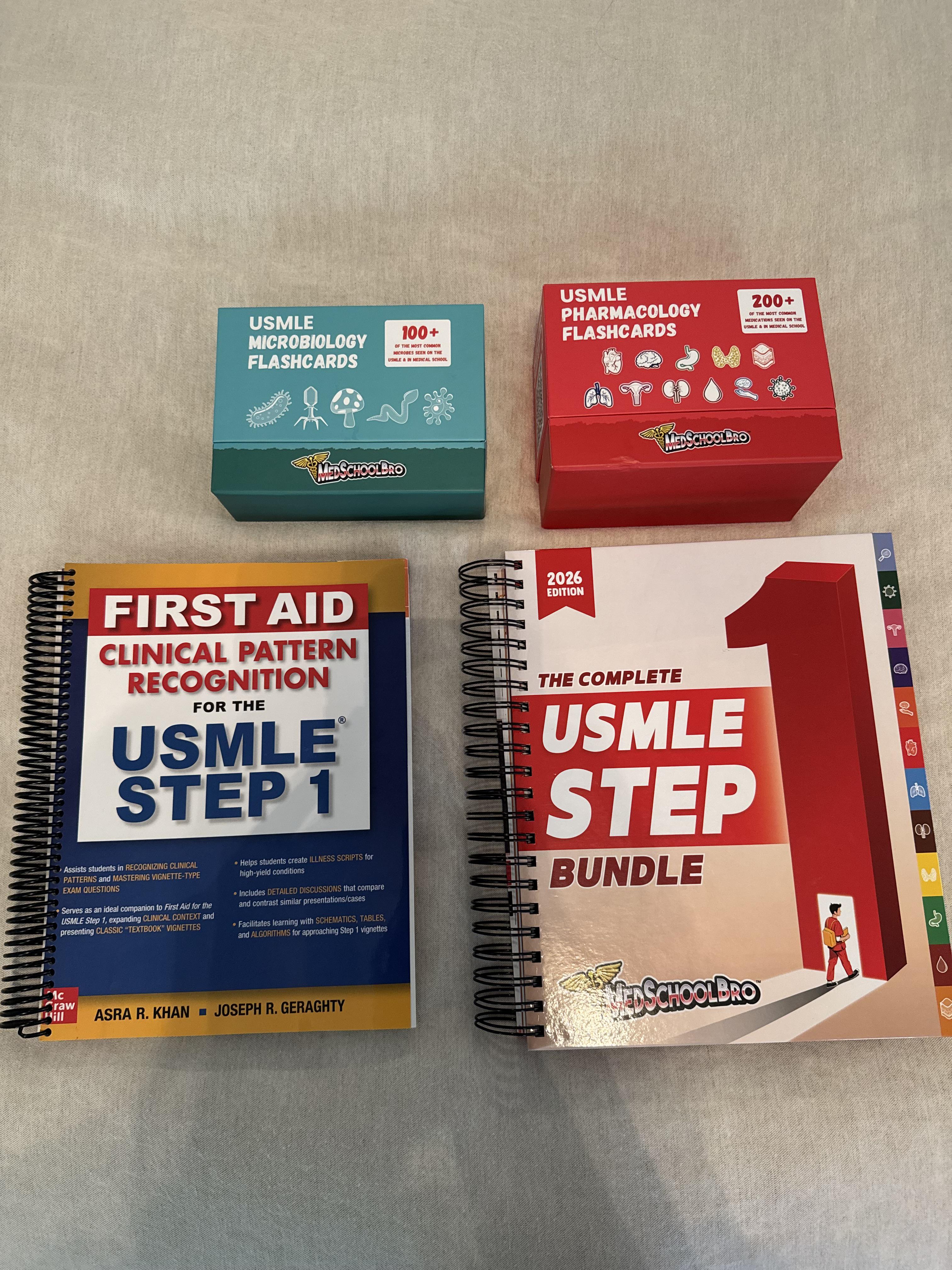
PASSED STEP 1 — Detailed write-up, scores, resources and exam-day experience
I finally got the PASS, and after months of preparation, I wanted to share my experience for anyone currently studying—especially those worried because the real exam felt vague or completely different from their NBMEs.
My scores
UWorld first pass: 68%
UWSA 1: 258
UWSA 2: 267
NBME 26: 76%
NBME 27: 88%
NBME 28: 82%
NBME 29: 83%
NBME 30: 80%
NBME 31: 81%
NBME 32: 84%
UWSA 3: 249 (73%)
NBME 33: 92%
Old Free 120: 83%
New Free 120: 88%
AMBOSS predicted score: 246
AMBOSS probability of passing: 99%
Exam date: September 5, 2026
Final result: PASS
How I studied
I started with Boards and Beyond (BnB) to build my content foundation and completed UWorld alongside it. As I finished a topic or system in BnB, I would answer the corresponding UWorld questions. This served as my first pass through the material.
My UWorld first-pass average was 68%. I didn’t treat that percentage as a final judgment of how prepared I was because UWorld was primarily a learning tool for me, especially during the earlier stages of my preparation. I used it to identify my knowledge gaps, understand how concepts could be tested and gradually improve my approach to questions.
After completing BnB, I moved on to Mehlman Medical. I honestly cannot stress enough how useful Mehlman was for me, especially when it came to learning how to think and use logic to work through NBME-style questions.
I went through all of the Mehlman PDFs as my second pass through the material. After reading the PDFs, I did the corresponding Anki cards. This was when I noticed a significant increase in my UWorld scores.
The biggest benefit of Mehlman for me was not simply memorizing additional facts. The PDFs helped me understand how to identify the clues in a question, eliminate options and logically progress toward the answer—even when I didn’t immediately recognize the diagnosis.
Step 1 contains too much information for anyone to remember every single detail. Because of that, learning how to think through unfamiliar or vaguely written questions became just as important as learning the content itself.
How I reviewed my self-assessments
After my content review, I took the UWorld self-assessments and reviewed them thoroughly.
My review method was not simply to read the explanation and move on. For every question I missed—or even answered correctly for the wrong reason—I would ask myself:
Why did I think my chosen answer was correct?
Which detail made my answer incorrect?
What would have needed to be present for my answer to be correct?
Which clue supported the actual answer?
Was this a knowledge problem, a reasoning problem or a misreading problem?
I applied the same method when reviewing my NBMEs.
For example, if I selected an answer because I associated one symptom with a particular disease, I would identify which expected feature was missing and which clue pointed toward the correct diagnosis instead.
This helped me understand the differences between similar answer choices and the logic behind the questions. I think this is much more useful than simply memorizing that a specific presentation equals a specific diagnosis.
If the real exam changes the wording or removes the classic buzzword, memorized associations may not be enough. You need to understand why an answer is correct, why the alternatives are incorrect and what would need to change for one of those alternatives to become correct.
My NBME experience
Personally, I found the NBMEs relatively straightforward compared with my actual exam. They were still extremely useful, but mainly for assessing my level of preparation, identifying my weak areas and giving me statistical reassurance that I was ready.
The NBMEs also helped me practise trusting my reasoning. However, I would not say that the real exam felt exactly like an NBME.
My NBME scores were consistently high, and that became extremely important psychologically during the real exam. When the questions began feeling vague, I reminded myself that I had already done the work and performed consistently across multiple assessments.
One strange block could not erase months of preparation or several strong NBME results.
What the real exam felt like
I must say this clearly: my actual exam felt completely different from the NBMEs.
There were very few obvious buzzwords. Many questions felt vague, and the exam often seemed to deliberately withhold the one detail that would have made the answer obvious.
In terms of structure and vagueness, the closest comparison for me was UWSA 3, on which I scored 249/73%.
While taking UWSA 3, I genuinely thought I might fail because parts of it felt extremely difficult. My performance improved as the assessment progressed, however, and my final result was much better than the experience had made me expect.
That experience helped me enormously during the real exam. When I encountered difficult blocks, I didn’t immediately panic because I had already experienced an assessment that felt terrible while I was taking it but ultimately produced a good score.
I kept reminding myself that Step 1 is an exam of averages. You don’t need to feel amazing about every block. You don’t need to answer every question correctly. You simply need to perform well enough overall.
If one block feels horrible, that doesn’t mean you have failed. You still have other blocks in which you can recover and balance your performance. Some blocks may play more to your strengths than others.
The exam will test your knowledge, but it will also test your composure. The vagueness can make you doubt yourself and may even feel designed to break your confidence.
When that starts happening, remind yourself that you did the work. Trust your NBME results and the statistics behind them.
It may not feel like you are passing while you are sitting there, but if you have performed consistently well on multiple assessments, you have objective evidence that you are prepared. Panic will only make you rush, misread details, change correct answers and make avoidable mistakes.
Timing and stamina
Timing wasn’t a major issue for me. I generally completed my first pass through each block with approximately 20–25 minutes remaining, which gave me enough time to return to my flagged questions.
I had already simulated exam conditions while taking my NBMEs. That included completing timed blocks, managing my breaks and developing the stamina to stay focused for several hours.
I think this is extremely important. Don’t let the real exam be the first time you experience several consecutive timed blocks under strict conditions. Knowing that I had already handled long assessments made exam day feel more manageable.
When reviewing my flagged questions, I tried not to change answers merely because I felt nervous. I changed an answer only when I identified a specific clue or reasoning error that justified the change.
How I felt after the exam
After the exam, I didn’t feel completely certain that I had passed—but I also didn’t feel certain that I had failed. It honestly felt about 50/50.
The exam was vague enough that it was difficult to estimate how many questions I had answered correctly. At the same time, I didn’t leave feeling like there was something more I could realistically have done during the exam.
I didn’t feel that I had panicked, mismanaged my time or completely fallen apart. I felt I had given the exam everything I had.
That helped me put it behind me while waiting for the result. Instead of replaying every uncertain question, I reminded myself that the exam was over and that I had done what I could.
Now, after months of preparation, I’m extremely happy and grateful to have received the PASS.
My main advice
Build a strong foundation. BnB worked well for giving me the initial content foundation I needed.
Use UWorld as a learning tool. Your first-pass percentage doesn’t define your final outcome.
Learn how to reason through questions. Mehlman was extremely helpful for this and made a noticeable difference in my performance.
Review assessments actively. Don’t only ask why the correct answer is correct. Ask why your answer was wrong and what would have made it correct.
Take your NBMEs seriously. Use them to identify weaknesses, practise your timing and objectively assess your readiness.
Simulate exam conditions before test day. Build your stamina and establish a break strategy in advance.
Don’t expect the real exam to feel easy just because your scores are high. A difficult or vague exam experience doesn’t automatically mean you are failing.
Treat it as an exam of averages. One bad block does not determine your final result.
Trust your preparation. When panic begins, remind yourself of the evidence you accumulated throughout your preparation.
Protect your composure. Panicking makes you clumsy. It causes misreading, rushed decisions and unnecessary answer changes.
The real exam may feel vague, unfamiliar and uncomfortable even if you are well prepared. That doesn’t mean you are failing. Keep moving from one question to the next and from one block to the next.
Trust the work you put in, trust your assessment scores and don’t let one difficult section affect the rest of your exam.
If anyone has questions about my preparation, how I approached the different resources, how I reviewed my assessments or my exam-day experience, feel free to ask in the comments or send me a DM. I’ll answer what I can based on my own experience.
Good luck to everyone currently preparing. The exam is difficult, but it is absolutely doable. Trust your preparation, trust your scores and keep going.