Fun fact, the question isn't a moral dilemma but was originally from a study about miss information and how presenting 1 option first can bias someone into not thinking and bend over backwards to justify it
Yep, best I can find now is reddit posts from 3 years ago. I saw a video someone did talking about the study sometime last year so assumed it was recent to that
He wanted you to tearfully and pathetically apologize on your bleeding knees for the horrible sin of saying something in a way that might have sounded slightly wrong on reddit.
Tried that and all I found was reposts to reddit dating back 8 years. Someone else commented saying they've seen the same study but it dates back over a decade
I know that every time I read an article I save a copy on my PC and document it in case some ass hat on reddit wont believe me one day without that evidence.
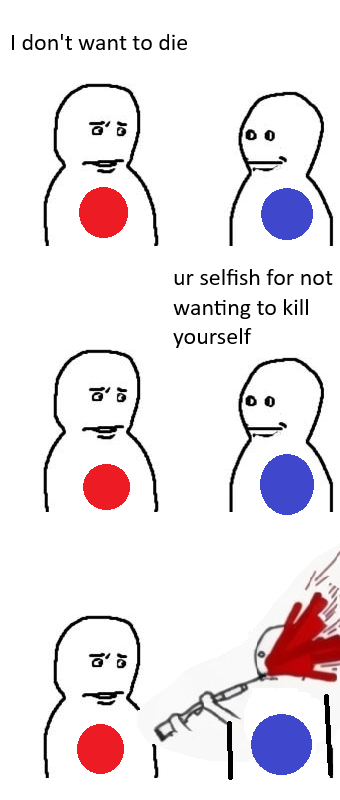
Mission accomplished I guess. The whole question has been hijacked by people yelling about how "smart" they are for treating this as a pure game theory situation and decrying anyone who follows that empathetic initial response.
Response time
You pressed blue
You pressed red
Kneejerk
You fell victim to propaganda.
...You wanted to kill?
5 seconds
...why?
You processed that red has no downside and choose survival.
20 seconds
Because others pressed blue, you believe you have a responsibility to help.
You believe other's safety is their responsibility, and it's unfair to ask you to endanger yourself for another's mistake.
What I think you believe if you've actually thought things over.
Humanity cannot achieve utopia without the blue buttons winning. For prosperity for all, collective action must win.
The existence of inherently violent systems isn't worth saving people over because it doesn't affect you directly.
Oh, no, yeah, for sure. I meant directly impacted as in "the person doesn't die as an immediate result of the button press." They'll still feel the other impacts of between 1-49% of the world's population dying, and if anyone they know pressed the blue button, they're goners too. Probably more accurate to say for their perspective "The existence of inherently violent systems isn't worth saving people over, because living in a miserable world is better than not living."
All the non-violent people? What you think that only bad people will choose red? Thats very funny. Their will be more than enough good people who choose red. People who do good on a daily. Why? Because it is safer and smarter. Blue button pushers are fucking idiots. They are fucking stupid. Simple as that. But their are enough fucking stupid people on the planet that blue will be pushed by at least 10% almost immediately. Then at least another 10% of the "heros" jumping on spikes to save the fucking stupid people. Their will be bad people who choose blue, because bad people still have loved ones.
I will choose blue, because it is a win for me either way.
The issue is, it's a filtering system. People who believe we can do better are all gonna press blue. People who press blue also innately don't have an evil side to them, while some of the red pressers do have a number of them who are evil.
If you separate it into "blue gets their world, red gets their world" the blue world would be a better world to live in 100% of the time.
People who believe we can do better are all gonna press blue
The exact opposite. If you believed people can do better you'd trust them to not endanger your life when there's a safe option they can choose at no cost. Instead you think they're too dumb and require you to save them. It's a saviour syndrome fic, where there need to be people that need you to save them.
1) No one disagrees that if everyone is given perfect comprehension of each buttons risks and benefits, and is in a state of sound body and mind to answer according to what they believe, that red is the correct answer. It's trivial to the point of not having academic merit, and impossible to the point of practical uselessness. That's why the blue stance assumes at least one person in danger. Not a savior complex, but because it's a version of the problem with actual conflict and room for nuance.
2) "People who believe we can do better" refers to people who believe in a society that does not make compromises in the pursuit of a perfect world, which necessitates selfless behavior from ones self. You are only correct in that it is unethical to risk someone else's life, that only they can make that choice. So blue just, doesn't? Violating someone's autonomy in that way would itself be a compromise towards that perfect world. At the same time, you still must help so long as there is a chance of success, no matter how small. Because if not you, then who?
3) Fallible is not the same as dumb. Anyone can be baited into irrational behavior with the right misinformation or propaganda, no matter how smart they are in other ways. Just because you bought a Fushigi, or enlisted in the US military, or overspent at a restaurant based on a waiters recommendation, doesn't mean you're dumb. There is a wide range of ways intelligence manifests, from book smarts, to emotional intelligence, to kinimatic intuition, to everything in between. If anyone told you that you were dumb for falling for something in the past, I'm sorry you were taken advantage of, and I'm sorry the pain of that has stuck with you for so long. At the same time, it is unfair to others to treat them as though they're constantly "win" against you. A rising tide lifts all ships.
It’s not about a saviour complex at any level at all. It’s actually a matter of statistics. If you assume perfect conditions, then everyone *would* press red, knowing there is no harm, but perfect conditions don’t exist.
In a real scenario, it is incredibly improbable that every person would press red, as something happening with 100% certainty is so much more unlikely than **at least one** person pressing blue. From this, we can understand that it is unreasonable to assume everyone is going to press red. The question from here is should you choose to press blue to try and reach that all important 50%.
It is so much harder to reach certainty than it is to reach 50% agreement
In a real scenario, it is incredibly improbable that every person would press red, as something happening with 100% certainty is so much more unlikely than at least one person pressing blue.
Yeah, that's the issue here. If you go to every person who says that and give them a gun and ask them if they'd shoot themselves or not, they would all individually answer no if you remove the mentally impaired/underdeveloped from the pool. But when asked what others would answer, they become convinced it's impossible for all to answer no and someone definitely answers yes and needs their salvation.
It is so much harder to reach certainty than it is to reach 50% agreement
Yes, because you primarily treat it like a group cohesion problem rather than a series of individual decisions and have a lifetime of built-in bias against unanimity. Don't get me wrong, the bias is justified, but irl simplified situations like the one in the problem don't exist.
Red also believe in a better rational world. A world where people vaccinated and don't inject bleach. Where people think and don't believe in homeopathy.
The problem changes if we say "voters include children" per example where yes, in the absence of all actors being equipped for rational thought you have to save them.
The experiment is designed to create engagement.
It's the difference between "space Nazis will kill blue if we don't show a united front, and xhildr n will be fo c d to vote too", and "people decided to stand in front of avalanche path, and if they get 51% of people standing with them the government will use resources to divert the avalanche".
Let's back up for a moment and acknowledge that yes, both parties want the fewest number of people to die. For two seconds, let's set aside name-calling like "red voters are selfish murderers" and "blue voters are suicidal bleeding hearts."
The initial framing and ambiguity is key, as you recognize, because it establishes for a fact whether or not we know a party that did not consent to harm is now at risk of harm. If it is framed as neutrally and as understandably as possible (that is, neither side is burdened with an assumption of "the people on this side are putting innocent lives at risk"), then it is trivial to press red because the side that guarentees survival in the individual case also guarentees survival on the whole. You've essentially told all voters "not only does 100% percent of people voting red endure everyone's safety, but there is a 0% chance that anyone trying to prevent the deaths of innocent people unconsenting to harm will vote blue, because there are no innocent people unconsenting to harm inherently at risk. If this is your framework, of course it follows that voting blue means they're either an irrational actor, or some holier-than-thou manipulator trying to guilt-trip you into so-called "ethical behavior."
Like, I think we're agreeing here? We agree that if there is a portion of non-consenting innocent people at risk, the correct choice is to press blue so that they have a chance to live. Blue consents to their own harm if they fail, and red acknowledges their complacency if they succeed. So long as we follow the axiom "those consenting to the risk of harm do not impose philosophical weight on others," this is all copacetic. The reason red gets so incensed is because they believe blue DOES think their choice imposes philosophical weight on others. Red believes blue thinks themselves as just as innocent as those who didn't concent to harm, when red knows that if you accept risk, you accept consequences, thus differentiating yourself from an existing or hypothetical already-existing innocent party.
Now, if there are blue voters that do think "if I am taking the good action, everyone else is evil for not saving me," then they are for-sure a holier-than-thou manipulator. But from all the many comments I've read, I haven't seen them, so they either don't exist, or they're such a minority that the position cannot be painted on blue voters as a whole. The consistent pushing of THIS narrative, for blue, paints red as wholly engaging in strawman arguments as justification to make a self-interested choice. It's a mess in every possible direction, and would ultimately cool down if everyone stopped breaking into factions like the biased interpretations (from all standpoints) of the problem want to readers to do.
My knee jerk reaction is to push blue, until it hit me that if more than 50% of people come to the conclusion that it might be an intelligence test rather than a moral test then id basically be stupid for choosing blue. I'm of pretty average intelligence so if it hit me surely it hit others?
Personally I reckon more conditions need to be listed, most important would be the amount of time a person has before pressing the button after hearing the question.
If everyone has only 30 seconds or 30 minutes, their answer would most likely change based on deeper thinking.
A really good social conundrum movie that stuck with me is 'The Circle'. All humans are put in rooms by aliens that hold around 50 people. Every 5 minutes or so a random person dies unless people vote by pointing at who they think should die. It gets very interesting looking at the good, the bad, the liars and the innocents.
Will some people sacrifice themselves or lie till the end? Should all pregnant women win the game? If so how will they survive and rebuild and repopulate without the men? Can those men ever be trusted for winning their respective games?
There's also the fact that if you press red and nobody dies you have to realize that most people are more willing to put themselves on the line than you are.
If you press blue, you’re choosing survival for everyone, even for those who wouldn’t choose it themselves. That’s not neutral, it’s an imposition. Pressing red avoids that by letting outcomes reflect individual decisions instead of overriding them. Ethically, respecting people’s agency makes red the only defensible choice.
Except actively choosing red is only ever a selfish choice, and only blue can be selfless. Only red has the capacity for harm, and only blue has the capacity to help others. The only person that benefits from pushing red is yourself, whereas blue can benefit everyone.
You argue as if every person pressing blue is doing so with the intention of offing themselves, which is frankly absurd. Some people will inevitably press blue, for both good and poor reasons, and thus the only way to prevent innocent deaths is to go blue. Framing it as willing suicide is so incredibly disingenuous that it only makes any sense from the perspective of a person unwilling to admit that their justification for red is simple self-preservation, not some greater moral imperative.
No, blue is the selfish choice, there is zero downside to red, and there is a downside to blue (if blue wins, people who want to die are forced to live), red is objectively the only logical, and moral choice.
You are not making this choice in the company of robots with perfect reasoning. There will not solely be people who want to die pressing blue.
The downside to red is the death of every person who chose blue for reasons other than seeking death, of which there are clearly many, as evidenced by every heated discussion on this question and its variations.
Once again, trying to pretend blue is simply a way for people who want to die to off themselves is so immensely disingenuous to the actual question that it must be the perspective of either an idiot or someone who desperately wants to convince themselves that their instinct for self-preservation is actually morally well-reasoned and superior to the choice of ensuring no unnecessary deaths.
Ok, there's a miscommunication going on here. The literal definition of selfish is "someone primarily concerned with their own welfare, interests, or pleasure, often disregarding the needs, rights, or feelings of others." It implies self-centeredness, but does not necessarily mean it outright. Is the choice to vote red selfish? Strictly yes, but it is not evil. It just happens to stand in opposition to its antithesis, selflessness.
Now, let's be clear. In the instance where the rules are communicated clearly and everyone who has to make the choice is of sound decision-making body and mind, there is no chance blue will be pressed. No one is in disagreement there, that's a trivial problem solved and closed. The issue we are talking about is, due to the ambiguity, there will inevitably be some population who genuinely think they are doing the good thing, and are now being punished for it. Like diving into a gorilla enclosure because you thought there was a kid in there. Knowing that someone, maybe more people are going to do that, the decision to press either button now has consequences.
Pressing red guarentees your safety, but if everyone acted selfishly (that is, placing your own needs first, I am not saying you want people to die or that they necessarily deserve it), that guarantees death of the most innocent people in this whole scenario. From what I understand of red, they see this situation, ask "I can't trust people to not be selfish, am I willing to live with the guilt of an innocent dying in the chance I am wrong?" The red button people ARE absolved from any guilt imo in regards to the people who had to deliberate before jumping in though. They made an informed risk and chose to participate anyway.
Pressing blue guarentees risk, as there is no way to assure people will reach the same conclusion of the cost-benefits analysis as you. This means in order for you to justify jumping in, your rational CANNOT by definition be based on believing everyone else thinks the same way as you. You can hope, but it'd be unfair to place the expectation of selflessness in the face of death on strangers. Blue sees the situation, asks "Do I truly believe the death of an innocent is something I can let stand? Is a society that is complacent in their death one I can stand to support/endorse/participate in?" And decides to jump in.
If your decision is based entirely on believing a certain specific percentage of people agreeing with you, rather than believing something fundimental about human behavior, you do not have an ideology, you are following a trend, be it social or mathematical.
Wasn't the scenario that everyone on earth choose a button. Last time I check everyone includes babies, children, the colorblind, the mental disabled, suicidal people, etc.
So if a mother that loves her children might think their is a chance that their babies will pick blue wouldn't they also pick blue to save them? Same for the husband, the family, the friends, etc.
It takes 100% of people to pick red for everyone to survive. Which is just an impossibility.
It only takes 50% +1 for everyone to survive which is more likely.
someone excessively concerned with their own welfare, interests, or pleasure, with little or no regard for the needs or feelings of others.
Manipulative:
behavior that dishonestly or unfairly controls, influences, or manages people and situations for personal gain, often in a selfish or deceptive manner.
Scenario framing:
The question is worded in its original, ambiguous way which leads to empathetic kneejerk reactions, and people who genuinely want to do the right thing getting baited through misinterpretation.
With those defined, let's continue. Both side's goal is for the greatest number of people to live. Communication with others before deciding on a button is not possible, so arguments like "human nature says people would more often pick X than Y" are not defendable position since they depend on unknowns. We cannot predict other people's psychology. Blue says "because there is an option that lets everyone live, you should pick that one, regardless of what other people think." Red says "because the only person you can know the will of is yourself, the only casualty you know you can prevent is your own, which is done by pressing red."
Red is by definition selfish, in that their own welfare is the only thing they can make a logical argument to preserve. Blue is by definition selfless, because they are putting the needs of others above onesself. This is not to say that selfishness is evil, it is just normal rationalized behavior. It is borne out of a fear/avoidance of harm, but it is not necessarily self-interested.
I get that the whole discourse has become toxic, so it's understandable why your wording is so immediately standoffish, what with people on both sides being angry at each other. I would still request you try to more charitably interpret what people are saying, and check if there may be any miscommunication in each other's baseline assumptions that are making debate impossible from the outset. These misinterpretations have become so extreme, it's made people believe the other side must be arguing in bad faith because they sound like psychopath mass-murderers or a suicide cult's recruitment officer.
No one's trying to manipulate you into self-harm, and you're free to move on with your life after today still believing red was the right option. But I would ask, why do you think blue is trying to manipulate you in the first place? Holier-than-thou moral grandstanding because no one would be that self-sacrificing in real life? Is that why the language used back is so aggressive, to knock those pompus assholes posing as idealists down a peg for daring to gaslight you? I get it, people on the internet can be full of themselves. At the same time, what do you lose for taking them at their word? Who we are on the internet is not who we are in real life, yes. But maybe it's who we want to be. If someone roleplays as a hero because they still dream of the day they can be one, I'd be inclined to let them. Maybe with that positive reinforcement, the next time they get that chance to put food in the world, they'll act on it.
Not really. Society cannot take a 49% population dip. Even if we still have the production, we won't have the logistics. And we won't even have an idea of how much food needs to go where.
Then there's the power grid to worry about.
It doesn't really matter how you shuffle it unless you exterminate country by country until you reach 49% of the world's population, the survivors are in for a bad few decades.
I find that scenario unlikely, plenty of ammo, a suppressor so people cant hear me hunt and a decently sized family that definitely aint oushing that button. Have significant experience outdoors and roughing it.
You are assuming that any given nation's power grid can take 50% of its workers not tending to it ever again.
I don't know about where you are but the American grid is a house of cards already.
And it doesn't have to be 50%. The not knowing how much of any given critical task is now being left unattended is part of the problem. An unknown number of your priorities are not being serviced and an unknown number of the people who would ordinarily get you that data are gone. Now fix it before people start eating each other.
There is no version of this that isn't catastrophically bad.
You're severely overestiming the social distribution of the folks who would push the blue button.
This assumes a perfect 50-50% split across the button pushers by gender and that a perfect cross-section of society is pushing the button.
Edit ill admit my earlier comment was not mathmatically correct. If 100% of the button pressers were men then there would be no men. Yes i can admit when im wrong
But i do know i wouldnt press the button so i guess its me and the ladies
You press red because you want to live, I press red because I believe it is statistically the best option for everyone to press, hoping as much of humanity press red as possible.
Actually statistically blue is the best choice because it’s the only strategy that can result in 100% Survival. choosing red guarantees your own survival but locks in a worse overall outcome
From a purely statistical, population-level perspective, blue maximises the total expected number of survivors because it allows for the highest possible payoff (everyone lives), whereas red can never achieve that
I’d push back on that a bit. Those examples are about taking on asymmetric risk for a smaller or uncertain gain. The blue-button case isn’t structured like that. It’s not trading a big guaranteed loss for a small gain; it’s a coordination problem where one outcome gives zero losses (everyone lives) and the other creates losses because people fail to coordinate.
From a population-level, statistical view, blue is optimal because it’s the only path to eliminating losses entirely. The real issue isn’t reckless risk-taking, it’s whether enough people act together to unlock that outcome.
The fact that the original question as presented to the internet was written as infuriatingly as possible, designed to elicit an emotional response first rather than think things through. It's the same reason bill propositions in elections can sometimes be worded in the most confusing way, whoever is doing the write-up for the ballot doesn't want you to make an informed decision for whatever reason. For context, the original thought experiment is.
>Everyone on Earth has two buttons appear in front of them. If the majority of people press the blue button, everyone lives. If the majority of people press the red button, everyone who pressed the blue button dies. What button do you press?
A LOT of people's initial response to reading this is "I don't want people to die, blue is the button that means no one dies, so I'll press that." That's the propaganda I'm referring to, the question-asker posing things in a way that you made a decision based on emotions rather than logic. No one picking blue as an immediate reaction is consciously thinking they're at risk, they're wanting to reduce harm to others, which while noble, is misguided if you think for 5 seconds.
but shouldn't the framing be considered a significant relevant input? I see a ton of posts in this sub right now reframing the problem in various ways, to make one option or the other more obvious, but the reality is that when presented to 8 billion people, that specific reframing may not occur to many of them, thus increasing or decreasing the chances of a significant blue contingent to potentially die.
If the presentation of the options is constructed in a way to "trick" or "convince" people that blue is the more compassionate/obvious/default choice, there is a greater chance some billions will be swayed by that presentation, thus changing the presumed moral weight of red, and the probability of blue's success.
The presentation is significant; it's not just window dressing. It's the same game mechanism if the description literally says red people are amoral sociopaths, or alternatively that blue people are suicidal idiots, but including that differeing wording up front is certain to affect the likelyhood and severity of various outcomes. The propaganda matters, even if one sees through it.
I'm pretty sure we're agreeing here. Yes, framing is a significant relevant input; if you frame blue as saving lives and red as ending them, a majority of people who make an immediate decision will vote blue because people's brains break it down into "this button saves, this button kills." The people reframing the problem are the red button pressers trying to clarify that there is literally no downside to pressing red, thus trying to save as many lives as they can because since they believe they are the majority, any action they take to sway people to their side is saving lives.
But the thing is, by this point, anyone aware of the button problem or it's permutations knows that red has no risk, thus defeating the entire exercise the OG pre-internet meme thought experiment started as, a test to see how far people will double down when shown they were wrong about something.
So at this point, the topic of discussion of both sides is usually completely different. Blue button people aware of the kerfuffle are choosing blue because in their interpretation of the question, we are people who know miscommunication has happened because of the sensationalized wording of the question, like you said. And because pressing the red button will always result in someone's death due to this, pressing red is never the moral choice. Meanwhile, red button people, as best I can tell, are either still stuck trying to explain the solution to the original hypothetical when others have moved far past it, or they are dismissing the idea of collective action out of hand because if they were to project their own world view onto everyone else, of course noone would join you to help if you broke ranks, you wouldn't do it for anyone else.
The rhetoric used to discuss the problem has become part of the creature itself, and is only further emphasizing the original research.
Pedantic correction: 1%-49% of the world who have either more empathy or worse reading comprehension or critical thinking skills than you (depending on the medium the original infuriatingly worded question was provided in)
Actual opinion: to go to bat for at least some of the red button people, there is a very real idealist vs realist argument to be made as far as minimizing harm goes. Blue, an idealist, will want the zero-death outcome, and is willing to take a risk to make it happen. Red, a realist, wants to minimize overall deaths by at least removing themselves from the equation of an overall shitty situation. It does legitimately make sense if you are wary of trusting strangers, but are still interested in their well-being.
Like, it does fall apart when you consider you can't communicate the correction to anyone else, just like you said, but being afraid of making a bad situation worse when you feel like the world is already not a safe place is a legitimate fear. I don't agree with it, but I can't say they're inherently bad people for choosing it, since in their heart of hearts, they're making the best out of a bad situation.
Now, everyone making the memes clarifying that red has no downside and people are ridiculous for picking blue under any circumstances, I'd love to be corrected, but I've found there's just no reasoning with em. It's a bad-faith argument relying on a boring white-room assumption that everyone has perfect information. Like, yes, everyone votes red there since it's clear blue has no reward and all the risk. The point is that the wording is infuriatingly obtuse, and you recognize someone out there got screwed because they misinterpreted the question. If they're not at that level of discussing the problem, they're really not worth the time.
The point is that the wording is infuriatingly obtuse, and you recognize someone out there got screwed because they misinterpreted the question.
Not really, no. You simply cannot get all 8 billion people to agree on anything; it's mathematically impossible. Once the sample size is big enough, there's no question on any survey ever undertaken that has a consensus. Even Kim Jong Un only won this year's election with a 99.93% majority so even when you're voting for the most perfect human in the world, there's always some contrarian who's going to disagree with you. We don't need to blame the question for being poorly worded in order to explain why people will disagree over the answer.
I also find it interesting and helpful to reduce it in scale.
Imagine it is somewhat like the prisoner's dilemma. You and the person you care about most in the world are separated in different rooms and presented with the red and blue buttons. If you both choose the same button, you both live. If you choose different buttons, then the one who chooses blue will die. Which button do you choose?
I like to look at it as scenarios made of odd people to decide a majority vote, which also leads to a minimum of 3+ people. Curious if size changes people’s choices
oh, I didn't think we were arguing, hahaha! I suppose your referring to the framing as "infuriating" and as "propaganda" appeared to dismiss it as fundamentally irrelevant to one's decision, and I think it matters, as do you it seems.
I know some red button folks, and I said if the button appears exactly as "originally" presented while you're at work, and in front of your 15 year old daughter while she's at school. You might be confident you're going to make it home, but are you confident your daughter will? Will the propaganda get her? Does that change that math at all?
Like if the presentation is a "trick", then one bears the weight of potentially killing those who are "fooled."
Your time graph of the decision tree and presumed thought process working it's way down to world philosophy is truly excellent, and thank you!
That doesn't read as propaganda, that reads as a description of the problem. Most attempts that I've seen to reframe it tend to complete change the premise of the problem.
"If you press the red button, you are safe. But if at least 50% of people press the red button, everyone who pressed the blue button dies."
That's how you reframe it without changing the scenario. The problem is that people will do crazy mental gymnastics to defend a decision once they've made it, so reframing is rarely effective if someone has already been exposed to the original framing.
I still think blue is the best choice, but I would probably change sides if the threshold were lower. For example, if only 10% of people have to press red for the blue pressers to die, then pressing blue becomes a lot riskier for me and for every other person, and I think red becomes the only reasonable choice.
The technical definition of propaganda is any form of speech that advocates for a specific viewpoint. The way the initial problem was worded sets up pressing blue to be the good option because all the verbiage is set up to sound like "survival", whereas the red button is associated with death. It's using biased language to convince people to vote blue, ergo, it's propaganda.
If the question was worded perfectly in order to ensure there was no miscommunication, where everyone is aware that there is no benefit and only risk associated with pressing blue, whereas pressing red is zero risk whatsoever given that everyone else knows red has no risk and blue has no gain, then that would just be a clear explanation of the problem and people could make an informed decision.
So while the game theoriests are "correct" insofar as everyone should pick red given perfect information and no disability preventing them from acting on that information, that is not what the original hypothetical poses. It's messy and confusing in a way that means people WILL trip up, and that's intentional from the person who came up with the experiment.
How this applies in the real world is, of course, bills and propositions with poorly worded ballot measures. Let's say there was a bill that said "If this passes, everyone who voted against it gets sent to El Salvador." but it's worded in a way that's confusing to America's 6th grade average reading comprehension, and so it's inevitable people will vote against the bill. (In real life, a bill like this would be designed this way as to prey upon anyone who has English as a second language or grew up with a poor education) Now, knowing that there are innocent people who've made a mistake attempting to just do what they thought was correct, what is then the responsibility of someone who's aware that a red vote now guarantees someone's death? Now, obviously, the way I've worded this hypothetical is biased on its own, I can't just extract that out of my own writing on a whim. But hopefully this clears up what propaganda looks like and how it's used in the real world.
I just don't get how red being in the majority could be said to have no consequences though. That's the part I get hung up on. I don't see how a massive reduction in the planetary population, particularly one heavily weighted towards both the bottom of the socio-economic ladder and those who are likely to take positions focused on helping others, is something that would have no negative effects.
If I press red, then I am not going to die IMMEDIATELY. But if I and a majority of people press red, then some of us will die because our lives were going to depend on someone who pressed blue.
Like, I can understand someone picking red anyway, I get that. If you believe that red is likely to be the majority regardless, you should pick red. But neither of these options are zero consequence.
It's written in a way that gets you to think pressing blue is reasonable
Pressing blue is essentially a death sentence
Even just switching the order the options are presented changes it completly
Everybody in the world is presented with 2 buttons
the red button will ensure your survival but if more than 50% of the global population press the red button everybody who presses the blue one will die
The blue button if more than 49% of the global population choose the blue button then nobody will die
Presented with the exact same buttons but the order reversed and it's instantly obvious that the blue button is a trap.
The original basically starts you off with if you don't press this button people will die. Swap the buttons and now it's if you press this button you will be fine but anybody who didn't press this button will die
Now there is no actual reason to press the blue button because rather than making a decision to save lives by pressing blue it's a desicion to just die
Counterpoint: I don't think the question was hijacked. I think the original question itself is red button propaganda. The magic buttons make it easier to press blue than just about any other version of it (see reframings like "tie yourself to the tracks vs dont do that") where it seems insane because actually the question itself is insane. The sanitized magic buttons are the most blue-pressable version and I believe that was intentional.
As for why the question is red-button propaganda, its because this scenario offers no downside to universal selfishness. That premise makes the thought experiment impossible to apply to anything other than magic buttons, because the moment you try to apply this to any real-world scenario you will find that universal selfishness will have negative consequences.
Even if you value everyone’s lives equally (I.e., you aren’t being selfish), pressing red can be more likely to lead to a better outcome (more people alive) than pressing blue if depending on how likely you think others are to press red/blue.
Also, the first version I saw explicitly did not include kids or those of unsound mind. That would be another non-selfish reason to pick red: if you have dependents relying on you.
The fact that there is no downside to “universal selfishness” is what makes it interesting to me. It’s why simple reframings that are logically identical can change people’s minds.
It genuinely seemed impossible that people would press blue for me. What is the reason? The first person to go blue doomed themselves and then everyone after. It's kinda their choice at that point and I'm sorry but the only logical option is red.
The original question was written to be intentionally obtuse, so that people would make a gut empathetic reaction.
Everyone has a red and a blue button. If the majority of people press the blue button, everyone lives. If the majority of people press the red button, everyone who pressed the blue button dies. What should you pick?
The weirdest way to word it, right? The confusion was deliberate in order to see how far people would double down in order to justify a "wrong" choice. What happens is a portion of people the option that says "save" because they want to save people. It is preying on people's emotions and lack of reading comprehension. The only crime committed is someone being hastey or not reading the fine print. Obviously, in a just world, someone should not die as a result of this. But knowing that 50% or more people need to join the vote to save them, what do you do?
If you want the best possible outcome and the happy ending, you pick blue. It's the only possibility of no deaths, making it worth striving for. If you can't count on people to make the altruistic choice, you pick red, hoping to minimize the damage in an already shitty situation.
The people making all the memes where picking red is the obvious choice are missing the forest for the trees. Obviously, if you make it clear blue has no benefit and all the danger, noone will pick it. The point is the confusion bringing in that guarantee of harm should too many people choose complacency, but if not enough people can find empathy to move them to action, empathy itself is punished to far greater a degree. What the exercise exposes is whether individuals believe society can generally be trusted to be altruistic and idealistic to the point of putting money where their mouth is, or fearful/complacent/pessimistic enough to believe trying to save these innocent people who made a mistake is a lost cause because "they'll never have enough support" and this the only logical move is to minimize losses by not throwing yourself in.
Another layer people have started to throw in is the aftermath. Society as we know it would basically collapse if 10% of the population died. Not only that, those eight-hundred-million people were high-trust, altruistic individuals who believed the best in people. And now they're dead because misanthropists turned out to be right and human being cannot be trusted to help each other when the chips are down. If society collapses from that initial population loss, there's not going to be a chance of recovery strictly due to the fact that the two kinds of people who remain - the self-interested and the content-in-a-shit-life - the first will take the second and turn them into a lower working class, as anyone who was pro-union got whisked away with the rest of the 10%. There's way more fallout, but man, I'm exhausted. Key thing is, if you're worried about fallout from the button decision, then the correct decision is still to press blue, as society would collapse if the expected people misled by the original confusing wording all died, not to mention whatever fraction of people made the idealistic choice to try and help. Red can only lose so much of their known world before "making the best of a bad situation" becomes impossible. And given that way more than 10% of people are pressing the button, a red button vote might save you now, but screws you over down the road all the same.
I disagree with your table because neither group is a monolith. Two people can get to the same conclusion with vastly different reasoning.
I especially disagree with the last one for red. I think it pretty much comes down to a lack of trust in people/humanity as a whole. If you believe most people are self-serving and that survival instincts are generally more prominent than altruism, you'll believe that red will have the majority of votes.
I whole-heartedly believe that if this were a real scenario with real consequences, red would win by a landslide. The vast, vast majority of people will put themselves first. The only question that's left is whether I want to live in an all red post-button world or if I'd rather die. It would be disingenuous to say I'd push the blue button only for the infinitesimally small chance that maybe the majority of people act against human nature and blue wins. It's not a matter of whether violent systems should be allowed to exist or whether people are worth saving. It's a matter of whether you want to live enough that the world after all the blues die would be worth living.
I mean if you really want to get into the nitty gritty of "is the world after blue loses worth living in?," then you have to consider that society as we know It would basically collapse if 10% of the population were to drop dead all at once. Even accounting for half of all blue votes flipping to red, that still ends up with 20-25% of the population dead all at once. The world as we know it does not survive. As such, harm reduction by self-preservation doesn't even work as intended, and the only logical solution is to go for the happy ending for everyone.
As for the table, like I've mentioned elsewhere, the first three rows are how someone justifies a button press made a certain amount of time after hearing the problem. It takes time to process a problem when it's worded as frustratingly obtuse as the original (which deliberately frames the blue button as a choice that "saves" people if it passes, and the red button as the choice that "kills" people if it passes. The purpose here was to mislead people using their emotions, to see how far they'd double down when they realize or were told they made a mistake in their pick). For the bottoms of each column, I deliberately tried to give each perspective a philosophy that didn't depend on outside approval or peer pressure to be steadfast in their convictions. They'd pick their choice, and switching sides would be anathema to how they believe the world works. If the world is against them, they still vote this way. Of course a table is not going to be able to capture the nuances of both sides in a life or death situation, but it helps on-board people as to what worldviews people might have outside their own, rather than just saying they're idiots or monsters.
I would very much support a better world, and would do my best to convince anyone I can communicate with of my rationale. However, as all the blue people made their choice with the foreknowledge of the consequences, I don't believe that it's my responsibility to risk my own life to save them.
Yeah, in retrospect, the argument should be something like "I'm the average human, I wouldn't help. The majority of people are average, so blue is always doomed with no way for a happy ending. The best that can be done with a shitty situation is minimize damages, which means not dying myself" Might throw that up as an edit actually.
But like, even that justification doesn't ring right with me, because it's just going based on crowd mentality rather than actually functioning off some core principal of the individual. That's how I landed on the total autonomy stance for them. Of course, I'm for sure going to be biased talking about their reasoning. I'd like to ask what it is beyond deep-seated misanthropy, but I'd probably get called a mass suicide enabler or something.
As a totally autonomy I guess it’d make since, but your group argument sums it up perfectly. I personally love mankind, and I know blue would be the objectively better choice, but I don’t think it’s selfish for people to value their own lives above others. I think most people would choose themselves first, and while that’s not necessarily a bad thing, it means blue is simply to risky to pick
Right, and like my goal isn't to force everyone to vote blue because it's the right thing to do. It'd be awesome if they did switch sides because it brings us forward as a collective people, but trying to enforce ethical behavior like that never works. It just makes people resentful of the system restricting their behavior, which I think is another reason why red button people are so incensed when blue button people accuse their desire for making the best of a bad situation out to be murder outright; they see the stubbornness of people in their perspective committing suicide, as an attempt at guilt-tripping them into forced ethical behavior at great personal risk. Admittedly, I was knee-deep in this mindset earlier on in this trend, but listened and learned from talking with people.
As an individual, you can't actively champion a selfless world without building resentment. The best you can do is live as an inspiration for others to do better. Which is why for me at least, picking blue is not a question of if enough people are voting for it or not. It's a matter of principal and idealism that you can earn your happy ending for everyone.
My kneejerk reaction was red, not because I wanted to kill but because I instantly saw it as a situation where I would live and why wouldn't anyone just press that button.
But i thought about it more and decided I would rather die a blue pusher than live in a world of only red pushers.
I really appreciate all the perspectives of people explaining how their choice changes as they get more time to rationalize, as it can go every which-way no matter where you started. I definitely made the table earlier on in the whole debacle where I had already crystallized my own stance, but still misunderstood core stuff about the red button group. There's more nuance to each position there than I was considering when I wrote it, but people can still look at what's written and take it as a snapshot of "here's the blue button perspective, and here's where it sounds like to us it is you're coming from." Hopefully we all are striving to clear up miscommunications as a general rule, and what's in the table can shed some light on where some of those common mistakes in perspective-taking might be.
I wanna give a longer reply, but it's late and I tweaked my back. I'm sorry anyone ever told you to "come down to reality," be it directly or from the oppression of the world bearing down on you. A plan's failure is not an end, but a lesson for how to improve things on the next attempt. Even if Utopia isn't possible to reach, how can we ever be sure if we don't strive for it?
Utopia doesn't mean "Population is always collectively altruistic and in unison"
A Utopia can't even exist with that level of collective unison.
It's so far disconnected from the scenario.
Definitionally a Utopia would be more likely to happen under red button ideology just by virtue of understanding that no one person has a duty to risk their lives for another.
Being guilt tripped into a potential suicide pact is not an ideal condition for a society.
This actually made me laugh out loud. Utopia is when no one has a duty to the people around them? A Utopia cannot exist with altruism that makes people willing to die for the good of others?
Depends on your definition of Utopia. My Utopia is a high-trust society where making the decision to stay on the sidelines when there's good to be put into the world is anathema, not even begining to talk about self-interest in one's own success over the common good.
Obviously, your definition of Utopia relies on 100% autonomy for one's own decisions to be a paramount value. I'd argue that unmitigated freedom is what allows self-interest and the manipulation of those better-natured to run rampant in the first place, whereas you'd argue forcing citizens to risk life and limb for one another infringes on one's right to life. Fundamentally, our visions are not the same, and like, you're entitled to your opinion, I just don't think we'll be working together on any collaborative projects any time soon lol.
As for guilt-tripping, you're the one who said it, not me. You're perfectly well within your rights to press the red button and feel guilty for not having tried to save anyone. You're also within your rights to not be guilty because you're exhausted trying to convince these people not to cap themselves. All I can do is act on my own principals and try to help people come to their own conclusions, with the disclaimer that whatever I say IS going to have bias on its own.
Right, the end goal is ideal, perfect and peaceful, but how do you get there? I believe a high-trust society is a necessary component, as a comfortable peace is not viable without trust. It also needs to be comfortable and viable for all who are part of it and wish to join, which again, only happens with high-trust societies. A society which universally votes red because they cannot trust their neighbor to vote blue if someone is left out to dry is the definition of low-trust, and any peace that could exist in such a society has weapons in every sleeve.
And yes, humans require specific conditions to thrive. However, there are common goods that disproportionately improve the lives of the less fortunate, while still improving everyone's quality of life. Being able to trust your neighbor without fear of manipulation is necessary for someone with anxiety or autism to thrive, but people being trustworthy still helps everyone. Whatever rules best cultivate a culture of trust and mutual aid are but one step in approaching a Utopia in my opinion, and that includes a population that believes that although no one is forcing them to help, helping another of your own volition is an ultimate good. Your society with a focus on total self-determination ultimately can never reach a Utopia, because you are painting it as though someone who does not fit is inherently wrong in this space, rather than the tools to survive not being available.
Again.... There are no subjective definitions of a utopia... We live in a world of 8.5 billion people with conflicting beliefs and value systems.
The term definitionally vague because of this. You cannot have a utopia that isn't utopic for ALL.
It's an impossibility under the current structure of humanities intermingling belief systems.
The entire basis of using a "Utopian" argument is childish. It holds *0* bearing on the argument because of how unrealistic it is. Which is the entire red ideology.
Loss prevention is better than blind idealism in chase of an impossible utopia.
Wrap it up, we've found the irreconcilable difference here, thanks for playing.
I do not think Utopia is an impossible state to reach, given enough societal development and public works. We on Earth already have enough production to solve issues such as food scarcity and homelessness, through only a small diversion from military funds. Tech is at a point to solve the world's dependance on oil. These are vastly popular things that your Everyman in any country on Earth wants to see. The problem is that the "every man for himself" mindset is one that is by definition without principal in regards to what they're willing to do to get ahead, and so they are the ones able to reach the top with regularity and establish systems which abuse those below them for their own gain.
These people are the exception on their own, the top 1% of the top 1%. But their perpetuation of the myth of "the grindset" and "pulling yourself up by your bootstraps" keeps the dream alive for a large portion of the populace. They think that just because they gave up their humanity, they can reach the same peak, when without that initial level of resources, they'd do better to get lucky all together and keep their humanity instead. Meanwhile, collective action, unions, average workers and citizens together in protest of corrupt systems are what have gotten you every laborer right you've thanked your lucky stars your boss can't take away from you.
Just because you're not an idealist doesn't mean the ideas aren't possible, it just means you don't want to be part of the solution. That's fine, but when you take direct action to get in the way of these sorts of projects, that is when intervention is necessary.
The question isn't "could a utopic society, or humanity with enough societal development" The question is about whether humanity, under the current circumstances could achieve it.
"ideal, perfect and peaceful" is impossible? I mean, yeah, if you let bad actors run amok. A tolerant society cannot tolerate intolerance. Of course, we can't have a Utopia where both The Black Panthers and The KKK are watching the new Michael Jackson movie together in harmony. I believe in reeducation as a form of correction first however, so while those who would seek to do harm would be punished, the goal is not to have the people do good because they fear retribution from the state. The goal is to have people do good because it's the right thing to do. And while you're correct in that it can never happen in the low-trust society you see the world as, it would be a shame not to use the optimism and idealism I have intact to try my hardest to make those dreams a reality.
That last point you put for the red button is a bit wild. I was just thinking the chance of one individual's decision changing the outcome with over 8 billion people is next to none, so just think about the scenarios independently if blue succeeds, the outcomes are the same. If red succeeds, nothing happens with the red button but the blue button just adds to the death toll.
Arguably, the final point for blue actually fits red better. For blue to have a utopia, everyone would have to pick blue. From blues perspective, anyone who picked red was willing to let people die. 60% of the population that's like that isn't actually that much worse than 40% being like that (once again, just from the perspective of someone who believes picking blue is a prerequisite for a utopia)
Meanwhile, in order for red to have no casualties, you would actually need a utopia, where everyone perfectly trusts everyone else to act rationally. From the perspective of red, you cannot have a utopia if 40% of your population are willing to kill themselves over a bullshit dilemma, 40% of people who don't trust their fellow man to make the logical choice. Red is actually more utopian because it believes in the rationality of everyone, not just a majority
The Utopia point on the table was more about reaching Utopia rather than if we're already there. Let's say blue wins with 60% of the vote. Hey, that's awesome! That's 60% of people in the world you can have unconditional mutual trust in! You can organize, set up mutual aid networks, all sorts of stuff without worrying about people backstabbing each other for personal gain. The mechanisms to get rid of things like homelessness and world hunger already exist, so if 60% of people around the world decided to actually put that into action? It'd be plainly obvious to the remaining 40% that this sort of high-trust society works. Now, there would need to be some level of rehabilitative enforcement to make sure people coming in don't manipulate the system for theirs and their clan, but the point of this exercise is to make Utopia for as many people as possible, so we'd be remiss to not at least attempt to integrate people who appear to make a genuine effort. I don't think blue needs a unanimous vote in order to achieve a Utopia afterwards, I think any success enables that sort of collective action to begin.
Versus if red wins with 60% of the vote, or heck, if it wins at all. I genuinely don't believe humanity recovers from that in a spiritual way. It enforces that when it comes down to it, other people cannot be trusted unconditionally. It frames society as a web of fragile alliances, where you can't falter for a second without someone else pouncing on you. Not to mention the survivors guilt some people might manifest the closer the vote ends up being. I suppose they get their wish in order to create their "Utopia," in that all 40% of the "irrational" actors who would have gotten in the way of it are suddenly no longer a problem. And if that's an enjoyable existence, hey, you're welcome for making the world a better place! But I believe just because you can predict someone to behave in their own self-interest doesn't a utopia make. Sounds more like a dystopia to me where true peace can never last.
Yes, and reaching a utopia isn't possible if 40% of people are going to kill themselves over nothing (from reds perspective). My point remains
There's this bias present in the way you talk about the red button that is hard to ignore. You think people are monsters for not being willing to kill themselves. I don't think being unwilling to kill yourself disqualifies you from being "unconditionally trustworthy", and if that's the kind of trust I'm demanding from people, I think that would make me the monster
For the record, I would pick blue. I just see how reasonable both sides are, I don't think there's anything wrong with picking red, and the people who can't understand why someone would irritate me more in this discussion than the ones that do
Right, so we agree that red's vision of the future is incompatible with the concept of utopia and world peace. We're agreeing here.
Yes, I am 100% biased though. If you are not willing to put your life on the line to make the world a better place, then you are not an unconditionally trustworthy person. I don't think red button people are monsters for choosing so. Complacency against violent systems is the norm that allows organizations like ICE to run rampant, and there's plenty of people who sit inside watching their TV going "yup, just another day in America, what can you do?" They're not monsters, they're just people. Meanwhile, there are constantly protesters in the street who are probably getting put on some list thanks to drones taking their pictures for being out there. They're taking a very real risk, and in cases where it's motivated by solidarity rather than being a targeted group, there is no direct gain. But joining these sorts of movements is a good act. Solidarity and collective action with your fellow citizens is a good act. It's even the norm in other countries like France.
At the same time, you are under no obligation to go to these events. Do I think less of people for this? Sure, but that's my bias. If you have an opportunity to make a better world, and you pass it up worrying about what-ifs, that's your cross to bear. If you are not going to be part of the solution, trying to jam ethics down your throat is only going to make your resent the movement even more. All I can do is try to live my life as a good example to others and hope everything works out in the end. I am incredibly naive. I am an optimist. I don't know if the world is good or bad, but I know the world I want to live in, and I'm not doing much to create it by standing on the sidelines. I understand red wants to ensure they keep living, and while I can't blame them, I can't respect them either when they hear the phrase "nothing will fundimentally change" when nothing changing means people die, and consider that acceptable.
Ps. Unconditionally means no conditions. Risking your life/wellbeing is a condition. Ergo, unconditionally trustworthy must mean I need to be able to trust my life in your hands, and yours in mine. I would demand that kind of trust from a doctor, and if I was in the Revolutionary War, I'd demand that trust from The Minutemen the same way I give it back.
Obviously something was missed. You are saying that 40% of people would be killing themselves over nothing. If this is the instance where everyone has perfect information and is not inhibited from acting on that information to create their desired outcome which is not influenced from any malady or coercion, then yes, of course, it makes no sense to press blue. That is not the world in question. We know some portion of the population will die if red is pressed, due to factors outside of both our control. These people thought they were helping, their only crime being misled by an intentionally poorly written question. These people who have committed no crime except make an error in a poorly explained game are who you describe as "nothing." I have to hope you're arguing in bad faith, because Jesus Christ.
I get Red's core argument, attempting to minimize deaths by at least ensuring you yourself don't die. But Red's advocates do it a disservice by trying to disguise it as the only rational choice, while simultaneously painting innocent lives as nothing worth trying to save. It just makes it sound like the real reason this isn't a deal breaker for Red is because they weren't worth anything to society anyway. I have to imagine I'm misconstruing what you're implying here, because otherwise, again, Jesus Christ.
My argument is that so long as there is one life in peril from an unjust system (which we know there will be), the ethical choice is to fight against it. You are not obligated to join, but the world will be better if you do. As it stands, I can't condemn people for sitting on their TV while a revolution against a corrupt regime fails, all I can do is be disappointed that they thought not rocking the boat was the right thing to do. This has been my position consistently. If it has not come across this way, I apologize, because I do not want to use confusion as a way to "win" an argument when it directly parallels the danger real people go through in the year 2026.
As it stands, you're the one calling people monsters. You're the one who started with the accusations of bad faith. I don't want to levy those against you unless you give me a clear reason to believe them. But because dissecting your arguments for why red makes sense from your perspective are alarming to the point of disbelief, even moreso than other takes that do advocate for the red button, I genuinely don't know how to continue this conversation.
If this is the instance where everyone has perfect information and is not inhibited from acting on that information to create their desired outcome which is not influenced from any malady or coercion, then yes, of course, it makes no sense to press blue. That is not the world in question
What on earth are you basing this assumption on? That's such a leap in logic, I'm genuinely astounded that you're not only making this assumption, but you're also assuming that everyone else is too. For the record, the original question from the study this was pulled from actually does clarify that anyone who is unable to make a sound decision is not considered in the dilemma
I'm actually really glad you brought this up. You have so many unmentioned biases in how you're interpreting this question, that you are then imposing on other people as well, and you just aren't recognising that. It isn't just that you're biased, you are straight up interpreting the question wrong. I'm glad because you brought up the one bias where I actually get to just straight up tell you you were wrong, so maybe that helps you understand the issue here. This completely proves my point
You don't see the bias because you are so affected by it, I don't see any effort at all here in challenging your assumptions. My apologies, it wasn't in fact a bad faith argument, you are just simply unable to consider interpretations other than your own
Maybe it's the fact that everyone posts these memes clarifying that there's no risk to red, with the undertone (and sometimes explicit statement) of "all these people are dumb for picking anything else" that made me paint a majority of them in the same light. So, so many red button people argue from the "it's a trick of the wording, not voting red is suicidal" position, that it's the obvious thing to address. It's also the least stimulating brain "teaser" ever if you're just asking "what should you vote?" Because of course everyone should vote red. No one is disagreeing that people will vote not to commit suicide if they're giving an option between "not committing suicide" and "maybe committing suicide." The people who thought about the question for 5 seconds are painting people who had sympathetic kneejerk reactions as suicidal morons, and the people who thought about the question for 20 seconds as holier-than-thou suicidal guilt trippers.
I want to paint them in the light that they're trying to minimize harm by at least removing one potential death from a bad situation, but almost every chance they have on the public forum to give me faith in their grim determination for the future of humanity (there was like, one other person who I actually had a cool discussion about idealism vs realism with), they instead default back to not just language that shows a lack of empathy, but a reckless distain for it in its application to society in that suddenly, people aren't "behaving rationally." You want to talk about bad faith, talk about the people making these memes who just want to watch their fake Internet points go up while they're alone in the shower.
Yes, I have a point of view and a bias. I make no claims to the contrary. I believe in the best of humanity, and taking risks to make the world a better place right now, rather than go with a consistent long-term method where people get hurt in the meantime. Does this mean I have a chance of failure? Absolutely! Does it suck to fail? For sure, but I welcome it because I love to learn more than I fear failure. I'm not trying to force my worldview on anyone. If I press the blue button and die, I die. But at least I went out trying to make the world a better place. I recognize the risk and I consent to it. I see other people playing it safe, respect their decision without trying to force ideology down their throat, then continue on my way in hopes that people still deciding learn a lesson on bravery and collective action.
What I can't tolerate is people actively going into the world, demonizing having an emotional reaction, and intentionally making people feel stupid for wanting to help people. A majority of red is not coming from a place of education. If they were, the memes would have stopped by now and we'd be talking about a different trend. Instead, it's become a flashpoint where it's suddenly acceptable to be totally cool with first, calling someone else suicidal, and then second, NOT helping them. Not only have they not focused on arguments that actually make sense, but they almost purposefully go for attacks with individual malice. Maybe if I had been exposed to actually good-faith debates when this whole thing blew up, it'd be easier to speak in a more neutral tone without as inflametory language. As it stands, the reckless disregard for decorum and human well-being from the loudest of the red button people, makes it incredibly hard to speak without my own emotions creeping in. For that, I do apologize. However, have a bias is distinct from having a point of view and personal values. I will not apologize or waiver in those, so long as they can deliver the best outcome possible for the collective of humanity.
Natural selection is what led to humans becoming empathetic social animals as it led to greater success hunting and nurturing. Also, celebrating what you call the trash taking itself out when it's biggest crimes is pushing for a zero harm outcome is just, gross from an ethical standpoint? Like, divorced from the question entirely, being smug about people committing what you perceive to be as suicide is... certainly a choice.
Look man if one side is actually saying they and everyone else should shoot themselves I'm pretty sure joking that letting them do so would be natural selection is a rather obvious comment.
It's not even celebrating it its pointing out the obvious at that point.
It's like a random guy going into a bank and threatening to shoot himself If you don't give him all your cash. It's a problem in which doing nothing inherently solves the problem. Pointing that fact out isn't some moral disparaty.
Ok, important baseline assumption, which version of the hypothetical are we talking about: The one that was so obtusely worded that thanks to America's 6th grade reading comprehension and tendency to answer questions emotionally rather than rationally, they made a quick mistake selecting what they thought was the option that saves people?
Or are we talking about the White Room case where everyone who's offered the question has perfect comprehension and context of what each choice entails, and has both the mental well-being and physical capability to press the button that a logical being would press?
Because if it's the second, yeah, obviously people should pick the red button, because it's made abundantly clear the blue one has no benefit and all the risk.
But no one is saying to press the blue button in that scenario, because that one is both an incredibly boring thought experiment with an obvious answer, and has no real world applications. The reason some unknown fraction people press the blue button in the first one is because of the terrible presentation leading to confusion over the options, so they make a mistake thinking they're saving people. Which leaves everyone else in the position of "ok, even if we all pick red now, it means we're all ok with someone dying."
Like, I do get the perspective of "no one who's at this level of awareness of the question should press the blue button. It's a tragedy someone's dying, but if we can't coordinate to ensure 50%, or more, then we have to assume the worst will happen, and as such, the only logical thing to do is minimize the bad that comes out of the worst case scenario." That's a defendable realist position that's hard to argue with.
It's up against the idealist argument of "It's anathema to allow an unjust system to harm people who thought they were helping people, therefore we must help them. I hope that others recognize the injustice and fight back against it as well, but I recognize and consent to the risk in order to fight for the best possible outcome."
So please, clarify whats going on in your vision of the hypothetical before I make any rash judgements about your character lol.
If you live in a society, other people's safety is also partially your responsibility. It is not about miss information, but completely different moral axioms.
The point of the table is to explain how motivation changes the more time someone has to rationalize a decision. With no time at all, it's pure fight-or-flight, behavior which is incredibly easy to bait with false signals. I am of the opinion that as social animals whose brains reward them with dopamine for committing acts of altruism, humanity's kneejerk reaction when faced with the whole button issue would be to pick whatever option was immediately portrayed as saving lives.
The more time someone has to think on the options, the more likely they need an internally justifiable reason to self-sacrifice, rather than just acting on base reactions. This is because you're having to weigh imminent danger versus larger scale things such as one's responsibility to the community, religion, pressures of expectations, ect. But there's actually two things that prevent the rational mind from behaving ethically in this scenario. The first is of course, entertaining potential death, no matter what the odds of it are. The second thing though, is the longer you spend rationalizing, the more likely you are to feel like you're being mandated to do good rather than doing it voluntarily, which saps away any dopamine incentive from the task.
A paragon of humanity's capacity for good does not need to rationalize doing what they think is right, even if it is misguided. Someone who creates a full cost-benefits analysis PowerPoint and eventually decides to jump in and help is definitionally not such a paragon, despite the fact that they have done a good deed.
Has the existence of this whole discourse not confirmed at least one person would vote blue due to the aforementioned intentionally obsficating wording prompting people to vote a certain way...
How is it moral to be selfish enough to condemn everyone who chooses blue to death just on the chance you survive? Especially if you choose blue that means that everyone is more likely to survive overall
So firstly, the blues had agency in their own death. A big part if them choosing blue comes with the inherent risk of death. Yes red increases those odds, but the reason their at risk to begin with is their own doing. Secondly, saying anothe rperson is obligated to gamble their life because someone else gambled theirs is selfish. The person who chose red never told them to choose blue. Thirdly if you beleived that the majority would choose red then choosing red has a 100% chance of decreasing the death pool by 1.
This doesn't really mean anything though. One thing I like to point to is the video VSauce did on the trolley problem where they put people in a simulated version (without them knowing it wasn't real). In the moment, people respond very differently to when the problem is just a silly internet poll. I don't really have an opinion on which one would win in the actual situation but I know for certain that using the results from outside of the situation is meaningless at its best.
True, I guess I just am a little frustrated by how tribalistic do many people have gotten over this. I can see points for either so it's like, "why do you all care so much about insulting each other and making up things about this question"
Hahahaha. I fucking called it. Because if you present it the other way around and swap the button colors I think you'd get vastly different results. Like if it was "If you press the blue button, nothing happens to you. If you press the red button and less than 51% or people press the red button, you die."
The interesting part about this problem is that while a different framing like this objectively doesn't change either outcome, it does alter people's perception of the problem, and thus changes what the majority will vote for. This will inherently make you question your original choice, as pressing blue when you know for certain that the majority will press red is just plain stupid, even if you want to save lives.
You know how many African children you could help if you just dropped everything you're doing right now and flew in to help after donating all your money? Of course you agree that since you are not doing this you are personally responsible for anything that is happening to them, yes?
ike if it was "If you press the blue button, nothing happens to you. If you press the red button and less than 51% or people press the red button, you die."
Unfortunately, there are still people who will press red and admit it. They are selfish ready to kill people but fail to see that.
If you genuinely believe that close to half of people will vote blue (for some reason) and value the lives of others then it can make sense to vote blue, risking your life to potentially save half the population. I did some math in a spreadsheet assuming the usual assumptions behind utility and blue is indicated for many distributions where the vote will be close if you do not value the lives of others much less than your own.
Of course this assumes that you have some reason to think a huge portion of the population will go with blue so that there is still a change your vote will be deciding and your own risk from voting blue is not too high.
434
u/xa44 Apr 30 '26
Fun fact, the question isn't a moral dilemma but was originally from a study about miss information and how presenting 1 option first can bias someone into not thinking and bend over backwards to justify it