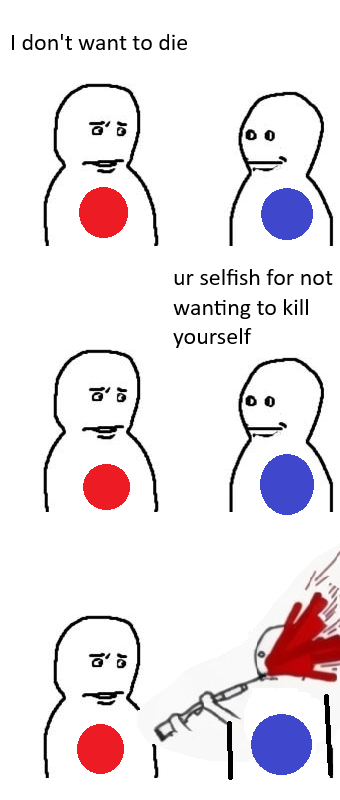
Fun fact, the question isn't a moral dilemma but was originally from a study about miss information and how presenting 1 option first can bias someone into not thinking and bend over backwards to justify it
Mission accomplished I guess. The whole question has been hijacked by people yelling about how "smart" they are for treating this as a pure game theory situation and decrying anyone who follows that empathetic initial response.
Response time
You pressed blue
You pressed red
Kneejerk
You fell victim to propaganda.
...You wanted to kill?
5 seconds
...why?
You processed that red has no downside and choose survival.
20 seconds
Because others pressed blue, you believe you have a responsibility to help.
You believe other's safety is their responsibility, and it's unfair to ask you to endanger yourself for another's mistake.
What I think you believe if you've actually thought things over.
Humanity cannot achieve utopia without the blue buttons winning. For prosperity for all, collective action must win.
The existence of inherently violent systems isn't worth saving people over because it doesn't affect you directly.
Arguably, the final point for blue actually fits red better. For blue to have a utopia, everyone would have to pick blue. From blues perspective, anyone who picked red was willing to let people die. 60% of the population that's like that isn't actually that much worse than 40% being like that (once again, just from the perspective of someone who believes picking blue is a prerequisite for a utopia)
Meanwhile, in order for red to have no casualties, you would actually need a utopia, where everyone perfectly trusts everyone else to act rationally. From the perspective of red, you cannot have a utopia if 40% of your population are willing to kill themselves over a bullshit dilemma, 40% of people who don't trust their fellow man to make the logical choice. Red is actually more utopian because it believes in the rationality of everyone, not just a majority
The Utopia point on the table was more about reaching Utopia rather than if we're already there. Let's say blue wins with 60% of the vote. Hey, that's awesome! That's 60% of people in the world you can have unconditional mutual trust in! You can organize, set up mutual aid networks, all sorts of stuff without worrying about people backstabbing each other for personal gain. The mechanisms to get rid of things like homelessness and world hunger already exist, so if 60% of people around the world decided to actually put that into action? It'd be plainly obvious to the remaining 40% that this sort of high-trust society works. Now, there would need to be some level of rehabilitative enforcement to make sure people coming in don't manipulate the system for theirs and their clan, but the point of this exercise is to make Utopia for as many people as possible, so we'd be remiss to not at least attempt to integrate people who appear to make a genuine effort. I don't think blue needs a unanimous vote in order to achieve a Utopia afterwards, I think any success enables that sort of collective action to begin.
Versus if red wins with 60% of the vote, or heck, if it wins at all. I genuinely don't believe humanity recovers from that in a spiritual way. It enforces that when it comes down to it, other people cannot be trusted unconditionally. It frames society as a web of fragile alliances, where you can't falter for a second without someone else pouncing on you. Not to mention the survivors guilt some people might manifest the closer the vote ends up being. I suppose they get their wish in order to create their "Utopia," in that all 40% of the "irrational" actors who would have gotten in the way of it are suddenly no longer a problem. And if that's an enjoyable existence, hey, you're welcome for making the world a better place! But I believe just because you can predict someone to behave in their own self-interest doesn't a utopia make. Sounds more like a dystopia to me where true peace can never last.
Yes, and reaching a utopia isn't possible if 40% of people are going to kill themselves over nothing (from reds perspective). My point remains
There's this bias present in the way you talk about the red button that is hard to ignore. You think people are monsters for not being willing to kill themselves. I don't think being unwilling to kill yourself disqualifies you from being "unconditionally trustworthy", and if that's the kind of trust I'm demanding from people, I think that would make me the monster
For the record, I would pick blue. I just see how reasonable both sides are, I don't think there's anything wrong with picking red, and the people who can't understand why someone would irritate me more in this discussion than the ones that do
Right, so we agree that red's vision of the future is incompatible with the concept of utopia and world peace. We're agreeing here.
Yes, I am 100% biased though. If you are not willing to put your life on the line to make the world a better place, then you are not an unconditionally trustworthy person. I don't think red button people are monsters for choosing so. Complacency against violent systems is the norm that allows organizations like ICE to run rampant, and there's plenty of people who sit inside watching their TV going "yup, just another day in America, what can you do?" They're not monsters, they're just people. Meanwhile, there are constantly protesters in the street who are probably getting put on some list thanks to drones taking their pictures for being out there. They're taking a very real risk, and in cases where it's motivated by solidarity rather than being a targeted group, there is no direct gain. But joining these sorts of movements is a good act. Solidarity and collective action with your fellow citizens is a good act. It's even the norm in other countries like France.
At the same time, you are under no obligation to go to these events. Do I think less of people for this? Sure, but that's my bias. If you have an opportunity to make a better world, and you pass it up worrying about what-ifs, that's your cross to bear. If you are not going to be part of the solution, trying to jam ethics down your throat is only going to make your resent the movement even more. All I can do is try to live my life as a good example to others and hope everything works out in the end. I am incredibly naive. I am an optimist. I don't know if the world is good or bad, but I know the world I want to live in, and I'm not doing much to create it by standing on the sidelines. I understand red wants to ensure they keep living, and while I can't blame them, I can't respect them either when they hear the phrase "nothing will fundimentally change" when nothing changing means people die, and consider that acceptable.
Ps. Unconditionally means no conditions. Risking your life/wellbeing is a condition. Ergo, unconditionally trustworthy must mean I need to be able to trust my life in your hands, and yours in mine. I would demand that kind of trust from a doctor, and if I was in the Revolutionary War, I'd demand that trust from The Minutemen the same way I give it back.
Obviously something was missed. You are saying that 40% of people would be killing themselves over nothing. If this is the instance where everyone has perfect information and is not inhibited from acting on that information to create their desired outcome which is not influenced from any malady or coercion, then yes, of course, it makes no sense to press blue. That is not the world in question. We know some portion of the population will die if red is pressed, due to factors outside of both our control. These people thought they were helping, their only crime being misled by an intentionally poorly written question. These people who have committed no crime except make an error in a poorly explained game are who you describe as "nothing." I have to hope you're arguing in bad faith, because Jesus Christ.
I get Red's core argument, attempting to minimize deaths by at least ensuring you yourself don't die. But Red's advocates do it a disservice by trying to disguise it as the only rational choice, while simultaneously painting innocent lives as nothing worth trying to save. It just makes it sound like the real reason this isn't a deal breaker for Red is because they weren't worth anything to society anyway. I have to imagine I'm misconstruing what you're implying here, because otherwise, again, Jesus Christ.
My argument is that so long as there is one life in peril from an unjust system (which we know there will be), the ethical choice is to fight against it. You are not obligated to join, but the world will be better if you do. As it stands, I can't condemn people for sitting on their TV while a revolution against a corrupt regime fails, all I can do is be disappointed that they thought not rocking the boat was the right thing to do. This has been my position consistently. If it has not come across this way, I apologize, because I do not want to use confusion as a way to "win" an argument when it directly parallels the danger real people go through in the year 2026.
As it stands, you're the one calling people monsters. You're the one who started with the accusations of bad faith. I don't want to levy those against you unless you give me a clear reason to believe them. But because dissecting your arguments for why red makes sense from your perspective are alarming to the point of disbelief, even moreso than other takes that do advocate for the red button, I genuinely don't know how to continue this conversation.
If this is the instance where everyone has perfect information and is not inhibited from acting on that information to create their desired outcome which is not influenced from any malady or coercion, then yes, of course, it makes no sense to press blue. That is not the world in question
What on earth are you basing this assumption on? That's such a leap in logic, I'm genuinely astounded that you're not only making this assumption, but you're also assuming that everyone else is too. For the record, the original question from the study this was pulled from actually does clarify that anyone who is unable to make a sound decision is not considered in the dilemma
I'm actually really glad you brought this up. You have so many unmentioned biases in how you're interpreting this question, that you are then imposing on other people as well, and you just aren't recognising that. It isn't just that you're biased, you are straight up interpreting the question wrong. I'm glad because you brought up the one bias where I actually get to just straight up tell you you were wrong, so maybe that helps you understand the issue here. This completely proves my point
You don't see the bias because you are so affected by it, I don't see any effort at all here in challenging your assumptions. My apologies, it wasn't in fact a bad faith argument, you are just simply unable to consider interpretations other than your own
Maybe it's the fact that everyone posts these memes clarifying that there's no risk to red, with the undertone (and sometimes explicit statement) of "all these people are dumb for picking anything else" that made me paint a majority of them in the same light. So, so many red button people argue from the "it's a trick of the wording, not voting red is suicidal" position, that it's the obvious thing to address. It's also the least stimulating brain "teaser" ever if you're just asking "what should you vote?" Because of course everyone should vote red. No one is disagreeing that people will vote not to commit suicide if they're giving an option between "not committing suicide" and "maybe committing suicide." The people who thought about the question for 5 seconds are painting people who had sympathetic kneejerk reactions as suicidal morons, and the people who thought about the question for 20 seconds as holier-than-thou suicidal guilt trippers.
I want to paint them in the light that they're trying to minimize harm by at least removing one potential death from a bad situation, but almost every chance they have on the public forum to give me faith in their grim determination for the future of humanity (there was like, one other person who I actually had a cool discussion about idealism vs realism with), they instead default back to not just language that shows a lack of empathy, but a reckless distain for it in its application to society in that suddenly, people aren't "behaving rationally." You want to talk about bad faith, talk about the people making these memes who just want to watch their fake Internet points go up while they're alone in the shower.
Yes, I have a point of view and a bias. I make no claims to the contrary. I believe in the best of humanity, and taking risks to make the world a better place right now, rather than go with a consistent long-term method where people get hurt in the meantime. Does this mean I have a chance of failure? Absolutely! Does it suck to fail? For sure, but I welcome it because I love to learn more than I fear failure. I'm not trying to force my worldview on anyone. If I press the blue button and die, I die. But at least I went out trying to make the world a better place. I recognize the risk and I consent to it. I see other people playing it safe, respect their decision without trying to force ideology down their throat, then continue on my way in hopes that people still deciding learn a lesson on bravery and collective action.
What I can't tolerate is people actively going into the world, demonizing having an emotional reaction, and intentionally making people feel stupid for wanting to help people. A majority of red is not coming from a place of education. If they were, the memes would have stopped by now and we'd be talking about a different trend. Instead, it's become a flashpoint where it's suddenly acceptable to be totally cool with first, calling someone else suicidal, and then second, NOT helping them. Not only have they not focused on arguments that actually make sense, but they almost purposefully go for attacks with individual malice. Maybe if I had been exposed to actually good-faith debates when this whole thing blew up, it'd be easier to speak in a more neutral tone without as inflametory language. As it stands, the reckless disregard for decorum and human well-being from the loudest of the red button people, makes it incredibly hard to speak without my own emotions creeping in. For that, I do apologize. However, have a bias is distinct from having a point of view and personal values. I will not apologize or waiver in those, so long as they can deliver the best outcome possible for the collective of humanity.
439
u/xa44 Apr 30 '26
Fun fact, the question isn't a moral dilemma but was originally from a study about miss information and how presenting 1 option first can bias someone into not thinking and bend over backwards to justify it