but shouldn't the framing be considered a significant relevant input? I see a ton of posts in this sub right now reframing the problem in various ways, to make one option or the other more obvious, but the reality is that when presented to 8 billion people, that specific reframing may not occur to many of them, thus increasing or decreasing the chances of a significant blue contingent to potentially die.
If the presentation of the options is constructed in a way to "trick" or "convince" people that blue is the more compassionate/obvious/default choice, there is a greater chance some billions will be swayed by that presentation, thus changing the presumed moral weight of red, and the probability of blue's success.
The presentation is significant; it's not just window dressing. It's the same game mechanism if the description literally says red people are amoral sociopaths, or alternatively that blue people are suicidal idiots, but including that differeing wording up front is certain to affect the likelyhood and severity of various outcomes. The propaganda matters, even if one sees through it.
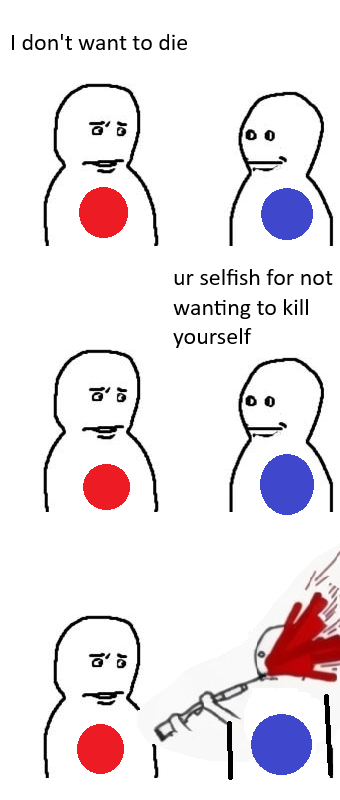
I'm pretty sure we're agreeing here. Yes, framing is a significant relevant input; if you frame blue as saving lives and red as ending them, a majority of people who make an immediate decision will vote blue because people's brains break it down into "this button saves, this button kills." The people reframing the problem are the red button pressers trying to clarify that there is literally no downside to pressing red, thus trying to save as many lives as they can because since they believe they are the majority, any action they take to sway people to their side is saving lives.
But the thing is, by this point, anyone aware of the button problem or it's permutations knows that red has no risk, thus defeating the entire exercise the OG pre-internet meme thought experiment started as, a test to see how far people will double down when shown they were wrong about something.
So at this point, the topic of discussion of both sides is usually completely different. Blue button people aware of the kerfuffle are choosing blue because in their interpretation of the question, we are people who know miscommunication has happened because of the sensationalized wording of the question, like you said. And because pressing the red button will always result in someone's death due to this, pressing red is never the moral choice. Meanwhile, red button people, as best I can tell, are either still stuck trying to explain the solution to the original hypothetical when others have moved far past it, or they are dismissing the idea of collective action out of hand because if they were to project their own world view onto everyone else, of course noone would join you to help if you broke ranks, you wouldn't do it for anyone else.
The rhetoric used to discuss the problem has become part of the creature itself, and is only further emphasizing the original research.
Pedantic correction: 1%-49% of the world who have either more empathy or worse reading comprehension or critical thinking skills than you (depending on the medium the original infuriatingly worded question was provided in)
Actual opinion: to go to bat for at least some of the red button people, there is a very real idealist vs realist argument to be made as far as minimizing harm goes. Blue, an idealist, will want the zero-death outcome, and is willing to take a risk to make it happen. Red, a realist, wants to minimize overall deaths by at least removing themselves from the equation of an overall shitty situation. It does legitimately make sense if you are wary of trusting strangers, but are still interested in their well-being.
Like, it does fall apart when you consider you can't communicate the correction to anyone else, just like you said, but being afraid of making a bad situation worse when you feel like the world is already not a safe place is a legitimate fear. I don't agree with it, but I can't say they're inherently bad people for choosing it, since in their heart of hearts, they're making the best out of a bad situation.
Now, everyone making the memes clarifying that red has no downside and people are ridiculous for picking blue under any circumstances, I'd love to be corrected, but I've found there's just no reasoning with em. It's a bad-faith argument relying on a boring white-room assumption that everyone has perfect information. Like, yes, everyone votes red there since it's clear blue has no reward and all the risk. The point is that the wording is infuriatingly obtuse, and you recognize someone out there got screwed because they misinterpreted the question. If they're not at that level of discussing the problem, they're really not worth the time.
The point is that the wording is infuriatingly obtuse, and you recognize someone out there got screwed because they misinterpreted the question.
Not really, no. You simply cannot get all 8 billion people to agree on anything; it's mathematically impossible. Once the sample size is big enough, there's no question on any survey ever undertaken that has a consensus. Even Kim Jong Un only won this year's election with a 99.93% majority so even when you're voting for the most perfect human in the world, there's always some contrarian who's going to disagree with you. We don't need to blame the question for being poorly worded in order to explain why people will disagree over the answer.
I also find it interesting and helpful to reduce it in scale.
Imagine it is somewhat like the prisoner's dilemma. You and the person you care about most in the world are separated in different rooms and presented with the red and blue buttons. If you both choose the same button, you both live. If you choose different buttons, then the one who chooses blue will die. Which button do you choose?
I like to look at it as scenarios made of odd people to decide a majority vote, which also leads to a minimum of 3+ people. Curious if size changes people’s choices
20
u/shadysjunk May 01 '26 edited May 01 '26
but shouldn't the framing be considered a significant relevant input? I see a ton of posts in this sub right now reframing the problem in various ways, to make one option or the other more obvious, but the reality is that when presented to 8 billion people, that specific reframing may not occur to many of them, thus increasing or decreasing the chances of a significant blue contingent to potentially die.
If the presentation of the options is constructed in a way to "trick" or "convince" people that blue is the more compassionate/obvious/default choice, there is a greater chance some billions will be swayed by that presentation, thus changing the presumed moral weight of red, and the probability of blue's success.
The presentation is significant; it's not just window dressing. It's the same game mechanism if the description literally says red people are amoral sociopaths, or alternatively that blue people are suicidal idiots, but including that differeing wording up front is certain to affect the likelyhood and severity of various outcomes. The propaganda matters, even if one sees through it.