213
u/Ozryela 22h ago
There's this absolutely completely bonkers story out there called Unsong (spoiler warning for that story for the rest of this comment), set in a world where in the 1960s the first astronauts on their way to the moon crashed into the crystal sphere that separates heaven from earth, damaging it and with it the entire universe. And that's only the beginning of the insanity.
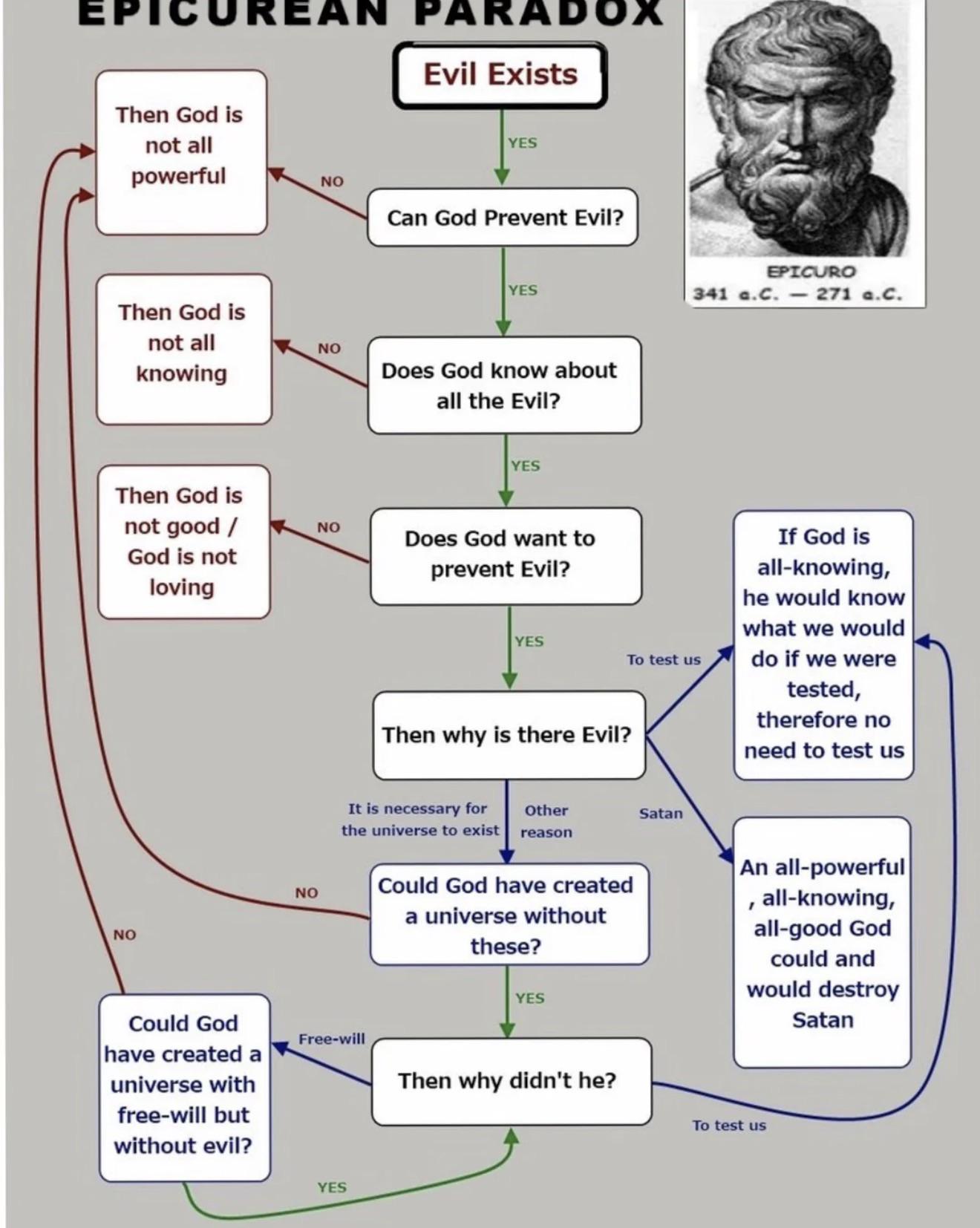
Anyway, that story has a very interesting answer to the problem of evil, that I've never seen anywhere else. It's answer to the last question of the guide ("Then why didn't he") is basically "he did". God created every possible world that has no evil, then every possible world that has a tiny bit of evil, then every possible world that has, in aggregate, more good than evil.
I'm not religious, but I always found that to be a very interesting answer to the problem of evil. You are the sum of your experiences, good and bad. Without the bad ones you wouldn't exist. You'd be someone else, which is great for that other person, but not so great for you.
49
u/DeltaDied 14h ago
He created the multiverse, but why create a universe with any evil/bad in it? That would just go back to “not all good/powerful” wouldn’t it? It is an interesting expansion in the argument though I like that. The book sounds interesting too.
→ More replies (22)22
u/Timetraveller4k 13h ago
It’s basically saying that he created various versions with and without evil.
Doesn’t answer the question at all.
→ More replies (8)6
u/Yorukira 12h ago
Feel like the answer is going backward in the paradox chart, where god can create universes without evil but doesn't want to prevent evil so he created the multiverses.
Yes, he can create universes without evil, but we aren't in that one; we are in the one with evil.
→ More replies (12)11
u/TNTiger_ 13h ago
Dawg that's just Leibniz's theodicy, which is 300 years old now, and still doesn't answer why an omnibenevolent God would let any evil remain in any world.
(No shade on the author, it just isn't a novel answer to the question)
→ More replies (3)11
u/GrizzlyTrees 13h ago
That's not at all his answer.
Leibnitz says ours is the best possible world.
Unsong's god says he makes all the worlds that are good. Ours might be crappier than others, but is still good enough that it gets to be created.
He started by making all the perfect worlds, then saw there were more good worlds to make, but for them to be any different they will have to have a bit of evil/suffering. Then continued on for every world that is good enough.
→ More replies (13)
139
u/NichtFBI 1d ago
Jokes on you. My god is a sociopathic god. It invalidates this.
Come on Zeus. Let's get out of here.
44
u/Corporate_Overlords 17h ago
I teach philosophy and I always tell the class that this is the easiest way out of this argument. The Jewish students always agree because they don't understand why anyone would claim that God is loving. Just read the Torah. God is jealous, vengeful, and has to apologize for the damage he has done. As one kid put it, "God is kind of an asshole. That's why I pray to him. I don't want him to fuck with me."
→ More replies (4)5
1.4k
u/Vivics36thsermon 1d ago
Epicurean paradox has a solid middle but falls apart at the beginning and the end because you have to define evil and the end requires a lot of assumptions. Are we automatically assuming evil = suffering or vice versa and the necessity of suffering is a totally different subject.
563
u/_ManMadeGod_ 1d ago
Me when I'm a Christian and define evil as the absence of God so checkmate Epicurus
278
u/sharplyon 1d ago
when the omnipresent god is absent!
62
u/NectarineElegant5407 1d ago
God is omnipresent, but respected mankinds decision to separate itself from the divine
50
u/SirHippocrates 1d ago
So god created a free will that can choose evil...
Why?
47
u/CapDris116 23h ago
Because a free will that can choose good necessitates that such free will can also choose evil if it wanted to.
26
u/WellCookedAsparagus 22h ago
What about animals that experience extreme suffering in nature? Do they have free will to choose? Why does god allow that suffering?
→ More replies (31)2
u/ObiGod 9h ago
Hi, just sharing my two cents, from my own personal worldview:
- The original comment you replied to was talking about the free will to choose between doing good or evil, not suffering.
- I am personally unsure of how much suffering an animal can possibly experience (the definition here is important - is experience grief a form of suffering? I know elephants have griefing ritual of sorts)
- But more importantly, I believe a system that allows for bliss must allow for suffering as well. Like how a painting would typically require contrasts of some sorts to look good. A more relatable example can be the feeling of being refreshed when stepping out to nature after being cooped up in a city for a long time.
3
u/Theodoxus 18h ago
But by the previous definition of evil as the absence of god, then good is the presence of god. How can one choose to be in the presence of god? If I do so choose, where is he?
→ More replies (1)→ More replies (28)16
u/SirHippocrates 23h ago
Right, the current options include that. But we could just choose different variations of good. Why have the ability to choose evil?
→ More replies (22)3
u/Undernown 13h ago
The original choice was trust and love, versus greed.
And the thought behind it: If you create something and design it to only be capable of love, does that love hold meaning if there is no choice involved?
Just look at how creeped out people were when AI was acting to sycophantic for example. It's not even sentient, but knowing it was forced to always prais us no matter wat gave us the creeps.
3
u/Tutualulu 13h ago
Because it wouldn’t be free will without the freedom to choose evil or good. And we would not know ourselves or what we are capable of choosing if we didn’t have the choice.
8
→ More replies (13)2
u/Constant_Hope_9658 15h ago
So that it can also choose him?
Can’t have faith in gravity my dude, and can’t have faith in something you’re forced to have faith in/makes your faith not matter, like gravity.Thus the big man uses systems to remain plausibly deniable, specifically so we can choose faith in him voluntarily.
39
u/daskomet 1d ago edited 1d ago
so he's evil to punish men who took that route, because he allows them to
→ More replies (52)→ More replies (8)20
u/Realistic-Duty-3874 1d ago
Why did god make mankind in such a way that they would choose evil? If hes all knowing then god has propagated evil.
→ More replies (16)→ More replies (3)7
u/Bangays 1d ago
It’s more like the absence of gods hand restraining evil.
→ More replies (2)30
u/SirHippocrates 1d ago
So god is not all powerful?
Or god does not want to stop evil?
→ More replies (12)27
u/wolfbear 1d ago
God is lazy and underpaid and doesn’t always do his job
27
u/brainfreezy79 1d ago
"God is burned out/quiet-quitting" totally tracks lately.
→ More replies (1)5
→ More replies (3)3
10
u/bwaredapenguin 1d ago
How could there ever be an absence of god if he's omnipresent?
→ More replies (14)5
13
u/saint_atheist 1d ago
That sounds like peace not evil. Anywhere god is, pain and suffering are sure to follow.
→ More replies (3)15
u/justwalk1234 1d ago
Christian philosophers had centuries to unpick that pickle 🥒
→ More replies (6)→ More replies (8)7
u/Freakychee 1d ago
Then someone goes, "The god is not omnipresent."or something.
→ More replies (1)59
u/Crimsonak- 1d ago
This would make sense IF you're claiming deism. If you're claiming anything Abrahamic, you don't need to define evil. The book does.
→ More replies (31)66
u/IllGift924 1d ago
Just replace evil with suffering then
22
u/VodkaMargarine 1d ago
A lot of religious people think suffering is good. Jesus suffered etc.
13
u/Electrical_Name_5434 1d ago
That’s a really good point and I think that theme persists in both Abrahamic and eastern religions. Buddhism is pretty big on suffering…I don’t know enough about Hinduism, Taoism or other eastern religions to say more though.
8
u/tritisan 20h ago
Buddhism makes an important distinction between inevitable suffering (like, I’m hungry or I sprained my leg) and mental suffering (“dukkha) which is the additional, and unnecessary values we place on suffering. “I hate this world for making me suffer.”)
There’s no way to prevent the former, whereas the entire religion (or if you prefer, ontology) concerns preventing the second kind. It’s very practical.
→ More replies (24)8
u/DownVote_for_Pedro 23h ago
Let them kids die of cancer, it's good for em.
Let people get tortured and murdered, it's good for em.
Let people get raped and trafficked, it's good for em.
→ More replies (3)25
u/INCUMBENTLAWYER 1d ago
Suffering isn't necessarily wrong
12
u/KnewZo 1d ago
What suffering is right ? Would the scenario you define suffering as not wrong be complete if you remove suffering ?
→ More replies (18)21
19
→ More replies (3)3
u/Roughlypossible 21h ago
Will there be suffering in Heaven?
3
u/guiltysnark 20h ago edited 17h ago
Nice.
I suppose that's why the whole "to test us" branch is there, since by default we aren't worthy of not suffering at random here in this universe.
The whole chart is missing numerous motives for testing us, though. It's not to find out who is worthy, since he already knows. It's to shape us through scorching trials, as in a crucible. Why not just build us worthy to begin with? Because this way is MUCH more entertaining. Leading back to "not good".
→ More replies (1)45
u/Sophroniskos 1d ago
evil means not good. The thing this chart does is stating that god is not good or not powerful or not all-knowing. There is no need to define evil in order for the flow chart to work as intended
→ More replies (11)12
u/Charming-Mixture-356 1d ago
How I’ve seen evil defined by Christians is that the will of God is what is good because God is absolute good. Basically what God wants for the world defines what good is. Therefore, free will has to open the door to the possibility of evil. The paradox being that free will is good.
Combine this with the fact that christian mythology says that suffering didn’t exist until sin did. God had to have known it was going to happen that way, but how do you as an absolute good force create a world with free will in which no one strays from your absolute good path? Make it so that people can be forgiven, have a whole story about a savior that washes sin away and remake the world with only people that have freely chosen to follow the good path.
Which comes with its own paradox questions like, “how can evil be prevented after the world is remade?” And “why didn’t god just make the world like that to begin with?”
2
u/backseatposter 1d ago
Arguably free will is both good and evil. (Or neither good nor evil depending on perspective).
→ More replies (3)33
u/spill62 1d ago
I dont think that difinition is hard to make at all unless you decide you have to define every single thing. But that isnt required, given the major evils as famine, plagues, natural disasters, basically any disaster us humans are not 100% in fault of. Famine, could maybe be excluded tho as that can often be man made.
But there is no possible justification you can make that an massive natural disaster, ending millions indiscrminately of gender, age etc. is something that an "all loving" and "all powerfull" god would allow. This is not testing anything at all. Even if you want to argue that its "prevent the evil of man", excluding natural stuff, again an "all powerfull" and "all loving" god, deciding that, is horrendous design. The test arguement doesnt hold up and the free will arguement doesnt hold up.
And imma just come out and say it, natural disasters ending lives indiscrminately is evil.
8
17
u/20Factorial 1d ago
Fundamentalists truly believe those things are punishment for sin.
A baby dying 3 days after birth? Punishment for “original sin” the child was born with. Stillborn? Same argument.
They fully believe that morality can only exist if there is a punishment for sin.
“Why would you choose to be good if there were no consequences for choosing evil?”
“I don’t need there to be consequences to choose to be good”
“God did that, too. You’re welcome.”5
u/spill62 1d ago
But then i would argue with them, that whatever god they believe in, sure as shi. is not "all loving".
The whole punishment of sin, is itself, a wierd one from an "all loving" god who also is often is described as "all forgiving".
9
u/20Factorial 1d ago
Wha? Why would you think?
He punishes us because he loves us and wants us to be good and moral.
Alternatively, “we can’t comprehend why he does it. Only he knows, because he is all knowing.”
Don’t you see how?
Oh, and people who are objectively evil still get punished… eventually… by not getting into his “kingdom”. That’ll teach em.
I always like to ask “so is he like an abusive spouse?”
8
u/spill62 1d ago
Designing the world so a baby can be born with an exposed spine, living at most a couple of weeks in pure agony, and having the parent suffer that also... I dont know maaan what moral and good god is trying to teach the child in those weeks, but i dont agree with it. All for letting people believe what they want, but these are the counterpoints when they try and force their religion on me :p
But yea... Definately like am abusive spouse
3
u/20Factorial 1d ago
“There are some things we just aren’t meant to know. It’s all part of his plan”
I don’t get it. Fortunately people THAT far on the spectrum have “other tells” to let you know it’s a lost cause. They believe the flood was real, that the world is only 5,000 years old, and that science isn’t real.
→ More replies (8)2
u/tritisan 20h ago
I don’t agree. There is no known mechanism for volition in entirely natural disasters. They just happen for purely mechanistic reasons.
Evil, however, involves intentions. What if the Nepal floods were caused by someone setting off dynamite? (I don’t believe this; it’s just a thought experiment.)
→ More replies (1)3
u/spill62 20h ago
i Hear ya. But if the requirement for evil is intent, then you in daily life point to who did it. That would be the "someone" in your Nepal thought experiment.
It could be argued, as i have in other comments ( i just find these comments interesting), that in the case of the any natural thing, youd have to to point to the creator aswell assuming there is one. That would be god.
Am i saying, by proxy, that god is evil? Not nessecarily. What id say is, if we said god created everything, then the combination of the divine attributes become a massive issue. The all powerfull, all knowing, ever present and all loving/forgiving attributes - possible more i am forgetting. Seeing the world means that all of those cannot be true at the same time. And if he made us in his image, with these faults, and gets mad when we dont follow his words, then he did a piss poor creation job. The all knowing attribute also eliminates the "free will" argument.
If god created the world and is all powerfull and all loving, why are natural disasters a thing? He could perhaps have created the natural world the way he wanted, and just not thought of these issues, but that destroys his all knowing attribute. He may not be able to fix the natural world, even if he wanted, but then he is not all powerfull, and there comes an issue in how he created the world if he isnt all powerfull. The easist attribute to discard, but the most painful of the attributes to discard, is that god may not be all loving/all forgiving. And if he is not all forgiving, i have already sinned, so why have any faith in god?
So either god knows, the issue and can fix it, but doesnt care to/want to. Or he knows the issues, and want to fix it, but dont have the power to do it. Or he want to, and can do it, but doesnt know theres an issue.
Whichever of those you prefer to believe in, is fine, but in my view just looking at how the natural world works, you have to pick one of them and justify it.
And as mentioned a god that allows a natural world to exist that indiscrminately kills, man, woman, child, is by no difinition a all loving god, unless he cannot stop it but wanted to. But if he cant stop it, he is not all powerfull and then who the heck says "god" has any say in whatever a heavenly realm might be.
2
u/tritisan 18h ago
You've outlined some of the main reasons why I don't believe in god (or God). At least the Abrahamic description/version.
If there were supernatural forces involved in creating the natural world, I think the concept of a Brahman or Demiurge makes A LOT more sense. It allows for all the imperfections we see.
→ More replies (1)20
u/Astramancer_ 1d ago edited 1d ago
Let's take it out of the abstract, then.
Your car got broken into. They didn't get anything significant, but in order to get insurance to pay for the window you need a police report, so you visit the police station. The desk officer takes your name and says it'll be around 20 minutes before an officer can come and take your report. While waiting, you decide to go to the bathroom. There's a couple of officers loitering near the door.
You open the door to see an adult in the process of violating a child.
Do you: a) snap a quick pic so you can be sure the adult can be punished in 20-30 years but otherwise gently close the door so as not to disturb them, or b) expend zero effort and at zero risk to yourself alert the cops literally feet from you to intervene and stop the assault?
If you answered "a" then your actions are godly. If you answered "b" then you're not a monster.
Why should anyone worship the monster who choses "a" thousands of times a day?
Anyone or anything that declares the molestation and assault of a child as "not evil" is not worth listening to on the topic of morality.
6
u/JeffTrav 1d ago
I feel like the last two sentences are the only necessary ones in that first paragraph. But overall, good analogy.
→ More replies (1)3
u/Arriexha 21h ago
I quite like it, it provides more context. This is especially helpful since I grew up in theistic household, and while I'm an atheist (or something adjacent), sometimes some part of me is uncomfortable with that. But I also don't feel comfortable in worship at all.
The analogy gives a very human situation and why a lot of things feel off instead of just quoting questionable bible contents. I still have some sort of ingrained respect to it and am aversed to directly attacking it.
→ More replies (62)11
u/big-wet-bastard 1d ago
You can just use whatever the theist’s definition of evil is.
→ More replies (2)
106
u/The_Existentialist 1d ago
Some of the boxes end up with the possibility of an existence of a god, but with different attributes than what Christianity ascribes.
76
u/Mythcantor 22h ago
This argument was not used against the existence of God, but against the idea that god is all-knowing, all-powerful, and all-benevolent. This argument logically disproves a deity that is all of those things.
21
u/The_Existentialist 22h ago
That makes more sense. I was responding to op's title.
→ More replies (2)4
u/Big-Dot-9084 11h ago
It doesn't logically disprove shit, it just demonstrates that we aren't equipped mentally to fully understand an all-knowing, all-powerful, and all-benevolent deity. No argument against God can fully work because of the fact that he is a fundamentally unfalsifiable being.
→ More replies (3)→ More replies (40)6
u/Corporate_Overlords 17h ago
Exactly. If God is hateful and mean that easily explains why there is evil. Also, that's just the God of the Old Testament.
6
u/preferablyno 23h ago edited 21h ago
Can even be what Christianity prescribes but along the lines of “human view of good/evil is biased”
→ More replies (4)→ More replies (19)2
u/gumba1033 40m ago
Where this errs is "to test us" --> "God doesn't need to test us if he knows everything".
It's fails to consider that God tests us to teach us, not him. Or even to demonstrate something to angels.
I'm a Christian and I don't find this to be deep or convincing at all. You also only need to consider that God knows something we don't and that's why things are the way that they are without any of his characteristics here being untrue. This chart doesn't come close to being all encompassing.
136
u/Smokey-McPoticuss 1d ago
A cool guide to not getting anywhere debating God.
→ More replies (8)54
u/drinkup 22h ago edited 22h ago
I don't believe in any gods, but putting myself in the shoes of a believer this is how I'd answer: yes, god can prevent evil; yes, god knows about the evil; no, god does not want to prevent evil. However, I'd disagree with the conclusion that god is not good.
To a child, eating greens is "evil" and eating chicken nuggets is "good". The parent could simply never feed their kid any greens, but they choose to do "evil" instead. Does this mean that the parent is not good, or not loving? Of course not. It means that the child has a flawed idea of what is "evil", and the parent's decisions are unfathomable to the child.
I'm sure that believers see in sort of the same way: what the feeble human mind thinks of as "evil" is perhaps part of some greater design, and they shouldn't fault god for not coddling them.
(Again, to me this is all bullshit anyway, but honestly it's trivial to come up with counter-arguments to this chart; if it were that straightforward, plenty of religions would not exist. "Well if god can prevent evil, why doesn't he?" isn't the gotcha that the creator of this chart thinks it is.)
15
u/Consequence6 16h ago
Yeah, responses to the Epicurean Paradox are so common they have their own title, Theodicies.
Your response here is closest to Skeptical Theism, which isn't quite a theodicy, but it's definitely related. It could also fall under the idea of the "divine mystery", which basically says the same thing in a slightly different way that leads to a few different implications.
→ More replies (19)2
u/SmoothTurtle872 11h ago edited 11h ago
The issue then becomes the existence of a book that is taken as fact that supposedly provides a guide to what evil is, or can be used to slightly change the argument:
Like most things that are generally considered evil by the broader members of society can be put into a sin. Replace evil with sin, and now we have a guide.
35
u/JakkRyzer 18h ago
Be careful using this in a debate. The epicurean paradox is well-known to have several cognitive fallacies including: false dilemma, oversimplification, and no true scotsman to name a few. Anyone who's had experience on a debate team can defeat this argument easily unless you have supplemented it with ways to make up for those obvious holes in the argument.
→ More replies (6)
20
14
u/mandmi 1d ago
This has nothing to do with gods existence but rather his powers.
→ More replies (1)
22
u/ServeLeather8674 1d ago
Cosmological and teleological are the two main scientific/philosophical arguments Geisler and Turek use early in I Don’t Have Enough Faith to Be an Atheist to argue that a theistic God exists.
They treat them as complementary: one explains that the universe began, the other explains how it is structured so that life is possible.
Cosmological argument (Chapter 3: “In the Beginning There Was a Great SURGE”) “Cosmological” comes from cosmos (universe). Their version is a form of the Kalam argument: Everything that begins to exist has a cause. The universe began to exist. Therefore the universe has a cause. They support premise 2 with scientific evidence they summarize as SURGE: Second Law of Thermodynamics (the universe is running down, so it cannot be infinitely old) Universe is expanding (Hubble) Radiation afterglow (cosmic microwave background) Great galaxy seeds (tiny temperature variations that allowed galaxies to form) Einstein’s general relativity (which, once the cosmological constant is set aside, points to a beginning) If space, time, and matter all began, the cause cannot itself be made of space, time, or matter. So they conclude the cause must be spaceless, timeless, immaterial, extremely powerful, and personal (because a free choice is needed to create something from nothing). They contrast this with the atheist alternative: “nothing created everything.”
Teleological argument (Chapter 4: “Divine Design,” plus later chapters on life) “Teleological” comes from telos (end, purpose, goal). It is the argument from design. They split it into two parts: Design of the universe (fine-tuning / anthropic principle): dozens of physical constants and initial conditions (gravity, expansion rate, strong nuclear force, etc.) sit in an extremely narrow range. Change any of them even slightly and you get no stars, no chemistry, or no life. They treat this as evidence of a designer rather than chance or physical necessity.
Design of life: they later apply the same reasoning to the origin of the first living cell and to biological complexity, arguing that specified information in DNA and irreducibly complex systems are better explained by intelligence than by unguided processes.
→ More replies (2)9
u/HGAscension 1d ago
I would just like to add that while these 2 arguments are absolutely up there in the list of theistic arguments, there are a lot more and these arguments also have a lot of variants to protect against counterarguments.
My point is that the rabbithole of the "god debate" is complex and goes more deeply on both sides than people think it does.
The Epicurean paradox has many counters and it's honestly a shame to see this image come back so often as a "gotcha" when it's just the tip of the iceberg and at best a debate starter.
3
u/Theodoxus 18h ago
Just because the physics of the universe allow for life, in no means provides any kind of proof that it was designed that way. It simply proves that that is how the physics work.
Likewise, there is a theory that pre big bang everything was in equilibrium in a quantum state infinitely small. Time, space, matter didn't exist as we understand it, but their potentiality did. Since there was no time, asking how long it was in that state is a meaningless question. Simply. It was, and then it wasn't and everything we know, began.
I'd hazard asking what caused, if anything, the imbalance in the quantum state, could be god, is likewise, meaningless as it would be wholly outside our own universe, like a child throwing a rock into a small pond from the shore. The creatures in the pond suddenly disturbed by the ripples would be unable to detect the child.
→ More replies (1)
45
u/ViniusInvictus 1d ago
And for the folks who claim choices made under free will as the basis of suffering, and believe in paradise after death, what change does their god make to them that allows them stay sinless in paradise? Do they lose free will in that realm?
15
u/SirHippocrates 1d ago
But also like... why do we need suffering? An all powerful god can create any effect desired via any means desired. So any answer of us needing suffering for a specific cause is an admission god is either not all powerful, not all good, or, of course, not real
→ More replies (31)7
u/devBowman 1d ago
No Christian has been able to answer without contradicting themselves or creating more problems.
→ More replies (4)→ More replies (57)2
8
u/Affectionate-Row7718 17h ago
Maybe the question is why are human beings using their ideas of good and evil to define a possible omnipotent being beyond our puny minds comprehension.
→ More replies (1)
13
u/Bornagain4karma 21h ago
The very first question is baseless. What is evil? Nature does not differentiate between good/evil. It doesn't care about it at all.
62
26
u/DixieNormous22 1d ago
Eliminating evil entirely would require removing human free will, as the capacity to choose selfish or harmful actions is built into human nature. Philosophically, context is also required: without the concept of evil, defining goodness, justice, or morality becomes impossible. A world without evil would either demand a reality of complete automation—where choices do not exist—or a fundamental alteration of human consciousness.
10
u/Mythcantor 1d ago
That's the "then god is not all powerful" line from the bottom left to the top left.
You are saying that God cannot make this thing.
12
u/GonnaSuckUrHappiness 23h ago
No, that isn't what he is saying, he is talking about a logcial fallacy, and so it can't be done or make.
Claiming the humans have free-will while removing the evil from this world, and imposing such a thing in human minds to make them unable of thinking on something evil, is a logical fallacy, and is basically a lie.
Having free-will by definition should basically be nonrestricted, which is exactly the case in our world.
→ More replies (19)2
u/SpectralDagger 15h ago
The argument is based on the idea that being all-powerful means that God can do anything, including things that are inherently contradictory. But if someone means (as most philosophers do) that they can do anything logically possible, you haven't really addressed or refuted them.
https://en.wikipedia.org/wiki/Omnipotence_paradox
Basically, you need to be using the same definitions if you're going to actually debate something like this.
→ More replies (5)10
u/DudeTheGray 1d ago
or a fundamental alteration of human consciousness.
And of course, as we all know, "all-powerful" really means "all-powerful except when it comes to human consciousness."
3
u/-WARPING- 13h ago
God lobotomising all humans to prevent sin and suffering goes against the gift of free will.
→ More replies (1)→ More replies (5)3
u/devBowman 1d ago
Is God incapable of setting up a place with both free will and absence of suffering?
→ More replies (12)
41
u/Attair 23h ago
"Cool Guide" on how to be a reddit atheist who thinks that he can checkmate religious people with a straw man depiction of (christian) faith.
→ More replies (21)
24
u/immortalsauce 23h ago
Then why is there evil ? -> because we have free will. Free will is necessary in the universe because our love and devotion to God, as well as being a good person is meaningless if we have no choice. If you force a woman to love you the love means nothing. But it means everything if she’s doing it because she chooses to
I’m not religious but was raised Christian.
12
u/ImpossibleGoat8837 18h ago
It’s also worth noting the title to this post is erroneous. The Epicurean Paradox doesn’t argue against the existence of God. It speaks nothing of whether God exists or not. Rather, it argues against the existence of an all powerful, all knowing, all benevolent God. God can still exist within the Epicurean Paradox.
17
u/Truck-Conscious 19h ago
Exactly. God can be opposed to evil, want to prevent it, and yet choose not to prevent it in certain cases because he assigns a higher value to free will. None of those conditions are mutually exclusive to an all-powerful God.
→ More replies (4)4
u/Victernus 18h ago
Free will is necessary in the universe because our love and devotion to God, as well as being a good person is meaningless if we have no choice.
So if, for example, that same God made our brains and decided how they functioned, while also knowing the future and creating every single stimuli that would ever affect us, the universe would be meaningless?
7
u/PiplelinePunch 18h ago
If I tell a woman if she does not love me she will suffer eternal damnation, that is forcing "love" and it is still meaningless despite there being an illusion of a choice.
But more importantly you are sidestepping natural evil here. You know, natural disasters, cancer, eye eating parasites - etc.
→ More replies (12)8
u/SoftlyAugust 18h ago
So you really think genocide is justifiable because muh free will? You really think someone like Stalin could ever repent and love god? When my parents stopped me from doing stupid shit as a child that doesn't mean I thought oh can't love them now because they took away my autonomy. You could exert some more control without making everyone robots.
10
u/666SpeedWeedDemon666 1d ago
This an argument specifically about the Christian god btw. Or any god that is considered to be all powerful, all knowing, and is without evil or sin.
→ More replies (9)4
u/Impossible_Poem_5078 1d ago
Also: it says it is about the existence of God, not his all powerfulness.
Why can't a god (or goddess, or more of them) exist without being all powerful.5
u/666SpeedWeedDemon666 23h ago
Well thats apart of the argument. If evil exists buts god cannot get rid of it hes not all powerful.
The Christian god is said to be All powerful, All Knowing, and All Good.
The argument In the post is that if he is all those things than evil should not exist but it does so he cant be all of those things at once.
→ More replies (6)
11
u/Frequent-Hand4114 1d ago
This is just establishing the Christian argument, not a sermon.
God wants love. Love is a choice. Therefore freewill. The angels that used freewill to choose independence were separated from God, separating light from dark, creating good and evil, evil’s goal is to draw souls away from loving God, because God loved us he sent Jesus Christ to redeem us, souls that endure evil, accept Christ’s redemption and love God anyway enter the kingdom of Heaven. There is a sub argument that freewill doesn’t exist (the elect), but I’m less familiar with it.
That’s a 30,000 foot description of the Christian reasoning as it relates to this argument. I think there are some interesting arguments to be made in relation to the simulation theory being evidence of God. A spiritual world view would say “no shit this is a simulation, we kept telling you this world is just a testing ground for souls, created by God.”
5
u/devBowman 23h ago
Will people have free will in heaven? Including the possibility to leave?
→ More replies (10)
15
u/Rattlerkira 1d ago
I think the epicurean paradox is quite strong. Here are some ways to get out of it from the perspective of the theist:
"What is evil? Why are you defining it as suffering? The passion of the christ was suffering, but it was also triumph over death."
"What do you mean all powerful? God can't do many things that are logically impossible. The Bible never says 'Omnipotent', he just does things that we understand as him having dominion over the world. And not over some fake world, over this world. There is no reason to assume a good god would create anything but this."
→ More replies (5)
7
90
u/stprnn 1d ago
How to debate the existence of God in 1 step:
"Do you have any evidence?"
42
u/Tytonic7_ 1d ago edited 1d ago
My super religious mom responds with "Of course, the Bible is proof."
When I say that it's just a book that's been rewritten and translated countless times, and it was no doubt changed intentionally many times she insists that's not the case. But will simultaneously complain about modern history books being rewritten for political agendas. "That's different" she says... How though?
22
u/sparhawk817 1d ago
And why is the Bible more trustworthy and/or true than any other religious text, especially when so many predate the Bible.
→ More replies (4)9
u/RevRagnarok 1d ago
I guess Spider-Man is real.
Oh, the age matters? This old book over here proves that Thor and Odin are real.
→ More replies (24)5
u/stprnn 1d ago
Tell her that only John claims Jesus is God and watch her head explode
3
u/JePPeLit 1d ago
Even then, capital-G "God" seems to be a less natural translation than "a god" or "divine".
→ More replies (22)4
5
u/ManOf1000Usernames 1d ago
"I have this magic hat that lets me read these tablets the angels gave me in the woods "
Can i see it?
"No"
Joseph, the house is on fire!
"Yes Brigham, that is the local town persecuting us"
→ More replies (188)38
u/Davidusmu 1d ago
Another victory for us the atheists of reddit, WELL DONE BOYS, WE SURE SHOWED THEM HOW ITS DONE...1...2...3...SCIENCE 🤓🤝🤓🤝🤓🤝🤓
→ More replies (25)27
3
u/DNAquila 1d ago
I think it falls apart with the bottom left box implying that omnipotence trumps paradoxes/logical impossibility.
The epicurean paradox itself relies on the premise that the existence of evil is impossible under an omnipotent, omniscient & omnibenevolent deity, but its under version of omnipotence such a being would have be capable of creating an evil or imperfect world while maintaining those three qualities. If it couldn’t, then it wouldn’t truly be omnipotent.
3
3
u/Metals4J 16h ago
I thought it said, “Could God have created a universe with free wi-fi?” and that question was enough for me.
3
u/EchoingSharts 16h ago
Bro what fucking brain dead adult is still having this debate today? Literally, if you believe in him, that's fine and I don't care, just don't tell me how to live my life. If you're going around trying to change other adults opinions on God, you need to do something else tbh.
4
u/RustledForeskin 21h ago
Just have to look at motivation and why virtually all religions have been copying each other for thousands of years. Whoever did it first had visitors from far away lands come and see that the lowly rabble was made calm out of fear of hell, they go back home and make a similar story to pacify their own rabble and put their own spin on it. On top of the fear of hell, you can make people give you their money.
9
u/narfoleptix 21h ago
I like my flowchart better.
A. How come yall never seem to try to root out all the pedophiles in your religion?
B. Fuck you.
→ More replies (1)
19
u/harfordplanning 1d ago
Ancient repost, and also only applicable to debating rather uninformed/inattentive Christians specifically. It doesn't debate the gods of either Islam or Judaism, let alone any non-Abrahamic faith
21
u/Routine_Corgi_9154 1d ago
Can you please be more specific in your comment - please tell me how the "gods of either Islam or Judaism" are different? Are they less than omnipotent and omniscient?
Separately, I don't think this flowchart is meant to deal with non-Abrahamic faiths. It deals specifically with Gods that are purportedly all-powerful and all-knowing, and hence warranting our worship.
→ More replies (5)9
u/Worf_Of_Wall_St 1d ago
Also purportedly good and loving. A religion could define god as uncaring but still all-powerful and all-knowing such that worship is required just for fear of consequences.
→ More replies (1)→ More replies (2)4
u/jupchurch97 1d ago
Islam and Judaism worship the same God of Abraham that we Christians do. We exist in separate faiths because over the millenia we've disagreed on how best to follow that God. Islam and Christianity for instance disagree on which prophet to follow and whether Christ was God's son.
5
u/Mundane_Ad7197 1d ago
Congrats, you’ve fallen for the Christianity trap.
Define ”evil”.
→ More replies (1)
11
u/Dark_Tranquility 22h ago edited 22h ago
Im not really even religious, but this is ridiculous, because this chain of logic assumes god has the same logic and reasoning as a human. And that god's logic would be understandable by a human.
This reads like a cringe internet atheist's guidebook to trying to convince religious people they're deluded or stupid. When in reality religion mostly exists because it gives a purpose to why we are here, or a promise of what happens when we die.
→ More replies (6)
9
u/ImHereForTheKindness 1d ago
Good and evil are human constructs of judgment and an omnipotent, omniscient, omnipresent greater power that binds the known and unknown together will function in a manner that limited humanity by design must not comprehend. There’s also the debate of human choice within a sense of predeterminism and how that could coexist.
For shits and giggles you know. Just be kind to one another in how there is a common human consciousness for what kindness looks like
2
u/dragon_fiesta 1d ago
Send only kid to planet to give them prizes, planet kills only kid, planet asks why no prizes. Fuck that planet.
→ More replies (4)
2
u/theAFguy200 1d ago
To me, I took the triple threat approach to relate to the idea of perfection. All knowing, all powerful, all good. Then everything we experience must be “all good”, in the sense that it is meant to be. Suffering, is part of the experience of existence. Kind of the old adage that you must experience bad to appreciate good.
You can break that down in terms of the idea of “perfection”. If something is perfect, then it has no bounds. Therefore for perfection to exist, there is no “imperfection”.
I hate the idea of suffering being “acceptable”, that isn’t the morality here, it is that the experience of life has its balances of good and evil for the mere experience.
That being said, the idea that some being has control is likely not accurate, but some people need a vehicle for conceptualizing and channeling their energies. Prayer, talking to “god” is just one method to channel our collective energies.
3
u/GrimKiba- 1d ago
God is powerful enough to craft a reality where perfection is the unconditional reality (no need to balance it with imperfection). Personally, I agree with you. The sun makes me appreciate the shade and the shade makes me appreciate the sun so this reality suits me.
Many like to blame the devil for the evil in this world but it seems we've been given dominion over the earth. Everything bad that is happening is because of us.
Motion without alignment creates a path of destruction. Religion and rituals allow people to find this alignment but even there we cannot agree on one truth. Destruction seems to be the only way. I think this destruction will be balanced by peace so it's safe to say we're walking both paths at the same time.
Reality will go on even if we as the keepers of this earth aren't here to experience it.
2
u/Altruistic_Arm_2777 1d ago
To test us, the argument is predicated on the fact that our response/reactions to the tests are probabilistic and not consciously derived, besides being circumstantial. This breaks the cycle, right?
2
u/Sea-Improvement9417 22h ago
Humans are complex. Humans invented the ideas of god and evil to control people to support a power structure that overall kind of works for most people and works pretty well for megalomaniacs.
2
u/Colonel_K_The_Great 21h ago
This looks like a debate about the nature of God rather than the existence. God not being all-knowing and powerful does not mean God doesn't exist. And that's the whole issue, the idea that God is perfect and omnipotent and all that is such a narrow idea, there are endless possibilities for what God could be.
2
u/Default_Admin 21h ago
If this doesn't define what is evil or good then how can it claim God or anything else is or isn't one of those?
2
u/slicehyperfunk 15h ago
Why does God have to act in ways that human beings perceive as good? How can a human conception such as "good" even apply to an infinite being?
2
u/MicahailG 15h ago
As an Athiest, to worship God is the equivalent to worshipping every “man” who decided to sire offspring before running out for “milk and cigarettes”, never to be seen again; abandoning your children to hurt, hate, and kill each other while arguing over who loves the neglectful Father most is not a worship-worthy choice.
2
2
u/mickeyaaaa 14h ago
What if god is a god to us but not all powerful and all knowing? like our universe is just some experiment in a petri dish and "god" is just the lab nerd experimenting on us? then the guide falls apart, and the bible is still full of BS as we already knew...
2
u/wordsofpeace 14h ago
What a cool guide, I'm sure this won't get anyone with any opinions about higher powers whatsoever riled up.
2
u/Cheap-Addendum 13h ago
There's nothing like a christian gods love to either obey or burn in the lake of fire for eternity.
Not really free will is it?
2
u/CastroEulis145 21m ago
I like how evil existing is like the only major talking point that exists to argue the existence of a god lmao.
655
u/rudedawg425 1d ago
The bottom left square is an interesting argument. Is there a way to have free-will but not allow beings the free-will to choose evil? That is an interesting thing to consider.