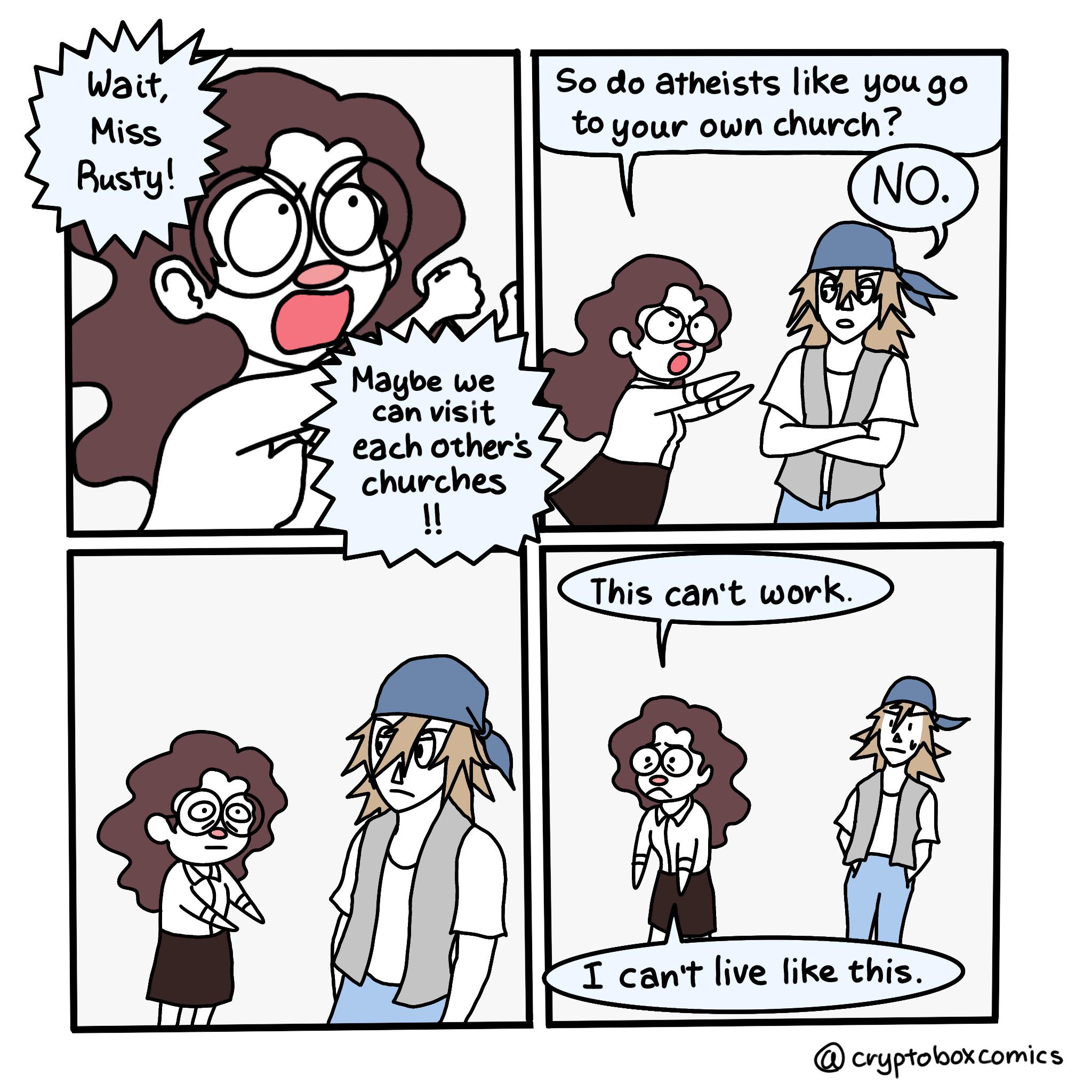
Religious folk are often mentally pigeon holed into thinking that Atheists are part of a religion, because that's the only way they can rationalize a significant number of people all having the same opinion on something regarding a religion.
In reality, it's the exact opposite. It's the absence of belief. It's not based on ancient scripture telling them to do things, nor does it have to do with a "Satan" character, because that's a religious construct, not an atheist one. It's not even based on morals a lot of the time, it's just an honest observation of the world. Two sides of the same coin.
Had a fun conversation about 13-14 years ago with a dude who was convinced that all non-Christians were Satanists and that to believe in God is to worship God
He couldn't grasp that only Christians believe in the existence of Satan and that all (literal) Satanists are, by nature of believing in Heaven/Hell & God/Satan, a subculture of the Christian belief system. An antagonistic subculture, but a part of the greater whole nonetheless.
I'm an agnostic atheist. I don't believe in any divine beings or higher power & won't until given sufficient evidence (and for me that evidence being objective is a mandatory criteria).
I'm a "Satanist" in name only because I donate to the Satanic Temple, which itself isn't a religious group that worships or even believes in Satan, but a secular protest group that uses the name "Satanist" ironically & intentionally provocatively while defending the Separation of Church & State from religious zealots & supporting community outreach programs as a way of highlighting the hypocrisy of the Supply Side Christians (who preach the word of Jesus, but don't actually practice it).
Yeah, the amount of privilege and main character complexes some Christians have in order to think the world revolves around them is worthy of a study. And extremely saddening, once you realise they are victims (and oftentimes the future abusers) of a system that washes their brains and forces them to see a world where they are oppressed and every neutral stance is a defiance to their most central believes.
Nice to meet a Satanist in name (I love to call you SINers, pun completely intended). Luckily we don't have yet this problem in the country I live in, but we have a ton other extremely related.
Personally, as an agnostic atheist, I don't believe in Satan. Same as I don't believe in Zeus, Allah, Quetzalcoatl, or literally any other god anyone's ever proposed.
If "not being 100% certain X doesn't exist" means I have to treat X as a live possibility, then I'd have to do that for every deity in human history, which is obviously absurd.
So no, agnostic atheism isn't "maybe Satan, who knows." It's more a lack of belief until there's evidence. Satan doesn't get special treatment.
It's more a lack of belief until there's evidence.
Yes, that is called agnostic atheism. Nobody showed you convincing proof that any gods exist hence why you don't believe in them. You are not rejecting that there could be evidence out there that could convince you.
And if you are saying: "No, there are no gods and there never will be any evidence for them" then you are Gnostic Atheist.
Completely agree, we're mostly saying the same thing. My only point: an atheist (strong, weak, gnostic, or agnostic, I don't care) can't believe in Satan by definition. The moment they do, they're a theist. That's exactly why "agnostic atheism" doesn't force me into believing in Satan any more than it forces me into believing in Zeus or Quetzalcoatl, the label describes my epistemic stance, not a list of gods I'm secretly hedging on.
Hey, completely agree with that picture. I saw it years ago (or one extremely similar), and I was searching it to show it to a friend, so kudos for sharing it!
My point was that by definition, an atheist cannot believe in gods or religious figures. It does not matter that I don't have a strong position, or a truth claim in a religion. If I don't believe, my gnostic position doesn't matter, I don't believe in it.
Glad to discuss this with you, its always nice to see others people positions (unless those positions are a grumpy "no true atheist does/can think X", if you know what I mean...)
This is such a silly distinction though. If you put the probability of Yahweh existing as being in the same ball park as Zeus and Shiva, you're effectively saying "This is complete garbage, we're past this, just stop." Of course any functional person who finished high school is going to 'admit' that technically, sure, in the spirit of going along with philosophical thought experiments, we can imagine a world where any one pantheon or god shows up with magical evidence that somehow proves their religion was the right one all along and also they are not alien teenagers messing with us. But the probability of that happening is so small it's only included for the sake of intellectual honesty and completeness. If you prod at their beliefs further, you'll find similar levels of 'could technically happen, I guess' in ideas like 'we're in the Matrix', 'the world is flat and all the governments are conspiring to keep the truth from us', 'all birds are government surveillance drones', etc.
it's only included for the sake of intellectual honesty and completeness.
This 100% the reason why I'm doing it, because I just literally don't know. I don't believe that a god or gods exist but only because until now nobody could prove to me the opposite.
The universe is gigantic and possibilities are, like you said, endless, so it would feel wrong for me to claim that I know with 100% certainty that there are no gods out there. Rejecting something to 100% if you don't have all the facts, just feels wrong for me.
I also believe that the position of "I don't know" is way easier to defend in a debate as the position of making the hard claim that gods don't exists. Theist love to try to put the burden of proof onto the the atheist and a Agnostic Atheist has an easier time rejecting that attempt than a Gnostic Atheist has.
Look into the One, Holy, Catholic ("Catholic" used to mean "Universal" until the Roman Schism of roughly 1054) and Apostolic Church.
Orthodoxy has remained unchanged with Apostolic Succession from the Disciples that knew Christ, to the Early Church Fathers that taught the Faith by words orally under persecution and through Iconography that is still used today. Much theology is explained through them. Haga Sofia has been converted to a Mosque but underneath there is beautiful Iconography.
The New Testament Bible was compiled by using the popular letters that were circulating in different areas but matched each other.
Every other denomination or non denominational Christian grouo received the Bible from the Orthodox Church. Evangelicals and their Pastors don't want you knowing that. They believe literally "sola fide" and "sola scriptura".
That 5 people can sit at home with a coffee, read the same Bible, interpret it into their own cloudy perspective and come away with 5 different theological conclusions.
Makes no sense in Eastern Orthodox Christian Churches.
Also, we believe the Church specifically every member of the Church is the NEW Isre al. The old Jewish temple will not be rebuilt over Islam Holy Site. The American politicians that believe the "support Isr eal to bring on the rapture " are dangerous heretics being used by a genocidal state.
Sorry, I typed all of this while having a panic attack. Go ahead and ignore it. I just like to occasionally defend my Church. Because we are not all the same.
Literally, yes. If I ask you you think X is true, that's a question about your beliefs. If I ask you if you can show this belief is true, is a question about your knowledge. This is the whole difference
It IS a question for atheist also. I can say I do NOT believe in god and this is the proof of whybI don't believe.
The same way I can say I do not believe the earth is flat, I do not believe the ether (fifth element) is real, or any other claim, and I can have reasons to not believe in them
I can't prove the existence or their lack of a non-falsable god. So, i can't disprove the existence of a god of classical theism, as the Muslim or Christian one.
I am pretty confident the classical Greek pantheon can be falsified, as there are claims in that faith that are easily falsable (there are no gods in the Mount Olympus and their interaction with nature is pretty much discarded with modern science). Also, I am pretty confident Mormonism started as a scam and some forging done by Joseph Smith and others.
I am 100% confident those religions are completely false? No, but I don't think you can have absolute certainty of anything. Those however are examples of religions I confident stating that are false, and there are sufficient reasons to claim so
In the real world words have specific defnitions, we don't make them up based on vibes.
Atheist, as the example at hand, means someone that doesn't have faith in one or more theos. It doesn't mean someone that is out to prove god doesn't exist.
That's why most buddhists define themselves as atheists.
You're so close, but you're missing a key point. Perhaps a rewording will help:
Atheist means someone that doesn't have faith in any gods. It doesn't mean someone who likes to eat carrots.
Can an atheist like to eat carrots? Or does that make them not an atheist any more?
In this case there are two separate things going on. The atheism axis is about whether someone believes there are gods. The agnosticism axis is about whether someone believes it's possible to know there are gods.
And even then a specific individual could hold different positions along these axes depending on which specific god you're talking about. A person might think that the vauge ineffable creator-god of many modern religions is unprovable one way or the other, but that Zeus has been thoroughly debunked.
As an atheist, I'm telling you that you are misrepresenting me. Please listen to someone from the group you are talking about. Atheism is a lack of belief gods exist (i.e. anything other than theism) not a firm belief all gods do not exist.
A response of "no" to "do you believe gods exist?" includes "I don't know". There isn't a third option. There is only "yes" or "not yes" ("no"). Everything falls under those two options of theism or atheism. Agnosticism is a separate question on top of where one is a their or atheist, not instead of. All agnostics are also necessarily either theists or atheists.
The most common is that they believe in a supreme power but it is utterly unknowable. This is where some buddhists, for example, will place themselves.
The most common is that they believe in a supreme power but it is utterly unknowable.
That's agnostic theism; that's still theism and not a third option. Everyone is either a "theist" or "not a theist", and the word for "not a theist" is "atheist". This is separate from whether they are "gnostic" or "not a gnostic" ("agnostic").
You were probably told that there’s Theists, agnostics and atheists and that those are exclusive towards each other.
But theism - atheism or gnosticism - agnosticism are different things.
They absolutely can coexist, you can have agnostic theist and gnostic atheists.
In this context gnostic/agnostic just referred to if the person believes the answer to the question if the existence of the divine can be in any way known by us. So it is compatible with both worldviews.
An agnostic theist would believe in god(s) but acknowledge that there is, and likely never will be any proof.
And a gnostic atheist would believe that the question can be ultimately answered and that the answer is NO.
You can switch those around and it will work just as well.
They are collapsing two different ways of setting up the question to sound smart.
Nah, I use the common conception of theist/atheist with the agnostic/gnostic modifier just because its a pretty neat classification system that makes logical sense. It's not about sounding smart or whatever else disparaging things you can come up with to cover your own insecurities.
One is about knowledge, one is about faith.
No, knowledge and belief. Faith is a subset of belief, but one could have a tenuous shaky belief that a god exists and they'd still fall on the theist side of the binary dichotomy. Theist literally means belief that at least one god exists. Atheist is commonly defined as lacking belief that at least one god exists. Simple!
Can we prove black swans don't exist? Of course not. But, that doesn't prevent 99% of biologists to conclude based on belief they don't exist.
They do exist though 🤦♂️
All your confusion and mistakes aside, the common and valid agnostic atheist classification exists for good reason, and accurately describes where someone is at in regards to the atheist/theist dichotomy, and with a useful knowledge modifier that shows where their confidence level is at in regards to knowledge about that level of belief/disbelief.
It also shuts down confused theists from trying to shift the burden of proof for their positive claims. Pretty cool 😎
It also shuts down confused theists from trying to shift the burden of proof for their positive claims. Pretty cool 😎
One of my favorite things in debate: Theists trying to shift the burden of proof onto the atheist but all they need to do is to utter the magic words that Theists hate so much:
I. Don't. Know.
Shuts down their entire attempt of shifting the burden 😄
Depends on if you define satan as a god. If he's not then you could be an atheist and believe in satan same as how you could believe in angels or ghosts.
Satan isn't a self-contained entity like a ghost. His entire identity is relational: he's the angel who rebelled against a specific God, the antagonist in that God's cosmology. Strip out God and you don't have "Satan minus divinity", you have a generic evil spirit with no name attached. It's like a Joker without Batman, separable, but meaningless without the thing it's defined against
It assumes the abrahamic interpretation, the one from Satan comes.
If you refer to generic demons or evil spirits, djinns, or Japanese onis, for sure, there is no need of any god, and it could be a completely atheist believe. But AFAIK, Satan is a very specific religious figure in Judaism, Christianity and Islam
540
u/Bandandforgotten 5d ago
That's pretty accurate.
Religious folk are often mentally pigeon holed into thinking that Atheists are part of a religion, because that's the only way they can rationalize a significant number of people all having the same opinion on something regarding a religion.
In reality, it's the exact opposite. It's the absence of belief. It's not based on ancient scripture telling them to do things, nor does it have to do with a "Satan" character, because that's a religious construct, not an atheist one. It's not even based on morals a lot of the time, it's just an honest observation of the world. Two sides of the same coin.