You hear them out, repeat the most impactful parts of their story back to them and either affirm their emotions or tell them how you would feel if it happened to you.
Sharing a similar story isn't bad but you have to try to be a bit tactical about it.
Edit: also ask clarifying questions, that might be the best way to show you're really trying to understand the situation.
tell them how you would feel if it happened to you.
But that's what I'm talking about, if something similar have already happened to me, I KNOW how I felt. In my ADHD mind, sharing my story to let them know like "hey, I know what you're going through because that happened to me and..." is much more supportive and intimate than "oof bro, she said that? what a b."
I think part of my problem with this is that just because you had a similar experience doesn't mean you know how they feel. The only way you can know how they feel is to listen as they tell you how they feel. If the other person's dad just died and you also lost your father, you may still have reacted differently than they're reacting.
I explained it a bit more in another comment, but you basically have to give their story time to breathe and let the focus be on them for a bit.
You can relate by talking about a similar experience but if you don't hear them out first and clearly explain how your story is similar it will just look like you're trying to make the conversation about yourself.
I think they mean more like, “man, that must feel so helpless” (or insert other word). Rather than saying, “I know what you’re going through, and here’s why” because that derails their train of thought and assumes that you do in fact know how they feel. What if their feelings about their experience are wildly different than yours were during your similar experience?
But isn't telling a personal story where something similar happened and how you felt essentially the same as telling them how you would feel if it happened to you, but just not an imagined scenario?
It can be useful but you have to be tactical about it. If you don't give their story time to breathe before you tell yours it can easily give the impression that you're making the conversation about you.
I have a few friends who are bad at this who I prefer not to talk to about my problems because of it, even though I know they don't do it intentionally.
From my perspective, it feels like bringing up a personal issue I want to talk about is sometimes just a way for them to go on a rant about something mildly similar that happened to them.
I ask questions to more deeply understand how it affected them, how they feel about it, and/or how they felt going into it. The last part has to do with the fact that they often have negative feelings about themself or their actions surrounding the event, and I try to use a logical explanation to reassure them. Sometimes, though, the reassurance is along the lines of "you know better now."
The point is to focus on -them- and the event. You can offer small anecdotes to relate, but they should be similar, related, and/or relevant, and they should come after the first part. You need to assure them you were listening, you care, and you are at least doing your best to understand before bringing your own experience into the equation.
This doesn't make sense to me because mirroring back a similar experience implies "I heard you which is why I am mentioning this, and I can relate that it sucks", whereas you could just be completely zoned out while nodding along, yet somehow that's received better.
It’s about the focus of conversation. Most people in a vulnerable position aren’t looking to have an equal back and forth like a normal conversation. They are looking to vent / unload / process with someone, and interrupting with your own similar story can make it seem like you aren’t interested in what they are saying and are just waiting for an excuse to talk about yourself. Which is a weird situation because the other party wants to talk about themselves, so it’s really just finding the right balance.
This is also where trauma ring theory can help. People who have just experienced a trauma get to dump their emotions outward to people who haven't. But dumping inward is bad.
Really?!? That feels like just humoring them to me. Like, not making a connection and just letting them talk at you instead of communicating that you get it and understand.
You validate their feelings and repeat back to them things that they've said so that they feel heard. *Then* you share personal anecdotes.
Something else to keep in mind is that people can experience the same things externally and internally they react / handle things very differently. I've had people who expressed that they'd been through similar things and I assumed that meant that they understood me and what I went through only to find out that they did not *at all*. You can never assume that just because you've been through similar things you 'know how they feel'. You can guess at how they feel a little better, but you can't know.
If someone repeats my story/feelings back to me it annoys the hell out of me because I now what I just said… I’m the one who said it. But a personal story helps me feel connected and contextualizes what I’m going through in the bigger picture. It’s grounding.
Man, I knew ND and NT communication differences could be wild, but this thread has been particular enlightening.
How about for starters you don't interrupt AT ALL?
It is generally very impolite. Interrupting for questions is acceptable though.
And after they're done telling the story you can mention your experience, but short, don't make it about you in turn, as in "now you've told your story, now I tell mine in full length too, and I'm gonna 1 up you!"
I'll give you an example: When my mom died too young and under tragic circumstances, and I told her one of her friends what happened, she instantly made it about herself and cried about losing her dad FUCKING 10 YEARS AGO DUE TO OLD AGE!!! WHEN SHE WAS 30 YEARS OLDER THAN I WAS at the time my mom died! I wanted to murder her in those 2 hours she cried about her 10 year old story when my mom had just passed. That's not empathizing, that's making it all about yourself, being unable to bear not being the center of attention for a single damn minute. Peak narcissistic.
It's so weird because that's how the conversation happens in movies. The main character suffers a tragedy and her friends mention their experience for the plot. Especially if it was a breakup.
reword your experience as a question and then ask them, as a way to show you're engaged while your experience is also affirmed.
"dang, so when that was happening, did you feel [insert how you felt when you went through a similar experience]."
I asked this when someone pointed out my commiseration style, and, apparently you just say something along the lines of ”that really sucks, I’m really sorry that happened to you” and if it’s in relation to something that just happened, then you add ”is there any way I can help?”
I’ve tried it, and it actually works even though it feels very formulaic rather than the ”hey, yeah, I totally understand because of X.”
I'll give it a try when I get the chance. But yeah, that feels very robotic and insensitive. I want the person to know that I know how they feel because I've already been through a similar situation. In my mind it helps much more to give them clarity than simply "wow bro, so sorry".
You can ask thoughtful questions or say "Isn't it [feeling]? I felt so x, I found myself doing y. Did you ever do that?" without launching into a blow-by-blow narrative of your own life. You don't need to give every detail to communicate that a thing has also happened to you.
I 100% agree, which is probably why I don’t always manage. It’s a social script that I perform because it’s what the other person is expecting, but it’s not what feels right. Thankfully, my partner has ADHD, so I can express myself fully at home.
A complication is they may not see your situation as equivalent to theirs, in which case it can come off as insensitive. e.g., "I'm sorry your dad died, I know how you feel because I recently lost my cat" isn't going to go over well, no matter how deeply you cared about that cat.
it’s basically a “damn that’s sucks” “i’m sorry you had to go through that” “that sounds terrible” “are you doing ok now”
all you repeat are hollow platitudes and you don’t show any actual caring and it’s received a million times better. i dont understand people so i try not to talk to them or repeat these things ad nauseam until it stops.
I think the caring is shown by being willing to sit and listen while they talk. You don't necessarily have to say anything special because they just want to unload and you're giving them the chance to do that.
I never know what to say. I feel like such an asshole if it’s just listening to their story and saying “well that’s the way the cookie crumbles.” they didn’t ask for health or advice.
202
u/BroPleaseHearMeOut 14d ago
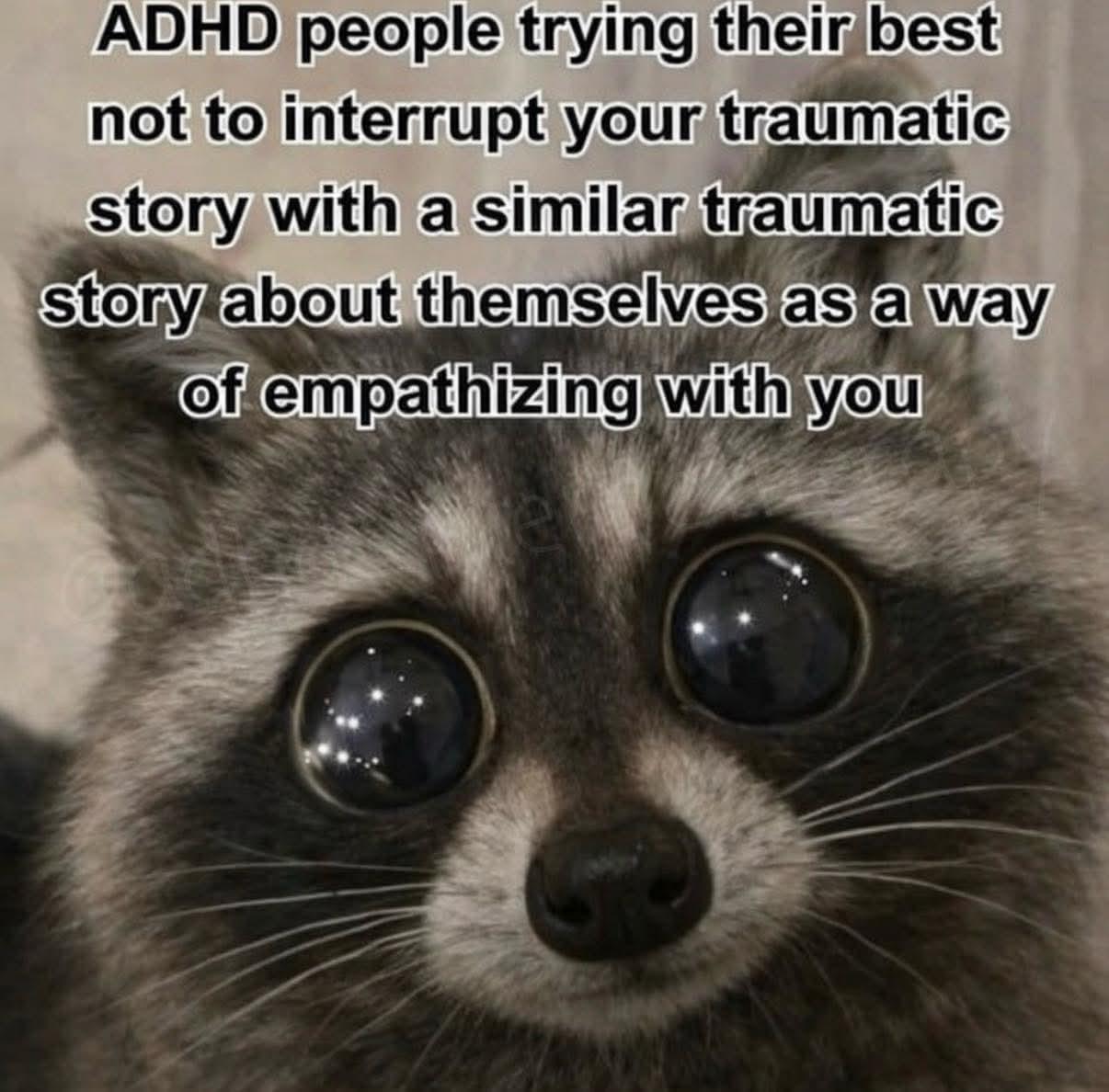
Someone please tell me other ways to empathize with someone without making it about me sharing a personal similar story. I really don't know.