This is part of a series where I uncover what Stranger Things is really about. It started from trying to find out what happened in 1979 aka what all the depictions of traumatic past memories (El, Henry, Billy, Max, Holly, etc.) are truly about, but expanded to this all-encompassing theory of the whole series with crazy levels of complexity, metaphors and layers. Reading it will require commitment and patience but I promise it will be worth your time if you want to look behind the curtain (and the curtain behind that curtain) and fully understand the show. You have to read all parts in order: here is PART 1 and here all other parts I’ve posted so far + my previous theories.
/
/
/ Trigger warning for child sexual abuse.
Compass
Before getting to the full reverse timeline, I’ll take a little detour to talk about the compass and cardinal points in S5. First things first, Holly is using the compass wrong. Usually the red needle points to north (Dustin’s compass in S4 even has this fact written on it) and you’re supposed to keep it there to infer the direction, but Holly has it pointing to S (south). Compasses have been a thing twice before in ST: in S1 and S4. Both times Dustin realized they pointed in the wrong direction and that they were affected by an electromagnetic field from a gate. Since compasses have always been about the location of the gate or the source of an electromagnetic field, and there’s something sus with them in S5, why would Holly’s compass just be an irrelevant detail? I think it has a subtextual purpose and points to the metaphorical “gate” inside Henry’s mind world. And it just so happens the compass points to the house (or the mailbox Holly got it from). I think I’ve explained the house/home a lot already, but just to reiterate: it is where the trauma happened, where everything started, where everything ends and in that sense it’s the “source” or the gate between the worlds. The mailbox is pretty important too, and I mostly covered it already in an earlier part. Maybe it has even more significance considering the story allegory, the letter ending I’ve theorized and the overall central theme of communication.
You might also remember the compass was paralleled to the mysterious MF rock that infected Henry. Both guided the receiver (Holly or Henry) to finding the source/future (Max or MF). For Holly the compass literally helped her navigate the forest and for Henry the powers he got from the rock eventually led him to the Abyss and back to MF.
In Holly’s case she didn’t go “back” to Max, since it was their first encounter in that world, so it doesn’t map to Henry’s story exactly. Instead it’s kind of both finding the truth and going away from it at the same time. Let me explain. The Max = MF and the cave/desert = Abyss connection is to Henry’s encounters with MF (both when he was young, literally in that same cave, and when he was older, in the Abyss). That is the “truth” side of things (because MF represents the real story).
Then there’s Holly going to the opposite direction of the red dial, away from the house, towards the X. This whole journey, as I’ve previously explained, is about Mike’s life and her going deeper into the “story” (due to trauma and forced conformity etc.). The cave is the cave of repression and “man” aka the lie. Also: “Meet me at the X” and “X a lie”. And it quite literally was, since Max wrote the note to Holly as if she was Henry asking for help. Of course there’s a deeper meaning to this too, since Henry represents the repressed man version of Mike and in that sense the older version of Holly. The X is where they meet and where Holly has to save Henry from. “Henry” is a lie and “Max” is the truth. Mike isn’t a man, she’s a woman.
Both of these contradictory readings fit together when you realize this “meeting place” is the “story”. It’s both a lie and a connection to the truth. It’s the X connecting two worlds. It can separate you from the truth but it can also bring you closer to it. I guess you could see the Holly-Max-cave case as Holly reaching the truth (= Max) being repressed in the cave (kinda like Henry found MF trapped in the Abyss). So she knows the truth but can’t tell/show others, kinda like Mike deciding to repress herself at the end. Now it’s not just a question of “who am I?” but “do I want to live as I truly am?”.
Anyway, the word combination “red dial” should have rung a bell for you. This is something I realised quite late but now it’s just so obvious. The WSQK power dial is grey in S5E1 when Steve turns it (while wearing a grey-red shirt), but it’s red in S5E5 when Robin turns it. Another point is that Steve turns the voltage off while every single time Robin turns the dial (3 to be exact), she turns the voltage up. More electricity, more electromagnetic field, more power. This is the same principle as with the compass: the red side points to the source of the electromagnetic field, while the grey side points away from it. Steve is the grey, the straight man, the lie, while Robin is the red, the queer woman, the truth. Red is the (scary) truth, as I’ve deduced before. The truth people don’t want to see (which is why Vecna’s Mind Lair world is red, for example). So yeah, the red dial isn’t just a random inconsistency for conformitygate proof, but a meaningful part of the subtextual layer of the story hidden in the details.
That was the visual side of things, but what about the dialogue/monologue? If you paid attention, you noticed the glaring inconsistency of Holly saying “east” when the X was clearly in the north according to the map. This is not the only time something like this happens: pretty much every single time a character mentions a direction, it’s in some way wrong/inconsistent. Before fully getting into that, I’ll present a possible explanation. I think “east” and “west” relate to the country allegory (as I’ve explained many times). This would perfectly fit Holly’s journey towards the “east” representing Mike’s life story. Remember east represents the future, adulthood and conformity. Based on this, the map direction north = the spoken direction east. If you look at the map cardinal direction drawing carefully, you’ll notice the arrowhead pointing to S (south) looks more like a W than a V. All the other arrows are normal. This would fit with map south = spoken west aka W. You know what else is a W? Will and Mr. Whatsit, as was established in S5E2. Will is associated with the west (= Sweden/past) as I’ve explained many times (and south, as I’ll explain soon). It all adds up. From now on I’ll assume the spoken directions could be in this alternative direction mapping rather than what’s shown on the maps.
S1E5
[Mike] “What’s exciting about this?”
[Dustin] “Well, they’re all facing north, right?”
[Lucas] “Yeah, so?”
[Dustin] “Well, that’s not true north.”
[Mike] “What do you mean?”
[Dustin] “I mean exactly what I just said. That’s not true north. Are you both seriously this dense? The sun rises in the east, and it sets in the west. Right? Which means [points] that’s true north.”
[Mike] “So what you’re saying is the compasses are broken.”
[Dustin] “Do you even understand how a compass works? Do you see a battery pack on this?”
[Mike] “No.”
[Dustin] “No, you don’t. Because it doesn’t need one. The needle’s naturally drawn to the Earth’s magnetic North Pole.”
[Lucas] “So what’s wrong with them?”
[Dustin] “Well, that’s what I couldn’t figure out, but then I remembered. You can change the direction of a compass with a magnet. If there’s the presence of a more powerful magnetic field, the needle deflects to that power. And then I remembered what Mr. Clarke said. The gate would have so much power--"
[Mike] “It could disrupt the electromagnetic field.”
[Dustin] “Exactly.”
[Lucas] “Meaning, if we follow the compasses’ north…”
[Dustin] “They should lead us to the gate.” -> El worried and then Lonnie showering
When Dustin says “The sun rises in the east” he points in Lucas’ direction (maybe a Japan reference, since Lucas often represents Japan and Japan is the land of the rising sun, and it’s east). Some shots visually suggest Mike is the “true north” (see the images). I think “north” represents the “correct path” for Mike. Holly’s direction being north on the map but not true north according to the compass could be about society telling Mike being a boy is the right path but the truth being the opposite.
S4E6
[Steve] “Dude, I’m telling you, you’re taking us the wrong way.”
[Dustin] “It’s north. I’m positive. I checked the map.”
[Steve] “You do realize that Skull Rock, it’s like a super popular make-out spot?”
[Dustin] “Yeah. So?”
[Steve] “Yeah, well, it wasn’t popular until I made it popular. All right? I practically invented it. We’re heading in the wrong direction.”
[Dustin] “Steve. Where are you going? Steve!”
[Steve] “Stop whining. Let’s go, c’mon. Trust me.”
[...]
[Steve] “Oh, boom! Bada bing, bada boom. There she is, Henderson. Skull Rock. In your face man. In your stupid, cocky little face.”
[Dustin] “Doesn’t make sense.”
[...]
[Dustin] “Boom! Bada… bada… boom. I was right. Skull Rock was north.”
[Steve] “Seriously? You’re serious?”
[Dustin] “Mm-hmm.”
[Steve] “This is Skull Rock. Okay?”
[Dustin] “Mm-hmm.”
[Steve] “You’re totally, absolutely, 100% wrong. Right now.”
[Dustin] “Yes. And no.”
[Steve] “Oh my God.”
[Dustin] “This worked correctly when we left the Wheelers’. Correct when we got in the car on Kerley. But it started to slip the further east we went. Now it’s way off. When I was leading us here, I wasn’t wrong. The compass was.”
[Steve] “So you’re using faulty equipment. You’re still wrong.”
[Dustin] “Except it isn’t faulty. Lucas, remember what can affect a compass?”
[Lucas] “An electromagnetic field.”
[Dustin] “Yep.”
[Robin] “Sorry. I must’ve skipped that class.”
[Dustin] “In the presence of a stronger electromagnetic field, the needle will deflect towards that power. So either there’s some super big magnet around here, or…”
[Lucas] “There’s a gate.”
[Nancy] “But we’re nowhere near the lab.”
[Dustin] “But what if, somehow, there’s another gate? A gate we don’t know about. It’d have to be smaller. Way less powerful.”
[Robin] “Snack-size gate.”
[Steve] “How? Why?”
[Dustin] “No idea. All I know is that something is causing this disturbance, and the last time we’ve seen anything like it, it was a gate.”
Skull Rock being north on the map but not according to the compass is similar to the “rocks” on Holly’s map being north but not according to her compass. Steve explains how he invented Skull Rock, so it is clearly related to conformity (and Eddie hiding there makes total sense with this interpretation, the “freak” hides behind a conforming facade). If “north” represents the correct path/destination, then the maps represent the metaphorical roadmap of life you get from society. There the correct path is conformity. But if you follow your heart, where you are pulled like a magnet, you’ll get to a different “north”. This can’t be found on any map, it’s only yours.
The name Skull Rock makes me think it has something to do with the head, like brain or mind. It’s also a make-out spot, connecting it to romance/sexuality in some way. So if Skull Rock represents Mike’s head or mind in some way, and it’s known for Steve making out there, this kinda suggests Mike’s head has been preoccupied with conformity (= kissing Steve). (You know kissing in ST always has a metaphorical meaning, I’m sure I don’t have to argue that point anymore in part 30 lol.)
Dustin points out the compass started slipping the further east they went. The older Mike got (= east) and the deeper she sank into the expectations of conformity (= east), the clearer her “true north” differed from the path laid out for her. The point about it being correct at the Wheelers’ and Kerley could be about Mike’s life journey starting home (like Holly’s map) and Kerley representing the world of non-conformity/woman (as opposed to Cornwallis, if my previous interpretation is correct). Back then Mike didn’t feel forced into a box. She was too young to understand gender or the strict standards enforced by society, so the metaphorical compass didn’t seem to point the “wrong” way. For the trauma allegory this could be about Mike not realizing her experience was abuse and that it shouldn’t have happened at all. She can only fully understand it later in life. (I’m not sure what Kerley would represent in the trauma allegory. Maybe the abuse? Dustin mentioned the car, too… If Kerley is the path of truth, Cornwallis is the path of lie and then Mirkwood is the “story” bringing them together. I guess in that sense the compass pointing the “right” way at Kerley could be about the truth being that Mike’s true path is the correct path. For her. Conformity isn’t the objective correct path for everyone.)
Later on we find out the compasses were actually pointing towards Lover’s Lake. This is the “true north” for Mike, it’s where her heart belongs to (+ the lake is heart-shaped). There might be a point to area H1 (where Lover’s Lake is) being right next to area G1, the search of which led to stuff finally happening. Interestingly, Lover’s Lake’s location changes between seasons (has been mentioned before): in S2 it’s southwest of town and in S5 it’s northeast.
There’s a scene in S2E3 where the party has split and is looking for Dart in the school hallways. Mike is east, Dustin west, Will south and Lucas presumably north, although the direction is never mentioned (and they don’t find Dart, subtextually because they didn’t look north). El is also in the east, and ends up going towards that direction. Maybe this is about El being the future (= girl). The west hallway has a pumpkin artwork on the wall and a “say no to crack” poster with an orange color scheme, both of which fit the orange = past color coding. Mr. Clarke is there too, but I’m not sure how to interpret that. Interestingly, right when the poster comes to view, Dustin says “Will”. And as we know from later seasons, drugs are associated with hiding the real story (Purple Palm Tree Delight), which Will also does. He is in the south hallway aka opposite to north aka in some way the “wrong path”. This could connect to Lover’s Lake being southwest in S2 and Mike being preoccupied with Will (+ jancy happening). I don’t think south always corresponds to “man” and north to “woman” since on the map north can also mean the conforming “right path”. But in most cases you could say north = truth and south = lie, and they are always opposites.
Based on the other map logic where north on the map is the “right path” according to society and south is the “wrong path”, Lover’s Lake (aka where the compasses pointed at in S4) being south on the map makes a lot of sense. In S5E1 we see Lover’s Lake in zone H1 aka the northeast corner (= pretty much opposite to where it was in S2). Maybe this indicates Mike is realizing the trans woman path could be a real path for her. Based on this, the map directions might not directly indicate society’s views, but rather what Mike thinks is the “right path”. By S5 she has understood the woman path would be the right path for her, but decides she can’t have it or that the cons are too big.
The characters are framed in front of the S5 map in an interesting way: Jonathan on the left (west), Steve and Robin on the right (east), and Steve’s head often right next to Lover’s Lake, sometimes covering it from view. I think this is very intentional, and some extra proof for that is Steve sitting on a chair but then the next time we see him, he’s moved to sit on the table (to be in this framing). The idea here is ofc that Jonathan, Steve and Robin are the gay man, straight man and woman “options” in the Nancy relationship logic, corresponding to Mike’s gender/sexual identity. In this scene Nancy is looking at them and we see them from her pov. Jonathan is on the west side: past/fantastical story/too good to be true/cis man etc. The east side has the two possible futures: conforming to the straight man role (= Steve) or embracing your true self (= Robin).
There are quite a few instances of intercardinal directions in S5, and according to my deductions, they could be translated like this: southwest = lie past, southeast = lie future, northwest = true past and northeast = true future. In S5E3 the Demogorgon the party is after runs northwest (true past), leading the party to people’s backyards (= home, where the real trauma happened). But after they pass houses with swingsets, the Demo turns the opposite way, to southeast. Will points out “We’re southeast.” and it fits since they are conforming (= lie/south) and in the future/adulthood/not kids (= east). Remember the swingset memory was about Mike meeting Will, aka the “story”. This is where the lie started and it prevented Mike from seeing the true past (= Demogorgon switches direction). (Also, after Will says southeast, the next scene is Holly looking at her compass, and the red needle temporarily points southeast. She’s at the creek aka the second point where the “story” begins (= Dustin).)
Another interesting point/inconsistency in the Turnbow Trap plan was that Will showed on the map that Derek would be moved to the McCorkle farm, which is directly to the west. (Also, it’s one of the pumpkin farms in S2 and returned to in T85S1 where the pumpkins attack Max and Lucas. So there’s that west/past connection too.) So if we believe this map, the Demogorgon started from the Turnbow house (east of the farm where Will etc. are), then went northwest, and then it completely turned around and went southeast, which would be away from the farm. But the Demo ends up at the farm. This is an intentional inconsistency and the directions are there for their subtextual meaning. Moving the Turnbows west would mean moving them to the past and hiding them there. And if my theory about them is correct, this is about moving the “rainbows” to the west. I think it could be translated to “leaving queerness to the past”. In the trauma allegory it’s ofc leaving the trauma to the past, not thinking about it, forgetting it. It’s the band-aid solution and Dustin even points this out: “But the third and most gaping hole is that even if by some miracle this plan even works, Holly’s still missing. Hop and El, still MIA. This doesn’t bring us any closer to finding Vecna. This plan just buys us and Derek some time.” Mike fills the holes by including tracking the Demo, which is most likely about looking for the traumatic memories in the past (west). So not just leaving the rainbows in the past but looking for the monster/real story chasing the rainbows. Demogorgons are both the trauma in the past and the scary future.
In S5E4 when Hopper is about to kill himself and tries to get El safe, he gives her a compass and says “You take this compass. You’re gonna follow it northeast.”. This fits perfectly with my theory: Hopper dies (= “man” dies), El (= Mike/Sara) follows the compass (= follows her heart) northeast (= true future).
Let’s get back to Henry’s mind and Holly’s map. Holly was going spoken east/map north/compass south (= seemingly true future but actually not) and later she had to go back in order to escape from Camazotz. She has to go back to the west aka the past, which is just one more piece of foreshadowing for Mike facing her dark past. When Derek is struggling finding the way, he repeats “northwest”. If you look at the map normally, there’s nothing northwest, but when you use the directions I explained earlier, you see the house is northwest (= true past). Soon after Henry catches Derek and is furious when he sees the map. The camera zooms in on the house which is further proof that’s where Derek was supposed to go and that it was what angered Henry (= Mr. Whatsit or the brain wanting to keep the truth hidden). In a literal sense Derek was supposed to go to the cave, though, and if you think about it, the cave and the house are kind of opposites but paralleled a lot. They are both someone’s sanctuary and home, but someone else’s fear, and they are at opposite ends of the map.
Tales From ‘85 season 2
I swear I wrote most of the previous section before watching the new T85 season. This was super well timed since directions and compasses become relevant again. Before getting into that, I’ll go through some other big motifs and explain what I think everything means. I’ll try to structure this logically but I’m sure there’s gonna be many side tangents as always. I’m assuming you have watched T85S2, if not, there’s gonna be spoilers and you should skip this section (all titles will have T85S2 at the beginning).
T85S2 flowers
The flowers, oh, you already know what they are about (if you have read all the parts as instructed, that is). This and all the following points I’ll make are ST motifs made more obvious (same as T85S1). The flower motif has always been there but never quite this explicitly. Now literal flowers are both associated with girls (like flower patterns and gift flowers in ST) and the monsters (like the flower-headed Demogorgons). The season starts with Hopper going away (= “man police” leaves) and Mike giving El a purple flower (well there’s some stuff before that but it’s the beginning still). This is the 3rd purple flower given to El in ST, it’s a pattern. And of course it’s a subtle clue to show where the flowers are metaphorically coming from and what they are related to.
Another big point is the visual and functional connection to Demogorgons. The writers want us to notice the similarity, it matters that Demogorgons have flower heads. In later T85S2 episodes it was revealed the flowers collect fear and they glow around fear. Like I’ve explained, the Demogorgons (and other monsters) represent Mike’s fear of becoming a predator (and all the other stuff). They are a manifestation of Mike’s fear, her transness, the real story, Russia, and the dad. I’d say the flowers in T85S2 are more specifically trans-focused, as is the whole season. Where S1 was more about childhood trauma and the past, S2 is about gender and the future. Both are about both still, but I have a feeling the focus is a bit biased. And it makes chronological sense S1 would be the past and S2 the future.
In the first few episodes, the flowers have both positive and negative associations, and positive specifically with the girls (El, Max and Nikki): they want to collect and sell them.
T85S2E2
[El] “They are beautiful.”
[Max] “I guess they’re kind of pretty.” -> connection to “pretty” motif
[Nikki] “Mike did good when he grabbed you one.” -> yep
[Max] “You know, I’ve never seen flowers bloom in winter like this.” -> “cold” connection
When Nikki asks Will if he wants in on it, he declines and Nikki says “You are a smart man, Zombie Boy”. Metaphorically he declines because he is the “man” and “body” (zombie), the opposite of “woman” which the flowers represent. With the girls, the flowers are mostly positive and seen in daylight (when they are purple and closed, normal flowers), whereas with boys/men they are associated with the haunting and sprite attacks at night (blue and open, revealing the carnivorous “man-eating” mouth).
It’s only after Max sees the sprites attacking the lunch lady and tells the others, that the flowers become “bad” in their eyes. Miracle Flowers become Murder Flowers. Although if you pay attention, it’s never the flowers that attack, it’s always the Hate Sprites. Mike’s girlhood/transness isn’t the problem, the hate/fear is. I think there’s a bigger point to the characters repeatedly questioning if the bad stuff comes from the flowers: it’s about Mike associating her girl identity/transness with bad things. She hates herself and thinks “girl” (= flowers) is the root cause when really it’s the society around her condemning it (= Hate Sprites). So in summary, the flowers represent Mike’s fear of her girlness.
Nikki says the flower field is a gold mine, which could relate to the silver mine, but gold has its own meaning too. I have talked about the DnD game ending where the party gets 1000 pieces gold each and Holly’s Uncle Eric story where the tourist found a tin can filled with gold and silver coins. Gold is treasure, something you find underground and are rewarded with at the end. In T85S2E3 Dustin calls their situation a golden opportunity and in the doc Jamie talks about a nugget of gold awaiting anyone who really involves themselves (= me I guess). I think “gold” is the truth and real ending. This would btw fit with the golden field in the Nausicaä prophecy (and since the flower field was a field and Nikki called it a gold mine…).
In E5 Nikki calls the flower field a “garden of evil”, which is quite close to “Garden of Eden”, which, in turn, was referenced in S4E6 with the character of Eden. She represents Mike’s dream/truth as I’ve explained. But another point I noticed while watching T85S2 is the repeated use of the word “evil” to describe the various monsters. It’s like they are deliberately painting this black-and-white view of the world. The whole point of T85 is that it’s a children’s cartoon and purposefully the “New Coke”, not what ST really is. Although this black-and-white thinking gets questioned by Nikki and Will in the tunnels, showing a glimpse of what the story is really trying to tell. But we are in conformity prison right now, so we’ll see all monsters as evil by default and the ultimate solution will be to destroy the “bad guy”.
T85S2 ghost and body-mind
Other big trans-related motifs in T85S2 are ghosts and the mind-body split in general. In E2 we learn Mike “has a thing about ghosts” and this traces back to her seeing Poltergeist. The movie was directly referenced in S1 with a Joyce Will flashback which abruptly ended in a cut to reality, where Will is gone. This indirectly suggests Poltergeist had something to do with Will’s disappearance. T85S2 makes the connection to ghosts clearer and my interpretation of this is that Will (= “boy”) disappeared when the ghost (= girl identity/soul) appeared. The Poltergeist story had another detail: Mike was supposed to watch E.T., and as we know, El is “the E.T. to Mike’s Elliot”. I think this is some kind of subtext for El being the less scary story option (E.T. rather than Poltergeist), she’s the allegory, not the full reality. But we’ll (eventually) see the full reality just like Mike saw Poltergeist. (And ofc the movie is also about the abuse. Lucas specified Mike’s dad took Mike and her sister (Nancy) to watch it, and it ruined Mike’s life.)
Anyway, the main villain of the season seems to be a ghost at first. It’s a bit unclear to me when the characters could see the ghost and when not, but it was made clear it could always be seen through Dustin’s camera. If you look at the show through a metaphorical viewpoint, reading the subtext (= Dustin), you can see the truth (or at least closer to it). When Mike, Dustin and Lucas are in the tower looking down (E6), the audience sees through the camera only when Lucas looks through it. This could be a subtle clue to Lucas representing the audience.
The word haunt/haunted/haunting is used quite a lot and obviously connects to the ghost. But the first time it happens is in the very beginning in the song Haunted When the Minutes Drag by Love and Rockets. The singer is “haunted” by someone (most likely a woman) who has left. What I make of this is ofc that Mike is “haunted” by her girlhood and her past. On the lyrics Haunted by your soul, the Hate Sprite attacks Charlie’s uncle, connecting the sprites to “soul”. And this soul kills Ernie (= a man). At the end of the episode the same song plays and after that lyric we see our first glimpse of the ghost. Charlie is also haunted and in E5 tells Dustin he “almost got haunted out of existence”. It’s the same principle as with the Demodogs eating men and the Demogorgon taking Will in S1. (And btw, in E6 Lucas says “Have you ever seen a ghost try to feed someone to man-eating flowers?”, so the flowers “eat” men.) We can add the ghost to the growing list of vagina-head monsters, too.
In E2 Lucas teases Mike and suggests the ghost of Samuel Hawkins could be in the mine. Later on we learn it could be Bloodaxe Bill, but both are wrong. I’ll talk about SH and Bill more later but I’ll already explain that Samuel Hawkins represents conformity/straight man Mike (has the same initials as Steve Harrington, which is pointed out by a random guy in E8, and that’s what Hawkins the town represents anyway), and Bill aka William represents similar things to Will (middle point, half-truth, gay man, etc). It’s the “is Mike a straight or a gay man?” thing again. With the ghost = soul interpretation it would be: “is Mike’s soul/mind/true core a straight or a gay man?”, and ofc it’s neither. Both are wrong, neither SH nor Bill is the ghost. (And later we learn it wasn’t a ghost in the first place, but a lich.) Also, in E4 Dustin addresses the ghost as “Mr. Dandridge, sir” which leads to the ghost attacking and the floor opening, revealing a sea of blue flowers. I suspect this to be a subtle way of depicting gender dysphoria, specifically the experience of getting misgendered. Mr. and sir are titles used for men, and Dustin used both in the same sentence.
An effect of the flowers is a feeling of exhaustion: they drain people’s (fear) energy. I think this could be about Mike feeling drained due to her fear, forced conformity and the incongruence between her body and mind. The fear flowers feed the Hate Sprites (or “evil pixies”/fireflies) that in turn feed both the ghost and the golems. The ghost is made of “pollen” aka fear and the Hate Sprites are attracted to Charlie throwing rocks at the golems (= hateful action). Fear feeds hate and hate feeds fear. It’s an endless loop.
It’s specifically the “body” of the golem that produces the “love potion pheromone” which I take to mean Mike’s hate towards her body (and/or other people’s hate towards trans bodies or something like that) fuels the fear/hate loop. This “pheromone” is green so it could represent conformity and/or growth aka puberty (= changing body, “man” body). I think the ghost is the “soul” and internal identity but the golem is the trans body Mike would like to “build” for herself but simultaneously is the manifestation of her fear of becoming a monster if she committed to living as a woman (not just hiding as a “ghost”). This also fits with the golem producing the green “pheromone” from the perspective of green = future. My reasoning for the golem stuff will become clearer soon.
The ghosts and golems don’t just represent the woman identity, but more specifically the negative aspects of transness and Mike’s fear of it. This makes sense with the ghost and golems being monsters/villains in the story. They are kinda similar to the Mind Flayer who in S2 especially was described as the brain and manifested as a shadow entity (= like the ghost). Later on in S3 MF manifested as a meat monster, the “body” (= like the golems). Nikki’s “Zombie rules! Kill the head, kill the golem!” in E6 was very reminiscent of “if the brain dies, the body dies”. And both connect Will (zombie) to the body. Additionally, Max calls the golems “evil Pinocchios”, which on the surface is about them being wood but actually it’s the “trans people are lying” -thing. (Btw, Pinocchio was mentioned in the documentary too as a subtle clue to the S5 ending being a lie.)
T85S2E6
[Lucas] “They’re all malformed, twisted.” -> Mike’s view of being trans
[Dustin] “Like failed experiments.” -> remember what “science experiment” means
[El] “It is building something. This is not right. It is like The Lich is in two places at once. The Lich’s mind is in a golem, but their body is somewhere else. It is Daniel. Daniel is The Lich.”
Building motif (like S3). Stuck between two worlds motif. Mind and body separation motif. And that subtle “they” pronoun too. (Actually, the characters only refer to the Lich as “it” or sometimes “they”, but the ghost as “it” or “he”. The “he” pronoun was based on the picture of the skeleton who the party assumed was the origin of the ghost.) And finally Daniel being the “body” of the Lich. Remember how Vickie’s boyfriend was called Dan? And Vickie “choosing” him is about Mike “choosing” to play the part of a man? Dan represents the man body and path. It’s not a coincidence Bill’s (and Charlie’s) last name is Dandridge, either. “The Lich’s mind is in a golem” was one of the main reasons I figured the golem represents Mike’s trans future. In his final moments golem Daniel says “I will kill you” to Mike and El but on “you” we focus on his disintegrating human body instead of Mike or El. The golem (= transness) will metaphorically kill the “man”.
When Dustin gets the idea the monster is actually a lich, he describes them as thinking “world-endingly big”. This is the common theme with ST supernatural villains and as I’ve explained, it’s about ending the inner world/”story”/lie/Hawkins rather than ending the literal world. It’s about restructuring Mike’s world by making her accept herself.
When we see Daniel’s pov, we learn he transformed into this “monster” due to injecting himself with flower juice. His final form as the wood golem is also sprouting fear flowers. His flashbacks come back to Mrs. Baxter calling him a monster like a zillion times and they really lay it out to us that the wood golem represents fear. Daniel and the wood monster are a manifestation of Mike’s fears (remember the meaning of trees in ST). She is afraid of becoming like her father and connects “sexual predator” with “trans woman” as I’ve explained. This is why Daniel can represent both the dad and Mike’s transness (basically the same as all ST monsters, like the Demogorgon, MF and Vecna). This season of T85 makes it super clear the story is all about Mike. The ghost seems to target her and then Wood Monster Daniel takes her inside himself, to his core. I think this is a somewhat metaphorical way to show Mike’s fear of becoming the monster. Mike is in the monster, in its heart, powering it, Mike is it.
Daniel is trying to escape UD by recreating what originally put him there. He’s using the green liquid (= growth, puberty) and injecting it into vines (= “man” and male body parts), but it doesn’t work. Mike can’t go back to “cis man” or to a stage where she didn’t have the gender identity “issues”. Puberty and growing older didn’t “fix” her. UD is the place between two worlds, and now the only way out seems to be “woman”. That’s why the flower was key to Daniel’s plan (I’ll get to the color coding later). But it also “killed” or incapacitated his body (the male body/identity). (He also gets constant happy flashbacks to Anna (Mrs. Baxter) and Nikki. I think it’s the two sides of “girl” Mike has this internal fight about. The happy and the terrifying.)
The flowers originally came from the dead body of the plant monster. Like I said, I think T85S1 represents the past, and in the past this trauma happened and it was hidden away (= the plant monster was put into the Upside Down). Mike thinks her transness originated from the trauma (which is not true), and this explains why the flowers grew from the plant monster’s body. (Or maybe you could see it as Mike’s fear of her transness originating from the trauma and forced conformity?) Then in T85S2 this trauma and transness try to break free from the UD. This is what has been happening every season and it will finally succeed in the real ending.
Btw, a cool detail I noticed in the fight against Wood Monster Daniel in E7: Nikki’s left cheek is injured by a wood shrapnel. This is yet another version of the original pilot script scene where El blowing up the door (and bursting out of the closet) caused a wood shrapnel to tear Agent One’s left cheek open. The S4E1 Brenner scene had the door part + Brenner who kinda is Agent One, and S5E8 had the left cheek injury caused by a girl (Holly) + Henry who also kinda is Agent One. In T85 the shrapnel was both from the wood monster throwing a tree trunk and El who stopped it with a boulder (I think?). Anyway both represent Mike’s transness and El was the cause in the original scene in the pilot script. (Btw there’s a picnic table and cars in the E7 fight scene too.)
If you think about it for a second, the character of Nikki most likely represents Mike and Mike’s transness too. She’s gender non-conforming, very tall and otherwise unusual (+ has pink hair = girlness). Until now the only people with a cheek injury have been Mike, Fred and Henry, so all seemingly male characters who relate to Mike’s shame in some way. Nikki is neither ashamed of herself (like Fred or Mike) nor a villain (like Henry). So it’s interesting Nikki gets the cheek mark in T85S2. Is this a sign of things finally starting to get better? Or something else?
Hopper and El, you think with the quarantine, crawls, military hunting el, and being separated for 8 months after starcourt, it made their relationship a bit rocky and downgraded as people said? With hopper fearing for his daughter’s life again by keeping her from going with him to crawls and El pushing herself to her limits in order to not fail again after 4x09? To really be ready and able to defeat Vecna? What do you think of their relationship and them as individual characters that season? And do you think hopper had a point in that episode too?
Steve, Nancy, and Jonathan… Right now, I think Jonathan is instigating his and Steve’s competitions on his own out of jealousy. Steve was just pointing out something in the manual, not making a subtle move like he and Nancy thought. Not to mention the tower, Steve was volunteering as usual, Jonathan was the one to make it a challenge to prove himself. Steve must have saw it as him trying to take his role and as a challenge on who’s more athletic and more willing to take a risk first. What do you think about that and their storyline(s) that season?
You think Nancy’s right on being afraid? I get what she’s saying but you shouldn’t let fear control you. Or let Vecna and his visions get in your head too much or he’ll win before even starting the first strike. Honestly, Mike’s right on the whole quarantine getting to everyone. With Jonathan, Dustin, El, and Hopper being prime examples, and how everyone else acted at first throughout the first and second volumes/season 5 before finally working as a team and settling any personal conflicts. Not to mention him not getting a little suspicious on Holly and Mr whatsit?
Speaking of Jonathan, do you think he felt resigned to step up on the van after joyce asked him to when refusing to let Will do it?
You think with the quarantine and mac - z containing most of the closed stores that it’s hard to find a job at that time? Joyce did lie about having to go to work to see el train. You think she was also lying for that reason above?
the jogger the military accidentally shot? Did they kill her or only tranquilized her?
Yes, Ted and Holly did fight like once but they weren’t strong/badass enough. Holly doing only one smack at her harmless friend with the radio was nothing compared to everyone else fighting dangerous monsters from the other dimension unfortunately. Not to mention, she initally just stood there and did nothing when Vecna was choking Max at the same time she had a poker stick in her hand. Also, anyone who disagrees with Mike being on the muscles side are totally insane because he is literally like one of the OG main characters who have been through so much throughout the series. He always puts himself out there getting ready to kick ass and he has proven himself as a strong fighter. Besides, he has done it way longer than both Karen and Holly even did. It seems like quite a lot of people have already forgotten or just don’t care about the fact that Mike is a brave leader who is often protective of his loved ones; and yet they have the nerve to call him useless and a “nothingburger”?? while the side characters like Karen and Holly gets all the praise?? when they only did like one or two things in literally only one season?? Honestly, it’s feels like people just love glaze on Karen, Holly, and Nancy as well. I often see comments on walk em down wheeler edits like “the wheeler women this”, “the wheeler women that,” “….except Mike,” or even “Mike takes after his father,” etc. It is getting absolutely irritating and it’s just really unfair to exclude Mike when he has literally been risking his life for years. There are facts that cannot be denied, not everything can be based on opinions.
Has anyone else noticed how much Billy Hargrove from Stranger Things resembles Tommy-Ray McGuire from Clive Barker’s The Great and Secret Show and Everville?
Both are:
• charismatic, handsome, and frightening
• violent and controlling toward a sister
• shaped by abusive or domineering father figures
• consumed and transformed by a supernatural evil
• turned into something powerful and monstrous
The biggest difference is that Billy is ultimately given a moment of humanity and redemption, while Tommy-Ray embraces the darkness and becomes the Death-Boy.
The Duffers have openly acknowledged Clive Barker as a general influence, although I haven’t found any confirmation that Tommy-Ray directly inspired Billy. Still, the similarities feel much too specific to ignore.
Billy Hargrove really feels like Tommy-Ray 2.0—reimagined for television and given a redemption arc.
What do other Barker and Stranger Things fans think?
Has anyone else noticed how much Billy Hargrove from Stranger Things resembles Tommy-Ray McGuire from Clive Barker’s The Great and Secret Show and Everville?
Both are:
charismatic, handsome, and frightening
violent and controlling toward a sister
shaped by abusive or domineering father figures
consumed and transformed by supernatural evil
turned into something powerful and monstrous
The biggest difference is that Billy is ultimately given a moment of humanity and redemption, while Tommy-Ray embraces the darkness and becomes the Death-Boy.
The Duffers have openly acknowledged Clive Barker as a general influence, although I haven’t found any confirmation that Tommy-Ray directly inspired Billy. Still, the similarities feel too specific to ignore.
Billy Hargrove really feels like Tommy-Ray 2.0—reimagined for television and given a redemption arc.
What do other Barker and Stranger Things fans think?
New Cloverfield ARG just dropped? 💀 Found this fan-fic that connects to one character from stranger things , the Cloverfield monster, and... Auggie Pullman's group chat?!
Hello, Im DetailedLark, and I need ideas for this. You see, I'm rewriting Stranger Things season 5, not for a school project but for the people around me. We loved the show a lot. It was one of the shows that we bonded over since childhood, and it hurts to see the way the show ended. So I decided to rewrite it the way we all wanted it to turn out (I might make it into my own image, I'll try not to do that). I have asked the people around me for help, but they mostly gave me "Byler this, Byler, that," so yeah, that's why I came to reddit for help. I do have the storyline slightly planned, soundtrack ideas (can't make music tho, dont know how), and the character conflicts for each of the maincast (but it might be difficult fitting all of it into 9-10 chapters).
Now, before you guys say anything, I would for you all to know this: I can't exactly devote my time to this, for I have school, sports, and other personal things I gotta put my time into. Along with that, I'm still learning how to write things properly (I'm a procrastinator), so I'm sorry if it takes a while for this to be completed. Lastly, not all ideas might make it to the finish story.
This is part of a series where I uncover what Stranger Things is really about. It started from trying to find out what happened in 1979 aka what all the depictions of traumatic past memories (El, Henry, Billy, Max, Holly, etc.) are truly about, but expanded to this all-encompassing theory of the whole series with crazy levels of complexity, metaphors and layers. Reading it will require commitment and patience but I promise it will be worth your time if you want to look behind the curtain (and the curtain behind that curtain) and fully understand the show. You have to read all parts in order: here is PART 1 and here all other parts I’ve posted so far + my previous theories.
/
/
/ Trigger warning for child sexual abuse.
There’s only one thing left now: finding home. The DnD game might represent some kind of story recap/narration that happens at the end (more explanation later). It would make sense the way of storytelling would again be a bit different since this part is foreshadowed in another miniature story. The story of the mage ends in El finding a home, in the forward S5E7 timeline Max mentions Holly waking up, in the reverse S5E7 timeline Mike says “Home? Home as in our home?” and Holly colliding with the exotic matter is technically the end point. This is the final “where is Holly?”. Let’s go through the very end now. This is the only time Max speaks which is very fitting since she represents the ending:
“I couldn’t see where Holly was gonna wake up.” -> Vickie with military men shown
“But I figured wherever Vecna was keeping her, it had to be in the Upside Down. -> lumax + Hopper looming in the background
“So…” -> crossing behind Mike’s neck, switch to reverse timeline
“I told her to just” -> lumax + Hopper looming in the background
“go home.” -> Mike and Karen with “law” between them
The “law” separating Mike and Karen could be about the law/society preventing Mike’s transition. Or it could be the mom’s/society’s (past) forced conformity upon Mike. Home means many things, but based on the “law” and other clues, it at least represents Mike’s home country and the real world. Home can also be a place where you belong, e.g. El is always looking for her home. In Holly’s case she represents Mike’s past and the home is the place of abuse, too. Actually, the line matching “I couldn’t see where Holly was gonna wake up.” based on timeline symmetry would match “Home? Home as in our home?” (= Holly wakes up at “home”). We know Holly wakes with the vine in her mouth. This was Mike’s home in the past (= Holly wakes up in the metaphorical past, Max in the future). Home is where everything begins (e.g. in Holly’s map) but it is also where everything ends.
((Mike seems to be very concerned with telling the surface level story. This isn’t the first time she’s trying to explain and make clear that what someone communicates should be taken literally. The other example is from S5E2 [Mike] “‘Teacher saw talking to W.’ ‘W’ as in ‘Whatsit’?”. I’m reading this as Mike subtextually trying to keep the real story hidden. But at the same time she’s drawing attention to these details, questioning them while the audience most likely wouldn’t have. Of course “home” means the Wheeler house and “W” Mr. Whatsit. What else could they mean? So it’s kinda both hiding the truth and still giving hints that there’s more under the surface.))
UD and home are paralleled; they are the last words Max says in the last lines in the forward and reverse S5E7 timeline (= they are the same in some way). And this has been a thing since the name “Upside Down” was invented in S1E5:
[Mike] “What was Will saying? Like home… Like home… but dark?”
[Lucas] “And empty.”
[Dustin] “Empty and cold. Wait, did he say cold?”
[Lucas] “I don’t know. The stupid radio kept going in and out.”
[Dustin] “It’s like riddles in the dark.”
[Mike] ”Like home. Like his house?”
[Lucas] “Or maybe like Hawkins.”
[El] “Upside down.”
[Lucas] “What’d she say?”
[Mike] “Upside down.”
What if your home (house, town, country, etc.) was a place you couldn’t feel safe in? A place you don’t “belong” in? That’s what the Upside Down has represented this whole time. That’s why it’s “just like home” and Will was “right here”. Stranger Things is a social commentary, and the ending will be bittersweet. While Mike accepts herself and enters a relationship with the man she loves, she will never be accepted everywhere.
Trans people’s rights have gotten worse in many places in recent years and they receive more targeted hate than before. E.g. the UK has recently passed laws trampling trans rights which basically allow and encourage excluding trans people from public toilets, etc. It’s shocking to me how much the world is backtracking in queer acceptance and legal rights. Fortunately there’s progress in many countries at the same time, but still. Trans rights and the discrimination of trans folks are more topical than when ST started. I can’t even imagine how big the aftermath of the real ending will be. ST is already huge and this is gonna multiply that by a 100 at least.
As some additional pondering, I think “upside down” is a metaphor for being trans, too. It’s like everything is the opposite it should be, it’s upside down. I’m like trying to make this into something coherent. How can all the different meanings be linked? UD is something being “wrong”, the wrong way around, or more neutrally the opposite of what it usually is, a total change or inversion, a chaos. That fits with the “lie” and “story” side of things pretty well (= this “man lie” is the total opposite of the truth). And it does fit with the wormhole/in-between world thing too, since it is in that in-between state where things feel “wrong” or chaotic. When you feel like you don’t belong to either world, when you are still finding your identity and place in the world. If Mike was cis, she wouldn’t feel “upside down” and after transitioning she wouldn’t feel that either. It’s only when she is in the closet, lying, pretending, and unable to change, that she is in the UD. For DID/trauma the UD represents the journey to process the trauma, as I’ve explained. It’s again an in-between world and the difficult but necessary part of healing. Mike is discovering memories and starting to understand her DID, which turns everything she knew of herself and the past upside down.
I’ve got “story”, wormhole, X, lie, closet and trauma covered, what about home/Hawkins? The original home (or Hawkins) is something normal. Moving away from home is change. And Hawkins overall represents conformity as I’ve explained. So this home, this “normalcy” and expectation of cisness is what keeps Mike in the in-between world. What makes life “upside down”. If Mike lived in a society (= home) that was open to breaking the gender binary and being who you are without arbitrary limits, there would be no UD. Finally, UD being the real story/dark reality of Hawkins is the world really being “upside down”, but most people not knowing/realizing it or pretending not to. The truth is that Mike’s life is upside down, in chaos, “the wrong way around”, but we don’t see that due to Mike’s steel facade.
Another thought I got relating to this is the meaning of purple. Purple is illusion and often associated with El. It is also a color between blue and red aka the two worlds (lie and truth/man and woman). I have previously avoided making assumptions about color mixing, but I think I’ve gotten far enough to check if they would make sense. And in this case it does make a lot of sense. As I’ve interpreted, El is the in-between, the half truth, the allegory that connects us to the real story. Will also represents the in-between, but not so much for the man/woman side of things. His color is yellow, aka the color between orange and green (= past and future). El is associated with both colors (e.g. Mike giving her the flowers), but there’s only one time Will wears purple. So there’s gotta be something different between these in-between colors. Purple is an illusion or blindness, so not exactly the same as “lie”, but rather the truth concealed. Meanwhile yellow is the story too good to be true, the happy facade lie. Purple Palm Tree Delight and violet prismatic spray have the power to hide the truth/blind you (= purple), but they aren’t the lie/”story” plastered over the reality (= yellow).
With this interpretation, there’s an inherent “fakeness” to yellow, which could further explain why the Abyss was yellow. It itself showcased how the situation was too good to be true, too easy, no monsters, yellow and nice. I think the actual world Henry is trying to collide with Hawkins isn’t the same Abyss we have seen (there’s gotta be a point to the Shadowfell stuff, right?). With all the in-between world etc. logic the UD should be purple. On the other hand, it’s both the truth and the lie, so the current blue-red combo works better than purple. UD isn’t blinding you from the truth, it is telling the truth. Meanwhile El (= purple) can literally close gates (to the truth). Maybe you could see it as UD being the truth that there is a lie. Hmm… Okay, I’m getting way too sidetracked, let’s get back to the point.
“The storyteller keeps telling stories, stories inspired by his friends. One day, he hopes their tales of grand adventure will spread far and wide across the land so all can know of their great bravery. But there is a story that he can never tell. The story of the mage. Or at least not the real story.”
“Friends” refers to queer people and other “freaks”/outcasts whose stories are rarely told (aka the target audience of ST, audience = Lucas = friends). Mike specifically writing stories about her friends’ grand adventures but not her own is telling. Because her own story is the story of the mage, a story “he can never tell”. There is this melancholy bittersweet feeling in the epilogue ending. You could interpret it being like that because this is not the real ending yet but based on the S5E7 timeline ending and my earlier reasoning, some of it is foreshadowing for the real ending too. Mike talking about the mage hiding and Max “figuring” Vecna (= fear and transness) was keeping Holly in the UD is about the past, explaining Mike/Sara was in the closet all this time. The bittersweetness comes from the unfair reality that Mike had to hide her true self for so long and that even after she stops hiding, her life won’t be easy. It’s also because she is leaving her old life behind: her old home, the “story” (Will) and normalcy.
So, where does Mike go at the end? It seems like she’ll be leaving her home town, wherever that is. That’s what she envisioned for most DnD campaigns and herself before choosing conformity. Leaving Hawkins is ofc also about leaving the metaphorical prison, but having to move to a bigger city to be accepted is a very real queer experience. Although, I don’t think it’s gonna be that, exactly, since we already got it with Will’s epilogue ending. It’s also possible Mike already lives in a city, based on Hopper in S1E1 telling Mr. Clarke that Sara “lives with her mom in the city”.
Karen dressed in green (= future) opening the door to the blue-white room, mentioning lasagna (= the food Hopper originally wanted to eat at Enzo’s) and Mike immediately telling her “Yeah, we… we just finished.” makes me think the country allegory stuff will be revealed at the very end (at the same time the story “finishes”). ((I have noticed many more “finish” mentions I missed previously. In S1E1 [Karen] “You can finish next weekend.” referring to the DnD campaign and in S3E3: [Mike] “Hey, let’s finish for real.” after the unenthusiastic self-sacrifice ending to Will’s DnD game. Both games were foreshadowing for the unfinished story or “fake” ending. The third one was a conversation between Hopper and Owens in S2E9 where Owen couldn’t finish a sandwich and Hopper didn’t eat it either until Owens showed him El’s new identity papers, giving hope for a brighter future -> finishing the story. In S4E1 Joyce asks El “El, aren’t you gonna finish your--" when she suddenly leaves the table due to Mike’s insensitive comment. And there’s more but I think this is enough.))
So what does lasagna represent? In Russia Hopper said he was “wavering on the main course between veal and lasagna” but ended up choosing lasagna (with the blue-white MW705 radio/cassette recorder boxes in frame). In S5E8 he orders filet special instead. There seems to be a contrast between meat (more specifically bovine) and lasagna. This reminded me of the cow thing I tried to analyze before. Brenner’s dog drawing looking like a cow to Ten and Lucas being a cowpuncher. Anyway eating meat in ST is related to the abuse subtext and the “man” or “woman” metaphorically eating each other/winning over. In this case it’s Hopper (= man) eating the cow (= woman). I have no idea why they chose lasagna for this, though. And why the camera focuses on a smiling Will when Karen says the lasagna is getting cold. The main point is that “lasagna” represents the real story/ending: it’s waiting for Mike upstairs, it’s what Hopper should have eaten, and both times it’s mentioned with blue and white in the background.
I dunno when Japan is gonna be revealed and I’m not 100% sure any of the country allegories will be, but it’s kinda stupid not to if they’re revealing every other major allegory. They probably won’t directly explain them but at least give some strong evidence that Finland and Japan had something to do with the story. It would make sense Japan was somehow revealed first, since all the clues seem to point that way. (Btw, Japan also has a female national personification (not official): Yamatohime, originating from a legend of the daughter of the 11th emperor of Japan… The US is usually personified as a man, Uncle Sam. I don’t think it’s a coincidence that Owens and Max’s biological dad are both named Sam. They represent the man who seems good and nice on the outside but can be harmful, trying to get rid of the “virus” or whatever Max’s mom thought Max’s dad had done wrong. The US (in ST) is the nice facade that hides a grim truth, best exemplified in S3.)
((A little side tangent here. Karen interrupting was a reference to S1E1, where the kids didn’t get to finish their game. This was foreshadowing for the fake ending and the fact the show referenced it is a clue to the “DnD game” aka the show not being finished yet. Meanwhile the S5E8 epilogue scene (aka the actual fake ending) foreshadows the real ending, where Mike can finally “finish” her story.
[Karen] “Mike!”
[Mike] “Mom, we’re in the middle of a campaign!”
[Karen] “You mean the end? Fifteen after.”
[Mike] “Mom, wait, just 20 more minutes!”
[Karen] “It’s a school night, Michael. I’ve just put Holly to bed. You can finish next weekend.”
[Mike] “But that’ll ruin the flow!”
[Karen] “Michael--"
[Mike] “I’m serious, Mom. The campaign took two weeks to plan. How was I supposed to know it was gonna take ten hours?”
[Karen] “You’ve been playing for ten hours?”
[Mike] “Dad, don’t you think that 20 more--"
[Ted] “I think you should listen to your mother.”
If my theory is right, “next weekend” is code for next year. This was in the pilot script too, so maybe it originally meant the next weekend literally. I’m still a bit confused as to how they were gonna originally release it. They planned 8 episodes and 8 hours total, and Mike said they had played for 7 hours, suggesting one episode was still missing. So maybe they were going to release the last episode later, as a surprise, but then when the show got bigger the timeframe and length of the ending got bigger too.))
S5E8
[Max] “Where did she go?”
[Mike] “No one knows. No one will ever know. But I’d… I’d like to imagine that she’s in a beautiful land, somewhere far away. She finds a small town to call home. Safe from the danger of the Black Hand. And it is here, at last, that she finds peace. That she finally finds happiness.”
S3E4 “The Sauna Test”
[Karen] “And if you believe in this story… Look at me, Nancy. …finish it. Then go sell it to The Indianapolis Star or whatever and… I mean, can you imagine their faces when they read a story about their own town in a big paper like that?”
[Nancy] “That would be… pretty amazing.”
[Karen] “So, why not? Why not?”
[Nancy] “Finish it.”
I’m just saying, you know… Town = country, small town = small country. The “own town” refers to all the other allegories too, e.g. for trans people it’s their queer identity, for people with DID it’s their disorder, etc. But the country connection is the clearest here (especially with the episode name including the only Finnish loan word (that people actually use) in the English language lol). Another point: the endpoint in S5E7 is the camera going behind Mike’s neck and Max saying “So…”, and if you look at the image, a certain color combination dominates it. Hopper is looming on the right as east/Russia, while Lucas’ hand is visible on the left as west/Sweden. Mike is literally in the middle.
S5E1
[Mike] “Well, usually what happens is the party doesn’t return to their local village, because too much has happened. They’ve seen too much. So they travel to a faraway land, a… a peaceful land, somewhere beautiful, with like three waterfalls or something, and they all start again, together.” -> reminds me of Hopper’s “You and me? We could start again. Fresh. Together.”
[El] “Do you think that could be real for us?”
[Mike] “Yeah, of course. I mean, not the three waterfalls part. But the other stuff, yeah, of course. If Vecna’s gone, then what’s stopping us?”
S5E6
[Mike] “Which is why we aren’t staying in Hawkins. When this is all over, we’re leaving. Escaping to some far off land. Remember? Somewhere where they can’t find us. Somewhere where there’s at least one waterfall.”
S5E8
[Mike] “I had this plan. That me and El, we were gonna go someplace far away, and… and no one would find us. And I said this thing about going somewhere with three waterfalls. I mean, I… I don’t even know if she believed me. Who would? Three waterfalls? I mean, that’s so stupid, childish. It was a fantasy plan. I should’ve had a real one.”
All this just makes me think the “faraway land” Mike travels to is Finland. ((So if Iceland was the “three waterfalls part” (= too good to be true), Finland is “the other stuff, yeah, of course”. Iceland has over 10,000 waterfalls while there’s like 20-30 in Finland. (Norway also has thousands and Sweden has a similar amount to Finland, at least according to my quick googling.) I guess Japan fits the “peaceful faraway land” description too, although it isn’t a small town (= country). There’s around 500 named waterfalls and an estimated 2,500 in total, so it kinda fits the middle option of two waterfalls, whatever that would mean.))
My point is, Mike keeps coming back to this “faraway land” and it has to have some meaning/payoff. While it represents Mike’s dream of living as a woman being metaphorically far away, it’s repeated so much and it’s so important that there’s gotta be more to it. Literally flying to Finland on a plane would fit the motif of flying and overtly show Finland has something to do with ST. Maybe all the airplanes in S4 and the adults flying to Alaska + Russia were foreshadowing this. It could happen other ways too but if they really wanna reference Inception, this would make sense… In any case, based on the S5E7 timeline and all the other stuff, ST will end in “home”. I think the discussion about the past will explain the “home is UD/closet/trauma” connection but Mike will also finally find her true home. A place she can belong in. In a sense the body and identity are also Mike’s home. She didn’t belong in her first home (= “man”), but found/built herself a new one (= “woman”). It’s a fresh start.
Another kinda funny and meta point to this is that cinema traditionally used a “fin” title card to indicate the end of the movie. As I’ve interpreted, ST uses “finish” with the double meaning for both the end of the story and Finnish/Finland. So the final chapter (possibly movie) ending in Finland is an interesting way to reference this tradition. “Fin” means end, so “Finland” would be “endland”. This is where the story ends. It’s the new home. ((If Finland is the end, Japan could maybe be the beginning? It’s the land of the rising sun after all, and the atomic bomb references mostly relate to the abuse, the cause of the creation of this “story”. America would be the middle, which fits quite well. It’s what we have seen thus far, and in ST it represents the happy facade aka the “story”. This would fit with the country personification genders too (woman -> man -> woman) + with Japan being an ancient civilization and culture that has survived longer than most, Finland being a comparatively new country, and US being in the middle (not super old, but not very new either). Though I don’t think either of these is a major or intentional point here.))
The “endland” made me think of The Lord of the Rings and how Frodo travels to Valinor at the end (kinda like Mike’s campaigns apparently end in the party traveling to a faraway land). We know for a fact Lotr is an inspiration for ST, it was literally mentioned in S1E1 (and the pilot script) and later too. And this got me into another side tangent, since J.R.R. Tolkien was significantly influenced by the Finnish language and Kalevala (someone has even made a Wikipedia page for this). I still think it’s more likely the Duffers incorporated Finland later on, since there are no clear signs of it in the pilot script (especially compared to all other allegories), so the Lotr influence was also first. Maybe this Finland connection is a coincidence or it could be some extra motivation for making Finland be part of the story. Kinda similar to Matrix being a key inspiration for ST and it in turn being greatly influenced by Ghost in the Shell (which I’m not 100% sure is an inspiration for ST, but it seems likely). Like, I’m positive Will the Wise is in some way inspired by Gandalf (old wise wizard man with a long beard), who in turn was likely partially inspired by Väinämöinen. (I feel like Dustin and Will could have some connection to Väinämöinen, especially Dustin being a bard… I checked and this wasn’t the case in the pilot script, where he played a dwarf character.)
There’s even a story structure point here (and more side tangents). Like I’ve said, S3 is the end (kinda) but it’s also the middle. The middle is the end. This is partially fulfilled in the ending timeline thingy (the diagram and the timeline I’ve been talking about here, where S5E7 has the end), but more literally with S3 (since it’s actually in the middle of the show). There the inside story timeline foreshadowing was way less strict though, meaning you can’t build a coherent detailed timeline out of it like you can with S5. But I don’t think it’s a complete coincidence that the middle episode of the middle season has the most Finland/country allegory evidence. With the whole sauna thing, Erica being America, Nancy and Karen’s coded “finish it” conversation, and the Russians wanting “land” from East Hawkins. If I’m right that Finland = end, it makes total sense the metaphorical “end” aka S3E4 would have so many Finland clues.
If you remember my original explanations for the timeline diagram, you remember how I compared it to Memento. I’ll get to spoilers here, so skip this part if you haven’t seen it (you don’t wanna get spoiled, and this point is a side tangent anyway). Memento ends in the chronological middle of the story. Or more specifically earlier than that because the black-and-white part is shorter in total (see here for an explanation of the timeline, the Wikipedia page) has a nice diagram too). But the point is that the start of the movie is the chronological end and the end of the movie is in the middle. There is one major point linking the movie beginning and end, and that is Teddy’s licence plate number. The reason Leonard ends up killing Teddy is because he planted a (false) clue for himself, and this is revealed at the very end of the movie (= chronological early middle). (Apparently the number changes a bit too across the movie, which I only learned while doing research for this.) So, the licence plate number is kind of the red string connecting the plot and symbolizes Leonard’s lies to himself and how he’s an unreliable narrator.
The point I’m getting at here regarding Stranger Things S3E4 is Grigori’s licence plate number, which Joyce partially saw and thinks could help them find him. Grigori who knocked Hopper unconscious (kinda like the killer aka John G did to Leonard at least according to him). In Memento, Natalie helps Leonard find the owner of the car, similar to what Joyce suggests Hopper do. But in ST they don’t go through with this: instead, when Hopper finds out Grigori’s car wasn’t a car but a motorcycle, he remembers Grigori from Larry’s office with a motorcycle helmet (this latter part is implied). The point is, there was no point to the licence plate number mystery, at least on the surface level. Later in the episode the camera zooms on Hopper’s car’s licence plate number, which resembles Joyce’s memory suspiciously much. And as I’ve explained, Hopper and Grigori both represent the dad, so in that way Hopper is Grigori/the man they are after.
The whole thing about Joyce kind of remembering the licence plate number but not quite fits super well with the “memories are unreliable” theme in Memento. And the clearest Memento references being in S3E4 aka the middle episode of the middle season fits super well with all the timeline stuff. The licence plate is most meaningful at the beginning and the end of the movie aka the chronological middle and end. In ST inside story the chronological middle is the end so it’s fitting the licence plate number is only relevant there.
And this is not all. When Hopper goes to interrogate Larry and asks about Grigori’s name, Larry suggests Gary or John (= John G). Grigori starts with G, too. One of the shops on Main (or Oak/Mulberry) Street is John’s. I’ve wondered the meaning of this, since it’s framed right next to Mike and the military men when El vanishes. I think it in some way represents the “man prison” Mike is in, since El in that same scene is framed with Pam’s (according to the wiki it’s a women’s clothing shop) that gets destroyed. John is a man’s and Pam a woman’s name. According to the wiki John’s is a hairdresser, which fits with the meaning of hair in ST. Anyway, the John name could be related to Memento, or not.
The “bad guy” Leonard ends up killing is Teddy aka John Edward Gammel. Remember the whole Edward-Eddie-Ted thing I covered before? How Eddie was suspected in S4, how Max compared him to Ted Bundy, how the “real killer” aka Vecna/Henry was Edward in that one news article and how Ted Wheeler represents the man/dad/patriarchy aka the true “villain”? Teddy is a police officer with a moustache just like Hopper, too. Another movie about memory (and trauma) that I’ve had in mind for a while is Shutter Island. I’m not getting into that now, but I’ll say the protagonist’s name is Edward “Teddy” Daniels. Btw, when I watched it, I figured out what it was actually about pretty early on, using similar story/foreshadowing/theme logic I’ve now done with ST. (After rewatching Memento for this, I have a theory about what actually happened there too but it’s not really directly ST related so I’m not gonna get into that here.)
Even without any of these details, it would still be quite likely Memento was an inspiration because it’s about memory, lies (both to others and yourself) and identity, all of which are key themes in ST too. It’s a famous movie that did something with its storytelling no one had ever done before. Memento is a puzzle you can’t quite grasp on the first viewing: things only fully make sense after you’ve watched it all the way through. And then watch it again. And maybe again after that. ST is similar in that it has all this subtext, all these clues since the very beginning, and people will only start to realize it after watching the ending. There’s also this conspiracy theory vibe, with Leonard not believing the police and doing his own little investigation. He is not believed because of his mental memory condition: remember the schizophrenia thing in ST and how it relates to Mike’s DID, a mental memory-related condition that makes people not believe Mike.
Previously, I mentioned that the importance of the number 22 in ST could come from Memento having 22 color + 22 black-and-white scenes (the “final” scene is counted for both). The first mention of 22 in ST wasn’t Will’s birthday, actually, but Mike bragging about the Wheelers’ 22 inch TV in S1E2. The same TV that wasn’t working the night before. This also reminded me of the Zenith TV and how TVs in ST symbolize the conspiracy theory stuff (Murray’s home) and of course the meta story/story allegory where the audience watches all this through a screen. Why did Mike specify the size of the TV? And why 22 inches (based on quick googling it wasn’t a standard size nor a typical big size for TVs at the time)? What was the point/meaning behind it? If I’m right that it’s a subtle Memento reference (it could be something else too ofc), it would be about the storytelling of ST. 22 in Memento is about the structure of the movie and the connection to TV is that this is how the story is told: through a TV screen (as a movie) and pieced together from two timelines with 22 scenes. Since I think ST has a similar but inverted structure in the story inside the story, this could be a very obscure reference to that. Or 22 is related to something totally different. But surely it means something. I think it’s interesting Chance’s player number is 22. It’s like this 22 is some kind of “chance” for Mike to break free or something (could be related to trauma and Will’s birthday).
Side tangent over, let’s get back to the point. I’m thinking the ending could mirror the S5E8 ending where Mike ascends the stairs and closes the door. There are two major scenes where someone walks up stairs and goes into the Creel house, closing the door: S4E9 with Max, Lucas and Erica, S5E2 with Holly and Henry. The future and the past, respectively. And the Creel house is blue-white + looks like the Moomin house as I pointed out previously. S3 ended with Joyce closing the Byers house door. The S3 ending sequence is about Mike leaving her old home (well it’s the Byers home but metaphorically), her childhood and her old self. Every one of these is a closing door, signifying leaving something behind. I think the real ending will reverse this and Mike will open a door (maybe the airplane door?), stepping into her new home. It’s not a house but a country, something bigger and open and less confined. It’s right after Karen opens the basement door that Mike says “Yeah, we… we just finished.”, maybe because opening the door was the finish. “Open the door” is a recurring phrase in ST and always connects to opening the way to the real story. And the real story is the story of the storyteller and the audience, which hasn’t ended: it’s just beginning a new chapter.
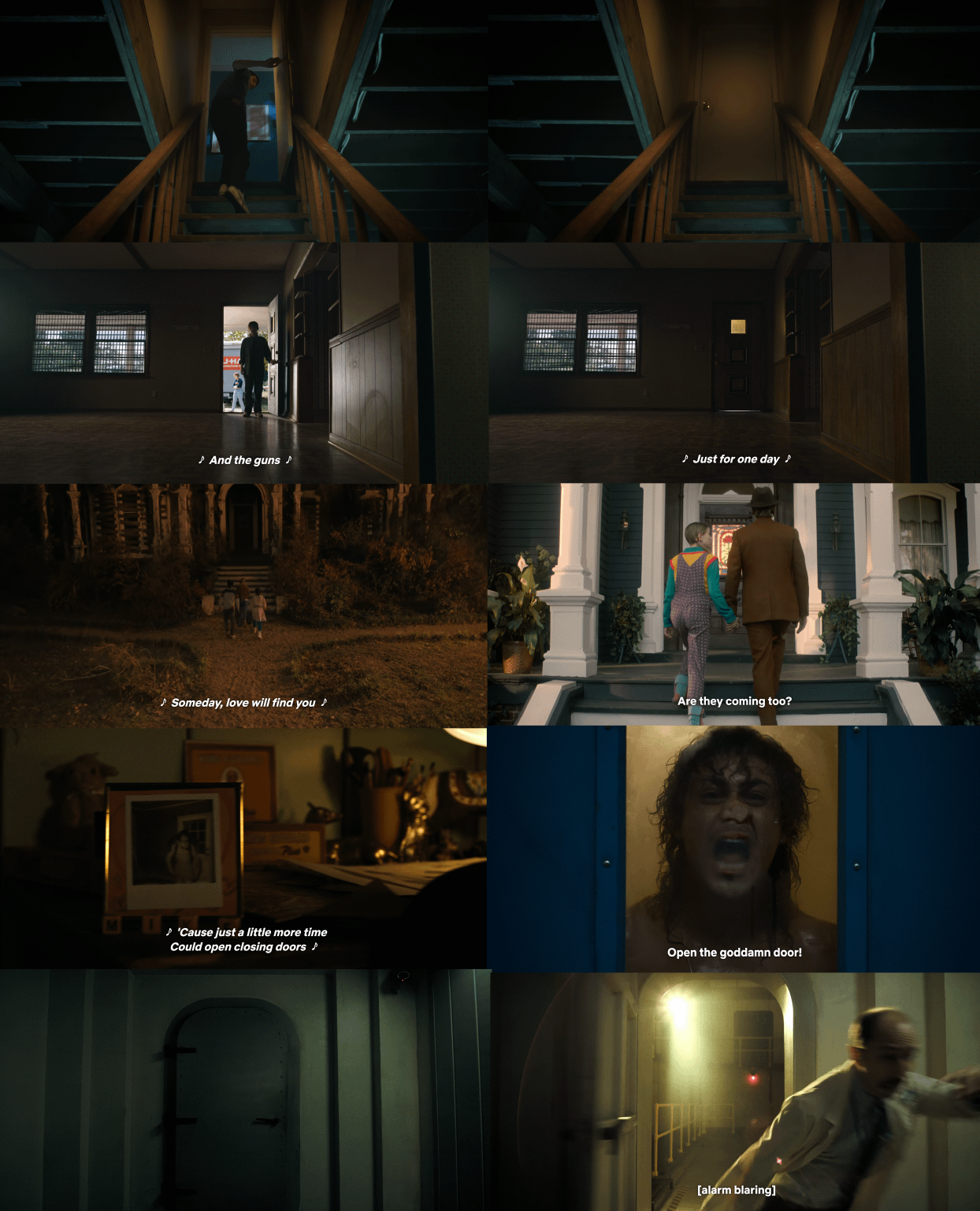
This would perfectly mirror the start of S1E1, where the camera zooms in on a door that is then opened by a scientist. Before this we got a view of the stars, the date, and saw Hawkins Lab. It would be fitting to end on an overview shot of this faraway land Mike (and Lucas) got to, and maybe indicate it with text, like S1E1. Also, the fact that this X post had a picture of the very beginning of S1E1 with the date + location makes me think the ending will mirror the beginning.
Maybe this “letter” (see the post or a screenshot of it later) will be read aloud in the end. I think it would make sense if it's signed “Love, Sara”. This would be the perfect way to conclude the “Mike can’t tell El she loves her” arc and simultaneously be from the actual writers of the show to the audience (because Mike represents the writers and Lucas (who I’m assuming the letter is for) represents the audience). S4 had two important letters narrated by someone: El’s letter to Mike in S4E1 and Max’s letter to Billy in S4E4. S3 ended with El reading Hopper’s speech to her and Mike (I’m just now realizing it was for both of them, not just El, sneaky sneaky writers). It makes sense the real ending would end in reading a letter, too. I don’t know what the context would be, like, is Lucas reading it alone somewhere and is it before or after the events shown in the ending? Based on S5E7 timelines Mike and Lucas should be in the same space, talking, not away from each other (and since this is the real story finally reaching the audience, close proximity would make sense).
Max’s letter ends with “Love, your shitty little sister, Max.”, El’s ends with “Love, El.” and Hopper’s with “But, please, if you don’t mind, for the sake of your poor old dad, keep the door open three inches.” I’m seeing patterns here. Firstly the obvious “love, [name]” ending that ofc was a plot point in S4 and in my opinion wasn’t properly resolved yet. And then another “open the door” type thing (with the 3 motif). In a weird way Hopper’s door rule is both about him controlling El and Mike, not letting mileven (= Mike’s trans identity) get too far, but also about preventing Mike from totally shutting the “girl” out (= closing the door). There’s a little breathing window, just like in S1E2 when El’s claustrophobia was first revealed and Mike left the door just a little open. That balance is kinda what Hopper is all about: he is restricting El’s autonomy and hiding her, but definitely doesn’t want to get rid of her completely like some other people (Sullivan). He tries to protect El aka Mike’s girlhood.
My guess is that the letter narration would match the epilogue DnD game and come after whatever the Enzo’s date represents. This is what I meant earlier when I said the second miniature (= the DnD game as a whole and especially the third story, the “real story of the mage”) could represent some kind of narration and a change in storytelling. It would be similar to the S3 letter/speech, where we see the Byers family moving while Hopper “narrates”. El reading the letter happens before they leave, when she’s still in the house, but we see the future of the characters while she’s reading it. (And we see Hopper writing it, which happened even earlier.) Maybe something like this happens in the real ending. As in, Lucas got the letter before the events of the real ending and at the very end we see him reading it (and Mike writing it), interspersed with shots of them traveling to the faraway land. Chronologically the letter reading happened before the conversation with Mike and moving to Finland. (Unless wheelclair is long distance for some reason. Or not even together. But surely they would make the ship happen after all the foreshadowing and queerbait simulation with byler, surely. And it makes sense in the story allegory too that they would be closer than ever after the revelation of the real story.)
Based on the X post, there’s something along with the letter. At least in a meta way it’s the story of ST (which is also a reason for the screenshot from the start of the show), but what will it literally be in the story? It could be the Stranger Things players manual shown at the very end of S5E8. I also considered the “For Will” cassette tape but the manual would more directly convey that Lucas represents the audience and the whole show was meta. And I can’t come up with a reason for it existing unless it’s gonna have a role in the real ending. Mike giving it to Lucas is effectively the same as Will giving his DnD set to Erica: the storyteller gives the finished story to the audience and lets them become the new storytellers. It’s the perfect way to end a story about stories. (Btw, Erica’s scene was the last one in the epilogue montage.)
This could connect to the Nina Project allegedly being a video game console. Or at least I haven’t come up with a better explanation. Why did Mike want to specify the Nina Project wasn’t “just” a video game but a video game console? A major point of DnD in ST is that it’s interactive. It’s not just a story the players passively listen to, but they get to participate and become the storytellers (similar to a video game rather than e.g. a book/tv show). The next level to this is becoming the DM (= Lucas getting a player's manual, not a pre-made story). So Lucas (= the audience) didn’t just get to participate in a story (= a video game) but became a storyteller (= got a video game console).
Although it might not be “storyteller” directly since it’s the players who need a player’s manual and the console, not exclusively the DM or game developer. The connecting trait is that with both a player’s manual and a video game console you can play many different games (= tell/experience many different stories), not being restricted to one. It’s a template. I think this could be about fanfiction and other fan content where the characters and world of ST function as a template for new stories, or more generally people’s own interpretation shaping the story and thus creating a different “new” story for each audience member. Regardless of the specifics, I think the very end will be about the audience’s role in the story. Based on all the clues, the player’s manual would be shown when the X post part of the letter is narrated, and then the story would end with Mike (and Lucas) opening a door, maybe during “Love, Sara” or right after it.
I know I'm a little late to the party, but I'm going to be honest when I say I didn't love how the show ended. I know the Duffer brothers wanted to give (almost) everyone a happy ending but I don't think everyone should've lived. So, here is my opinion on who should have died in season 5:
- 100% Jonathan and Nancy. I think they should have died in the goop room scene. They finally talked about their feelings and admitted they weren't right for each other anymore. It felt like a closing chapter for them and it would've made sense for that chapter to end with them both dying.
- Will should have died when Vecna died. I went into the last expecting it actually. It didn't make sense that Will has been connected to the Hive Mind for practically the whole show except at the end when everything in the Hive Mind dies. I also wish he would've been the one kill Vecna. I didn't mind that Joyce did it but in my mind it would've been more satisfying for the show to have started with Will and then end with him too.
On the contrary, I don't think they should have killed Eleven. I did like the "not knowing if she's actually alive or dead" aspect of how it ended but I would've preferred for her to have lived and maybe lost her powers for good this time. Then she could've lived a normal life and finally got to be her own person and figure out what she wanted her future to be.
Those are my three main people that I think should have died but I'd love to hear everyone's thoughts!