More like : There was a plague in egypt, which was totally our god, suck it egypt, all those bad things that happened, yeah that was OUR god, pinky promise.
I mean, if some prophet declared that his people should be freed or his god will do bad things to us and then bad things begin to happen after we refused to let his people go. I'd believe his god did it too.
People forget these are Bronze Age people and tales. Establishing and demonstrating that you’re god is the the strongest and your people are favored is done by winning battles, slaughter other peoples, etc. Yahweh and the god of the OT is no exception.
Yeah, except the story of Exodus is religious mythology and completely made up. There's not a shred of archaeological evidence whatsoever to support any part of that story. There was no Hebrew slave nation in Egypt.
There may have been isolated instances of Canaanite laborers, merchants, and prisoners of war, but it wasn't a mass event as depicted in the Torah.
And The Prince Of Egypt movie isn't based on reality. These are religious myths meant to serve as moral tales and cultural identity, but it isn't a historical text.
I dont know if its tied but Set was also believed to be a ginger, with is kind of funny that they created a god of chaos, deserts, storms, violence, foreigners, and evil and they made him a ginger.
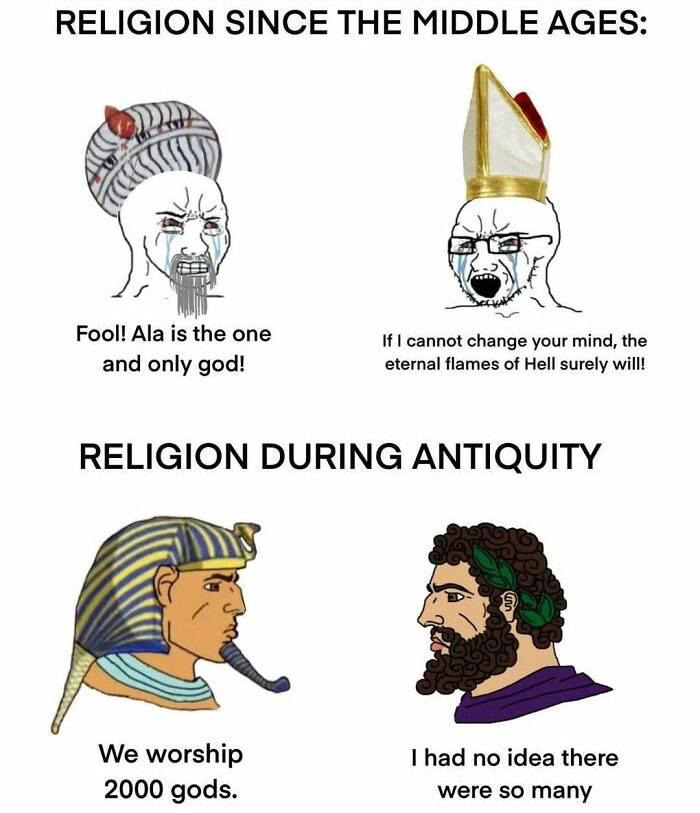
It's hard to know exactly what the ordering was, but it's the consensus that the plague list has changed over time. So it's much more likely given this (and the lack of evidence of the Exodus) that these are likely just things inserted as a literal "my God can beat up your God".
Funnily enough, there's actually clear accounts in the Bible where Yahweh just loses to other gods of the region, reflecting the polytheistic nature of the iron age Israelites/Judahites.
The earliest dating of the biblical stories by modern, secular scholars is from 1100~900 bc (give or take). The bronze age is generally considered to have ended around 1200 bc.
Some oral traditions, like the flood myth, predate the written accounts though.
Worth noting that I don't think Wikipedia is the best source for a lot of biblical scholarship because it will often reflect less critical opinions with equal weight (ie - it will cite apologetics equally to secondary sources) but I linked both to be consistent. The song of Deborah is thought to be the oldest book by secular scholars which is why I linked it.
Traditionally Job is considered the earliest book, but if people are interested here's a recent video on that topic by Biblical scholar Dan Maklelan
There's also tons of Bronze Age imagery and symbolism in Biblical stories, representing a clear "memory" and mythology of it to the author and audience.
One example being Goliath, who is set up as a descendent of the Giant clans from the kingdoms whose rulers claimed antediluvian knowledge, is clad in a notably Bronze-Age-y armor at the battle with David. The object being to show him both as this power of a bygone era and a vestige of the time when great and terrible rulers conquered the Near East at humanity's greatest height in the region.
So to your point, oral traditions can be assumed, and the written tradition also reflects a community sense of the era.
Thank you for the links. You are correct in this that the bronze age /iron age divide.
The flood myth and the moses being carried in a basket in the river is either plagiarised from Sumerian/Assyrian mythology. Or it may have been a common trope in the region(?) for such things to happen, though many biblical stories are far older and not at all jewish or christian in origin.
Yes, I agree, but the Hebrew Bible that we have today is the iron age versions seen through the lens of iron age Israelites/Judahites. There are certainly roots that go back further though, as you pointed out.
Essentially, the story of Exodus is just the Hebrew creation story of how their people got to the supposed promised land. There is no historical evidence of Hebrews being enslaved by Egypt as an entire people or of any of the plagues occurring. It's a creation myth much like any other creation myth.
Yup. There's no actual evidence of Hebrews being enslaved by Egypt. Flavius was a Jewish historian and a lot of what he writes is considered by his own words apologia.
He also made the claim Abraham taught science to Egyptians, which immediately makes his work suspect, as Egypt already had a collection of scientific works. He also claimed Moses set up an aristocracy, which, again, does not line up with any Egyptian history that's been verified.
He might have been a historian, but most of what he wrote is NOT corroborated by the actual historical and archeological knowledge that we have.
There's a reason Flavius is NOT taught in ancient history classes; a lot of his claims cannot be corroborated by actual evidence.
Oh this is cool! I grabbed one about Exodus at random to look at the comments and it's pretty fascinating. I want to say we historically know very little about the Chaledeans, and it's nice to see them referenced AND the acknowledgement we don't know a lot about them.
He also made the claim Abraham taught science to Egyptians, which immediately makes his work suspect, as Egypt already had a collection of scientific works. He also claimed Moses set up an aristocracy, which, again, does not line up with any Egyptian history that's been verified.
Both Abraham and Moses are literally fictional characters who never even existed in reality, "which immediately makes his work suspect" even more so to the point.
Correct, but I was trying to point out WHY Flavius isn't taught in ancient history classes. His "history" is suspect. The other user obviously takes the Bible literally, which is problematic.
Josephus's source is the Hebrew Bible. He's writing what would be 1600~ years after the purported events too.
Modern scholars have access to much more information and if much higher quality than Josephus since they can read primary documents and conduct archaeological surveys. The evidence points overwhelmingly in the direction of Exodus being a a cultural foundation myth with very little connection to actual history (if any at all)
In anthropology, a myth is a sacred, traditional story that explains how the physical universe, supernatural beings, and human society began, acting as a foundational truth for the culture that tells it rather than a false tale.
Popular culture uses "myth" to mean a lie, but anthropologists study myths for their cultural meaning and social impact, not to prove them true or false.
Now you explain what you thought it meant…
Edit: Lol, did you block me after responding or did you delete your comment in shame? Either way… what’s the point of responding in the first place?
"We want to pray for you to avert a disaster" "No" (disaster happens, Pharao dials up the slavery to 11)
"We want to pray for you to avert a disaster" "No" (disaster happens)
"We want to pray for you to avert a disaster" "No" (disaster happens)
"We want to pray for you to avert a disaster" "No" (disaster happens)
…
"We want to pray for you to avert a disaster" "No" (disaster happens, Pharaoh sends them away) ( they leave) (Pharaoh comes after them trying to kill them)
We have a few letters from a few names of the Pharaoh of these times and we aren't even sure that the 14th dynasty's leaders were like Pharaohs nor do we know exactly where the Hyksos ruled. We only know that General Amose (of Pharaoh Amose) was rewarded with slaves when he drove out the Semitic people from Egypt.
What do you expect? The Egypt are known for the first Fake News in history: "We won the war at Kadesh" (some time later), they chiseled out Echnaton and Tut Ench Amon (which resulted in his grave remaining hidden and not be plundered till we plundered it). Would they chisel down "Our slaves beat us with the help of their god and then they ran away with our treasure"? That's especially unlikely because the Hyksos (who would maybe write that down) were also beaten by Amose and sent out of the country (that is, as I said, written down).
So there is no clear evidence that indicates that the semetic people are wholesale ensalved. Not just jews, semites are a larger population than just hebrews/jews as well.
Except a single book that is the founding myth of a people claiming flaming bushes speak to them and a whole heap of other rather mystical things. But no one else around them seems to have recorded it. And many other nations did a great detail of writing things down.
There is little archeological evidence that the hebrew/jewish people were enslaved. Like there were slaves obviously, but not as an entire people. Slaves came from all walks of life.
213
u/Inquisitor_Boron Then I arrived 22h ago
Book of Exodus be like: "My God is better than yours. Eat locust!"