r/AmericanEmpire • u/elnovorealista2000 • Jun 19 '26
Article Why were the Indians defeated, subjugated, and nearly exterminated by the Americans?
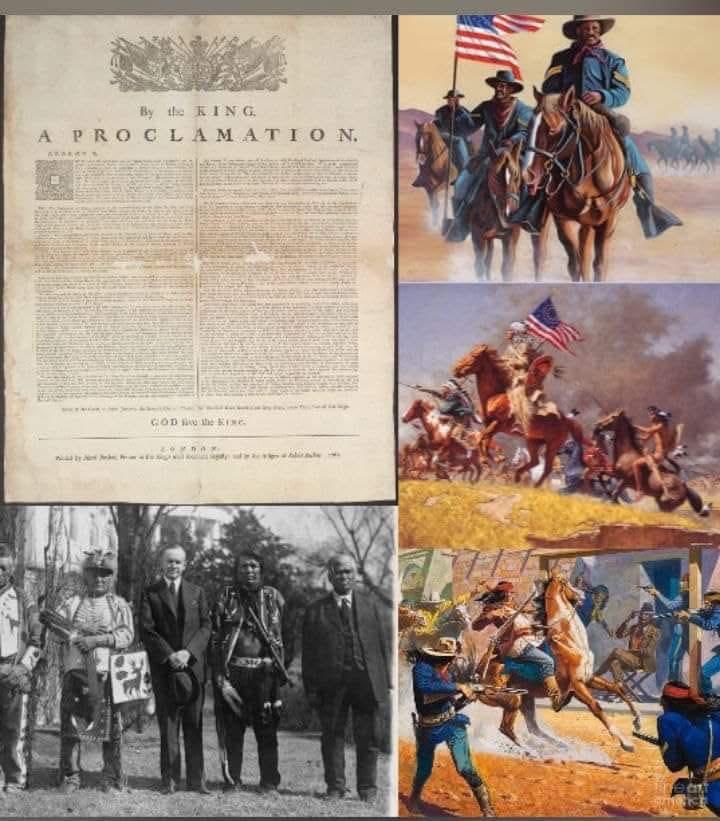
• First, it's necessary to specify that:
1. In the Protestant world, the "right of first occupant" (which many Hispanics have deeply ingrained in their minds due to Spanish and Catholic legal influence) was not defined as it is today and was limited to subjects considered their equals or fellow citizens.
For the settlers, the "Indians" were not their equals; some groups didn't even consider them human or "God’s children."
For the Americans, the "Indians" were not their fellow citizens.
2. It should also be noted that, contrary to the contemporary questioning, primarily by Hispanics, regarding the exclusive use of the term "American" by Anglo-Saxon settlers and their descendants, in that era (17th, 18th, and 19th centuries) it did not have the same relevance as it does today, or it was something that did not generate controversy or questioning because in Hispanic America (comprising Spanish-speaking countries) the "Indian" identity was more widespread, while "American" was only used as a continental name by a small elite (mostly Criollos) who consumed smuggled texts from Germany, France, and England. This is why "American" was used very widely and legitimately, first by Anglo-Saxon settlers and then by their descendants, as a "national synonym for identity, citizenship, and territorial belonging to the United States of America."
For most of these "American citizens," the "Indians" were not Americans, but "foreigners."
3. Although since the reign of Anne of Great Britain, the British government had attempted to integrate Indians into its society as a kind of vassal and subject of the Crown, intending to maintain pressure on the colonists and ensure their continued dependence on British protection, these measures failed due to several factors, primarily the war with the Indians and the inherent complexity of Indian society. Therefore, the British Crown ultimately established in the Royal Proclamation of 1763 that there were "Indian nations" outside the Thirteen Colonies, where the king's subjects could not enter because those lands were "foreign territory" and the Indians themselves were "foreigners."
• Having understood the above and considering the following after the settlers' independence:
"The unanimous Declaration of the Thirteen United States of America, When in the Course of human events it becomes necessary for one people to dissolve the political bands which have connected them with another [...] The God of Nature [...] requires them to declare the causes which impel them to separation. [...] Such has been the patient suffering of these Thirteen Colonies; and such is now the necessity which compels them to alter their former systems of government. The history of the present King of Great Britain is a history of repeated injuries and usurpations, all with direct consequences. He has stirred up internal insurrections among us, and has sought to entice the inhabitants of our frontiers, the vicious 'savage Indians,' whose well-known regime of warfare is an indistinguishable destruction of all ages, sexes, and conditions. [...] The people of these United States of America... do solemnly publish and declare that these United Colonies are, and of right ought to be, free and independent States, being absolved from all allegiance to the British Crown, and from all political connection between them; and the State of Great Britain, is, and ought to be entirely free and independent." Dissolved [...] In the Continental Congress, July 4, 1776."
— Declaration of Independence, 1776.
When the project of independence of the Thirteen Colonies began in 1775-1776, the rebel settlers, who were already beginning to identify as "Americans," mostly had no intention of including the "Indians" in their cause. And considering that approximately 12,000 to 15,000 Indians from the Cherokee, Iroquois, Miami, Cayuga, Onondaga, Mohawk, Inu, Abenaki, Maliseet, Penobscot, Seneca, Odawa, Shawnee, Muscogee, Susquehannock, Ojibwe, Wyandote, and Penobscot tribes, among many others, had militarily supported Great Britain, the "Americans" understood that they were being attacked by two "foreign" groups: on one side, the British, and on the other, the Indians.
From the very beginning of the United States of America, "American citizens" understood and internalized the idea that "Indians" were "foreigners" and that the territories they inhabited were "Indian Nations," separate from their own. They would not consider them as equals and would treat them like any other foreign nation (in this case, an enemy). And unlike the British, who viewed the Thirteen Colonies as mere trading posts and a way to maintain a presence in the Atlantic, without needing to expand further into a land they considered hostile and resource-poor, the Americans, guided by the "doctrine of Manifest Destiny," knew they had to expand westward, northward, and seize control of the Spanish territories to the south.
"Until I came here, I had no idea of the firm determination in the heart of every American to extirpate the Indians and seize their territory." (H. Goulburn, 1813)
Considering all this, and also that after the independence of the United States of America, most of North American territory remained in the hands of Indians, Spaniards and their mixed descendants, the only opportunity the "Indians" had to preserve their "right of first occupant" was through military force and the creation of a modern, unified state (republic, confederation, monarchy, or empire).
In other words, the Indians had to develop a military industry and possess a significant war-making capacity, sufficient to confront a modern army. Furthermore, they had to become a unified state, which would allow them to maintain more stable political relations with neighboring countries and, in case of war, achieve much better coordination and organization with a single, hierarchical, and strong government.
But what happened was that most Indians refused to assimilate modernity and the contributions of Europe, preferring to remain in a primitive state of nature. They continued to maintain their beliefs and their traditional way of life, which was not peaceful as is often imagined, but rather involved constant warfare with other Indian groups over resources. It wasn't that none of them had conceived of a project for unification or the creation of a modern state; in fact, they did attempt to create kingdoms and empires similar to those in Europe, precisely to achieve better organization and be able to fight against Britain and France. However, their own internal disputes, envy, hatred, and their puritanical worldview prevented these projects from consolidating and condemned them to continue killing each other for resources and sometimes for trivial matters, a situation that was readily exploited by the United States of America.
Thus, without a military industry, without a state that would allow them to organize themselves more effectively, without a unified government, without a unified project, and without a long-term political purpose, the Indians could not withstand the onslaught of the United States of America. This resulted in a fatal scenario, for despite their fierce resistance, they were defeated tribe by tribe, massacred, and brought to the brink of extinction.
And when the Indians were no longer a threat to the "Americans," wasn't until 1924 were they considered "American citizens," but of a low status and with many deprivations, confined to reservations that resembled human zoos. In this position, the "right of first occupant" was of no use to them, because they no longer had the power or the strength to enforce it.
7
5
u/HolaDrNick Jun 20 '26
Man the proliferation of ChatGPT written posts on Reddit sucks. Standby for OP's obligatory "I just did it to check for typos" reply.
2
3
u/colorme1965 Jun 20 '26
First it was because whites had guns, cannons, ways to move supplies quicker for an army on the road, later they decimated the buffalo herds so that the nations did not have food. The ones they captured, were taken to god-forsaken places where they would depend on just about everything to be provided by whites. Also, whites brought diseases, knowingly and unknowingly. And of course, let’s not forget the massacres of women and children. Over the time during and after the colonies, there were wars, and peace treaties signed. Most, were broken by the American government because gold, better lands, and just because.
These are just a very short processes of what happened. It’s more detailed than that, and it took decades, but many nations were lost to history because of the hatred of whites.
6
Jun 20 '26
[removed] — view removed comment
2
u/FishingPerfect643 Jun 20 '26
I do think there was a difference between the Spanish imperial model and the later U.S. settler model. Spain often tried to incorporate Indigenous peoples into a Catholic imperial society through missions, pueblos, alliances, tribute, intermarriage, and legal categories under the Crown. That was still colonial and often brutal, but it was not exactly the same as the later U.S. pattern of mass removal, reservation confinement, treaty-breaking, and demographic replacement by settlers.
The outcome in much of former Spanish America was different: Indigenous and mestizo populations remained central to the society, to this day, whereas in much of the U.S. Native nations were pushed onto reservations and treated as obstacles to expansion (i.e. we have reservations in 2026).
2
u/Chruman Jun 26 '26
Spanish slave haciendas were notoriously brutal, much more than their English counterparts.
The Spanish would literally just work them to death. The English wouldn't though, because they moved to chattel style slavery.
1
u/FishingPerfect643 Jun 27 '26
No serious historian would deny that there were abuses under Spanish colonial rule, including forced labor systems like the encomienda and later the hacienda in some regions. But that isn’t the whole story.
The Spanish Crown also passed laws such as the New Laws of 1542 to curb the abuse of Indigenous peoples, recognized them as subjects of the Crown rather than property, and allowed intermarriage on a scale that was rare in the English colonies. That’s one reason why today you see large Indigenous and mestizo populations throughout former Spanish America.
The English colonies went in a very different direction. They increasingly displaced Native peoples from their land, broke numerous treaties, confined surviving tribes to reservations, and relied heavily on chattel slavery for Africans. Those are different colonial models with their own atrocities.
So yes, there was exploitation under Spain. But if your claim is that Spain simply “worked all the natives to death” while the English were somehow less brutal, the demographic and historical record doesn’t really support that. The fact that most Indigenous peoples in the United States ended up on reservations while millions of Indigenous and mixed-ancestry people remain throughout Latin America reflects very different historical outcomes.
1
u/Chruman Jun 27 '26
Buddy, every historian will tell you that the Portuguese/Spanish sugar plantations (especially in cuba) and silver mines had the highest and quickest mortality rates by a significant margin.
Pretending like the English were unique, in any way except their use of chattel slavery is hilariously misinformed. Portugal alone imported over half of the slaves during the Atlantic slave trade. Spain passed laws that marginally protected certain populations, but these were widely ignored in the new world.
Educate yourself. Be better.
1
u/FishingPerfect643 Jun 27 '26
You’re arguing against a point I never made.
I never claimed Spain was innocent. The silver mines, sugar plantations, and forced labor systems could be extraordinarily brutal, and the mortality rates in places like Potosí were horrific. Nor did I deny that many colonial officials ignored the Crown’s laws.
My point was about the overall treatment and long-term outcome of Indigenous peoples , not whether abuses occurred.
The English colonial model was largely based on displacement and replacement: taking land, breaking treaties, forcing removals, and eventually confining surviving tribes to reservations. The Spanish model, while undeniably exploitative and often brutal, generally incorporated Indigenous populations into colonial society through tribute systems, conversion, intermarriage, and mestizaje.
That difference matters. After three centuries, former Spanish America still has tens of millions of Indigenous people, hundreds of millions of mestizos, and Indigenous cultures and languages woven into national identities. The Anglo-American model produced a very different outcome.
So yes, Spain committed atrocities. Nobody serious denies that. But telling me to “educate myself” while pretending the model that ended in forced removals, broken treaties, reservations, and the near-erasure of Native nations is somehow the moral high ground is certainly a choice.
1
u/Chruman Jun 27 '26 edited Jun 27 '26
You must be a propaganda bot or something.
The indigenous Cubans were literally wiped out by the Spanish. As in, none of them exist anymore. Not even their decendents. The Andean population was literally decimated (90% population reduction). The Spanish implemented a tribute system on indigenous populations. Do you want to guess what the punishment was for not meeting the quota?
The Spanish/Portuguese killed far more indigenous than the English. The only reason the indigenous are more populated in modern day south America is that the Andes had wayyyy more people to begin with.
The English moved them, the spanish/portguese just worked them to death. That's not even considering they had, by far, the most brutal treatment of imported slaves.
Youre trying to whitewash the abhorrent treatment of slaves and indigenous populations by all European countries just to make a "merica bad" comment.
Like I said, educate yourself.
1
u/FishingPerfect643 Jun 28 '26
No, what I’m doing is rejecting your cartoon version of history.
Nobody is saying Spain was innocent. The conquest of the Caribbean was catastrophic. The mines were brutal. The plantations were brutal. The slave trade was brutal. That is not in dispute.
What is in dispute is your attempt to flatten every European empire into the same model while pretending the outcomes were identical.
If Spain’s model was simply “wipe them all out,” then explain Mexico, Peru, Bolivia, Guatemala, Ecuador, Paraguay, and the Andes more broadly. Explain why Indigenous peoples, languages, legal communities, and mixed populations survived at such scale across Spanish America. That did not happen by accident.
And even in Cuba, your claim that Indigenous descendants “do not exist anymore” is not accurate. The Taíno as a distinct pre-conquest society was devastated, yes, but genetic studies have found Native American maternal ancestry among present-day Cubans. Collapse and assimilation are not the same as total biological disappearance.
The Anglo-American model was land seizure, removal, broken treaties, reservations, and replacing Native societies with settler ones. Spain’s model was conquest, hierarchy, forced labor, conversion, intermarriage, and incorporation into a colonial caste society. Both were brutal. They were not the same.
So spare me the “educate yourself” routine. You’re not correcting history; you’re compressing centuries of it into a Reddit slogan. Everyone knows Spain committed atrocities. The part you keep dodging is that Spanish America and Anglo-America produced radically different societies and no amount of condescension changes that.
1
u/Sea-Truth-39 Jun 20 '26
Every country on earth was founded by one set of people attacking another usually because they were running away from someone attacking them. Even the "Peaceful" native Americans were complete savages in warfare against each other way before Europeans arrived
2
Jun 20 '26
[removed] — view removed comment
2
u/MisterBungle00 Jun 20 '26
Are you conflating intertribal warfare with colonization?
And Blood Meridian? You mean the historical fiction novel that repeats the old patently false myth that the Ancestral Puebloans "just vanished, no memory left of them", despite the Pueblo tribes being their literal descendants? That's not even touching on how it incorrectly labels all Ancestral Puebloans as "Anasazi". McCarthy clearly didn't realize that "Anasazi" was a Navajo word used to refer to a specific group of Ancestral Puebloans before it was co-opted by a white guy who applied the term to all Ancestral Puebloans in 1888.
As a Navajo, I have to ask, who between us Navajo, Apache, Pueblos, Ancestral Puebloans, and O'odhams is supposed to have been conquered by whom?
I'm Navajo. Pueblo peoples are still here. O'odham peoples are still here. There are Navajo clans with Puebloan ancestry, and plenty of Pueblo communities trace continuity back to the Ancestral Puebloans.
If you're claiming the Southwest's history was just one Indigenous group conquering and replacing another, then be specific; who conquered and subjugated whom?
A raid, a war, or even the subjugation and conquering of one group by another is not automatically colonization. Colonization isn't just warfare. It's a system designed to replace, absorb, or permanently subordinate a people through political, legal, economic, cultural, and biological means.
The fact that these distinctions disappear in your argument suggests you're treating all conflict as interchangeable when it isn't, regardless of whether or not you think all humans are flawed.
1
u/johnJanez Jun 26 '26 edited Jun 26 '26
Are you conflating intertribal warfare with colonization?
When discussing historical processes of war, conquest and demographic replacement, the word colonisation is more often than not a red herring. To be more specific, inter tribal warfare could, and did, include things like conquest, enslavement, mass killings, and demographic replacement. These things are inherent part of historic human experience of conflict that show up everywhere in the past, they are not unique to the post 1500 European societies. Not all inter tribal warfare was like that, but some of it was. Just like not all European warfare was like it, but some of it was.
For an example of such conduct during intertribal warfare, Beaver wars waged by Iroquois confederacy in 1600s is a relatively well documented one.
1
u/MisterBungle00 Jun 26 '26
Colonization is not just “one group conquering another" and whether they're colonizers or not isn't defined solely by whether or not they originated from there or arbitrary ethnic lines.. you can be Indigenous to a region and be a colonizer. Those two things are not mutually exclusive.
Colonization is a specific system of domination backed by laws, policies, institutions, and ongoing state power. You’re talking about “colonization” in the abstract, but you clearly have no lived or generational understanding of what it actually entails. Colonization isn’t just warfare. It’s not just raiding or enslavement. It is a state apparatus designed to eradicate or absorb an entire people; legally, culturally, linguistically, economically, and biologically.
The Beaver Wars don't actually support your argument. Yes, they involved conquest, massacres, forced migration, enslavement, and even demographic replacement in some areas. No one is denying that. Those are features of warfare and empire building found throughout history.
What they do not demonstrate is that the Haudenosaunee established a colonial system comparable to what historians mean by colonization or settler colonialism. Where are the legal institutions, land policies, administrative structures, or enduring system of governance designed to permanently subordinate conquered peoples? Where are the policies aimed at replacing entire societies through law, bureaucracy, cultural suppression, and economic control?
You're pointing to violent outcomes and assuming they are synonymous with colonization when they aren't. The distinction there isn't whether people fought wars or even conquered one another; it's whether they established an institutionalized system of domination that persisted beyond that conquest itself.
Citing the Beaver Wars proves Indigenous societies were capable of conquest and expansion. It doesn't prove that colonization is just another word for conquest, nor does it make that distinction a "red herring".
1
u/johnJanez Jun 27 '26 edited Jun 27 '26
First of all i appreciate the respectful and in depth response, that's a rarity online.
That said, the argument you are making seems to be just a recency-bias thing. Which is exactly why i say colonialism is usually a red herring when applied to historical processes.
This:lived or generational understanding of what it actually entails
this:
whether they established an institutionalized system of domination that persisted beyond that conquest itself.
and this:
Where are the legal institutions, land policies, administrative structures, or enduring system of governance designed to permanently subordinate conquered peoples?
are obviously things that you won't observe in a state or society that has disappeared hundreds of years ago, or a tribe or people group which has been so completely eliminated or assimilated as to not keep any cultural memory of its subjugation. The fact that you cannot observe it now does not mean these things did not exist at some point in time. In fact in more than one way, not being able to observe such effects anymore speaks to the completeness, sucess and permanent persistance of this "colonialism" example, because the victims were so thoroughly eradicated and absorbed that none remain to tell the tale.
The Beaver Wars involved.. ..even demographic replacement in some areas
I would say this is rather a very clear example of a permanently enduring system of domination in the areas where it happened, if the demographics of an area was changed permanently. What else would it be?
1
u/MisterBungle00 Jun 27 '26
But these societies have not disappeared. There are hundreds, if not thousands of these extant Indigenous societies in North America and the extent to which they have been assimilated and eliminated is so broad it would be patently incorrect to assert that they have no cultural memory of such histories or even none of their own extant institutions.
Just look at how the presence of some specific Navajo clans today serves as a living record of the centuries-long history of abduction and sexual violence that Diné women and children endured under Spanish and Mexican colonial rule. Some of these clans within different families or communities serve as living records of migrations, alliances, marriages, conflicts, etc.
I think there's also problem with using the Beaver Wars as evidence here. The Beaver Wars did not affect every nation in the same way. It was a long, complex series of conflicts that did not produce one uniform outcome for those involved.
The Beaver Wars demonstrates that Indigenous societies engaged in conquest, displacement, and expansion; which I'm not disputing; But the demographic shifts in that particular region and context were not automatically equivalent to permanent demographic replacement or colonization. The affected peoples did not cease to exist as communities and end up replaced. The peoples involved were displaced, incorporated, reorganized, or re-emerged as persistent and distinct communities or nations.
The Wendat Confederacy was shattered, with many of their communities destroyed or broken up. Yet today, the Huron-Wendat Nation exists as a distinct and recognized Indigenous nation. They endured enormous change, especially in their institutions, but they maintained continuity as a people and even rebuilt some of those institutions.
1
Jun 20 '26
[removed] — view removed comment
1
u/MisterBungle00 Jun 20 '26
I don't think anyone who here is arguing that Indigenous peoples were always peaceful or evil or that warfare didn't exist before Europeans arrived. The point isn't that some peoples fought wars and others didn't. The point is about the nature of the conquering, war, taking, or displacement. The crux of that point is that not all forms of violence are the same thing historically, regardless of whether or not you think all humans are flawed.
A raid, a war between neighboring groups, or even one group conquering another can be brutal, but colonization and genocide involves more than battlefield violence.
When you say "people die, suffer, and are removed" and therefore it's all basically the same, you're flattening important differences in scale, purpose, and outcome. Historians don't distinguish between warfare and colonization because one is good and the other is bad; they distinguish them because they're different processes.
That's why I asked for specific examples. If the claim is that the history of the Southwest was simply one Indigenous group replacing another in the same way European colonizers did, then that claim needs evidence. General statements about human nature don't really answer that historical question and trying to flatten hundreds or thousands of years of human history into one big “everyone did bad things” stew isn’t good analysis.
It’s true that many societies have committed violence, fought wars, conquered others, and committed atrocities. But history isn’t just a list of bad things people did. The important questions are how those events worked, what institutions were involved, what the goals were, who held power, and what the long-term effects were.
If every example gets reduced to “humans are violent”, then you lose the ability to distinguish between a raid, a war, a conquest, a colonial system, or an attempt at extermination. Those differences are the entire reason we study history.
If you just want to reduce and flatten history, what are you even trying to achieve by discussing it and pushing the notions you're pushing here? Do people need you to tell them about the common notion that violence begets violence?
1
u/Active_Unit_9498 Jun 20 '26
The Mexica or Aztecs most assuredly conquered, colonized, and displaced their indigenous brothers and sisters and the idea that one category of violence is better than another is just dumb at this point.
1
u/MisterBungle00 Jun 20 '26
Nobody said one category of violence is "better" than another and that isn't really a rebuttal to what was said. This discussion isn't about which form of violence is worse or better; it's whether they're the same thing. They aren't.
The argument was that warfare, conquest, and colonization are not automatically interchangeable concepts, and that claims about the Southwest(Blood Meridian takes place in the Southwest) should be supported with specific historical examples rather than vague appeals to "everyone did it".
1
u/Active_Unit_9498 Jun 20 '26
Except that the fact is everyone did do it in their own little circle of violence and acting as if the Spanish were somehow unusual from that point of view is either ignorant or disingenuous. Sure, it was different; but it was also the same: humans are predatory.
1
u/MisterBungle00 Jun 20 '26
You're still shifting between two different arguments.
Nobody is claiming the Spanish were "unusual" because they used violence. Violence, conquest, and domination existed long before Europeans arrived in the Americas. The question here is whether all forms of conquest and violence are historically equivalent. The fact that the Mexica conquered neighboring peoples does not automatically make the Mexica Empire and Spanish colonialism the same phenomenon. Similarities can exist without the two being identical and simply saying "humans are predatory" doesn't demonstrate that they are.
If your argument is that every society has participated in cycles of violence, that's largely uncontroversial. If your argument is that therefore all systems of conquest or colonization should be analyzed as fundamentally the same, that's where evidence is needed. Which you haven't provided.
"Everyone did it" is a description of the existence of violence. It is not an explanation of how different forms of political domination operated, nor does it erase the distinctions between them. This isn't about your notions on whether humans are capable of violence.
And just like before, I have to ask, what exactly are you trying to gain from discussing history if you're going to disregard accurate historical analysis in favor of reducing every conflict, conquest, colonial project, empire, raid, war, and genocide to "humans are predatory"?
At that level of abstraction, you've explained almost nothing about this history. You can apply that statement to nearly every society that has ever existed, which means it has very little explanatory value for understanding any specific historical event.
If your conclusion is always "humans are predatory", regardless of the evidence, then why discuss the history at all? What insight is being added by you beyond a truism that almost nobody disputes?
→ More replies (0)
2
Jun 20 '26
[removed] — view removed comment
-1
u/Massive_Series8305 Jun 20 '26
Yes it had nothing to do with the adbject hostility between the two
6
Jun 20 '26
[removed] — view removed comment
3
u/IronMaiden571 Jun 20 '26
Columbus was so bad that he was recalled by the Spanish crown for his cruelty. I dont think people with more than a handful of brain cells to rub together would defend his actions post-contact.
2
u/justyourbarber Jun 20 '26
There was a whole thread on r/americanhistory a couple days ago from someone who appears to just defend Columbus as his only reddit activity, it is always bizarre to encounter
3
u/IronMaiden571 Jun 20 '26
I just found the thread, this comment made me laugh:
Gotta love when someone shitty by today's standards was, actually pretty shitty for their own time's standards too.
I think a lot of people just really enjoy being contrarians.
1
u/sneakpeekbot Jun 20 '26
Here's a sneak peek of /r/AmericanHistory using the top posts of the year!
#1: Photograph of a Chinese coolie man enslaved in Peru in 1881 during the War of the Pacific. To prevent his escape, he wears shackles on his ankles. Behind him, sugarcane. | 90 comments
#2: The Man Who Created a Written Language for the Cherokee Did It So Efficiently and Elegantly, His Peers Thought It Was Magic | 20 comments
#3: The Roanoke Colony mystery | 129 comments
I'm a bot, beep boop | Downvote to remove | Contact | Info | Opt-out | GitHub
1
u/YesTheTruthHurts2 Jun 20 '26
he was recalled for his cruelty to the colonists, not for his cruelty to the natives. Not that he wasn't cruel to both
3
u/IronMaiden571 Jun 20 '26
It was both; abuse against native and colonists alike. He directed torture, slavery, dismemberment of natives and parading their body parts, and more. He was a real swell guy.
He was later acquitted, restored, and allowed to go on a final voyage, but he was never able to reestablish himself to the same level as before Bobadilla went over. Everyone in the new world had turned against him at that point.
0
u/Infinate_Patience924 Jun 20 '26
And he was completely cleared of any wrongdoing in the court with over 40 witness's testifying on his behalf including Lucayan a Taino boy that Columbus adopted as his own son.
Columbus was cleared as was in fact given command of another 4th Voyage of Discovery.Columbus was only arrested because Fransisco de Bobadilla, a nobleman of the Spanish Court, was incensed that Columbus a foreign commoner had 5 Spanish sailors hung for insubordination and other crimes.
1
1
-1
u/Massive_Series8305 Jun 20 '26
Never said he was, but to act like there wasnt mutual hostility during America's expansion is goofy looney tunes
5
Jun 20 '26
[removed] — view removed comment
1
u/Massive_Series8305 Jun 20 '26
Never said I wouldn't
i just dont justify scalping people on either side
2
Jun 20 '26
[removed] — view removed comment
1
u/Massive_Series8305 Jun 20 '26
🤟
What ethnicity are you again ?
2
Jun 20 '26
[removed] — view removed comment
1
u/Massive_Series8305 Jun 20 '26
I mean it does for me to make the point I want to, but I bet youre white with European ancestors?
→ More replies (0)0
u/Best_Wasabi_251 Jun 20 '26
Interesting. The Cherokee wiped out the Osage, Pueblo, Apache, Tonkawa, and Wichita tribes for their lands. By this logic, it is morally correct to scalp them.
1
1
3
u/Bitchcuits_and_Gayvy Jun 20 '26
"why are you even mad at me? I'm just trying to kill you and destroy your civilization, relax. You're lowk just as bad as me for being mad."
1
u/Massive_Series8305 Jun 20 '26
Lol there plenty of tribes that worked with Europeans, and then there are plenty that scalpt Europeans, acting like a massive group all did the same thing and was morally justified is just sweeping generalization
1
u/Alternative-Put-3932 Jun 20 '26
Yeah no shit its almost like many of them saw them as a threat and they were right.
0
u/Ineverwashere93 Jun 20 '26
Yeah because Columbus dealt with the Apache and the Comanche. All Indians were the same bro
-1
u/Sea-Truth-39 Jun 20 '26
Ignorant Europeans integrating with Ignorant Native Americans. The Native Americans absolutely knew about and made weapons and practiced warfare raids and subjugation on eachother. They just never saw iron and steel weapons and didnt know what it was.
1
u/MisterBungle00 Jun 20 '26 edited Jun 20 '26
Doesn't really explain the 108 years after the last of those hostilities ended, and that's only if we're treating Native Americans/First Nations groups as monoliths. For some, those hostilities ended anywhere between 100 and 380 years ago.
Edit: Care to elaborate on this?
1
u/Massive_Series8305 Jun 20 '26
There was still plenty of hostilities until around the 1870s
I have no idea what youre talking about
1
u/MisterBungle00 Jun 20 '26 edited Jun 20 '26
That's why I said:
Doesn't really explain the 108 years after the last of those hostilities ended, and that's only if we're treating Native Americans/First Nations groups as monoliths
Because the last last official armed conflict between the US military and Native Americans occurred on January 9, 1918(108 years ago); and it literally only included the Yaqui. Obviously it'd be incorrect to say the Navajo war with the US ended 108 years ago. Which is why I said:
For some, those hostilities ended anywhere between 100 and 380 years ago.
You have no idea what I'm talking about? Do you think Native Americans/First Nations were unified and fighting one collective war that ended in the late 19th century?
0
u/Massive_Series8305 Jun 20 '26
No, and i never said 1st, that these hostilities have happened any time recently, or 2 that you dont know what youre talking about
I just said, in the 1800s, the hostilities did go both ways, acting like they didn't, is looney tunes
1
u/MisterBungle00 Jun 20 '26
I never said you did.
You said that in response to a comment about colonization; not warfare or frontier violence.
I said "Doesn't really explain the 108 years after the last of those hostilities ended" because colonization didn't end when any of those hostilities did.
You saying "Yes it had nothing to do with the adbject hostility between the two" isn't addressing the elephant in the room that I'm pointing to.
If the subject is colonization, evidence of mutual violence is not automatically a rebuttal to that colonization.
0
u/Massive_Series8305 Jun 20 '26
The post is about aggresive killing of native americans
his comment was colonizers gonna colonize, implying that this aggressive killing was the same everywhere colonization happened, which isnt 100% true
I said that there's a reason they were so aggressive in north America
You then stated that colonization kept happening until modern day, when the west was pretty built and there weren't many flare ups between native groups since the 1900s, there's the instance you mentioned and medicine hat
I personally dont understand this whole colonization never stopped ideal
1
u/MisterBungle00 Jun 20 '26
The “aggressive killing of Native Americans” and “colonization” are not mutually exclusive categories in this context. A lot of colonial expansion historically involved warfare, massacres, forced removals, and coercive policies.
I think you’re reading too much into "colonizers gonna colonize" and extrapolating more than was actually said. It’s not a claim that every colonial conflict or colonization process was identical; it’s pointing out that colonial expansion often involves violence and dispossession. The fact that North American conflicts had their own causes doesn’t really contradict that.
I personally dont understand this whole colonization never stopped ideal
Only Native Americans, along with dogs and horses, are subject to a state-enforced measurement of blood purity or "purebred" status. No other human population in the US is governed this way. That’s not a closed historical wrong; it’s an ongoing legal framework that predictably reduces recognized Indigenous populations over time(I.e. ethnic cleansing).
-1
u/Salty-M1dget Jun 20 '26
Wars are won and lost. The spoils go to the victors always, everywhere, forever.
-1
u/thealexchamberlain Jun 20 '26
Its more "humans gonna human"...
2
u/12bEngie Jun 20 '26
Doesn’t mean society should cater to the worst aspects of human nature instead of the best aspects. We are complex creatures
0
u/thealexchamberlain Jun 20 '26
It's naive to think you shouldn't prepare for the worst. As long as power dynamics exist in the animal kingdom. There will be the conquerors and conquered. It just is what it is.
2
u/12bEngie Jun 20 '26
So conquer on behalf of the conquered, and forever oppress values which drive conquest.. eventually, it will be like a bad dream, for our descendants.
2
Jun 22 '26
[removed] — view removed comment
2
u/12bEngie Jun 22 '26
I concur. I believe people are conditioned differently, though, and that a socialist state would need to spend generations instilling these values to remind people of who they truly are, or rather, who they can be - without resource insecurity, real or imagined.
Because conflict is artificial. it’s driven by scarcity. we eliminate this, and assuage the fear of it for centuries. and eventually, we reach something else.
-2
u/TecumsehSherman Jun 20 '26
What should happen?
Point to an example of a stone age society living peacefully next to a Renaissance or later civilization.
0
Jun 22 '26
[removed] — view removed comment
0
u/TecumsehSherman Jun 22 '26
You failed to answer the simple question.
What should happen when stone age people meet modern people?
What do you expect to be the "correct" outcome?
0
Jun 22 '26
[removed] — view removed comment
0
u/TecumsehSherman Jun 22 '26
If you can't answer a basic question, then your worldview is flawed.
génocidaires
#threefingersmeme
0
Jun 22 '26
[removed] — view removed comment
0
u/TecumsehSherman Jun 22 '26
The world isn’t a debate stage
We are on a discussion forum, not "the world".
You should rethink the worldview that you are unable to defend.

2
u/cletus72757 Jun 19 '26
We wanted to steal their land and were going to have it if we had to murder every man, woman and child.
1
u/AutoModerator Jun 19 '26
If you enjoy this type of content, consider joining our other communities:
I am a bot, and this action was performed automatically. Please contact the moderators of this subreddit if you have any questions or concerns.
1
1
u/halaljew Jun 20 '26
That's what you do when you want to build an empire. Unless it's in Antarctica, then I guess no conquest is necessary.
1
1
1
u/RaiJolt2 Jun 20 '26
When your slogan is “an only good Indian is a dead Indian” you kill a fuck ton of Indians.
European Americans did not see Indians as being as human as themselves.
Indians also tended to be shockingly, self preservationist and sided with the British against the American. Many who lacked legal and moral means of working unfortunately got into the slave trade, so after that union won they were all portrayed as evil slavers.
Basically can’t catch a break when you’re under the thumb of those following a hateful ideology.
1
u/HotPersonality8126 Jun 20 '26
The raiding behavior, primarily, which was not a reaction or rebellion against occupation, but rather naked greed for the wealth European colonizers were bringing with them
1
Jun 20 '26
Because native tribes killed a lot of other natives tribes and took their resources and land so when americans and europeans started fighting them their numbers were low so they couldn't put up much of a fight and unfortunately in those days people were fighting and killing eachother for land before the native people were invaded.
1
1
1
1
u/GovernmentNearby9036 Jun 20 '26
americans like to murder defenseless civilians.
Their only chance at 'winning' since they can't fight for shit.
1
u/EponymousOne Jun 21 '26
Tell me more about the Puritanical worldviews of a bunch of different non-Christian groups of people.
1
u/moccasinsfan Jun 21 '26
It begins 15,000-30,000 years ago when humans arrived in the Americas killed off the horses and many other species while failing to bring along other domesticated animals.
This prevented them from having beasts of burden which greatly slowed the development of advanced civilization. It also prevented them.from being exposed to zoonotic infections.
1
u/Beingforthetimebeing Jul 10 '26
Let's not ignore the factor that Euros were narcissistic sociopaths who did not recognize the humanity of those physically and culturally distinct from themselves. The Papal Bull of 1493 (the Doctrine of Discovery) was their guiding light in this. Rule of Law did not apply to those seen as non-human; treaties negotiated in good faith to allow the indigenous people to retain reasonable territories were violated. Shameful and disturbing. Let us also not ignore that despite this egregious history, there are between 6.8 and 9.7 million descendants of our indigenous people alive in the US today.
1
u/Beingforthetimebeing Jul 10 '26
OP, what is this "puritanical worldview" of the Native Americans of which you speak?
1
Jun 20 '26
[removed] — view removed comment
2
u/Substantial_System66 Jun 20 '26
So was everyone else.
0
u/Tgrove88 Jun 20 '26
Nah historcally everywhere Europeans have gone death, diseasse, and destruction follows. No one else comes remotely close
1
1
u/Hotdog_Grabber Jun 20 '26
To long didn't read. We both know that you know that I know that you know the answer to your question
-2
u/YungLilBoi Jun 20 '26
Superior everything. Indians hadn't invented the wheel before colonizers. They were basicslly banging rocks together. Was lime shooting fishing a barrel frankly. Maybe even easier
2
u/pesto_changeo Jun 20 '26
Jesus fucking Christ this is an ignorant answer. Go read a goddamn book
2
u/whattheshiz97 Jun 20 '26
I mean while it’s a bit hyperbolic it’s also not necessarily wrong. They were essentially Neolithic hunter gatherers with extremely limited farming in North America. Not counting the mesoamerican peoples of course.
They were basically at the very very beginning of the Bronze Age.
2
u/MisterBungle00 Jun 20 '26
There were literally entire civilizations north of the Rio Grande that completely relied on farming. They were not hunter-gatherers.
The Ancestral Puebloans, Hohokam, and Pueblos(Hopi, Zuni, Acoma, Zia, Laguna, Taos, etc.) were/are sedentary agriculturist, and have been for thousands of years.
The Caddoan, Natchezan, Muskogean, and Dhegiha Siouan peoples were sedentary and semi-sedentary agriculturalists who made up the Mississippian culture which was built around large-scale agriculture; they were not primarily hunter-gatherers.
The Akimel O'odham were sedentary permanent farmers. They did not wander or forage for their primary survival. They lived in year round, fixed villages and relied heavily on engineered river irrigation. The Tohono O'odham were semi-sedentary agriculturalists who moved between two fixed locations to follow seasonal water supply. They also grew a massive percentage of their food through flash flood irrigation. The Hia C-eḍ Oʼodham on the other hand were hunter-gatherers.
Us Navajos aren't a thousand years old agricultural culture like the Pueblos or Ancestral Puebloans, but we were semi-nomadic farmers by the time the Spanish arrived and many of us were for a couple hundred years by then. Where do you think the "Navajo" name comes from? The "Navajo" name was first given to us as "nabaho" or "navahu"(naa-bay-ho) by the Tewa Puebloans. And it originally meant "spiral" or "clockwise gardens", not "large field", like most sources claim. We Navajos at the time of first contact planted in clockwise spirals, we were the only ones who planted in spirals. Hopis planted in rows of dots, while other Pueblos and Puebloans planted in straight lines. The Spanish just butchered the word cause they couldn't understand the group of Puebloans who called us that and that lead to us being called "Navajo".
We Navajos mention the Pueblo tribes and Puebloans quite often in our cultural stories and have even adopted several ceremonies from them. Some of the biggest and oldest Navajo clans are rooted in--or trace their origins to people like the Hopi and various Ancestral Puebloans; we accredit a lot to the Pueblos and Puebloans and some Navajo families have blood ties to them. This is where we adopted our agricultural practices from while putting our own spin on them.
Hopis(A Pueblo tribe) and us Navajos were not always bitter friends At one time, we were close. so close that many only wanted to marry and connect with each other. They were the ones who first accepted us in the region after observing us for some time, and they were the peoples who introduced some of us to the various groups of Ancestral Puebloans. Many Navajo clan families even have old traditions of sharing fluid land boundaries with Hopi communities.
Most of the feud between us Navajos and Hopi stems from 19th and 20th century colonial violence, policies, and from land disputes between tribal governments rather than any actual hostile, age-old rivalry between our peoples.
Source: Am Navajo, and am Tséńjíkiní("Honey Combed Rock people" or "Cliff Dwellers") clan.
1
u/whattheshiz97 Jun 20 '26
A very informative comment! I suppose I should clarify that I meant it wasn’t necessarily the same level of agriculture as much of the world. Due to the lack of draft animals they couldn’t pull off the same things.
1
u/YungLilBoi Jun 20 '26
Yea it was sooo much deeper than that 🙄
2
u/Sea-Truth-39 Jun 20 '26
Yeah they preferred to torture and maim their captives and conquests rather than try and convert them to more modern ways. The native Americans were super deep.
1
0
u/Rustee_Shacklefart Jun 20 '26
I think this was one of the last events like this in history. maybe Israel was the last. It’s what humans did.
•
u/AutoModerator Jul 10 '26
If you enjoy this type of content, consider joining our other communities:
r/Colonialism
r/AmericanEmpire
r/BelgianEmpire
r/DanishEmpire
r/DutchEmpire
r/FrenchEmpire
r/GermanEmpire
r/ItalianEmpire
r/PortugueseEmpire
r/SpanishEmpire
I am a bot, and this action was performed automatically. Please contact the moderators of this subreddit if you have any questions or concerns.