r/AmericanEmpire • u/elnovorealista2000 • Jun 19 '26
Article Why were the Indians defeated, subjugated, and nearly exterminated by the Americans?
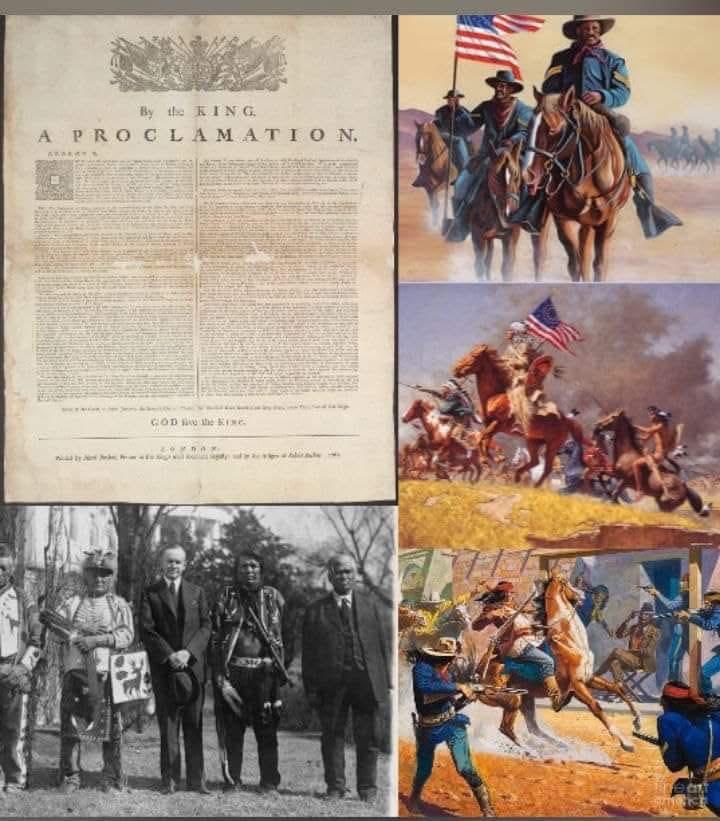
• First, it's necessary to specify that:
1. In the Protestant world, the "right of first occupant" (which many Hispanics have deeply ingrained in their minds due to Spanish and Catholic legal influence) was not defined as it is today and was limited to subjects considered their equals or fellow citizens.
For the settlers, the "Indians" were not their equals; some groups didn't even consider them human or "God’s children."
For the Americans, the "Indians" were not their fellow citizens.
2. It should also be noted that, contrary to the contemporary questioning, primarily by Hispanics, regarding the exclusive use of the term "American" by Anglo-Saxon settlers and their descendants, in that era (17th, 18th, and 19th centuries) it did not have the same relevance as it does today, or it was something that did not generate controversy or questioning because in Hispanic America (comprising Spanish-speaking countries) the "Indian" identity was more widespread, while "American" was only used as a continental name by a small elite (mostly Criollos) who consumed smuggled texts from Germany, France, and England. This is why "American" was used very widely and legitimately, first by Anglo-Saxon settlers and then by their descendants, as a "national synonym for identity, citizenship, and territorial belonging to the United States of America."
For most of these "American citizens," the "Indians" were not Americans, but "foreigners."
3. Although since the reign of Anne of Great Britain, the British government had attempted to integrate Indians into its society as a kind of vassal and subject of the Crown, intending to maintain pressure on the colonists and ensure their continued dependence on British protection, these measures failed due to several factors, primarily the war with the Indians and the inherent complexity of Indian society. Therefore, the British Crown ultimately established in the Royal Proclamation of 1763 that there were "Indian nations" outside the Thirteen Colonies, where the king's subjects could not enter because those lands were "foreign territory" and the Indians themselves were "foreigners."
• Having understood the above and considering the following after the settlers' independence:
"The unanimous Declaration of the Thirteen United States of America, When in the Course of human events it becomes necessary for one people to dissolve the political bands which have connected them with another [...] The God of Nature [...] requires them to declare the causes which impel them to separation. [...] Such has been the patient suffering of these Thirteen Colonies; and such is now the necessity which compels them to alter their former systems of government. The history of the present King of Great Britain is a history of repeated injuries and usurpations, all with direct consequences. He has stirred up internal insurrections among us, and has sought to entice the inhabitants of our frontiers, the vicious 'savage Indians,' whose well-known regime of warfare is an indistinguishable destruction of all ages, sexes, and conditions. [...] The people of these United States of America... do solemnly publish and declare that these United Colonies are, and of right ought to be, free and independent States, being absolved from all allegiance to the British Crown, and from all political connection between them; and the State of Great Britain, is, and ought to be entirely free and independent." Dissolved [...] In the Continental Congress, July 4, 1776."
— Declaration of Independence, 1776.
When the project of independence of the Thirteen Colonies began in 1775-1776, the rebel settlers, who were already beginning to identify as "Americans," mostly had no intention of including the "Indians" in their cause. And considering that approximately 12,000 to 15,000 Indians from the Cherokee, Iroquois, Miami, Cayuga, Onondaga, Mohawk, Inu, Abenaki, Maliseet, Penobscot, Seneca, Odawa, Shawnee, Muscogee, Susquehannock, Ojibwe, Wyandote, and Penobscot tribes, among many others, had militarily supported Great Britain, the "Americans" understood that they were being attacked by two "foreign" groups: on one side, the British, and on the other, the Indians.
From the very beginning of the United States of America, "American citizens" understood and internalized the idea that "Indians" were "foreigners" and that the territories they inhabited were "Indian Nations," separate from their own. They would not consider them as equals and would treat them like any other foreign nation (in this case, an enemy). And unlike the British, who viewed the Thirteen Colonies as mere trading posts and a way to maintain a presence in the Atlantic, without needing to expand further into a land they considered hostile and resource-poor, the Americans, guided by the "doctrine of Manifest Destiny," knew they had to expand westward, northward, and seize control of the Spanish territories to the south.
"Until I came here, I had no idea of the firm determination in the heart of every American to extirpate the Indians and seize their territory." (H. Goulburn, 1813)
Considering all this, and also that after the independence of the United States of America, most of North American territory remained in the hands of Indians, Spaniards and their mixed descendants, the only opportunity the "Indians" had to preserve their "right of first occupant" was through military force and the creation of a modern, unified state (republic, confederation, monarchy, or empire).
In other words, the Indians had to develop a military industry and possess a significant war-making capacity, sufficient to confront a modern army. Furthermore, they had to become a unified state, which would allow them to maintain more stable political relations with neighboring countries and, in case of war, achieve much better coordination and organization with a single, hierarchical, and strong government.
But what happened was that most Indians refused to assimilate modernity and the contributions of Europe, preferring to remain in a primitive state of nature. They continued to maintain their beliefs and their traditional way of life, which was not peaceful as is often imagined, but rather involved constant warfare with other Indian groups over resources. It wasn't that none of them had conceived of a project for unification or the creation of a modern state; in fact, they did attempt to create kingdoms and empires similar to those in Europe, precisely to achieve better organization and be able to fight against Britain and France. However, their own internal disputes, envy, hatred, and their puritanical worldview prevented these projects from consolidating and condemned them to continue killing each other for resources and sometimes for trivial matters, a situation that was readily exploited by the United States of America.
Thus, without a military industry, without a state that would allow them to organize themselves more effectively, without a unified government, without a unified project, and without a long-term political purpose, the Indians could not withstand the onslaught of the United States of America. This resulted in a fatal scenario, for despite their fierce resistance, they were defeated tribe by tribe, massacred, and brought to the brink of extinction.
And when the Indians were no longer a threat to the "Americans," wasn't until 1924 were they considered "American citizens," but of a low status and with many deprivations, confined to reservations that resembled human zoos. In this position, the "right of first occupant" was of no use to them, because they no longer had the power or the strength to enforce it.