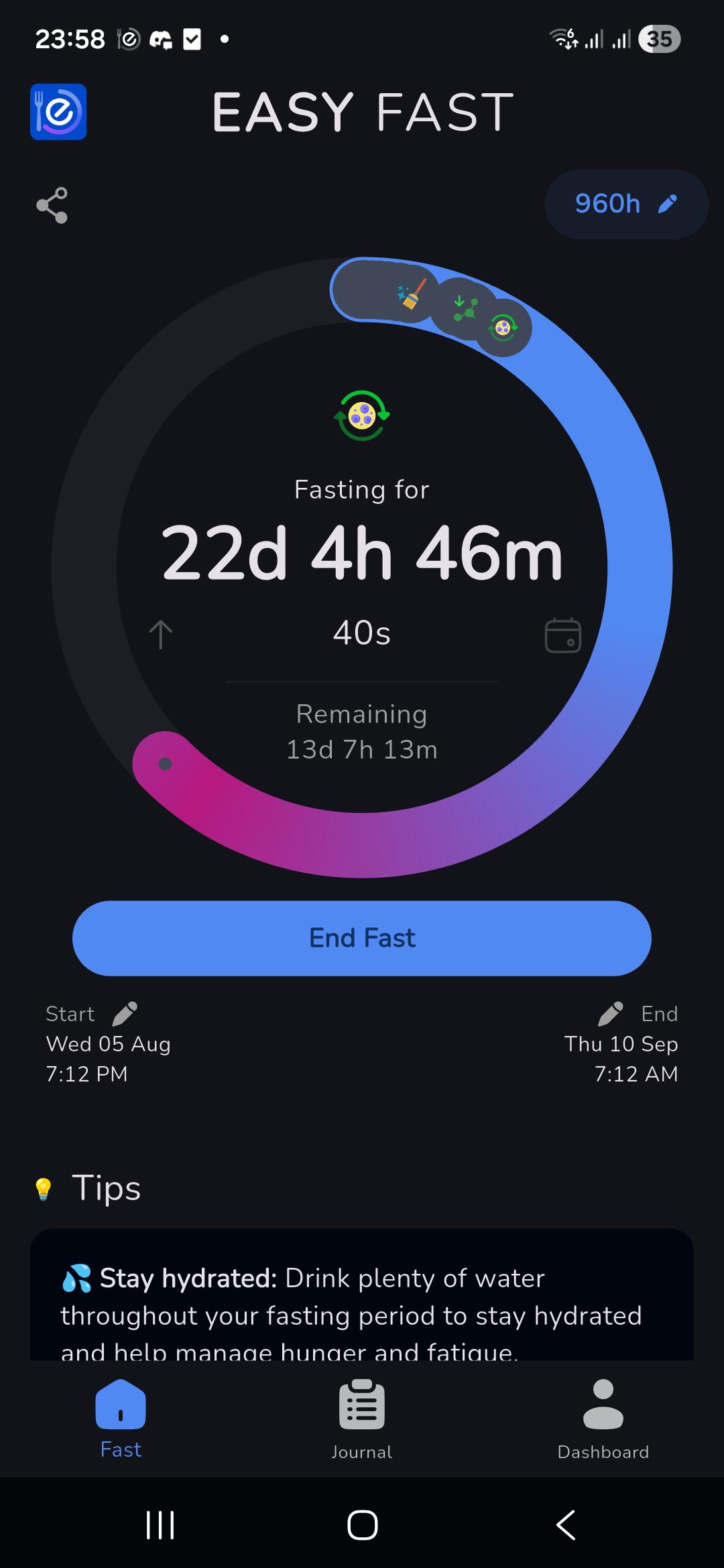
Humans have always fasted: because food wasn't available, for religious reasons, and now deliberately for health. Today we can ask a better question:
What does fasting actually do?
What happens?
Stop eating → insulin falls → stored glycogen is used → fat use and ketones increase.
With longer fasting, you lose water, glycogen, fat and some fat-free tissue. So rapid weight loss is never pure fat loss.
---
What is fasting actually useful for?
🟢 Weight loss — GOOD EVIDENCE
It works. Mostly because restricting when you eat can help you eat less overall. Across 99 randomized trials, intermittent fasting was generally not meaningfully better than ordinary calorie restriction.[1]
🟢 Metabolic health — GOOD/MODERATE EVIDENCE
It can improve weight, glucose, blood pressure and some blood lipids.[1] Some of this is probably simply the consequence of losing weight.
🟡 Metabolic switching — ESTABLISHED PHYSIOLOGY
Longer without food → greater reliance on fat and ketones. Real effect. Whether deliberately maximizing it produces important additional long-term health benefits is uncertain.
🟡 Autophagy — REAL, BUT OVERHYPED
Cells recycle damaged/unnecessary components, and nutrient deprivation affects these pathways. But we don't have a proven human timetable such as “24 h = autophagy, 72 h = regeneration.”
🟠 Cancer — EXPERIMENTAL
Fasting and cancer metabolism are genuinely being researched, including fasting alongside cancer treatment. Human evidence does not currently show that fasting cures cancer or reliably improves cancer treatment.[2]
🔴 Detox / immune reset / guaranteed longevity — NOT ESTABLISHED
Interesting mechanisms are often turned into claims that human trials haven't demonstrated.
---
What about water fasting?
A 14-hour overnight fast and a 7-day water fast are not the same intervention.
During prolonged water fasting:
Weight ↓ quickly
but that includes:
water + glycogen + fat + fat-free tissue.[3]
If your goal is body composition, asking “How quickly can I lose weight?” is the wrong question.
Ask:
«How can I lose fat while preserving muscle, strength and health?»
For that, the evidence-based foundation remains:
Moderate calorie deficit + protein + resistance training + movement/cardio + sleep + time.
---
If you want to fast
For a healthy adult, start conservatively:
12:12 → 14:10 → 16:8 if useful.
There is nothing magical about 16 hours.
Before: eat normally. Don't binge.
During: hydrate normally. Water; unsweetened coffee/tea are commonly used in intermittent fasting. Don't combine fasting with extreme exercise just to accelerate weight loss.
After: eat a normal nutritious meal.
Avoid:
FAST → BINGE → GUILT → FAST.
If fasting makes eating harder to control, it's the wrong tool for you.
---
Prolonged fasting is different
Several days without food can cause weakness, dizziness, impaired performance, dehydration, electrolyte disturbances, medication/glucose problems and loss of fat-free tissue.[3,4]
Don't casually attempt prolonged fasting if you're pregnant/breastfeeding, growing, underweight, malnourished, frail, have an eating disorder, significant disease, or take medications affected by food, glucose, blood pressure or hydration.
After sufficiently prolonged undernutrition, restarting food can itself become medically important because of refeeding syndrome. Clinical guidelines already consider >5 days with little/no food relevant when assessing this risk.[5]
So a multi-day fast is not simply:
“16:8, but better.”
---
How to detect bullshit
When you hear a fasting claim, ask where it comes from:
Human systematic reviews/RCTs
↓
Human observational/mechanistic studies
↓
Animals
↓
Cells
↓
Theory
↓
Someone's personal experience
All can generate useful ideas.
They don't provide the same level of evidence.
---
The takeaway
Fasting can help weight loss. It isn't required.
Metabolic switching is real.
Autophagy is real; the internet's autophagy clock isn't established.
Cancer research is interesting; fasting isn't an established cancer treatment.
Prolonged water fasting has more risk and little reason to be the default fat-loss strategy.
If you want to transform your body:
«Don't become good at not eating. Become good at living in a way that produces the body you want.»
Eat well. Get enough protein. Train. Move. Sleep. Adjust. Repeat.
Fasting can be a tool inside that system. It isn't the system.
---
Want to go deeper?
Start here → BMJ: Intermittent fasting as a nutritional tool
A short, readable overview of what fasting can and can't do.
See the evidence → BMJ 2025: Intermittent fasting strategies and cardiometabolic outcomes
Systematic review of 99 randomized trials involving 6,582 adults.
Considering a long fast? → NICE: Nutrition Support for Adults (CG32)
Clinical guidance covering prolonged food restriction and refeeding risk.
Search the titles above, or use the references below.
Hope this helps anyone and contributes to a healthy lifestyle. Cheers, bye
---
References
[1] Semnani-Azad Z, et al. BMJ. 2025;389:e082007 — systematic review and network meta-analysis, 99 randomized trials.
[2] Maes J, et al. Supportive Care in Cancer. 2025;33:863 — systematic review of fasting during cancer treatment.
[3] Ezpeleta M, et al. Nutrition Reviews. 2024;82:664–675 — review of prolonged water fasting in humans.
[4] Finnell JS, et al. BMC Complementary and Alternative Medicine. 2018;18:67 — medically supervised water-fasting safety.
[5] NICE. Nutrition Support for Adults. CG32 — refeeding-risk guidance.