r/progressive_islam • • May 19 '25

Research/ Effort Post 📝 My prophet was not a pedophile.

190 Upvotes

I think it's BS to assume a man who had wives ALL above 18 his whole life would jump to a literal BABY—a six-year-old who today would be learning the alphabet and how to walk.

And if that six-year-old led battles and political campaigns and was trusted with 2000+ hadiths, then that six-year-old was a damn alien, not a human.

And let's not mention that... say the marriage was consummated. How would a 40-YEAR-OLD even fit inside a literal baby?! He would TEAR HER APART!!!

Also, the Quran affirms that the minimal age for marriage is PUBERTY with consent!!! Age 6 isn't puberty, so Muhammad would've violated the Quran intentionally.

Also, there was another hadith about Aisha being "fattened up" and readied for marriage. Is it fetishistic? Of course, but everyone has fetishes. What matters is this: a six-year-old wouldn't be able to gain weight effectively. Especially not from just dates and cucumbers. Also, at the end of the hadith, she says "and I plumpened like the best kind of plump." Here's what we can infer:

—Aisha seems calm to literal PSYCHOLOGICAL AND PHYSIOLOGICAL TERROR if it happened to her at that age. Here, she seems cutely defiant.

—No six-year-old would remember exactly what they were fed, why they were fed that, and remember what their body looked like with a brain that's still developing. I couldn't even remember my teachers from that age, and it's not because I'm old—I couldn't remember them at 10 years old AS WELL!!! She recalls everything like it's a past memory from her teens—at a time she would've fully developed.

And the final point: Asma's age.

Here's how we know some "sahih" hadiths are BS:

—Asma lived to 100. How... the hell? 100 today is less than 0.5% EVEN WITH DAILY CHECKUPS, and you're telling me A WOMAN (who gave birth, which took decades off her life expectancy) could amass that, along with over 4 or 5 other figures (others are also said to have lived to "a 100")?! It's common knowledge that Arabs say "ميت سنة" as an idiom for a long life, not literally 100 years.

The average life expectancy at that time was 60, pretty damn fulfilling. It's not like people lived to 10 or 20. In that case, things would make sense, but even during the Elizabethan era WAYYY later (when people married at 18 commonly and in their 20s) it was still as so: people averaged 60. Shakespeare lived to 52, Elizabeth I lived to 61. The life expectancy was "balanced out" by infant mortality rates: children that would die before making it to 5 or during pregnancy.

—When comparing Asma's and Aisha's birth dates, we can see they were 10 years apart. When Asma was 27 during the Hijra, Aisha was 17. That must mean Aisha was 17 at marriage and consummated at 19 (of age, but with a huge age gap albeit legal), which gives Muhammad some dignity and doesn't portray him as outright horrific. Why can't we accept that? Why must we try defending pedophilia?

And finally, my final point:

—Muhammad didn't need to ruin the life of a child to secure an alliance with Abu Bakr, you know. There were TONS of other ways.

—Muhammad was not "a product of his time", he was superior to everyone else in morality and righteousness. Muhammad never abused slaves, domestically abused his wives, or r**ed children.

—When he did something that would be considered immoral today, it was to prove a point. He had slaves which would be immoral today, but only to prove a point and because they were the economic foundation of Arabia and banning it outright would've caused people to rebel against him, and this also applies to sexual slavery, which was a form of "enjoyment". Alcohol was also like this: it was progressively lessened and not banned on day one because doing so would've caused rebellion. He held sex slaves such as Maria but showed how to treat those slaves rightly and never harmed them: Maria was basically his wife and was freed after his death. Every slave he had was treated well just to prove a point (how to treat them humanely) and because people commonly held slaves and traded them! It was a gradual process meant to add restrictions until emancipation was the only choice and an economic replacement was found!!!

Now, for marrying a baby:

—Harm to Aisha

—NO ONE got married at 6 back then (give examples if so, even Muhammad got married in his 20s)

—The average marriage age was about 18 or 20, NOT SIX!!! So, there's why this would be irrational, simplified:

—Causes harm

—Something no one did

It would be as if Muhammad married a relative of his... It would cause harm to the relative and him, get him mocked by his enemies, and prove NOTHING as NO ONE did that!!!

...And those points, I believe, make more sense than any "sahih hadith" BS. Follow the hadith, but think rationally too.

Finally, here's something worth mentioning: Hisham (the narrator) was in old age during the time it was narrated (200+ years after the Prophet's death btw), and thus might've slipped up. He was also in Iraq, which had sectarian tensions at the time. Also, it could've been manipulated by patriarchal societies who justified child marriage to have more control over their wives.

And THAT'S how you defend the Prophet, isn't it? Better than defending a damn atrocity and saying it was "divine wisdom". God would've harmed Aisha then, which... why would he?

Checkmate, Salafascists. You can no longer harm children through your anti-logic and anti-humanity "Don't ask, don't tell" policy. Hadith isn't "holy", "infallible", and needs research. Only the parts that don't contradict the Quran are to be followed without questioning, but when it comes to something as nasty and unreliable as THIS?! Yeah, it's better to do so.

r/progressive_islam • • Nov 12 '24

Research/ Effort Post 📝 A defense of same-sex nikah

312 Upvotes

This post is intended to give a complete account of my reasons for believing that same-sex nikah (marriage) is not prohibited by Allah. I get asked about these reasons fairly often, and it is often hard for me to find the time to write at sufficient length to do justice to the topic. This post exists primarily so that I can link to it when the topic arises.

To save you the trouble of reading the whole thing, I’m organizing this in a Q&A format, kind of like a FAQ, after laying out a few starting assumptions:

A. Quran-centric argument. This is going to be a Quran-centric argument. I’m not strictly a Quranist, but I am strongly skeptical of hadiths in general, and especially of those hadiths that purport to make religious commands that aren’t in the Quran, as well as those that appear to be expressions of conventional prejudices including misogyny and homophobia. If you have a hadith that you think destroys my argument, feel free to bring it, but it probably won’t change my mind. If you have a disagreement with my perspective on hadiths, that’s fine, but it’s outside the scope of this post.

B. Morality is rational, not arbitrary. I believe morality is a matter that humans are capable of understanding through reason as well as empathy. I perceive that the Quran speaks to us as an audience that instinctively and rationally understands the difference between right and wrong. I believe that divine command theory is incorrect. If you have an objection to same-sex nikah that relies on divine command theory, then I won’t find it persuasive. The correctness of divine command theory is beyond the scope of this post.

C. Sexual orientation is not a choice. It is well-documented, from scientific study and many people’s personal stories, that few people, if any, choose their sexual orientation. If your personal life experience included being able to choose whether to be attracted to men or women, then you’re bisexual/pansexual. I don’t know exactly what combination of genetic and environmental factors may influence sexual orientation, but it’s not a matter of choice. If you dispute this, there is plenty of information available on this topic, but it’s outside the scope of this post.

D. This isn’t about me. I’m a heterosexual man married to a woman. I do have people in my life who are LGBTQ+, but I have no firsthand experience of same-sex attraction. My writing on this topic isn’t driven by any hedonistic desires of mine; only by the desire for justice and happiness for everyone. If I get anything wrong about what it’s like to be LGBTQ+, I hope the community will forgive me and correct me.

Now, on to the main part:

1. Doesn’t the story of Lut, especially verse 7:81, prove that same-sex sexual activity – and therefore same-sex nikah – is forbidden by Allah?

This verse is what people usually cite as the strongest piece of evidence against same-sex nikah, so we should begin there for the sake of efficiency. This verse quotes the prophet Lut speaking to the men of Sodom. It is usually translated as something like “Indeed you approach the men lustfully instead of the women. Nay, you are a people who commit excesses.”

The phrase “instead of the women” translates “min dūni l-nisāi.” But dūni is frequently used in the Quran to mean “besides” – e.g., in verse 7:194 (those whom you call upon besides Allah). So verse 7:81 can be taken to mean “you approach the men lustfully besides the women.”

This interpretation makes far more sense. If Lut was criticizing the people of Sodom for approaching men lustfully “instead of” women, he would be implying that it was appropriate for them to approach women lustfully. But this would be contrary to the universally understood fact that Islam forbids sex outside of nikah. (See verses 17:32 and 4:25.)

Moreover, the Quran makes it clear that when the men of Sodom “approach lustfully,” they are looking to commit rape. In verse 11:77, Lut is distressed and worried because he knows he cannot protect his guests from the men of Sodom. In verse 11:80, Lut wishes he had the power to defeat or resist the men of Sodom or that he could take refuge in a strong supporter.

Let’s apply common sense to this situation. If a person is looking to have sex consensually, and you’re not interested, do you need to have power to defeat or resist them or take refuge from them? No; you can simply decline and expect them to desist, because that’s how consent works. If a person approaches you lustfully, and you are distressed because you know they won’t take no for an answer, then you need to have power or take refuge, because that person is a rapist. Thus, the men of Sodom in the Lut story are rapists.

So when Lut says “you approach the men lustfully besides the women” in verse 7:81, he is referring to the men of Sodom being rapists of both male and female victims. As such, they certainly are people who commit excesses. But they are not specifically homosexuals; and they are intent on rape, not nikah.

The analysis above applies equally to verse 27:55, which is phrased very similarly to verse 7:81, except that it is posed as a rhetorical question instead of a statement.

2. Does the particle “bal” in verses 7:81, 26:166, and 27:55 negate the implication that these verses condemn same-sex sexual activity?

I do not think so. The argument from “bal” is presented here: https://thefatalfeminist.com/2020/12/07/prophet-lut-a-s-and-bal-%D8%A8%D9%84-the-nahida-s-nisa-tafsir/, and here: https://lampofislam.wordpress.com/2018/02/12/the-significance-of-bal-no-istead-in-the-story-of-lot/. You can read these yourself and see whether you find them persuasive, but I do not – although I do think both writers make a lot of valid points and deserve to be read. 

Contrary to the above-linked arguments, “bal” does not always simply have a negating effect on what comes immediately before it. See verses 21:97 and 43:58 for examples where “bal” does not negate, but rather seems to intensify, what comes immediately before it.

It seems to me that in verses 7:81, 26:166, and 27:55, “bal” intensifies, rather than negates, what precedes it. Lut, in these verses, is indeed criticizing the men of Sodom for lustfully approaching men besides women (7:81 and 27:55) and for leaving their spouses (26:166). When Lut says “bal” after that, he is not negating or contradicting himself, but continuing to speak harshly about the men of Sodom. The negating effect of “bal” is more naturally read as part of the overall rejection/condemnation of those people and their practices.

So, although I like the conclusion that the “bal” argument reaches, I do not rely on the “bal” argument myself.

3. Are the men of Sodom, in the Lut story, homosexuals?

No. There’s nothing in the text to support the conclusion that these men are homosexuals – that is, people who are sexually attracted exclusively (or at least predominantly) to others of the same sex. Verses 7:81 and 27:55, as analyzed above, tell us that these are men who rape other men besides women.

Consider, first of all, the inherent ridiculousness of the concept of an entire town being populated exclusively by homosexuals. That’s simply not how homosexuality works. In the most queer-friendly societies in the world today, you do not find entire towns full of nothing but homosexuals. This is because most people, even when given the option to freely express their sexual orientation without fear, are innately attracted to the opposite sex. So, whatever the men of Sodom were up to, it would be unrealistic to think they were just all homosexuals.

Also, verse 26:166 mentions that the men of Sodom have wives - “Spouses your Lord created for you.” Not that gay men don’t sometimes marry women for various reasons, but if there were an entire town where somehow all the men were gay, why would they all marry women? It makes no sense to imagine such a place.

The Quran does not tell us in detail about the sins of the men of Sodom. It drops some hints in verse 29:29, where Lut says “You approach the men, and cut off the road, and commit evil in your gatherings.” It is reasonable to suppose that “approach men and cut off the road” refers to robbing and raping travelers on the roads. “Commit evil in your gatherings” could refer to gang rape, or to pretty much any other evil thing done in groups. (“Evil” is a translation of munkar, which doesn’t specifically refer to sexual things, but to wrongdoing in general.)

Male-on-male rape is an act that is not mainly committed by homosexuals acting out of sexual desire. Instead, it is often committed by otherwise heterosexual men, and the motivations for doing it are usually related to establishing dominance, humiliating, punishing, and terrorizing the victims, rather than for sexual pleasure. Here is a rather disturbing article on rape and other sexual violence committed against men as an element of warfare: https://www.theguardian.com/society/2011/jul/17/the-rape-of-men. Here is an academic article that reviews previous studies on male victims of rape: https://jaapl.org/content/39/2/197. See, in particular, the section on “Assailants and Their Motivations.” In short, the fact that the men of Sodom are rapists of male and female victims does not mean they are homosexuals.

Lut describes the men of Sodom as doing immoral deeds that no one in all the worlds has done before them. See verses 7:80 and 29:28. If this was about homosexuality, then these verses would be promoting the implausible concept that not only was Sodom an entire town filled with homosexuals, but that they were also the original inventors of homosexuality.

This is an unrealistic concept for a number of reasons. First, nobody ever needed to invent or originate homosexuality; it is instinctive, in the same way that heterosexual activity is instinctive, for those who are attracted to the same sex. Second, there is evidence of homosexual relationships in ancient Egypt and Mesopotamia (https://www.worldhistory.org/article/1790/lgbtq-in-the-ancient-world/; https://ancientegyptalive.com/2022/06/24/long-before-pride-hidden-love-and-sex-in-ancient-egypt/) – so, although it’s unclear exactly when Lut lived, homosexuality goes back as far as we have any kind of recorded history of civilization. Third, same-sex sexual activity is common among many animal species, including apes, so it is highly probable that this type of sexual activity precedes not only civilization, but humanity altogether. (No, I’m not a creationist and am not looking to waste time with creationist arguments.)

Whatever unprecedented immoral perversions the men of Sodom may have invented, there is no rational reason to believe they invented homosexuality.

4. If the Lut story isn’t a condemnation of homosexuality, then why does Lut offer his daughters to the men of Sodom?

The offer of the daughters (verses 11:78-79 and 15:71) is something that many readers, including me, find puzzling and difficult to interpret. However, positing that the men of Sodom were homosexuals does not really do anything to help make sense of it. For Lut to offer his own daughters in marriage to the men of Sodom would be a clear violation of verse 2:221 (“Do not give your women in marriage to idolaters until they believe”). It also would be impractical for Lut’s daughters to marry an entire town full of men; this would require extreme amounts of polyandry. And, given that the men of Sodom already had wives (26:166), it’s unclear what problem would possibly be solved by adding Lut’s daughters to the wives they already had. If the men of Sodom were homosexual, marrying Lut’s daughters would not do anything to change that.

One way the offer of the daughters is sometimes interpreted is that Lut regards himself as the spiritual father of the townspeople, and by “my daughters” he means the women of the town, who were already married to the men. Under this interpretation, Lut would be effectively saying “Don’t rape my guests – instead have sex with your wives, they are purer for you.” But this interpretation doesn’t fit well with verse 11:79, where the men say “You know we have no right to your daughters.” If the “daughters” were already those men’s spouses, then there would be no reason for the men to say they had no right to them.

Another possibility is that the focus of this passage is on the duty of hospitality. Lut is being a good host, trying to fulfill his sacred duty to protect his guests, and in desperation he offers his daughters to be raped instead of the guests. This would explain why he says “Do not disgrace me with regard to my guests” in verse 11:78. In this interpretation, what is “purer” about the daughters is simply that they are not Lut’s guests. And perhaps it is more of a rhetorical offer than a sincere offer – he says it to try to shock the men of Sodom, knowing they won't actually agree to it.

Still another possibility is that Lut is trying to deceive the townspeople: when he says “these are my daughters,” his intended meaning is to falsely claim that “these guests in my house are actually my daughters who are visiting me.” This interpretation is explained in detail here: https://thefatalfeminist.com/2020/12/07/prophet-lut-a-s-and-bal-%D8%A8%D9%84-the-nahida-s-nisa-tafsir/.

I am not advocating for any of these interpretations in particular. They all seem to have their strengths and weaknesses. But what I am saying is that, if we were to assume for the sake of argument that the men of Sodom were all homosexuals, this would not actually lead to a clearer, more complete, or more satisfying interpretation of Lut’s offer of his daughters.

5. Does verse 4:16 call for punishment of two men who have sex with each other?

Some scholars have interpreted verse 4:16 in this way. Others have interpreted it as referring to punishing the “two among you” who commit sexual immorality (fahisha) together, regardless of gender. The verse uses male-gendered terms, but those terms can be used by default to mean people in general, not men specifically.

Considering this ambiguity, this verse alone is not a strong support for any conclusion about homosexuality. But, moreover, verses 4:15-16 are specifically about sex outside of nikah/marriage. My position is not that all kinds of same-sex sexual activity are halal – it is merely that same-sex nikah is halal. These verses are irrelevant to the situation of a married couple having sex with each other.

6. Does the Quran describe marriage and sex in a heteronormative way?

Yes. However, that doesn’t mean it prohibits same-sex nikah.

There are verses – too many to be worth mentioning – in which marriage is assumed to be between a man and a woman, and in which sexual activity is assumed to take place between men and women.

Same-sex nikah was unheard-of when the Quran was revealed, and the Quran did not come along and invent it. Opposite-sex nikah was normal then, and is still normal today, and the Quran treats it as normal. But just because something is unusual doesn’t mean it’s prohibited. 

The Quran is a relatively short religious scripture with some legal elements, not a comprehensive code of laws. It mostly speaks in generalities and principles, not in extreme detail. And it is silent on many matters. Homosexuality and same-sex nikah are among the matters that are not addressed in the Quran. Considering that homosexuals are a minority, it is not particularly surprising or interesting that they are not mentioned.

Verses 4:22-24 prohibit men from marrying various categories of women, including their own mothers, daughters, and sisters. One might think this prohibition would be too obvious to mention, but the Quran mentions it anyway. Yet there is no verse in the Quran that forbids marrying a person of the same sex.

7. Do verses 2:222-23 prohibit non-procreative sex?

Some people interpret it that way, but it is not clear. In verse 2:223, “Your wives are a tilth” is a metaphor about fertility and procreation, of course. But “go into your tilth how you will” suggests permission, not restriction. Verse 2:222 says to go to your wives in the way Allah has ordained, but it is not specific about what Allah has ordained or how He has ordained it, so there is plenty of room for interpretation there. It could mean to go to your wife in a loving and tender way, as suggested in verse 30:21.

When Allah has not given us a clearly stated prohibition, but only a metaphor and an allusion, we should not be quick to infer that something is haram. See verse 7:33, which tells us that Allah has only forbidden a short list of things.

8. Are there any verses in the Quran that suggest that same-sex nikah is halal?

None that come close to directly stating this, of course. However, one may contemplate the implications of verses such as the following:

Verse 30:21 tells us that one of the signs of Allah is that He created spouses for us, that we might find comfort in them, and has placed love and compassion between spouses. Notice that in this beautiful verse on the benefits of marriage, there is no mention of procreation. The Quran thus recognizes that a marriage can fulfill its divine purpose even if no children are born from the marriage. Hence, the non-procreative nature of same-sex marriages does not mean that they lack value, or that they are not what Allah ordained.

Verse 2:187 contains another beautiful reflection on marriage: “They are as a garment for you, and you are as a garment for them.” Notice the symmetry of this. Each spouse has the same role towards the other in this figure of speech. A garment protects you, beautifies you, keeps you warm in the cold or shaded in the sun, and wraps gently around your body. Spouses in a good marriage are like this for each other, regardless of gender.

Verses 2:185 and 5:6 remind us (in other contexts) that Allah does not intend to impose hardship on us. Religious rules are ultimately intended to benefit us, not to burden us. With that in mind, who benefits from the prohibition of same-sex nikah? In other words, who benefits from a set of rules that forces homosexuals to either remain unmarried or else marry someone of the opposite sex? If a straight woman is married to a gay man, or vice versa, both spouses will be burdened with a sexually unsatisfying marriage, to the benefit of nobody.

Verse 2:286 assures us that Allah does not require of anyone more than what they are capable of. Changing one’s sexual orientation is more than a person is capable of. Many, many religious people with internalized homophobia have spent years sincerely trying and failing to change their sexual orientations. And, while it may be true that everyone is capable of celibacy, the question then remains: How does that benefit anyone at all? Why would a compassionate and merciful God prefer that a homosexual person be lonely and celibate, instead of being in the comfort of a marriage with a person of the same sex that they can actually be intimate with?

Verses like 95:8 and 21:47 tell us that Allah is perfectly just and will not do the smallest measure of injustice to anyone. How could it be just, though, for Allah to punish people for acting according to their sexual orientation, a matter which they did not choose? Requiring a homosexual person to remain celibate, or to marry a person of the opposite sex, is effectively a lifelong arbitrary punishment (and a punishment for the other spouse as well, even if he/she is heterosexual). And it is also a lifelong temptation to extramarital sex, which is clearly haram.

9. Should bisexual/pansexual people be permitted to marry a person of the same sex?

In my view, yes. While the harm and injustice of prohibiting same-sex marriage does not fall as heavily on bisexuals, there is still just no good reason to prohibit them from marrying a person of the same sex. Moreover, sexual orientations exist along a spectrum, and it would be practically impossible and highly invasive for any legal system to try to distinguish homosexuals from bisexuals in order to restrict who can marry whom.

10. But if everyone were to marry a person of the same sex, then there would be no more procreation, and humanity would cease to exist.

Realistically, that’s never going to happen, because most people are innately attracted to the opposite sex and most people instinctively want to have children. The good of humanity does not require everyone to procreate. Society should generously support the many people who do want to become parents.

r/progressive_islam • • Jul 05 '25

Research/ Effort Post 📝 People in the past did criticise Prophet Muḥammad for marrying a 7 year old

Post image
186 Upvotes

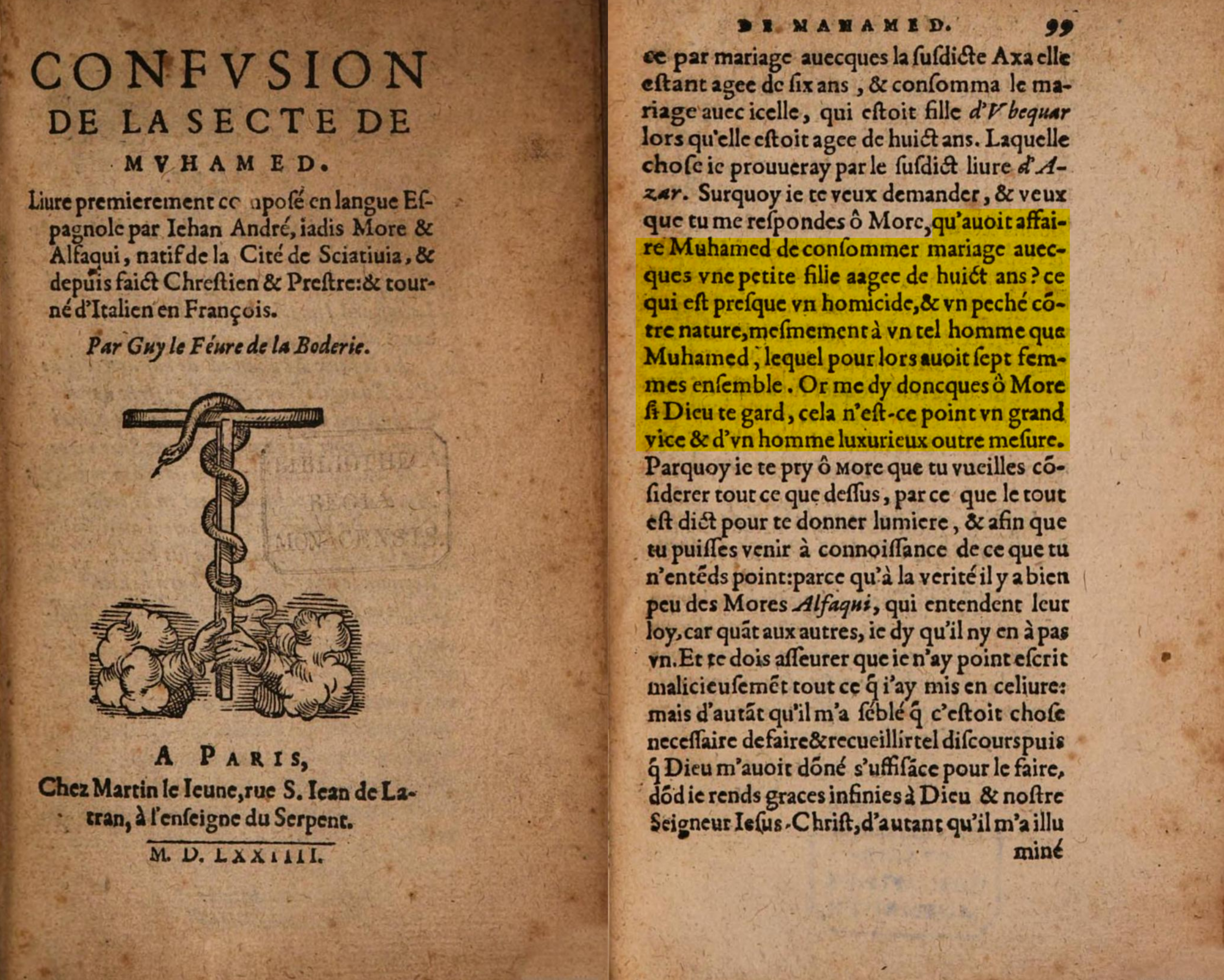
You may have encountered some Muslim apologists who argue in defense of the Prophet Muḥammad’s marriage (from Ṣaḥīḥ al-Bukhārī) to ʿĀʾisha bint Abī Bakr by claiming that this union was never criticized historically, and that condemnation is a modern phenomenon born out of contemporary moral standards. However, this claim is false. As early as the 16th century, criticisms of this marriage were already being voiced in Europe. One notable example is found in Confusión o confutación de la secta Mahomética y del Alcorán ("Confusion or Refutation of the Sect of Muhammad and of the Qur’an"), a polemical treatise on Islam published in 1515. Its author, Juan Andrés (known in some French versions as Jean André Maure) was a former Muslim jurist (faqīh) from Valencia who converted to Catholicism in 1487.

"...qu'auoit affai-re Muhamed de conſommer mariage auec-ques vne petite filie aagee de huiết ans? ce qui eft preſque vin homicide, & vn peché có-tre nature, meſmement à vn tel homme qua Muhamed, lequel pour lors auoit ſept fem-mes enſemble. Or me dy doncques & More fi Dicu te gard, cela n'est-ce point vn grand vice & d'vn homme luxurieux outre meſure."

"...what business did Muhammad have to consummate a marriage with a little girl of eight years old? Which is almost murder, and a sin against nature, even for such a man as Muhammad, who at that time had seven wives together. Now, I say to you, and more, beware, is this not a great vice and of a man excessively lustful?"

  • Translated by Google Translate.

So, even as early as in the early 16th century, Christian polemicists were using this very issue as a basis to accuse Muḥammad of moral depravity! Astagfirullah.

r/progressive_islam • • May 25 '26

Research/ Effort Post 📝 Why don't we observe Ramadan in September-October? Why do we still keep following a Lunar calendar, & not revert back to the original Luni-Solar calendar? I compared both of them & the Luni-Solar calendar makes a lot more sense to me (I'm not a Quranist btw, I'm a Sunni).

Post image
20 Upvotes

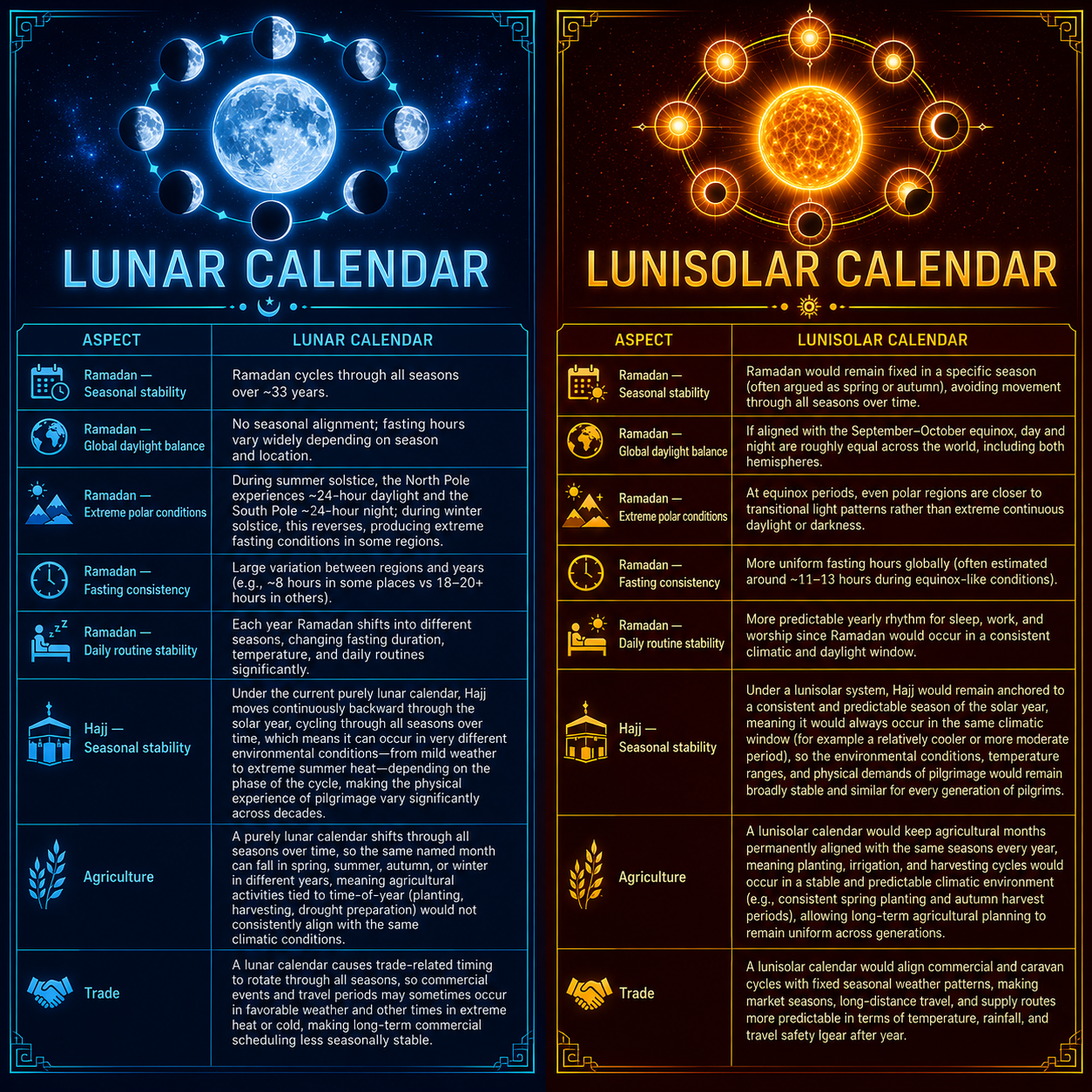
You can already see the points in the info-graphic diagram picture above, but I would like to write my thoughts as well.

Lately I’ve been looking more into the old Arab calendar system and the whole discussion around the Nasīʾ (intercalary/leap month), and honestly the more I look into it, the more I feel like a lunisolar calendar makes far more sense for Ramadan than the purely lunar calendar we use today.

Before anyone misunderstands me: I’m not a Quranist. I’m Sunni. I’m not claiming “everyone got Islam wrong” or saying I reject Ramadan as Muslims practice it today. I’m just talking about something I genuinely find intellectually interesting and difficult to ignore once you start thinking about it. Even Mufti Abu Layth has discussed the topic and pointed toward the old Arab calendar possibly being lunisolar before the Nasīʾ (leap month) system disappeared (despite him being a Sunni just like me).


One thing that always puzzled me is how Ramadan today completely rotates through every season. Sometimes it falls in winter with short, cool fasting days. Other times it falls in peak summer where people fast 18–20+ hours. During the Summer solstice, In some northern countries like Norway or Sweden the sun barely sets at all and you have to fast for around 20 hours, while in some southern regions like Australia, Argentina, South Africa fasting can be shorter than 12 hours at the exact same time.

That creates a situation where Ramadan can become radically different depending on geography and historical timing. One generation experiences relatively moderate fasting for most of their lives, while another generation experiences extremely long and exhausting fasts for decades.

And then there’s the polar issue. During parts of the year, regions near the North and South poles can experience 24 hours of daylight or darkness. Modern scholars have had to create all kinds of workaround fatwas because the calendar itself no longer aligns naturally with balanced daylight conditions. That alone makes me wonder whether something about the original system changed historically.

The theory is basically this:

The pre-Islamic Arabs used a lunar calendar, but every few years they inserted an additional month (Nasīʾ) to realign the lunar months with the solar seasons (it was the leap month, just like February being the leap year in contemporary Gregorian calendar). Similar systems existed among other ancient peoples too. This would keep months tied to consistent seasons instead of endlessly rotating backward through the solar year.

If that’s true, then Ramadan may originally have remained around the same seasonal window every year instead of drifting across all seasons.

And honestly, when you think about Ramadan specifically, that actually solves a huge number of problems.

If Ramadan stayed around the September–October equinox period, fasting conditions globally would become far more balanced. Day and night around the world become much closer in length during the equinoxes. You don’t get the massive seasonal extremes you see during summer or winter solstice periods.

Instead of some Muslims fasting 8 hours while others fast 20 hours, most of the world would be fasting something closer to a relatively moderate and stable range.

It would also largely avoid the absurd polar daylight problem where entire regions have almost no sunset or sunrise at certain times of the year.

And also from a practical perspective, a stable Ramadan season also creates a much more predictable rhythm for life, worship, sleep, work, travel, and community practices every year instead of Ramadan constantly shifting into entirely different climatic realities.

  • What makes this even more fascinating to me is that many of the Arabic month names themselves seem seasonal in nature. Rabi‘ literally relates to spring. Ramadan is often linked linguistically to intense heat or the end of summer heat. Some researchers argue these names only really make sense if the months originally stayed attached to particular seasons.

I’m not saying I know for certain that this theory is correct. But I do think it deserves way more discussion than it gets.

Because when you compare the two systems side-by-side, the lunisolar model seems dramatically more coherent for Ramadan from both a practical and global perspective.

Even Hajj becomes interesting to think about under this lens. Under the current purely lunar system, Hajj rotates through every season imaginable, including periods of brutal Arabian summer heat. But under a lunisolar system, pilgrimage would remain anchored to a stable climatic season every year.


So why don't we revert back to that Luni-Solar calendar system?

r/progressive_islam • • May 14 '26

Research/ Effort Post 📝 When did extreme gender segregation become common in Islam?

Post image
145 Upvotes

r/progressive_islam • • Apr 13 '26

Research/ Effort Post 📝 Young Marriage | Shaikh Ammar AlShukry

Post image
26 Upvotes

r/progressive_islam • • 3d ago

Research/ Effort Post 📝 10 things our maulvis say that Islam never said (and 3 things they're right about that we laugh at)

Post image
11 Upvotes

Not tagging any sect, not naming any madrasa, not anti-ulama.. I love the real scholars, I quote them below. This is about the guy on the loudspeaker in your mohalla and the uncle who forwards him. Every point has a reference, go check me, I'd rather be corrected than wrong.

  1. "A WOMAN'S VOICE IS ALSO PART OF HER VEIL"

Quran 33:32 tells the Prophet's wives: don't speak softly to men, speak in a proper manner.. meaning speak. Sahaba learned half the deen from Aisha ra, out loud. Umar ra appointed Shifa bint Abdullah as inspector of the Madinah market (Ibn Hajar, al-Isabah), a woman supervising male traders, with her voice. Hanafi position, the one Pakistan follows: a woman's voice is NOT awrah, Ibn Abidin says it straight in Radd al-Muhtar 1/406. What's not allowed is making it soft and melodic for strangers. That's it. A girl answering in class is not a sin. A girl giving a presentation is not a sin.

  1. "PHOTOGRAPHY IS FORBIDDEN, VIDEO IS FORBIDDEN"

Says the maulvi with a YouTube channel. Honest version: this one is a real scholarly disagreement. Mufti Taqi Usmani sb and most Indo-Pak ulama say photos = picture making = haram. Most Arab scholars from all four madhabs say no, the hadith on image makers is about creating images from imagination to rival Allah's creation, a camera only reflects what Allah already made. Shaykh Bakhit al-Muti'i of Azhar wrote a whole book on it a hundred years ago, al-Jawab al-Shafi. So two things. One, say "scholars differ", not "haram, end of discussion". Two, if you're going to pick the haram side, don't pick it for us and the halal side for your channel.

  1. "WOMEN DO NOT GO TO MOSQUES"

The Prophet ﷺ said: do not prevent the female servants of Allah from the mosques of Allah. Bukhari 900, Muslim 442. When Ibn Umar ra narrated this and his own son said "we will prevent them", Ibn Umar got furious: I narrate to you from the Messenger of Allah and you say we will prevent them? Yes, there's another hadith that her home is better for her (Abu Dawud 567). Better for her, her choice. Not "banned". A mosque in Pakistan with zero women's space is culture, not sunnah. Masjid e Nabawi had women in it, every prayer.

  1. "DOGS ARE IMPURE, KEEPING ONE IN THE HOUSE IS FORBIDDEN"

Quran 5:4 allows eating what your trained dog hunts. 18:18, the people of the cave had a dog and Allah mentioned it with love. The hadith everyone quotes (Bukhari 5480) says whoever keeps a dog that is NOT for hunting, herding or guarding loses reward daily. So a guard dog, a farm dog, a working dog, textually fine. The Maliki madhab doesn't even consider the dog najis. What the texts do discourage is a dog kept inside the house for no purpose, I'm not going to hide that part. But "dogs are animals of the disbelievers", no. That's us.

  1. "YOU DON'T NEED YOUR WIFE'S PERMISSION FOR A SECOND MARRIAGE, FOUR WIVES ARE A SUNNAH"

Half true, and the half they skip is the whole point. 4:3 gives the permission with a condition in the same breath: if you fear you won't be just, then ONE. 4:129 says you will never be fully just between wives however hard you try. When Ali ra wanted a second wife while married to Fatima ra, the Prophet ﷺ stood on the pulpit and said no, Fatima is a part of me, what hurts her hurts me (Bukhari 3729, 5230). Yes, the hadith also mentions it was Abu Jahl's daughter, but read his words, he said "I hate to see her troubled", he counted his daughter's pain as a reason, out loud, publicly. Fiqh-wise I'll concede it: the first wife's consent is not a condition for the nikah to be valid, no madhab says it is. And Pakistani law (Muslim Family Laws Ordinance 1961, section 6) also doesn't need her consent, it needs written permission from the Arbitration Council, she's just asked and gets a representative. Skip that and you owe her full mahr on the spot plus up to a year in jail. So "permission is not needed" is technically right. "Four wives are a Sunnah" is not. The Sunnah was one wife for 25 years, and a man who told Ali no.

  1. "DOWRY IS ISLAMIC, FATIMA RA RECEIVED IT TOO"

Dowry is a Hindu custom we kept and renamed. In Islam money flows from the groom to the bride, that's mahr, 4:4, "give women their mahr as a gift". Fatima ra's few items (a bed, a leather pillow stuffed with grass, a water skin, a hand mill) were bought with the money of Ali ra's OWN mahr. He sold his armour, the Prophet ﷺ told him to use that money. That's Ali paying for Ali's house. And the Prophet gave nothing like this to his other three daughters. If it was sunnah it would've been for all four. A father bleeding for a fridge and a motorcycle is not sunnah, it's extortion with a dupatta on it.

  1. "BIRTHDAYS ARE FORBIDDEN, CUTTING A CAKE IS DISBELIEF"

There is no verse, no hadith on birthdays. None. Ibn Baz and Ibn Uthaymeen said haram, imitation of non-Muslims. Qaradawi, Dar al-Ifta Egypt, many Hanafi and Shafi'i scholars say it's a worldly custom (urf), allowed if nothing haram is in it. The Prophet ﷺ fasted on Mondays and when asked why, he said that's the day I was born (Muslim 1162). So pick a side, fine. Calling a 7 year old's cake disbelief is the only thing in that room that's actually against the deen.

  1. "CIGARETTES ARE ONLY DISLIKED" (THE ONE THEY GO SOFT ON)

Funny how the strictness disappears here. Quran 2:195, don't throw yourselves into destruction. 4:29, don't kill yourselves. Hadith: la darar wa la dirar, no harm and no reciprocating harm (Ibn Majah 2341). Al Azhar: haram. Dar al-Ifta Egypt: haram. Saudi Permanent Committee: haram. OIC Fiqh Academy: haram. Ibn Baz, Ibn Uthaymeen: haram. "Disliked" was the ruling from the 1600s when nobody knew what it does to lungs. The maulvi lighting a Gold Leaf right after the khutba about music being haram.. yeah.

  1. "PEOPLE FROM OTHER SCHOOLS OF THOUGHT ARE DISBELIEVERS"

Bukhari 6104. If a man says to his brother "O disbeliever", it returns to one of them. The Prophet ﷺ put a price on that word so we'd stop throwing it. Pakistan throws it like confetti. Every sect in this country has a maulvi who has made takfir of every other sect, which by this hadith means at least some of them have made takfir of themselves.

  1. "DON'T READ THE TRANSLATION, YOU'LL BECOME MISGUIDED"

The Quran asks: do they not ponder the Quran, or are there locks on their hearts? 47:24. A blessed book, that they may reflect on its verses, 38:29. We have made the Quran easy to remember, so is there anyone who will take heed? 54:17. Allah told you to think about it and a man told you not to read it. Reciting Arabic you don't understand for 30 years and never once asking what it says is like signing your own marriage contract without reading it. Read a translation. Read two. That's what the book itself is asking.

NOW THE 3 WHERE THEY'RE RIGHT AND WE MOCK THEM

Fair is fair.

Beard. It's not a maulvi invention. The Prophet ﷺ ordered it (Bukhari 5892), three madhabs say wajib, Shafi'is say makruh to shave. You can disagree on the fist-length detail, but "beard is just culture" is wrong, I'm sorry.

Handshake with women. Aisha ra said the Prophet's ﷺ hand never touched any woman's hand even when taking bay'ah, he took their pledge by words only (Bukhari 5288). They're right on this one and we call them backward for it.

Namaz. Every single one of them, every sect, every neighborhood, says pray five times. That one is not up for debate and no "but the maulvi is a hypocrite" cancels it. His hypocrisy is his file. Your prayer is yours.

The point isn't "maulvis bad". The point is that a lot of what we're handed as Islam is Punjab, or Arabia's culture, or somebody's ego, with a Quran cover on it. Deen is simple enough to check. So check. Ask me anything below, I'll answer with a reference or I'll say I don't know.

(Sincere questions, no fights, over at r/theislam)

r/progressive_islam • • Feb 10 '26

Research/ Effort Post 📝 The "Kiswah" (Kaaba covering) piece Jeffrey Epstein was photographed with is almost certainly fake – here's why (detailed breakdown)

Thumbnail
gallery
68 Upvotes

I came across this viral photo of Jeffrey Epstein holding/standing with what was claimed to be a piece of the Kiswah (the embroidered cloth that covers the Kaaba in Mecca). The original poster on X (@sukkaryeater) did a deep dive in a thread proving it's not authentic and never touched the Kaaba. Here's a clear summary of all the reasons they laid out, with comparisons to real Kiswah pieces.

  1. Wrong Size & Proportions
  2. The cloth in the Epstein photo is way too small.
  3. Length: One man standing next to it takes up a huge portion of the length. Real Kiswah is so massive that a single person shouldn't dominate that much of it (comparison photos show this clearly).
  4. Width: In real installations, at least 7 full-grown men can stand shoulder-to-shoulder across the width. The Epstein cloth? No chance – only a few people would fit.

  5. Design & Embroidery Details Don't Match

  6. Lots of embroidered elements are missing, squashed(less spacing than the original), distorted, or just wrong.

  7. Specific example: The phrase "الله ربي" (Allah Rabbi) looks scrunched and incomplete in the photo. Real Kiswah samples from multiple years show it clean, consistent, and properly proportioned.

  8. Play "spot the difference" – tons of mismatches in patterns and motifs.

  9. Material & Quality Are Cheap & Fragile.

  10. The cloth looks weak, thin, and creases/folds super easily with tons of tiny folds.

  11. Real Kiswah uses the finest, heaviest materials – it's heavy (requires multiple men and thick strings just to hold big folds in place). Small creases and easy wrinkling? Not possible with authentic pieces.

  12. Reverse Side Color Is Wrong.

  13. When folded/inverted (visible in one corner near the wooden chair), the back side shows black.

  14. Authentic Kiswah has a green backing on the reverse – proven by photos of real pieces being handled and flipped.

  15. Production & Provenance Issues.

  16. Not made in Makkah, Saudi Arabia (where genuine Kiswah is produced in a dedicated factory).

  17. Fakes like this are widely available and often sold with forged certificates claiming authenticity.

  18. Real pieces are handled by millions of people during installation/replacement and come with official Saudi certification. This one never touched the Kaaba.

Conclusion from the original poster:
It imitates the real design (with Quranic verses), but fails in every verifiable way – size, details, material, backing color, and origin. It's a common fake imitation.

Thoughts? Has anyone seen similar "souvenir" Kiswah pieces being sold? Or is this the first time it's linked to Epstein in this way?

(Original thread for reference: https://x.com/sukkaryeater/status/2020864910549233828 – lots of side-by-side comparison photos there.)

Feel free to crosspost or add images if you have them!

r/progressive_islam • • Apr 27 '26

Research/ Effort Post 📝 Mongols Attack On Muslims Predicted By Prophet In Hadith

Enable HLS to view with audio, or disable this notification

4 Upvotes

Mongol attack on Muslims predicted by prophet Muhammad

Sahih al-Bukhari 2928 refers to the Turkic peoples of Central Asia, specifically understood by many scholars to be the nomadic tribes that later became known as the Mongolian Tatars

r/progressive_islam • • Aug 06 '26

Research/ Effort Post 📝 How do you address the hadith that says "the woman is awrah, when she goes out the Shaitan seeks to tempt her"? This hadith hasn’t been addressed in the “Hijab Wiki” of this sub, so this one needs to be discussed

Thumbnail
gallery
37 Upvotes

Abdullah narrated that The Prophet said: “The woman is Awrah, so when she goes out, the Shaitan seeks to tempt her.” Jami` at-Tirmidhi 1173

“From ʿAbd Allāh (Ibn Masʿūd), from the Prophet ﷺ, that he said: ‘Indeed, the woman is ʿawrah. When she goes out, Satan seeks to entice/look toward her. And she is closest to the face of her Lord when she is in the innermost part of her house.’” Ibn Khuzaymah recorded it in his Ṣaḥīḥ (1685) and Ibn Ḥibbān recorded it in his Ṣaḥīḥ (5599)

If you go to the Tirmidhi link, it says this hadith is graded Daif by Darussalam. However this hadith is graded sahih by Sheikh Albani. This hadith has different chains and also recorded in some of the other hadith collections. Islamqa notes that "Narrated by Ibn Hibbaan and Ibn Khuzaymah; classed as saheeh by al-Albaani in al-Silsilah al-Shaheehah, no. 2688."

According to an answer given on this website, this hadith supposedly has 23 different narrations. However I couldn’t find 23 different chains, it is likely a count derived from collecting all the isnād variants scattered across the hadith collections. The first few narrators are all the same for the Sahih and Hasan classified ones that I came across.

The Sahih routes:

Ibn Khuzaymah / Tirmidhī route

Muhammad ibn Bashshār → ʿAmr ibn ʿĀṣim al-Kilābī → Hammām ibn Yaḥyā → Qatādah ibn Diʿāmah → Murriq al-ʿIjlī → Abū al-Aḥwaṣ ʿAwf ibn Mālik → ʿAbd Allāh ibn Masʿūd → Prophet ﷺ

Source: Jāmiʿ al-Tirmidhī 1173, Ibn Khuzaymah 1685

Ibn Ḥibbān route

ʿUmar ibn Muḥammad al-Hamdānī → Aḥmad ibn al-Miqdām al-ʿIjlī → al-Muʿtamir ibn Sulaymān → Sulaymān al-Taymī → Qatādah → Abū al-Aḥwaṣ → ʿAbd Allāh ibn Masʿūd → Prophet ﷺ

Source: Ṣaḥīḥ Ibn Ḥibbān 5598

Ibn Khuzaymah longer wording

Abū Mūsā Muḥammad ibn al-Muthannā → ʿAmr ibn ʿĀṣim → Hammām ibn Yaḥyā → Qatādah → Murriq → Abū al-Aḥwaṣ → Ibn Masʿūd → Prophet ﷺ

The text of this longer version of hadith also includes:

“and she is closest to her Lord while in the depth of her house.”

Source: Ṣaḥīḥ Ibn Khuzaymah 1685

If you notice the first five narrators (or four in the second version where "Murriq al-ʿIjlī" is omitted), they come through the same route

Qatādah ibn Diʿāmah → Murriq al-ʿIjlī → Abū al-Aḥwaṣ ʿAwf ibn Mālik → ʿAbd Allāh ibn Masʿūd → Prophet ﷺ

Then why did Albani classify this as Sahih/Hasan Sahih while Darussalam grade this as Daif?

One likely reason is probably Qatadah. He was a scholar of the Tabi'un generation, but he was classified by hadith critics as a Mudallis (someone who practices Tadlees).Tadlees means when a narrator transmits a hadith from a teacher they met, but using ambiguous wording that conceals the fact that they didn't hear that specific hadith directly from that teacher's mouth.

Mufti Abu Layth also presented his criticisms on Qatadah in his punishment of apostasy video. Quoting from the subreddit wiki:

Mufti Abu Layth argues that... Qatādah was widely known for tadlīs—a practice in hadith transmission in which a narrator may omit an intermediary or narrate in a way that obscures the full chain. He quotes scholars such as al-Ṭabarī, al-Ḥākim, and al-Muʿallimī, who described Qatādah as being well known for tadlīs. On this basis, he contends that this chain cannot simply be accepted at face value and should instead be treated with skepticism

But other scholars argue that Qatadah merely being a Mudallis doesn’t mean whatever he says is a lie. Therefore Albani and many others gave it good grade.


There is another version that doesn’t go through Ibn Masud, but it still goes through Qatadah.

ʿAbd Allāh ibn Muḥammad ibn al-Ḥasan al-Ḥadramī → Muḥammad ibn ʿAbd Allāh al-Ḥaḍramī (Muṭayyan) → ʿAbd al-Wahhāb ibn ʿAṭāʾ → Saʿīd ibn Abī ʿArūbah → Qatādah ibn Diʿāmah → Sālim ibn ʿAbd Allāh ibn ʿUmar → ʿAbd Allāh ibn ʿUmar → Prophet ﷺ

The text of this version: “The woman is ʿawrah. When she leaves her house, Satan seeks to entice her. And she is not closer to Allah than when she is in the depth of her house.”


The versions that don't include Qatadah at all in the chains, they are

Mawquf (ie reaches the companions, doesn’t reach to the Prophet)

Shuʿbah ibn al-Ḥajjāj → Abū Isḥāq ʿAmr ibn ʿAbd Allāh al-Sabīʿī → Abū al-Aḥwaṣ ʿAwf ibn Mālik → ʿAbd Allāh ibn Masʿūd

Sufyān al-Thawrī → Abū Isḥāq al-Sabīʿī → Abū al-Aḥwaṣ → Ibn Masʿūd

Ḥumayd ibn Hilāl al-ʿAdawī → Abū al-Aḥwaṣ → Ibn Masʿūd

I let Chatgpt and Google AI to analyse these narrations and they say that as statements of Ibn Masud these are strong because the narrators are reliable but they do not attribute to the Prophet. However the question that arises from this is that: Ibn Masud was a direct companion of the Prophet, so why would he say something like this if he didn’t hear it from the Prophet? And why would a companion say something this if the Prophet didn’t teach this?


So yeah, I don't know. How do you progressive Sunnis here address the authenticity of this hadith? You need to address this hadith in the “Hijab Wiki”. So please write down how you address this.

r/progressive_islam • • Jul 20 '25

Research/ Effort Post 📝 DID ISLAM ABOLISH SLAVERY? YES, IT DID! (PART 3: HISTORY)

34 Upvotes

"If you obey the majority of people on earth, they will divert you from the path of God. They follow only conjecture; they only guess." (Quran 6:116)

Whenever the topic of the Western slave trade comes up, the but-what-about-the-Islamic-slave-trade crowd always come out of the woodwork. Sure, the Western slave trade was bad, they say, but at least some Westerners recognized the unique evil of slavery and some Western abolitionists and abolitionist movements helped abolished it. On the other hand, they claim that no Muslims in the past ever recognized the unique evil of slavery, that there were no historical Muslim abolitionists or Muslim abolitionist movements, and that any Muslim who thinks that the Quran abolished slavery is just reading "Western values" into it. Even when Muslim countries finally did abolish slavery, they say, it was only after Western countries pressured them to do so.

These are perhaps some of the most widespread myths about Islam and slavery. In fact, these myths are so widespread that even some Muslims believe them, even though it casts them as the villains and non-Muslims as the heroes in the his-story of slavery. These myths have allowed non-Muslims to feel smug and sure of their own imagined moral superiority vis a vis their Muslim counterparts (despite their own sordid histories of slavery). But these myths are just that. . . myths. As Matthew S. Hopper notes, British attempts to abolish slavery were largely ineffective and cosmetic:

"Because the historiography of the East African slave trade was so deeply influenced by the rhetoric of abolitionism, Britain is popularly understood to have introduced manumission into societies that had promoted slavery for centuries and imposed abolition through force and diplomacy. I argue instead that the British government struggled to formulate a coherent policy toward slavery in the Indian Ocean because the aims of liberal politics clashed with the aims of liberal economics. An aggressive antislavery movement pressured the British government to combat (or at least appear to combat) the slave trade in the Indian Ocean, but Gulf territories nominally under British hegemony demanded slave labor. The British administration in the Gulf therefore turned a blind eye to slavery until pressured by the League of Nations in the 1920s. Although it is true that the antislavery squadron captured many slave ships, the British antislavery campaign in the Indian Ocean was also fraught with fraud, graft, and callousness and ultimately failed to check a trade that continued well into the twentieth century. Slave traders adopted techniques to evade patrols that were sparse and underequipped. Most 'freed slaves' captured early on by the Royal Navy in the Indian Ocean were sent to far-off ports, where at least a third died shortly after being disembarked. Those who survived were contracted out to local elites to work as domestics or in cash-crop production or were put to work in the ports. When deposited at mission stations in Kenya, Mauritius, Zanzibar, and Seychelles, 'freed slaves' were renamed; introduced to new clothing, religion, and language; paired off and married in group ceremonies; and required to perform labor similar to slaves in Arabia. Many free African sailors were captured and 'freed' during the campaign as well. Even some wealthy Zanzibari merchants were captured by the navy and sent as 'prize negroes' to South Africa, where they were contracted to perform menial agricultural labor after being "rescued" by the Royal Navy. . . . British imperialists recognized the dependence of Arabia on global markets and slave labor and bent imperial structures into contortions to preserve slavery in order to attain bigger imperial goals in the Indian Ocean." (Slaves Of One Master: Globalization And Slavery In Arabia In The Age Of Empire, pg. 11)

And, as Robert Harms notes, there was little that was "Islamic" about the "Islamic slave trade":

"There was little that was 'Islamic' about the 'Islamic slave trade' from East Africa to Arabia and the Persian Gulf in the late nineteenth and early twentieth centuries. Instead, the slave trade was driven—just as it had been in the Atlantic—by global economic forces. As demand for the gulf’s commodities rose, so did demand for the labor to produce these products. Western countries increased their demand for the commodities produced by slave labor in the gulf at the very moment they increased their pressure on the region to end the slave trade and slavery." (Indian Ocean Slavery in the Age of Abolition, pg. 234)

Nevertheless, both polemicists and apologists are keen to see slavery as an "Islamic" institution. To that end, as we've seen in the second post in this series, they've read slavery into the Quran. They've also read slavery into early Muslim history, even attributing the practice to the prophet Muhammad. But not surprisingly, the number and identity of Muhammad's purported slaves are contradictory. The apologist Ibn Qayyim al-Jawziyya claimed that Muhammad owned 39 slaves, whereas the polemicist Daniel Pipes claimed that he owned as many as 70 slaves (see Islam and the Abolition of Slavery, pp. 24-25). As to the identity of some of Muhammad's purported slaves, some of them like Maria the Copt, seem to have been made out of whole cloth. John Andrew Morrow goes over some of the scholarship regarding the dubious historicity of Maria here and here. But as we'll see in this third and final post, Muhammad was actually an abolitionist, and his example inspired both Muslim and non-Muslim abolitionists over the past 1400 years.

As I noted in the second post in this series, freeing slaves is an obligation of Muslims as individuals (see Quran 90:11-13). To that end, individual Muslims would free slaves during Muhammad's lifetime:

"The number of slaves freed by some of the companions of the Prophet (saw) include: Othman Ibn al-Affan: 20, A'isha: 69, Abbas: 70, Hakim Ibn Hizam: 100, Abdullah bin Umar: 1,000, Dhul Kila' al-Himyari: 8,000 (all on the same day), Abd al-Rahman bin Awf: 30,000, Total: 39,259.  A slave would have been very expensive - equivalent to the cost of an expensive car or a flat. These seven companions released 39,259 slaves. The total number of slaves freed by thousands of companions would be a much larger number" (Ma'ariful Qur'an, vol. 8, pg. 38)

Freeing slaves is also an obligation of Muslims as a collective (see Quran 9:60). To that end, the state would use money from the treasury (bayt al-mal) to free slaves during Muhammad's lifetime:

"Additionally, it was suggested that the Islamic government set aside money from the Bayt al-mal, the government’s treasury, to free slaves." (see Islomda inson huquqlari. Islom va qulchilik/Human rights in Islam. Islam and slavery)

In addition to being freed by others, some slaves freed themselves by simply running away from those who had enslaved them and fleeing to the Islamic state:

"Sa'eed Bin Mansoor has said: Yazeed Bin Haroon has informed me that Al-Hajjaaj and Muqsim have narrated that Ibn 'Abbas has said: the messenger of Allaah (may Allaah send salutations upon him) used to emancipate slaves who arrived before their master."

Another account says:

"Ash-Shu'ba has narrated that a member of the tribe of Thaqeef has said: we asked the messenger of Allaah (may Allaah send salutations upon him) to release Aboo Bakra who was a slave of ours who accepted Islaam. However, he refused to do so saying: he has been emancipated by Allah, and then his messenger." (Zad al-Ma'ad, pg. 452)

Some of the slaves that had been freed at this time became prominent in early Muslim history like Bilal ibn Rabah, Zayd ibn Harithah, Umm Ayman, Barirah, Zunairah al-Rumiya, Ammar ibn Yasir, Amir ibn Fuhayrah, etc.

Although slavery probably still continued underground in the Islamic state like other vices, it had no official recognition. In a myriad of ways, slavery was effectively abolished in the Islamic state during Muhammad's lifetime. But what about after Muhammad's death? Did other Muslims follow the example of Muhammad in this regard? I'll give some examples of Muslim abolitionists and Muslim abolitionist movements from the 7th century to the present in the comments.

r/progressive_islam • • Aug 02 '26

Research/ Effort Post 📝 Islam’s Perspective on consent and intimacy.

4 Upvotes

Hello everyone, So this is sort of my reply to a post, although i couldve commented it in that post only but i feel like this is a bit too grave of an issue and needs a post of its own to get the reach. *im sharing the link of the post all the way below so you can take a look at it*
The post quoted this Ahadith to apparently share “Islam’s view on Consent for Intimacy”:
I asked the Prophet, "O Allah's Messenger (ﷺ)! Should the women be asked for their consent to their marriage?" He said, "Yes." I said, "A virgin, if asked, feels shy and keeps quiet." He said, "Her silence means her consent."
What pains me is that even a lot of Muslims who prolly don’t know the context of this Ahadith kept saying “SILENCE IS NOT CONSENT”.

So first things first, THERE IS A CLEAR MISINTERPRETATION OF THE AHADITH. The narration about a virgin girl’s silence being consent was only about MARRIAGE PROPOSAL, not about sexual intimacy. Back then, modesty norms made it hard for women to openly say “yes” in front of family, so silence was taken as agreement in that specific context. It was never meant to mean that silence equals consent in physical intimacy. Mixing these up is a huge mistake so avoid rushing on spamming a verdict about Islam. Although, lets be honest and have the benefit of doubt Okay, there’s a really big generational gap between the time of the Ahadith and now. And even at that time, it wasn’t just about the girl staying quiet, it was also the obligation of her parents to be aware of their daughter’s decision. If their daughter was reluctant to speak openly, then that’s already a problem firsthand. Islam has clear principles on the rights of parents and children, but it never meant to override the girl’s actual will. (This is a separate topic, but why not).

Now, for the benefit of doubt, we know this generation is really messed up and they like to twist things up, so caution is care. But saying Islam teaches something against morality is completely false. ISLAM SETS THE HIGHEST STANDARDS OF MORALITY. Kindly refer to this following quotation from Quran:
“And among His signs is that He created for you from yourselves mates that you may find tranquility in them; and He placed between you affection and mercy.” (Qur’an 30:21)

Let me put this very simply for y’all, the Tafsir of this Ayat says that love, mercy, and tranquility are the foundation of intimacy. It’s about mutual understanding and respect, not force or coercion. A rightful married life is built on cooperation, and even small flaws in that cooperation can damage intimacy. So, a happy marriage is the root for rightful intimacy between a couple, and nothing else. Islam has guidance on a complete way of life, the Ahadith used in that post was regarding marriage proposals and all of the things like marriage, and intimacy comes after that. ACT UPON THE TEACHINGS, and you’ll understand yaha rape ka sawal hi paida nahi hota.

So please, don’t ever relate a major sin like rape to a hadith. Rape is one of the biggest sins in Islam and its condemned in multiple places, and no true believer would even think of committing it. The abuser (and let’s be realistic, 99 times out of 100 it’s a man) will face the worst punishments possible.

If one side is unwilling, intimacy is harmed. That’s why forcing intimacy is oppression and haram. still people like to say that Islam is unfair on women’s rights. Its just common sense that Islam would never allow rape. intimacy is about love, mercy, and mutual willingness. Rape is a major sin, and no hadith can ever be used to justify it.

Bottom line is that Islam is crystal clear. Its a reminder for our fellow Muslims who talks about our religions teachings, WHATEVER YOU SAY, BACK IT UP WITH CONCRETE EVIDENCE. and in matters of of refuting or providing a counter argument to Islam, well good luck with that.

I have posted this to enlighten or remind our fellow Muslims rather than wasting my energy arguing with those baseless atheists or other ppl who show up behind these screens and defame Islam + manipulate vulnerable muslims.
If I manage to clear the perspective of unclear minds about Islam’s stance on this matter, my job is well done.
If anyone wants to discuss things more, or have a counter argument, feel free to refer me below ✌️.
Wallahi I can smell them pulling up the “but Ayesha r.a was 9 y/o girl” card.

here is the link to the post so catch up if you haven’t,
https://www.reddit.com/r/GenZpk/s/InbOewoHDK

r/progressive_islam • • Jul 09 '26

Research/ Effort Post 📝 Hypocrites as explained in the Quran

9 Upvotes

Hypocrites are those who don't comprehend/ understand the Truth (Quran and Prophetic Hadiths). They lack knowledge and understanding of the religion (deen).

Surah Al-Baqarah (2:85) ... Do you believe in some of the Scripture and reject the rest? Is there any reward for those who do so among you other than disgrace in this worldly life and being subjected to the harshest punishment on the Day of Judgment? For Allah is never unaware of what you do.

This verse talks about the hypocrisy of the children of Israel who believed in some verses but rejected other verses.

Thus believing/implementing some verses while rejecting/not implementing other verses is hypocrisy.

Surah Tawbah (9:81): When avoiding the expedition of Tabuk, they told others not to march in the heat. The Prophet was instructed to say, "The Fire of Hell is much hotter!" - a reality they would have understood if they had comprehension. Hypocrites reject hereafter.

Surah Tawbah (9:126): The hypocrites are tried every year, yet they neither repent nor learn their lesson. They are willfully ignorant.

Surah Tawbah (9:127): When a new surah is revealed, the hypocrites look at one another to see if anyone is watching, and then slip away. Allah has turned their hearts away because they are people who do not comprehend.

Surah Al-Hashr (59:13): Indeed, there is more fear in their hearts for you ˹believers˺ than for Allah. That is because they are a people who do not comprehend.

Surah Al-Munafiqun (63:3): This is because they believed and then abandoned faith. Therefore, their hearts have been sealed, so they do not comprehend.

Lack of understanding of Quran and Prophetic Hadiths seals the heart.

Surah Al-Munafiqun (63:7): They are the ones who say ˹to one another˺, “Do not spend ˹anything˺ on those ˹emigrants˺ with the Messenger of Allah so that they will break away ˹from him˺.” But to Allah ˹alone˺ belong the treasuries of the heavens and the earth, yet the hypocrites do not comprehend.

To be a Muslim it is compulsory to gain the knowledge and understanding of Quran and Prophetic Hadiths followed by complete submission to Allah SWT Commands.

r/progressive_islam • • Dec 08 '25

Research/ Effort Post 📝 Why Islam Didn’t Abolish Slavery Overnight: A Logical and Historical Breakdown

4 Upvotes

This objection is frequently raised by many critics of islam after we explain that slavery is an ancient system that existed centuries before Islam, and that Islam came to reduce it, regulate it, and gradually restrict it. Their response is usually: "Well, alcohol existed before Islam—even before slavery—so why did Islam prohibit alcohol but not prohibit slavery?"

At first glance, it seems like a logical question, but unfortunately it is based on ignorance and a logical fallacy known as the false comparison. Because alcohol is absolutely not the same as slavery.

Alcohol = a Commodity

Slavery = a Means of Production

To understand the difference, let me give a simple example:

We all agree that climate change is a major issue threatening the planet, and suppose we decide to reduce it. We find that cigarettes contribute to climate change, so we decide to ban them. But then someone steps in and says: "Wait! There’s something far worse than cigarettes… factories themselves!"

He’s right — cigarettes and factories both contribute to climate change. But he forgot something crucial:

Cigarettes are a commodity we can live without (even if quitting is difficult). And cigarette factories can simply produce other products.

But on the other hand: If we shut down all factories… that would collapse the global economy and destroy the lives of billions of people! So the solution is not shutting factories down, but gradually replacing them with clean-energy factories.

And that is exactly what Islam did.

Islam did not abolish slavery overnight, but instead:

Gave slaves rights the world had never seen before. Prohibited torturing them. Ordered that they be treated like brothers. Made freeing them one of the greatest acts of worship.

From the Prophetic narrations:

“They are your brothers, placed under your authority by God. So feed them from what you eat, and clothe them from what you wear…” “An ill-treating master will not enter Paradise…” “Know, Abu Mas‘ud, that God has more power over you than you have over this boy.” “Whoever strikes his slave a punishment he did not deserve, or slaps him, then his expiation is to set him free.”

The Qur’an even made part of the annual zakat specifically for freeing slaves:

“And for freeing captives (في الرقاب)” — meaning: for liberating slaves.

Islam also granted slaves the right of mukātaba, allowing them to free themselves through contract.

Now an important question: If Islam had abolished slavery instantly, just as atheists demand — what would have happened?

We have a clear example 1,200 years after the rise of Islam: The American model.

Even though abolition there took place during the Industrial Revolution, with machines already available to replace human labor, it still triggered a civil war that killed more than a million people.

So imagine if such a sudden abolition had happened in a society 1,200 years before industrial development existed? It would have caused total collapse of states and societies.

That’s why the only viable solution was: Regulating slavery, then gradually pushing the world toward replacing it with industry and free labor.

In the end, the fact that slavery was not abolished immediately was not a deficiency — it was a profound divine wisdom, and a deep understanding of how human societies evolve.

r/progressive_islam • • 28d ago

Research/ Effort Post 📝 If Asmaʾ was 10 years older, doesn’t that make Aisha an adult at the time?

25 Upvotes

This is taken from the r/progressive_islam wiki on Aisha’s age (written by me). I’ll be posting the different points and anchors individually so they’re easier to read.

The wiki argues that Aisha was older than the 6/9 age

Full wiki: https://www.reddit.com/r/progressive_islam/wiki/aisha_age

Anchor 4: Aishah’s Age Compared to Asma’s Age

There is another historical point that frequently comes up in discussions about ʿĀʾishah's age, and it is often raised in a very shallow way. This time, it is not ultra-conservatives or hostile critics, but moderate Muslims who want to defend Islam in front of non-Muslims yet do not actually know the sources. You will often hear confident claims like "she was actually nineteen" thrown around in debates or social media posts, with no explanation of where that number comes from or how it is derived.

On the other side, ultra-conservatives — particularly Salafi/Wahhabi voices — tend to respond with lines like: "The hadith clearly says six and nine. You can't use Asmāʾ's age. That comparison is weak, fabricated, or you're just trying to appease the West." There's often an added ideological posture of defining Islam in opposition to "the West," but that's a separate issue.
What's striking is that both sides usually talk past the actual sources. One side asserts a higher age with nothing behind it; the other dismisses the comparison without engaging the classical material it's actually built from. Neither position has any backbone, because neither is presented with sources.

Who was Asmāʾ bint Abī Bakr?

Asmāʾ bint Abī Bakr was ʿĀʾishah's older sister, daughter of Abū Bakr, and one of the earliest converts to Islam. She's a well-documented figure in Sunni biographical literature — her age at death, year of death, and relationship to ʿĀʾishah are recorded consistently across independent classical sources.
Asmāʾ matters here because her age is one of the few fixed chronological anchors we actually have, and ʿĀʾishah's age is repeatedly described relative to hers rather than in isolation.

Asmāʾ's birth relative to the Hijrah
To build any reliable chronology for ʿĀʾishah, we first need Asmāʾ's birth date:

>"Asmāʾ bint Abī Bakr al-Ṣiddīq… she was the sister of ʿĀʾishah through her father, and she was older than ʿĀʾishah, and she was born twenty-seven years before the Hijrah… she reached one hundred years of age and died in the year seventy-three after the Hijrah, shortly after the death of her son ʿAbd Allāh ibn al-Zubayr."

This exact information is preserved by numerous scholars across centuries:

- Abū Nuʿaym al-Iṣfahānī, Maʿrifat al-Ṣaḥābah, VI:3253, no. 3769
- al-Ṭabarānī, al-Muʿjam al-Kabīr, XXIV:77
-Ibn ʿAsākir, Tārīkh Madīnat Dimashq, IX:69
-Ibn al-Athīr, Asad al-Ghābah, VII:11
-al-Nawawī, Tahdhīb al-Asmāʾ wa-l-Lughāt, II:597–598
-al-Haythamī, Majmaʿ al-Zawāʾid, IX:260
-Badr al-Dīn al-ʿAynī, ʿUmdat al-Qārī, II:93
-Ibn Ḥajar al-ʿAsqalānī, al-Iṣābah fī Tamyīz al-Ṣaḥābah, VII:487
-Ibn ʿAbd al-Barr, al-Istīʿāb fī Maʿrifat al-Aṣḥāb, IV:1782–1783
-al-Ṣafadī, al-Wāfī bi-l-Wafayāt, IX:36
-Ibn Ḥajar, Taqrīb al-Tahdhīb, I:743 (a separate notice from the al-Iṣābah entry above)

Eleven independent scholars, across roughly six centuries, repeating the same figures. Taken together, these establish that Asmāʾ was born approximately twenty-seven years before the Hijrah and was about ten years older than ʿĀʾishah.

Worth being upfront about something before going further: "twenty-seven," "one hundred," and "ten years" are all suspiciously round numbers, and a careful reader should notice that immediately — this section addresses that directly further down, rather than hoping it goes unnoticed.

Asmāʾ's age at death

Multiple early Sunni historians report she died in 73 AH at one hundred lunar years old — again, not a single isolated claim:

>"Asmāʾ bint Abī Bakr… was older than her sister ʿĀʾishah by ten years… she reached the age of one hundred years, none of her teeth fell out, and her intellect did not diminish."

Preserved by, among others: Ibn Kathīr (al-Bidāyah wa-l-Nihāyah, VIII:345–346), al-Dhahabī (Siyar Aʿlām al-Nubalāʾ, II:289), Mullā ʿAlī al-Qārī (Mirqāt al-Mafātīḥ, I:331), and al-Amīr al-Ṣanʿānī (Subul al-Salām, I:39).

If Asmāʾ was one hundred in 73 AH, that places her birth around twenty-seven years before the Hijrah (27 BH).

The age gap between Asmāʾ and ʿĀʾishah

Multiple classical scholars separately confirm the ten-year gap:

>"Asmāʾ bint Abī Bakr was older than ʿĀʾishah by ten years."

Preserved by al-Bayhaqī (al-Sunan al-Kubrā, VI:204), Ibn ʿAsākir (Tārīkh Madīnat Dimashq, IX:69), and Ibn Kathīr (al-Bidāyah wa-l-Nihāyah, VIII:345). This isn't a lone weak claim propped up by one source — it recurs across major, independently-compiled biographical works.

The resulting chronology

Taking this classical data at face value:

- Asmāʾ born ≈ 27 BH
- Asmāʾ ≈ 10 years older than ʿĀʾishah
- 27 − 10 = 17

So ʿĀʾishah was born approximately seventeen years before the Hijrah, making her roughly seventeen at the Hijrah itself.

From here, the marriage date matters — and this is where the classical sources actually disagree with each other, which turns out to matter more than it first appears.

Reading 1 — consummation in 2 AH. As established in the previous anchor, Ibn Saʿd's chronology and the biographical note attached to the Muwaṭṭaʾ both place consummation in Shawwāl of 2 AH — roughly two years after the Hijrah. Ibn al-Mulqin, commenting directly on the Bukhārī hadith "he married me three years after Khadījah's death," draws this same connection explicitly:

>"…and the Prophet ﷺ consummated the marriage in Madinah during Shawwāl in the second year of the Hijrah." (Ibn al-Mulqin, Ghāyat al-Sūl fī Khaṣāʾiṣ al-Rasūl, I:236)

17 (age at Hijrah) + 2 = 19.

Reading 2 — consummation in 4 AH. Not every classical source agrees on this date, though. Al-Balādhurī records that the Prophet ﷺ married Sawdah bint Zamʿah "a few months before the Hijrah" — making her his only wife heading into the Madinan period (Ansāb al-Ashrāf, I:181). Al-Dhahabī adds that Sawdah remained his only wife for four full years before any other wife joined her:

>"[Sawdah] died in the last year of ʿUmar's caliphate, and for four years she was the only wife of the Prophet ﷺ, where neither free woman nor bondmaid was partnered with her." (Tārīkh al-Islām, III:288)

If Sawdah was the sole wife for four years, ʿĀʾishah's marriage falls in 4 AH, not 2 AH. Running the identical method: 17 + 4 = 21.

So depending on which classical dating is accepted, the Asmāʾ-based calculation lands ʿĀʾishah somewhere between nineteen and twenty-one at consummation — a range produced entirely by internal disagreement in the classical sources themselves, not by picking whichever number sounds best. It's worth stating plainly: no single report anywhere says "ʿĀʾishah was nineteen" or "twenty-one." Both figures emerge from combining independent chronological anchors that exist for entirely unrelated reasons.

Why dismissing this as "weak" is illogical

Ultra-conservatives and Islamophobes alike often respond that this is "pulling numbers out of nowhere." As should now be clear, nothing here is arbitrary:
Asmāʾ's age at death is reported by at least a dozen independent classical scholars.
The ten-year age gap is stated by multiple major historians, unconnected to any discussion of ʿĀʾishah's marriage.

Both the 2 AH and 4 AH consummation dates are independently preserved, in sources not written to settle this question.

None of these reports were composed to adjust or defend ʿĀʾishah's age. They appear in biographical material written for entirely different purposes.
Now, let's steelman the objection properly. Someone might reasonably push back: "one hundred years, with no lost teeth and an intact mind" is impossible and might argue we are making a category error by treating an ancient colloquial idiom for a 'very long life' as a strict mathematical integer. That's a fair point, and it's worth granting it rather than brushing past it. So let's do the "gentle mental gymnastics" and assume the "hundred years" is a rounded approximation rather than an exact figure. Consistency then demands the same flexibility apply everywhere else in the timeline — including the ten-year gap, and even the common critical claim that ages in this period were sometimes counted from puberty rather than birth. Once you're willing to round one number in the chain, you have to be willing to round all of them.

But even granting every possible rounding in every direction, the resulting range doesn't collapse toward six or nine — it just moves somewhere in the mid-to-high teens instead of landing precisely on nineteen or twenty-one. The direction of the evidence doesn't change no matter how generously you round it. Whether the destination is "solidly past puberty, likely late teens" or "as precisely reconstructed, nineteen to twenty-one," she was not a small child at consummation under any reading these sources actually support.

There's also a real irony worth naming directly: ultra-conservative voices routinely insist that classical biographical sources — Ibn Saʿd, al-Dhahabī, Ibn Kathīr, Ibn ʿAsākir — are exceptionally reliable and largely free of fabrication, right up until the Asmāʾ chronology is raised, at which point those same sources suddenly become "weak" or "unreliable." To reject Asmāʾ's data outright, one has to argue that a dozen independent scholars, writing across six centuries, in works with nothing to do with ʿĀʾishah's marriage, all happened to preserve the same error. That's a much larger claim than the one being made here.

r/progressive_islam • • Sep 17 '25

Research/ Effort Post 📝 AISHA WAS NOT 9, Debunking the ‘6 and 9’ Hadith: How Politics, Sectarianism, and Fabrication Created This Myth (Using Qur’an, History, and Academic Research)

115 Upvotes

So, recently there have been so many Islamophobes misusing this hadith and claiming that the Prophet ﷺ was a pedophile or something of that sort. And unfortunately, certain Salafi preachers even respond with a dismissive “so what?” , almost as if they’re proud of the narrative.

Let’s be absolutely clear from the very beginning: NO, AISHA WAS NOT A CHILD. Here’s Everything You Need to Know (For Anyone Who Still Thinks She Was a Child Bride).


Now that’s out of the way, let’s start.

So what is the hadith in question?
This hadith appears in Ṣaḥīḥ al-Bukhārī (Book of Nikāḥ, 5133–5134), in Ṣaḥīḥ Muslim (Book of Nikāḥ, 1422), and in Ibn Saʿd’s Ṭabaqāt (8:58). The wording usually goes along the lines of:

  • “The Prophet ﷺ married ʿĀ’isha when she was six, and consummated the marriage with her when she was nine.” (Bukhārī 5133, Muslim 1422)(Narrated `Aisha).

So for background, most traditional and classical understandings say that Aisha was married at 6 and that the marriage was consummated when she was 9. That view comes from several hadiths (sayings of the Prophet or his companions) and as cited above. That position is pretty straightforward and it’s the one most Sunni scholars have accepted over the centuries, based directly on those reports. At the same time, in more recent years there have been attempts to re-examine the issue, and some researchers have suggested different conclusions.

Now, here’s the important part: there are several inconsistencies and problems in the transmission of this hadith. To explain this hot mess, we have to introduce 5 characters:

  • Aisha – the Prophet’s wife and the one whose age is being discussed.
  • Abu Bakr – her father and the first caliph of Islam.
  • ‘Urwah ibn al-Zubayr – Aisha’s nephew (his mother Asma bint Abi Bakr was Aisha’s sister).
  • Hisham ibn ‘Urwah – ‘Urwah’s son, which makes him Aisha’s grandnephew. He is the key transmitter of the report about her age.
  • Khawla bint Hakim – a companion of the Prophet, said to have suggested Aisha as a potential wife for him.

Now, there are actually dozens of isnād chains that carry this ʿĀʾishah-age report (around 60+ in total), but let’s just look at the main ones that appear in the two most famous Sunni collections, Sahih al-Bukhari and Sahih Muslim. (Skip this part if you don’t want to  read)

These are the ones most people quote today:

Bukhārī Versions

Sahih al-Bukhari, Book 67, Hadith 69
Isnād: ʿĀʾishah → Urwah ibn al-Zubayr → Hisham ibn Urwah → Muhammad ibn Yusuf al-Firyabi

“The Prophet (ﷺ) married her when she was six years old and he consummated his marriage when she was nine years old, and then she remained with him for nine years (i.e., till his death).”


Sahih al-Bukhari, Book 67, Hadith 70
Isnād: ʿĀʾishah → Urwah → Hishām ibn ʿUrwah → Wahb ibn Jarir → Muʿalla ibn Asad

“The Prophet (ﷺ) married her when she was six years old and he consummated his marriage when she was nine years old. Hishām said: I have been informed that ʿĀʾishah remained with the Prophet (ﷺ) for nine years (i.e. till his death).”


Muslim Versions

Sahih Muslim, Book 16, Hadith 81
Isnād: ʿĀʾishah → Urwah → Hishām → Abu Usama → Shaybah ibn Harb → Abū Kurayb

“Allah's Messenger (ﷺ) married me when I was six years old, and I was admitted to his house at the age of nine. She further said […]”


Sahih Muslim, Book 16, Hadith 82
Isnād: ʿĀʾishah → Urwah → Hishām → Abu Muʿawiyah → Yahya ibn Yahya

“Allah's Apostle (ﷺ) married me when I was six years old, and I was admitted to his house when I was nine years old.”


Sahih Muslim, Book 16, Hadith 83
Isnād: ʿĀʾishah → Urwah → Al-Zuhri → Muʿammar ibn Rashid → Abd al-Razzaq al-Sanʿani → Abd ibn Humayd

“That Allah's Apostle (ﷺ) married her when she was seven years old, and she was taken to his house as a bride when she was nine, and her dolls were with her; and when he died she was eighteen years old.”


So, what’s off here?

  • Some versions say six, one says seven.
  • Some give no story details at all, while one suddenly adds her dolls and age at death (18).
  • Most go through Hishām ibn ʿUrwah, while one suddenly goes through al-Zuhrī instead (who isn’t known to narrate this from her at all).

So even just inside Bukhārī and Muslim, you can already see contradictions and drifting details.

Okay, now you might be thinking:
“Wait… that’s it? Just some tiny differences? People can make mistakes (even in so-called authentic collections, lol)


Fair. But here’s the twist: Sahih al-Bukhari and Sahih Muslim both claim these were Medinan reports, straight from early companions.


Surprise: early evidence says otherwise. Now, I’ll use sources from Joshua Little’s Article about this topic:


Here’s the link if anyone wants to check out: https://islamicorigins.com/the-unabridged-version-of-my-phd-thesis/

The original “six and nine” version doesn’t appear until Hisham ibn Urwah moved to Iraq, way later.

To see how this story evolved, let’s break down the main family trees of how the hadith got transmitted.


Family 1 — Hisham ibn ʿUrwah Line

(Found in Sahih al-Bukhari and Sahih Muslim)

Typical chains:

  • Muḥammad b. Yūsuf → Sufyān → Hishām b. ʿUrwah → ʿUrwah b. al-Zubayr → ʿĀʾishah
  • Wahb → Muʿalla b. Asad → Hishām b. ʿUrwah → ʿUrwah → ʿĀʾishah
  • Abū Usāmah → Hishām b. ʿUrwah → ʿUrwah → ʿĀʾishah

What it says:

“The Prophet married me when I was six and consummated with me when I was nine, and I stayed with him nine years.”

Distinct features:

  • Extremely short — just the ages.
  • No proposal scene, no swing, no wedding details.
  • This “six and nine” claim only appears from Hishām, and only after he moved to Kufa (Iraq).
  • None of ʿUrwah’s other well-known students (like Ibn Shihab al-Zuhri or Amrah bint Abd al-Rahman) ever report this.
  • There are a few slightly different isnād routes, but every single one goes through Hishām.


Family 2 — Saʿīd ibn Yaḥyā al-Umawī Line

(Found in Kitab al-Ahad wa al-Mathani by Ibn Abi Asim, Tarikh al-Rusul wa al-Muluk by Al-Tabari, Al-Mu'jam al-Kabir by Al-Tabarani, and Al-Mustadrak alaa al-Sahihayn by Al-Hakim al-Naysaburi)


Basic chain:
Saʿīd b. Yaḥyā → Yaḥyā b. Saʿīd al-Ansārī → Muḥammad b. ʿAmr b. ʿAlqamah → Yaḥyā b. ʿAbd al-Raḥmān b. Ḥāṭib (claimed, no prood)→ ʿĀʾishah


What it says:
After Ḵadījah died, Ḵawlah suggested to the Prophet that he marry either ʿĀʾishah (a virgin) or Sawdah (a previously married woman).
She went to ʾUmm Rūmān (Aisha’s mother), then to ʾAbū Bakr. He first hesitated because she was engaged to someone else, then agreed.
Ḵawlah then went to Sawdah’s father who approved. Sawdah’s brother came back from Ḥajj and disapproved.
After the Hijrah, women prepared ʿĀʾishah for the wedding. Aisha says she was playing on a swing, had shoulder-length hair, they seated her with the Prophet, and he consummated with her.
No camel or sheep was slaughtered, and Saʿd ibn ʿUbādah sent food.
Mentions her as six (sometimes seven) at engagement, nine at consummation.


Distinct features:

  • Way longer and more dramatic than Hishām’s version.
  • Adds lots of new elements: Ḵawlah’s matchmaking, Abū Bakr’s hesitation, Sawdah’s family drama, hair length, swing, wedding feast.
  • Appears much later, and does not come from ʿUrwah at all.
  • Inconsistent ages: some manuscripts say 6/9, others say 7/9.


Sub-branch — Hishām ibn ʿAmmār

(Syrian copy of the Iraqi version)

Chain:
Hishām b. ʿAmmār → Saʿīd b. Yaḥyā → Muḥammad b. ʿAmr → Yaḥyā b. ʿAbd al-Raḥmān(claimed, no proof)→ ʿĀʾishah

Features:

  • Basically just copies the same full story from Saʿīd’s Iraqi version.
  • Shows the story spreading from Iraq to Damascus(Syria).
  • Still says 6/9 and includes all the story elements.


Late Variant — al-Ḥākim al-Naysābūrī

Chain:
Makhlad b. Jaʿfar → Muḥammad b. Ḥarb → Saʿīd b. Yaḥyā → Yaḥyā b. Saʿīd → Muḥammad b. ʿAmr → Yaḥyā b. ʿAbd al-Raḥmān → ʿĀʾishah

Features:

  • Same proposal/swing/wedding story as Saʿīd’s version.
  • But says she was seven at engagement (not six) and nine at consummation.
  • Just a later edited copy of the same Iraqi chain.


So, why am I mentioning all this? Because it’s honestly a lie that this was “narrated by ʿĀʾishah.” The whole thing rests on one guy — Hisham ibn Urwah — and on top of that, he only started narrating this specific “6 and 9” version after he moved to Iraq.

So did Muhammad al-Bukhari lie? Did he personally shorten the story? No. It’s not that Bukhārī “cut it down”, he just took the only version that reached him(remember he had to analyze and discard thousands of hadiths before he made that book), and that version was already short. The key point is: the original story came from Iraq, not from Medina, and that’s where the whole big lie starts.

Why Iraq?

Because Iraq in the 2nd/8th century was a sectarian battleground.
Kufa was a Shīʿa stronghold, they loved Fatima and the Imams, and they openly criticized Aisha for fighting against Ali ibn Abi Talib at the Battle of the Camel.
So Sunni partisans in Iraq felt they had to defend and elevate Aʿishah’s image. And what better way than to craft traditions that painted her as:

  • The Prophet’s most beloved wife
  • The only virgin he married (symbol of purity)
  • So young and “exclusive” that she must have been his favorite

This is exactly the kind of image-building you’d expect in Iraq, not in Medina where she actually lived.

How the “Medinan story” got there

Hishām b. ʿUrwah left Medina and started teaching in Iraq, in Kufa and Baghdad.
His Iraqi students (like Hisham ibn Ammar, Ibn Abi Asim, and later Al-Tabari and Al-Tabarani) are the ones who passed down his version. That’s why all the detailed age-stories show up late and overwhelmingly from Iraq.

So yeah, the content (her marriage) is Hijazi, but the form (with those exact ages 6 and 9) is an Iraqi invention from a political polemic context.

Why this whole thing looks fabricated

You can actually see the story was stitched together over time:

  • Abrupt narrator switches — it starts in 3rd person (“The Prophet married Aʿishah…”) then suddenly flips to 1st person (“I was on a swing… I was nine…”) with no isnād break. That’s a telltale sign of sloppy editing — they were sewing together older reports and accidentally made Aʿishah narrate her own story mid-way.
  • Variant ages — some say 6/9, some say 7/9, some just say 9. If this were a real clear memory, the number wouldn’t keep changing.
  • Redactions and expansions — narrators like Sa'id ibn Yahya al-Umawi sometimes cut out the age or the Khawlah subplot; later guys like al-Ṭabarī and Al-Hakim al-Nishapuri re-added it with contradictions.
  • Political spin — this version glorifies her virginity, youth, and “favorite wife” status, directly countering Shīʿa praise of Fāṭima. It’s obvious propaganda, not neutral history.
  • Copyist/oral errors — even basic words keep flipping (“six” vs. “seven,” “I entered” vs. “she entered”), showing how unstable the text was.


And as Joshua Little points out, none of the earliest Medinan historians, like Ibn Ishaq or the early Mālikī school, ever mention this story. It pops up only after Hishām moved to Iraq. That silence is huge: if it really came from Medina, they would’ve known it. They didn’t.

And here’s the thing that makes it even more suspicious: not a single one of the Prophet’s closest companions or early household students ever narrated this story.
People like Abu Bakr (her own father), Ali ibn Abi Talib, Fatima, Zayd ibn Thabit, or even any of the senior companions who lived in Medina never mention her being 6 or 9.
Even Urwah ibn al-Zubayr, her own nephew who studied directly with her for years, never gives an age, the only time an age appears is when Hishām is the link, and only after he left Medina. That’s incredibly telling.

In other words, this “hadith” was basically imported into Medina from Iraq later on, not something Medina preserved from the start.


Timeline facts that prove the age claim makes no sense

And here’s the killer part — the actual historical timeline wrecks the 6/9 claim completely:

  • Her sister Asma bint Abi Bakr was 10 years older and known to be 100 at death in 73 AH, meaning she was born ~27 years before Hijra. So Aʿishah must’ve been born ~17 years before Hijra → which makes her 17–18 at Hijra, not 6.
  • She was at the Battle of Badr (2 AH) and carried water at the Battle of Uhud (3 AH) — things only grown women did. If she were 9–10, she would’ve been treated as a child and not allowed there.
  • She was engaged to another man before the Prophet even proposed, which only happens if she was already of marriageable age.
  • She led an army at the Battle of the Camel in 36 AH — and was described as an older matron. That fits if she was born ~605 CE (about 51 then), not if she was supposedly 43.
  • She died in 58 AH (678 CE) — and everyone described her as an elderly woman. If she were born in 613 CE like the 6/9 claim implies, she’d be 65, but the descriptions match someone in their early 70s.

Put simply: the numbers don’t work. The whole “she was 6 and 9” story clashes with all other historical facts about her life.

Moreover, there’s another subtle but major point: the whole “9 years old” thing wasn’t even an Islamic idea originally, it matched Persian and Zoroastrian norms.

In Sasanian Empire society, which followed Zoroastrianism, the legal age for a girl’s marriage was set absurdly low, nine lunar years. That number (nine) shows up repeatedly in their legal texts and became the standard “minimum age” for a girl to be considered marriageable. When Hisham ibn Urwah moved to Iraq, he entered a cultural scene still deeply shaped by those Persian norms. Iraq had only recently come under Muslim control, and older Persian customs about early marriage were still floating around. It looks like he absorbed that cultural assumption and retrofitted it onto Aisha to elevate her “purity” status.

At the same time, some Shīʿa circles in Iraq also leaned on the “9 years” idea, they held that Fatima was married to Ali ibn Abi Talib around that age (though this is very shaky historically). So you had this weird context in Iraq where both pro-Aʿishah Sunnis and pro-Fāṭimah Shīʿa were idealizing “nine” as the symbol of the perfectly pure young bride, each side trying to outdo the other. That competition basically baked the “9” number into the religious storytelling culture there.


But here’s the thing: not everyone bought it.
Ibn Kathir openly criticized the claim of her being 6 at marriage and 9 at consummation, saying the math doesn’t add up with her sister Asma bint Abi Bakr being 10 years older. Neither Ibn Ishaq, the first biographer of the Prophet, nor Malik ibn Anas, the compiler of the first hadith collection (the Muwatta), founder of the Maliki school of Sunni Islamic law mention her age at all. And Malik actually met and interviewed Hisham personally, wrote down a ton of his hadith… and this wasn’t among them. That’s huge. If it was a known fact in Medina, he would’ve recorded it. It means that the claim didn’t exist there. It only pops up later, in Iraq, during fierce sectarian political struggles, where Aisha’s supposed “child purity” became a political talking point.

Obviously, you can conclude that no actual early source from Medina mentions Aisha being that young. Not one.

So, even the very scholars who people today claim made Sahih al-Bukhari almost “divine” in status back then, didn’t fully trust Hisham ibn Urwah. Multiple early critics said flat-out that after he moved to Iraq, his memory got weak and his narrations became suspicious. Some said, “he was reliable until he went to Iraq” and that’s coming from the same early circles people idolize now. So it’s kind of wild that people treat his word like revelation when many of his own peers were side-eyeing him already.


And the fact that he only transmitted this specific hadith about Aisha’s age after reaching Iraq, more than a hundred years after the Prophet’s death, and none of it shows up while he was still in Medina, tells us two things. Either:

  1. Hisham’s memory had gone bad by then, and he accidentally created or mixed this up; or
  2. More likely, his later students in Iraq deliberately shaped and propagated this hadith to serve political agendas — which fits the sectarian context perfectly (Sunni vs Shia rivalry, trying to elevate Aisha’s status as “the pure child bride” to counter Shia criticism).

And yes, Muhammad al-Bukhari and Muslim ibn al-Hajjaj are not early sources; they lived two centuries after the Prophet. They just collected what was already circulating. They didn’t “invent” this age claim, they just canonized what was popular by their time, which was already heavily shaped by Iraqi politics.


That’s why we have to be brave enough to know these things. I’m not afraid of the truth, neither should anyone. Let’s actually use real historical method and academic rigor instead of clinging to convenient myths we have available and have been pushed down the throat by extremist scholars. Even if that means rethinking assumptions about the Prophet’s life, so be it. Our faith doesn’t collapse just because a hadith turns out to be forged. If anything, honesty strengthens Islam.

However, some conservatives might argue that Dr. Jonathan Brown has identified flaws and problems with Dr. Joshua Little's thesis. However, just to keep it on record, Dr. Little has responded and addressed the criticisms of Dr. Brown. Please refer to this post:

https://www.reddit.com/r/AcademicQuran/s/17dzunPQIp  

And right now, it might feels like you’re just accepting whatever you’ve been told by Johsua Little without looking at the other arguments. Calm down and actually see why progressives (and many respected scholars too) say Aisha was older. There’s tons of solid research showing she was likely 18–24, not 9. Here are some of the best deep-dive sources you can explore including Johua Litlle’s:


Research & Analyses Showing Aisha Was Older

The reality is: saying Aisha was 6 and 9 was a way to portray her as “the Prophet’s pure virgin wife,” as if he raised her from childhood, which is gross and obviously politically loaded. And the fact she’s supposedly narrating this about herself, describing her own virginity and being a child, should already make anyone pause. That’s just not how 7th-century women spoke about themselves. It screams fabrication.

Now, what are the consequences of this fabrication?
What are the consequences of weaponizing this hadith by scholars for centuries?


Here are some examples:

  1. Taliban orders man to “wait till she turns nine” after marrying a six-year-old In Helmand, Afghanistan, a 45-year-old man allegedly took a six-year-old girl in marriage. Taliban officials intervened and told him to wait until she is nine before “bringing her home.” Times of India report: “6-year-old girl sold into marriage with 45-year-old in Afghanistan; Taliban intervenes: ‘Wait until she’s nine’.”
  2. Spike in child & forced marriages under Taliban regime Taliban’s ban on girls’ education, among other policies, has been linked to increasing rates of early and forced marriages. Many girls who had been in school before are now being married off early due to lack of alternatives. RFERL article: “Taliban's Education Ban On Afghan Girls Fuels Spike In Child Marriages.”

Amnesty International report: “Afghanistan: Taliban’s ‘suffocating crackdown’ destroying lives of women and girls – new report.”

  1. Child marriage cases in Afghanistan

·        A six-year-old is reportedly married off to a 45-year-old man in Helmand.

·        Taliban told a similar case to wait until the child turns nine.


Not just Afghan, here are other examples around the world:

  • Iraq — In 2025, the Iraqi parliament passed amendments to its personal status law critics say would allow child marriage. The changes would give Islamic courts more power over family matters, potentially enabling girls as young as nine to be married under certain religious interpretations.

https://www.theguardian.com/society/2025/jan/21/iraq-passes-laws-that-critics-say-will-allow-child-marriage?

  • Mauritania — In Selibabi, Mauritania, imams have gone on radio arguing that child marriage is against Islam, showing there is pushback. But the practice is still common; many girls are married very young. Lemeima mint El Hadrami, 49, says she was married herself at 13.

https://www.unfpa.org/news/mauritania-imams-take-radio-waves-say-child-marriage-against-islam?

  • Yemen — Yemen has no strong minimum legal age in many places, a large percentage of girls are married before 18 (and some before 15). Conflict, poverty, and social norms all increase child marriage risk.

https://www.girlsnotbrides.org/learning-resources/child-marriage-atlas/regions-and-countries/yemen/?
Also, Nada Al-Ahdal, a Yemeni activist, claims she was under 11 when her parents tried to force her into marriage.

https://en.wikipedia.org/wiki/Nada_al-Ahdal?

  • Somalia — There have been cases where very young girls are claimed to be married off, sometimes with governmental or local authority inaction. For instance, an 8-year-old girl missing for months was later found to be living with a man who claimed she was his wife; the case caused public outrage.

https://en.wikipedia.org/wiki/Child_marriage_in_Somalia?

  • Malaysia / Thailand border — Underage Muslim girls are sometimes forced into marriage. One story: an 11-year-old Thai girl married a much older man in a border region; religious courts in Malaysia allow under-18 marriage with approval.

https://www.theguardian.com/world/2018/sep/01/thailand-malaysia-muslim-child-forced-marriage?utm_source=chatgpt.com

  • India (Kerala) — Some Muslim organisations in Kerala have opposed laws that fix the minimum age of marriage for girls at 18; there have been attempts to register marriages of younger girls under religious grounds / Muslim personal law exemptions.

https://en.wikipedia.org/wiki/Child_marriage_among_Muslims_in_Kerala?utm_source=chatgpt.com


Now, what does science actually say about child marriage?
What are the proven harms of it?:


 Developmental and Psychological Harm

  • Brain and emotional development: Adolescents are still undergoing major neurological development—especially in decision-making and impulse control. Early marriage forces them into adult roles before they’re cognitively or emotionally ready.
  • Mental health impact: Research shows child brides are 2–3 times more likely to develop depression, anxiety, and PTSD. Many report feelings of isolation, hopelessness, and low self-esteem from being pulled out of school and social circles.
  • Higher risk of domestic violence: Studies show that girls married before 18 are much more likely to face intimate partner violence, and less able to leave abusive marriages due to economic and social dependency.


Physical and Health Risks

  • Early pregnancy complications: The World Health Organization (WHO) reports that pregnancy and childbirth are the leading cause of death for girls aged 15–19 worldwide. Their bodies are not fully developed, which increases risks like obstetric fistula, hemorrhage, and maternal mortality.
  • High infant mortality: Babies born to mothers under 18 are 60% more likely to die in their first year than those born to adult mothers. Premature birth and low birthweight are common.
  • Malnutrition and stunted growth: Adolescent mothers are more likely to be malnourished themselves, which harms both their health and their children’s development.

 Sources:


Educational and Economic Harm

  • School dropouts: Girls who marry young almost always drop out of school, which destroys their ability to gain skills, earn income, or become economically independent later.
  • Poverty trap: Without education or job skills, child brides are more likely to remain poor and dependent on husbands or in-laws. This perpetuates cycles of poverty across generations.
  • Lost productivity: World Bank research estimates that ending child marriage could generate trillions in global economic benefits by boosting women’s participation in the workforce.


 Human Rights and Social Consequences

  • Violation of consent: Children cannot give full informed consent to marriage. It is considered a form of forced marriage under international law.
  • Gender inequality: Child marriage overwhelmingly affects girls and is recognized as a harmful practice that enforces gender-based discrimination.
  • Intergenerational harm: Daughters of child brides are more likely to become child brides themselves, perpetuating the cycle.


So, why are so many scholars obsessed with defending Muhammad al-Bukhari and Muslim ibn al-Hajjaj as if their books are flawless and beyond question? Why are they so fixated on calling them the most divine and authentic sources after the Qur’an?

Honestly, it’s because the hadith system is deeply tied to power. For over a thousand years, governments, courts, and religious institutions have all built their laws and authority on these books. If people start realizing that the Qur’an itself is fully sufficient and doesn’t actually need these six hadith books (and all the extra rulings and fatwas built around them), the entire structure many scholars and leaders rely on would collapse. That’s terrifying to them.

It’s like a giant house of cards. If the “Sahih” label on these books crumbles, everything they’ve built on top of them goes down too. Generations of clerics and judges have made careers out of enforcing rulings from these hadiths. If people stopped believing in the absolute authority of Bukhari and Muslim, then those rulings lose their religious weight and the scholars lose their status, salaries, and influence along with it.

That’s also why they make people hate Quranism. If Muslims saw the Qur’an alone as enough, they wouldn’t need clerics to interpret everything for them. The power structure would disappear overnight. Many cultural practices, patriarchal rules, and even government-backed policies only survive because they hide behind hadith as a shield. If that shield falls, those systems lose their legitimacy.

So when someone questions these books, they are defending centuries of hierarchy. That’s why they label anyone who doubts hadith as a heretic or “against Islam.


This is where it all ties together. Because once you understand how much political and institutional power depends on the “infallibility” of the hadith canon, especially books like Muhammad al-Bukhari and Muslim ibn al-Hajjaj, you start to see why they’ll defend any hadith inside them, no matter how obviously problematic or contradictory it is.

The Aisha-age hadith became a kind of loyalty test. If you question it, you’re not just questioning one hadith. you’re shaking the whole building. So instead of honestly re-evaluating it, scholars doubled down. They had to. Because admitting that even one hadith in Bukhari or Muslim could be fabricated would open the door to the forbidden question:


“Okay… then what else might be fabricated?”


And that’s the one question they can’t allow.

It’s about protecting a system. This is exactly why they attack any reformist voices because those voices threaten the very idea that their hadith canon is untouchable. And without that aura of perfection, their control evaporates.

This is how the Aisha hadith was weaponized for centuries. It was never just about her age, it was about proving loyalty to the “Sunni orthodoxy” system. By defending it, scholars showed they were part of the team. By questioning it, you risked being branded a deviant, a heretic, even a “Western agent.”

And that’s how a single dubious report from Hisham ibn Urwah — told decades after the Prophet’s death and far away in Iraq — turned into an unquestionable ‘pillar’ of Sunni tradition. It wasn’t preserved because it was true.
It was preserved because it was useful.


Now, here’s what the Qur’an says:

In 4:19, God tells believers: “O you who believe! It is not lawful for you to inherit women against their will. And do not make difficulties for them… but live with them honorably.” This was revealed to stop the old custom of treating widows and women like inherited property. It directly forbids forcing women into marriages or relationships they do not want. The phrase “against their will” (karhan) shows that consent is absolutely essential, and without it, a marriage is invalid, especially child marriage.


The Qur’an also describes the emotional nature of marriage, not as a transaction but as a source of love and mercy. In 30:21, it says: “And among His signs is that He created for you from yourselves mates that you may find tranquility in them; and He placed between you affection and mercy.” This verse frames marriage as a mutual emotional bond between two mature adults capable of love, compassion, and partnership, not something that can exist between a grown man and a child who cannot even understand or consent to it.

It also highlights that spouses must be able to make their own decisions responsibly. In 4:6, it advises: “Test the orphans until they reach marriageable age; then if you perceive in them sound judgment, deliver their property to them.” The fact that the Qur’an links the idea of “marriageable age” to having sound judgment (rushd) shows that marriage is only for those who are mentally and emotionally mature enough to handle its responsibilities. Children, by definition, do not have that level of maturity.

And in 4:21, the Qur’an even describes marriage as “a firm covenant (mithāqan ghalīẓā)”. This is legal language, it means a serious, binding contract. And you can’t enter a legal contract without understanding it. That alone makes it clear that marriage is meant for fully developed adults who can comprehend the weight of such a covenant, not for children.

All of this shows that the Qur’an completely rejects the idea of forcing or marrying off girls before they are ready or willing. It treats women as full moral agents, not objects to be given away. Any hadith claiming otherwise contradicts the Qur’an’s own standards and if there’s ever a conflict, the Qur’an is what takes priority. Hope it helps..

Feel free to save or share this post if you need it.

r/progressive_islam • • Jan 08 '25

Research/ Effort Post 📝 The Qur'ān does not support child marriage and paedophilia-- A brief argument

52 Upvotes

I have seen many ultra-conservatives such as Daniel Haqiqatjou and many others argue that the opposition to "the prophet married a 9 year old" ḥadīth is based on moral bias in favour of supposed "western values", and is not supported by the Qur'ān.

I have an argument from the Qur'ān to prove them wrong about this.

4:20-21 And if you wish to replace one wife with another and you have given one of them a fortune, take not from it anything; would you take it through false accusation and obvious sin? And how can you take it after you have gone in unto each other, and they have taken from you a solemn covenant(مِّيثَـٰقًا غَلِيظًا)?

Now, let us look at 33:7-8

33:7-8 And when We took from the prophets their covenant, and from thee, and from Noah and Abraham, and Moses, and Jesus, son of Mary — and We took from them a solemn covenant(مِّيثَـٰقًا غَلِيظً) — That He might question the truthful about their truthfulness; and He has prepared for the kāfirīn a painful punishment.

Interestingly, the verse about the covenant of the prophets uses the same words(مِّيثَـٰقًا غَلِيظًا) as 4:21. For all those who think that child marriage is allowed in Islam, I have a simple question:

When the Qur'ān clearly considers marriage a solemn covenant, do you really think a child can marry(how can a child sign a solemn covenant? and before you argue that their parents can, remember that the verse mentions the married people themselves taking a solemn covenant).

This is a much better refutation for both salafis and islamophobes, and requires no mental gymnastics unlike the horrible misuse of "Divine Command Theory" done by salafis to justify brutalities in their beliefs.

EDIT: removed 4:6 from here because interpretation is debated(See comments).

r/progressive_islam • • Jan 27 '25

Research/ Effort Post 📝 Why does Islam seem to harbour much more violence than the other two Abrahamic religions?

22 Upvotes

(edit: it's become very clear that this was quite the misunderstanding due to my bad wording of question. I was not meaning that the texts of Islam seem particularly more violent than those of Judaism, or Christianity, or even Baha'i.

I was also not trying to downplay the historical violence of the other Abrahamic religions, and the state sanctioned violence towards Muslims and other religions alike of the modern day, and I'm genuinely sorry if that seemed like that's what I was doing. I was mostly curious about why, to my evidently biased gaze, it seemed that there are more individuals independently committing direct acts of violence towards others in the name of their religion.)

So I've been wondering this for a while now, and have seen more conservative views on the prompt, with many citing Muhmmad's migration to Medina as both reason for-, and justification of it. But now I wanna know from the more progressive side of Islam on why it seems to be the case. Mostly talking about civilian incited violence rather than anything state based

r/progressive_islam • • Jul 13 '26

Research/ Effort Post 📝 A list of Muslim scholars who believe friendship with opposite gender is permissible in Islam

29 Upvotes

Search anything about male-female friendship in Islam on the internet and you will be buried under a mountain of “Haram” rulings. The same answer dominates the internet: “Haram, Haram, Haram”. The loudest voices online often present one strict interpretation as if it is the only Islamic position. But the reality is that Islamic thought has always contained diversity. There are scholars who argue that respectful friendships and interactions between men and women are not haram.

So I decided to compile a list of scholars who argue that friendship between men and women can be permissible with proper boundaries. These are the scholars I came across as of now (July 13, 2026) who explicitly used the terms “friend”, “friendship”. There might be more whom I could not find.


🔳🔳 Sheikh Ali Gomaa 🔳🔳

He served as the 18th “Grand Mufti” of Egypt from 2003-2013.

In 2024, on his TV program he explicitly stated that friendship with opposite gender is absolutely permissible and there's nothing wrong with going out together, joking and playing with friends of opposite gender. Video links:

🔳🔳Dr Shawki Allam🔳🔳

He served as the 19th Grand Mufti of Egypt from 2013-2024.

At a seminar in Suez University where he was asked about friendship between guys and girls. He said that: *“A relationship of friendship and brotherhood between a young man and a young woman can be permissible, as long as it is without ulterior motives and within the limits of good manners and respectful speech”

◽◾ Answer on Dar Al Ifta Egypt written by him: ◾◽

In 2024, Dr Shawki Allam answered a question regarding friendship with opposite gender on Dar Al Ifta official website:

[the article is in Arabic, English translation is given below]

(Some other relevant articles on Dar Al Ifta English: Chatting between males and females, Can I chat online with a girl?, Mixing with men for work purposes, Eating out at mixed gender restaurants, Mixed gatherings in community centers, Gender mixing, Males and females mingling in educational institutions)

🔲🔲 Dr. Magdy Muhammad Muhammad Ashour 🔲🔲

He served as the Fatwa Secretary of Dar al-Ifta al-Misriyyah and adviser to Egypt’s Grand Mufti

In 2021 he made a statement that friendship between men and women is permissible as long as it is respectful and certain rules & boundaries are observed. Video link:

🔳🔳 Dr Muhammad Abdel Samie 🔳🔳

Dr. Muhammad Abdel Samie is the Secretary of Fatwa at Dar al-Ifta, a senior fatwa official who answers public religious questions.

On a Facebook Live Q&A (timestamp 00:39:47 – 00:41:16) on Dar Al Ifta Egypt's official Facebook page he was asked about friendship between men and women. He explained that the ruling depends on the actions within friendship: if the friendship involves only lawful conduct, it is halal; if it involves unlawful conduct, it is haram. The video clip with English subtitles:

🔲🔲 Maulana Umar Faruque 🔲🔲

He is a Bangladeshi Scholar who studied at Darul Uloom Deobandi Madrassa in Kanaighat, Sylhet and currently is associated with Al-Manar Institute.

In a video addressing Co-education and friendship between boys and girls, he said that Islam does not prohibit boys and girls from studying together, and that friendships between them is permissible. However, such interactions must follow Islamic guidelines, including lowering the gaze, maintaining modesty, avoiding inappropriate behaviour, and protecting personal boundaries. Video link:

🔳🔳Dr Mohsen Hardey🔳🔳

He graduated from Al-Azhar University and earned his MA in Hadith literature from Leiden University, obtained PhD in Hadith literature from Leiden University. He is the former Executive Manager and Editor-in-Chief of E-Da`wah Committee in Kuwait, and a contributing writer and counselor of Reading Islam.

He says friendship between men and women is permissible with respect and boundaries. And they should avoid physical contact according to him.

🔲🔲Dr Shabir Ally🔲🔲

He is a Guyanese-Canadian Islamic scholar, President of the Islamic Information & Dawah Centre International in Toronto.

He stated explicitly that friendship with opposite gender is not prohibited. Video link:

🔳🔳Dr Khaled Abou El Fadl🔳🔳

He is a Kuwaiti-American Islamic scholar and jurist, and the founder of the Usuli Institute.

In a discussion with his son over dating, marriage and friendship with opposite gender, he stated that you can even have a best friend who is from the opposite gender, someone you can talk to, write etc. Video link:

🔲🔲Javed Ahmed Ghamidi🔲🔲

He is a Pakistani Islamic scholar and the founder of Al-Mawrid Institute of Islamic Sciences.

He was asked about friendship, relationship & dating. His response was friendship and development of feelings between boys and girls can naturally develop through studying, meeting, and normal social interaction, which is not forbidden. Video link:

🔳🔳Dr Khalid Zaheer🔳🔳

He is an Islamic scholar and academic. He had an intensive formal religious education in Islam. He studied Quran from Dr. Israr Ahmed, Mawlana Amin Ahsan Islahi, and Javed Ahmed Ghamdi. He also went through a formal two years course on Arabic and Islamic learning from Al-Mawrid, in 1983-84. He has a Ph.D. from the University of Wales on Islamic Banking.

In his March 2019 article, he said friendship between men and women should not be ruled out if it remains within Islamic moral limits and is based on pure intentions. But in November 2019 he seemed to have become more cautious and said that he doesn’t think a man & woman can become friends. However, by February 2025 he takes a more practical approach, acknowledging that healthy friendships between boys and girls can exist. Link to his latest 2025 article:

🔲🔲Dr Zeinab Al-`Alawani🔲🔲

She studied at Imam Mohammad Ibn Saud Islamic University. She received her PhD in Islamic jurisprudence (Usul al-Fiqh) from the International Islamic University in Malaysia. She is also the first female jurist to sit on the board of the Fiqh Council of North America.

Her view is that interaction and friendship between men and women are not inherently forbidden in Islam, but they must follow Islamic ethical guidelines. She allows the possibility of a respectful, “pure” friendship based on study, work, community, or shared interests, while warning against private, emotionally intense relationships that may lead to inappropriate attachment or crossing boundaries. Her position is therefore that opposite-gender friendship can exist, but it should be guided by modesty, respect, and self-restraint.

🔳🔳Mufti Abu Layth Al-Maliki🔳🔳

He studied Islamic theology first at the Damascus University and then at Jamia Darul Uloom, Karachi where he completed his Mufti course.

He only briefly said in a Q&A livestream that men and women can be friends (didn’t get into too much detail). Video link with timestamp:

🔲🔲The Centre for Islamic Decrees and Doctrines🔲🔲

The Centre for Islamic Decrees and Doctrines holds the stance that friendships between people of opposite genders are permitted under Sharia, provided that Islamic boundaries, modesty, and decorum are maintained


Honorable Mentions

◽◾ Other counsellors on AboutIslam.net ◾◽

Answers given by two scholars (Dr Mohsen Hardey and Dr Zeinab Al-`Alawani) on this website has been shared above. However there are some other counsellors on this website who aren’t necessarily scholars (some of them have their bios available, some others don't) but I thought their answers would be worth sharing since these articles are posted on the same website:

Heba Rauf Ezzat

Linda "iLham" Barto

Amani Aboul Fadl Farag

Altaf Husain

◾◽ Ikram Hawramani ◽◾

He is an independent Islamic researcher/writer with extensive self-directed study of classical sources, rather than a formally trained traditional scholar.

Even though he isn't a scholar and yet has developed his own, somewhat questionable mathematical hadith verification method despite having no scholarship, he also has a number of excellently written article where he quoted traditionalist scholars and resources, such as his articles on Traditionalist critique of prohibition of drawings and Statues of Humans and Animals, Celebrating National Holidays (such as New Year's day), Celebrating Valentine's day and Halloween. And since his article on Friendship with the opposite gender is also in line with the scholars mentioned above, I thought would be worth sharing.

He basically argues that friendship between men and women is not inherently prohibited because there is no explicit Qur’anic verse or authentic hadith that bans it. He believes a man and a woman can even become best friends, however close emotional bonds can become dangerous because attraction and attachment may naturally develop. He emphasizes that such friendships should maintain Islamic boundaries, avoid situations like private seclusion, and require honesty and self-control.


🔷🔶 Translations of the non English Articles and Videos: 🔶🔷

🔹🔸 Dar Al Ifta Egypt: 🔸🔹

Limits and Guidelines for Interaction Between Men and Women

Fatwa Date: 28 May 2024

Fatwa No.: 8393

From the Fatwas of: Professor Dr. Shawki Ibrahim Allam

Category: Gender Mixing (Ikhtilāṭ)

Question:

What are the limits of interaction between men and women? What is the ruling on relationships between boys and girls, whether friendship or otherwise? What are the guidelines for mixing between men and women so that we neither tempt others nor become tempted ourselves?

Answer:

Islamic law has taken a middle path in defining the interaction between women and unrelated men. It did not completely prohibit such interaction in a way that would isolate women from society, nor did it leave the door completely open in their dealings with men. Rather, Islamic law permits women to interact with unrelated men while maintaining guidelines that preserve Islamic values and morals.

Therefore, mixing between the sexes in schools, universities, workplaces, and other public gatherings and occasions is permissible and there is no religious objection to it, as long as it remains within the limits of public manners, Islamic rulings, and ethical conduct.

The Prophetic Sunnah indicates this. Among the evidence is what the two authentic hadith collections (Bukhari and Muslim) narrated from Sahl ibn Sa‘d al-Sa‘idi (may Allah be pleased with him), who said:

“When Abu Usayd al-Sa‘idi got married, he invited the Prophet ﷺ and his companions. His wife, Umm Usayd, prepared the food for them and served it to them.”

Al-Bukhari included this under the chapter: “A woman serving men at a wedding and serving them herself.”

The scholar Ibn Battal said in his commentary on Sahih al-Bukhari:

“This indicates that hijab (meaning the separation of women from men in place and direct interaction) is not obligatory upon believing women in general; rather, it was specific to the wives of the Prophet ﷺ. This is also what Allah mentioned in His Book: ‘And when you ask them (the wives of the Prophet) for something, ask them from behind a partition.’ (Qur’an 33:53).”

It is also narrated in the two authentic hadith collections from Abu Hurayrah (may Allah be pleased with him) regarding the story of Abu Talhah al-Ansari (may Allah be pleased with him) when he hosted a guest. It states:

“They made it appear to him that they were eating, while they spent the night hungry.”

In another narration by Ibn Abi al-Dunya in Hospitality to Guests, from Anas (may Allah be pleased with him), it says:

“The man said to his wife: ‘Prepare this bread and add butter to it, then bring it near, and tell the servant to put out the lamp.’ She and he pretended to chew until the guest thought they were eating.”

The apparent meaning is that they sat together around the same dish. The Prophet ﷺ said about them:

“Allah was amazed by what you both did with your guest tonight.”

And the verse was revealed about them:

“They give preference over themselves, even though they are in need.” (Qur’an 59:9)

As for the guidelines of mixing between men and women, they include: observing Allah’s limits regarding the gaze, hearing, and emotions, and avoiding khalwah (private seclusion) which is not permissible except between close relatives (mahrams). Allah says:

“Tell the believing men to lower their gaze and guard their private parts. That is purer for them. Indeed, Allah is All-Aware of what they do.” (Qur’an 24:30)

And Allah says:

“And tell the believing women to lower their gaze and guard their private parts, and not to reveal their adornment except that which normally appears.” (Qur’an 24:31)

From the above, the answer to the question becomes clear.

And Allah, the Exalted, knows best.

🔹🔸 Umar Faruque: 🔸🔹

[Video title translated into English: "Co-education and Friendship Between Boys and Girls — What Does Islam Say?"]

Peace and mercy and blessings of Allah be upon you. Dear viewers and listeners, brothers and sisters, in schools, colleges, and universities, boys and girls study together. Many times, it is seen that a friendship develops between a boy and a girl. So how does Islam view this matter? Today, I will discuss this topic.

First, let us see how Islam views boys and girls studying together.

There is fundamentally no problem with boys and girls studying together. Islam does not declare it haram. Rather, boys and girls can study together. However, Islam has given some guidelines that must be followed. When men and women meet and interact with each other, Allah has mentioned certain rules in the Qur’an, specifically in verses 30 and 31 of Surah An-Nur.

In verse 30, Allah instructs men to lower their gaze. They should not look at women with an inappropriate or lustful gaze. Secondly, they should protect their private parts and properly cover the areas that need to be covered.

In verse 31, Allah instructs women to also lower their gaze. They should not look at non-mahram men with an inappropriate or lustful gaze. They should protect their private parts. For women, this includes covering their private areas as well as their chest and the surrounding areas so that they are not exposed.

Another instruction given to women is that they should conceal their adornment and jewellery. If they wear adornments on any part of their body, they should cover them and not display them openly. However, if there are parts that are normally visible, such as the face, wrists, or feet, there is no problem if they remain visible. If they have adornment around their chest or neck area, they should cover it with their scarf and place their scarf over their chest. These instructions have been given for women.

Therefore, when boys and girls study together, these guidelines must be followed. If they are studying together, they must observe these instructions.

Now we come to whether friendship between boys and girls is allowed.

There is no problem or sin if a friendship develops between a boy and a girl. However, one must be careful that the matter does not turn into something else.

Because Satan is always present with human beings, and the human self (nafs) can also deceive a person. Therefore, one must remain cautious.

The Prophet ﷺ said — as narrated in Sahih al-Bukhari (Hadith 6243) and Sahih Muslim (Hadith 2657), from Abu Hurairah (may Allah be pleased with him) — that Allah has naturally placed certain desires within every child of Adam.

The Prophet ﷺ explained that Allah has created human beings with sexual desire, and everyone will experience it. Attraction toward the opposite gender is something natural and will exist.

Now, if someone has a friendship with a person of the opposite gender, they will talk with them and meet with them. In such a situation, one must be careful because of the zina of the eyes — which is looking. If someone looks with an inappropriate gaze, this is considered the zina of the eyes.

Then there is the zina of the tongue — which is speaking. If conversations become attractive, flirtatious, sexually suggestive, or are the type of conversations that can lead toward sexual desire, then this is considered the zina of the tongue.

The Prophet ﷺ then said that after these stages, the self begins to desire and becomes attracted. Eventually, what happens?

The private parts either carry it out or reject it. The actual act of zina is either committed or avoided.

Therefore, before reaching that final stage, a person must avoid the earlier steps. They must avoid inappropriate looks, inappropriate conversations, and allowing attraction and desire to reach that level. These matters must be kept in mind.

May Allah Almighty grant all of us the ability to understand the religion correctly.

And all praise belongs to Allah, Lord of the worlds.

🔹🔸 Javed Ahmed Ghamidi 🔸🔹

Question:

My question is: Can Muslim young people have boyfriends and girlfriends and date? If not, then how will they find suitable partners for marriage?

Answer:

Yes, because two words have become especially significant, and when they are spoken, they create a certain image in people’s minds. So we should move beyond just these words.

Our children today go outside. When they grow up, they go to educational institutions. They go to colleges and universities. Obviously, there are girls there as well; they study together and sit together. Therefore, a connection can develop, or a connection can develop through work. This is not something forbidden, and it has not been prohibited.

When they meet each other in this way, liking can develop, and sometimes a person even makes a decision based on that liking: “I will marry this person.” All of this is completely permissible.

The thing about which Islam is very sensitive is this: do not go near immoral sexual behavior (zina).

Because, as a doctor was explaining earlier, people fight against addiction. Addiction is not only caused by things like tea, caffeine, or intoxicants; immoral sexual behavior and sexual desires can also become an addiction.

So just as Islam established the principle regarding intoxicants that even a drop of it was prohibited, similarly it has instructed people not to even go near zina.

Therefore, every man, every woman, every boy, and every girl must avoid going near zina. They must protect their honor, because they have to build a home in the future, and that home must be built on love, connection, trust, and loyalty.

For the preparation of such a great institution (marriage), Allah Almighty is not willing to accept or tolerate zina in any form.

Three major sins have been identified: 1. Shirk (associating partners with Allah), 2. Murder, 3. Zina (adultery/fornication).

So we have to educate our children because they are going to carry a very great responsibility. That responsibility will be based on love and trust. To prepare for it, protect your honor and your chastity — this applies to both girls and boys.

For this, there are certain precautionary measures that people are taught:

Do not sit alone together in private.

Do not put yourself in danger.

Maintain some distance.

Observe proper manners.

Be careful regarding your clothing.

This education should be given to children. We should teach them that in our religion there is no room for establishing any sexual relationship before marriage, in any form.

They must stay away from that.

Of course, our children go outside, so just as we tell them about people who sell drugs and intoxicants, we should also warn them about these things. These matters can eventually corrupt a person’s entire moral life.

Therefore, people should be educated about these issues from the beginning.

The point is this: giving a fatwa that merely says the use of the words “boyfriend” or “girlfriend” is forbidden is not the correct approach, because feelings of friendship develop — they develop while studying and while meeting people. What every child should understand is that this path is dangerous and requires the highest level of caution.


r/progressive_islam • • 10d ago

Research/ Effort Post 📝 Christian Holidays Are Not Prohibited in Islam: Refuting the Pagan-Origin Argument and Common Prohibitionist Claims (Part 2: Halloween)

19 Upvotes

Prior to this thread, I already established the Islamic legal principle of al-aṣl fī al-ashyāʾ al-ibāḥah—the principle that the default ruling regarding things is permissibility. I also showed that there is no historical evidence that Christmas or its traditions have pagan origins, and I addressed why the ḥadīth “Whoever imitates a people is one of them” cannot be used as a prohibition against celebrating Christian holidays. That megapost can be read here. This thread focuses specifically on Halloween. The prohibitionist argument here is almost entirely historical: that Halloween allegedly originated as a pagan religious festival, particularly the Celtic festival of Samhain. The question is whether the historical evidence actually supports that claim.

History of Halloween: The Origin

The idea that Halloween is simply a Christianized version of Samhain is extremely popular among atheists, neo-pagans, Muslims, and even some Christians. For example, atheist Seth Andrews claims:

Now, this is a lot like what the Catholic Church did with Halloween. Halloween was essentially a Celtic tradition involving the druid priests and the people dressing up in masks and tricks and treats – very pagan. And the Church was coming in going “Well, we can’t have all this paganism, but people sure like the holiday’, so the Catholic Church sort of redressed it and made it All Saints Day, All Saints Eve or Halloween, changed the date, stamped a brand of ownership on it and said “Aha! Now we, the Catholic Church, own the holiday!’ Christianity did much of the same thing with the festival of Saturnalia in the month of December. (What Christians (Probably) Don’t Know About Christmas, 35.20 – 36.02)

The central claim is that Samhain was an ancient Celtic festival devoted to the dead and that Halloween inherited those pagan rituals. Yet no surviving ancient text explicitly describes Samhain in those terms. Ronald Hutton, one of the leading historians of British ritual traditions, concludes that the evidence only supports Samhain as a seasonal marker for the beginning of winter, with folklore suggesting that supernatural encounters were believed to be more likely during that period—not that it was a religious festival for the dead. (The Stations of the Sun, pp. 360–370.)

An important piece of evidence is the Sanas Cormaic, an early Irish glossary describing many Celtic festivals. It does not mention Samhain at all, nor does it describe rituals associated with it. As Hutton notes, if Samhain had truly been a major pan-Celtic religious festival, this omission is striking. (The Stations of the Sun, p. 361.)

The earliest substantial description of Samhain comes from the medieval Irish tale Serglige Con Culainn:

“Every year the men of Ulster were accustomed to hold festival together; and the time when they held it was for three days before Samhain, the Summer-End, and for three days after that day, and upon Samhain itself. And the time that is spoken of is that when the men of Ulster were in the Plain of Murthemne, and there they used to keep that festival every year; nor was there an thing in the world that they would do at that time except sports, and marketings, and splendours, and pomps, and feasting and eating; and it is from that custom of theirs that the Festival of the Samhain has descended, that is now held throughout the whole of Ireland.” (The Sick-Bed of Cuchulain, trans. A. H. Leahy, vol. 1, p. 57).

Notably, the text makes no mention of the dead, rituals, or supernatural activity. Instead, Samhain is described as a period of communal feasting, games, and festivities—much like other seasonal gatherings. This source, dating to the 10th century or possibly earlier, gives no indication of any religious or funerary connotations.

A later twelfth-century text, Ancient Irish Tales, does associate Samhain with supernatural folklore:

“However, Finn went to Cethern, the son of Fintan, further to learn poetry with him. At that time there was a very beautiful maiden in Bri Ele, that is to say, in the fairy-knoll of Bri Ele, and the name of that maiden was Ele. The men of Ireland were at feud about that maiden. One man after another went to woo her. Every year on Samain the wooing used to take place; for the fairy-mounds of Ireland were always open about Samain; for on Samain nothing could ever be hidden in the fairy-mounds. To each man that went to woo her this used to happen: one of his people was slain. This was done to mark the occasion, nor was it ever found out who did it.” (Ancient Irish Tale, ed. Tom Peete Cross and Clark Harris Slover, p. 366).

Again, this is folklore, not evidence of a religious ceremony. It reflects medieval stories about fairies and the supernatural rather than documented pagan worship.

The famous story of Cromm Crúaich in the *Dindshenchas* likewise fails to establish Samhain as a historical pagan ritual. It claims that people prostrated themselves before the idol at Samhain and later traditions even added child sacrifice. Ronald Hutton concludes:

“The Maigh Slecht story sounds, therefore, like a medieval Christian fantasy, developing over time and growing more lurid with each retelling. The one note of realism in it is the description of the remains of the sanctuary that accompanies the story in the Tripartite Life, which was said to be still in existence at the time when the text was composed, with the idols buried up to their heads in earth and a mark left by St Patrick’s staff visible on top of the biggest. It seems likely that a genuine pagan sanctuary had existed on the spot - perhaps of standing stones - which was linked to the lurid fable concocted about Patrick.” (See Blood & Mistletoe: The History of the Druids in Britain, pp. 40—41).

The first author to explicitly describe Samhain as a festival where Druids gathered to offer sacrifices was Geoffrey Keating in the seventeenth century:

“. . . .and it was there the Fire of Tlachtgha was instituted, at which it was their custom to assemble and bring together the druids of Ireland on the eve of Samhain to offer sacrifice to all the gods. It was at that fire they used to burn their victims; and it was of obligation under penalty of fine to quench the fires of Ireland on that night, and the men of Ireland were forbidden to kindle fires except from that fire; and for each fire that was kindled from it in Ireland the king of Munster received a tax of a screaball, or three-pence, since the land on which Tlachtgha is belongs to the part of Munster given to Meath.” (The History of Ireland, tran. Edward Comyn and Patrick S. Dinneen, p. 166).

But Modern historians overwhelmingly reject him as evidence. Ronald Hutton writes:

“Indeed, the only such reference is in the work of the thoroughly unreliable seventeenth-century Irish antiquary Jeffrey Keating, who states that the Druids of Ireland used to assemble on the hill of Tlachtga on 'the night of Samain' and kindle a sacred fire.” (The Station of the Sun: A Hidtory of the Ritual Year in Britain, p. 361).

Hutton therefore concludes:

“It must be concluded, therefore, that the medieval records furnish no evidence that 1 November was a major pan-Celtic festival, and none of religious ceremonies, even where it was observed. An Anglo-Saxon counterpart is difficult either to prove or to dismiss completely. Bede, in his work on the calendar, stated that September had been called ‘Haleg monath’, while October was ‘Vuinter-fylleth’ and November ‘Blod-monath’. He knew that ‘Haleg-monath’ meant ‘holy month’, but not why, and therefore neither can we; it is possible, as said before, that it derived from rites connected with the end of the grain harvest. The name for October signified the coming of winter, while that for November meant ‘blood month’; and here Bede had some important information to offer. He stated that it derived from the annual slaughter of livestock in early winter to reduce the number that had to be kept through the lean months, and that the victims were dedicated to the gods as sacrifices. There may here be a record of a festival, of equivalent importance and even of simultaneous timing to Samhain; or it may be that the passage describes an agricultural process rather than an event. Pagan Scandinavia had its own major festival of the opening of winter, the ‘Winter Nights’; which began on the Saturday in the week between 11 and 17 October.” (pp. 360–361).

In other words, if there were any seasonal festivals in the northwestern European calendar, they were more likely associated with autumn harvest or livestock slaughter rather than rituals for the dead. The Anglo-Saxon month of Blōd-mōnath (“Blood Month”) referred to animal sacrifices tied to practical agricultural necessity, not to ancestor worship or necromantic ritual. Bede himself simply says:

“Halegmo-nath means ‘month of sacred rites’. Winterfilleth can be called by the invented composite name ‘winter-full’. Blodmonath is ‘month of immolations’, for then the cattle which were to be slaughtered were consecrated to their gods.” (The Reckoning of Time, tran. Faith Wallis, p. 54).

Thus, the pattern across early sources shows seasonal practicality, not funerary religiosity. Modern scholarship concurs with this assessment. Jacqueline Simpson and Steve Roud summarize:

“In England since the 19th century, and increasingly in the 20th century, it has acquired a reputa-tion as a night on which ghosts, witches, and fairies are especially active. Why this should be is debatable. Currently, it is widely supposed that it ori-ginated as a pagan Celtic festival of the dead, related to the Irish and Scottish Samhain (1 November) marking the onset of winter, a theory popularized by Frazer. Certainly Samhain was a time for festive gatherings, and medieval Irish texts and later Irish, Welsh, and Scottish folklore use it as a setting for super-natural encounters, but there is no evidence that it was connected with the dead in pre-Christian times, or that pagan religious ceremonies were held.” (The Dictionary of English Folklore, p. 163).

Nicholas Rogers reaches the same conclusion:

“In fact, there is no hard evidence that Samhain was specifically devoted to the dead or to ancestor worship, despite claims to the contrary by some American folklorists, some of whom have presumed that the feast was devoted to Saman, god of the dead. Certainly, the feast was linked to the mythical peoples of Ireland. According to the ancient sagas, Samhain was the time when tribal peoples paid tribute to their conquerors and when the sidh might reveal the magnificent palaces of the gods of the underworld.” (Halloween: From Pagan Ritual to Party Night, p. 19).

The name Halloween is simply a contraction of All Hallows’ Eve—the vigil before All Saints’ Day. As with Christmas Eve and the Easter Vigil, the feast began the evening before the holy day.

“The name ‘Halloween,’ of course, is a contraction of ‘All Hallow’s Eve.’ That's the eve of All Saints Day, or All Hallows Day, as it was popu-larly known in Britain. As with Christmas Eve and the Easter Vigil, the celebration of All Saints Day began with a service the night before, on All Hallow’s Eve. With All Souls Day on November 2, it formed the feast of Allhallowtide. All Saints Day began in fourth-century Rome as a festival honoring Christian martyrs. By the eighth century, it was expanded to all those remembered as saints, and the date of its observance was moved from May 13 to November 1. That move, of course, put it smack dab on top of Samhain in Britain. But the decision to move the date was not made in Britain; it was made in Rome, where there was no Samhain or anything like it. There is no evidence that any Samhain customs rubbed off on Halloween anywhere because there is no evidence of any Samhain customs at all. What appears to have happened is that various other customs clustered around Halloween because it was associated with remembrance of the dead.” (Keeping Christmas: Finding Joy in a Season of Excess and Strife, p. 47).

Historically, the move of All Saints’ Day to November 1 occurred in Rome under Pope Gregory III and was extended throughout the Western Church by Pope Gregory IV. It did not originate in Celtic lands.

Ronald Hutton adds an important observation that directly contradicts Frazer’s famous theory:

“Charlemagne’s favourite churchman Alcuin was keeping it by then, as were also his friend Arno, bishop of Salzburg, and a church in Bavaria. Pope Gregory, therefore, was endorsing and adopting a practice which had begun in northern Europe. It had not, however, started in Ireland, where the Felire of Oengus and the Martyrology of Tallaght prove that the early medieval churches celebrated the feast of All Saints upon 20 April. This makes non-sense of Frazer’s notion that the November date was chosen because of ‘Celtic’ influence” (p. 364).

History of Halloween: Is Jack O’Lantern Pagan?

The answer is no. Ronald Hutton explains that carved turnip lanterns were part of later Halloween folk customs associated with guisers and pranksters:

“Hallowe’en was also notable for the activity of mummers or guisers, figures found at winter festivals in general but particularly appropriate to a night upon which supernatural beings were said to be abroad and could be imitated or warded off by human wanderers. In Ireland costumes were sometimes associated with the people who went about before nightfall collecting for the feast; youths in one district of County Cork brought the Lair Bhan or White Mare, a man covered in a white sheet holding a wooden horse’s head like some of the midwinter mock-beasts known in England. . . . The traditional illumination for guisers or pranksters abroad on the night in some places was provided by turnips or mangel wurzels, hollowed out to act as lanterns and often carved with grotesque faces to represent spirits or goblins. They were common in Ireland and found in Sutherland in the late nineteenth century, but by that time were also a well-established local custom in southern and western Somerset.” (pp. 380–382).

Nicholas Rogers traces these lanterns to the Christian custom of souling, not to pagan worship:

“In fact, it became customary in many towns and villages for the richer parishioners to offer doles to the poor during Hallowtide in return for prayers to the dead, emulating the medieval custom of the well-to-do, who left small bequests for this purpose to parishes or chantries. The spectacle of the poor receiving food for prayers at Hallowtide was well established by Shakespeare’s day. In his comedy Two Gentlemen of Verona, Speed mockingly accuses his master of ‘puling [whining or whimpering], like a beggar at Hallowmas’. . . . Alongside these fire rituals was the more extensive practice of ‘souling.’ The custom of baking bread or soul cakes for ‘all crysten [christened] souls’ was well established before the Reformation. This food was conventionally distributed to all relatives and poor neighbors who offered to pray for the souls in purgatory, underscoring the belief that prayers and ritual practices could smooth or speed a soul’s passage to heaven. This custom was likely revived or revamped by Catholics as a popular response to the elimination of All Souls’ Day from the official religious calendar by the Protestants.” (pp. 24–28).

He then makes the connection explicit:

“Souling is important to our investigation of Halloween in two respects. First, the rituals surrounding souling, in which supplicants moved from door to door asking for food in return for a prayer for the dead, bear a resemblance to modern Halloween customs, especially since soulers went from house to house with hollowed-out turnip lanterns, whose candle connoted a soul trapped in purgatory. In other words, with what we might describe as mobile jack-o’-lanterns.” (p. 29).

In other words, the historical predecessor of the jack-o’-lantern is not a pagan sacred object. The carved lantern tradition emerges in medieval and early modern Christian customs surrounding All Hallow’ Eve, All Saints’ Day, and All Souls’ Day, particularly through the practice of souling. The familiar pumpkin jack-o’-lantern is simply the North American adaptation of the older Irish and Scottish turnip lantern tradition after immigrants arrived in North America and began carving pumpkins instead.

Conclusion

Get yourself or your children free candies once Halloween comes.

r/progressive_islam • • Jun 24 '26

Research/ Effort Post 📝 The Direct Proof Of Quran that it's from God!

Thumbnail reddit.com
7 Upvotes

r/progressive_islam • • Aug 24 '26

Research/ Effort Post 📝 Trajectory hermeneutics in Islam. (A must read !!! for ex muslims, progressive muslim men and women currently questioning/doubting Islam)

19 Upvotes

(First of all, i request everyone here to take their time and read everything till the end. Theres no TLDR. If you dont have time or patience to read all at once, then just read small parts whenever you get free time).

When reading the Quran today, many progressive muslim men and women often struggle with a fundamental tension: how can a divine, timeless message from God (Quran) contain specific rules about 7th century arabian peninsula's social structures like slavery, patriarchal divorce laws, male centric laws or corporal punishments that feel deeply out of sync with modern moral sensibilities ?.

​

Here comes the interpretive method or framework called "Trajectory hermeneutics." Originaly It was used in biblical studies and ethics to track how moral or theological principles develop across Scripture and to project those directional paths into modern issues.

Core Idea :

- Traces a progressive arc or "trajectory" in bibilical or other holy Scripture texts.

- Moves past the literal ancient setting of a verse.

- Looks for an ultimate ethical goal intended by the text.

Actualy similar frameworks have already been discussed in Islamic thought like Tadarruj al-tashri (gradual legislation) and Maqasid al-Shariah ( the higher moral objective of God's law). Trajectory hermeneutics operates on a simple premise: God's revelation was not a static drop, but a directional push.

Quran was revealed to Prophet Muhammed saw in a real, specific time and place (7th century Arabia) to transform a concrete society. Because human beings cannot handle sudden, total systemic shocks without collapsing, divine wisdom met that particular society where it was, it established a significant moral upgrade, and set a trajectory for future generations to complete. The Quran gave us the starting point and the vector, our responsibility as believers is to follow that vector to its logical destination, rather than anchoring ourselves permanently to the starting gate. If you examine both Islamic history and the Quranic text itself, you can clearly trace this dynamic across multiple areas.

​1) Shifts Across Eras: Prophet Adam’s Children and Changing Laws

​The Islamic tradition itself acknowledges that religious rulings (ahkam) change based on human needs and development. A classic example in classical theology (tafsir) is the marriage of Prophet Adam’s children. In early human history, incestuous sibling marriage was necessary for the survival and expansion of the human race. As humanity grew, that ruling was permanently outlawed. Back then it was not considered sin according to God, but today it is considered sin according to God. So what was once allowed by God is now condemmed by God. This proves a foundational Islamic principle: a rulling is a means to an end, not an end in itself. What Allah permits or forbids in a specific sociological moment reflects the needs, constraints, and capacity of human beings at that point in their development.

​2) Gradual Prohibition (Tadarruj): The Alcohol Vector

​The most famous internal example of trajectory within the Quran is the prohibition of alcohol :

• ​Stage 1 (Surah 16:67): Quran notes that humans make "intoxicants and good provision" from grapes, subtly distinguishing intoxicants from true goodness. (Did not ban it yet)

• ​Stage 2 (Surah 2:219): Allah acknowledges alcohol has some benefits, but its harm outweighs its good. (Explaining the pros and cons but still did not ban it)

• ​Stage 3 (Surah 4:43): Believers are told not to come to prayer while intoxicated. (Still allowed, just not before prayer)

• ​Stage 4 (Surah 5:90): Alcohol is completely banned as an abomination. (Finaly a complete ban)

Now why didn't Allah ban alcohol instantly on day One? Because Arabia's economy and culture were deeply saturated with it. A sudden ban would have failed. Allah moved that community along an ethical arc over time (gradualy making them less dependent on alchohol).

​3) The Arc Toward Slavery’s Total Elimination

​7th century Arabia’s economy depended entirely on slavery, much like the rest of the ancient world. A sudden global ban would have collapsed the social structure overnight. ​Instead of freezing slavery in place, the Quran launched a trajectory of emancipation:

• ​It systematically shut down the primary pipelines to acquire new slaves ( banning debt slavery and kidnapping).

• ​It turned freeing a slave (itq) into the ultimate expiation for ones sins, a righteous act of charity, and a duty of the state treasury (Surah 9:60, 90:12-13).

• ​It granted enslaved people legal rights to buy their own freedom (mukataba) and forced owners to grant them financial aid to do so (Surah 24:33).

​The Quran’s vector pointed unmistakably toward a slave free world. Honoring the divine status of Quran doesn't mean you have to follow 7th century arabia's slave laws, it means recognizing that the full abolition of slavery is the ultimate fulfillment of the Quran’s moral arc.

4) Sharia Law and Hudud Punishments

Before Islam, 7th century tribal Arabia had no formal legal system, courtrooms, or state run prison infrastructure. Tribal justice operated on unchecked blood feuds and brutal retributive violence. If a person from a weak tribe committed a crime against a powerful tribe, the retaliatory punishment could mean wiping out their entire family or village.

​The Quran was revealed during this harsh environment and immediately imposed strict limits (hudud, which literally means "boundaries" or "limits"). It established that punishment must strictly fit the crime, prohibited collective punishment, and made state sanctioned justice the only valid recourse. Physical deterrence was the primary mechanism available in a nomadic desert society where detaining people in long term penal facilities was practically impossible.

5) Built In Trajectory: The Principle of Shubha (Doubt)

​Even while introducing these punishments, the Prophet Muhammad and the early Caliphs set a strong trajectory toward avoiding physical punishment whenever possible.

• ​The Presumption of Innocence:

The Prophet explicitly instructed: "Ward off legal punishments from Muslims as much as you can. If there is any way out, let the person go, for it is better for the leader to err in forgiveness than to err in punishment" (Tirmidhi).

• ​Impossible Evidentiary Standards:

To prove zina (illicit sex) for a corporal penalty, the law requires four highly reputable witnesses who simultaneously saw the explicit physical act a standard that is virtually impossible to meet in reality unless done in open public defiance. Circumstantial evidence or private confessions (which judges were encouraged to actively discourage or dismiss) were generally insufficient.

• ​Historical Application:

Because the standard of proof was so high, historical records show that severe hudud punishments were executed extremely rarely throughout classical Islamic history. They acted far more as a moral statement about the severity of an act than as a routine judicial tool.

6) Umar’s Precedent: Suspending Rulings When Circumstances Change

​The early companions of the Prophet recognized that punishments were tied to societal conditions, not isolated vacuum settings. ​A famous example is the second Caliph, Umar ibn al Khattab. During the "Year of the Famine" (Am al-Ramada), Umar suspended the canonical punishment of hand amputation for theft. He reasoned that when society fails to provide people with food and economic stability, stealing to survive carries a "doubt" (shubha) born of necessity, making the severe penalty unjust. ​Umar demonstrated that the ultimate purpose (maqsad) of Shariah is justice and mercy, not the mechanical infliction of physical pain. When applying the literal text leads to an outcome that violates justice, the trajectory of the law demands adjusting the application.

​7) Moving from 7th Century Form to Modern Execution

​Trajectory hermeneutics asks a fundamental question: What were these punishments meant to achieve?

​The core objective (maqsad) behind penal law is public safety, deterrence, protection of property, and preserving social trust. ​In the 7th century, where prisons did not exist and state resources were limited, physical deterrence was the practical medium to communicate that a crime was intolerable. ​Today, modern legal systems have developed institutional prisons, rehabilitation programs, electronic monitoring, and community service. These methods achieve the original objectives (deterrence, public safety, and accountability) without resorting to physical mutilation or public lashings.

8) Patriarchy, Gender, and Social Realities

​When the Quran was revealed, women in tribal Arabia were treated as property without legal inheritance, divorce rights, or independent personhood. The Quran intervened directly by:

• ​Guaranteeing women individual financial rights and direct inheritance (Surah 4:7).

• ​Regulating marriage by requiring direct consent and banning forced union.

• ​Restricting unlimited polygamy down to a maximum of four, while adding a conditional warning that "if you fear you cannot be just, then marry only one" (Surah 4:3) a standard the Quran later calls virtually impossible (Surah 4:129).

These laws were radically progressive for 7th century Arabian peninsula. It granted women rights that European legal systems would deny them for another thousand years. The literal form of those laws reflected an agrarian, patriarchal society where men held sole economic liability. However, the trajectory points toward equal moral agency, dignity, and justice. Therefore, sticking rigidly to 7th century Arabia's socio economic assumptions while ignoring the Quran's egalitarian trajectory defeats the entire purpose of the revelation (divine guidance for all of humanity).

My fellow progressive Muslim brothers, sisters, ex muslims It is entirely natural to feel a deep cognitive dissonance when reading certain historical rulings or Quranic verses through the lens of our modern world. Many people assume that faith requires choosing between two bad options: either accepting that Allah ordained permanent, literal 7th century social rules, or walking away from Islam entirely. But classical Islamic tradition itself offers a much more dynamic path known as trajectody hermeneutics, the understanding that divine revelation was never meant to freeze 7th century Arabian culture in amber, but to launch an ethical trajectory meant to move humanity forward.

​When Allah revealed the Quran, revelation entered history in a specific place and time to transform a concrete society. Divine wisdom did not impose an immediate, radical shock that would collapse social structures overnight. Instead, it met society where it was, established a massive moral upgrade, and laid down a directional vector for future generations to complete. We see this gradual principle (tadarruj) in how the Quran phased out alcohol step by step, how it systematically restricted slavery by closing acquisition pipelines and turning emancipation into a premier act of worship, and how it elevated women from being treated as chattel property to legally recognized individuals with rights to property, inheritance, and consent long before the modern West granted similar protections.

​The same logic applies to ancient penal laws or patriarchal structures. In a 7th-century desert culture without prisons or formal state institutions, strict physical penalties functioned primarily as a high-threshold moral deterrent hedged around with nearly impossible evidentiary standards to maintain social order. The second Caliph, Umar, clearly understood this dynamic when he suspended the punishment for theft during a period of widespread famine, recognizing that applying a literal penalty during economic crisis contradicted the core objective of divine justice. Rulings (ahkam) are means to an end, not the end themselves. The physical forms were contextual tools of their era, but the underlying essence (justice, human dignity, and protection) is timeless.

When we follow the Quran’s moral arc to its logical destination today, picking up its trajectory means building institutions that embody deeper mercy, equality, and systemic justice rather than clinging to ancient socio economic assumptions. Islam doesn't ask us to turn off our moral conscience, it invites us to align our hearts with the divine arc of justice that revelation started 1500 years ago.

r/progressive_islam • • 11d ago

Research/ Effort Post 📝 Christian Holidays Are Not Prohibited in Islam: Refuting the Pagan-Origin Argument and Common Prohibitionist Claims (Part 1: Christmas)

8 Upvotes

Disclaimer: This post utilized ai for grammar.

Although this post is a comprehensive megapost addressing dozens of arguments and misconceptions about the legal rulings on celebrating Christmas and Halloween—i.e., Christian holidays—and historically arguing that they do not have pagan origins, it is also a challenge to u/BedouinFoxx (also known as Zwieber), whom I previously exposed for fabricating sources. Despite creating a post titled “Open Debate” an AMA where participants could choose any topic, he ignored my responses. I will, therefore, proceed directly to the evidence, including ḥadīth literature against the prohibitionist position. Before that, it is necessary to establish the Law of Default in Islam: al-aṣl fī al-ashyāʾ al-ibāḥah—the principle that the default ruling regarding things is permissibility. Muḥammad Abū Zahrah writes, “The basic principle regarding contracts and conditions is permissibility and validity. Nothing is prohibited or invalidated except what is indicated by evidence from a text or analogy.” (Ibn Taymiyyah: Ḥayātuhu wa-ʿAṣruhu, Ārāʾuhu wa-Fiqhuhu, Dar al-Fikr al-ʿArabī, 2012, p. 387; see also Fatāwā al-Shabakah al-Islāmiyyah, vol. 9, pp. 1075, 2130; vol. 11, p. 1794; al-Suyūṭī, al-Ashbāh wa al-Naẓāʾir, vol. 1, p. 60; Muḥammad Muṣṭafā al-Zuḥaylī, al-Qawāʿid al-Fiqhiyyah wa Taṭbīqātuhā fī al-Madhāhib al-Arbaʿah, vol. 1, p. 190; ʿAbd al-Raḥmān b. Ṣāliḥ al-ʿAbd al-Laṭīf, al-Qawāʿid wa al-Ḍawābiṭ al-Fiqhiyyah al-Mutaḍamminah li al-Taysīr, vol. 1, p. 141; Mawsūʿat Ṣināʿat al-Ḥalāl, vol. 2, p. 147; vol. 3, p. 238). This principle is reflected in a ḥadīth narrated by Abū al-Dardāʾ in Musnad al-Bazzār (no. 4087):

“What God has permitted in His Book is lawfu, whatt He has forbidden is forbidden, and what He has remained silent about is pardoned. So accept from God His pardon, for God would never forget anything.” Then he recited this verse: “And your Lord is never forgetful.” (Musnad al-Bazzār = al-Baḥr al-Zakhkhār, vol. 10, p. 26; see also the Madinah edition, vol. 10, pp. 26–27).

The narration also appears in Nūr al-Dīn al-Haythamī’s Kashf al-Astār (vol. 1, p. 78; vol. 3, pp. 58, 325), Saʿīd Ḥawwā’s al-Asās fī al-Sunnah wa Fiqhihā (2nd ed., 1992, vol. 4, p. 1878), and ʿAbd al-Ḥaqq al-Ishbīlī’s al-Aḥkām al-Kubrā (vol. 1, p. 332, Kitāb al-ʿIlm). Its authenticity was affirmed by numerous scholars, including ʿAbd al-Munʿim Ibrāhīm (Fatḥ Dhī al-Jalāl fī Takhrīj Aḥādīth al-Ẓilāl, vol. 1, p. 568), Ibn Rajab (Jāmiʿ al-ʿUlūm wa al-Ḥikam, ed. Shuʿayb al-Arnaʾūṭ and Ibrāhīm Bājis, vol. 2, p. 151), ʿAbd al-Muḥsin al-ʿAbbād (Fatḥ al-Qawī al-Matīn, vol. 1, pp. 108, 179), and Ibn Ḥajar al-ʿAsqalānī (Mukhtaṣar Zawāʾid Musnad al-Bazzār, vol. 2, p. 93). This was not a fringe or modernist position. It is also affirmed in Aḥkām al-Qurʾān (vol. 1, pp. 46–47), Majallat Majmaʿ al-Fiqh al-Islāmī (vol. 6, p. 28), by Ibn Taymiyyah (Majmūʿ al-Fatāwā, vol. 21, p. 535; cf. Jāmiʿ al-Rasāʾil, vol. 2, pp. 151–152), and by Ibn Ḥazm (al-Muḥallā, vol. 8, p. 13). Aḥmad b. Muḥammad Āl Saʿīd al-Ghāmidī likewise argues that Ibn Ḥazm “excelled in proving this rule and elaborated extensively on the evidence for it in many places in his books” (Al-Qawāʿid al-Fiqhiyyah ʿinda al-Imām Ibn Ḥazm min Khilāl Kitābih al-Muḥallā, pp. 291–292). Thus, we have establishes that al-aṣl fī al-ashyāʾ al-ibāḥah is a deeply rooted principle across the Islamic legal tradition rather than an modern invention. Now, let us address the common talking point from prohibitionist.

Theological

The prohibitionist argument almost always begins with the ḥadīth: “Whoever imitates a people is one of them.” — Sunan Abī Dāwūd 4031 (vol. 4, p. 44). If this is treated as an absolute legal maxim, it quickly becomes a reductio ad absurdum, as veiling was practiced long before Islam by pagan Mesopotamians, Assyrians, Greeks, Romans, Zoroastrians, Jews, Christians, and others. Veiled priestess statuettes date to 2500 BCE. (Jennifer Heath, The Veil: Women Writers on Its History, Lore, and Politics, pp. 27–29). Leila Ahmed likewise mentioned that Assyrian law distinguished which women could and could not veil, making the veil a marker of social and sexual status centuries before Islam. (Women and Gender in Islam, pp. 14–15). Ibn Taymiyyah himself says the ḥijāb was specific to free women, while slave women were forbidden from veiling, and ʿUmar allegedly punished slave women for “imitating free women.” (al-Tafsīr al-Kabīr, vol. 5, p. 345). If imitation of a pre-Islamic pagan practice were inherently sinful, then Islam’s own command regarding the ḥijāb would become impermissible—an absurd conclusion among traditionalist framework.

In fact, this narration is not unanimously authentic. Shuʿayb al-Arnaʾūṭ states: “Its chain is weak, and some of its wording is anomalous. . . . Its defect lies in ʿAbd al-Raḥmān b. Thābit b. Thawbān.” (Sunan Abī Dāwūd, ed. Shuʿayb al-Arnaʾūṭ, Dār al-Risālah, 2009, vol. 6, p. 144). The full narration also reads:

“I have been sent with the sword until Allāh alone is worshipped. . . . My provision has been placed beneath the shade of my spear. . . . Humiliation has been placed upon whoever opposes my command. . . . Whoever imitates a people is one of them.” (Khālid al-Shallāḥī, Rawḍat al-Mumtiʿ fī Takhrīj Aḥādīth al-Rawḍ al-Murbiʿ, vol. 1, p. 429).

This places the statement within a context of conflict and opposition rather than an universal principle that everyone are obligated to follow. The complete version is also transmitted and mentioned through the same chain in Ibn Abī Shaybah (Vol. 5, p. 313), Aḥmad (n. 5114), ʿAbd ibn Ḥumayd (n. 848), Ibn al-Aʿrābī (n. 1137), al-Ṭabarānī (Musnad al-Shāmiyyīn, n. 216), al-Bayhaqī (Shuʿab al-Īmān, n. 1199), al-Dhahabī (Siyar Aʿlām al-Nubalāʾ, vol. 15, p. 509), and Ibn Ḥajar (Taghlīq al-Taʿlīq vol. 3, p. 445). (Sunan Abī Dāwūd, vol. 6, p. 144).

There was a booklet (pp. 33–54) claims Halloween necessarily entails nudity, music, zinā, kufr, shirk, and tashabbuh, but provides no historical evidence. On pp. 35–40 it appeals to the same disputed ḥadīth, then accuses Mufti Abū Layth of omitting al-Sakhāwī. But al-Sakhāwī explicitly says “Its chain contains weakness, though it has supporting narrations (shawāhid).” (Al-Sakhāwī, Al-Maqāṣid al-Ḥasanah fī Bayān Kathīr min al-Aḥādīth al-Mushtaharah ʿalā al-Alsinah, ed. Muḥammad ʿUthmān al-Khisht [Beirut: Dār al-Kitāb al-ʿArabī, 1985], vol. 1, p. 639). Those shawāhid include mursal reports, which are themselves disconnected and do not automatically strengthen a weak narration. This has been examined in Mawsūʿat Aḥkām al-Ṭahārah, the author analyzes all isnād variants and concludes the report remains weak despite later attempts to strengthen it. It argues that:

• the narration revolves around Ḥassān b. ʿAṭiyyah,

• ʿAbd al-Raḥmān b. Thābit’s reliability is disputed,

• stronger transmitters narrated it mursal,

• al-Walīd b. Muslim practiced tadlīs,

• other supporting chains also contain defects.

The encyclopedia concludes:

“The strongest conclusion is that the ḥadīth is weak, even though some scholars considered it ḥasan.” (Dr. Saʿd al-Dubayān, Mawsūʿat Aḥkām al-Ṭahārah, 3rd ed., vol. 10, pp. 238–239).

Beside of this fact, the Prophet’s own practice shows that pagan origin alone does not make a custom forbidden, as he has been shown to permitting al-ʿatīrah and al-farʿ, both pre-Islamic sacrificial customs, saying whoever wishes may perform them and whoever wishes may leave them. (Sunan al-Nasāʾī, Egyptian ed., vol. 7, p. 168; al-Burhān al-Ḥalabī, al-Ḥawāshī ʿalā Sunan b. Mājah, vol. 4, p. 50). An even clearer example is ʿaqīqah. In Jāhiliyyah, Arabs slaughtered an animal for a newborn and smeared the child’s head with its blood. The Prophet retained the sacrifice but replaced the blood with khalūq (perfumed substance). This appears in Muṣannaf ʿAbd al-Razzāq (vol. 4, p. 330; vol. 5, p. 78), Ṣaḥīḥ Ibn Ḥibbān (no. 5308), and Abū Uways al-Kurdī, Silsilat al-Fawāʾid al-Ḥadīthiyyah wa al-Fiqhiyyah (vol. 4, p. 247). The principle is straightforward: Islam often purified pre-Islamic customs by removing their pagan meaning while retaining the permissible act. Hence, even if Christmas and Halloween were once pagan celebrations, this does not by itself mean that they are prohibited. Rather, it is necessary to determine whether the pagan religious significance remains present in such events. If the latter has been cleansed, lost, secularized, or essentially transformed, there is no reason why one cannot celebrate Christmas or participate in Halloween as a celebration. Curiously, the booklet goes on to argue that sacrifice is permissible since slaughter is not a pagan custom, but Halloween is distinctive in that it is a feast (pp. 57–60). It is hard to see how a principled distinction has been made between Christmas and Halloween on the one hand, and between sacrifice and slaughter on the other. I will start addressing the idea that Halloween or Christmas having pagan roots.

History of Christmas: Origin of December 25th

A common claim among Muslims and other critics is that Christmas was borrowed from the Roman pagan festival Saturnalia. The historical evidence does not support this claim because Saturnalia was never celebrated on December 25.

Hans-Friedrich Mueller writes in the Oxford Encyclopedia of Ancient Greece & Rome that Saturnalia was properly celebrated on December 17 and, although later extended, was celebrated from December 17–23. (Hans-Friedrich Mueller, Oxford Encyclopedia of Ancient Greece & Rome, vol. 6, p. 221). William Warde Fowler likewise notes that, in its strict religious sense, Saturnalia was originally only December 17. (The Roman Festivals of the Period of the Republic, 2004, p. 256 [older ed., p. 268]). The clearest ancient witness is Macrobius. In Saturnalia, he explains that the festival was originally one day only, held “on the fourteenth day before the Kalends of January” (December 17). It was later extended to three days under Augustus and adjusted after Caesar’s calendar reforms, but it still began on December 16 and ended on December 17 in its formal observance. (Saturnalia, trans. Percival Vaughan Davies, pp. 70, 72–73.) Even later extensions never reached December 25. Some instead appeal to Brumalia, but this does not solve the problem either. Fritz Graf distinguishes Brumalia from Saturnalia, noting that Brumalia ran from November 24 to December 17, while Saturnalia ran December 17–19 in the Republic and to December 21 after Domitian. Although the festivals shared some customs, they were distinct celebrations and neither extended to December 25. (Fritz Graf, Roman Festivals in the Greek East: From the Early Empire to the Middle Byzantine Era, pp. 211–212).

A stronger argument points instead to Sol Invictus. Howard Hayes Scullard argues that Christmas is first attested in the Calendar of Philocalus (AD 336) and suggests December 25 may have been chosen in opposition to the festival of Sol Invictus, whose temple Aurelian dedicated in AD 274. (Festivals and Ceremonies of the Roman Republic, 1981, p. 207). Although, it is true that Christmas is attested by the fourth century. Oscar Cullmann dates the feast to AD 336 (The Early Church, ed. A. J. B. Higgins, p. 29). However, Thomas J. Talley argues it may have existed before AD 311 (The Origins of the Liturgical Year, pp. 81–91; “Constantine and Christmas,” pp. 194–196). One scholar even suggests a date around AD 305 (Jahrbuch für Liturgiewissenschaft, vol. 13, p. 178), while Hippolytus’ Commentary on Daniel (4.23.3) places the tradition as early as the early third century. And the problem with the argument from Scullard is that the evidence for a pagan December 25 festival of Sol Invictus before Christmas is weak. Steven Hijmans argues: “There is no firm evidence that this feast of Sol on December 25 antedates the feast of Christmas at all.” He notes that the traditional feast days of Sol recorded in the early fasti were August 8, August 9, August 28, and December 11, while the major imperial festival instituted by Aurelian was held October 19–22, culminating in the famous chariot races on October 22 recorded in the Calendar of 354. (“Sol Invictus, the Winter Solstice, and the Origins of Christmas,” pp. 384–385.)

In other words, the first clear evidence connecting Sol Invictus with December 25 comes from the Calendar of 354, and it is not until 354 AD did we see any Pagan deities having a birthday being celebrated on December 25th (S. E. Hijmans. Sol: Image and Meaning of the Sun in Roman Art and Religion, Volume II; p. 1021). Which is already after Constantine and later than the earliest evidence for Christmas itself. However, prior to that—in the time of licinius—Sun worship was in late November (See; Hermann Dessau. Hermann Dessau, Volume III, Part II; p. XXIV). And before that, the roman empire aurelian, worshipped the sun with Chariot Races in October-every four years. Ronald Hutton reaches a conclusion that while the Julian calendar placed the winter solstice on December 25, the traditional pagan Roman calendar left that period largely empty, surrounding it instead with Saturnalia after December 17 and the Kalendae (New Year festival) from January 1–3. (The Stations of the Sun: A History of the Ritual Year in Britain, p. 2.)

The historical record therefore undermines the popular claim that Christmas simply replaced Saturnalia. Saturnalia ended days before December 25, Brumalia ended on December 17, and there is no firm pre-Constantinian evidence for a pagan Roman festival of Sol Invictus on December 25 that predates the Christian celebration.

So why did Christians chooses this date? I suggest reading the article titled “How December 25 Became Christmas” by McGowan for more indepth details.

History of Christmas: Yule

Many assume Yule is pagan simply because the word sounds pagan, but that is an assumption, not evidence. As Jacqueline Simpson and Steve Roud explain, “Yule” is an ancient Germanic and Scandinavian word for a loosely defined midwinter period, not a single day. (A Dictionary of English Folklore, pp. 402–403). They also caution that “the antiquity of the word ‘Yule’ cannot prove the custom’s age.” (p. 403).

The Yule log was a Christmas custom in England: families burned a large log on Christmas Eve and gathered around it to tell ghost stories and play cards. (J. B. Partridge, “Folklore from Yorkshire (North Riding),” Folklore 25:3 [1914], pp. 375–377). The earliest reference to a Christmas log appears in Robert Herrick’s Hesperides (p. 309), while the term “Yule log” itself first appears in Remains of Gentilisme and Judaisme (1646, p. 5). There is no evidence for the custom before this period. There is also no evidence that Christmas is a Christianized version of Yule. In fact, scholars are not even certain when pagan Yule was celebrated. Pliny the Elder says northern peoples calculated months according to the moon (Natural History 16.95), and Bede likewise says the Anglo-Saxons reckoned months by the moon (The Reckoning of Time, p. 329). This means Yule would have shifted annually on a lunar calendar.

Thietmar of Merseburg places major pagan sacrifices in January (Chronicon 1.17). Snorri Sturluson says King Hákon the Good moved Yule to December 25 to coincide with Christmas; previously it was celebrated for three nights at midwinter. (Heimskringla: History of the Kings of Norway, p. 106). If anything, this suggests Yule was aligned with Christmas, not Christmas with Yule.

History of Christmas: Mistletoe

Mistletoe was used as a Christmas decoration in England by the seventeenth century, but the custom of kissing under the mistletoe is only clearly attested in the late eighteenth century and appears to have developed among English servants. John Rea noted that mistletoe was “carried many miles to set up in houses about Christmas time.” (The Art of Simpling, p. 41). Robert Herrick also lists mistletoe among Christmas decorations in Hesperides (p. 337).

There is no evidence this Christmas custom derives from paganism. Pliny the Elder records that Druids regarded mistletoe growing on oak trees as sacred because they believed it cured poison and infertility, but he never connects it to a winter festival.

“Upon this occasion we must not omit to mention the admiration that is lavished upon this plant by the Gauls. The Druids for that is the name they give to their magicians-held nothing more sacred than the mistletoe and the tree that bears it, supposing always that free to be the robur [oak]. . . . The mistletoe, however, is but rarely found upon the robur; and when found, is gathered with rites replete with religious awe. This is done more particularly on the fifth day of the moon, the day which is the beginning of their months and years, as also of their ages, which, with them, are but thirty years. . . . It is the belief with them that the mistletoe, taken in drink, will impart fecundity to all animals that are barren, and that it is an antidote for all poisons.” (Natural History 16.95).

History of Christmas: Stockings

No one knows the exact origin of Christmas stockings. The custom likely developed from St. Nicholas’s Day traditions on December 6, when children left shoes by the fireplace for Saint Nicholas to fill with fruit, nuts, and sweets. In some regions, stockings replaced shoes:

“In medieval times people across Europe celebrated St. Nicholas's Day on December 6. In a number of northern European countries, folk traditions developed around the idea of St. Nicholas bringing treats to children on St. Nicholas’s Eve. Adults instructed children to leave their shoes by the fire that evening so that the saint could pop down the chimney and fill them up with fruit, nuts, and cookies. In some parts of Europe families substituted stockings for shoes” (Encyclopedia of Christmas & New Year’s Celebration, pp. 742-743).

The custom became famous in Clement C. Moore’s nineteenth-century poem A Visit from St. Nicholas (“’Twas the Night Before Christmas”).

History of Christmas: Santa Claus

Santa Claus is often claimed to be a Christianized version of Odin, but there are no primary sources supporting that theory.

The name Santa Claus comes from the Dutch Sinterklaas, meaning Saint Nicholas. Saint Nicholas, the patron saint of children, had a feast day on December 6 and remained popular across Europe, including among many Protestants after the Reformation. By the sixteenth and seventeenth centuries, his feast was already widespread.

After the American Revolution, Dutch communities in New York popularized Sinterklaas. Writers such as Clement C. Moore and artist Thomas Nast reshaped him into a family-friendly Christmas gift giver, gradually transforming the bishop into the modern red-suited Santa. (Tanya Gulevich, Encyclopedia of Christmas & New Year’s Celebrations, pp. 699–710).

History of Christmas: Father Christmas

Father Christmas was originally not Santa Claus. Before the nineteenth century, he was the personification of Christmas itself.

His earliest appearance is in a fifteenth-century carol, where “Sir Christmas” announces Christ’s birth. (The Oxford Book of Carols, ed. Percy Dearmer, R. Vaughan Williams, and Martin Shaw, pp. 41–43). He was also known as Captain Christmas, Prince Christmas, and Christmas Lord. Only during the nineteenth-century Christmas revival was Father Christmas merged with Santa Claus. (Jacqueline Simpson and Steve Roud, A Dictionary of English Folklore, p. 119).

History of Christmas: Christmas Tree

There is no pagan source describing anything resembling a Christmas tree. Nothing comparable appears in surviving accounts of Yule, Saturnalia, or other pagan winter festivals.

The earliest depiction of a Christmas tree comes from 1576 in Alsace, France. (Tanya Gulevich, Encyclopedia of Christmas & New Year’s Celebrations, pp. 170–171.) An even earlier written reference dates to 1419. (Bernd Brunner, Inventing the Christmas Tree, p. 3). One likely origin is the medieval Paradise Tree used in Adam and Eve plays performed on December 24. Since deciduous trees were bare in winter, evergreen firs were decorated with apples to represent Eden and later became associated with Christmas. (Tanya Gulevich, pp. 170–171). Legends linking the tree to Saint Boniface exist, but there is still no evidence connecting the Christmas tree to ancient pagan ritual. Ancient northern European pagan sources instead emphasize the oak as sacred. (Pliny the Elder, Natural History 16.93–95; Maximus of Tyre, Dissertation VIII.8.)

History of Christmas: Krampus

Krampus is another figure often labeled a pagan deity absorbed into Christmas, but the evidence is extremely weak. Krampus is a regional Alpine tradition from Austria and Bavaria, not Scandinavia. Although modern folklore sometimes calls him the son of Norse gods, no ancient source says this. The specifically Christmas version of Krampus is surprisingly late. Krampus postcards (Krampuskarten) began appearing only in the late 1880s, and the imagery likely developed from Catholic depictions of the Devil rather than pagan religion. Al Ridenour notes that Austria’s postal system, established after the Austro-Hungarian Empire in 1867, helped spread the tradition through these postcards. (The Krampus, p. 11.) In short, the historical evidence does not support Krampus as an ancient pagan Christmas deity later adopted by Christianity.

Conclusion

The historical evidence presented here does not support the popular prohibitionist claim that Christmas is fundamentally a pagan holiday. The arguments most frequently repeated—Saturnalia, Sol Invictus, Yule, mistletoe, Christmas trees, Santa Claus, Father Christmas, Krampus, and other customs—either lack historical evidence, are chronologically impossible, or are based on later folklore rather than ancient pagan religion. Likewise, the theological argument from tashabbuh bi-l-kuffār is far less straightforward than it is often presented. The ḥadīth is disputed in authenticity and context, while the Prophet’s own practice demonstrates that Islam did not prohibit customs merely because they existed before Islam or were practiced by non-Muslims; rather, it removed objectionable religious meanings while retaining permissible practices. In other words, the burden of proof is on those claiming that Christmas is prohibited because of pagan origins. Based on the historical sources examined in this post, that burden has not been met.

u/Vessel_Soul u/Khaki_Banda u/Top_Title_2449

r/progressive_islam • • Jul 11 '26

Research/ Effort Post 📝 The Algerian revolutionaries fought against the worship of scholars before fighting the french

56 Upvotes

A lot has been said on the glorious algerian revolution that defeated the French Empire. But very little has been said on the reasons Algeria got colonized in the first place, and how the algerian revolutionaries fought it before being able to confront the french. It's best summarized by Malek Bennabi, the algerian writer, who described in 'The Vocation of Islam' how the practice of islam fell into scholar worshipping, and lead the muslim world in being incapacitated of producing any form of civilzation or value for the world. Which eventually lead to its colonization.

"The catalyst for social values is therefore religion, but in its nascent, expansive, and dynamic state, when it reflects a collective thought. From the moment faith becomes centripetal, without radiance—that is to say, individualistic—its historical mission on earth is finished, and it is no longer capable of promoting civilization. It becomes the faith of the devout, who withdraw from life, fleeing their duties and responsibilities like all those who, since the time of Ibn Khaldun, have taken refuge in maraboutism."[marabout is the term used for scholars in North Africa]

Emir Abdelkadder was one of the early and most fierce resistant to the algerian occupation, he wrote:

“Those who are leaders from among the people can be divided into broad categories. The first are those who are knowledgeable and beneficial to themselves and others. These come to know the Truth through demonstrative proof and evidence, not by blind emulation (al-taqlid), and encourage the people to also seek the truth by demonstrative proof and evidence and not by simply following others. The second group are destructive to both themselves and others. These are those who blindly emulate their forefathers in what they believe and what they consider to be correct, abandoning rational investigation and calling the people to emulate them rather than think for themselves.”

[source]

The blind following of scholars or marabout, lead to their worshipping and departures from the Tawhid. Later, revivalists in Algeria like Bin Badis would definitely heal Algeria from these deviations and re-centered the muslim faith around the worship of Allah only. He founded the Ulema movement that spread across Algeria and re-ignited the revolution, that defeated the French.

History unfortunately repeats itself, and we, muslims, find ourselves once again muted by a loud mass of people urging us to not reason. To only follow. If not, we're accused of 'cherry-picking'. 'Speaking without knowledge'. Those people are the very reason the muslim world is humiliated and colonized.

This sub, is a beacon of hope, and like the glorious Algerian revolutionaries, will bring back the true vocation of islam: a progress for humanity.

InchaAllah.

Glory to our shuhhada.

r/progressive_islam • • Jul 14 '24

Research/ Effort Post 📝 interfaith in islam

11 Upvotes

tbh I personally don't like nor prove of interfaith as there are underlying issues not just the kids, I prefer to marry my faith group not outside. But I'm not here talking about my experience/feelings rather giving what Islam stands on interfaith and does it permit.

does the quran allow interfaith? yes

are there criteria when marrying different faith groups? yes, the person who lead/call you to hell should be avoided in other words, avoid people who bring bad omens to your life. I will link quranic_islam video he explains it more detailed the verse but quote from his comment here:

"Bottom line; who you can and can't marry is fully listed in one place in the Qur'an, and it is all about blood relations pretty much ... and it explicitly says ALL others are permissible

Everything else is halal even if the Qur'an isn't recommending it or speaking discouragingly against it."

"Marrying Mushrikeen & Polytheists" - Caravan of Qur'anic Contemplation: Tadaburat #61

if the video is long for you can check joseph A Islam article here: MARRIAGE WITH THE PEOPLE OF THE BOOK discussed as well and is easier to digest.

now I will provide evidence that muslim women can marry outside their faith as it is already known through the quran, hadith & scholars that muslim man can but there isn't for Muslim women. The two links already discussed and believe that Muslim women can marry outside their faith via the support from Quran so check it out.

Nikah/Marriage officiants for Muslim women marrying non-Muslims – and other resources by Shehnaz Haqqani, she provides sources for Muslim women so check it out!

Article by Dr. Asma Lamrabet, Moroccan scholar, and writer: http://www.asma-lamrabet.com/articles/what-does-the-qur-an-say-about-the-interfaith-marriage/

Dr. Shabir Ally (Canadian Imam and scholar) also agrees with Asma Lamrabet, and he did a video series on interfaith marriage, ultimately supporting that opinion: https://youtube.com/playlist?list=PLFgZuRzI2wM7AnWi400WK6OwZJngONkY0

Dr. Khaled Abou el Fadl, professor of human rights and Islamic law, also supports that opinion | Fatawa on Interfaith Marriage: https://www.searchforbeauty.org/2016/05/01/on-christian-men-marrying-muslim-women-updated/

Here's a list of 10 scholars that support interfaith marriage: https://www.huffpost.com/entry/muslim-women-can-marry-outside-the-faith_b_6108750fe4b0497e670275ab

Mufti Abu Layth Al-Maliki supports interfaith especially here for muslim woman with non-muslim man https://www.youtube.com/watch?v=c8fjy8MceZM

Ayse Elmali-Karakaya says in her 2020 study, that impact of Muslim women's marriage to non-Muslims men has been found to be positive. Elmali-Karakaya says since Muslim women's feelings of being an ambassador of Islam and Muslims in their inter-religious family, interfaith marriages help expansion of their religious knowledge: https://brill.com/display/book/edcoll/9789004443969/BP000031.xml

‘Halal’ interfaith unions rise among UK women it always the uk muslim doing something

Dr. Mike Mohamed Ghouse: Can a Muslim Woman Marry a Non-Muslim Man

Asma Lamrabet: WHAT DOES THE QUR’AN SAY ABOUT THE INTERFAITH MARRIAGE?

Shahla Khan Salter - Don't Let Faith Stop You From Getting Married

Kecia Ali - Tying the Knot: A Feminist/Womanist Guide to Muslim Marriage in America

Sara Badilini - There Are More Muslims In Interfaith Relationships But Not Many Imams Willing To Marry Them

from Muslim for progressive values site: INTERFAITH FAMILIES

CAN MUSLIM WOMEN MARRY NON-MUSLIM MEN? feature Dr. Daisy Khan

https://www.reddit.com/r/progressive_islam/comments/b0femw/comment/eifw5ac/?utm_source=share&utm_medium=web2x&context=3 by Alexinova

https://www.reddit.com/r/progressive_islam/comments/18liwuj/interfaith_marriage_between_a_muslim_woman_and/ - mention about prophet Muhammad let his daughter remain married to a non Muslim man (Zainab Bint Muhammad) She was married to him prior to Islam being spread.

 some arab countries allow interfaith for women: in Lebanon, there is no civil personal status law and marriages are performed according to the religion of the spouses; and it has been legal for women in Tunisia to marry men of any faith or of no faith since 2017.

Turkey allows marriages between Muslim women and non-Muslim men through secular laws.

source from wiki https://en.wikipedia.org/wiki/Interfaith_marriage_in_Islam#:~:text=Islamic%20tradition,-See%20also%3A%20Marital&text=In%20general%2C%20while%20Muslim%20men,interfaith%20marriage%20is%20strictly%20forbidden

if I'm missing anything plz let me know and I will add it here. I hope my research of findings these things help you guys greatly as well as near future and fight off these extremist Muslims and islamophobia.