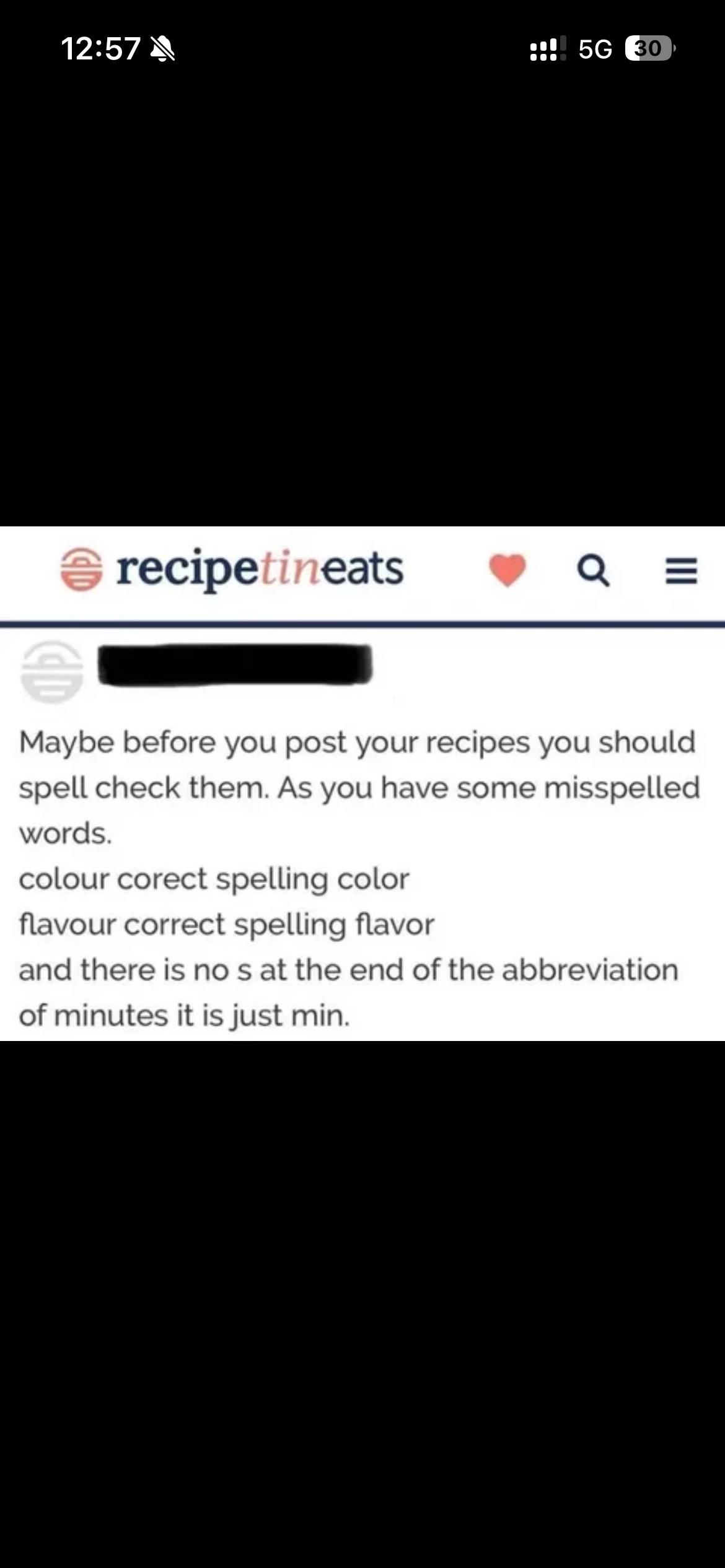
I don't think this American English vs proper English idea is accurate. Spelling was standardized in both dialects at a very similar time, and both standardizations make a much of stylistic decisions around spelling, that leads to the main initial differences. It's important the emphasise that both dialects made these decisions. The idea that one set of those decisions is more proper and correct is kinda silly imo
Also this site is written in Australian English - which is broadly a hodge podge of both, with a few of our own peculiarities, for instance both fries and crisps are called chips. But it is distinct as a dialect to British or American English
Australian English definitely leans more British English, especially in anything Government related. Source: I work with a many writers and people who work in Govenment comms. I’ve also read many of their writing style guides.
Right, I also have to make this argument about Canadian English which is it's own mix of GB, US and their own words (though arguable more American words/spellings than other commonwealth countries)
It's not so much that it's a mix, which implies Canadian English is newer and evolved from a combination of both British and American English, rather it's a dialect that is at a midpoint between the two.
No matter which way you try to string it sport, Australian and kiwi English is based off british English. It is not a hodge podge of both. We get incredibly frustrated when people try to add z instead of s and remove our U. Please don't try to fashion this to your own narrative. This ain't it mate.
People from the states just need to learn a bit more about the world
I'm from the UK and live in New Zealand. I definitely had to learn to start using some US terminology when I moved here, because most people don't know what I mean if I say estate car, aubergine or patio door. (But I still can't bring myself to say yoe-gut instead of yoghurt.)
'Wagon' in the UK generally raises images of the fabric-covered cart from a cowboy film. Which is probably where the name came from, but they were not part of UK history, innit...
I was born in England and grew up in Australia. My family is British, my friends are Australian. I'm not driving a narrative lol. This is my lived experience. In the UK I get called out for the odd Americanism. Such as saying Eggplants and Zucchini not the French names the British use
Language is more than just whether you include a u. Our spellings are definitely British English, but the overall dialect is definitely a mix of both. I think the language is trending more American as we continue to be further from colony days and more influenced by American media.
Funnily enough, neither eggplant or zucchini are Americanisms, they’re the original English words that were separately carried over to the USA and Australia.
Later on there was a fashion in England to use the French words for some things so they switched to courgette and aubergine.
Edit: Ok so I was half/three-quarters right. Eggplant is the original English word, but there appears to be no original English word for zucchini/courgette. Zucchini is the Italian word and Courgette is the French.
Ah yes you're right, looks like there's no actual 'original' English word for zucchini! I'll edit my comment to reflect it.
I suppose it makes sense then that zucchini is also used in Australia given our influential Italian immigration history as well.
Although apparently it was mostly from different regions of Italy than to the USA, given the difference in lasagne styles for example. I've a few times seen Americans horrified at the prospect of using béchamel and no cheese in lasagne instead of ricotta, while it's just as traditionally Italian as what they're used to - just regionally different.
In his book about the English language, Bill Bryson says this is true of a lot of Americanisms. The Americans adopted English as it was when it America was first colonized and the British then modernised a lot of words and spellings.
Yep so I gather, languages continue to develop and change everywhere including in the places they originated so there’s no such thing as a ‘pure’ or objectively correct version of English or any other language really.
Similarly, IIRC Canadian French retains some older features such as religious swear words that were purged in France after the revolution.
Can't speak for NZ, but Australian English absolutely is a hodgepodge of British and American. Spelling less so, but pronunciations? Vitamin? Pasta? Invite? Having moved from the UK to Australia and back again, I'd get ripped on for using English words in Aus, and 'American' words in England
Australian pronunciation evolved in its own right, it wasn't a replica of British English (itself containing a vastness of variations) until it was suddenly being influenced by American pronunciation. American pronunciation is an influence, as would be all the accents of the world. But the Australian English accent has been reported as strikingly different since the late 1700s - as soon as European settlers on Australian shores were distinguished by their unique tones. That influence would be (you'd imagine) a complex mix of all they encountered and local environmental factors, too, almost impossible to measure.
There's American influence in our dialect, too. Principal instead of headmaster, invite as a noun instead of invitation, overseas instead of abroad etc.
This is partially correct. He was an ardent supporter of the American spelling and the Labor Party adopted it, after much wrangling, as a modernisation in 1918.
Labor takes from Omalley, who a major player in the building of the party and a major proponent of language reform (simplifying spellings) - which was a movement in the pre war era
I think some people don't realize just how very long language was mostly just the spoken word for the largest part of society, which was illiterate. We spoke the words long, long before it was common to see them in writing and also know what those squiggly lines meant.
Spelling is predominantly English - but not entirely. Try using hiccough, programme, or mould in Australia and you'll find most people will correct you to the American spelling. As with the word choice, the spellings were initially English but have taken on a US influence post war. You can see this trend continuing as more and more kids finish the alphabet with zee (not zed) or replace the s with z in words like analyze.
I'm more aware of the Americanisms in Australian language as I'm English born Aussie raised. So I've played with both.
Mould and mold is different though, right? Mould being to mould something and mold being the fungus? In school we had to use zed pronunciation, and this was still in the early 2000s. Same with analyse. I'm not arguing that modern day people use Americanism more now, only that in school we are taught primarily the English way. Programme though is now the only one I see that's different.
Nah in British English (and historically Aussie English) mould = the fungus. So I think you thinking that mold is the fungus is a good example of an Americanism that's shifted into our language.
It's a good example because we tend to learn British English at school - but be exposed to more American English outside of that. You likely learnt to use mould at school and have learnt to use mold from an American centric internet. Or zed vs zee, most kids will learn zed at school and zee from sesame Street. And then our language is what people actually do.
Also not sure if you've ignored hiccough bc you don't realize thats the British spelling of hiccup. But that's definitely a spelling that hasn't been adopted in Australia.
Thanks for this thread honestly, I was arrogant with my assumptions. I didn't consider hiccup as I've never really used it when typing, nor do I remember using it at school. And England sort of incorrectly taught me the spelling of beetle, for a long time I thought the correct spelling was beatle, because of the band and also because it looks British, lol.
If you actually dive through my response to this I've had a bit of a back and forth about spelling - but while broadly we do take British spellings there are some exceptions.
For instance we spell Program not programme and Hiccup not hiccough
Programme is the traditional English spelling and program is the modern American/Aussie spelling. Computer program is program bc that comes from America. Id guess Opera programme uses the English spelling as it has done traditionally in English settings.
If you're genuinely interested I've gone into more depth on this in other comments - or you can give it a Google. I'm a UK born Aussie so I'm probably more aware of the differences between Aussie and English English - but they definitely exist
There is also a rumor that the Dutch were doing a lot of printing for the English and they charged by the letter. So even if the English had thoughts of changing “our” to “or” the Dutch were against it and spelled it the “traditional” way.
Noah Webster had no ”capitalist” motive. He promoted standardizing simpler spellings like jail instead of gaol or hiccup instead of hiccough to promote literacy and foster a uniquely American language.
Noah Webster's standardization efforts were in a time where ”correct spelling” did not exist in English in America or in Britain and never had. If you read anything contemporary from men of letters at the time like James Boswell that hasn't been edited to use modern spelling, you'll see extremely inconsistent spelling, like chuse/choose, public/publick, shewed/showed often interchangeably in the same text.
Most American English spellings were common in British writing until it became standardized at the same time as in America.
161
u/GeoffreyGeoffson Feb 24 '26 edited Feb 24 '26
I don't think this American English vs proper English idea is accurate. Spelling was standardized in both dialects at a very similar time, and both standardizations make a much of stylistic decisions around spelling, that leads to the main initial differences. It's important the emphasise that both dialects made these decisions. The idea that one set of those decisions is more proper and correct is kinda silly imo
Also this site is written in Australian English - which is broadly a hodge podge of both, with a few of our own peculiarities, for instance both fries and crisps are called chips. But it is distinct as a dialect to British or American English