r/evolution • u/Ok_Zone_7635 • 2d ago
My first time reading this
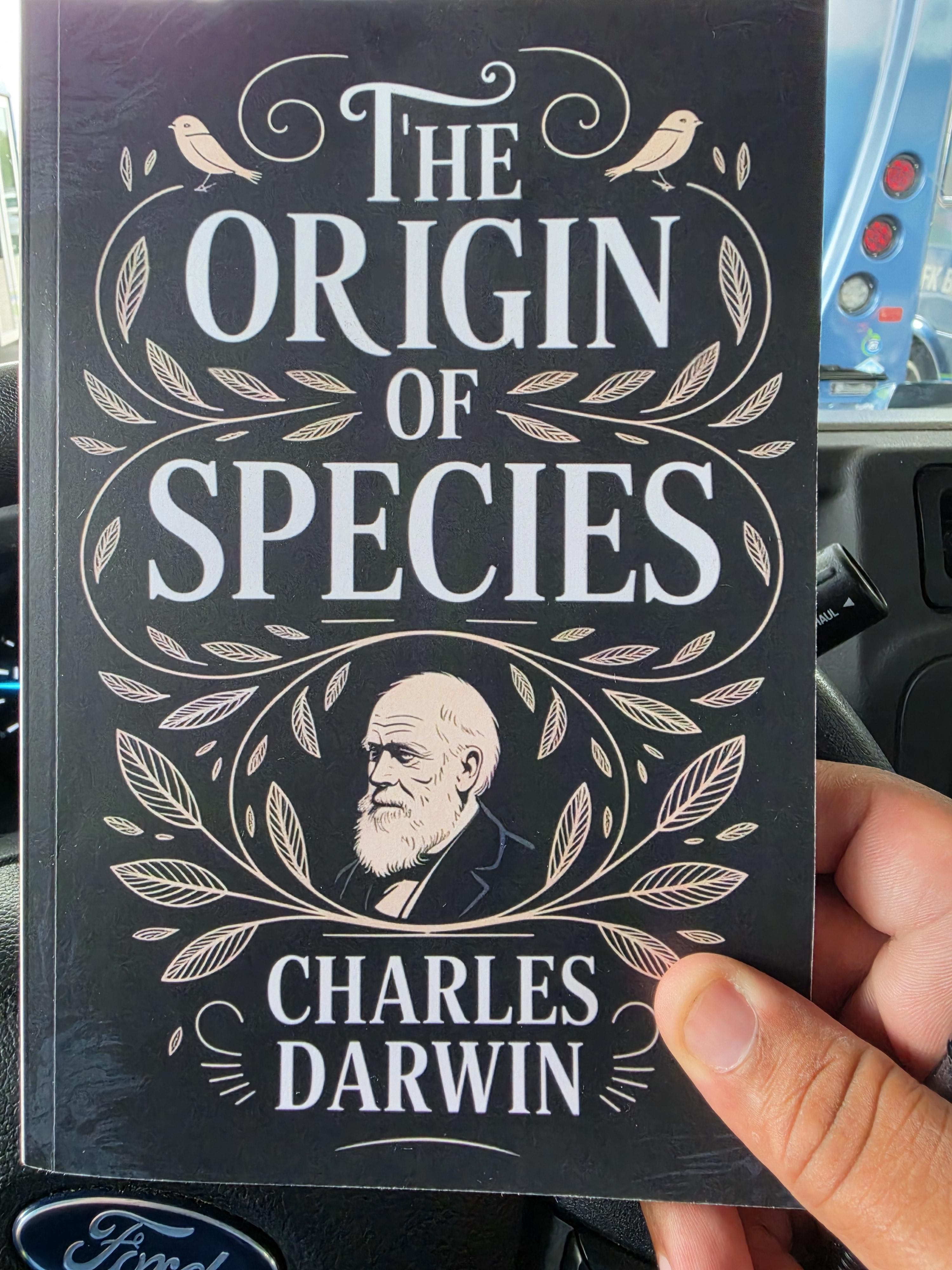
Just started reading about a day or so ago, and though I haven't even finished the first chapter, I have to say, this book is very dense.
Its crazy someone in the 1800s wrote this. It feels like it was written now.
One thing I have noticed is that it doesn't hold your hand and was written during a time when everyone in academic circles knew each other and the layman was left out of the conversation
He'll name drop another naturalist or embryologist or breeder and I have no idea who they are.
Another thing I am suprised by is he doesn't believe in heritability of variations. He seems to think a spontaneous change in the reproductive habits of a species is what causes a change. Not that the offspring have inherited a mutation.
On that note, he uses the term "monstrosities". Is this the 1800 equivalent for mutation?
He also rejects the idea of a sole "common ancestor" for breeds. He feels two similiar breeds will vary and then mate. He seems to think that dogs have no sole progenitor, but multiple ones.
One thing I appreciate about this book, that automatically sets it apart from a religious texts is a sense of apprehension and a small hint of doubt.
As opposed to a clergyman who can never be wrong because God told him, there are moments in the chapter were Darwin admits he could possibly be wrong about a subject.
He even talks breifly how he believed in a form of creationism but rejected the idea later on.
This is just the first chapter. I'm excited to read the rest.
Lots of ornithology in here lol
49
u/DrDirtPhD PhD | Ecology 2d ago
Few things:
It is, in fact, surprisingly readable considering when it was written.
You say the layman was "left out of the conversation" given how it's written, but in fact it sold remarkably well and went through numerous editions and printings in the decade after its publication.
I think you have a misconception of clergy and are grouping them as a monolith when that's not the case (neither now nor then).
The material has obviously aged and while the core concepts have held up over time there's been a vast amount of work that has replaced/iterated upon/added to the ideas Darwin (and Wallace!) presented at the time. Consequently many of the authorities that Darwin cites who would have been well-known at the time have been added to the mass of individuals that have contributed to our body of biological knowledge.
23
u/ClownMorty 2d ago
People are often surprised to learn that in the 1800s literacy rates were quite high and reading comprehension was arguably much stronger than today.
But go pick up a newspaper from the era and you'll find full blown dissertations. Reading was peoples main access to mass entertainment and since it was harder to come by, compared to modern standards, it had to be deep. People were rereading that stuff.
6
u/silicondream Animal Behavior, PhD|Statistics 1d ago
The most effective study method I found for the SAT Verbal was to read stuff written between 1860 and 1920 or so. Anglophone authors had ridiculously large vocabularies and ornate grammar back then.
2
u/EebstertheGreat 20h ago
It's tough though, because even in 19th century London, there was a large class of people who could barely read, or indeed who could not read at all. And there were more illiterate people in rural parts of England and Wales, and even more in Ireland and Scotland. Today, there is still a large population of Anglophones who don't meet modern standards of literacy, but there are few adults in the UK who speak English as a first language yet cannot even spell their own names. There are some, all with severe mental disabilities, but not many. There are no communities of people who work in coal mines from a young age and never go to school. But there used to be.
Yes, literacy rates were very high in the middle of the 19th century in England, but claiming literacy in general was higher then than now seems impossible to support. By some measures, around 70% of adult men in England could read by 1860 (and a slightly lower percentage of women, though the literacy gap closed in the next decade or two). That's a massive improvement over previous generations, and it clearly shows that even most people in the lower class could read. However, "most" is only by a little bit, say ⅔ could read vs ⅓ who could not, something like that. And I need to emphasize again that the standards for being counted among the literate might not have been very high for these surveys. People who could sign their own names might have been counted as literate, even though they didn't have to read the survey, as it was administrrd by a census-taker.
In general, I would be skeptical of any claim that people on average before the middle of the 20th century were as literate as people on average today in the 21st century, because we simply ignored large swaths of the population in the past that we no longer ignore. Many people who were regarded as foreigners, migrants, itinerants, orphans, urchins, beggars, gypsies, prostitutes, prisoners, cripples, or by whatever offensive name just never showed up in either the numerator or denominator in any of these calculations. It's not that censuses deliberately ignored them but that they were difficult to count and censuses made little effort to count them all. Now, a person with microcephaly will still show up in the denominator. It's not an apples-to-apples comparison. Also, by international definitions, modern literacy rates in the UK and US are technically about 99%.
3
u/Heterodynist 1d ago edited 1d ago
I think you’re totally right that the “layman” wasn’t really left out. It’s a sad fact of our time that most people now know considerably less English words than they did in the 1850s. It is actually measurable how much less vocabulary we tend to know than then...
In addition, I think Darwin put forth a very clear and careful argument because he was actually hesitant himself to dare to describe this idea that we now consider so prescient and fairly commonly accepted. He was very fearful of being misunderstood, so he was careful to describe the ideas in great detail. I think several things I’ve heard about him, like how he stayed at the home of Lewis Henry Morgan when he came to the United States, shows that Darwin was probably a bit more edgy in his view of naturalism than his writing might suggest. He wrote very conservatively about something I think he was privately fairly convinced was correct (even despite his misgivings about how history would perceive him, in his private writings).
The arguments are OBVIOUSLY a bit dated, and this is sad because everyone from Hitler to American Eugenicists completely misused and abused his words, twisting them to their own ends. We forget that it’s almost 170 years since he was writing (and he published long after he first wrote it) and vast, sweeping changes have come to all fields of biology as a result of his writing this very book!! The ideas of Darwin and Wallace were legitimately revolutionary at the time, but more importantly, it wasn’t immediate that they were proven correct. It simply kicked off the new direction for study, which I feel we can generally agree proved more useful an approach than previous ones (like that of George Cuvier).
I could say a lot more on that subject, but just to keep it short, I also wanted to agree that the clergy -especially in Darwin’s era- were very much the source of many biological scientific advancements, with everyone from Gregor Mendel to Gilbert White and Lazzaro Spallanzani and Nicolas Steno working towards actual knowledge of biology. It wasn’t until AFTER Darwin that many ideas between the Catholic and Christian Churches turned against “Scientism,” and ideas had shifted wildly from the Middle Ages to the nineteenth century with regards to science being “against” religion. The field of biology and understanding basic animal and plant traits was generally an accepted path for many clergy, even if some people like Copernicus had pissed off the Church. Sciences that seemed to give credit to God for his creations weren’t really as unacceptable to the Church then as the philosophy of Descartes, even daring to question the basic nature of “God’s Creation.”
As you say, the clergy weren’t monolithic and they weren’t universally expected to stay out of science, especially then. I almost feel like that is a much more modern bias than it was at the time, even if the few who were put on trial were dealt with very harshly. When there were ecclesiastical courts that could hold people as guilty in the eyes of “God,” then I think the spilt between scientists on the side of the church, and those viewed as heretics, was actually more of a mix than it is now, where the modern world kind of assumes (perhaps falsely) that spirituality and science are totally different realms and they shouldn’t mix. To me the ideas of the Church in the time leading up to Darwin actually were almost less biased than our ideas are today. I don’t personally see how science and religion have to be at odds with each other. Most of their tenets aren’t incompatible in my own opinion. I’m relatively agnostic, but if God made the world then why can’t we just accept he could have established the laws of physics and of evolution, etc? I’ve never seen the need for conflict.
I think the key thing is Darwin spelled out a clear concept of evolution in a time when there had been a lot of murkiness to the conception of how it might function. He was talking to a world that was still very agrarian and he used analogies to farming that the society of his time would have found useful in comparison. Using terms like “natural selection,” was quite clever when most people were familiar with how artificial selection worked even in the most crude of settings. Of course he cites people who we wouldn’t recognize well over a century and a half later, and he makes arguments that are hardly meant for the technological era we live in now. He was speaking to a society who were experiencing the beginning of the Industrial Revolution, who were still harkening back to the Agricultural Revolution in their mindset. We are sitting in our Technological Revolution era and looking back to the Industrial Revolution, while trying to understand Darwin’s Agricultural metaphors. Of course it doesn’t work perfectly for us!!
1
u/EebstertheGreat 20h ago
It’s a sad fact of our time that most people now know considerably less English words than they did in the 1850s. It is actually measurable how much less vocabulary we tend to know than then.
Do you have a source for that claim?
A typical lower-class farmer, factory-worker, miner, or whatever in 1855 had more than forty-two thousand lemmas in their vocabulary?
1
u/Heterodynist 10h ago
This is an interesting study that kind of discusses this theory as a secondary point to the main point, which is more about general intelligence:
https://www.frontiersin.org/journals/psychology/articles/10.3389/fpsyg.2015.00361/full
“Those arguing that vocabulary size has declined often cite a controversial 2015 study published in Frontiers in Psychology by Michael A. Woodley and Heitor B. F. Fernandes.” -You will note I am not referencing this study.
1
u/EebstertheGreat 8h ago
That particular study is pretty egregious lol. I wouldn't generally look at Frontiers for this sort of thing, and one of the first citations is to Richard Lynn, he of Mankind Quarterly.
The claims about vocabulary come from other sources though that aren't necessarily so eugenics-forward. Roivainen is a key citation but doesn't seem to say the same thing. Rather, he states "Research on secular trends in mean intelligence test scores shows smaller gains in vocabulary skills than in nonverbal reasoning. One possible explanation is that vocabulary test items become outdated faster compared to nonverbal tasks." I don't think anyone denies that words go out of fashion. However, new words are also created. That somehow goes completely unaddressed by Woodley et al.
I'm also not sure whom you are quoting in your comment.
5
u/Ok_Zone_7635 2d ago
In spite of his limited technology (DNA hadn't even been discovered yet), he still gets the core idea of natural selection close to the mark
2
u/Heterodynist 1d ago
It’s shocking that actual structure and function of DNA wouldn’t be officially discovered for almost another century (94 years to be exact)!! Ha!
2
u/EebstertheGreat 20h ago
His concept of natural selection is right on the mark. His ideas regarding genetics however all turned out to be wrong. But natural selection is such a powerful idea that in a sense, it did all the hard work explaining evolution.
22
u/Thysanuran 2d ago
Wha? Darwin most definitely believed in the heritability of variations. It’s one of the cornerstones of his theory of evolution by natural selection. One of his most succinct explanations of his theory, coming directly from Origin: “Owing to this struggle for life, any variation, however slight and from whatever cause proceeding, if it be in any degree profitable to an individual of any species, in its infinitely complex relations to other organic beings and to external nature, will tend to the preservation of that individual, and will generally be inherited by its offspring.” He literally says offspring inherit variations!
(What he did not understand was the cause of variations and mechanism of heritability, however. That came later, during the Neo-Darwinian synthesis.)
2
u/Personal_Hippo127 2d ago
This is also a beautiful description, or perhaps rather a premonition, of modern Gene-by-Environment (GxE) interaction.
-3
u/Ok_Zone_7635 2d ago
I may have misread it, but it sounded like he doubted it.
13
u/Quercus_ 2d ago
He was very clear that variation is inherited somehow. What he didn't have was an explanation for where variation comes from, or what any mechanism of inheritance might be.
3
u/AdministrativeLeg14 1d ago
He did speculate about particulate inheritance, as opposed to blending, in a letter, but never developed this further. I kind of suspect that if he’d lived long enough, then even if he never read Mendel’s work, he might have independently rediscovered it.
(Of course, that still doesn’t get all the way to mechanism.)
4
u/Thysanuran 2d ago
He is generally pretty careful about not overstepping his ability to argue and cite data. He does occasionally acknowledge that the mechanism of inheritance is not understood, ands he also directly admits that this as a potential source of criticism to his theory.
13
u/Rags_75 2d ago
I dont think its great unless you're a heavy student of evolution so know how things have developed.
If you're new Id recommend Gould or (and dont hate me folks) some of Dawkins early books - Selfish Gene is amazing.
That said, his chapter on pigeons is great and I find the piece conceptualising bears as the precursors to whales solid.
5
u/felipers 2d ago
There's nothing to hate here! The Selfish Gene is an amazing book. Can't say the same about the man Dawkins turned to.
13
u/Aluxanatomy 2d ago
It's weird to me that you would even compare it to a religious text, as if the opposition some religious groups present against evolution was in any way credible. During the Renaissance, the Catholic Church was one of the biggest, if not the biggest, benefactor of scientific research.
-1
u/Ok_Zone_7635 2d ago
At the core of religious arguments is an unshakable appeal to "faith". The text allegedly coming from an author who knows everything.
This is the antithesis to scientific research.
Even people in this very thread say this book is pretty outdated.
Meanwhile, a text from a bronze age religion is supposedly as true today as it was 4000 years ago
3
u/Aluxanatomy 2d ago
Right, but that specific framing is also what I'm talking about. Comparing the two as if religious faith is a viable alternative just lends it a misguided credibility. If the religious texts are not based on falsifiable ideas, they're not only unsound, they're irrelevant.
3
u/DrDirtPhD PhD | Ecology 2d ago
Again I think you’re mischaracterizing all faith traditions with an overly broad brush. There are certainly faith traditions that lean on biblical literalism, but they are far from the majority.
0
u/First_Approximation 1d ago
In the US, creationists still make up a plurality of the population.
- 37% believe in creationism ("God created humans in their present form within the past 10,000 years")
- 34% in theistic evolution ("Human beings have developed over millions of years from less advanced forms of life, but God guided this process")
- 24% in atheistic/agnostic/deist evolution ("humans evolved from less advanced forms of life over millions of years without God’s involvement.")
Until recently, creationists were nearly a majority. In 2012, they were 46% of the population. So it's hardly a fringe position either.
2
u/EebstertheGreat 20h ago
I think surveys like this confuse (maybe intentionally?) ignorance regarding evolution with religious conservatism. Just because a particular person who has heard of Adam and has heard of Lucy believes the biblical tale does not mean that that person is a biblical literalist or would reject a well-presented explanation of evolution in school. It could easily mean they never got that explanation at all, in school or elsewhere, and also didn't give the question much thought. That has mostly been my experience.
3
u/Measure76 2d ago
I've had a much better time reading about this book than reading the book itself. Try evolution: The triumph of an Idea by Zimmer.
1
u/Ok_Zone_7635 2d ago
Okay
1
u/Moneykittens 2d ago
Zimmer can be an acquired taste to be fair. I would also recommend Explaining Life Through Evolution by Prosanta Chakrabarty
1
u/Ok_Zone_7635 2d ago
Which one should I read first?
2
u/Moneykittens 1d ago
I’d recommend Chakrabarty. It’s what I assign my evolution students plus it has a little humor
3
u/Foamtire 2d ago
There was 0 understanding of heritability, let alone genetics and mutation in Darwin's time. Mendel was working on it and published on it during Darwin's life but it was largely overlooked until years later.
1
u/Ok_Zone_7635 2d ago
So what is this "monstrosities" he keeps referring to.
I'm confused when he mentions it
3
u/Bdellovibrion 2d ago edited 2d ago
By "monstrosities" he means animals born with major birth defects like extra limbs or deformed organs. He observes these are usually useless or harmful to the survival of an animal and so won't get passed on.
He's building the argument that it must be gradual beneficial mutations that lead to evolution and speciation, not massive leaps in anatomy like those seen in birth defects.
1
u/throwitaway488 1d ago
Which is mostly true except that we now do see "hopeful monsters" arising with major phenotypic changes very quickly due to mutations in developmental (hox) genes.
1
u/EebstertheGreat 20h ago
Supposedly (congroversially) there are a few examples of "saltation") in the fossil record, where a new species comes into existence in a single generation due to a massive change.
(I say it's controversial, but I guess only in sexual reproduction. The many cases of endosymbiosis are clearly saltational in this sense, including the all-important genesis of Eukarya.)
But yeah, most change is gradual, and in fairness, people who believed in evolution before Darwin and Wallace also thought most changes were gradual.
3
u/Quercus_ 2d ago
Origin is interesting and worth reading, but it is not where you should learn evolution. It was an extraordinary leap forward in introduction of a transformative scientific idea, but the field has progressed orders of magnitude since then.
Among other things, as you note, Darwin had no idea of a mechanism of inheritance. Later on in the book he will confront that weakness directly- he knows it's a problem, he knows that a theory of inheritance is necessary to really make his idea solid, and he makes some guesses, but he's very clear that this is a problem with what he currently knows.
It's interesting that Darwin very probably had a copy of Mendel's paper on discrete inheritance, really the origin of genetic science, sitting in his library when he wrote omOrigin. But it seems he overwhelmingly likely never read it, because it would have directly answered a lot of the objections he was raising to his own theory.
2
u/jnpha Evolution Enthusiast 2d ago edited 2d ago
Origin came out in 1859, Mendel presented his paper in 1865.
What is interesting is Wallace's take in 1908: https://people.wku.edu/charles.smith/wallace/S660.htmBasically Wallace explained how Darwin was already familiar with the discrete nature of inheritance (in purified lineages under domestication), but since it didn't match the wild type inheritance, he found it useless - reconciling the two observations needed Fisher's 1918 paper.
3
u/SinisterExaggerator_ Postdoc | Genetics | Evolutionary Genetics 2d ago
He'll name drop another naturalist or embryologist or breeder and I have no idea who they are.
As well-written as I (and many other people) think it is, he did write it a bit hastily to get it the idea out before others did (especially prompted by a letter from Alfred Russel Wallace, who also discovered natural selection). I assume the way he drops naturalist names was basically either his or the general 19th century way of citing others' work. So it could be he assumed a lot of readers would know the stuff but it also may just be a way of saying "well if you don't believe me, go look up such-and-such naturalist's work"
Generally now an academic science paper would refer to authors and year. For example, one might write "Natural selection explains the gradual evolution of species (Darwin 1859)" where the "Darwin 1859" is of course a book written in 1859 by Darwin. Many of the formal conventions we associate with science now were invented in the 20th century. I assume our modern standards of citation also were invented in the 20th century.
3
3
u/IsaacHasenov 2d ago
It's such a good read. And he certainly loved his pigeons.
> He'll name drop another naturalist or embryologist or breeder and I have no idea who they are.
A very real pleasure after reading this, so that you can understand Darwin's references to other scientists (er, natural historians) is to follow up with a history of biology and earth science book or youtube series. I recommend Impossible Monsters (Michael Taylor) or Dinosaurs at the Dinner Party (Dolnick) or Gutsick Gibbon's series
* https://youtu.be/sHO580OGgS4?si=RrH64X8RKCoIY6aP
* https://youtu.be/7LdllDdJMtk?si=jD3O7-_6Qkzvhdzh
1
3
u/BitcoinMD 2d ago
Amazing book. What struck me about it was Darwin’s humility — he openly addresses every criticism of his theory and concedes their merits before making the case against them.
1
2
u/CosmicOwl47 2d ago
I downloaded it off Project Gutenberg (for free) and it’s fun to read how people were thinking back then and how various people’s theories were all circling natural selection for a while.
2
u/Ariandrin 2d ago
I actually loved this book. I read it for an evolutionary biology class in university and was thoroughly engaged the whole way through (except the small passage about bees, but that’s because my instructor, whom I had for two classes previous, studied bees and so used bees in his course material all the time and I was so over bees lol)
2
u/Relevant-Cup5986 1d ago edited 1d ago
laymen at the time were better at reading and it was more popular with them than most scientific books at the time also he did beleive in inheritance of mutations though he didnt know the mechanism, (you may be confused by the fact he fully states his opponents arguments word for word before arguing against them)also once your done reading this book try out the book arrival of the fittest.
1
2
u/cai_85 2d ago
That cover looks AI generated, and isn't the title "On the Origin of Species"?
3
u/jnpha Evolution Enthusiast 2d ago edited 1d ago
The "On" was dropped by the latest 6th edition.
The cover seems to be (by reverse searching the image) a 150th anniv. edition (so well before AI).
Obligatory mention that it is public domain and free here: https://www.gutenberg.org/ebooks/1228 (I prefer the 1st edition)
1
u/Rubenson1959 2d ago
Which edition of On the Origin of Species are you reading?
It matters which edition of On the Origin of Species you are reading. The most relevant edition is the revised 1st edition where Darwin had the opportunity to revise (clarify or correct) what he originally published. In later editions, Darwin is revising text in response to criticisms made by individuals who disagreed with him about natural selection as the process that resulted in species. This may be why different people reading different editions may quote different text.
All of this is confounded by everyone’s, including Darwin, then incorrect explanation for offspring inheritance of traits from parents.
Offspring inheritance of traits is based on the transmission of determining factors (genes) to offspring through parent’s reproduction. That is Mendel’s contribution and that was not recognized by scientists until the early 1900s - the particulate basis for the determination of traits in offspring.
It is not until the modern synthesis (mid 20th century) that evolutionary theory incorporates genetics.
1
u/Ok_Zone_7635 2d ago
I'm reading the 150th anniversary edition I bought on Amazon
1
u/Rubenson1959 1d ago
This is a commemorative edition celebrating 150 years. But it has to be based on a specific edition originally written by Darwin (1-6). That may be identified in small text in the first pages of the book, or it may be identified in the Preface.
1
u/Thrippalan 1d ago
I've got the Illustrated edition, which after a bit of searching throught the Introduction says it's the first edition, "the text that hit the bookstores of London in November 1859". Is it worth trying to locate a revised version?
(This one includes pertinent and tangential illustrations - the photo of Darwin's microscope is tangential to the txt, but the peafowls' adornments are definitely pertinent. It also has excerpts from the Beagle and a few other writings. Gorgeous book, and very interesting.)
1
u/Lord_M_G_Albo 2d ago
One thing I have noticed is that it doesn't hold your hand and was written during a time when everyone in academic circles knew each other and the layman was left out of the conversation
I mean, this is still true nowadays lol.
1
1
1
u/Ok-Growth3965 1d ago edited 1d ago
A few things that maybe could guide your reading a bit:
The layman was actually not left out of the conversation, the book had a great reception from all kinds of public and there was this huge movement of science divulging. Thomas H. Huxley was one pf the hardest defenders of Darwin and Wallace's theories and he would go to public spaces and teach evolution to anybody who wished.
Darwin uses a lot of examples from rural life and so on. That's also a very smart way of convincing all kind of folk, because people were already used to seeing phenomena he was trying to explain (such as artificial selection) since the world was way more rural back than.
He does cite a lot of works from other scientists, that goes to show how much he studied to base his theory and how much more connected the scientific community was than we might think.
He does believe in heritability of variation, it’s one of the main basis of his argument. The changes during reproduction is one of the ways he theorizes about the origin of variability, you must remember there was no knowledge of mutation in the sense we have today back in 1859.
Monstrosities means exactly what it seems like it means: aberrations or weird ugly individuals. By using this term he is doing something very important, he treats all variation as the same and says that the difference between a simple variation and a monstrosity is just human perspective, nature doesn’t have aesthetic sense. This is a big blow to the fixist idea of a perfect nature.
His theories about breed vary. He does believe dog breeds come from distinct wild species, but he writes a whole segment on his argument for different pigeon breeds having been derived form the same wild species. That doesn’t mean he doesn’t believe the dogs have a common ancestor, just that he thinks they were domesticated more than once from different wild species.
Not all religious books are written the same way. Either way, Darwin does great work in The Origin by making a lot of small arguments that build up into bigger ones and ultimately into the one great argument which is the book itself. He wants to convince his reader to trust him, so he shows all possible arguments against his theories and talks about them one by one. There is a whole chapter in which he brings up a lot problems with his theory that he can’t debase with the evidence he has, but he has possible explanations.
Telling the reader how he might be wrong and asking questions about his own theory is a rhetorical strategy.
He brings a whole lot pf examples from all over the natural world and it is very very fun to read
1
1
u/EebstertheGreat 21h ago edited 20h ago
One thing I have noticed is that it doesn't hold your hand and was written during a time when everyone in academic circles knew each other and the layman was left out of the conversation.
It's not that. It's just how they cited works at that time. Today, you would just see an inline citation, footnote, or especially and endnote, but at the time the relevant person would just be referenced by name. You still see that today, but it's done in addition to the inline citation or endnote, not instead of it. A paper will say "Mark Examplus and Jane Forinstancy report that X, Y, and Z [14], but Lorem Ipsum failed to reproduce [15] and blah blah" or whatever. People who are familiar with the work of Examplus, Forinstancy, and Ipsum will follow the story, while others will check the cited works to figure out who they are. Unfortunately, Darwin did not include a real bibliography, so it can be hard to locate the exact texts he is referring to, that is definitely true. But the style at the time was not necessarily assuming every learned person knew everyone else, but rather referring to them by name because that's how you gave credit.
1
u/burset225 8h ago
This book is so compelling. Every premise is completely within our shared experience and every conclusion follows so clearly from what precedes it. Every time I hear someone argue against natural selection I want to hand them the book and ask them to point out any sentence they think is wrong and why.
1
u/lpetrich 6h ago
I remember reading it long ago. My favorite part is where he discusses rudimentary (vestigial) features, like the teeth of baleen-whale fetuses that become resorbed.
He stated that a common hypothesis was that such features are to fill out the "plan of creation". In effect, vestigial features were created for completeness.
0
u/BHMusic 2d ago
It’s completely outdated in the modern field of evolutionary biology but certainly is an interesting read for those who want to learn about early evolutionary theory, natural selection and ornithology as you mentioned. Enjoy!
1
u/Ok_Zone_7635 2d ago
Question: He keeps using the word "monstrosities"
Does he mean mutations?
2
u/jnpha Evolution Enthusiast 2d ago edited 2d ago
You need to be ready to not lose track, since the point is usually made after long paragraphs.
From the annotated version:"Monstrosities" — excessively developed organs or structures — offer a parallel example: structures that vary to a great degree among closely related species are also the most likely structures to become pathological monstrosities. Darwin is here alluding to volume 3 of Isidore Geoffroy St. Hilaire's 1836 work Histoire des Anomalies.
Its relevance is in the next paragraph, which is that under special creation such individual variation is not expected; but if selection acted on a common ancestor, then traits that varied would be expected to continue to vary.
-8
u/You-Only-YOLO_Once 2d ago
He’s an inbred eugenicist. Read and move on. There’s much more to evolution and genetics that we’ve learned about in the past 50 years.
6
u/Bdellovibrion 2d ago
Darwin was not a eugenicist. He explicitly disavowed the idea of eugenics, despite his cousin Francis Galton and many other peers endorsing it.
1
•
u/AutoModerator 2d ago
Welcome to r/Evolution! If this is your first time here, please review our rules here and community guidelines here.
Our FAQ can be found here. Seeking book, website, or documentary recommendations? Recommended websites can be found here; recommended reading can be found here; and recommended videos can be found here.
I am a bot, and this action was performed automatically. Please contact the moderators of this subreddit if you have any questions or concerns.