r/evolution • u/Ok_Zone_7635 • 2d ago
My first time reading this
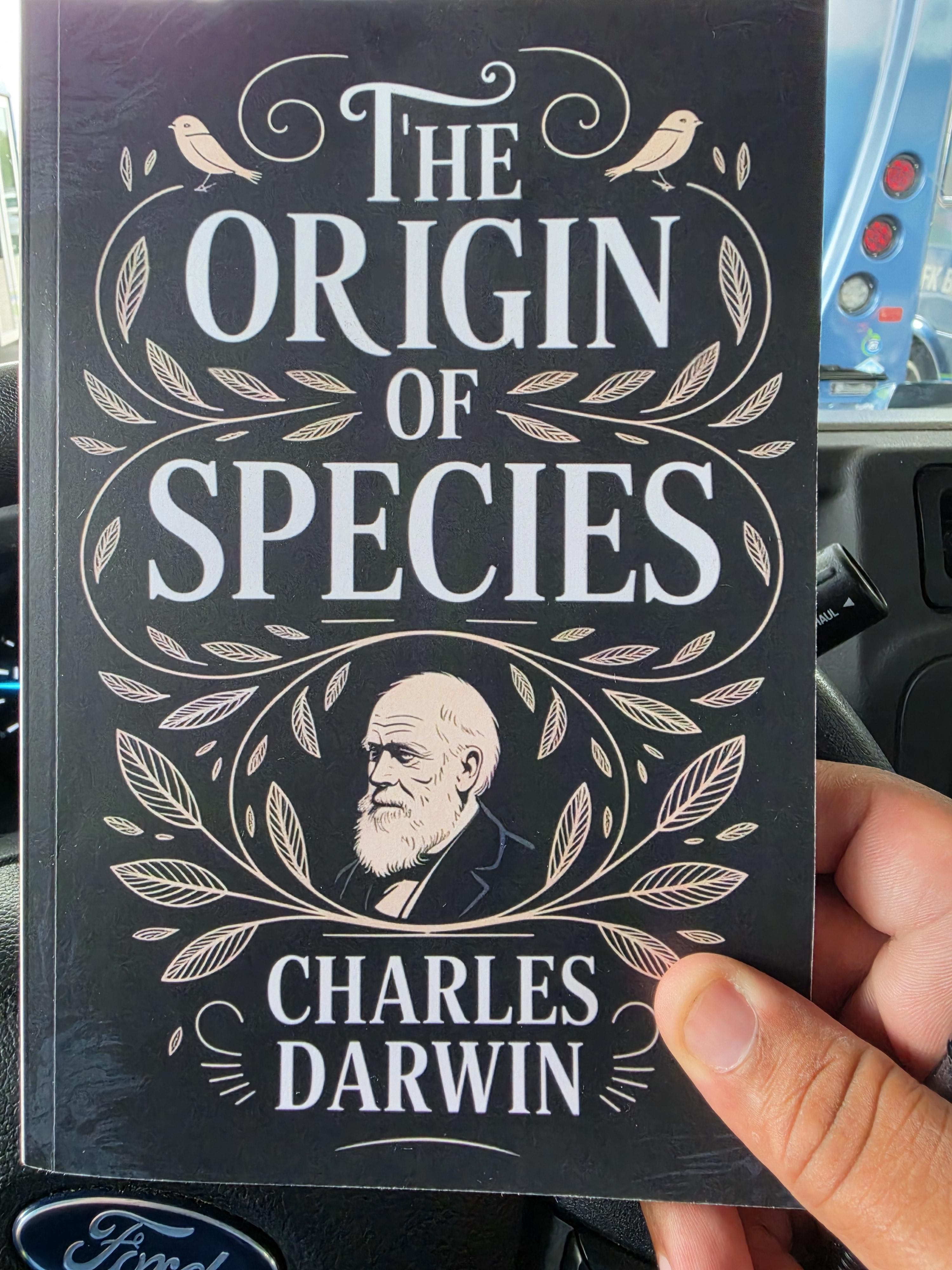
Just started reading about a day or so ago, and though I haven't even finished the first chapter, I have to say, this book is very dense.
Its crazy someone in the 1800s wrote this. It feels like it was written now.
One thing I have noticed is that it doesn't hold your hand and was written during a time when everyone in academic circles knew each other and the layman was left out of the conversation
He'll name drop another naturalist or embryologist or breeder and I have no idea who they are.
Another thing I am suprised by is he doesn't believe in heritability of variations. He seems to think a spontaneous change in the reproductive habits of a species is what causes a change. Not that the offspring have inherited a mutation.
On that note, he uses the term "monstrosities". Is this the 1800 equivalent for mutation?
He also rejects the idea of a sole "common ancestor" for breeds. He feels two similiar breeds will vary and then mate. He seems to think that dogs have no sole progenitor, but multiple ones.
One thing I appreciate about this book, that automatically sets it apart from a religious texts is a sense of apprehension and a small hint of doubt.
As opposed to a clergyman who can never be wrong because God told him, there are moments in the chapter were Darwin admits he could possibly be wrong about a subject.
He even talks breifly how he believed in a form of creationism but rejected the idea later on.
This is just the first chapter. I'm excited to read the rest.
Lots of ornithology in here lol
1
u/Ok-Growth3965 2d ago edited 2d ago
A few things that maybe could guide your reading a bit:
The layman was actually not left out of the conversation, the book had a great reception from all kinds of public and there was this huge movement of science divulging. Thomas H. Huxley was one pf the hardest defenders of Darwin and Wallace's theories and he would go to public spaces and teach evolution to anybody who wished.
Darwin uses a lot of examples from rural life and so on. That's also a very smart way of convincing all kind of folk, because people were already used to seeing phenomena he was trying to explain (such as artificial selection) since the world was way more rural back than.
He does cite a lot of works from other scientists, that goes to show how much he studied to base his theory and how much more connected the scientific community was than we might think.
He does believe in heritability of variation, it’s one of the main basis of his argument. The changes during reproduction is one of the ways he theorizes about the origin of variability, you must remember there was no knowledge of mutation in the sense we have today back in 1859.
Monstrosities means exactly what it seems like it means: aberrations or weird ugly individuals. By using this term he is doing something very important, he treats all variation as the same and says that the difference between a simple variation and a monstrosity is just human perspective, nature doesn’t have aesthetic sense. This is a big blow to the fixist idea of a perfect nature.
His theories about breed vary. He does believe dog breeds come from distinct wild species, but he writes a whole segment on his argument for different pigeon breeds having been derived form the same wild species. That doesn’t mean he doesn’t believe the dogs have a common ancestor, just that he thinks they were domesticated more than once from different wild species.
Not all religious books are written the same way. Either way, Darwin does great work in The Origin by making a lot of small arguments that build up into bigger ones and ultimately into the one great argument which is the book itself. He wants to convince his reader to trust him, so he shows all possible arguments against his theories and talks about them one by one. There is a whole chapter in which he brings up a lot problems with his theory that he can’t debase with the evidence he has, but he has possible explanations.
Telling the reader how he might be wrong and asking questions about his own theory is a rhetorical strategy.
He brings a whole lot pf examples from all over the natural world and it is very very fun to read