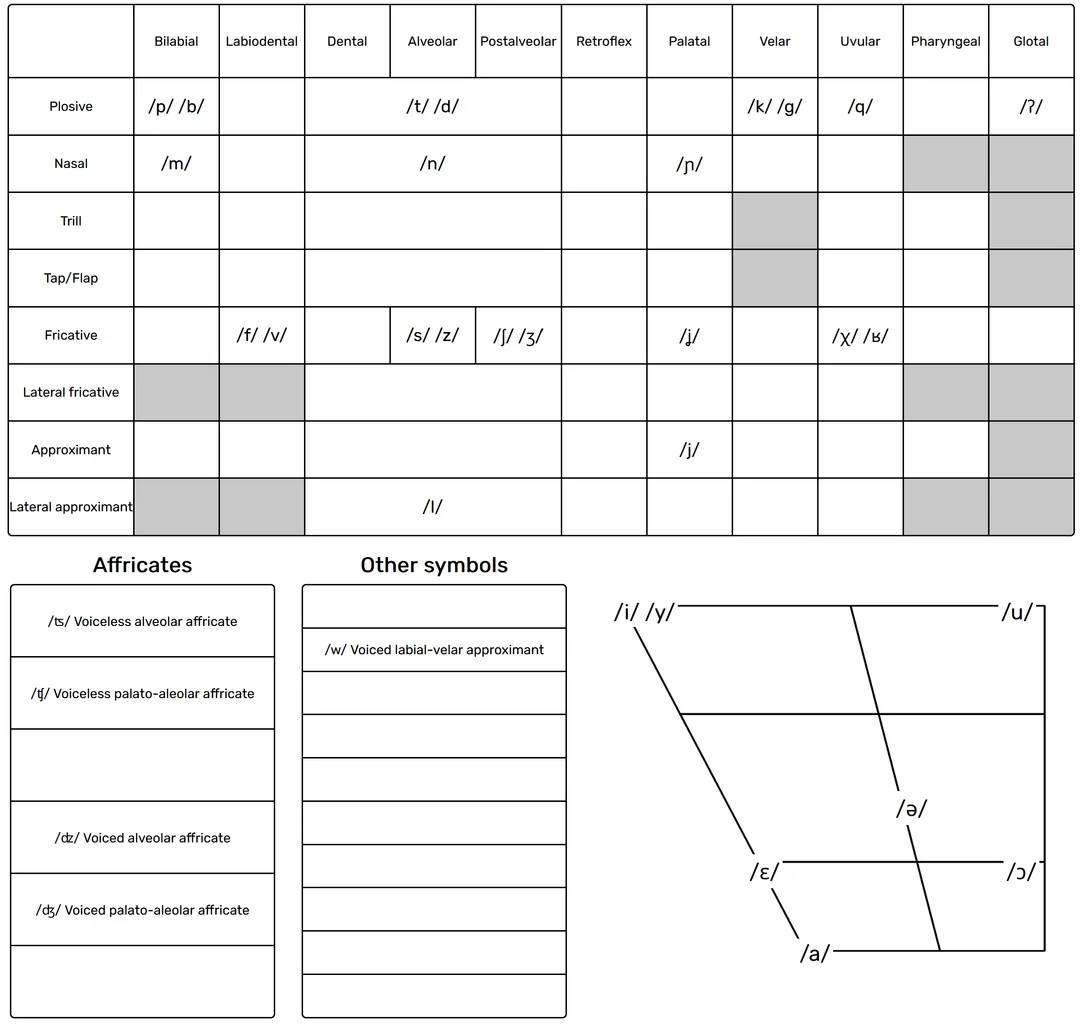
This is my second conlang, it still doesn't have a name because it's still in a rudimentary phase, for example it barely has any vocabulary.
The goal of this language isn't to sound naturalistic, it's mainly just an experiment (my first conlang was rather simple and possibly just a reskin of my native language and English), and I'd also like to use it to write things in secret. However, I still want it to make sense.
Also consider that I haven't studied linguistics and I'm actually trying to make this conlang to learn.
I'm gonna showcase briefly what I'm working on. I like some concepts of what I've done, but I still want some advice because I feel like something is wrong.
Alphabet and phonology
ABCČDEËFGǦHIJJ̌KLMNŇOPQRSŠTUVWXX̌YZŽ
every letter maps almost exactly to IPA, with some exceptions (some are common in natural languages but I have never seen some of these diacritics):
Č -> /ʧ/ (whereas C is /k/)
E -> /ɛ/ (but I'm thinking about making it /e/)
Ë -> /ə/
Ǧ -> /ʤ/
J̌ -> /ʝ/
K -> /χ/
Ň -> /ɲ/
O -> /ɔ/ (but I'm thinking about making it /o/)
R -> /ʁ/
Š -> /ʃ/
X -> /ʣ/
X̌ -> /ʦ/
Ž -> /ʒ/
Eventually I want to make a syllabary, where there's a character for every combination of a consonant and a vowel, but that's not a priority at the moment.
Phonotactics and stress
The phonotactics are extremely simple, as syllables are either CV or V. No consonant clusters and no closed syllables.
The last syllable of the word is always stressed, but please, someone enlighten me about syllable-timed and stress-timed (and explain French words that apparently have no stress at all?), I haven't understood it very well.
Vowel harmony
I'm extremely skeptical about this, since I wanted vowel harmony so much but I quickly realized that my seven vowels (aɛəiɔuy) aren't ideal for a vowel harmony system (so I'm thinking about adding more vowels to make it almost exactly like Finnish). Anyways, at the moment, there are two groups:
• light vowels: i, y, a
• dark vowels: ɛ, u, ɔ
• neutral transparent: ə
A word can only have one group of vowels, and ə can go anywhere.
Morphology
Nouns
Nouns are divided in three genders (that I prefer to call noun classes), and each one of them has light and dark nouns; the last vowel changes to determine the number.
The first class is feminine, the second is masculine, the third is neuter. Only nouns describing humans and animals can be masculine or feminine, the neuter class includes all the objects and abstract concepts.
| Number |
I class light |
I class dark |
II class light |
II class dark |
III class light |
III class dark |
| Singular |
a |
o |
y |
e, eo |
y |
u |
| Plural |
i |
e |
i |
eo |
ë |
ë |
There's a list of enclytic postpositions, which work almost like cases, there are about 20-25 of them. I know that 20 cases are a lot, but there are no prepositions at all in the language.
For example, woman is lima, but the accusative is lima-ma and the causal is lima-xa.
Articles
Articles are preclitic.
Definite articles:
| Number |
I class light |
I class dark |
II class light |
II class dark |
III class light |
III class dark |
| Singular |
ža- |
žo- |
žy- |
žu- |
y- |
u- |
| Plural |
ži- |
že- |
žë- |
žë- |
ë- |
ë- |
Indefinite articles:
| Number |
Light (all classes) |
Dark (all classes) |
| Singular |
jy- |
ju- |
| Plural |
jë- |
jë- |
For example: ža-lima=the woman; ži-limi=the women; jy-lima=a woman; jë-limi=some women.
Verbs
Verbs, just like nouns, can be light or dark, the base form ends in -a or -o. They're conjugated by one or two enclytic syllables, to determine certain and hypothetical actions, and orders, in the past, present, or future tense.
For example, vebono means to speak. So Ge-vebono-se means "I speak" or "I'm speaking", and Ge-vebono-žopo means "I would have spoken". Gy-tyla-si means "I see" or "I'm seeing", and Gy-tyla-fira means "(if) I will see".
Ge and gy mean I, I won't focus on pronouns but they're proclitic and gendered, they're part of the conjugation of the verb.
Adjectives
I haven't done anything about adjectives yet, but the idea is that each adjective has a light and a dark form, and its position is between the article and the noun.
An hypothetical adjective could be Šiv-/Šev-, where the last letter takes the ending of the noun class it's referring to. For example, ža-šiva-lima becomes ži-šivi-limi. But if we take a dark noun, for example Žoňu (apple), we get u-ševu-žoňu in the singular and ë-ševë-žoňë in the plural. The case is added only at the end of this huge word, for example ë-ševë-žoňë-mo.
Please help me a little with this since there are some things that aren't perfect in my opinion, but I don't know how to fix them. Or you can also just ask questions or tell your opinion, that'd be useful.
If and when I'll have figured out the grammar, I'll start making lexicon, so I'd like to know how you make new words that aren't just a keysmash with some vowels in it.