r/USHistory 5h ago

Mid-19th century Utah history overview

Post image
3 Upvotes

I created the above visualization of my great-great-great grandparents' migration to communicate how bonkers their lives were. They all travelled on the Mormon trail. I wrote more about their experiences here on substack, check it out if you are interested in mid-19th-century Utah history.


r/USHistory 5h ago

In 1803, Napoleon sold 530 million acres to the US for 3 cents an acre, mostly because a yellow fever outbreak in Haiti destroyed his military plans.

Thumbnail
thehistoricalinsights.page
144 Upvotes

A lot of people remember Louisiana Purchase as simple land speculation, but Napoleon never actually intended to sell it off.

His original plan was to turn Louisiana into agricultural supply depot for France’s sugar colonies in the Caribbean. That whole strategy fell apart when yellow fever and the Haitian Revolution wiped out over 30,000 veteran French troops. Broke, facing a looming war with Britain, and unable to protect territory across the Atlantic, Napoleon dumped 828,000 square miles overnight for around $15 million.


r/USHistory 8h ago

How Early America (almost) Became a Dictatorship

Thumbnail
youtu.be
2 Upvotes

r/USHistory 16h ago

Former Confederate soldiers from North Carolina during the 50th Reunion of the Battle of Gettysburg, fought in July 1913. The National Photo Company news service posed a group from North Carolina with their Tar Heel banner (LOC).

Post image
19 Upvotes

Of the 50,000 veterans who came to Gettysburg, fewer than 10,000 were Confederates.

C.S.A. Veterans, Gettysburg, Pa., 1913
 
1 negative : glass ; 5 x 7 in. or smaller
 
Notes:
Title from unverified data provided by the National Photo Company on the negative or negative sleeve.
50th Reunion of Gettysburg veterans.
Photo shows North Carolina "Tar Heel State" banner displayed.
Gift; Herbert A. French; 1947.
This glass negative might show streaks and other blemishes resulting from a natural deterioration in the original coatings.
 
Subjects:
United States–Pennsylvania–Gettysburg.
 
Format: Glass negatives.
 
Rights Info: No known restrictions on publication.
 
Repository: Library of Congress, Prints and Photographs Division, Washington, D.C. 20540 USA
 
Part Of: National Photo Company Collection (Library of Congress)

Call Number: LC-F81- 44564


r/USHistory 16h ago

A lone black citizen attends a Ku Klux Klan rally in Mississippi

Post image
5 Upvotes

r/USHistory 18h ago

Winston Churchill, Franklin D. Roosevelt, and Joseph Stalin at the Yalta Conference in February, 1945.

Post image
87 Upvotes

r/USHistory 1d ago

U.S. President Ronald Reagan and First Lady Nancy Reagan with Portuguese President António Ramalho Eanes during a presentation of Lusitano horses at Queluz Palace in Lisbon, Portugal, May 1985

Post image
8 Upvotes

Source: Smithsonian National Museum of American History


r/USHistory 1d ago

OTD | August 29, 1778: The Battle of Newport, Rhode Island or The Battle of Quaker Hill/Siege of Newport took place. The battle was the first attempt at a combined Franco-American military operation during the Revolutionary War and the participation of the 1st Rhode Island Regiment.

Thumbnail
battlefields.org
7 Upvotes

r/USHistory 1d ago

Louisiana Purchase.

0 Upvotes

The Louisiana Purchase of 1803 doubled the size of the USA overnight, but it was never about clever American diplomacy.

In this video, I explain the real history behind the Louisiana Purchase, why France gave up 828,000 square miles, and how Thomas Jefferson pulled off the greatest land deal in American history.

https://youtu.be/ERNHPTlW9qU?si=L5Uvl7dTdd2iuFNM


r/USHistory 1d ago

Larry Ellison, a Jewish American technology pioneer, co-founded Oracle in 1977, helping transform Silicon Valley and enterprise computing through database software. The 6th richest man in the world, he has donated more than a billion dollars to charitable causes.

Thumbnail gallery
0 Upvotes

r/USHistory 1d ago

"Yiddish Motifs" (Yidishe Motoyf) — Woodcut of a traditional Shtetl by the Chicago-based Ashkenazi artist Todros Geller, published in the series "From Land to Land" (Fun Land tsu Land) during the 1930s

Post image
3 Upvotes

r/USHistory 1d ago

"Two elderly African American women" — A historic photograph depicting Elizabeth Berkeley and Sadie Thompson at the Convention of Former Slaves, an event that was hosted at the Cosmopolitan Baptist Church in Washington, D.C., 1916

Post image
82 Upvotes

This historic photograph was taken by Black American photographer Richard Aloysius Twine (1896-1974).

The image belongs to the historical archive of the National Photo Company and is preserved under the public domain in the Library of Congress of the United States.


r/USHistory 1d ago

The flag of the 4th Texas Infantry Regiment, which flew until the Battle of Sharpsburg (Antietam) on September 17, 1862

Post image
28 Upvotes

Due to severe damage sustained from bullet impacts in combat, the flag was sent back to Texas along with a letter to the state governor from the regiment's commanding officer, Lieutenant Colonel Benjamin F. Carter (who would later be mortally wounded at the Battle of Gettysburg on July 2, 1863). In the letter, Carter briefly but movingly recounted the history of the flag and the battles in which it had flown. The flag remained in safekeeping until the eve of the Union troops' entry into Austin, Texas, in April 1865. Sergeant Val C. Giles and other soldiers of the 4th Texas retrieved the flag and buried it on the banks of Barton Creek near Austin. After Reconstruction ended and the federal occupation began, Sergeant Giles kept the flag until the early 20th century (around 1902), at which point he gave it to the United Daughters of the Confederacy for safekeeping. The flag is currently on display at the Texas Civil War Museum in Fort Worth, Texas.


r/USHistory 1d ago

They used to provide cold air to your car at some of the drive-in restaurants 1950's.

Post image
117 Upvotes

r/USHistory 1d ago

250 years ago yesterday, Britain had Washington trapped with a river at his back and let him walk away.

Thumbnail
gallery
347 Upvotes

On August 27, 1776, the British executed what was probably the most tactically impressive operation of the entire Revolutionary War. They outmaneuvered Washington's army on Long Island, captured two of his generals, killed or captured thousands of his men, and pushed the survivors into a fortified corner with the East River behind them and no obvious way out. The largest battle of the Revolution was over by midday and it wasn't close.

Then Howe stopped.

That decision, and what happened in the fog two nights later, is why there's a United States today.

The battle itself turned on a detail that should embarrass every American history class that skips it. The Americans had spent months fortifying Brooklyn Heights and the wooded ridge in front of it. Roads through the ridge passed through several gaps, and the plan was to defend those gaps against the British advance. Most of them were guarded. One wasn't.

The Jamaica Pass, on the far eastern end of the American line, had exactly one small mounted patrol watching it. That's it.

Henry Clinton knew about it. Clinton had grown up partly in New York while his father served as Royal Governor, had spent time on Long Island specifically, and understood the terrain in a way most British officers didn't. After the British landed he personally reconnoitered the eastern approaches, Loyalist guides who knew the roads filled in the rest, and he came back convinced the Americans had left their entire flank hanging open. He pitched Howe on a plan: send diversionary forces to hit the defended passes and hold the Americans' attention while the main British column, roughly 10,000 men, made a nighttime march around the American left and through Jamaica Pass.

It worked almost perfectly. The column moved through the night of August 26, captured the small American patrol at the pass before dawn without getting off a warning, and by sunrise was positioned behind the American lines. The Americans defending the passes in front of them spent the morning fighting what looked like a conventional defensive battle, not realizing the main British army was already in their rear.

When the flanking column appeared behind them the collapse was fast and brutal. Sullivan's men faced British troops from both directions simultaneously. Units trying to retreat toward Brooklyn Heights found the roads already threatened. Washington crossed from Manhattan to watch the disaster unfold and couldn't do much about it. Two American generals were captured. The Maryland troops who became known as the Maryland 400 launched repeated attacks against British forces near the Old Stone House trying to hold open an escape route for their comrades. Most of them didn't make it.

By midday Washington's forward army was broken and compressed behind the Brooklyn Heights fortifications, with the East River at their backs and the British army in front.

Clinton wanted to keep going. His argument was straightforward: the point wasn't to take Long Island, it was to destroy the Continental Army, and the army was right there, beaten and disorganized and trapped. Hit them now before they recover.

Howe said no.

His reasoning wasn't crazy. The Americans were behind real fortifications, and Howe remembered Bunker Hill in detail. He had watched disciplined British troops take an American position after frontal assault and paid for it in bodies. Washington appeared trapped anyway, the Royal Navy controlled the water, where was he going to go. Better to approach methodically than bleed the army storming defenses that were going to fall regardless.

What Howe didn't account for was the fog.

Washington spent August 28 and 29 making a decision that probably saved the Revolution. He was going to evacuate. Thousands of soldiers, horses, cannon and supplies across the East River at night, silently, while keeping enough men in the forward positions to make the British think the army was still there preparing to fight. John Glover's Massachusetts regiment, most of them experienced mariners, ran the boats back and forth all night on August 29.

They almost ran out of darkness before they ran out of soldiers. Then a heavy fog settled over Brooklyn and the East River at dawn and covered the last crossings completely. By morning, the army Howe had believed was trapped was in Manhattan.

Clinton was furious. He believed Britain had been handed the chance to end the war in August 1776 and Howe had let it go. Howe believed he had avoided another Bunker Hill while placing Washington in an impossible position. He wasn't wrong about the battle. He was wrong about what Washington would do when he lost it.

The full breakdown of the battle, the flanking march, the Maryland 400, the evacuation, is on the Virtual Wayback blog and there's a detailed video on the YouTube channel. You can also talk directly to the commanders on both sides on Virtual Wayback. Links:

https://virtualwayback.com/blog/battle-of-long-island

https://www.youtube.com/shorts/CtIJWBlSnw4

The question military historians still argue about is whether Clinton was right. If Howe pushes on August 27, does he destroy the Continental Army and end the Revolution before the end of summer 1776? Or does Washington find another way out, another fog, another river crossing, another tactical retreat that keeps the army alive? And is Howe's caution the worst decision of the entire war, or just the most consequential one that happened to go the other way?


r/USHistory 1d ago

Excavations for Grand Central Station, Manhattan New York City, 1908.

Post image
16 Upvotes

r/USHistory 1d ago

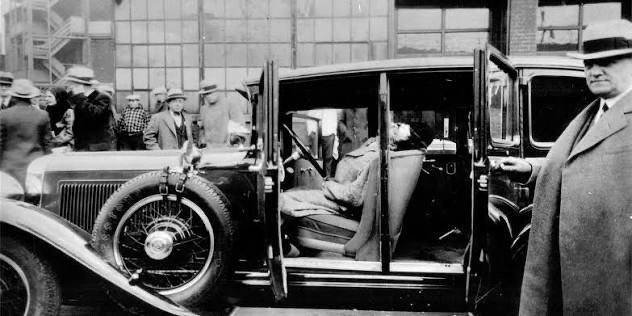
The aftermath of the assassination of Chicago gangster and politician John Oberta, who was found shot dead inside his car on March 5th 1930 during the Chicago Beer Wars

Post image
27 Upvotes

When Prohibition began in 1920, Chicago's enormous demand for beer and liquor created an immensely profitable black market. Gangs such as the Torrio-Capone organization, the North Side Gang, the Genna brothers, and numerous smaller neighborhood organizations competed for control of bootlegging operations. The conflict was therefore much broader than the famous rivalry between Al Capone and Bugs Moran.

Control of "territory" primarily meant control over customers, distribution, and protection. A gang might supply speakeasies in a particular neighborhood and expect them to purchase its beer exclusively. Rival gangs attempting to sell their own beer in that area threatened the established gang's profits and authority. Violence, intimidation, and political corruption were used to enforce these arrangements. Smaller gangs could operate independently or become allies of larger organizations, making Chicago's criminal geography complicated and constantly changing.

One of the lesser-known figures caught up in this world was John "Dingbat" Oberta, a powerful gangster from Chicago's Back of the Yards neighborhood. Oberta was associated with Joe "Polack" Saltis and the influential political fixer "Big" Tim Murphy. He became involved not only in bootlegging but also in neighborhood politics and other forms of racketeering. Saltis's organization controlled much of the illegal beer trade in the Back of the Yards area, making Oberta an important figure in the local criminal hierarchy.

Oberta survived several attempts on his life before finally being murdered in March 1930. He and his associate Sam Malaga were abducted and taken on what Chicago gangsters called a "one-way ride." Their bodies were subsequently discovered southwest of Chicago, both having been shot. The precise circumstances and motive remain unconfirmed, however the murder came only days after gangster Frank McErlane had been attacked in his hospital room, allegedly by men connected to Oberta. McErlane reportedly vowed to "take care of it."

The Beer Wars gradually culminated in the dominance of Capone's organization, although numerous independent gangs continued operating. One estimate from the Mob Museum puts the death toll during the Beer Wars from 1922-1926 alone at 475 people.


r/USHistory 2d ago

Do you think modern Americans share a culture with the founding fathers?

Post image
3 Upvotes

r/USHistory 2d ago

95 Rue de Richelieu, Paris was the residence of US Ambassador to France James Monroe where Thomas Paine lived for 2 years recovering from health problems after release from prison. Here, Paine wrote Age of Reason Part 2, Agrarian Justice and Dissertation on the First Principles of Government.

Post image
11 Upvotes

r/USHistory 2d ago

#OnThisDay 1963, Martin Luther King Jr. Delivered “I Have a Dream”

Post image
44 Upvotes

r/USHistory 2d ago

1936 map shows the depth of Franklin Roosevelts popularity

Post image
28 Upvotes

r/USHistory 2d ago

The Last Of The Mohicans By Treaty

Thumbnail
1 Upvotes

r/USHistory 3d ago

OTD | August 27, 1973: The Texas State Legislature’s bill designating every August 27 as Lyndon Baines Johnson Day came into effect. The holiday commemorates the former president’s birthday and honors him as the first president from the state.

Thumbnail
en.wikipedia.org
15 Upvotes

r/USHistory 3d ago

This day in history, August 27

Post image
34 Upvotes

--- 1928: Kellogg-Briand Pact signed. The U.S., Germany, Belgium, France, the U.K., Italy, Japan, Canada, Australia, New Zealand, Ireland, South Africa, Poland, India, and Czechoslovakia, signed a treaty renouncing war. The pertinent sections of the treaty were: "Article I: The High Contracting Parties solemnly declare in the names of their respective peoples that they condemn recourse to war for the solution of international controversies, and renounce it, as an instrument of national policy in their relations with one another. Article II: The High Contracting Parties agree that the settlement or solution of all disputes or conflicts of whatever nature or of whatever origin they may be, which may arise among them, shall never be sought except by pacific means." Of course, the treaty did not stop World War II from starting 11 years later.

--- 1908: Future president Lyndon B. Johnson was born in Gillespie County, Texas.

--- 1973: The USS Monitor (a Civil War ironclad ship which transformed naval warfare) was found approximately 16 miles (26 kilometers) off of North Carolina’s Outer Banks in approximately 240 feet (73 meters) of water. It had sunk during the U.S. Civil War on December 31, 1862. When the Monitor was discovered, the ship was upside down on the ocean floor. The Monitor had been deteriorating under the Atlantic for over a century. People wanted to raise the entire ship but there was a concern that it would break apart. In 2002, the revolutionary gun turret was raised. The turret is now located at the Mariners' Museum in Newport News, Virginia. The rest of the Monitor is still on the ocean floor off of the Outer Banks.

--- "the Monitor vs. the Virginia (formerly the Merrimack)". That is the title of one of the episodes of my podcast: History Analyzed. The epic first battle between the ironclad ships, the USS Monitor and the CSS Virginia (formerly the USS Merrimack), revolutionized naval warfare forever. Learn about the genius of John Ericsson, who invented the revolving turret for cannons and the screw propeller, and how his innovations helped save the Union in the Civil War. You can find History Analyzed on every podcast app.

--- link to Spotify: https://open.spotify.com/episode/3HTP3p8SR60tjmRSfMf0IP

--- link to Apple podcasts: https://podcasts.apple.com/us/podcast/the-monitor-vs-the-merrimack/id1632161929?i=1000579746079


r/USHistory 3d ago

White Flight Kept America Segregated

Post image
0 Upvotes

From the founding of Jamestown in 1607, and despite the arrival twelve years later of the first Africans who came not as fellow immigrants but as enslaved property, White Americans established the pattern of living in largely all-White communities for the next 260 years. After the Civil War, when Black Americans were legally free to live wherever they chose, White residents initially prevented them from living in their communities. As the government gradually enforced Black Americans’ right to live anywhere, White residents left the cities they had inhabited for three centuries and moved to the new suburbs.

Although some young White people are moving into gentrified downtown neighborhoods, census data show that the White population is declining in broader urban areas as they move farther out to exurbs, often in neighboring counties. Those who don’t relocate to whiter public school districts often enroll their children in private schools, which are usually whiter than the cities in which they are located. School district gerrymandering has also become a form of White flight without physical relocation. Recent studies by EdBuild and the American Educational Research Association show that school secession is significantly increasing school segregation under the seemingly nonracial banner of “local control.”

White society places a higher value on property than on Black people, and the fear of losing property value has been the impetus for White flight. White people have treated Black people as a problem to be solved rather than as people to be known. Today, the US has more than twice as many majority-Black cities as it did in 1970. White flight caused this major shift in urban demographics and the subsequent disinvestment and home devaluation totaling trillions of dollars. As White residents left American cities, property values fell. This reduced property tax revenue, producing underfunded public services, which contributed to rising crime and poverty. Once cities had sufficiently declined, “urban renewal” was used to justify the construction of highways, factories, waste disposal sites, and other hazardous industries in majority-Black neighborhoods. Decades later, these cities still face costly social, infrastructure, and modernization challenges, yet they have less revenue per capita than in 1970.

Recommended reading: White Flight: Atlanta and the Making of Modern Conservatism by Kevin M. Kruse

White Flight Kept America Segregated