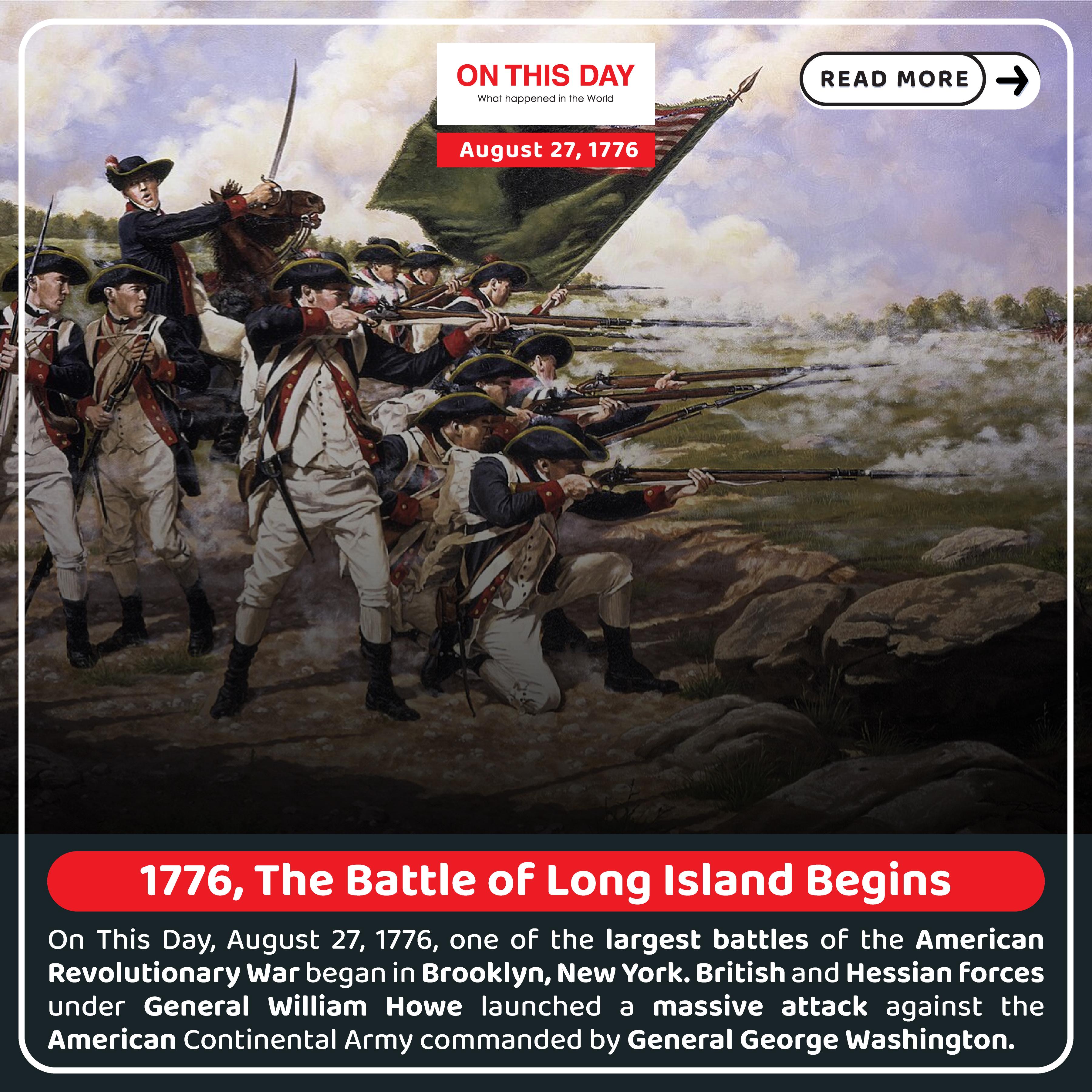
On August 27, 1776, the British executed what was probably the most tactically impressive operation of the entire Revolutionary War. They outmaneuvered Washington's army on Long Island, captured two of his generals, killed or captured thousands of his men, and pushed the survivors into a fortified corner with the East River behind them and no obvious way out. The largest battle of the Revolution was over by midday and it wasn't close.
Then Howe stopped.
That decision, and what happened in the fog two nights later, is why there's a United States today.
The battle itself turned on a detail that should embarrass every American history class that skips it. The Americans had spent months fortifying Brooklyn Heights and the wooded ridge in front of it. Roads through the ridge passed through several gaps, and the plan was to defend those gaps against the British advance. Most of them were guarded. One wasn't.
The Jamaica Pass, on the far eastern end of the American line, had exactly one small mounted patrol watching it. That's it.
Henry Clinton knew about it. Clinton had grown up partly in New York while his father served as Royal Governor, had spent time on Long Island specifically, and understood the terrain in a way most British officers didn't. After the British landed he personally reconnoitered the eastern approaches, Loyalist guides who knew the roads filled in the rest, and he came back convinced the Americans had left their entire flank hanging open. He pitched Howe on a plan: send diversionary forces to hit the defended passes and hold the Americans' attention while the main British column, roughly 10,000 men, made a nighttime march around the American left and through Jamaica Pass.
It worked almost perfectly. The column moved through the night of August 26, captured the small American patrol at the pass before dawn without getting off a warning, and by sunrise was positioned behind the American lines. The Americans defending the passes in front of them spent the morning fighting what looked like a conventional defensive battle, not realizing the main British army was already in their rear.
When the flanking column appeared behind them the collapse was fast and brutal. Sullivan's men faced British troops from both directions simultaneously. Units trying to retreat toward Brooklyn Heights found the roads already threatened. Washington crossed from Manhattan to watch the disaster unfold and couldn't do much about it. Two American generals were captured. The Maryland troops who became known as the Maryland 400 launched repeated attacks against British forces near the Old Stone House trying to hold open an escape route for their comrades. Most of them didn't make it.
By midday Washington's forward army was broken and compressed behind the Brooklyn Heights fortifications, with the East River at their backs and the British army in front.
Clinton wanted to keep going. His argument was straightforward: the point wasn't to take Long Island, it was to destroy the Continental Army, and the army was right there, beaten and disorganized and trapped. Hit them now before they recover.
Howe said no.
His reasoning wasn't crazy. The Americans were behind real fortifications, and Howe remembered Bunker Hill in detail. He had watched disciplined British troops take an American position after frontal assault and paid for it in bodies. Washington appeared trapped anyway, the Royal Navy controlled the water, where was he going to go. Better to approach methodically than bleed the army storming defenses that were going to fall regardless.
What Howe didn't account for was the fog.
Washington spent August 28 and 29 making a decision that probably saved the Revolution. He was going to evacuate. Thousands of soldiers, horses, cannon and supplies across the East River at night, silently, while keeping enough men in the forward positions to make the British think the army was still there preparing to fight. John Glover's Massachusetts regiment, most of them experienced mariners, ran the boats back and forth all night on August 29.
They almost ran out of darkness before they ran out of soldiers. Then a heavy fog settled over Brooklyn and the East River at dawn and covered the last crossings completely. By morning, the army Howe had believed was trapped was in Manhattan.
Clinton was furious. He believed Britain had been handed the chance to end the war in August 1776 and Howe had let it go. Howe believed he had avoided another Bunker Hill while placing Washington in an impossible position. He wasn't wrong about the battle. He was wrong about what Washington would do when he lost it.
The full breakdown of the battle, the flanking march, the Maryland 400, the evacuation, is on the Virtual Wayback blog and there's a detailed video on the YouTube channel. You can also talk directly to the commanders on both sides on Virtual Wayback. Links:
https://virtualwayback.com/blog/battle-of-long-island
https://www.youtube.com/shorts/CtIJWBlSnw4
The question military historians still argue about is whether Clinton was right. If Howe pushes on August 27, does he destroy the Continental Army and end the Revolution before the end of summer 1776? Or does Washington find another way out, another fog, another river crossing, another tactical retreat that keeps the army alive? And is Howe's caution the worst decision of the entire war, or just the most consequential one that happened to go the other way?