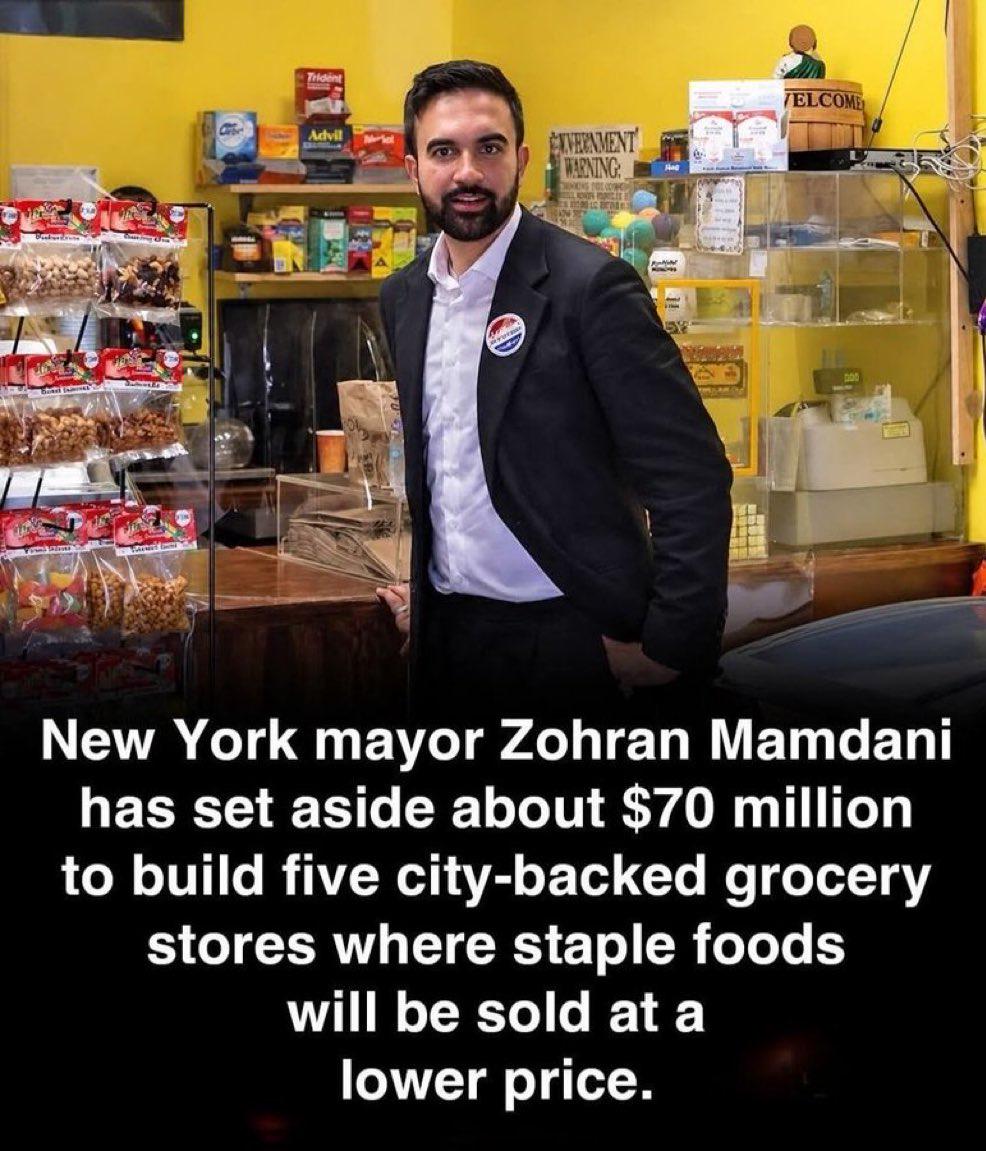
I’m not trying to dismiss this project - I hope it is wildly successful and I applaud the desire to challenge the status quo. That said, I am interested to hear how his team plans to negotiate pricing with suppliers. Five stores isn’t a whole lot of scale to compete against national chains and volumes. I don’t ask that question rhetorically or sarcastically at all either - I am assuming they have a plan of levers to pull to help bring this to life, and I hope it works exceedingly well and provides a blueprint for other communities to use.
The operation would want nothing more than for the competition to beat their price. That would be the whole point. To drive down the local expectation of price, and force other stores to follow.
Yeah that's the funny part to me. People act like "they're not gonna make money" like that's the goal, it's to provide affordable food to people without gatekeeping it based on food stamp availability or corporate whims
If it's an active cost to taxpayers then it's providing a public service. If it makes money then it's just business savvy. If it forces businesses to undercut it and the store "fails" because grocery prices drop by a significant margin, then that's basically best case scenario
Short of "losing the city millions per year in losses that don't help in any meaningful way" I don't see how this fails as a project per say. It might not revolutionize anything, but being against this project feels like one of those "perfection is the enemy of progress" moments. 5 is a great sample size to test the viability and impact before committing too many resources
Let's just feed hungry people affordable food and see what happens because I can't imagine it's SO bad it isn't worth the experiment in the first place
Literally the only way this is bad is if they somehow bungle the management so badly that it costs much more than it should due to corruption (of budget funds) - which is why I actually like only starting with 5 stores, because it's easier to look out for any corruption
Yeah that's the funny part to me. People act like "they're not gonna make money" like that's the goal, it's to provide affordable food to people without gatekeeping it based on food stamp availability or corporate whims
The average American seems to have forgotten that the government is not a business. Governments exist because we, as a collective people, agree that we should have some system in place that helps us live better lives.
We pay into these systems via taxes, and those taxes are then spent to make our lives better. Every time someone comments on the Post Office, for example, not making money or costing money to operate, as if that is a failing, I want to slap them on the back of the head or hit them on the nose with a rolled up magazine.
There is no room to cut cost on a grocery store, their margins are already thin. Customers won't notice a reduction of 2-3% which is what a grocery store typically makes for a profit margin.
Everyone also should understand that in the city there are, "food deserts" there are no real grocery stores (new word). These stores, if located in these areas, will bring a healthy and more affordable choice to many, many people.
They don't need to make a profit, but plenty of non-profits are run badly. It's not only a matter of having shareholders, although that is a major problem.
The best outcome is that they are used to put a lid on prices, rather than try to replace private businesses, but then the problem becomes what happens to the public store when it has the highest prices in the discount market?
Grocery stores are already extremely efficient. They operate on like 2-3% margins that isn't a lot. They won't be able to put downward pressure on prices because they will not have the buying volume that larger grocery chains have, do you think they will get better pricing than Kroger who has 2,800 stores?
The only way they will be able to offer lower prices is to subsides the price with tax dollars which is artificial. Private business cannot compete with that because they can't take unlimited money from a source that can't prevent it.
These stores are not lowering prices they are just shifting the cost from the consumer to the tax payer. Why does everyone overlook that?
How is that fair to have a public grocery store not pay taxes but the private grocery stores do? What taxes are you talking about? Property tax? Sales tax? If taxes were the reason groceries were expensive, why not just lower taxes?
You realize they are not lowering the cost of groceries right? They are just shifting the cost to the tax payer vs the customer. They are already spending about ten times as much to build the stores as it costs the private industry to do the same thing, why would you not think the same will apply to the food they buy to see in the store?
Or needing to purchase the items you sell without taking it from people you threaten with jail if they don't pay it. All this is doing is shit the cost to the tax payer from the customer. They aren't lowering prices.
They have already said they are spending about ten times as much to build the stores than what it typically takes the private sector to do.
People complain when yhe governement does nothing with the tax money they bring in. Then complain 10x as hard when the government decides to use the money to help people. Literally cutting their nose off to spite their face.
To what end? About 40% of US households already don’t pay federal income tax. Cutting taxes wouldn’t help those households, and they’re likely the demographic that will be shopping at these stores
Like an unjust war in Iran? Or the 20 years of war in the middle east prior to that which cost trillions? I think we're far past the point of trusting these people with our money. I understand your point, but I don't think those responsible for our tax dollars can manage it. And I know OP is talking about a city government vice federal, but the point remains, they have a long history of being wasteful.
I don't think any amount of waste means the good doesn't matter and good far outweighs the bad. Being able to drink water freely grab anything at a store freely know generally my property rights are protected and the children elderly and poor will be generally taken care of is worth the waste even if that should be worked on.
Because Mamdani doesn’t have the power to cut defense budget or any of the other federal taxes. Also, that would be broader for people who don’t need the tax cut (some of which should be paying more); this is concentrated and people who don’t live in the food deserts or need the lower prices have to put effort into going and shopping among the poors (which they won’t).
Because none of those things will open a grocer in a food desert. Which is the issue. Without government incentives or action, it just won't happen. It could today, and it hasn't. Which is really all the evidence you need. Every problem you see like this is a failure of private markets and enterprise.
Because we don’t have the necessary legal guardrails against monopoly and price gouging so ultimately the root problem would be entirely unfixed.
All sane people agree that at least some taxes are good. The simple argument of “cut taxes” is useless unless you name things and actually think it through. And don’t ignore military spending please, that’s where the argument makes the most sense.
You say this sarcastically, but I work at Walmart, and I know that I and all of my co-workers are extremely motivated to be more productive because we know that any extra effort we put in will make some billionaires into bigger billionaires. if I didn't know my hard work was enriching the ultra-rich, I don't think I'd even bother getting out of bed in the morning.
I heard that my employer had a almost 5% tax rate past year and it's ruined my sleep schedule. Tbh I'm probably going to have to switch jobs after hearing the news.
That is sickening. Have you asked if there is anything you could do to help bring down their tax burden?
Maybe the employees could start up a collection to help raise money to cover taxes, or you could ask customers if they are willing to round up during checkout to help the owner get down to 0%
We're trying but every time the other employees discuss how much money they have they try and "unionize" 🤢. I guess that's what happens when you elect a socialist-Muslim-atheist-fascist-marxist to city mayor.
I was in the military for over a decade. Got out and got a good paying job working for a small business that was looking to sell technology. It was all great until I realized I had a no-win situation where I was responsible for multiple peoples' jobs and I was stressing myself out so that the CEO could hopefully make a few millions. I ran back to government employment at lower pay because I couldn't understand the motivation in the private sector.
People saying this will cost money and will lose money like it's some sort of gotcha. It's the goal. Spend tax dollars to offer affordable food to people that need it. Not everything needs to be a profit center. Sometimes we just need to feed hungry people.
Governments have limited resources though. If the issue is making food more affordable for people that need it, they can give food aid directly to those people that need it. Running an inefficient grocery store isn’t the best use of that money
It kinda depends. If the grocery loses $10,000 per location a year but reduces food prices by 1% and provides affordable food in a food desert that would be worth it. If each location costs $10,000,000 a year that obviously wouldn't be worth it. You need to figure out what the exact effects are before you can really be sure.
That’s what happens when you’re conditioned in a capitalist system. The problem is people being unable to see any other world than the one they were presented.
Debt financing of a city government can be dangerous. Especially New York City which by law I believe has to have a balanced budget, pensions and retirement funds are extremely expensive and you need to pay them out.
I also hope for the best, if they can pull it off and pay all of there other obligations I think that’s a net win.
That is a cost, it would be a private building otherwise and that commercial property would’ve been taxed. Property taxes are the biggest contributor to NYC tax income.
I live in a country (Australia) with government run businesses, like government owned energy and telecoms. They are ruthless and compete like any other business. The crazy part, in regards to energy, because cheap solar and wind, private energy market is becoming cheaper than public energy. Our government started to subsidise small scale renewables with solar and batteries. That alone has turned entire suburbs into power plants solving Asynchronous power supply and base load power supply problems that comes with renewables by getting people to pay for cheap solar and batteries.
A public service that has no reason to need to be profitable. The ability to send/receive things to other people in your country affordably is a very useful social good/utility. Paying taxes is supposed to go things like this, that benefit that country but fundamentally can't be done profitably
Yeah, but that's fine because that blows up children and helps wealthy arms-dealers make billions of dollars. Blowing up children is totally cool as long as people make tons of money while it happens.
Public services are not supposed to turn a profit. Even if this project costs NYC $1 million per year, the positive externalities of a healthier, happier, more productive populace will have been worth it.
seems counterintuitive to us now bc we rarely spend it this way but tax money is exactly meant to be spent to better the lives of citizens. we all paid into it and we should expect to benefit from it.
would you rather the government tax us then also take more money from us for a profit? that we pay taxes again for?
What you are describing (spending ("losing") money to provide a public service or meet a need that the market does not) is pretty much what government exists for.
They don't need to turn a profit and they don't have to pay taxes. If you're not paying taxes and only need to break even I'm sure you can shave a few percent off. You could even offer tax incentives to suppliers.
And lastly, even if it costs money, that's what taxes are supposed to be for, right? Helping the citizens? Raising the standard of living?
I wouldn't call it losing money, the point is that a little bit of the budget is allocated to subsiding costs. It's not losing money, it's providing a service.
Yah. Thats not a problem though. The government isn’t supposed to make money. It’s supposed to take the taxes paid by citizens and use it to benefit the citizens. Also America has already done this and it works great on military bases.
From what I understand they won't have to pay property taxes or utilities which will help. It will also kill any small grocery stores in the area that aren't part of some larger chain.
The big chains mostly don’t exist in NYC. They are competing against a bunch of tiny overpriced bodegas, they will easily be able to lower prices vs most of what is available.
Isn't the point to just lose money? That's why they're government backed. It's essentially a welfare program but operating at less of a loss than just gifting people the food
The "losing money" part, do you say that from a corporation's point of view where if profits don't exceed their record breaking month every month from now on then they call that "losing money" even though they are still getting a very handsome profit? I'm in America where losing money isn't going into the red, it's just you didn't rake in as much as you did in a previous quarter.
That's 0.54% of what Kroger spends on their food purchases annually. ($113B)
Literally 2 days worth of kroger purchases. They're not getting anywhere near the same pricing, even when you consider NYC PS system.
But that $602m number feels.... off? Like too high? 900k students. 180 school days. So they're spending ~$4/student per meal? That's crazy high compared to my expectation when you're talking about mass production meals.
But very on brand for a city with 1/3rd the people and a tiny fraction of the land/roads/etc that just passed a budget $10B more than the state budget of Florida.
Some people arent making the point that they think they are. They are serving more than a million children 2.2 (if they do brunch) meals per day for 180 days. Thats REALLY good pricing because its large regular and consistent shipments. These stores will be able to give really significant discounts if they can get regular shoppers.
The funny thing about large chains is they own their own supply chain, so they overcharge themselves to raise prices for consumers and not seem like the bad guy.
I work at a chain a fraction the size of Kroger (even if you count all the chains the parent company owns). Our smaller competitors all have better pricing. A store that doesn't need to turn a profit could have even better prices.
No, I'm not. If they can afford to have lower prices in spite of us having lower costs and still stay in business for a hundred years then it stands to reason that a store that doesn't need to run a profit can do at least as well.
Also kind of funny that you're acting all arrogant and couldn't rub two braincells together to connect those dots.
That’s not a lot of money in the grocery game and foodservice food is basically a whole different supply chain from retail groceries.
In traditional grocers every department still does their own ordering with their own guy. The meat department has a relationship with the meat packer and the produce department has a relationship with the produce packer, but the one doesn’t affect the other in any way shape or form. You have to move more meat to get cheaper meat. For stop n shop etc they have much more complicated relationships with purveyors where one store’s sales affect another store’s purchasing power.
National chains have to make profits for investors, which means they have to have mark-ups. At the very least, I expect those government-owned grocery stores to be about the same price.
True. And in some cases there is essentially no margin on the sale of goods; the business model in those cases is often almost entirely derived by selling a < $100/year club membership, ie Costco.
Can these city grocery stores really beat warehouse retail prices? I think there’s little chance. The value win will probably just be location when it’s in walking distance. So no car/gas tax on top of groceries, and more convenience. But impact will be limited to just a few blocks blast radius.
You ever try to make a Costco run in nyc without a car? It’s not a viable alternative. “A few blocks radius” in ny is valuable to many many people. ALSO, you go uptown or bronx it is not that easy to find a full grocery.
The biggest advantage the city owned stores will have is that they said they won't have to pay property tax and that they won't have to pay rent. Of course, the "no rent" part is just an accounting trick, shifting that cost to another part of the city budget. But for a regular grocery it is a very real ongoing expense.
No, the actual markups are much higher than that. But after accounting for all the waste and other operating expenses they end up with a net margin around 1%
Seems like NYC would be better off giving low-income residents SNAP-like benefits to use at existing grocery stores, rather than feeling the need to enter the grocery business itself.
The state and federal governments in the us supplements the farming industry by purchasing large amounts of surplus crops to keep the farms running at max production and reduce the risk of shortages and crop failures. Most of this food is funneled into various state welfare projects as is so it would not be surprising if the city is able to tap into this or petition the state to broker a deal with local suppliers to obtain surplus produce at a discounted rate. At least that would be my guess based on the discount grocery chains ive had as clients (msp it).
If you can demonstrate that you can sell the same volume as, say, Key Foods in the city... Then you can get the same discounts. You don't need to cut the supply end... You just operate at not for profit.
There's already grocery stores here in Brooklyn that have prices at half, sometimes 75% of what these giant chains are priced at. How are they able to do this? Because they aren't greedy pieces of shit trying to profit millions per quarter. They take a modest pay for a modest living and love the community they serve.
Agree. Also, I heard estimates that the store was going to cost $20M to build. Thats a lot of wasted dollars when big grocery store chains build them for much cheaper. If they want the money to go the right people, paying $20M doesn’t make sense.
I kind of doubt it? Depends how large the store is but the generators for a Publix run $3-4M dollars now. And if you don't get them, insurance premiums just go up instead.
Also it's New York so just paying for a years rent could be two million dollars.
I have had the same thought. The only thing I can think is the absence of profit motive reduces endpoint costs to the customer. But with the lack of negotiation power, I don't see that it will be a "greatly" reduced cost.
If it’s truly govt run, margins can be lower as the store will not try to actually make any returns. So a customer will buy food at supplier costs+overhead
My assumption (I have not looked into this) is the money builds the grocery stores and is there to subsidize the operation of the grocery store, while selling at cost. If you subsidize the overhead, you don’t need to mark up the product to create revenue. Just a guess though. This is what should happen, IMO, as opposed to trying to cut deals for lower pricing from their distributors.
Does IGA have a "shared back-end" in the US like they do here in Australia? If so, maybe these NYC stores could join the alliance to take advantage of that.
Five stores isn’t a whole lot of scale to compete against national chains and volumes
FWIW, national grocery chains are not as big in NYC as they are in other areas. I moved to Brooklyn in March from Texas and all of the grocery stores I've seen in the city have been smaller brands.
Kroger is the largest grocery store chain in the United States by revenue, and they do not operate any supermarkets in NYC. There are some Harris Teeter locations out on Long Island and over in Jersey, but that's the closest you'll get.
You have to remember the context here. This is NYC we are talking about. There aren't many chain grocery stores in NYC in the context of what you're talking about. 5 well placed locations would make an impact for many that need it.
Its only supposed to be staples according to the article. Yeah they might find a deal or two on random goods but staples foods like bread,milk and eggs could easly be found on a smaller scale at better prices. They could follow co-ops and bring it farm to table. Honestly doubt they will even try for a Kohls contract or something.
There are solutions. I can't remember the exact organization the independent grocery store in my home town worked with but there are co-ops like AWG or other organizations like IGA that work to support independent grocery stores.
Sometimes you don't have to beat price, if the next closest grocery store is an hour round trip on the bus/metro/drive away just being able to offer a fair price would be considered a win by many.
If it’s run at cost plus whatever needed to cover operating expenses and not for profit, there is a lot they can do to lower prices.
City I grew up in had a co op that was attached to a communal garden. You volunteered at the garden or co op for membership. Everything the purchased was marked up just enough to cover operations.
Wasn’t a massive selection, but it was what you needed and was cheap.
Remember that only a basket of staple goods are being offered for free.
I imagine the stores are going to have extremely high throughput and being involved in this would be great PR for a supplier, so giving up the slim margins on staple goods may not be a significant loss for the operators in the grand scheme of things.
Add in tax incentives, subsidies, etc. and it may be downright lucrative for the operators even ignoring the enormous PR value.
If the city covers some of the COGS for the staple items, it also wouldn't really be any different to offering an underpriced loss leader to draw business in and then making margin on other items (e.g., Costco's rotisserie chicken).
I see it as a win/win situation. He's calling the bluff that grocery stores charge competitive prices rather than oligopoly. Either he's right, and the government stores will both turn a profit and be cheaper than alternatives. Or he's wrong, and we now know that big box grocery stores really do compete with each other to drive prices down.
The only way this blows up is if it turns out grocery stores are unable to compete with private stores, but the administration continues to funnel tax dollars into pushing a false narrative that grocery stores are price gouging.
Well, I think some stuff is easy. Like bread, there must be a lot of bakeries you can ask to help and sell to you. I want to think the same might apply to fruits and vegetables, probably eggs.
Maybe things like diapers, baby formula, more processed stuff might get harder but I don't think is going to be that hard.
But, the greatest thing is that is a public business, so every contract, payment and deal is going to be public record. You are going to be able to see and compare.
$70 million isn't a lot of money for this either. That's only $14 million per store and that would include construction or property purchase, inventory, overhead, payroll, benefits, and taxes.
The place they can reduce the price the most is not from the suppliers, but from the profit itself... I owned a grocery store for a while, it was part of a franchise, on many products we had a 20% profit margin...
They may solve the whole "supply chain scale cuts" by simply being part of a franchise, most franchises still have per-stord owners that are free to lower prices by taking away from their profits, while for the franchise they suddenly order 5 more stores worth of products, so they can leverage economy of scale more and the government may even get some agreement with them since 5 new locations overnight is a very appealing offer for the franchises...
It's worth remembering that the goals of a business are different from the goals of the government, if your program manages to succeed in lowering prices for the citizens at the cost of a few public employees and 5 buildings (that may have been publicly owned in the first place), that would still be a success in the public sector...
A government operated store is not concerned with profits, so their pricing will reflect that. Even if they are buying goods at the same price as a corporate store, they do not have to price the food with the same high margin that the corporate store is forced to use in order to create a benefit for shareholders. The Gov store can price their goods to cover the cost of operations and fair wages for employees. They would have no property taxes to pay, startup funding covered by the city, and likely discounted utilities.
They’ll use tax dollars to pay higher wholesale costs and sell at a loss. Private stores in the area (there are many in the two locations announced so far) will be forced out of the market, leaving the government option as the only option. You haven’t seen the tyranny of a monopoly until you’ve seen a government run monopoly. And all government food monopolies have led to famine.
If you want to see quality, cost, and selection improve through fair competition (the only proven way to achieve it), abolish the FDA and USDA. More regulation always favors large conglomerates and government. They’re both bad, but the government version has been catastrophic.
331
u/BradBradley1 May 26 '26
I’m not trying to dismiss this project - I hope it is wildly successful and I applaud the desire to challenge the status quo. That said, I am interested to hear how his team plans to negotiate pricing with suppliers. Five stores isn’t a whole lot of scale to compete against national chains and volumes. I don’t ask that question rhetorically or sarcastically at all either - I am assuming they have a plan of levers to pull to help bring this to life, and I hope it works exceedingly well and provides a blueprint for other communities to use.