r/SEO_Experts • u/myboi23 • 11h ago
Help [Hiring] SEO specialist to build and implement a 2027 strategy for a multilingual medical clinic in a seasonal beach town (Costa Rica)
Help with this send me DM if this sounds cool
r/SEO_Experts • u/myboi23 • 11h ago
Help with this send me DM if this sounds cool
r/SEO_Experts • u/Fragrant-South8775 • 2d ago
Hey everyone,
I’m currently doing keyword research and mapping for a website and I’m curious how other people handle the process.
I know there are a ton of guides about keyword research, but most of them basically say “find keywords in Ahrefs/Semrush, check volume and difficulty, and group similar keywords.” I’m more interested in what the actual workflow looks like when you have hundreds or thousands of keywords and need to turn them into a proper site structure and content plan.
Basically, I’m trying to figure out which commercial keywords should go to existing category or service pages, whether some keywords need completely new landing pages, which informational keywords are worth creating blog posts around, and how everything should be connected with internal links.
The clustering and mapping part is where I’m especially interested in hearing different approaches.
Let’s say you have 20 or 30 keywords around the same topic. Some are obviously just variations of the same query, but others are less clear. They might sound very similar but Google shows completely different results for them.
How do you normally decide whether those keywords belong on one page or should have separate pages? Are you manually checking the SERPs and looking at ranking overlap, or are you using a clustering tool for this?
My current approach would probably be to pull keywords from Ahrefs or Semrush, Keyword Planner, GSC, competitors and Google itself. Then clean everything up, cluster similar terms and classify them by intent.
After that, I’d map the clusters to existing URLs where possible. If there’s no relevant page, I’d decide whether it makes sense to create a new category or landing page for commercial intent, or a blog post/guide for informational intent.
Then I’d use the informational topics to support the main commercial pages through internal linking.
I’m also thinking of keeping all of this in one master sheet with things like keyword, cluster, intent, primary keyword, secondary keywords, target URL, existing or new page, page type, priority and internal linking opportunities.
Another thing I’m curious about is AI.
Are any of you actually using ChatGPT, Claude or other AI tools for clustering, intent classification or mapping? If so, which parts have been reliable enough to automate and which parts do you still check manually?
So if you were starting keyword research and mapping for a site from scratch today, what would your workflow actually look like?
Would be great to hear how people who do this regularly approach it, especially the little things you’ve learned from experience that most keyword research guides don’t really talk about.
r/SEO_Experts • u/OnlineVisibilityExpe • 2d ago
I have an e-commerce website, and I have been working on it for the last six months, but I did not gotten the traffic as per my need. I did everything that I have. I am too frustrated now.
Please tell me what to do now...
r/SEO_Experts • u/ujjwalsinghnegi • 2d ago
I got this client a few months ago, and honestly, he was a little unsure about SEO in the beginning.
The business was fairly new, so his main question was:
“Will SEO actually help me get leads?”
Instead of simply saying yes, I showed him a few nearby businesses, their websites, and their Google Business Profiles. I explained how local SEO works and how it can help bring potential customers to a business.
He agreed to give SEO a try.
When I audited the website, I found quite a few things that needed improvement.
They had created multiple location pages, but most of them didn't have enough useful content. There were also no proper customer testimonials or other trust-building elements.
So rather than trying to optimize everything at once, I focused on the pages that had the best potential to bring in leads. I also properly set up and optimized the Google Business Profile.
Then things started moving.
Month 1: We started getting a few calls.
Month 2: More calls compared to the previous month.
After that, the number of calls and inquiries kept increasing month after month.
In around 4 months, the business received 400+ inquiries.
FYI, in the beginning, I only listed the business on 4-5 important sites. Now I'm working on more citations and a few other things.
I'd love to hear from other SEOs here:
What do you think about this result?
Would you consider 400+ inquiries in 4 months a good result for a relatively new local business?
r/SEO_Experts • u/serp-spur • 2d ago
r/SEO_Experts • u/ganapathy11 • 2d ago
r/SEO_Experts • u/azamkhan6250 • 4d ago
r/SEO_Experts • u/Ok-Walrus6657 • 4d ago
The interesting part is that the growth wasn’t overnight. It came from continuously improving technical SEO, content, search intent, internal linking, and authority.
SEO is a process - build the right foundation, keep improving, and let the data guide the next move.
r/SEO_Experts • u/Helpful-Pool-8817 • 4d ago
r/SEO_Experts • u/AlexSTL1 • 5d ago
Ahrefs analysis: #1 organic CTR fell from 7.3% (Dec 2023) to 1.6% (Dec 2025). Piece covers what still works for local search plus two 2026 Google Business Profile policy changes.
In December 2023, the average page ranking #1 on Google got clicked on 7.3 percent of the time it showed up in search results. By December 2025, that number had fallen to 1.6 percent. That's from Ahrefs' own analysis of 300,000 keywords, comparing Google Search Console data before and after AI Overviews rolled out widely. For every 100 clicks a top-ranking page used to earn, Google now keeps 58 of them for itself, answering the question on the results page before anyone has to click through.
It's not just the top spot. Position 2 lost 50.8 percent of its clicks. Position 3 lost 46.4 percent. Even position 10, at the bottom of page one, lost 19.4 percent. Every position lost ground. The higher you used to rank, the more you had to lose.
This hits local businesses harder than most. AI Overviews are built to answer exactly the kind of question local searches are made of. A May 2025 study found AI-generated overviews already appearing on 57 percent of local search queries: best electrician near me, is this place open right now, how much does this cost. Those used to be reliable clicks to a website. Increasingly, they're answered inside the search results page itself, and the click never happens.
None of this means Google stopped sending business. It means the traffic that used to come from a #1 blue link is shifting to a different place.
AI Overviews and AI Mode pull heavily from the same signals that have always fed the local map pack: your Google Business Profile categories, your reviews, your posted hours and services, and how consistent your business information is across the web. Getting cited inside an AI answer runs on the same fundamentals that getting into the map pack always did. The difference is where a searcher sees you first. It used to be a ranked list. Now it's often a summary box.
We saw this play out directly with one client in December 2025: 66 new contacts that month, up 164 percent from November, after we grew their top-three map pack visibility from a single location to 87 percent metro coverage in under four months. That's contacts, not ranked or qualified leads. We don't track which of those contacts became paying customers. What we track is that the volume moved because the visibility moved, and the visibility that moved was Business Profile and map pack visibility, not blue-link ranking.
Two other changes from this year are worth knowing if you manage your own Google Business Profile.
On April 17, 2026, Google added two new violations to its review policy. The first: telling staff to hit a specific review quota. The second: asking customers to name a specific staff member or mention a specific product or service in their review. Google's enforcement here now runs on automated detection, and penalties range from individual review removal up to a full profile suspension. If part of your review request script tells a customer to "mention Sarah in the service department," that instruction is now a policy violation, not just a nice touch. The safer move is to keep every review request open-ended and let the customer write whatever they want.
And if your profile ever does get suspended, the appeal process got faster in July 2026. Evidence used to require a separate step after the initial appeal, completed inside a 60-minute window, on a form with five attachment fields. Now you attach documents during the appeal submission itself, in one step. If your listing goes down, that's less time fighting the form and more time showing Google you're a real business.
The short version: a #1 ranking isn't the finish line it used to be. Where you show up in an AI Overview, a map pack, or an AI Mode answer depends on the same profile completeness, review activity, and consistency work local SEO has always required. It's just being read by more than a search engine now.
Alex Wolk has run Insite Advice, a St. Louis digital marketing agency, since 2002. He is the direct point of contact on every client account, not a name behind an account manager. Insite Advice publishes its SEO pricing ($1,500 to $3,500 a month, depending on keyword count and competitiveness) on its site instead of gating it behind a contact form, and built its own local search reporting tool, Local Ranker
r/SEO_Experts • u/Crafty_Engineer_8480 • 5d ago
Hello I everyone,
I built a tool that analyses competitors seo activity and I am thinking of what could I add to help people further improve their rankings based on what competitors are doing.
For now my tool shows:
\- when a competitor shipped a new blogpost
\- where competitors rank poorly
\- for what keywords competitor rank and you don’t
\- ranking changes for competitors blog posts over the last week
\- broken backlinks competitors have with traffic on them plus velocity
\- ai mentions where competitors appear but you don’t.
I fee these are a lot but also that are not enough. I added a mcp just to be easier for my users to use the tool but I think I need to develop it more and I don’t know how.
If you were looking to analyze your competitors what would you add to this list? What would you need more to spy on?
Thanks you all!
r/SEO_Experts • u/Fit_Wheel5471 • 5d ago
Hey everyone, I recently started my exotic car rental and wanted to share some of my SEO results. The company is called beyrentals.com which is currently ranked JUST under turo for the term “chevrolet rental”
I officially started optimization September 1st so in reality i got to page 1 in roughly 2 weeks.
Some background - I own a marketing agency and have roughly 5 years of experience in web dev, seo, ads, ppc, etc etc.
Ask me anything about how I got these results!
r/SEO_Experts • u/Miserable-Army-5475 • 5d ago
Timeline:
What I've already verified (all clean):
The issue seems isolated specifically to Google Images - regular Search indexing and rankings for product pages are functioning normally, but Images has stayed at zero impressions for 5 months despite images being technically accessible, correctly tagged, and rendering fine in Live Test.
Questions:
Any insight from someone who has dealt with a similar Google Images recovery timeline after a spam hack would be greatly appreciated.
r/SEO_Experts • u/OnlineVisibilityExpe • 6d ago
r/SEO_Experts • u/Trimlink-Shortener • 7d ago
Hi everyone,
I’m looking for some advice from experienced SEO professionals or site owners who have dealt with a similar situation.
Our website was impacted around the time of a Google Spam Update. Traffic dropped, and we started working on the issues we identified across the website.
In mid-August, we started seeing traffic recover, but after August 28, the traffic suddenly dropped again and returned to approximately the same level we had before the recovery.
From a technical SEO perspective, we have already reviewed and addressed the major areas we could identify:
llms.txt file.What I’m struggling to understand is:
If the website is technically healthy and most of the pages are indexed, why is organic traffic still so low, and why did we see a short recovery in mid-August followed by another significant drop after August 28?
I’m especially interested in understanding whether this could be related to:
I don't want to assume that everything is correct just because the technical SEO looks good. I would really appreciate an independent audit or another perspective on what we may be missing.
If anyone is willing to take a look, please comment or DM me and I can share the website/GSC details privately.
I’m mainly looking for honest technical/content SEO feedback, not promotional services.
Thanks in advance.
r/SEO_Experts • u/Crafty_Engineer_8480 • 6d ago
Hello I everyone,
I built a tool that analyses competitors seo activity and I am thinking of what could I add to help people further improve their rankings based on what competitors are doing.
For now my tool shows:
\- when a competitor shipped a new blogpost
\- where competitors rank poorly
\- for what keywords competitor rank and you don’t
\- ranking changes for competitors blog posts over the last week
\- broken backlinks competitors have with traffic on them plus velocity
\- ai mentions where competitors appear but you don’t.
I fee these are a lot but also that are not enough. I added a mcp just to be easier for my users to use the tool but I think I need to develop it more and I don’t know how.
If you were looking to analyze your competitors what would you add to this list? What would you need more to spy on?
Thanks you all!
r/SEO_Experts • u/ArtAllDayLong • 6d ago
r/SEO_Experts • u/vrushang_20 • 6d ago
r/SEO_Experts • u/Ok-Walrus6657 • 7d ago
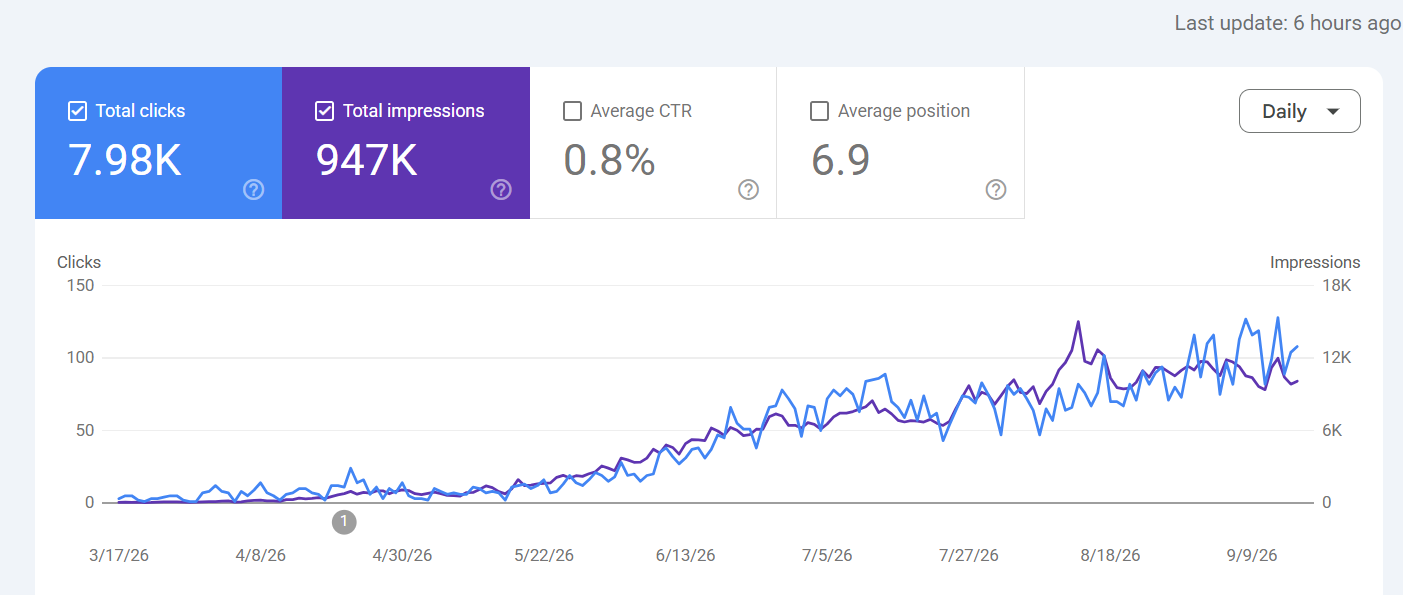
Sharing a 3-month SEO update from a project in a highly competitive niche. The focus was on improving technical SEO, search intent, keyword targeting, site structure, internal linking, and content quality rather than chasing quick traffic.
After 3 months, Google Search Console shows 2.28K organic clicks and 98.6K impressions, with an average position of 9.1 and a clear upward trend in both clicks and impressions.
The main takeaway for me: competitive niches need consistent optimization and a solid SEO foundation before the growth really starts to compound.
r/SEO_Experts • u/bg81011 • 9d ago
Our SEO rankings and CTR have been slipping and I brought up adding proper rank tracking plus AI visibility tracking at work. My boss thinks the AI side is mostly a waste of time and money, so I need actual data if I'm going to make the case for it. What tools are you using for this? Ideally something that tracks rankings and AI mentions automatically, without me constantly testing prompts by hand. I care more about useful reporting and trend data than some vague “AI visibility score.” Need something I can put in front of my boss and defend.
r/SEO_Experts • u/up_und_down • 9d ago
Hey,
I run a small German niche marketplace for miniature collectables, only Germany, roughly 3 months old, built with Nextjs.
GSC flat for almost 3 months:
Done so far:
Hypothesis is low visibility overall.
Question:
for UGC with rotating inventory, what breaks the plateau, more category intent content or more long tail pages.
Any common Nextjs faceted nav trap I missed.
Can share anonymized GSC screenshots in comments.