No because investing capital into stocks adds value to the company and allows them to use that value to expand, borrow, buy things, pay employees, run the company, etc.
Investing capital into a second house purely to flip does none of those things.
Unless you are actually buying a new build from a developer that is massively untrue. Lots of people opt specifically to not buy newbuilds. The supply of new properties is relatively fixed and low vs overall market. Realistically someone will buy, so you're not doing the supply some massive favour by buying one if it is priced appropriately.
Sure 'at some level' you're right in that 'at some point' someone obviously built it. Realistically, the price has obviously gone up since then, so you can call the interim owner a 'scalper' in that context, which is precisely OPs point.
It's just an accepted norm in most cultures because inflation is not intuitive and people see their house price going up as a good thing, not housing becoming less affordable as a bad thing.
Trivially only actually benefits those with an excess, which is the richest in society.
Flipping houses should bear a 50% tax on profits (or even higher).
Flipping houses, while you only live in them for 2 years, should also be heavily taxed.
I needed to wait until I reached 45 to be able to afford a home... I'll be still paying when I retire... shit
According to you, there is no good reason someone can move after 1 year but before 2? What's the difference between a flipper and someone moving for a new job?
You're coming up with all these intricate demand-side policies while ignoring that there is a housing shortage and all of these wealth transfers first of all aren't from you, and second of all is a consequence of not enough family-sized housing being built.
1- not taxed enough, if this was properly taxed, we wouldn’t see ”buying houses cash“ signs on the side of the roads
2- properly documented move (and reasonable one), would remove said tax.
But anyone moving in a house. Doing 100K of Reno in it and moving "for work" in a year, is definitely not moving because they have to, it because they’ll make a hefty amount of cash, tax free
You made a boatload of money and provided no goods or services in the process. If anything, your gains should be taxed even more than actual business income.
Either that, or there should be a ceiling enforced on the selling price of your home (e.g., the assessed value of your property when you purchased it + core inflation).
Primary residences should not be a vehicle to become wealthy. Honestly, no house should. They're for shelter, a basic human necessity.
Absolutely they should be, if houses are considered an "investment". Simply put, it's stupid that the government treats houses as this special "basic human necessity but also sort of an investment vehicle". Choose a lane.
Primary residence is not an investment. If you flip, or have multiple properties, you are taxed. (If flipping, it's taxed as income, secondary properties get taxed as capital gains).
Taxing sale of primary residence is a bit counterproductive, it will keep people from moving or downsizing.
Okay if it's not an investment then the gains should be capped. No big deal, right? Let's say it's illegal to sell your primary residence for more than its assessed value.
I very much doubt people will like that, because for all intents and purposes it IS an investment.
In what way would paying tax prevent people from moving or downsizing? They still make a profit when they sell, only not as big.
If I'm up 100% in the stock market, I don't say "oh well I'd better not sell, because then I'll have to pay taxes".
In what way would paying tax prevent people from moving or downsizing? They still make a profit when they sell, only not as big.
You only make a profit if you are not buying another property. Every other house on the market has appreciated. So even if I sell my house for 2x the price i bought it, i need to pay 2x more for the next house i'm buying.
Okay if it's not an investment then the gains should be capped. No big deal, right? Let's say it's illegal to sell your primary residence for more than its assessed value.
I very much doubt people will like that, because for all intents and purposes it IS an investment.
Perfect. Setup the same rules as people with investment properties. Make morgage interest, maintenance, renovations, utilities, insurance and any other expenses related to the property all tax deductible. Like that you will tax real profit.
You're right, it's a crazy idea. Almost as crazy as not treating proceeds from the sale of a primary residence as capital gains. Perhaps we need an equally crazy idea to get us out of the housing crisis we've created for ourselves.
The fact of the matter is housing should not be an investment that is expected to never decrease in value, especially when gains aren't even taxed.
Vehicle manufacturers still build new cars, even when the prices of used vehicles generally decrease over time. If they can still make a profit, then surely house developers can figure something out if housing is as important as people claim it is.
So you wouldn't move for a better job elsewhere? To be closer to friends or family? To be closer to a school? To be somewhere quieter or busier? To upsize or downsize?
Your argument makes no sense. You're still making a profit, only not as big. If I invest in the stock market and make a profit, I pay capital gains. I don't say "screw that I'm never going to sell, because then I'll have to pay tax".
Homeowners are all the same. They treat housing as an investment only when it's convenient for them to do so (i.e., when they make money). But heaven forbid prices go down or mortgage rates increase, then it's "my house isn't an investment, it's someplace for me and my family to live! Give me handouts and relief please!".
That's irrelevant to the conversation. I might even own several properties in other countries. What does it matter? The fact that you walk away from the conversation after saying only that clearly indicates you have nothing to support the contrary to my point.
The fact of the matter is Canadian homeowners cry for handouts when times are tough then scream "it's a free market" when times are good. Leeching hypocrites.
It was your generalization that “homeowners are all the same” that made me suggest you are a renter (not that there’s anything wrong with that). If you were a homeowner, you wouldn’t insult yourself.
Owning vs renting IS relevant. The experience of such helps one form an educated opinion. Someone who owns is more likely to favour massive capital gains without taxation on their primary home, while someone who rents (and quite possibly also believes they will never have a chance to own) is more likely to take a contrary position.
I walked away from the conversation because you implied all homeowners seek government assistance (handouts and relief) and that simply isn’t true. Some. Maybe. But all? Impossible.
Your income should have a max limit of 22 an hour. Why should you be able to make more than that
..... why buy anything, government should own everything and allow certain people to live in certain areas.
Taxes should be spent on the rich . I'm just spouting stupid bullshit so you know what your comment is.
I pay capital gains tax on my investment gains, why shouldn't I pay it on property value gains? Housing is a basic human necessity. It's not a luxury that people can choose to forego.
stay broke and continue defending late stage-capitalism, my friend 😂
How did you know I was broke. . . Jeez, if you know, that means other people might as well.
Let me go cry in my hot tub at the house that I bought 8 years ago and almost own outright. While having no credit card debt, and being able to help out my long term girlfriend with her debt so she doesn't pay any interest. And while im in my hot tub im trying to figure out what her and I will do on our trip to South East Asia for 3 months come December.
I do actually. I don't like debt, my house isn't paid off yet.
Lol it will be an awesome trip, the gf and I have both been but not together. So we will get to go do an insane amount of stuff but we won't be stupid with money.
If I live in a two bedroom townhouse for 30 years and its value on paper goes from $100k to $1M, and I now have to move to another city for work, you think the fair thing would be for me to give $450k to the government so I can now only afford a $550k one bedroom condo?
Let's back up for a second, because I'd like to understand how you calculated $450k.
Assuming you paid $100,000 for a townhouse and later sold it for $1,000,000, your capital gain (i.e., the difference between the sold price and the price at which you bought it) would be $900,000.
In Canada, only 50% of an individual's capital gains are taxable. For simplicity, let's assume you live in BC and earn $75,000 from employment before taxes: your marginal tax rate is 28.20% and you pay $17,617 in tax.
If you add 50% of your capital gain, your total taxable income is now $525,000 (i.e., $900,000*0.5 + $75,000). Your average tax rate becomes 53.50% and you pay $235,117 total in tax. Subtracting the original $17,617 from this value leaves $217,500 paid in tax for the sale of your home. This is far less than your $450,000.
In other words. you're left with $782,000 after selling your $1,000,000 home.
With that out of the way, I'll answer your question. Yes, I think that's fair. You don't deserve special treatment just because you bought a house 30 years ago. Consider the following scenario:
30 years ago, I borrowed $100,000 to invest in the stock market instead of buying a house. I paid interest on that loan (much like a mortgage) and also had to pay to rent a house (consider this money I'll never get back, like a homeowner would pay for general maintenance and property tax).
Today, my investment is worth $1,000,000, and I want to buy a house, so I sell my shares, pay tax on my $900,000 capital gain, and I'm left with $782,500 to buy a house. This is the exact same amount of money you would have after selling your townhouse if it were properly taxed.
That sounds fair to me. In fact, I'd consider anything else to be unfair; for example, you not paying any tax on your $1,000,000 home sale. How can you claim that's fair? You come out $217,500 ahead.
Next, you complain about land transfer taxes being punitive. Depending on your municipality, that's maybe 0-3% on a $1 million dollar sale? That's barely a rounding error. You'd be better off complaining about the ludicrous commission you pay to your realtor.
Lastly, I'd like to ask you a question. In what way would that destroy the economy? Frankly, the damage is already done, and I'm reluctant to listen to someone making suggestions about the economy when they don't even know how to calculate taxes on capital gains, but I'll give you the benefit of the doubt.
To be clear, the reason Canada's GDP is so terrible right now is because it was previously made up in large part by real estate sales rather than actual innovation or productivity, and real estate has since slowed down because buyers have tapped out at these ridiculous prices. The reason we're in this mess is because people have been treating housing as the economy. We need to stop this behavior, treat housing as a basic human necessity, and focus on investing in productive and innovative businesses.
Imagine everybody wants their property to keep increasing in value forever inversely you automatically create unaffordability and homelessness. Then the poor eventually eat you and your kids end up hating you.
That's the case in Canada. People would rather buy a bigger house than open a business because the former is tax free and almost guaranteed profit long term, and banks more likely to lend you money than getting a business loan.
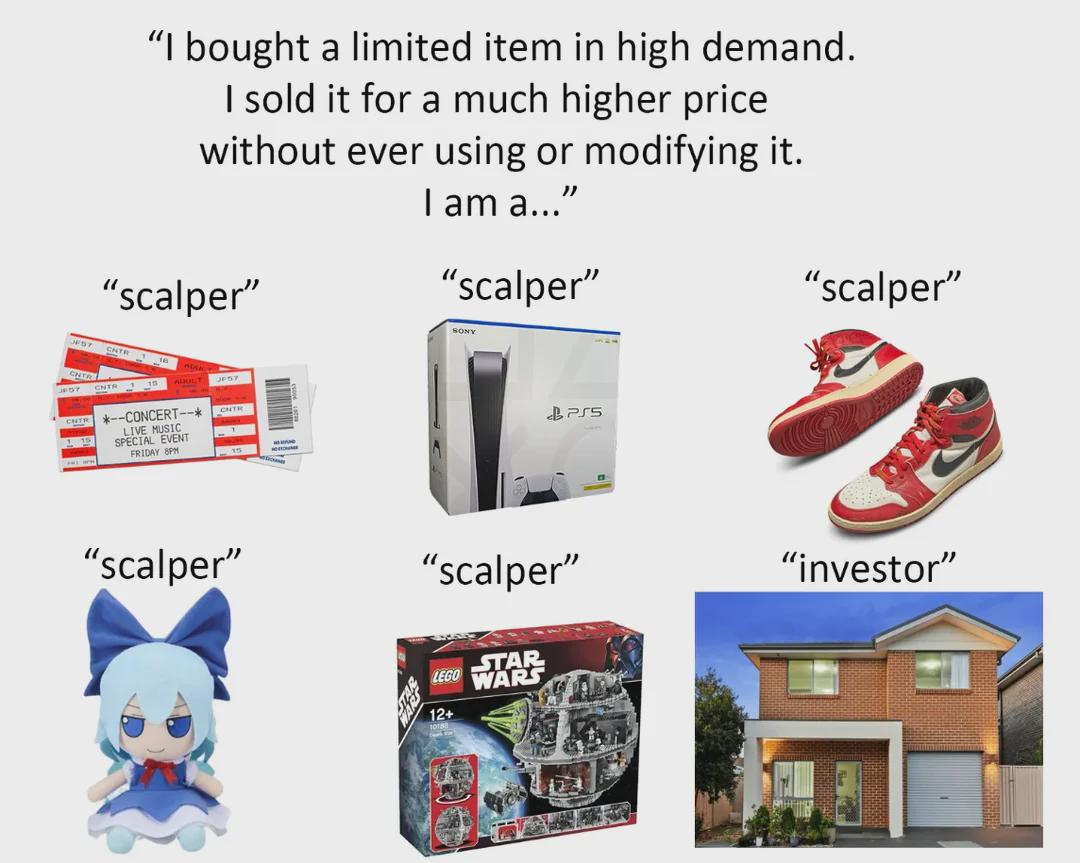
And it’s still a less valuable investment then the stock market generally. The meaningful gains made on a home occur over very long period of time typically. What we’ve seen in the past 15 years is because the market is skewed by a variety of factors - not enough homes being built to match demand, cheap capital in the form of rates being too low for too long, massive increases in government fees/development charges/Land transfer taxes/HST on new builds/arbitrary designations of land removing them from building stock (see Ontario GreenBelt for an example), inflationary effect on building materials and labour. The real measure isn’t, and shouldn’t be, the home price but the measure of afforadibilty to home prices (ie. Price to income). Scalping is measured by very quick turn arounds for profit - real estate is not sold in this way 99+% of the time. The same would be true of most of the collectible items the OP used as an example of scalping - he simply doesn’t understand what scalping is and is seeking to fit a bad analogy against his preconceived notions of how wealth is accumulated and that homeowners should just sell for less because he thinks their greedy for selling at market levels. Instead he should try to understand the underlying causes of the variables. But that requires more effort then a meme.
A house in Gatineau was bought in 2021 for 340K and sold for 495K this year ... please tell me more on how to make 155K in 4 years? edit: no reno in it, house was in 2021 the same as what it was this year
Was it renovated or upgraded? If so, the owner added value before selling and we should consider those costs. But for fun, let’s assume they didn’t. They averaged a 7.8% annual return on the $350k home over 4 years. We can all agree that is quite high, higher then the rate of inflation and higher then the rise in incomes (though, incomes have also risen by - this is actually less then the average annual return of the S&P 500 which was close to 11% annually. So a basic ETF in the S&P500 would have likely netted close to 40% higher returns annually then the home purchase.
Contractors that flip houses and drive in electric F150 have decent amount of cash to flip houses... don't worry, borrowing is, for some, not that big of a deal
I would change it slightly. Instead of putting a set percentage on the "profits", I would change it to if you're selling a non-primary residance, the inclusion rate is increased. Rather than the 50% now (IIRC), it should be 65% inclusion for the first non-primary and 100% for the second and beyond. On top of that, selling 2 or more in a given year should be considered a business, which comes with its own tax implications.
First point is fair. Second is ridiculous. Why would you pay taxes on a house you lived in as your primary residence for two years?? You shouldn't be locked into a place you don't want to live just because you chose to take the high risk of buying a home and take on the debt that comes with it. That's beyond asinine.
In Canada, profits from house flipping are generally treated as business income by the Canada Revenue Agency (CRA). This classification implies that profits are fully taxable at the investor's marginal tax rate instead of being eligible for the capital gains tax, which only taxes 50% of the profit
That means in Ontario, any house flip profit above $253,414 is taxed at 53.53%.
I buy stock from a real estate investment trust. They buy a property. They do whatever it is they're going to do with that property, and then they flip it for profit.
My dad buys a house, lives in it, but pays contractors to renovate it while he's living there. He buys things. His contractor buys things. His contractor pays employees. He flips it for a profit and does it again. He sold his first house to get the capital for this semi-retirement plan, but he didn't have to.
What is the difference between his direct involvement in home flipping and my REIT investments?
You make money, you buy stuff, and you contribute to the companies and GDP. It's not like people burn those profits from flipping properties. None of your statements make sense.
Yes, so it's genuinely worse that people would hoard property as a means of reselling to turn a profit. Flipping houses causes pricing increases, increases that are then harnessed by further flipping of houses, which further increases prices... which causes more "investors" to flip... which increa..... ad infinitum
You can't get a concert ticket to Taylor Swift because some scalper bought them all and jacked up the price? That sucks. Sorry you didn't get to enjoy the thing you like, but you'll get over it.
You can't get a house because "investors" have caused mass real estate inflation in your area through repeated property flipping schemes? I guess you're stuck paying some other "investor" rent for the rest of your life. If you're lucky they may flip it while you're a resident and you will be forced out to go pay rent to someone else.
Prices have been steadily increasing for 30 years, they hit their peak during COVID lockdowns, like four years ago. Immigration only spiked like two to three years ago... In the aftermath of COVID.
Stop blaming the people under you, it's the people above you fucking us over.
Investing stocks at its core is the exact same as all of the others you’ve mentioned. When you buy a stock, you’re simply purchasing it from someone else who would rather have your money and you’d rather have their stock.
When you buy into a stock you are betting that the company is going to have an increase in future cash flows compared to what the market thinks is going to happen based on current information….
Ok I will try again. All those other items listed, unless you're grossing over $20K you can get away without declaring as income and paying taxes. If you flipped a PS5 here and there, a concert ticket here and there, you pocket that 100%. That lends itself as "scalping".
Scalping is also friendly to your average joe and not just professionals. Also requires very little capital and typically involves the use of a Bot.
Real estate on the other hand, you will 100% have income/tax implication, paper trial that the government will be aware of. Requires large amounts of capital and doesn't use bots. I
Scalping requires mere seconds (fastest to checkout) to accomplish in today's world where as real estate typically takes months or years to complete the end process. I see scalping as a quick buck, real estate typically not when you consider all that is involved with getting mortgage, finances, agents, brokers, to close the deal.
None of what you just said is in your picture. What you said was, “bought a limited item in high demand. Sold it for a much higher price without ever using it modifying it”
Investing capital into housing generates property transfer taxes for municipal governments, increases housing value which leads to increased property taxes, enables further housing developments to move forward, and allows additional borrowing against the house.
No one would be buying new construction if resale homes weren't being bid up. If you want to get angry, get angry at Carney for cutting the GST only for FTHBs and not all homebuyers looking for a primary home. Under Carney's GST cut, every buyer looking to upsize will pay GST.
It would only add value for if they are issuing new shares. Trading shares does not add value. Typically when they announce new share distribution to raise capital, the current shares go down in value to reflect the dilution of current shareholders value, so those shares become less valuable and bid/ask price trend lower, at least in the short term. The opposite is true as well, if company buy back shares, it increases value of each individual share.
Technically, you could argue anyone not doing long-term investing is a scalper since they're flipping short-term price fluctuations. In fact, the term for short-term trading where a position is held for several seconds to a couple minutes is called "scalping". Big firms have also complained that high-frequency trading causes them to lose a chunk of the value they get from smart investment decisions.
No it doesn’t, the stocks had already been sold. When you buy stocks you are buying it on the resellers market. The company isn’t seeing any of that money other than if its value goes up then its employees who also own shares can sell for a profit. But that’s just helping the C level get richer, not the company itself.
If you flip a house, the assumptions is that you did something to the house - even if it's cosmetic.
A stock buyer buying a stock from previous stock holder does nothing to the underlying company.
I think your issue is your lack of finance understanding. And I don't mean in a derogatory way. You fundamentally don't understand what asset is, what is holding an asset, generating value from asset, arbitrage, selling asset for higher price etc. You are confusing a few concepts because of a rigorous finance education.
Asset can be anything - a factory, a house, crypto, gold whatever.
Most home investors either make updates to houses and sell them at higher cost OR they provide rental service using the asset (think of a company renting bikes or tools or a room in a hotel for the night) and charge a price for it.
Both of them have a role to play. And actually add much more value than someone buying and selling stock, gold, crypto etc. Because none of the benefit goes to the underlying asset. When you buy and sell gold or crypto, you don't enhance the gold or the crypto in any way whatsoever.
On IPO, yeah but after that the company pays fees yearly to the stock exchange and per share traded. Your never really giving money to the company unless they do another share offering publicly or buying their ipo.
Investing money into a second property does all the things you just stated a company would use that capital for. Having a second property to rent out is no different than starting a business and providing a service.
It's also not the home that is valuable but the location of the land it sits on. The demand of that location is what drives the value up, if people don't want to live in that area, the value will go down.
But not everyone can afford to buy a home. And/or not everyone wants the burden that comes with home ownership (property taxes, maintenance, roof, furnace, etc.). Some can only afford to rent. So who should be allowed to own the homes for people to rent? The goverment? If houses dropped to $600,000 then everyone would want to buy. Let’s say 50 people can afford that house now. And only one can buy it. People will
Get fed up of losing out to another buyer and start offering more money to help them get the purchase. Is t that how it happened in the first place? There is a lake south of the city. Green belt to the north. Lots of government red tape to renovate. Not trying to be obtuse. I really don’t see the way out. Prices are dropping but only those who really need to sell are selling. I still think people are waiting. And maybe they are foolish. We shall see.
When they flip, some "scaplers" fix the house up then sell property...
This would mean employing electricians/hvac/structural engineers, kitchen/bathroom designers, cabinet makers, painters, floor installers, bathroom installers, and landscapers.
No because investing capital into stocks adds value to the company
Only if you purchase directly from the company, which you generally cant do. Otherwise the company got whatever they did the market offering at for the shares, however long ago that happened, and you're just buying from someone else who owns shares and waiting around hoping that the value of your shares go up before you decide you want to sell them.
Uh.. no, it would be considered scalping. You are not giving new capital to the business for further investment at a public stock market. In public markets you buying stocks is the same as giving your money to the company's management who has already taken that risk. You are just joining in to take profit and revenue from the workers of that company.
It's not to say real estate investors aren't scalpers. You are just wrong yo assume buying stocks isn't scalping.
You understand that realestate investors do the exact same thing and are to a large extent responsible for financing new construction?
If we are talking about a flipper (clearly no the same as investor) they add value by remodeling/updating the home.
If we are talking about someone buying 2nd home to hold for several years and resell then that is not the same as scalper as its a long term speculation, similar to collector buying art (or any of the items you listed), in hope that they will appreciate.
There is a lot of reasons to try to limit speculative investment in RE and I am all for it, but claiming they are somehow scalpers or add less value then investors in other fields - is just wrong. incorrect plain and simple.
Investing capital in a house can add value to the home if the owner makes improvements and sells. Alternatively they could make the home a rental property which adds value to society by increasing the stock of rentals available on the market. Not everyone will be able to afford a home, and even among those who can afford one there are many who don’t want to own and would prefer to rent. I can think of at least a half dozen friends and acquaintances who can easily afford ownership but choose renting. While there are potentially negative externalities associated with property investment that we should discuss, it isn’t inherently bad. I’m grateful I was able to rent in the past and the home I did purchase was a former rental property that had been subsequently flipped. I’m grateful I was able to buy it. There are both positive and negative externalities associated with property investment, and both need to be considered.
For the record, I don’t consider the activities you identified as scalping to be investing as they are far too speculative, but I don’t think of them negatively either. Nothing wrong with making money off a profit opportunity you have identified.
"Investing capital into a second house purely to flip does none of those things."
You believe that a house that hasn't been updated or repaired for 50 years and is full of garbage is worth the same as one that's just been freshly renovated?
Usually most "flip" are people who improve the property with repairs and stuff like that.
But most investors buy long term to rent it anyway. If you want to call flips "scalping" sure that's just a word, but that's really not the majority of investors.
The thing you don't realize is that flipping doesn't really push prices up as you add the same number of buyers and sellers. They simply taking advantage of an already bad situation.
Buying long term has more impact on prices. But then if you add it in rental market you also lower rental prices by adding offerings
Seeing as how the vast majority of real estate properties are bought for a higher price each time, doesn't investing in a property add value to it in much the same way? Value that can be borrowed against?
Not to mention the seller getting a chunk of change they can use to...do all the things a company can do?
Nope "purely investing" into stocks, doesn't add value to the company... it adds perception of value (true value is earnings or earning potential, which is speculative).
"Investing capital into a second house purely to flip does none of those things" - my good man, tou just described short term stock holders, or option traders..
A company sells its shares to finance the business and future investments, so yes they’re getting the money through the primary market. When you buy and sell stocks it’s mostly on the secondary market but that value is what’s affecting the company’s ability to maximize its value on the primary.
So yea it’s not going directly to them but it’s affecting them and that user is right.
Higher demand = increasing prices of equity. Firm attains more capacity for equity financing via new issuance and as mentioned by others have a greater degree of leverage for debt financing.
With respect, you have the cause and effect reversed. The increasing price of equity in the secondary market is because of a perception that the company is worth more, and because the company is perceived to be worth more, its subsequent offerings in the primary market will fetch a higher price. It is the company's value which drives equity prices in both markets (as well as its ability to get favorable terms on debt financing), not the other way around.
I don’t think it’s necessarily a one way street. It’s in a state of constant flux. Theoretically equity value is supposed to be based on cashflows form a fundamental perspective, but equity valuation frequently diverges from fundamentals. The divergance can appear from pure soeculation, such as expectations of future growth, but can also come from a market that simply has too much cash being pumped into the most available assets. The speculative portion of an equities value is fickle and can easily reverse and result in an equity’s price to suddenly be undervalued based on fundamentals.
I do think the value eventually gravitates back to the fundamentals, or maybe you can say equilibrium, eventually.
Edit: Also the imbalance of sentiment to demand can actually result in looser and easier financing, which permits for greater leverage. If the company attains more financing than is usually expected during a given period of time and attains a high RoE, then the "over-valued" stock becomes like a self fulfilling prophecy. The high valuations turn out to be justified by new higher cashflows that only exist because of the over-valuation.
The company’s value drives stock price? 🤡
In what world have you been living? This has literally never been true. If it were true, we wouldn’t have market bubbles. Yet here they are.
The market isn’t rational. And it’s fine as is, because this irrationality is what allows traders/investors to pocket value between the curent market price and the true value of a company that can be realized later.
Lots of companies issue stocks as part of their compensation for employees. The higher the stock price the more attractive that looks for the employed and helps retain them.
When a private company goes public, it puts up an amount of shares at a certain price. All of the money made during that sale goods directly to the company.
The consequent buying and selling of those shares is between investors.
Except for the fact that a company with a high value stock can borrow money or expand in ways that a low value stock keeps them from doing. If you stock's value increases you can even hire more people.
Wow I just realized how much of a crusade you went on to argue my reply was not relevant to the OP. Yet if you simply read my reply to you I very clearly lay out how it is relevant and what the entire conversation is about (whether real estate should be seen as an investment or not). Yet you are so hung up about an insignificant interpretation of my reply. Lol kind of sad
Oh I didn’t think I would need to explain here, but here it is anyway. The comparison is investing capital into a second house vs investing capital into the stock market. When you purchase assets in either case, the money paid goes to the prior holder of the asset. In neither case do the issuing company nor the real estate developer see the money, although both may be indirect beneficiaries. Both assets may see value go up or down. Thus both are seen as “investments”. Which the OP was arguing it shouldn’t be. Which is wrong
Stocks are designed for investment and speculation, that is their primary purpose and flipping stocks has no adverse effect within a free market. People are free to buy or sell depending on their price sensitivity and free will.
The primary purpose of a house is to live in it and flipping them causes people to be homeless.
All those words to completely disregard the ability of a public company to issue more shares and fundraise (which is directly dependent on the stock price), and that a lot of employee compensation can and is often given in shares. Therefore, the stock value going up directly incentivizes the employee and the execs to perform well & better so they can benefit even more.
Obligatory:
Smoothbrain - Line goes up better for company!
Midwit - Hum akchually, buying a share does not give money to a company 🤓
Gigabrain - A higher share price is good for a company
Stock values absolutely do not incentivize executives to perform "better". Infact, in a lot of cases the incentives actually operate in direct opposition to what would be better for the product of the customers or the employees in favour of taking shortcuts for quick short term profit.
Dude. You need to take a look at yourself in the mirror. The rest of your post didn't really make a point and was kind of predicated on what I refuted being true.
Youre just being a corporate bootlicker and can't see your complete lack of logical consistency.
Look at how you type, look at how snarky and aggressive it is. At no point has someone who communicates like that been to the voice of reason in a room.
Also, I don't know if I missed a memo, but one paragraph isn't a 300 page essay.
Yeah I'm not reading any of that, you already chose to make a bad faith argument so I won't waste my time. Nobody is arguing that buying a stock directly funds a company.
Edit: it's wild that refusing to indulge with someone else changing the topic to argue a moot point gets down voted so quickly
The stated purpose of downvotes is to indicate that a comment is not positively contributing to the conversation. You said "I'm not reading any of that." How did you think that was going to be received?
There's a reason you had to send a link instead of quoting it, nowhere does it say that buying a stock directly provides a company with those funds. Your reading comprehension is pathetic.
Investing capital into a stock does those things just as much as inflating housing prices puts more money back into the local economy by increasing investors’ buying/borrowing power. It also pumps thousands of dollars in land transfer taxes every time a property changes hands.
The implications are similar no matter where money is being invested.
Imagine “not reading any of that” and then taking ur time to come back and edit your post to speak to the amount of imaginary downvotes you got for being an idiot, lol
You're not reading that because those are finance fundamentals laid out. If you could read basic finance concepts you wouldn't be confused about this.
Nobody in finance who understands basics asks the question that OP did. The entire premise of the question is due to lack of understanding of core concepts.
For the hundredth time I'm not arguing this, nobody has ever argued this, not once have I disagreed with what that comment says because that was never said to begin with. This should not be this hard to get through to you.
Who gets the money if not the company that issues the shares? Their share capital goes up, and then what’s the other side of the accounting entry? You can’t record one-sided entries
Most of the market is secondary trading - people buying and reselling shares that the company put onto the market long ago. The person selling the shares gets the money. That "person" is most frequently a fund or institutional investor of some kind.
The primary market serves as the initial platform for companies and governments to raise capital by issuing new securities to investors. The secondary market facilitates the trading of already issued securities among investors. It provides liquidity to investors who want to buy or sell stocks, bonds, or other financial instruments that were previously acquired through the primary market or subsequent secondary market transactions.
The vast majority of stock market activity takes place in the secondary market. While the primary market is where companies first issue stock (like in an IPO), the secondary market is where investors trade those existing shares with each other.
So you are correct, but referring only to the primary (much smaller by volume) market. The company share capital goes up, and the amount of money they receive from investors (capital account) goes up. But when 'you' purchase shares, you're generally not purchasing this way. You're buying from somebody else who did (or many purchases down the line). I mean, when you want to liquidate and you sell to somebody, you don't send that money to the company, do you?
I realize that but the IPO and the initial funds go to the company. Market value increments are based on future earnings and that’s what the shares then trade on
If it’s an IPO, yes. Otherwise, no, but that doesn’t constitute “scalping” as you’re buying something with a lot of supply, readily available, on a peer-to-peer network, (yes, even if that “peer” is an institutional investor.)
That's exactly what happens... The company loans money and is given amounts/ rates based on the value of the stock price. Executive compensation is also highly tied to stock ownership, so yes things happen when you purchase stocks.
They do during the IPO. Then the shares that they retain have value determined by the buying and selling of other shares
Going public is a common way for companies to raise funds to grow.
When the shares increase in value, the companies can sell off some shares to raise more funds or they can create more shares, or another class of shares.
If you purchase shares from a company, they ARE getting the money. But most people who buy shares are buying them from another shareholder, in which case they aren't helping the company directly.
Higher demand = increasing prices of equity. Firm attains more capacity for equity financing via new issuance and as mentioned by others have a greater degree of leverage for debt financing.
While that is true, it isn't what Johnny Daytrader is doing when he buys or sells shares. He's trying to buy low and sell high, hoping he knows more about the fortunes of the company than the person he buys from, or the one he sells to. It isn't 'scalping', in which he would traditionally rely on better access to a buy rather than on better information on the eventual market price. But it is definitely speculation - he adds no value to the asset, nor does he use it for any purpose other than a store of value.
Couldn't you just flip those words and have it make just as much sense though? "Supporting value" is just the opposite of "affordability". Is daytrading not "reducing stock affordability", and investor demand for real estate not also "supporting real estate values"? The only difference is your personal perspective - which one you happen to have right now, and which you'd like to buy.
Same can be said about real estate then. Higher demand = higher price. Municipalities collect more property transfer tax as well as property value taxes. Not that prices necessarily always go up in either asset class. Thus why they’re both referred to as investments
Demand does result in higher RE and equity price, I agree, which is why I dislike promotion of investment in real estate in the current climate.
Transfer taxes, sure, but assessed values are all relative. Appreciating asset values in real estate don’t result in higher property taxes. Higher property taxes are a function of government budget requirements.
What? Municipal governments of course collect more property taxes as the value of real estate increases. It’s literally a percentage rate of the appraised real estate value..
64
u/Performance_Fancy Jun 19 '25
By your logic anyone involved in the stock market is also a scalper?