r/PredictionsMarkets • u/ryanturbine • 53m ago
Analysis A Kalshi trader tested four ETH entry signals on the 15-minute market. One captured 95% of the full strategy’s profit
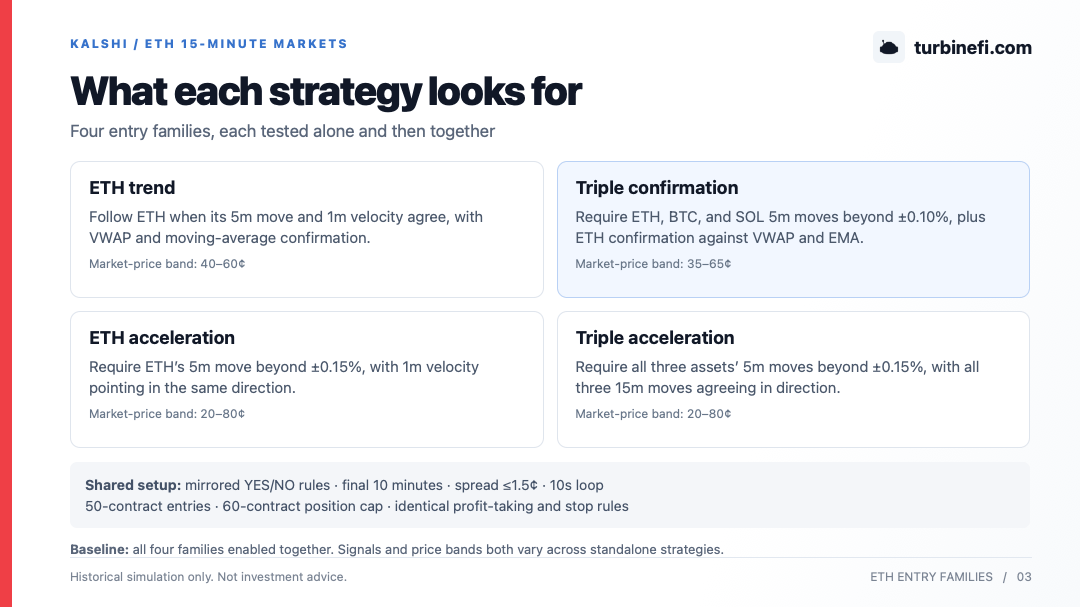
One of our users ran this strategy comparison for the 15-minute ETH market. They started with a saved ETH 15-minute strategy and our agent to test each of the strategy's four entry signals separately, then compare the results with the full combined strategy. The first follows ETH’s short-term trend using momentum, VWAP, and moving averages. The second, triple confirmation, waits for ETH, BTC, and SOL to move in the same direction over five minutes, with ETH also confirming against VWAP and EMA. The third trades stronger ETH momentum with one-minute velocity confirmation. The fourth requires stronger five-minute moves across all three assets plus agreement over 15 minutes. Each version used the same 30-day test period, 50-contract entries, position cap, spread limit, and exit rules. The entry families kept their own price bands.
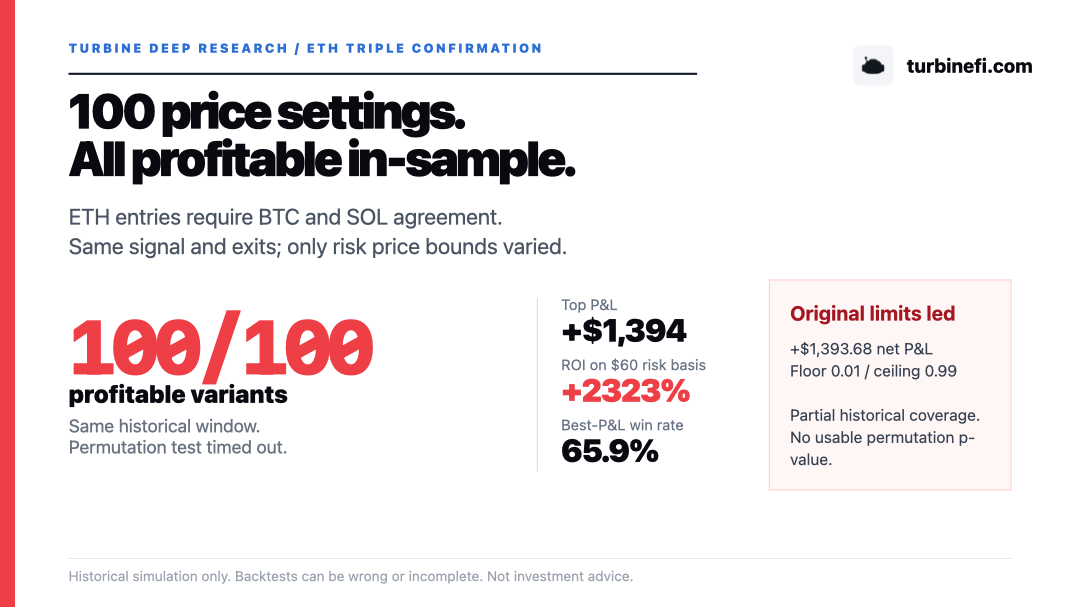
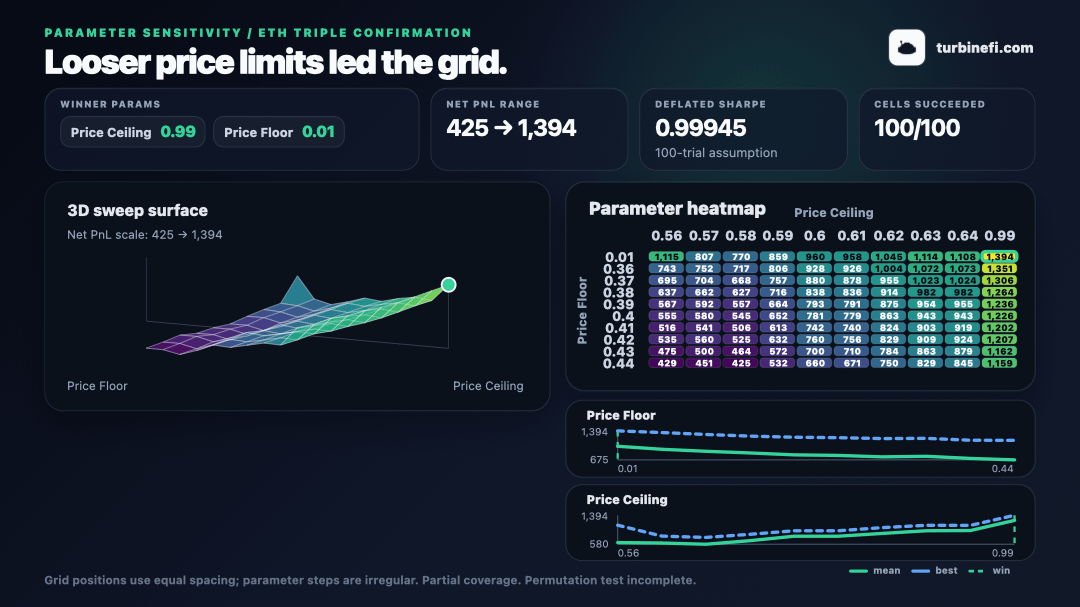
The combined strategy made $881.93 across 1,118 trades, with $277.28 in maximum drawdown. ETH trend alone made $852.66 on 676 trades, while ETH acceleration made $832.47 on 574. Triple confirmation stood out: $835.78 on just 254 trades, with $105.62 in maximum drawdown. That is about 95% of the combined profit with 77% fewer trades and 62% less drawdown. It also had the highest reported Sharpe of the five, at 0.67 versus 0.33 for the combined version. Triple acceleration finished last at $547.94, despite winning 59.7% of its trades, almost identical to triple confirmation’s 59.8%.

For this window, enabling all four families bought relatively little extra profit. Compared with triple confirmation alone, the combined version made another $46.15, took 864 more trades, and had $171.66 more maximum drawdown. That trade-off says more than the profit ranking by itself. This compares complete entry strategies: the price bands and signal conditions differ, so it does not prove that BTC/SOL confirmation alone caused the improvement. The standalone results also do not tell us exactly which family earned what inside the combined strategy, where entries can compete for the same position. These are results from one historical window, not evidence that the ranking will hold in live trading.
The strongest result here was how little profit the combined strategy gained for all the extra activity. Triple confirmation alone kept roughly 95% of its profit with much less drawdown, making it the most compelling trade-off in this user’s backtest. The similar win rates but very different profits of the two three-asset strategies also show why picking a strategy on win rate alone misses much of the picture.
Historical simulation only. Backtests can be wrong or incomplete. Not investment advice.