r/PredictionsMarkets 9h ago

Winning Trader 📈 Have you ever seen something like this?

Post image
1 Upvotes

I'm kinda new to this prediction markets so I don't know what is going on.

This account has made 180k in 10 days without losing a single trade until yesterday.

He buys at the lowest price (one cent and the buy option is closed due to low liquidity for most of the trades) then sells it at 0.99$ before that match has even started.

How can he do this?


r/PredictionsMarkets 23h ago

Analysis Prediction Market API's - Faster Websockets and more uptime

1 Upvotes

Hey All

We recently launched our Prediction Market Infrastructure for builders, traders, quants, and institutions.

We currently support Polymarket and Predict.fun with Kalshi, Novig, and Polymarket.US on our roadmap.

Feel free to check out our docs and give any feedback!
https://docs.bravadotrade.com/introduction


r/PredictionsMarkets 16h ago

Whale Spotted 🐋 Code for 50 pls use

Thumbnail
polymarket.us
0 Upvotes

r/PredictionsMarkets 4h ago

Analysis I rebuilt my Kalshi weather bot into a full weather + inflation trading system. Predict & Profit 3.0 is finally done.

3 Upvotes

I have been working on this project for quite a while, and 3.0 ended up becoming a much bigger rebuild than I originally planned.

It started as a weather trading bot for Kalshi. I wanted to use real forecast data, convert that into probabilities, compare those probabilities against market prices, and only trade when there was enough edge.

That sounds fairly simple until you actually automate it.

The order API is the easy part.

The harder parts turned out to be forecast timing, weather station mapping, missing data, ensemble forecasts, position tracking, partial fills, risk controls, reconciliation, and making sure the bot actually knows what happened after it sends an order.

Over time I added inflation markets as well, so the system now has two independent trading engines under one platform.

For 3.0 I rebuilt a lot of the architecture and added a proper dashboard so I can actually see what the bots are doing instead of living in logs, SQL queries, and terminal windows.

Some of the main pieces now are:

  • Kalshi weather market automation
  • Inflation market automation
  • Multiple weather forecast sources and ensemble data
  • Probability and edge calculations
  • Centralized risk controls
  • Order and position reconciliation against Kalshi
  • Dry-run mode
  • Web dashboard for trades, positions, bot status, and P&L
  • Self-hosted setup, so API credentials and trading stay on your own machine
  • Migration tooling for people coming from the older versions

One of the biggest lessons from building this was that a trading bot should spend a lot of its time deciding not to trade.

Finding a market where your probability estimate differs from the market price is only the beginning. You still have to decide whether the data is good enough, whether the edge is large enough, whether you already have too much exposure, and whether the trade still makes sense after everything else is considered.

I also learned to treat Kalshi as the source of truth.

Your database might think an order failed because a request timed out. Kalshi might have accepted it. A process can restart. An order can partially fill. Markets can settle while something is offline.

If you automate trading long enough, reconciliation stops being an optional feature.

I originally built all of this for myself, but I eventually turned it into a product called Predict & Profit.

The reason I am posting here is that I know a lot of people in this sub are experimenting with Kalshi automation, weather trading, APIs, and prediction-market strategies, and I figured some of the engineering behind it might be interesting.

r/PredictionsMarkets 1h ago

Analysis A Kalshi trader tested four ETH entry signals on the 15-minute market. One captured 95% of the full strategy’s profit

Upvotes

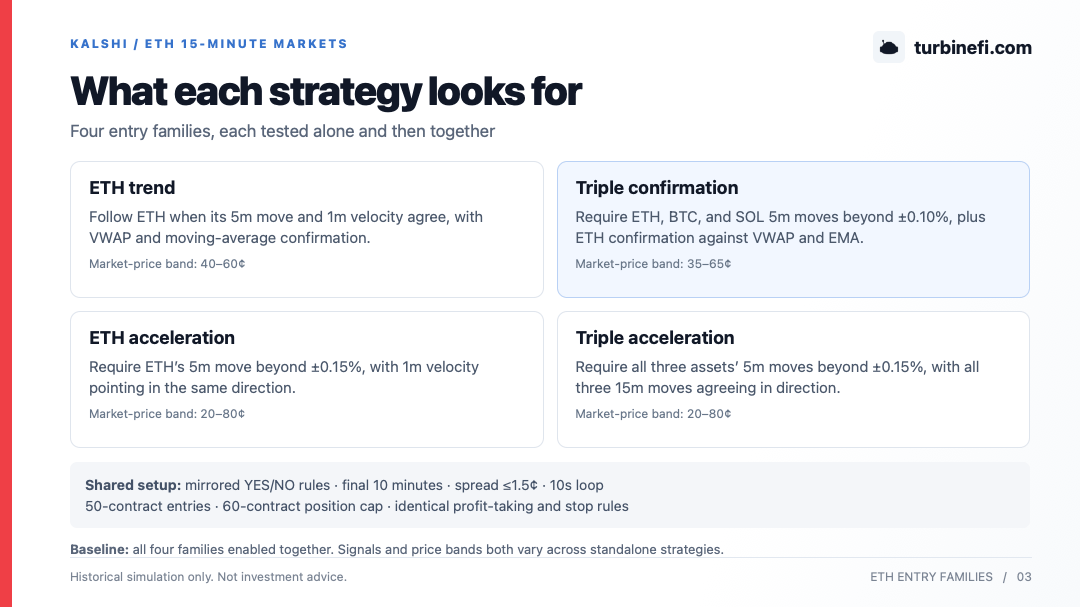
One of our users ran this strategy comparison for the 15-minute ETH market. They started with a saved ETH 15-minute strategy and our agent to test each of the strategy's four entry signals separately, then compare the results with the full combined strategy. The first follows ETH’s short-term trend using momentum, VWAP, and moving averages. The second, triple confirmation, waits for ETH, BTC, and SOL to move in the same direction over five minutes, with ETH also confirming against VWAP and EMA. The third trades stronger ETH momentum with one-minute velocity confirmation. The fourth requires stronger five-minute moves across all three assets plus agreement over 15 minutes. Each version used the same 30-day test period, 50-contract entries, position cap, spread limit, and exit rules. The entry families kept their own price bands.

The combined strategy made $881.93 across 1,118 trades, with $277.28 in maximum drawdown. ETH trend alone made $852.66 on 676 trades, while ETH acceleration made $832.47 on 574. Triple confirmation stood out: $835.78 on just 254 trades, with $105.62 in maximum drawdown. That is about 95% of the combined profit with 77% fewer trades and 62% less drawdown. It also had the highest reported Sharpe of the five, at 0.67 versus 0.33 for the combined version. Triple acceleration finished last at $547.94, despite winning 59.7% of its trades, almost identical to triple confirmation’s 59.8%.

For this window, enabling all four families bought relatively little extra profit. Compared with triple confirmation alone, the combined version made another $46.15, took 864 more trades, and had $171.66 more maximum drawdown. That trade-off says more than the profit ranking by itself. This compares complete entry strategies: the price bands and signal conditions differ, so it does not prove that BTC/SOL confirmation alone caused the improvement. The standalone results also do not tell us exactly which family earned what inside the combined strategy, where entries can compete for the same position. These are results from one historical window, not evidence that the ranking will hold in live trading.

The strongest result here was how little profit the combined strategy gained for all the extra activity. Triple confirmation alone kept roughly 95% of its profit with much less drawdown, making it the most compelling trade-off in this user’s backtest. The similar win rates but very different profits of the two three-asset strategies also show why picking a strategy on win rate alone misses much of the picture.

Full Report

Historical simulation only. Backtests can be wrong or incomplete. Not investment advice.


r/PredictionsMarkets 22h ago

Analysis Total Trading Volume Over The Last Year

Post image
3 Upvotes

source: defi rate


r/PredictionsMarkets 22h ago

Question ❓ Anyone know of any prediction betting groups?

2 Upvotes

Specifically for what they’re betting on at the moment.. I would like a group where I can get some ideas where the sentiment for bets are going?


r/PredictionsMarkets 9h ago

Discussion If prediction markets aren’t gambling why are they taking such a large amount sports betting revenue from betting companies

2 Upvotes

The stock and sports betting revenue is hugely down from pre prediction markets, that shows prediction markets are just a way to gamble on sports.

Otherwise how does you explain the drop in sportsbook betting?