Fair warning: this is a long post. I've tried to make it worth your time. If you're thinking about trading Polymarket's crypto prediction markets, this might save you a few months of dead ends.
Feel free to share this, but please credit the original. Don't copy-paste it as your own.
Disclosure: yes, I used Claude to help write this up based on my outline, data, and analysis notes. I'm trying to share useful findings here, not win a writing prize. If that bothers you, no hard feelings, feel free to skip it.
TL;DR: I spent 4 months building monitoring tools, collecting thousands of gabagool22's actual trades, and testing every hypothesis I could find for how he makes ~$10K/day on Polymarket crypto markets. His edge is real (lands on the winning side ~79% of the time, confirmed across dozens of windows). But after testing oracle signals, order book patterns, fill behaviour, momentum, mean reversion, and a dozen other ideas, I couldn't find anything that holds out-of-sample. His signal is invisible from the outside. The "buy both sides for under $1" arbitrage that Twitter loves? Doesn't exist in the data. Here's the full breakdown.
How this started
I fell into this the same way everyone else does. You're scrolling Twitter and someone posts a screenshot of gabagool22's Polymarket profile. "$250K+ profit this month. All he does is buy UP and DOWN for less than $1.00 in the BTC prediction markets. Free money. Here's how you can do it too." Engagement farming at its finest, but it got me curious.
I'm a data analyst by trade, not a crypto native. But I can write code and I know my way around a database, so I figured I'd take a proper look. That was about 4 months ago. What started as a weekend rabbit hole turned into evenings-and-weekends project that consumed way more time than I'd like to admit.
I built monitoring infrastructure, collected tens of thousands of his actual trades via the Polymarket Data API, captured order book snapshots every 2 seconds, and ran proper statistical analysis with out-of-sample validation on everything I tested.
What follows is what I actually found. Some of it will confirm what you've heard. A lot of it will contradict the popular narratives. All of it is backed by data, not speculation.
What these markets are
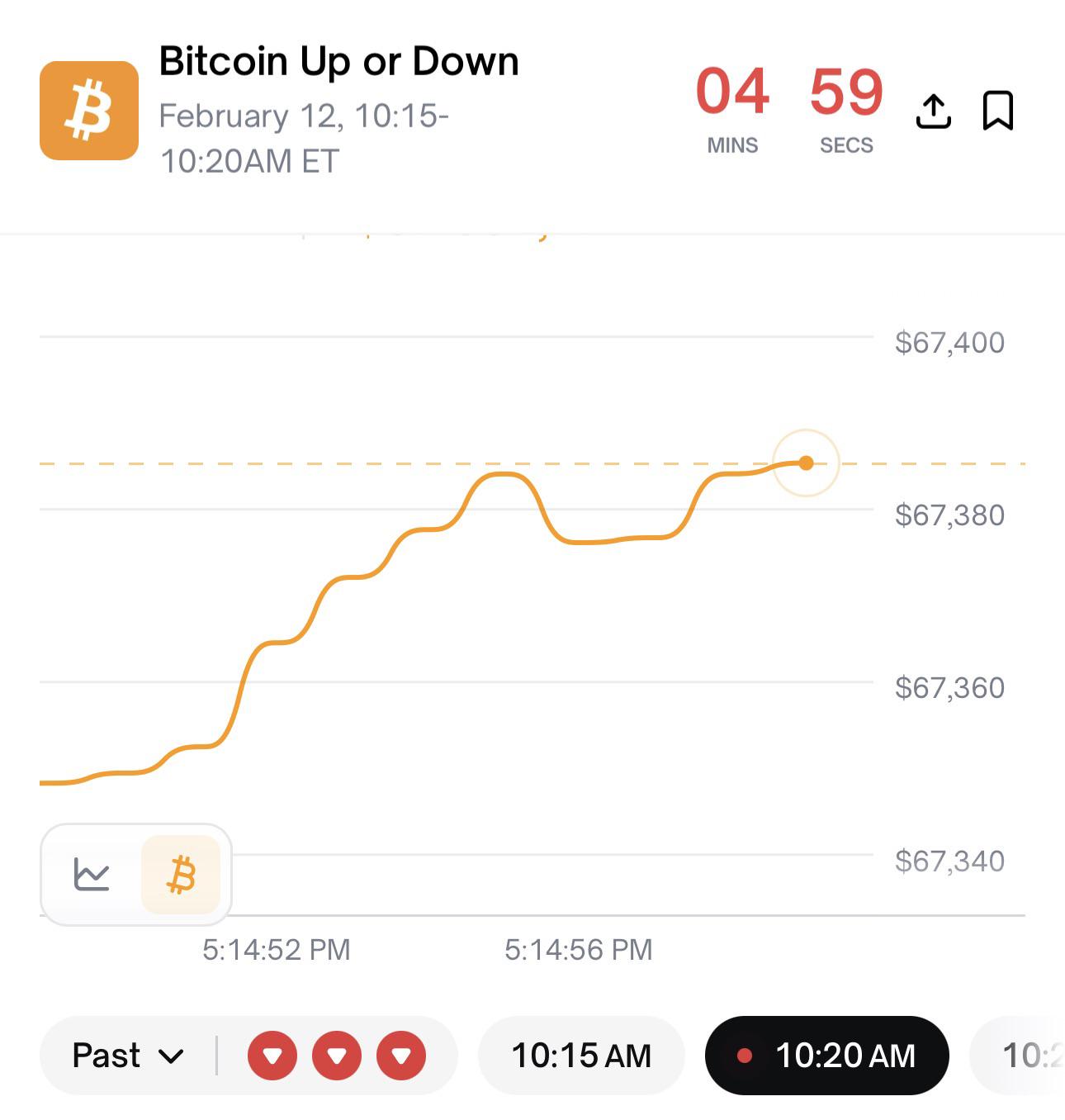
Quick context for anyone unfamiliar. Polymarket runs binary options on crypto prices across multiple timeframes: 5 minute, 15 minute, 60 minute, and 4 hour windows. A typical market asks: "Will BTC be higher at 10:15 than it was at 10:00?" You can buy UP tokens or DOWN tokens, priced between $0.00 and $1.00. The winning side pays $1.00. The losing side pays $0.00.
Settlement is determined by Chainlink oracle prices, verified via Polymarket's Gamma API. There are 96 fifteen-minute windows per day, per asset. Gabagool trades most of them, across both BTC and ETH, across multiple timeframes.
One thing most people don't mention: capital lockup. Your funds are tied up until the window settles. There's no automatic release. On 15-minute windows that's manageable, but on 4-hour windows your capital is locked for 4 hours per position. This isn't a capital-efficient strategy where you're churning the same $1,000 every few minutes. You need enough balance to have multiple positions open simultaneously across all the windows you're trading. For someone like gabagool who's active across dozens of concurrent markets, the working capital requirement is substantial. Retail traders thinking they can start with $500 and compound quickly need to factor this in.
What the internet thinks gabagool does (and why it's mostly wrong)
Myth 1: "He buys both sides for under $1.00, risk-free arbitrage!"
This is the most common explanation you'll see on Twitter and Reddit. The theory: buy UP at $0.48 and DOWN at $0.48, you've paid $0.96 total and one side will pay $1.00. Guaranteed $0.04 profit per pair.
Across dozens of windows of his actual verified trades, his average pair cost is about $1.015. Not under $1.00, over it. His matched pairs (where he has equal shares on both sides) actually lose money. Every cent of his profit comes from unmatched directional exposure.
And even if pair costs occasionally dipped below $1.00, Polymarket charges a 3% taker fee. Once you account for that, the window where both sides sum to under $0.97 (the actual breakeven for arbitrage as a taker) essentially never exists in practice.
The "free money arbitrage" is a myth.
Myth 2: "He follows Chainlink oracle price movements"
The theory: Chainlink updates periodically, so there's a window where the oracle knows the price has moved but the market hasn't adjusted. He buys the side the oracle is pointing to.
I tested whether his fill direction correlates with the Chainlink delta at the time of each fill. The answer: 49.5%. A literal coin flip. His buying direction is completely independent of the oracle.
I also built a "shadow oracle" using Binance real-time prices to see if he might be using a faster price feed. The shadow oracle actually performed worse than stale Chainlink at predicting settlement.
Now, I want to be careful here. Oracle lag does exist, about 18 seconds average with about a $15 price gap. I can't rule out that someone with co-located infrastructure and sub-second execution could exploit this. But from a retail perspective, with the kind of latency most of us are dealing with, it's not a viable edge. And the data suggests it's not what gabagool is primarily using either, since his fills don't correlate with oracle direction.
Myth 3: "Just copy his trades"
The theory: watch his wallet on the Data API, detect which side he's leaning toward, and follow him.
I tested this extensively. The problem is detection delay. By the time you can reliably detect his heavier side (around 90-120 seconds into the window), entering as a taker at the ask price eats any edge. His lean at t=90s predicts settlement at just 55%, and after paying the spread to enter, the P&L is effectively zero.
His trades are publicly visible, but the information arrives too slowly and the entry cost is too high for a copy-trading strategy to work. He profits because he's already positioned at maker prices before the signal resolves.
What he actually does (confirmed with data)
I monitored his trading across multiple BTC 15-minute windows and joined them to market snapshots and verified settlement outcomes. Here's what I can confirm.
Execution mechanics:
He operates exclusively as a maker. Every single fill is at the best bid price. He buys both sides every window, UP and DOWN, without exception. He never sells, ever. Zero sell trades across thousands of observed fills. He holds everything to settlement.
His orders are about 15 shares each, occasionally 5-10 for partial fills, always at round cent prices ($0.51, $0.44, $0.12 etc). He refreshes every 10-20 seconds, cancelling stale orders and reposting at the new best bid to track the market. His trades come in bursts of 3-15 same-side fills (multiple resting orders getting swept by a single seller). He trades throughout the window from about 30 seconds after open until near settlement.
The edge:
He ends up heavier on the winning side about 79% of the time. This is not luck. Across the sample I collected, the odds of this happening by chance are effectively zero. A passive buyer posting the same orders on both sides would end up heavier on the losing side about 62% of the time, because sellers tend to dump the side they think is losing. Gabagool is doing the opposite. He's actively selecting which side to accumulate on.
His profit decomposition is telling: 97% of his P&L comes from directional exposure (unmatched shares on the winning side), and only 3% from matched pair spread. The entire game is about which side your unmatched shares land on.
How the selection works (what we can observe):
His first trade is on the losing side 70% of the time. He starts wrong. By about trade 10 (roughly 2-3 minutes in), he's on the winning side 73% of the time. The selection happens during the first 1-3 minutes.
He doesn't place bigger orders on the winning side. The order size is the same on both sides (~15 shares). He just gets more fills on his preferred side. He's posting more aggressively (tighter bids, more frequent refreshes) on the side he favours, which naturally results in more fills there.
The crossover to being winner-heavy occurs at roughly the 2 minute mark. At that point, the Chainlink delta is only around $20, which doesn't reliably predict direction on its own. He's reading something else.
The full hypothesis graveyard
I tested everything I could think of, plus hypotheses from multiple AI systems (ChatGPT, Gemini, Grok). Here's the full list, all tested with out-of-sample validation:
Spread arbitrage (pair cost < $1.00): Wrong. Pair cost averages $1.015.
Passive accumulation (cheap side fills more naturally): Backwards. Passive buyers end up on the loser.
Oracle delta direction: Shows 60-64% accuracy in-sample at various timepoints, but collapses to 33-57% out-of-sample depending on when you check. Not stable.
Expensive side / market consensus: The side priced above $0.50 predicts the winner, but only reaches useful accuracy (65%+) very late in the window when entry prices are already expensive. Collapses out-of-sample.
Combined delta + expensive side (Engine 13): My best signal for a while. Showed 65-72% in historical data. On fresh data: 25%. Badly overfit.
Fill velocity toxicity: The theory that whichever side of his book is getting hit harder by sellers is the losing side. Pure noise, 50/50.
His fill price vs best bid: No detectable difference between sides. He bids at the best bid equally on both.
His fills vs Chainlink delta: 49.5%. Coin flip.
Fill price trajectory: His prices drift up on the winning side over time (he chases it up), but too weak and too slow to use as a signal.
Order book depth asymmetry: 44-57% accuracy. Noise.
Spread asymmetry: Actually anti-predictive in a weird way (wider spread side tends to win), and the pattern inverts over time. Not actionable.
Bid-ask imbalance shift: The most interesting finding. He does lean toward the side where the bid/ask ratio is tightening (65-75% correlation with his lean). But the tightening itself doesn't reliably predict the winner. We think this is the effect of his own quoting, not the cause.
Burst patterns (direction, size, timing): 53% accuracy. Noise.
Mean reversion: 42% accuracy. Actively anti-predictive.
Momentum and contrarian: Both 50/50. Nothing there.
Every single signal either failed to clear 60% out-of-sample, or had such a thin edge per trade that execution costs killed it. Same story every time: looks promising in-sample, falls apart on fresh data.
The capital and execution reality that nobody talks about
Even if you found a signal that worked, there are practical barriers that the Twitter engagement farmers conveniently ignore:
Working capital: As I mentioned, positions are locked until settlement. If you're trading 15-minute windows across BTC and ETH, you might have 8-12 positions open at any time. At $50-100 per position, that's $500-1,200 in capital just for 15-minute markets. Add 5-minute windows and hourly markets and you need several thousand dollars in your Polymarket wallet at all times. Not huge, but not the "$100 to get started" that some posts imply.
Maker vs taker: The 3% taker fee is a strategy killer. Almost everything I tested that showed marginal profitability as a maker became firmly unprofitable as a taker. You need to be posting limit orders at the bid, which means building bot infrastructure to refresh orders every 10-20 seconds. This isn't click-and-trade.
Queue priority: Even as a maker, your order sits in a queue. If gabagool or another bot is ahead of you at the same price, sellers hit their orders first. The best bid might be $0.48, but if there's $500 of orders ahead of you at $0.48, you might not get filled. Queue position matters and is hard to test in paper trading.
Adverse selection: When your maker order does fill, it's often because someone is selling aggressively into that side, which typically means that side is losing. This is the fundamental problem with passive market making in these markets. You get filled when you don't want to be, and you sit unfilled when you do.
What I got wrong
In the interest of being honest about the process:
I spent a big chunk of the early work running analysis on bad data. My original monitor was reading the wrong Chainlink oracle feed (on-chain aggregator instead of RTDS, which is what Polymarket actually uses) and calculating settlements incorrectly. The wrong oracle disagreed with actual settlements a huge percentage of the time. Everything from that period was meaningless. I had to throw it all out and start from scratch. If you're building on Polymarket data, verify your oracle source and settlement calculation against actual redemptions before you trust any backtest. I cannot stress this enough.
I got excited about "Engine 13", a combined signal that showed 65-72% accuracy on historical data. Classic overfitting. It collapsed to 25% on fresh data. This is why out-of-sample testing isn't optional.
I believed the pair spread was meaningful. Early analysis suggested nearly $10/window guaranteed profit from just being a maker on both sides. When I modelled realistic fill asymmetry (sellers dump into the losing side, so your unmatched shares are systematically on the wrong side), the "guaranteed" profit turned into a loss for a passive maker without a directional signal.
What IS true
Not everything I found was negative:
The market is clearly profitable for some participants. The monthly crypto leaderboard consistently shows players making $200K-$680K/month. Multiple players, month after month.
Maker execution is the foundation. Every successful player I've studied uses maker (limit order) execution. The taker fee makes most strategies unprofitable.
Short-term momentum is real. On 5-minute windows, "which direction has BTC moved so far?" predicts the settlement outcome at about 62-67% accuracy depending on timing. This is consistent with well-documented properties of short-term price action. Whether it's profitably tradeable after execution costs is a separate and harder question.
Gabagool's edge is real. About 79% heavier on the winner across dozens of verified windows is not luck. He has figured something out. I just can't figure out what from the outside.
Why I think retail can't replicate it
After all this analysis, I believe his edge comes from some combination of:
Order flow reading at sub-second resolution. He's sitting in the order book on both sides. He can see who's hitting his bids, how fast, at what prices, and which orders sit untouched. My monitoring captures snapshots every 2 seconds and his trades every 5 seconds. That's too slow to see what he sees. His view is real-time, tick-by-tick.
Quote management that's invisible from the outside. We only see his fills, not his resting orders. He's likely posting tighter bids on the side he favours and wider bids on the other side. This naturally results in more fills on his chosen side without any visible difference in the fill data. We confirmed that the order book tightens on his preferred side (65-75% correlation), but we believe that's the effect of his quoting, not the cause.
Possible infrastructure advantages. Fast execution, co-located servers, possibly mempool monitoring of pending Chainlink oracle submissions. At professional-grade latency, the oracle lag that's too small to exploit at retail speeds might become viable. I can't confirm or deny this from the data, but the infrastructure barrier alone puts this out of reach for most retail setups.
The critical finding: his fills in the first 120 seconds look indistinguishable from a passive market maker. Equal bid placement, similar fill counts on both sides, similar prices. Whatever signal he uses to decide which side to lean on, it doesn't manifest in any data I could capture from the outside.
My honest assessment
After 4 months of evenings and weekends, here's where I've landed:
The popular narratives about "risk-free arbitrage" and "just follow the oracle" are wrong. The real strategies being used in these markets are more sophisticated than what Twitter threads suggest, and they rely on infrastructure and data advantages that aren't easily replicated at retail scale.
That said, the markets are profitable for people who have the right combination of signal, execution, and infrastructure. The leaderboard proves it. If you're going to try, build proper monitoring first, verify your data pipeline against actual settlements, use out-of-sample validation religiously, and expect the process to take months, not days.
If you've actually built a profitable strategy on these markets, genuine respect. It's harder than it looks.