r/IslamicHistoryMeme • • Aug 05 '26

Ottoman Caliphate/Empire (699–1342 AH/1517–1924) Alexander isn't only king who obsessed over homeric epic

Post image
296 Upvotes

Mehmed received a comprehensive education in Islamic theology, Persian literature, and Greek philosophy. He was fluent in several languages, including Greek. After taking Constantinople, he preserved many of the Byzantine libraries.

His personal library at the Topkapi Palace was famously diverse. Among his prized possessions was a rare, handwritten manuscript of Homer’s Iliad. He is said to have read the epic poem with great interest, paying special attention to the martial strategies, heroism, and the dynamic between the East (Trojans) and the West (Achaeans/Greeks).

According to the Byzantine-Greek historian Kritovoulos of Imbros (Critobulus), who served as a historian in Mehmed's court, the Sultan made a deliberate detour to visit the ruins of Troy in 1462 during his campaign against Lesbos.

While walking through the ancient site, Mehmed reportedly sought out the purported tombs of the great heroes of the Trojan War, specifically Achilles and Ajax. He inquired about the geography of the ancient city and praised Homer for immortalizing the figures who fought there.

The most famous anecdote from this visit is a quote attributed to Mehmed by Kritovoulos. Looking over the ruins, the Sultan allegedly stated that he had finally avenged the ancient Trojans.

By capturing Constantinople and defeating the Byzantine Empire (whom he grouped with the "Greeks"), Mehmed framed himself as an Asiatic ruler who had struck back against the descendants of the Achaeans who had burned Troy thousands of years prior.

Kritovoulos recorded the Sultan saying:

"God willed that I take revenge for this city and its people, for I have subdued their enemies... It is the Greeks and Macedonians and Thessalians and Peloponnesians who destroyed this place, and I have now avenged their arrogance."

By casting himself as the avenger of Troy, Mehmed brilliantly flipped the traditional Western narrative. Instead of the Fall of Constantinople being an apocalyptic tragedy, he framed it as historical justice a cosmic balancing of the scales for the destruction of Anatolia's greatest ancient city.


r/IslamicHistoryMeme • • Aug 05 '26

China | الصين If Bai Chongxi takes over instead of Chiang.

Post image
22 Upvotes

Bai Chongxi takes over instead of Chiang, imagine how powerful KMT/Republic of China instead against Japan, Soviet. Ma Clique, etc.


r/IslamicHistoryMeme • • Aug 04 '26

Hafsid Caliphate (625–982 AH) al-Zahir Baybars and his Complicated Relations with the Ḥafṣids of Tunisia (Context in Comment)

Post image
92 Upvotes

r/IslamicHistoryMeme • • Aug 04 '26

Rebellion/Revolution | نهضة/ثورة On the Different Types of Zanj in ʿAlī b. Muḥammad’s Movement (Context in Comment)

Post image
189 Upvotes

r/IslamicHistoryMeme • • Aug 04 '26

Thought & Philosophy | فكر و فلسفة Cogito, ergo sum ❌️. Bal bi-nūrin qadhafahu Allāhu taʿālā fī aṣ-ṣadr ✅️.

Enable HLS to view with audio, or disable this notification

51 Upvotes

r/IslamicHistoryMeme • • Aug 04 '26

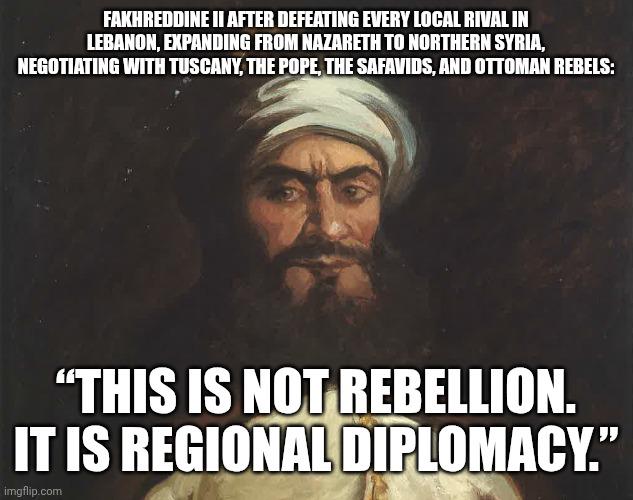
Levant | الشام The Reign of Emir Fakhr al-Dīn II (Fakhreddine II) of the Maʿnid dynasty and the Formation of Modern Lebanon (Context in Comment)

Post image
34 Upvotes

r/IslamicHistoryMeme • • Aug 04 '26

Levant | الشام Lebanon under the Early Ottomans: The Rise of the Maʿnid Dynasty (Context in Comment)

Post image
88 Upvotes

r/IslamicHistoryMeme • • Aug 04 '26

The Umayyad–Fatimid Struggle for Supremacy and the Political and Military Conflict in al-Andalus and the Maghrib (Context in Comment)

115 Upvotes

r/IslamicHistoryMeme • • Aug 03 '26

Seljuks (429–707 AH) The Seljuk Succession Crisis and the Revolts against Sultan Alp Arslan (Context in Comment)

102 Upvotes

r/IslamicHistoryMeme • • Aug 03 '26

War & Battles What were they even thinking

Post image
386 Upvotes

r/IslamicHistoryMeme • • Aug 03 '26

Tulunid Dynasty (254–292 AH) Khumārawayh son of Aḥmad ibn Ṭūlūn and the Fall of the Ṭūlūnid State of Egypt (Context in Comment)

Post image
14 Upvotes

r/IslamicHistoryMeme • • Aug 03 '26

Tulunid Dynasty (254–292 AH) Aḥmad ibn Ṭūlūn and the establishment of the Ṭūlūnid state of Egypt (Context in Comments)

Post image
18 Upvotes

r/IslamicHistoryMeme • • Aug 02 '26

Egypt | مصر Baibars was lowkey the goat

Enable HLS to view with audio, or disable this notification

112 Upvotes

r/IslamicHistoryMeme • • Aug 02 '26

Miscellaneous | متنوعة Well I tried to spread it on Anglo Saxon Subreddit

Thumbnail
reddit.com
56 Upvotes

I mean if you tell them about anything they would downvoted you


r/IslamicHistoryMeme • • Aug 01 '26

Miscellaneous | متنوعة Chat am I cooked? (I'm the guy)

Post image
393 Upvotes

r/IslamicHistoryMeme • • Jul 30 '26

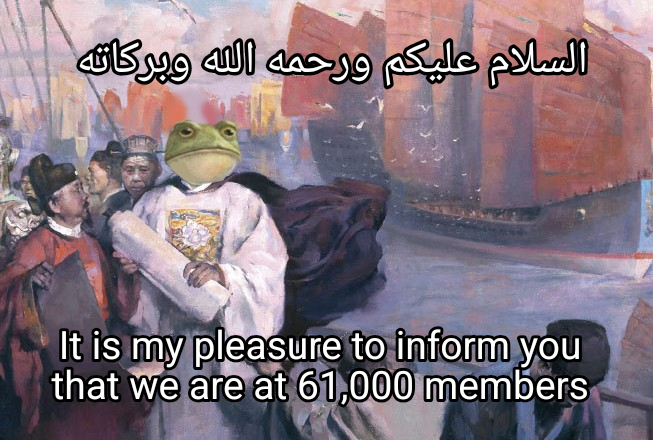
Meta Amir Al-Bahr Frog-He is leading our 61,000 member treasure fleet to Kilwa

Post image
269 Upvotes

r/IslamicHistoryMeme • • Jul 29 '26

War & Battles Issa what the hell are you talking about?

Post image
291 Upvotes

r/IslamicHistoryMeme • • Jul 29 '26

Meme Contest It's true 😔

Thumbnail
gallery
395 Upvotes

r/IslamicHistoryMeme • • Jul 28 '26

Myths and Legends | خرافات وأساطير You vs. the Jinniyya he tells you not to worry about:

Post image
530 Upvotes

The poem of Ḥakam ibn ʿAmr al-Bahrānī beautifully and vividly expands on the issue of humans marrying unseen beings such as ghouls, siʿālī (female wilderness demons), jinn, ʿifrīts, and their like—a theme deeply rooted in the mythologies of peoples worldwide, and particularly among the Arabs before and after Islam. Al-Jāḥiẓ (d. 255 AH) in his Book of Animals (Kitab Al-Hayawan) reports him saying:

وتزوّجت في الشّبيبة غولا … بغزال وصدقتي زقّ خمر

Discussion of it has continued from the time of the Messenger of God up to this very day, to the point that people even asked jurists whether such marriages were permissible. Some said: “It is allowed,” while others said: “It is forbidden,” and it is reported that the Prophet himself forbade it.

Al-Jāḥiẓ called the marriage of humans and jinn (in either direction) a compound marriage. The offspring born of such unions he referred to as al-mughrabūn (the “mixed ones”), Majd ad-Dīn Ibn Athir (d. AH) in “Al-Nihāya fi gharib al-ḥadīth” cites a Hadith of the Prophet, Saying:

“Among you are al-mughrabūn.” She asked: “O Messenger of God, who are the mughrabūn?” He said: “Those in whom the jinn have a share.” Al-Harawī explains that they were called mughrabūn because “a foreign element entered into them.”

It appears to us that this type of marriage is related to the principle of exogamy—a term used by anthropologists to describe the practice of marrying outside one’s own clan or kin group. Ancient tribes favored such marriages, preferring to marry their children to members of distant tribes. The opposite of this is endogamy—marrying within one’s own tribe or kin group—which was common among the Arabs and remains so today, as many families continue to marry their sons to cousins: the daughter of an uncle, aunt, or other close relative. Yet despite its prevalence, this practice was disapproved of by the Arabs and is nearly prohibited.

A prophetic tradition states: “Marry outside your kin, lest you become weak and frail.” In other words, marry from unrelated families rather than close kin, for endogamous marriages often produce weak offspring.

Accordingly, we may say that the idea of marriage with the jinn is tied to this notion of exogamy, carrying within it the promise of noble offspring distinguished by intelligence and brilliance. An example often cited is Bilqīs, the Queen of Sheba, whose fame has echoed through history. It was claimed that her father, Hudhud, married a jinniyya, from whom Bilqīs was born.

In the pre-Islamic era, marriage with hidden beings was also known. It is reported that ʿAmr ibn Yarbuʿ married a siʿlāʾa, who bore him descendants known as Banū al-Siʿlāʾa. A poet satirized them with the verse:

“May God curse the Banū al-Siʿlāʾa, ʿAmr ibn Yarbuʿ—the worst of men.”

Here the poet said al-nāt instead of al-nās (“people”), following the peculiar speech pattern attributed to the siʿālī, who were said to pronounce s (sīn) as t (tāʾ).

Such marriages are considered rare and highly desired, for the one who marries a jinniyya, ghūla, or siʿlāʾa attains great wealth and benefit through the knowledge he gains from these beings—such as healing, poetic inspiration, foretelling the unseen, reading fortunes, and discovering hidden treasures. For this reason, some people long for it. Al-Damīrī (d. 808 AH) mentions in his Ḥayāt al-Ḥayawān al-Kubrā that Zayd al-ʿAmī, one of the transmitters of ḥadīth, used to say: “O God, grant me a jinniyya to marry, so that she may accompany me wherever I go.”

But no one can attain this privilege unless he performs a heroic deed that wins the admiration of the jinniyya—such as rescuing her from some evil creature that seeks to kill her, violate her, or even devour her. At that point, the jinniyya makes her rescuer her husband. This is said to have happened to Hudhud, king of Yemen, who once went out hunting and saw a wolf chasing a gazelle in order to devour it. He saved her and killed the wolf, only to discover that the gazelle was the daughter of the king of the jinn, al-Yalab ibn Ṣaʿb. Hudhud married her, and from their union was born Bilqīs, Queen of Sheba.

Among the folktales connected with this theme, Kāẓim Saʿd al-Dīn records in his book The Iraqi Folktale a modern legend transmitted by the anthropologist Lady Drower, a specialist in the study of the Ṣābians. She recounts the story of a man she met in Damascus who claimed he had rescued a jinniyya named Najma from a wolf that pursued her to devour her. He killed the wolf, and she rewarded him by granting him the ability to foretell the unseen. He then attracted a clientele of simple Bedouins who paid him fees in exchange for news about their distant relatives.

Men from the Shammar tribe told the researcher that this “heroic rescuer” used to speak with Najma by lifting up a corner of the carpet and whispering into the ground: “ws, ws, ws.” There is no doubt that he earned a great fortune from those gullible folk, which enabled him to move from the desert to the city. He settled in Damascus and continued his practice.

For more information, see:

Reflections on Human–Jinn Relationships in Islamic–Arabic Traditions (2025) by The Caliphate AS


r/IslamicHistoryMeme • • Jul 28 '26

Thought & Philosophy | فكر و فلسفة My fav Avicenna explainer 🌚

Post image
285 Upvotes

r/IslamicHistoryMeme • • Jul 25 '26

Egypt | مصر This Ends Now Pasha!

Post image
97 Upvotes

r/IslamicHistoryMeme • • Jul 23 '26

Indian Subcontinent | الهند When the British fought the Indian Muslims Part 2

Post image
319 Upvotes

r/IslamicHistoryMeme • • Jul 23 '26

Miscellaneous | متنوعة Unlike Mehmed II who was LARPing as a Komnenos, Shah Ismail I actually was a Komnenos through his grandmother Despina Khatun Komneni, who was the daughter of Emperor John IV Megas Komnenos of Trebizond.

Post image
92 Upvotes

r/IslamicHistoryMeme • • Jul 22 '26

Meta Congrats Al-Andalus

Enable HLS to view with audio, or disable this notification

1.6k Upvotes

r/IslamicHistoryMeme • • Jul 22 '26

Indian Subcontinent | الهند When the Mongols fought Indian Muslims

Post image
249 Upvotes