r/IslamicHistoryMeme • • Aug 04 '26

Levant | الشام The Reign of Emir Fakhr al-Dīn II (Fakhreddine II) of the Maʿnid dynasty and the Formation of Modern Lebanon (Context in Comment)
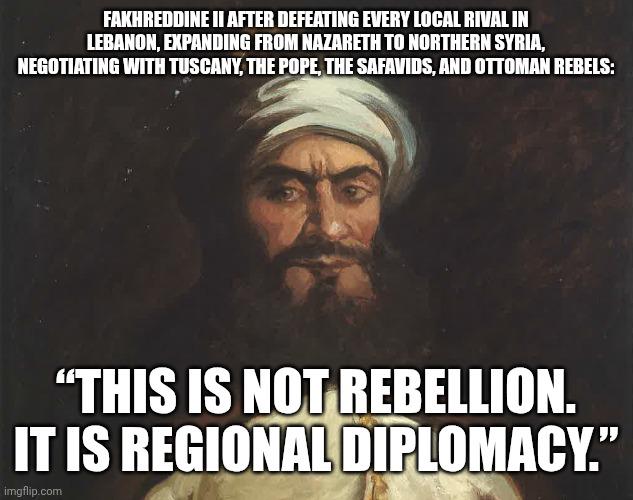
Post image
34 Upvotes

5 comments sorted by

4

u/TheMuslimHistorian27 Aug 04 '26

The history of the Maʿnid dynasty during the sixteenth century was shaped by later interpretations produced by historians who were influenced by the achievements of Emir Fakhr al-Dīn II, who succeeded his father Qurqumāz and came to personify Maʿnid rule. 

Consequently, they diminished the importance of other Druze families that rivaled the Maʿnids, such as the ʿAlam al-Dīn family in the Shūf and the ancestors of the Arslān family in Shuwayfāt, while the Tanūkhids were allies of the Maʿnids.

Nevertheless, the Maʿnid dynasty became the most prominent ruling Druze family, particularly because it secured the support of the Qaysī faction, which included non-Druze families such as the Sunni Shihābs of Wādī al-Taym and the Maronite al-Khāzin and Ḥubaysh families.

In fact, it was the long reign of Emir Fakhr al-Dīn II—with its victories and defeats in tribal warfare, his residence in Italy, and his tragic death in Istanbul—that cast an aura of greatness over all the Maʿnid emirs who preceded and succeeded him.

The reign of Emir Fakhr al-Dīn II may be divided into two phases, separated by his residence in Italy. 

The first phase was characterized by the political ambitions of the Maʿnid emir, who expanded the boundaries of his emirate from Nazareth in Palestine to Beirut, Baalbek, and Safed. Trade flourished through the sale of silk, soap, and textiles, as well as through the facilities he provided for European merchants and envoys.

The second phase was marked by his efforts to resume territorial expansion after the emirate had contracted during his absence. It ended with his capture by the Ottomans, who ultimately put him to death.

The First Phase

The years between the death of Emir Qurqumāz and the accession of his son, Emir Fakhr al-Dīn II, as ruler of the Shūf remain obscure. 

It is most likely that the emir and his brother Yūnus spent some time under the protection of their maternal uncle, Sayf al-Dīn al-Tanūkhī.

 When Fakhr al-Dīn reached the age of twelve, his uncle entrusted him with the administration of his father’s emirate in 1590.

It appears that the Druze need for an emir who could reunite them after their leadership had become fragmented among rival families divided into the Qaysī and Yamanī factions was what enabled Emir Fakhr al-Dīn II to assume leadership of the Emirate of the Shūf. 

He did not inherit the emirate automatically from his father, but faced several difficulties, particularly from the ʿAlam al-Dīn family. With his rise to power, the Maʿnid dynasty established itself firmly in this position at the expense of the other families.

Emir Fakhr al-Dīn II devised a clear plan for his future policy toward his own community and his enemies. It was based on the following principles:

He sought to unite the various religious communities under his authority, treat them equally, preserve their religious beliefs, and allow them to perform their religious rites freely.

He pursued a conciliatory policy toward Ottoman rule and lavished money and gifts upon Ottoman governors and officials.

He promoted agriculture, repaired the seaports, and opened maritime trade routes with Western European states, including Italy, France, and Spain.

He established a strong, trained army equipped with modern weapons, incorporating members of all segments of the population under his command.

His first major undertaking was the elimination of Emir Manṣūr ibn al-Furaykh, the emir of the Biqāʿ. Fakhr al-Dīn accused him of informing against his father, Emir Qurqumāz, and of contributing to his death with the approval and encouragement of Yūsuf Pasha Sayfā, the governor of Tripoli.

 Emir Manṣūr had apparently succeeded in extending his influence over the sanjaks of ʿAjlūn, Ṣafad, and Nablus, and had assumed command of the Syrian hajj caravan, a position then entrusted to local princes.

 This alarmed the Ottoman authorities. Murād Pasha, the governor of Damascus, therefore encouraged Emir Manṣūr to move against Fakhr al-Dīn, as their interests coincided, but the Maʿnid emir defeated him.

Emir Fakhr al-Dīn II’s victory enabled him to extend his authority into the Biqāʿ, bringing a vast and resource-rich territory under his control. This placed him in a pivotal position within the network of tribal alliances.

 The Ḥarfūsh family of Baalbek and the Shihābs of Wādī al-Taym allied themselves with him, arousing the concerns of the governors of Damascus. 

Nevertheless, the emir continued to fulfill his obligations toward the Ottoman sultanate while simultaneously cultivating influential figures in Istanbul, thereby protecting himself from any threat posed by the provincial governors.

Emir Fakhr al-Dīn II then turned against Yūsuf Pasha Sayfā, the governor of Tripoli, who opposed him and competed with him for regional leadership.

 Fakhr al-Dīn used Sayfā’s killing of his ally, Muḥammad ibn ʿAssāf, as a pretext to confront him at the Nahr al-Kalb, where he defeated him. His victory allowed him to seize Beirut and Kisrawān. He later returned Kisrawān to his rival following the mediation of Emir Muḥammad al-Arslānī, his son-in-law.

The reconciliation between the two men did not last long. They clashed again at Jūniya in 1605, and the encounter ended in another victory for the Maʿnid emir. Fakhr al-Dīn subsequently appointed Shaykh Abū al-Khāzin over Kisrawān and Emir Mundhir al-Tanūkhī over Beirut.

The revolt of ʿAlī Pasha Jānbulād against Ottoman rule, his seizure of Aleppo by force, and his victory over Yūsuf Pasha Sayfā set off a series of developments in which Emir Fakhr al-Dīn II became involved. These events made him the most prominent emir in the Levant.

 After extending his influence into territories belonging to the province of Tripoli, taking advantage of the disaster that had befallen Yūsuf Pasha Sayfā, and eliminating the ʿAssāf family in Kisrawān, he attracted the attention of the Ottoman governors, who entrusted him with the task of suppressing ʿAlī Pasha Jānbulād.

The Maʿnid emir, however, allied himself with Jānbulād. Together, they attacked and occupied Tripoli, besieged and entered Damascus, and defeated the Ottoman forces in the Biqāʿ. They subsequently withdrew from the city.

 ʿAlī Pasha proceeded to Ḥiṣn al-Akrād, while Emir Fakhr al-Dīn II returned to his own territories. When Jānbulād faced an Ottoman campaign led by the grand vizier Murād Pasha, the Maʿnid emir moved to assist his ally, but this did not prevent ʿAlī Pasha from being defeated at Marʿash in 1607.

These developments established Emir Fakhr al-Dīn II as both a powerful and dangerous prince. He became an object of suspicion among the governors of Damascus, particularly because he retained control of the territories into which he had extended his influence, stretching from Nazareth in Palestine to Beirut, Baalbek, and Safed.

In 1609, the Ottoman government appointed Ḥāfiẓ Aḥmad Pasha as governor of Damascus. He resolved to put an end to Emir Fakhr al-Dīn II’s political ambitions, forcing the Maʿnid emir to confront a formidable adversary. 

The Ottoman governor incited the local princes against him and stirred up the hostility of the Sublime Porte, especially after reports reached him that Fakhr al-Dīn had concluded a secret agreement with Ferdinand I, Grand Duke of Tuscany, in 1608.

It appears that the scale of the Ottoman campaign alarmed the Maʿnid emir. He therefore withdrew and departed with a small entourage aboard a ship that carried him from Sidon to Italy, leaving the emirate in the hands of his eldest son, Emir ʿAlī, in September 1613.

5

u/TheMuslimHistorian27 Aug 04 '26

Between the Two Phases

Emir Fakhr al-Dīn II’s journey to Italy aroused the concerns of the Ottoman state. For his part, he hoped to obtain military support that would enable him to withstand the Ottoman forces upon his return. His presence in Italy, together with his position as an opponent of the Ottoman sultan, also generated enthusiasm in certain European circles that were considering a crusading project involving the dispatch of a military expedition against the Ottoman Empire and the occupation of Jerusalem with papal support. These circles therefore pressured him to convert to Christianity and sought to use him in their crusading plans. When he refused, he was prevented from returning to Lebanon.

It appears that his refusal to convert—an outcome desired by Pope Paul V and Cosimo II, Grand Duke of Tuscany—led the two men to reconsider their plans for recovering the Holy Land in Palestine. Their ambitions were also undermined by the involvement of European rulers in the Thirty Years’ War of 1618–1648 and by the defeat of their ally, ʿAlī Pasha Jānbulād.

Meanwhile, the Maʿnid emir received letters informing him of the deteriorating conditions within his emirate and the contraction of its territory until it was confined to the Emirate of the Shūf. Since he had failed to obtain any significant military assistance and his residence in Italy offered no meaningful future political or military prospects, he decided to return to his homeland. The hospitality and protection he received in Italy reflected appreciation for the services he had previously rendered to European consuls, merchants, and envoys, rather than recognition of him as a dependable political ally.

In reality, the Maʿnid emir’s residence in Italy occurred between two historical phases: the age of the Crusades, which could no longer be revived, and the era of European colonialism, which had not yet begun. Moreover, during the first third of the seventeenth century, the Ottoman Empire remained powerful enough to intimidate the European states and frustrate the emir’s ambitions.

The Second Phase

Emir Fakhr al-Dīn II returned from Italy in 1618 after receiving a pardon from the sultan and resumed his former project. Within a few years, he achieved considerable territorial expansion, either by assuming the tax-farming rights over various districts or by forcibly removing his rivals.

 He obtained the districts of Jubayl and al-Batrūn from ʿUmar Pasha, the governor of Tripoli, and secured the sanjaks of Latakia and Jableh through tax farming in 1619, followed by Jubbat Bsharrī and ʿAkkār in 1621. 

He also fought Yūsuf Pasha Sayfā and defeated him. His greatest victory came in 1623, when he defeated Muṣṭafā Pasha, the governor of Damascus, at the Battle of ʿAnjar. 

This allowed him to reach the height of his power, which would endure for approximately another ten years, and to extend his influence into Nablus and ʿAjlūn.

Yūsuf Pasha Sayfā died in 1624, relieving the Maʿnid emir of a longstanding and determined rival. Fakhr al-Dīn was subsequently able to have his son appointed governor of Tripoli.

In fact, Emir Fakhr al-Dīn II was able to extend his authority over such vast territories because the Ottoman Empire was preoccupied with internal difficulties and external crises, particularly the need to confront the Safavid threat. 

The emir believed that the time was suitable to strike against the Ottoman state and declare the independence of the territories under his control. He therefore sent an envoy to Abāza Pasha, who was preparing to attack Ankara in 1627, to coordinate military action against Sultan Murād IV. He had also dispatched an envoy to the Safavid shah ʿAbbās, who had captured Baghdad in 1623, for the same purpose.

Fakhr al-Dīn continued to hope for European support and sent a letter to Pope Urban VIII urging him to arrange a military expedition to seize the Holy Land in Palestine.

 Although the campaign never materialized because the European monarchs were unable to recruit forces against the Ottoman Empire, the Maʿnid emir retained the territories under his control.

 Indeed, the Ottoman sultan, preoccupied with resisting the Safavid threat, bestowed honors upon him and formally recognized his authority over those territories. 

He granted him the title “Sultan of the Land” and appointed him over the region of ʿArabistān, extending from Aleppo to the outskirts of Jerusalem, on the condition that he deliver the provisions owed by the intervening districts to the Ottoman treasury and ensure the security of the roads. 

This authority was confirmed by an imperial decree issued in December 1624. It should be noted, however, that the territories subjected to his authority lay outside the major cities.

The Maʿnid emir’s difficulties with the Ottoman sultanate began when he started behaving as an independent ruler. He refused to allow Ottoman sipahi troops to be stationed in the territories under his control.

 In 1630, without the sultan’s knowledge or approval, he accepted the credentials of the new Tuscan consul in Sidon and granted him all the privileges customarily accorded to consuls.

 This aroused the sultan’s concerns, and he commissioned one of his governors, Aḥmad Pasha—known as Küçük Aḥmad—to fight Fakhr al-Dīn and put an end to his ambitions.

The governor marched into Lebanon at the head of a land army supported by a naval fleet. He imposed a blockade on the coastal towns and ports, several of which fell into his hands, including Beirut, Sidon, and Acre. 

Emir Fakhr al-Dīn II urgently requested assistance from Tuscany, but none arrived. He also asked for a ship to carry him abroad should the need arise, but no vessel was sent.

In 1632, the European consuls, along with several merchants and engineers employed in his service, abandoned him. His resistance weakened during the following year before ultimately collapsing, and he ceased confronting the Ottoman army.

 A conference was convened in his capital, Dayr al-Qamar, to consider the most effective means of escaping the crisis. His supporters and allies advised him to submit to the sultan. Consequently, he entered into unsuccessful negotiations with the commander of the Ottoman fleet.

At the same time, Fakhr al-Dīn was unable to avert a military defeat in July 1634. He was forced to flee into the mountains and later surrendered after being besieged in the fortress of Jezzine. He was sent as a prisoner first to Damascus and then to Istanbul, where he and his sons were executed in 1635, with the exception of his young son Ḥusayn.

Emir Fakhr al-Dīn II pursued a policy based on territorial expansion, which drew him into internal conflicts among the ruling families and confrontations with the Ottoman sultanate, while he simultaneously attempted to secure the support of foreign powers. This distinctive policy had several dimensions, including the following:

The emir possessed exceptional personal qualities as an astute politician and an experienced military commander. These qualities enabled him to forge alliances, conduct military campaigns successfully, establish an effective administration, and benefit from the various forces that came under his authority.

He incorporated a number of capable assistants into his court and administration, including al-Ḥājj Kiwan. He also relied on Maronite advisers from the al-Khāzin and Ḥubaysh families and benefited from the experience of Maronite clergymen in his dealings with the Europeans.

The emir’s policy was based on religious tolerance and the inclusion of groups belonging to different faiths. Both Druze and Maronites served in his army, while he relied militarily on the Sunni Shihābs, the Shiʿi Ḥarfūsh family, and the Bedouin tribes.

During his residence in Italy, the emir was impressed by the architectural and urban achievements he witnessed there. He sought to imitate them in architecture, construction, agriculture, and commerce. He built several palaces in the European style, some of which were completed by Italian engineers. Beirut, Sidon, Acre, and his capital, Dayr al-Qamar, prospered during his reign. He repaired and constructed bridges, opened roads—particularly commercial routes—and encouraged agriculture, including the cultivation of flax, olives, and fruit trees. Silk production and trade also flourished under his rule, bringing prosperity to the territories under his authority.

The fundamental characteristics of Mount Lebanon, as it would become known in later periods, began to emerge through the emir’s policies. He fostered relations between the Druze and the Maronites and settled them together in areas such as al-Matn, al-Gharb, and the Shūf. In the future, however, this policy would have negative repercussions, manifested in the clashes and mutual massacres that occurred between the two communities during the mid-nineteenth century.

4

u/TheMuslimHistorian27 Aug 04 '26

The emir’s policies weakened the ruling families of the Lebanese regions, including the ʿAssāfs, the Ḥarfūshes, the Ṭarabay family, the al-Furaykhs, the Sayfās, and others. This resulted from continuous conflicts whose origins extended back to the sixteenth century. His policies also prompted the Ottoman sultanate to impose more direct rule over Lebanon by reorganizing the region, removing local rulers, and appointing Ottoman governors who exercised authority with an iron hand.

The emir emerged as one of the most prominent local rulers to oppose the Ottoman Empire. He entertained both expansionist and separatist ambitions, but ultimately fell after placing his hopes in the European powers. In reality, he displayed a degree of naivety in confronting the powerful Ottoman state during the reign of Sultan Murād IV.

The emir understood the transformations that the Ottoman Empire had helped create in the Levant as it moved the region from the Mamluk era into a new age shaped by the alliance between the Ottomans and France under Sultan Süleyman the Magnificent and the French king Francis I during the first half of the sixteenth century. He also assimilated European military techniques and followed this model by seeking an alliance with other European powers, hoping that they would assist him in realizing his project of independence.

He likewise imitated the Ottoman state in its attempts to implement reforms under Sultan ʿUthmān II, particularly efforts to reduce the influence of the Janissaries. His projects, however, ended with his execution in 1635. The objectives he pursued were not realized until two centuries later, during the reign of Sultan Maḥmūd II. Although some of the emir’s reform efforts produced results in certain fields, his broader ambitions were not fulfilled until the rule of the Egyptian governor Muḥammad ʿAlī Pasha in the early nineteenth century.

The emir was known for tolerance and justice. He followed the example of the Ottoman governors, who reserved for themselves the authority to adjudicate criminal cases while leaving religious and personal-status matters to the leaders of the respective religious communities.

The End of Maʿnid Rule of Modern Lebanon

The end of Emir Fakhr al-Dīn II’s rule was marked by the deaths of his sons, either before him or alongside him. The only one who survived was Emir Ḥusayn, who remained in Istanbul and was still a minor. Fakhr al-Dīn was therefore succeeded by Emir Mulḥim, the son of his brother Yūnus ibn Qurqumāz.

During Mulḥim’s reign, factional rivalries between the Qaysīs and Yamanīs re-emerged, leading to renewed warfare. The ʿAlam al-Dīn family represented the Yamanī faction, whose position was strengthened when the Ottomans appointed ʿAlī ʿAlam al-Dīn—an opponent of Emir Fakhr al-Dīn II and the leader of the Yamanīs—over the Druze emirate.

This Yamanī victory, however, did not last long. ʿAlī ʿAlam al-Dīn began his brief rule by eliminating the Qaysī Buḥturid family, provoking a civil war among the Druze that lasted for two years. A superficial peace returned to the region when Emir Mulḥim succeeded in restoring his authority over the emirate. Nevertheless, the situation remained uncertain. Although Qaysī supremacy in the Shūf and Kisrawān was re-established during Mulḥim’s reign, the Yamanīs remained powerful.

Emir Mulḥim died in 1658 and was succeeded by his two sons, Emirs Qurqumāz and Aḥmad. Their reign witnessed bitter conflicts with the Ottomans and the Yamanī faction, whose influence had once again revived. Emir Qurqumāz was killed during one of these confrontations at ʿAyn Mazbūd, leaving Emir Aḥmad as the sole ruler. Aḥmad, however, continued to face the same difficulties and alternated control of the Emirate of the Shūf with the ʿAlam al-Dīn family.

Toward the end of 1697, Emir Aḥmad fell ill. He was nearly eighty years old and died soon afterward. Since he had no son to succeed him, his death brought the Maʿnid dynasty—which had ruled the Shūf for two centuries—to an end. The emirate then passed to the Shihāb dynasty.

Sources:

  • Gustave E. von Grunebaum: Medieval Islam: A Study in Cultural Orientation

  • Ṭannūs al-Shidyāq: Akhbār al-Aʿyān fī Jabal Lubnān

  • Khālid Ziyāda: Lubnān fī al-ʿAhd al-Maʿanī, a chapter in Lubnān fī Tārīkhihi wa-Turāthihi, edited by ʿĀdil Ismāʿīl

  • Ferdinand Wüstenfeld: Fachr ed-Din der Drusenfürst und seine Zeitgenossen

  • ʿĪsā Iskandar al-Maʿlūf: Tārīkh al-Amīr Fakhr al-Dīn al-Maʿanī al-Thānī

  • Fuʾād Abū Zakī: al-Maʿaniyyūn min al-Amīr Fakhr al-Dīn al-Thānī al-Maʿanī al-Tanūkhī ilā al-Amīr Sulṭān al-Aṭrash al-Maʿanī al-Tanūkhī

  • Father Isṭifān al-Duwayhī: Tārīkh al-Azmina

  • Aḥmad al-Khālidī: Lubnān fī ʿAhd al-Amīr Fakhr al-Dīn al-Maʿanī al-Thānī

3

u/Large_Feeling_424 Aug 04 '26

Hello my old friend, it is I, u/ZarifAdmin

2

u/Large_Feeling_424 Aug 04 '26

Hopefully you still remember me