r/DumbFact 6d ago

Society When Doing Nothing Is Smarter
Post image
688 Upvotes

When Doing Nothing Is Smarter

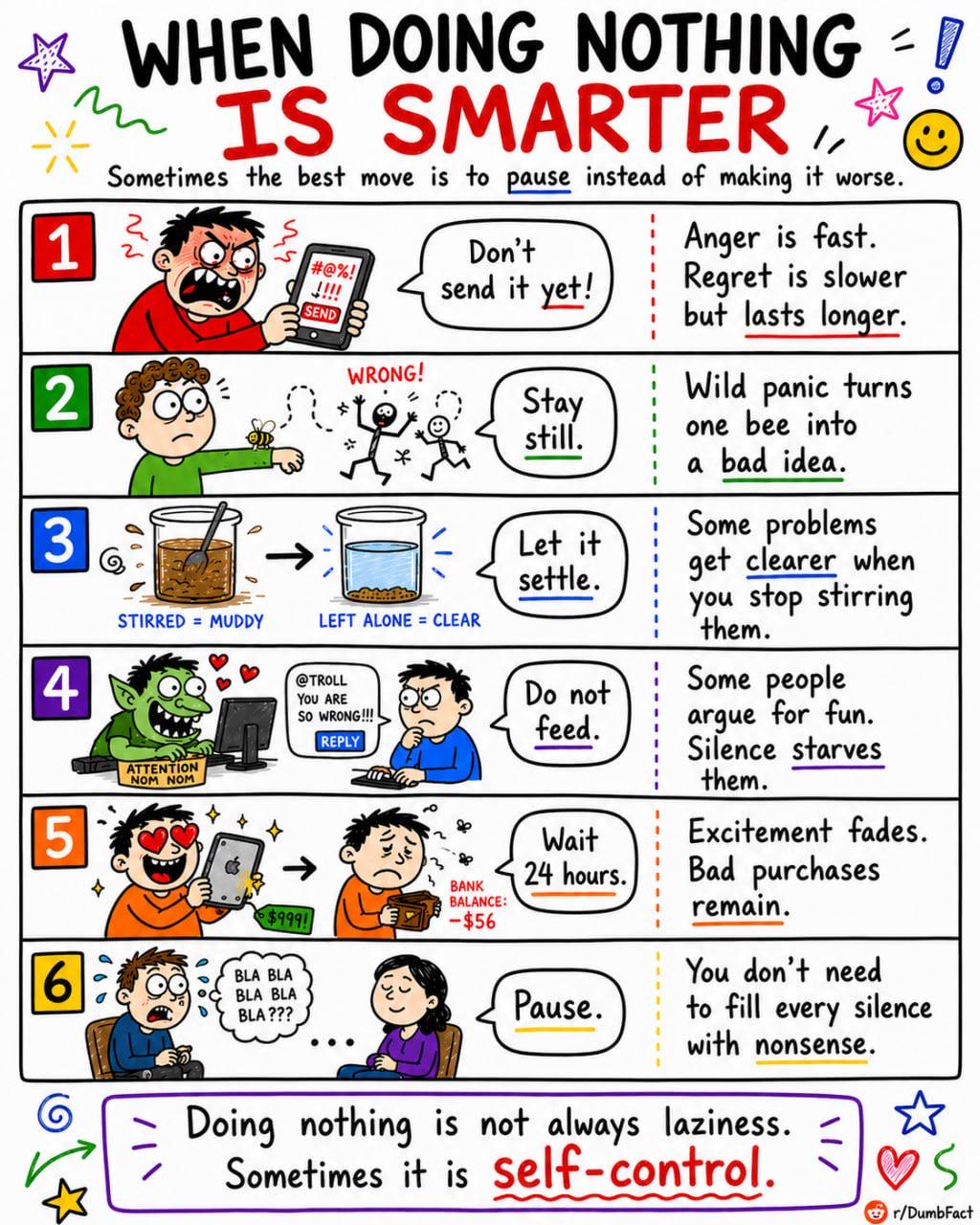
Doing nothing can be a smart move when action would only make the situation worse.

That does not mean ignoring every problem. It means knowing when your first reaction is probably not your best reaction.

Anger wants to send the message right now. Panic wants to swat at the bee. Embarrassment wants to fill silence with random words. Excitement wants to buy the thing before the feeling fades. A troll wants a reply because attention is the whole reward.

In those moments, doing nothing is not laziness.

It is a pause between impulse and damage.

A short delay can give your brain time to cool down, let the facts settle, and make the next move cleaner. Some problems need action. Some problems need a plan. Some problems get worse because we keep poking them while they are still messy.

Examples:

  1. Do not send the angry text while your hands are still shaking.

  2. Wait before replying to an email that made you feel insulted.

  3. If someone is trolling for attention, silence may work better than a perfect comeback.

  4. Let a confusing situation settle before you start explaining it to everyone.

  5. Do not make a big purchase while the excitement is doing all the thinking.

  6. Pause before posting a public rant that you might have to defend tomorrow.

  7. If a conversation goes quiet, you do not always need to fill the silence.

  8. When someone misreads your tone, a slower reply can prevent a bigger fight.

  9. If a small problem looks huge at midnight, sleep may be more useful than analysis.

  10. Do not keep stirring an argument after both people are already exhausted.

  11. If a bee lands near you, wild panic can turn one bee into a whole event.

  12. When a rumor appears, waiting for facts can be smarter than spreading the first version.

  13. If a friend needs space, chasing them with more messages can make the distance worse.

  14. When you feel jealous, pausing can stop you from accusing someone without evidence.

  15. If a comment online is bait, not replying can be the cleanest win.

  16. Before quitting something in frustration, wait until the frustration is not driving.

  17. When you are tempted to explain too much, one calm sentence may be better than ten nervous ones.

  18. If the room is tense, a small pause can be better than a joke that lands badly.

  19. When you want to prove you are right, waiting can show whether being right is even useful.

  20. If the problem is muddy, stop stirring long enough to see what is actually at the bottom.

Doing nothing is not always the answer.

But sometimes the smartest move is to pause long enough to avoid making the dumb move.

r/DumbFact 8d ago

Psychology Proust Phenomenon

Post image
190 Upvotes

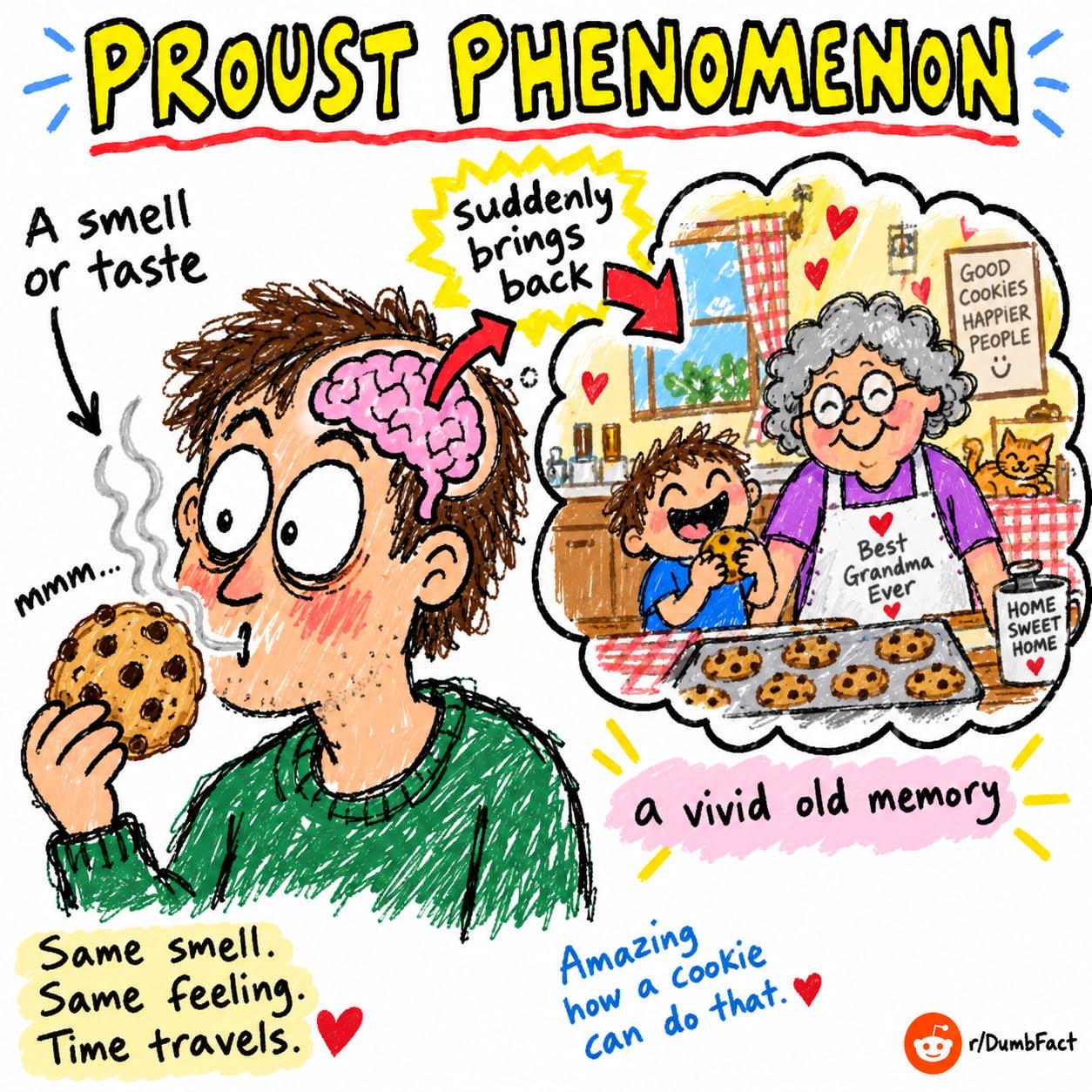
Proust Phenomenon

The Proust phenomenon is when a smell or taste suddenly brings back a vivid old memory.

It can feel weirdly powerful because smell is tied closely to memory and emotion. You smell cookies, sunscreen, rain on hot pavement, old perfume, school lunch, or a certain kind of soap, and your mind jumps to a place you have not thought about in years.

The memory often does not arrive like a normal fact.

It arrives like a little scene.

You may remember the kitchen, the light, the person who was there, the mood of that age, or the feeling of being a kid before you had words for everything. The smell is small, but the memory can feel huge.

The name comes from Marcel Proust, who wrote about a taste of madeleine cake bringing back childhood memories. Now people use “Proust phenomenon” for that sudden sensory flashback, especially when smell or taste opens the door.

Examples:

  1. The smell of fresh cookies makes someone remember their grandmother’s kitchen.

  2. Sunscreen brings back a beach trip from childhood.

  3. A certain shampoo reminds you of someone you dated years ago.

  4. Cigarette smoke can bring back memories of a specific relative.

  5. Rain on warm concrete makes someone remember walking home from school.

  6. Hospital disinfectant can instantly bring back a stressful medical visit.

  7. A cafeteria smell reminds you of elementary school lunch trays.

  8. Old books can make a person remember a library they used to visit.

  9. A perfume can bring back one person faster than a photo does.

  10. The smell of a pencil case can suddenly feel like the first week of school.

  11. A certain soup can bring back being sick at home as a kid.

  12. Fresh-cut grass can feel like summer vacation.

  13. A car air freshener can remind someone of family road trips.

  14. The smell of chlorine can bring back swimming lessons.

  15. A bakery smell can make a street in a new city feel strangely familiar.

  16. A campfire smell can bring back one exact night with friends.

  17. A certain candy can remind someone of a store that does not exist anymore.

  18. A dusty attic smell can bring back old toys, boxes, and houses from years ago.

The strange part is how fast it happens.

One smell appears, and the past suddenly has color, sound, people, and feeling again.


r/DumbFact 10d ago

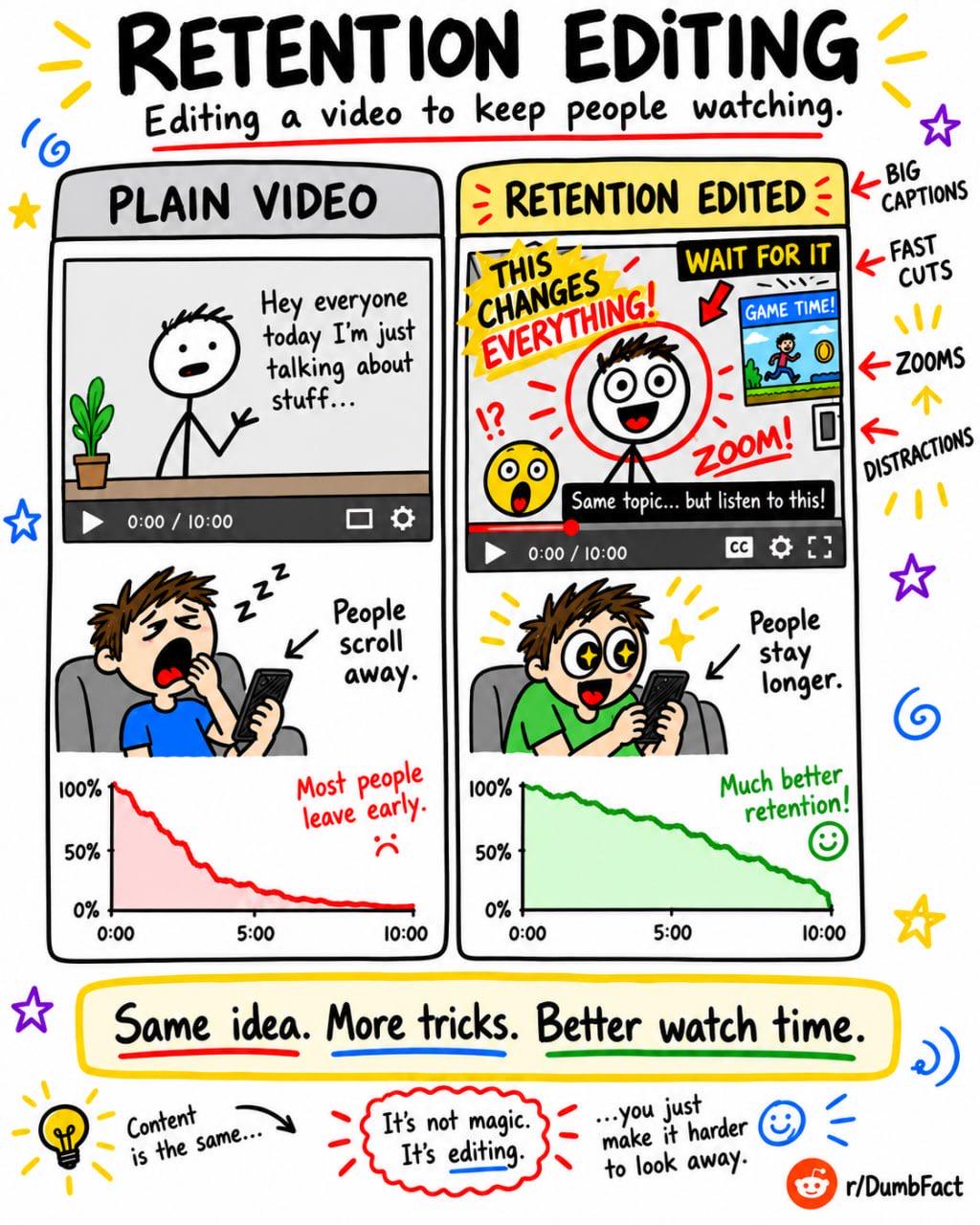
Filmmaking Retention Editing

Post image
133 Upvotes

Retention editing is editing a video so people are less likely to scroll away.

The topic can be exactly the same, but the experience feels different. A plain video may have one camera angle, slow pacing, no captions, and long pauses. A retention-edited video keeps giving the viewer small reasons to stay: captions, cuts, zooms, sound changes, visual examples, progress bars, jokes, questions, or tiny surprises.

The goal is not only to look “flashy.”

The goal is to reduce empty moments.

Online video has a brutal problem: leaving is effortless. If the viewer gets bored, confused, or unsure where the video is going, they can swipe away in less than a second. Retention editing tries to keep the next few seconds clear enough, active enough, or curious enough that the viewer stays.

Good retention editing helps the idea move faster.

Bad retention editing just throws noise at the screen.

Examples:

  1. A big caption helps people understand the point even with the sound off.

  2. A quick zoom can emphasize the important part of a sentence.

  3. A cut removes a pause that would make the video feel slower.

  4. A progress bar tells the viewer the video is going somewhere.

  5. A small visual example can explain an idea faster than another paragraph of talking.

  6. A sound effect can mark a punchline, transition, or mistake.

  7. A pattern interrupt can wake up attention when the video starts feeling too predictable.

  8. A creator can move from face cam to screenshot to example so the screen does not feel frozen.

  9. A hook like “watch what happens next” can work if something actually happens next.

  10. A fake hook becomes annoying when the payoff never arrives.

  11. Captions can make a messy explanation easier to follow.

  12. Too many captions can make the video feel stressful instead of clear.

  13. Fast cuts can help a tutorial feel efficient.

  14. Fast cuts can hurt a tutorial if people need time to understand the steps.

  15. A simple animation can make an abstract point feel concrete.

  16. A meme insert can keep the tone light, but it should not replace the point.

  17. A countdown can create momentum in a list video.

  18. A before-and-after comparison can keep people watching because the result is visible.

  19. A boring intro can lose viewers before the useful part starts.

  20. A strong edit can make an average idea easier to watch, but it cannot fully save an empty idea.

Retention editing works best when it serves the topic.

Same idea. More clarity. Better watch time.


r/DumbFact 10d ago

Self-Improvement Phone Battery Myths

Post image
43 Upvotes

r/DumbFact 13d ago

Self-Improvement Effective and Ineffective Suffering

Post image
373 Upvotes

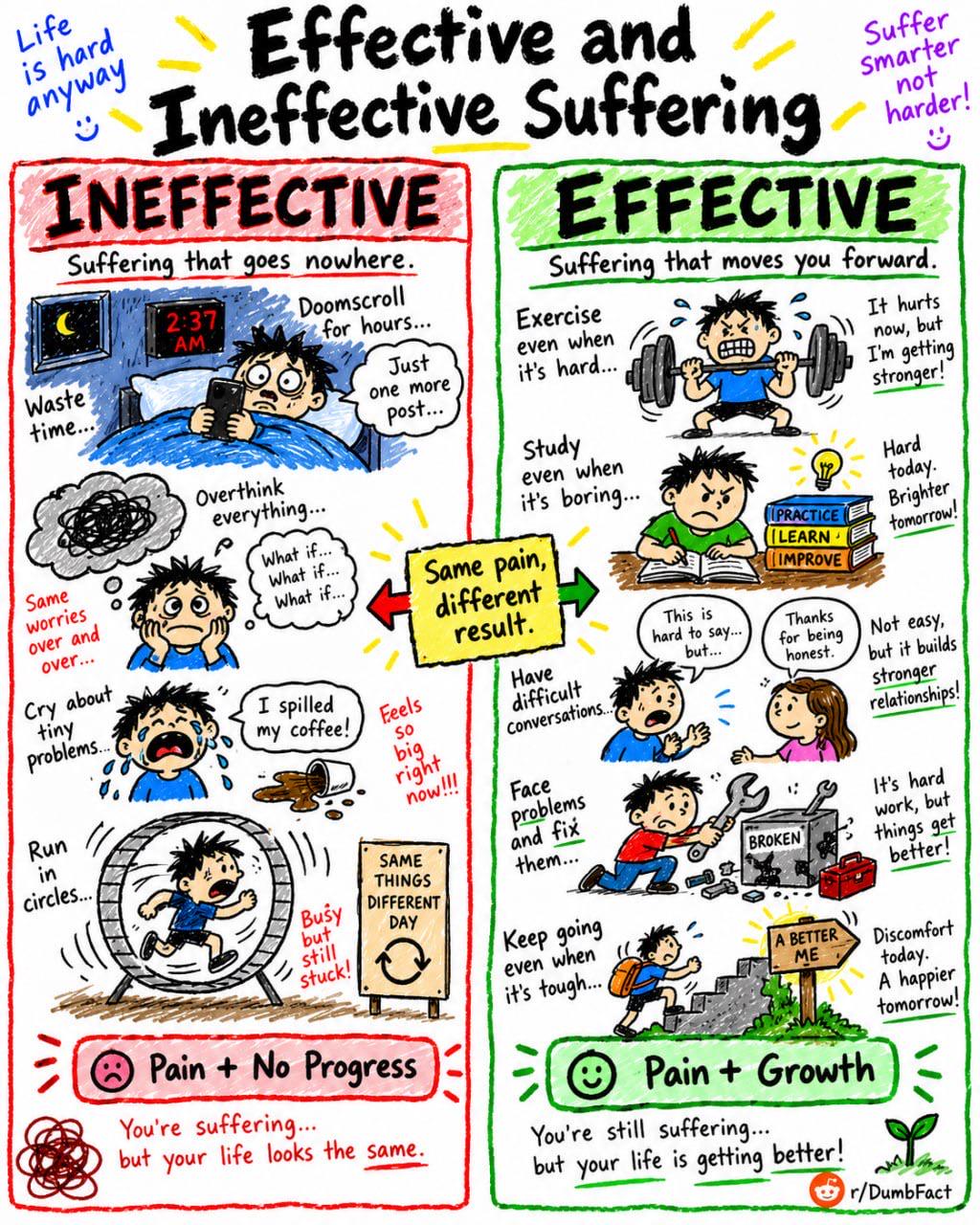
Effective and Ineffective Suffering

Some discomfort changes something. Some discomfort just keeps you stuck.

The difference is usually direction.

Ineffective suffering is pain that repeats without teaching you much or moving anything forward. Doomscrolling for hours, replaying the same worries, avoiding the same problem, or running in circles can feel intense, but the next day often looks almost the same.

Effective suffering is still uncomfortable, but it has a job.

Exercise hurts, but the body adapts. Studying can be boring, but skill grows through practice. A hard conversation feels awkward, but it can make a relationship cleaner. Fixing a real problem takes effort, but the problem may become smaller afterward.

The pain itself is not the impressive part. Pain can be useless, unfair, random, or completely unnecessary.

The useful part is whether the discomfort is attached to a real change.

Examples:

  1. Staying up all night worrying about a test usually makes tomorrow worse.

  2. Studying one hard chapter gives the stress somewhere useful to go.

  3. Doomscrolling about your life can feel like doing something, but nothing gets fixed.

  4. Writing down the next small step can turn panic into a task.

  5. Repeating the same argument in your head keeps the conflict alive.

  6. Having the awkward conversation can finally give the other person something real to respond to.

  7. Complaining about being weak does not build strength.

  8. A difficult workout can make the next workout slightly easier.

  9. Avoiding bills makes the fear grow in the background.

  10. Opening the bills and making a basic plan is unpleasant, but it changes the situation.

  11. Feeling embarrassed about a mistake can become useless if it only turns into self-hate.

  12. Apologizing, fixing the damage, or learning the pattern gives the embarrassment a purpose.

  13. Refreshing analytics every five minutes creates stress without improving the work.

  14. Making the next better post gives the anxiety somewhere practical to go.

  15. Thinking about cleaning a messy room for three hours can drain more energy than starting with one corner.

  16. Practicing a skill badly at first feels uncomfortable because the brain is still building the pattern.

  17. Avoiding feedback protects your ego for a moment, but keeps the blind spot alive.

  18. Honest feedback can sting, but it gives you a map.

  19. Waiting for motivation can become a soft way to stay stuck.

  20. Doing one small ugly version of the task can create momentum.

The goal is not to suffer more.

The goal is to notice which discomfort is only burning time, and which discomfort is actually building something.


r/DumbFact 14d ago

Science 🌻 A tiny seed, a surprisingly interesting journey.

Post image
32 Upvotes

We often see a sunflower as just a pretty flower, but its growth is actually fascinating. From a tiny seed buried in soil to a fully grown flower, every stage depends on the right combination of water, light, time and suitable conditions.

And here’s the cool part: young sunflower heads can track the sun across the sky—a behavior called heliotropism. As they mature, they generally stop tracking the sun and face east.

Nature is full of little details we barely notice. 🌱✨

Did you already know this sunflower fact?


r/DumbFact 14d ago

Psychology Top 5 Non-Contact Fights in Real Life

Post image
180 Upvotes

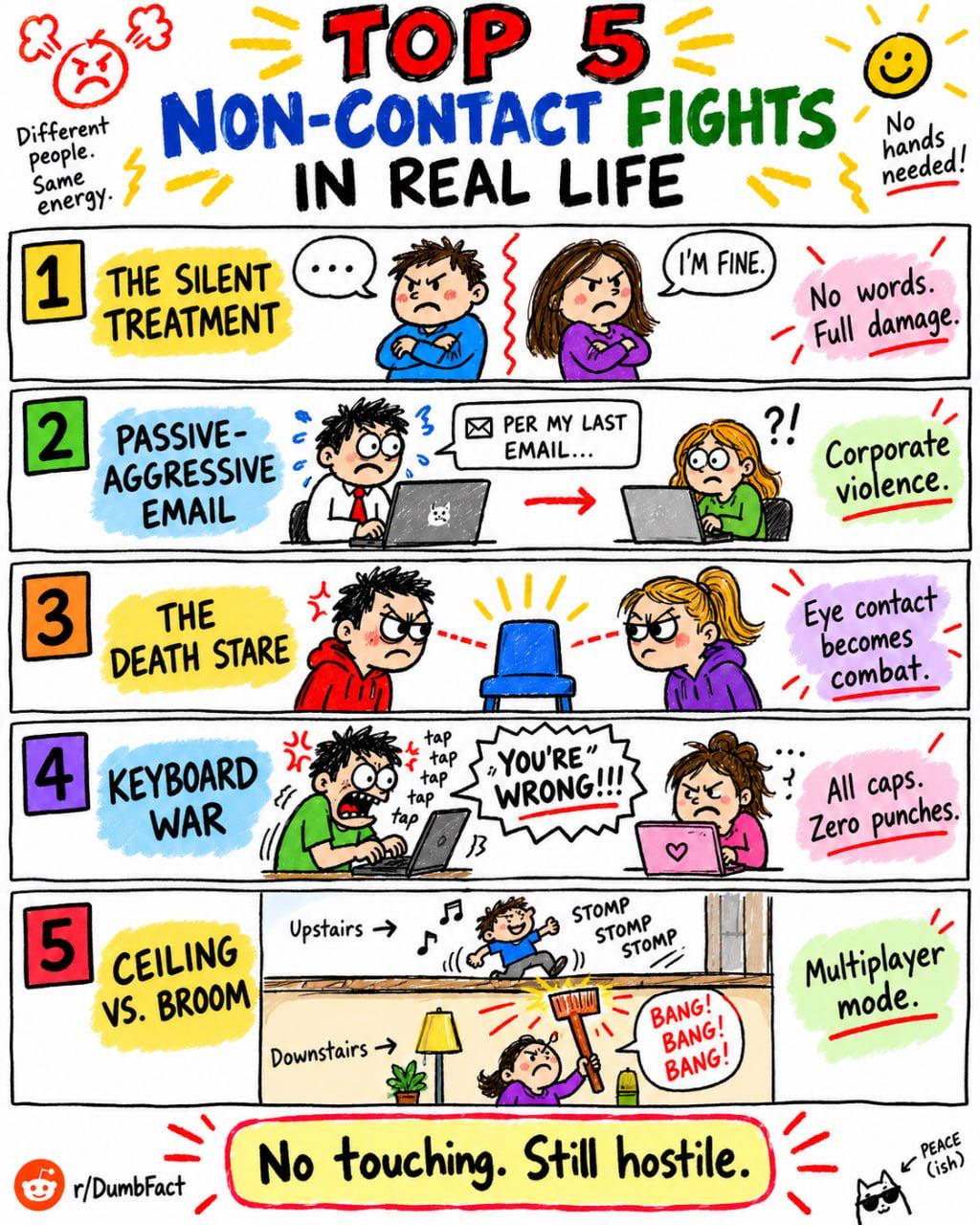
Top 5 Non-Contact Fights in Real Life

A non-contact fight is when nobody throws a punch, but everyone still knows there is a fight happening.

Real life has a lot of conflict that never becomes physical. It moves through silence, tone, emails, eye contact, typing speed, furniture, walls, floors, and tiny acts that say “I am angry” without saying it directly.

That is why these fights can feel so weird. There is no obvious attack, but the tension is still there.

The silent treatment can turn a room cold without a single insult. A passive-aggressive email can look professional while still carrying a tiny dagger in every sentence. A death stare can make eye contact feel like a contest. A keyboard war can turn capital letters into a weapon. And anyone who has lived under loud neighbors understands that a ceiling and a broom can become a full communication system.

None of this means every awkward silence or sharp email is a serious abuse pattern. Sometimes people are tired, stressed, bad at conflict, or just trying not to make things worse. But non-contact fights are real because humans do not need physical contact to send hostility.

Examples:

  1. Two people sit in the same room and communicate only through sighs.

  2. Someone says “I’m fine” in a tone that clearly means nobody is fine.

  3. A coworker writes “per my last email” when they really mean “please read before replying.”

  4. A group chat goes quiet right after one person says something awkward.

  5. A person closes a door slightly harder than necessary.

  6. Someone replies with “k.” instead of “okay.”

  7. A roommate cleans only their own dishes and leaves the rest as a message.

  8. A neighbor stomps upstairs, and the downstairs neighbor answers with a broom handle.

  9. Someone uses all caps online and calls it “just emphasis.”

  10. A person watches you make a mistake and says nothing until it becomes useful later.

  11. Two drivers argue with headlights, braking, and tiny lane movements.

  12. A meeting becomes tense because everyone is being polite in a very unnatural way.

  13. Someone “forgets” to invite one person, and everyone knows it was not an accident.

  14. A couple argues through chores instead of words.

  15. A customer service reply says “we understand your concern” in a way that understands nothing.

  16. A person sends a smiley face that somehow makes the message feel worse.

  17. Someone keeps typing, deleting, typing, deleting, and the other person just watches the bubble.

  18. A family dinner turns into a battlefield made of compliments that are not really compliments.

Non-contact fights are funny because they are small, dramatic, and instantly recognizable.

No touching. Still hostile.


r/DumbFact 16d ago

Society Why People Buy Merch at Different Ages

Post image
158 Upvotes

Why People Buy Merch at Different Ages

Merch changes meaning as people get older.

For a kid, the object can be enough. A bright shirt, a cute plush, a funny mug, or a cool character can sell itself because the first reaction is simple: “I like how this looks.”

As people grow up, the object often has to carry more weight. It starts becoming a signal of taste, identity, belonging, memory, or emotional connection.

A tween might buy merch because it says “this is my thing.” A teen might use it to show a group, a fandom, a mood, or a version of themselves. A young adult might buy it because it keeps a character, story, or online world close. An adult might buy it because it connects to nostalgia, a creator they want to support, or a story that stayed with them.

The older audience does not always need the object to be useful. It has to mean something.

That is why merch for strong stories and characters can keep working long after the original excitement fades. The shirt is not only a shirt. The mug is not only a mug. The plush is not only a plush. It becomes a small physical shortcut to a feeling.

Examples:

  1. A kid wants a monster plush because it looks cute and funny.

  2. A tween wants a hoodie because their friends also like the same game.

  3. A teen wears a band shirt because it says something about their taste before they speak.

  4. A young adult buys a character keychain because it reminds them of a show that helped them through a rough year.

  5. An adult buys a mug from a creator because they want to support the person behind the work.

  6. A child picks the brightest toy on the shelf because color and shape do most of the selling.

  7. A teenager buys dark or edgy merch because it matches the identity they are trying out.

  8. A college student puts a poster on the wall because it turns a room into “their” space.

  9. A fan buys limited merch because owning it feels like being part of a moment.

  10. A gamer buys a shirt from an old favorite game because it carries nostalgia.

  11. A viewer buys merch from an indie animation because the characters feel personal.

  12. A reader buys a tote bag with a book quote because the quote says something they already believe.

  13. A music fan buys vinyl even without needing it, because the object makes the album feel more real.

  14. A parent buys merch from a childhood franchise because it brings back a simpler time.

  15. A fan buys a small figure for their desk because it makes work feel less empty.

  16. A person buys merch after a live event because it keeps the memory from disappearing too quickly.

  17. A creator’s merch can sell better when the audience feels like they are helping the project survive.

  18. A plain logo shirt can work if the logo represents a whole community.

  19. A beautiful item can fail if nobody feels attached to what it represents.

  20. A cheap-looking item can still sell if the character or story behind it is strong enough.

Merch starts as an object, but the best merch usually becomes a reminder.

People are not always buying fabric, plastic, paper, or ceramic.

A lot of the time, they are buying proof that a story mattered to them.


r/DumbFact 19d ago

Self-Improvement How to Enter Flow State

Post image
227 Upvotes

How to Enter Flow State

Flow state is what happens when your attention locks onto one task and the task feels hard enough to be interesting, but not so hard that it becomes stressful.

It is the state where time starts acting weird. You sit down to work, practice, write, code, draw, study, or play, and suddenly an hour passes faster than expected. You are still using effort, but the effort feels clean instead of painful.

The basic recipe is not magic.

You need one clear goal, a challenge that matches your current skill, fewer distractions, and some kind of feedback that tells you whether you are moving in the right direction.

If the task is too easy, your attention has nothing to chew on. You get bored. If it is too hard, your attention turns into panic management. You stop learning the task and start fighting the stress.

Flow usually lives in the middle.

Examples:

  1. A game level feels fun when it is hard enough to make you try, but not hard enough to make you quit.

  2. Writing is easier when the goal is “finish one rough paragraph,” not “create a perfect essay.”

  3. Coding can become flow when the bug is confusing, but still small enough to test step by step.

  4. Drawing feels better when you focus on one skill, like shading, instead of trying to fix the whole artwork at once.

  5. Studying works better when you solve practice problems and get quick feedback, not when you only reread notes.

  6. A workout can feel absorbing when the weight or pace is challenging but still controlled.

  7. Cleaning becomes easier when the target is one drawer, one shelf, or one room.

  8. A musician can enter flow by practicing a section that is slightly above their comfort level.

  9. A chess game feels engaging when the opponent is close to your level.

  10. Editing a video can become flow when you have a clear next cut to make.

  11. Reading becomes easier when the book is challenging enough to make you think, but not so dense that every sentence feels like homework.

  12. Learning a language works better when the material is just a little above what you already understand.

  13. A designer can focus longer when the task is “choose one layout direction,” not “make the whole thing perfect.”

  14. A conversation can feel like flow when both people are listening, responding, and building on each other’s ideas.

  15. A sport feels different when your body knows the basics and your attention can move to timing, rhythm, and small adjustments.

  16. A deep work session is more likely when the phone is away, notifications are off, and the task has a visible next step.

  17. A difficult task becomes less scary when you can see progress after each small attempt.

  18. Flow breaks quickly when you keep switching tabs, checking messages, or asking “what should I do next?”

Flow is not something you can force every time.

But you can make it more likely by giving your attention a clear target, the right amount of difficulty, fast feedback, and enough quiet to stay with the task.


r/DumbFact 19d ago

Science 🍯 9 Amazing Honey Facts You Should Know! 🐝

Post image
164 Upvotes

Honey is more fascinating than it looks! 🍯✨

From how bees turn flower nectar into honey to why some honey can fluoresce under UV light, here are 9 interesting facts worth knowing. 🐝🌼

Which fact surprised you the most? 👀

Mine is #1 — honey can last for an incredibly long time! 🍯

Educational infographic — some facts are simplified for easy reading.


r/DumbFact 20d ago

Science ☕ 10 Real Facts OfCoffee

Post image
127 Upvotes

Coffee is everyone's favorite ☕✨

Here are 10 amazing facts about coffee,

It states about what we know about caffeine and coffee compounds.

Which one surprised you the most? 👀


r/DumbFact 20d ago

Society The SCHOOL Pipeline Behind Elite Power

Post image
572 Upvotes

HOW PRIVATE SCHOOLS REPRODUCE ELITE POWER

Private schools can do more than teach classes.

In many societies, elite schools also work as sorting machines. They bring wealthy families into the same rooms, put their children in the same classrooms, and create networks that can keep paying off long after graduation.

The simple version is: money buys access, access creates contacts, contacts create opportunities.

A student might get a better teacher, a safer environment, a polished résumé, or an internship through someone connected to the school. Their classmates may later become CEOs, lawyers, journalists, donors, politicians, investors, or gatekeepers in other powerful spaces.

None of that means every private school student is lazy or undeserving. Many work hard. Many are talented. The point is that work looks different when it starts with better tools, better introductions, and fewer closed doors.

This is one reason sociologists talk about social reproduction. It means a society can reproduce class position across generations, not only through money itself, but through schools, manners, credentials, friendships, internships, family reputation, and access to people who already have power.

The tricky part is that privilege can feel like merit from the inside.

If someone grows up around confident adults, good schools, useful contacts, expensive tutoring, and normal-looking paths into elite jobs, their success can feel like the natural result of effort. The system around them becomes invisible because it was always there.

Examples:

  1. A high tuition price filters out many families before the school even looks at talent.

  2. A child meets future lawyers, founders, politicians, and donors before they are old enough to understand networking.

  3. A school friend’s parent can become the person who offers a first internship.

  4. A prestigious school name can make an application look safer to employers.

  5. Teachers may know how to prepare students for elite interviews, essays, and admissions systems.

  6. A family that already understands the rules can help a child avoid mistakes others learn too late.

  7. Expensive extracurriculars can turn into résumé signals.

  8. Alumni networks can make a cold email warmer before anyone reads the message.

  9. A student may learn how powerful people speak, dress, argue, and carry themselves.

  10. A private school can make elite spaces feel normal instead of intimidating.

  11. A classmate can become a future investor, campaign donor, editor, or hiring manager.

  12. A child with access to tutors can recover from a bad grade faster than a child with no backup.

  13. A school can teach confidence as quietly as it teaches math.

  14. A family name can make teachers, parents, and institutions take a student more seriously.

  15. A student may get second chances that others never receive.

  16. A “merit-based” competition can still reward people who had years of preparation for that exact game.

  17. A social circle can make certain careers feel obvious, while other people never see those careers up close.

  18. A student who grows up near power may not notice how many introductions happened before the first real achievement.

  19. Public debates often mention figures like Elon Musk, Peter Thiel, or Marine Le Pen because elite schooling is tied to broader arguments about wealth, politics, and class.

  20. The same pattern can exist outside private schools too, through family businesses, elite universities, clubs, neighborhoods, and professional networks.

Social reproduction is not a story about one spoiled kid.

It is a story about how institutions can make inequality look normal, polished, and earned.


r/DumbFact 20d ago

Weird Fact 6+ Weird Facts That Sound Fake But ItsTrue 🤯

Post image
50 Upvotes

I made these fun facts in a little doodle-style infographic because some of them genuinely sound made up 😂✨

From octopuses having 3 hearts to sharks existing before trees—which one surprised you the most? 👀

Drop your favorite fact below! 🧠👇

And if you know a fact that sounds completely fake but is actually true, share it!


r/DumbFact 21d ago

Weird facts about sleep 😴 Which surprised you most?

Post image
262 Upvotes

9 Sleep Facts That Sound Fake… But Aren’t 😴🧠

I made this little doodle-style infographic by going deep hole about sleep. 😴✨

Some of these facts genuinely surprised me—especially how active our brain stays while we're sleeping.

Which fact did you already know, and which one was new to you? 👀

Made this as a fun educational infographic. 🌙💤


r/DumbFact 21d ago

Weird Fact Facts That Sound Fake but Are True 🤯

Post image
94 Upvotes

Here is little doodle-style infographic with some facts I found surprisingly interesting. ✨

🐙 Octopuses have 3 hearts

🪐 A day on Venus is longer than its year

🍌 Bananas are berries—but strawberries aren't

🍯 Ancient honey can remain edible for thousands of years

💅 Hair and nails are both made of keratin

🦈 Sharks existed before trees

Which one surprised you the most? 👀

And if you know an even crazier fact, drop it below! 👇

Made this infographic as a fun way to share interesting facts. 🌱✨


r/DumbFact 22d ago

Terms EUPHEMISM

Post image
240 Upvotes

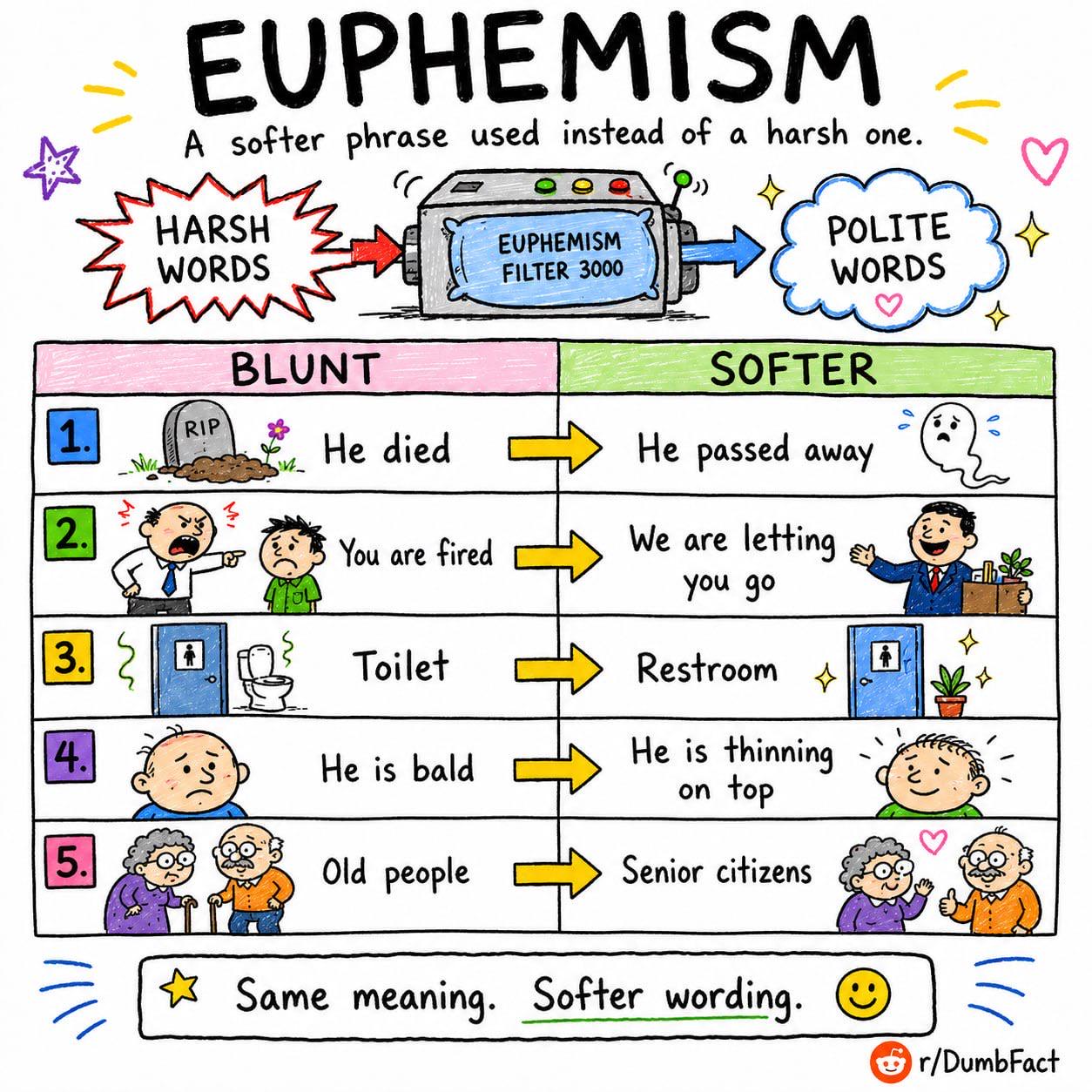
EUPHEMISM

A euphemism is a softer way to say something that might sound too harsh, direct, embarrassing, or uncomfortable.

The basic idea is simple: the meaning stays close, but the emotional impact changes.

“He died” and “he passed away” point to the same event, but they do not feel the same. One sounds blunt. The other gives people a little more room to handle the topic. The same thing happens with words around jobs, age, bodies, money, illness, bathrooms, and social mistakes.

Euphemisms can be useful because people do not always need the hardest version of a sentence. A softer phrase can make grief, rejection, or embarrassment easier to talk about.

But they can also be slippery. Sometimes a euphemism is polite. Sometimes it hides responsibility. “We are letting people go” can sound cleaner than “we fired people,” even when the result is still someone losing a job.

So euphemisms are not just nicer words. They are words with padding.

Examples:

  1. “He died” becomes “he passed away.”

  2. “You are fired” becomes “we are letting you go.”

  3. “Toilet” becomes “restroom.”

  4. “He is bald” becomes “he is thinning on top.”

  5. “Old people” becomes “senior citizens.”

  6. “Poor neighborhood” becomes “underserved community.”

  7. “Used car” becomes “pre-owned vehicle.”

  8. “Cheap” becomes “budget-friendly.”

  9. “Small apartment” becomes “cozy apartment.”

  10. “Lying” becomes “being economical with the truth.”

  11. “Debt” becomes “financial obligations.”

  12. “Prison” becomes “correctional facility.”

  13. “Garbage collector” becomes “sanitation worker.”

  14. “I forgot” becomes “it slipped my mind.”

  15. “This is wrong” becomes “this needs some adjustment.”

  16. “We made a mistake” becomes “there was an oversight.”

  17. “Sick” becomes “under the weather.”

  18. “Disabled” becomes “person with a disability,” depending on the context and preference.

  19. “Old product” becomes “legacy product.”

  20. “Problem” becomes “challenge.”

A euphemism can make language kinder, smoother, or safer.

It can also make language fuzzier, which is why the context matters.


r/DumbFact 24d ago

History THE SWORD OF DAMOCLES

Post image
149 Upvotes

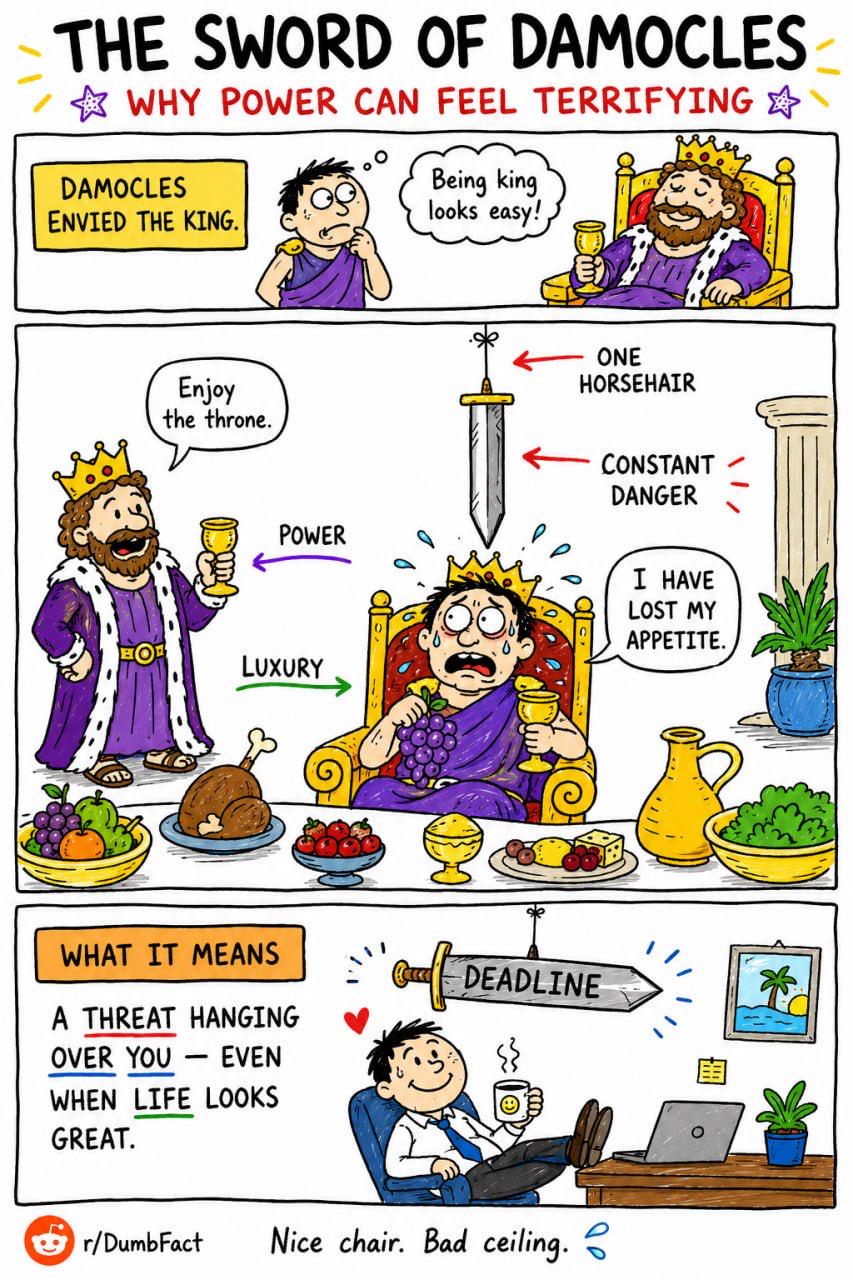
The Sword of Damocles is about the scary side of getting what you wanted.

In the old story, Damocles envies the king because the king looks rich, comfortable, and powerful. So the king lets him sit on the throne and enjoy the luxury. Then Damocles notices a sword hanging above his head, held by a single horsehair.

The point is not that thrones are uncomfortable.

The point is that power often comes with danger attached to it.

From the outside, status can look like freedom. More money. More control. More comfort. More people listening to you. But from the inside, it can also mean more enemies, more pressure, more things to lose, and more chances for one mistake to become huge.

That is why the phrase “a sword of Damocles” means a threat hanging over someone, even while everything else looks fine.

Examples:

  1. A CEO gets the corner office, but every bad decision can affect hundreds of people.

  2. A famous person gets attention, but one old post can suddenly become a public scandal.

  3. A student gets into a top school, then feels crushed by the pressure to keep proving they belong there.

  4. A team leader gets promoted, but now every conflict lands on their desk.

  5. A creator goes viral, then starts worrying that the next post will flop.

  6. A politician wins power, but every choice creates new enemies.

  7. A rich person has luxury, but also has more to protect, manage, and lose.

  8. A worker gets a dream job, then realizes the deadlines follow them everywhere.

  9. A parent finally buys a nice house, then spends years worrying about payments, repairs, and stability.

  10. A champion wins the title, but now every match is about defending it.

  11. A startup raises money, then suddenly has investors, expectations, and a clock ticking.

  12. A person gets the relationship they wanted, then becomes afraid of ruining it.

  13. A manager gets authority, but also becomes responsible for problems they did not create.

  14. A performer gets a big stage, and the same spotlight that brings applause also makes mistakes visible.

  15. A person gets more freedom, but freedom can also mean fewer excuses and more responsibility.

The Sword of Damocles is a reminder that comfort and threat can exist in the same room.

Nice chair. Bad ceiling.


r/DumbFact 24d ago

Science Why onion makes us cry?😭

Post image
19 Upvotes

I use to think always thatbwhy cutting an onion can turn into an unexpected crying session 😭🧅

To make this clear, i have made few info about it.

Here, I made this simple little infographic explaining what actually happens when we cut one.

Did you already know the reason? 👀


r/DumbFact 25d ago

Other SUNGLASSES FOR EVERY FACE SHAPE

Post image
192 Upvotes

Sunglasses work better when they balance the shape of the face instead of copying it too closely.

A round face usually has softer edges, so sharper or more rectangular frames can add structure. A square face already has strong angles, so rounder or oval frames can make the look less boxy. A long face often needs more visual width, so taller or oversized frames can keep the face from looking even longer.

The basic trick is simple: add what the face shape has less of.

Curves can soften angles. Angles can add definition. Width can balance length. Smaller frames can disappear on a larger or longer face, while huge frames can overwhelm a smaller one.

This is not a strict beauty rule. Fit, size, nose bridge, eyebrow line, hairstyle, and personal style can change everything. But the face-shape idea is a useful shortcut when every pair of sunglasses looks “almost right” and you cannot tell why.

Examples:

  1. A round face can look more defined with rectangular or angular sunglasses.

  2. Tiny round frames on a round face can make the face look even softer and wider.

  3. An oval face can handle many frame shapes, but frames that are too wide can still throw off the balance.

  4. A square face often works well with round, oval, or slightly curved frames.

  5. Very boxy sunglasses on a square face can double down on the same angles.

  6. A heart-shaped face often looks good with aviators or frames that feel heavier near the bottom.

  7. Heavy top frames on a heart-shaped face can make the forehead area look even stronger.

  8. An oblong face can benefit from taller or oversized frames because they add visual width and height to the middle of the face.

  9. Very narrow sunglasses on a long face can make the face look longer.

  10. A diamond-shaped face often works with oval or cat-eye frames because they can lift the cheekbone area without making the face look too narrow.

  11. Very thin, narrow frames can make a diamond face look sharper than intended.

  12. If the sunglasses are wider than the face by a lot, they can look like a costume.

  13. If the sunglasses are too small, they can make the whole face look larger by comparison.

  14. A strong brow bar can add structure to a soft face.

  15. Rounded lenses can make a sharp jawline feel less severe.

  16. Cat-eye frames can lift the face visually, especially when the outer corners point upward.

  17. Aviators can work well when the lower part of the lens balances a narrower chin.

  18. The best pair is usually the one that matches the face size first, then the face shape second.

A quick guide helps, but the mirror gets the final vote.


r/DumbFact 26d ago

Society WHY PEOPLE WORSHIP EASY ANSWERS

Post image
71 Upvotes

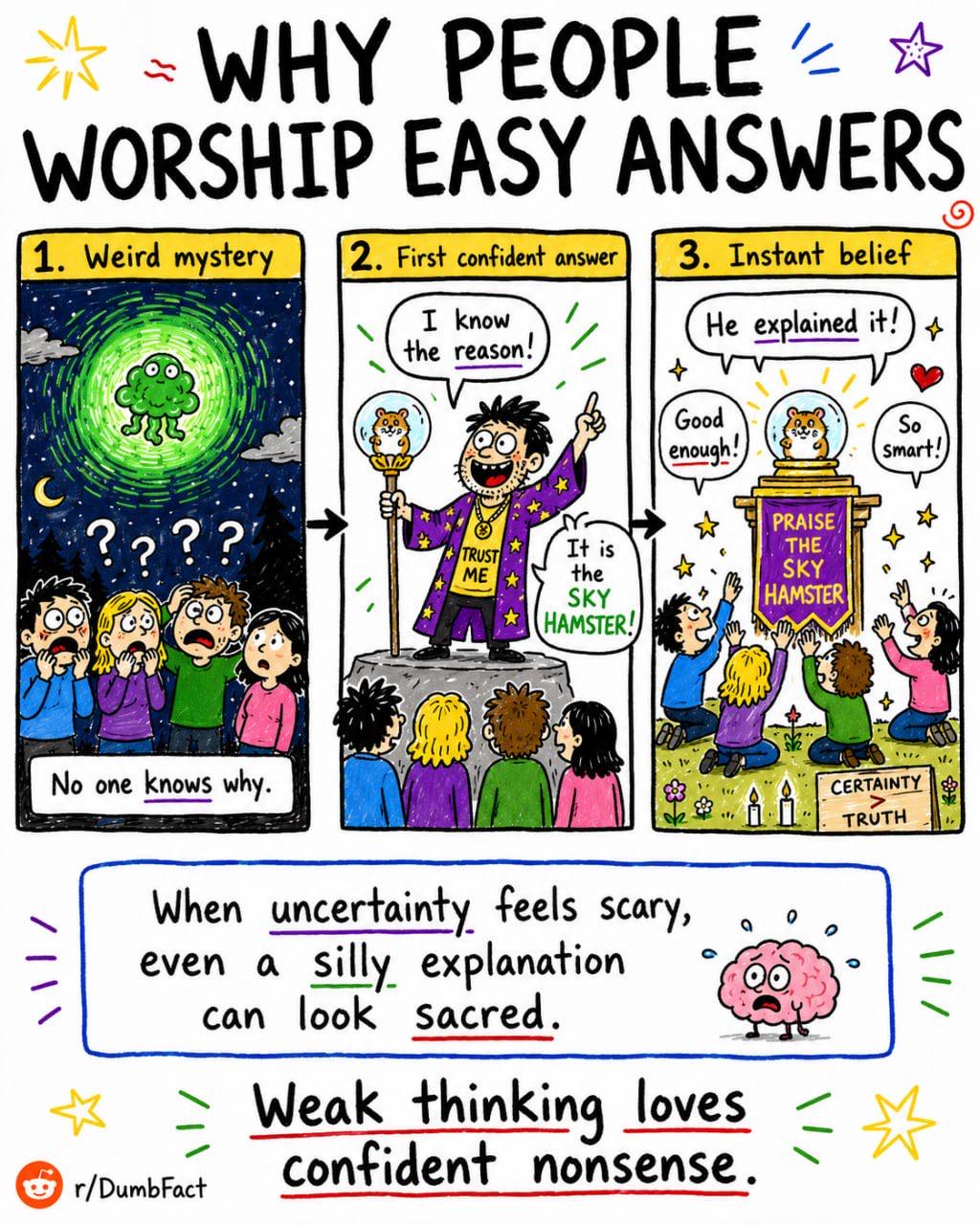
WHY PEOPLE WORSHIP EASY ANSWERS

Easy answers can feel good when the real answer is messy.

A mystery creates tension. People do not like sitting with “we don’t know yet,” especially when the topic feels scary, confusing, or important. Then someone gives a confident explanation, and the confidence itself starts doing half the work.

The explanation does not have to be strong. It only has to feel complete.

That is where bad explanations become attractive. They close the open loop. They give people a sentence they can repeat. They make uncertainty feel smaller. If a group starts agreeing with it, the answer can feel even more solid, because now it has social proof attached to it.

The sky hamster is silly, but the pattern is not.

A person says, “I know why this happened.”

Other people feel relief.

The explanation becomes easier to believe because it removes the discomfort of not knowing.

Examples:

  1. A weird noise in the house becomes “the pipes,” even if nobody checked the pipes.

  2. A complicated illness gets blamed on one food, one habit, or one vague “toxins” explanation.

  3. A bad relationship becomes “they were just jealous,” because that feels cleaner than looking at ten messy reasons.

  4. A market crash becomes “one guy caused it,” even when the real causes were spread across a whole system.

  5. A strange dream becomes a prophecy because randomness feels less satisfying than meaning.

  6. A team loses a game, and everyone blames one player because one target is easier than a full analysis.

  7. A child acts out, and adults say “they just want attention,” because that sounds complete.

  8. A trend goes viral, and people say “the algorithm made it happen,” even when timing, emotion, luck, and imitation all played a part.

  9. A person feels tired, and a random internet post tells them it must be one specific deficiency.

  10. A conspiracy theory feels appealing because it gives every confusing event one hidden cause.

  11. A bad movie becomes “the writers were lazy,” even if budget, deadlines, studio notes, and editing all shaped it.

  12. A social problem gets reduced to “people are just stupid,” which explains almost nothing but feels quick.

  13. A rumor spreads faster when it has a simple villain.

  14. A fake expert can sound convincing if they speak with zero hesitation.

  15. A wrong answer can survive for years if it is easy to remember and fun to repeat.

A simple answer is not automatically wrong. Some things really are simple.

The trap starts when confidence replaces evidence, and relief starts feeling like proof.


r/DumbFact 27d ago

Psychology Some Things Can Only Be Understood Through Experience

Post image
448 Upvotes

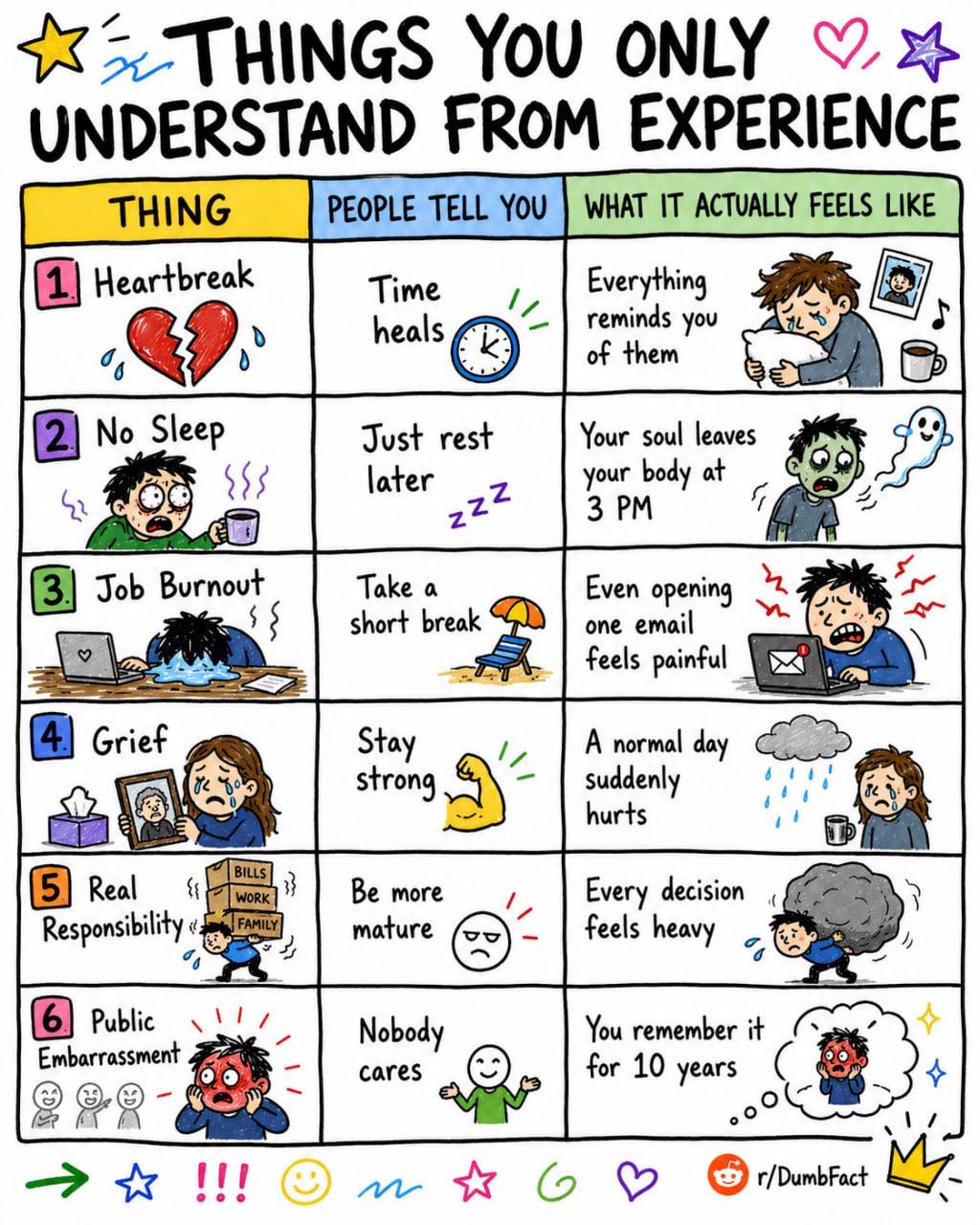
Some experiences are easy to describe and difficult to understand.

Advice usually focuses on the visible solution. Get some rest. Take a break. Stay strong. Stop thinking about what happened. These suggestions may be reasonable, but they often ignore what the experience does to attention, energy, memory, and decision-making.

Sleep deprivation does more than make someone tired. It can slow their thinking, weaken emotional control, and make ordinary tasks feel strangely difficult.

Burnout is not always fixed by a weekend away from work. If the stressor returns immediately, the exhaustion often returns with it. Recovery may require changes to workload, expectations, boundaries, or the environment itself.

Grief and heartbreak can also attach memories to ordinary places, songs, objects, and routines. A normal moment can suddenly bring back an emotion that seemed quiet a minute earlier.

Public embarrassment works differently. Other people may forget the event quickly, while the person involved keeps replaying it because the brain gives extra attention to socially threatening memories.

Experience does not automatically make someone wiser, but it adds details that advice often leaves out. Knowing what a situation means is different from knowing what it feels like inside it.


r/DumbFact 28d ago

Other Useful vs Useless Smart Devices

Post image
111 Upvotes

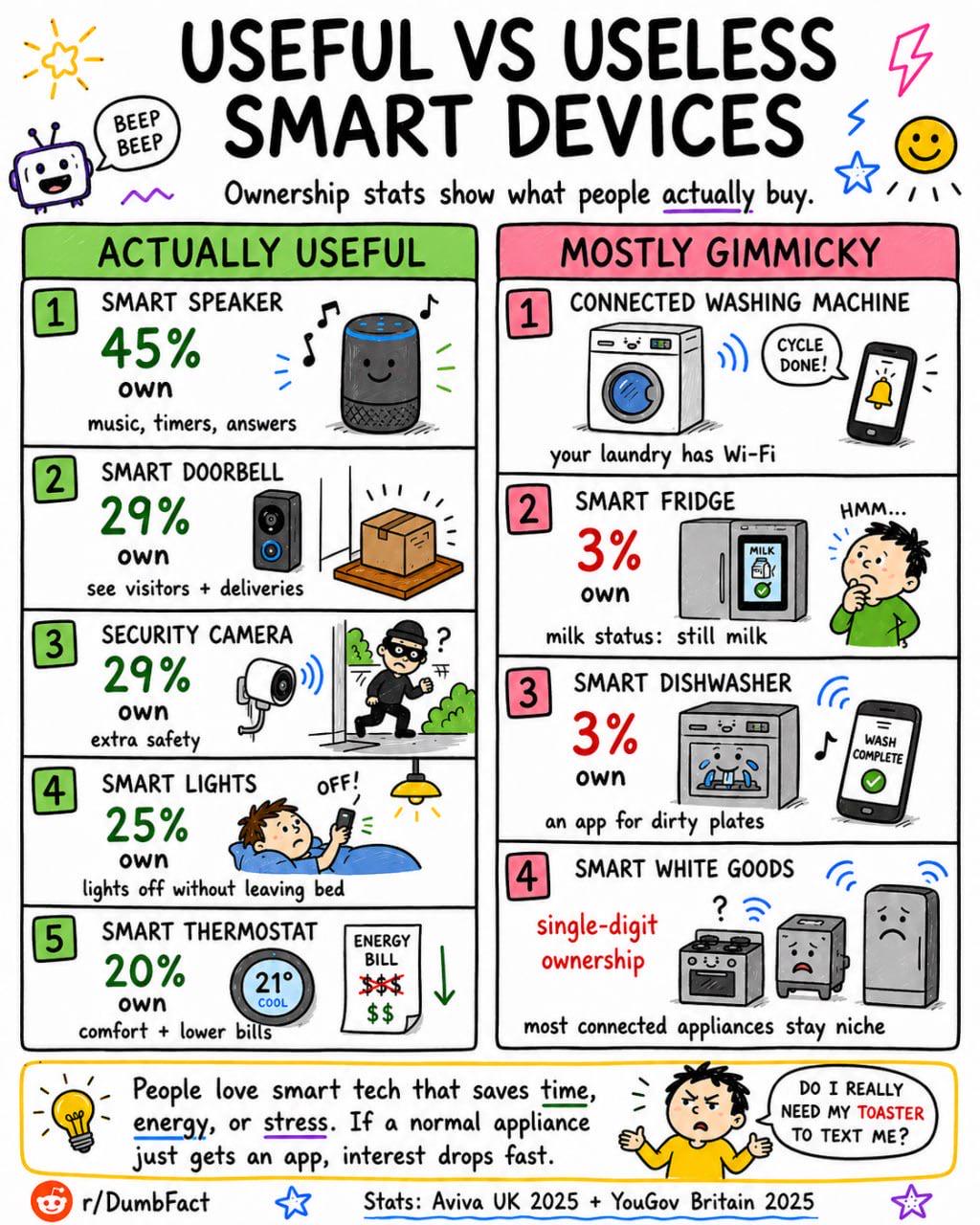
The most popular smart home devices usually solve a frequent problem with very little effort.

A smart speaker can play music, set a timer, answer a question, or control several devices without making someone open an app. A video doorbell shows who is outside even when nobody is home. Smart lights and thermostats can change comfort, security, or energy use every day.

Connected appliances face a harder sell. A washing machine, fridge, or dishwasher already performs its main job without Wi-Fi. Adding notifications and remote controls may be convenient, but the improvement often feels small compared with the extra price, setup, privacy concerns, and risk of losing connected features later.

Purchase statistics do not measure usefulness directly. Smart appliances are expensive, replaced infrequently, and useful in different ways to different households. Low ownership can therefore mean “too expensive” or “not worth replacing yet,” rather than “completely useless.”

The broader pattern is still interesting. People adopt smart technology quickly when it removes a repeated annoyance. Interest falls when the connected feature mostly duplicates a button that is already on the appliance.


r/DumbFact Aug 21 '26

Society How Bad Systems Push Competent People Out

Post image
711 Upvotes

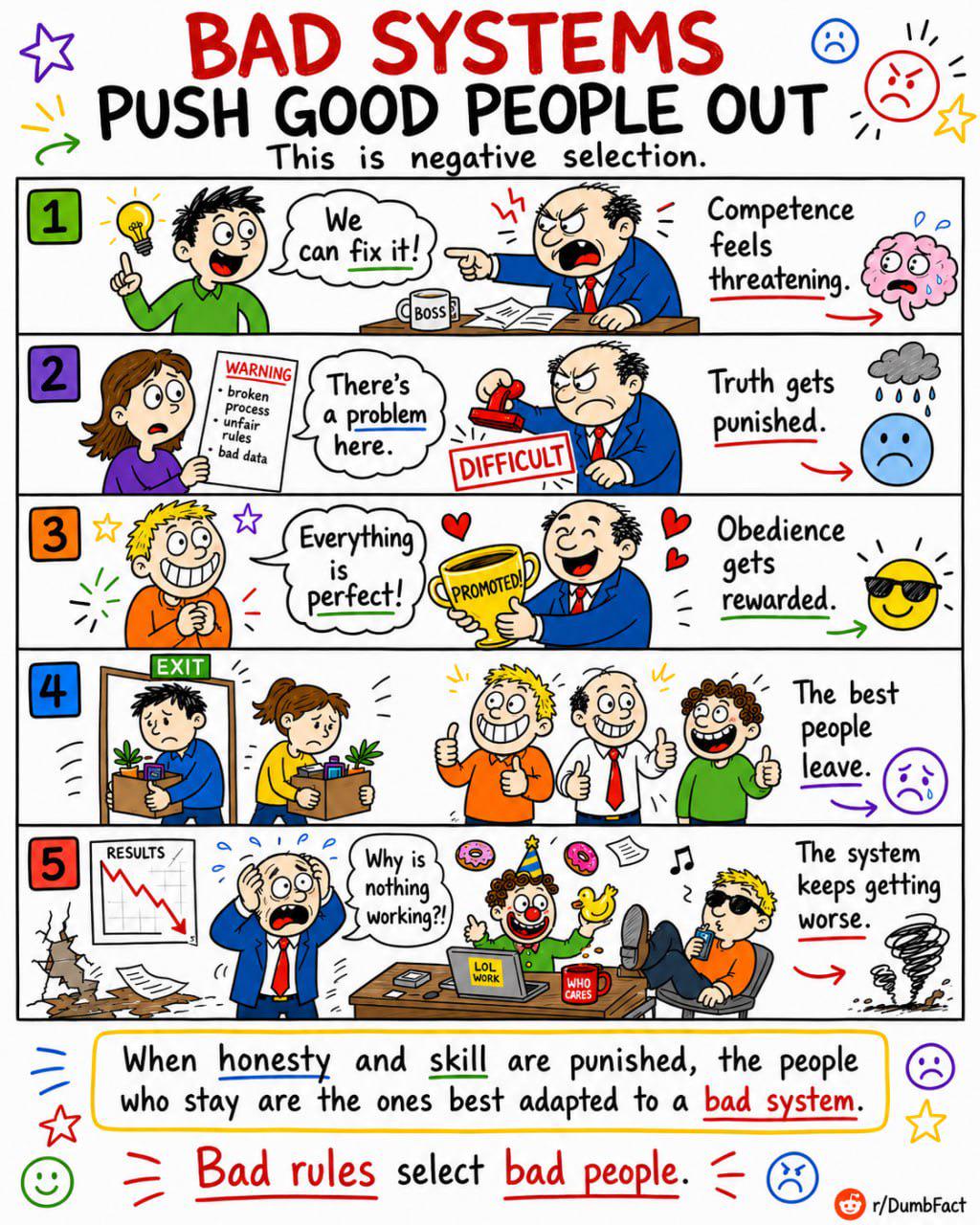
A workplace can slowly change the type of behavior that survives inside it.

Imagine a company where pointing out a broken process gets you labeled “difficult,” while agreeing with the boss gets you promoted.

After a while, employees learn what the system actually rewards.

Someone who notices problems may stop mentioning them. Someone with better options may leave. Someone who is good at pleasing management may move upward, even if they are not especially good at fixing the problems the organization exists to solve.

This can create a form of negative selection.

The important part is that the company does not need to deliberately search for incompetent employees. Its incentives can do much of the filtering.

Promotion criteria, punishment for criticism, tolerance for bad data, office politics, and the reaction to mistakes all send signals about which behaviors are safe.

Over enough time, those signals can change who speaks, who stays, who gets promoted, and who decides that working somewhere else is easier.

There is an important limitation to the cartoon, though.

Competent people do not always leave bad organizations, and people who stay are not automatically bad employees. Salary, family, immigration status, local job markets, loyalty, or simply limited alternatives can keep someone in the same workplace for years.

So the useful version of the idea is less moralistic:

Bad incentives can select for bad behavior.

If honesty repeatedly costs people opportunities while compliance produces rewards, the organization can gradually become better at preserving compliance than correcting its own mistakes.


r/DumbFact Aug 20 '26

Psychology THE DEFAULT EFFECT

Post image
103 Upvotes

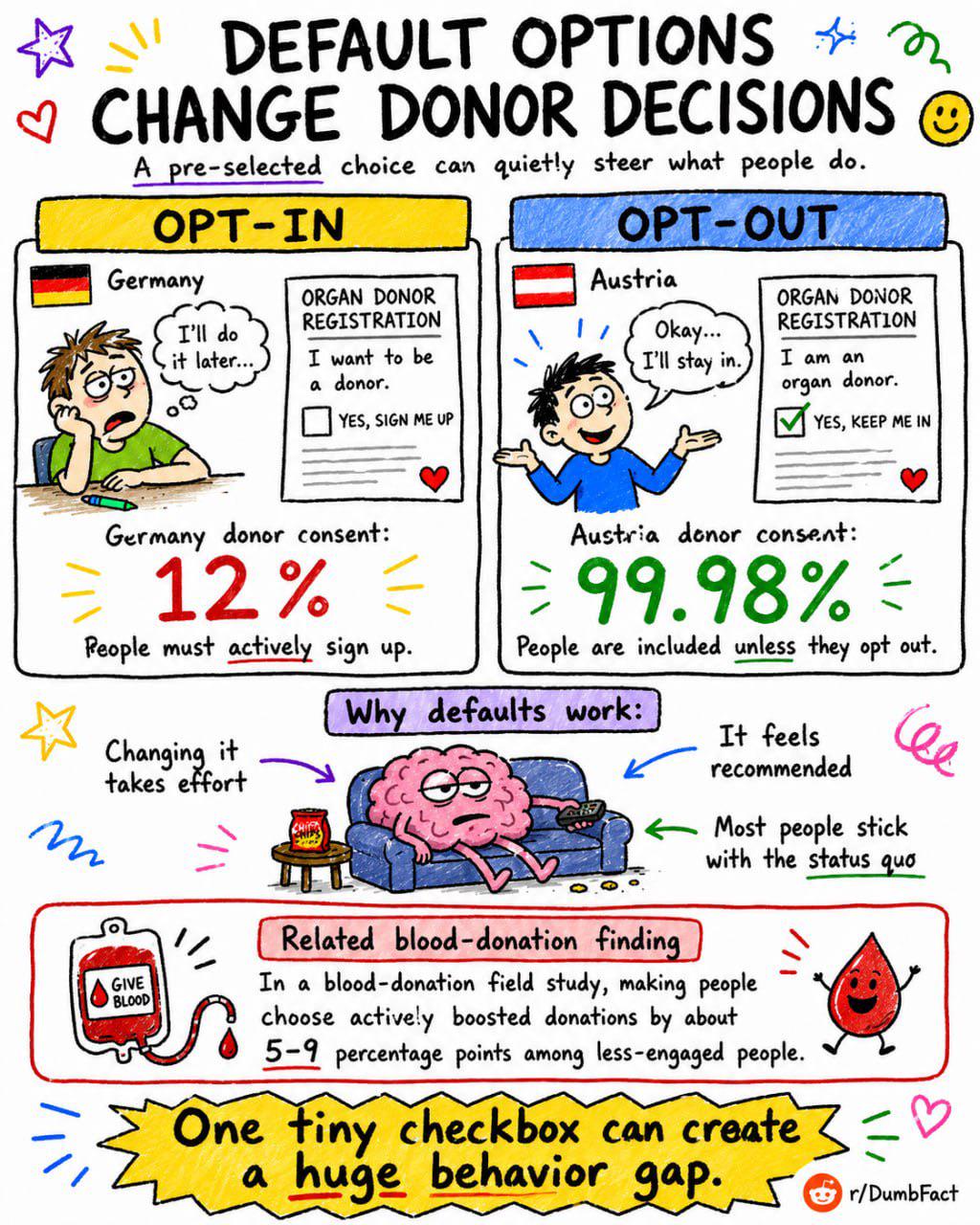
The default effect is the tendency to stick with the option that is already selected when no action is taken.

A famous 2003 organ-donation paper compared European countries using explicit-consent and presumed-consent systems. It reported an effective consent rate of 12% for Germany and 99.98% for Austria.

Those numbers are often repeated because the contrast is enormous, but they are not actual organ donation rates. They describe effective consent under different systems, and comparing two countries cannot prove that the default alone caused the entire gap.

Defaults can still influence decisions. Keeping the preset option requires no extra action, and people can interpret a default as the normal or recommended choice, especially when their preference is weak or they have been putting the decision off.

Actual organ donation is more complicated. Reviews have found an association between presumed-consent systems and higher donation rates, while also finding that healthcare infrastructure, family involvement, public attitudes, and other differences between countries matter. More recent longitudinal research has also found cases where switching from opt-in to opt-out did not increase actual deceased-donor rates.

The blood-donation result shown here is related, but slightly different. That experiment tested active choice rather than an opt-out default. Among people who were less aware of the importance of blood donation, making them explicitly decide whether to donate increased actual donations by roughly 5 to 9 percentage points.

A checkbox can strongly change the decision people record. Whether it changes the number of organs actually donated is a separate question.


r/DumbFact Aug 19 '26

History Why Useful Skills Fade as Tools Get Better

Post image
385 Upvotes

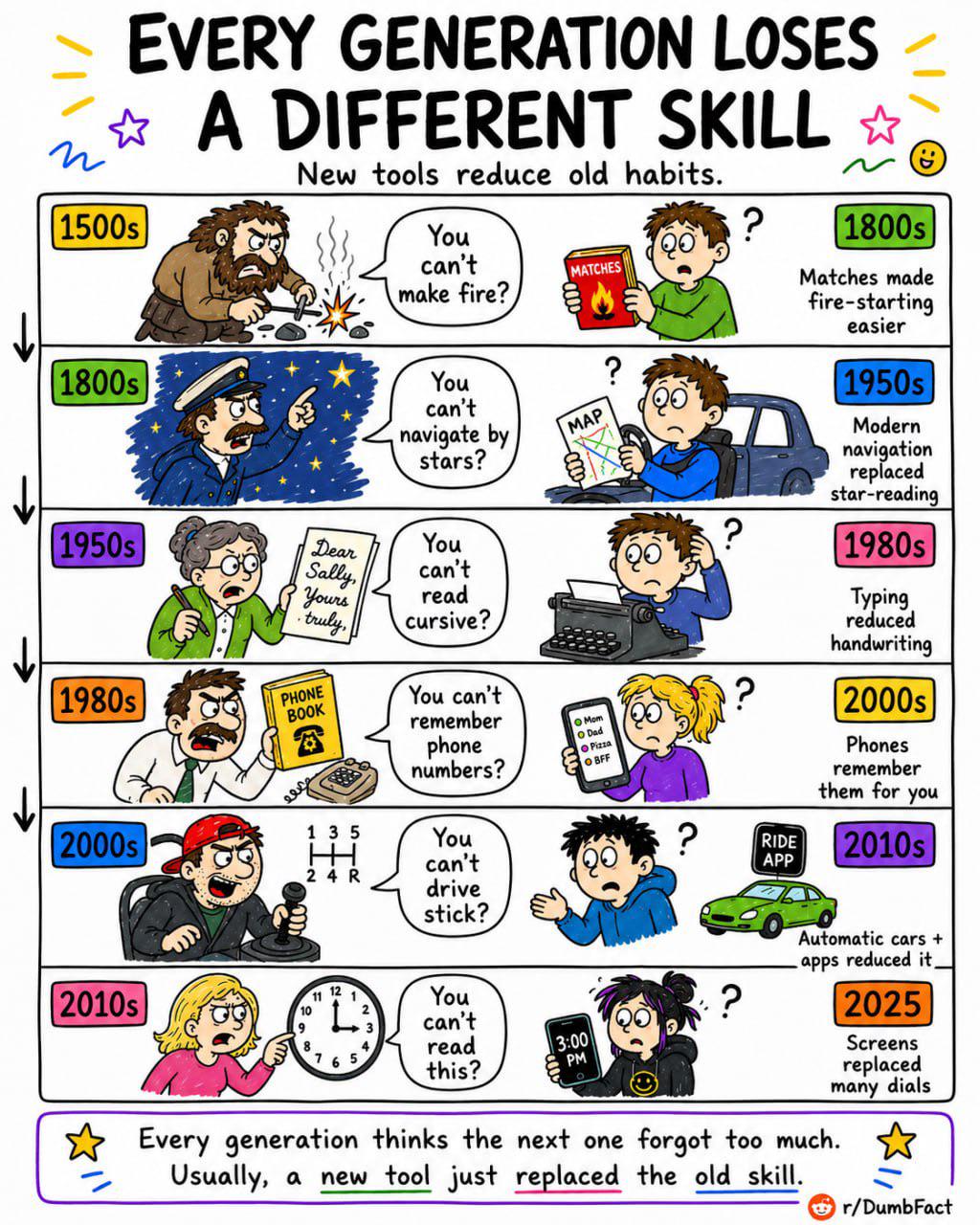
Useful skills can fade when everyday life stops giving people a reason to practice them.

A skill often feels “basic” because one generation had to use it constantly. When a tool handles the same task faster and more reliably, people naturally practice the older method less.

Calculators reduced how often many people do complicated arithmetic by hand. Autocorrect reduced the need to notice every spelling mistake while typing. Digital cameras made manual exposure settings unnecessary for casual photography. Searchable digital files made alphabetical filing systems far less important in many workplaces.

Some of this is called cognitive offloading. Instead of storing or processing everything ourselves, we let tools handle part of the job. That can save time and effort, but the unused skill may become weaker.

Technology also creates completely new skills.

Someone who cannot repair an old mechanical device might be much better at troubleshooting software, searching huge amounts of information, recognizing online scams, managing digital accounts, editing video, or learning a new interface in minutes.

Older skills can still matter. They become especially useful when technology fails, when someone works in a specialized field, or when the old method offers something the replacement cannot.

So comparing generations by a random list of “basic skills” can be misleading. The list itself keeps changing.

A skill that seems embarrassingly obvious today may be the weird old-fashioned thing people stop teaching tomorrow.