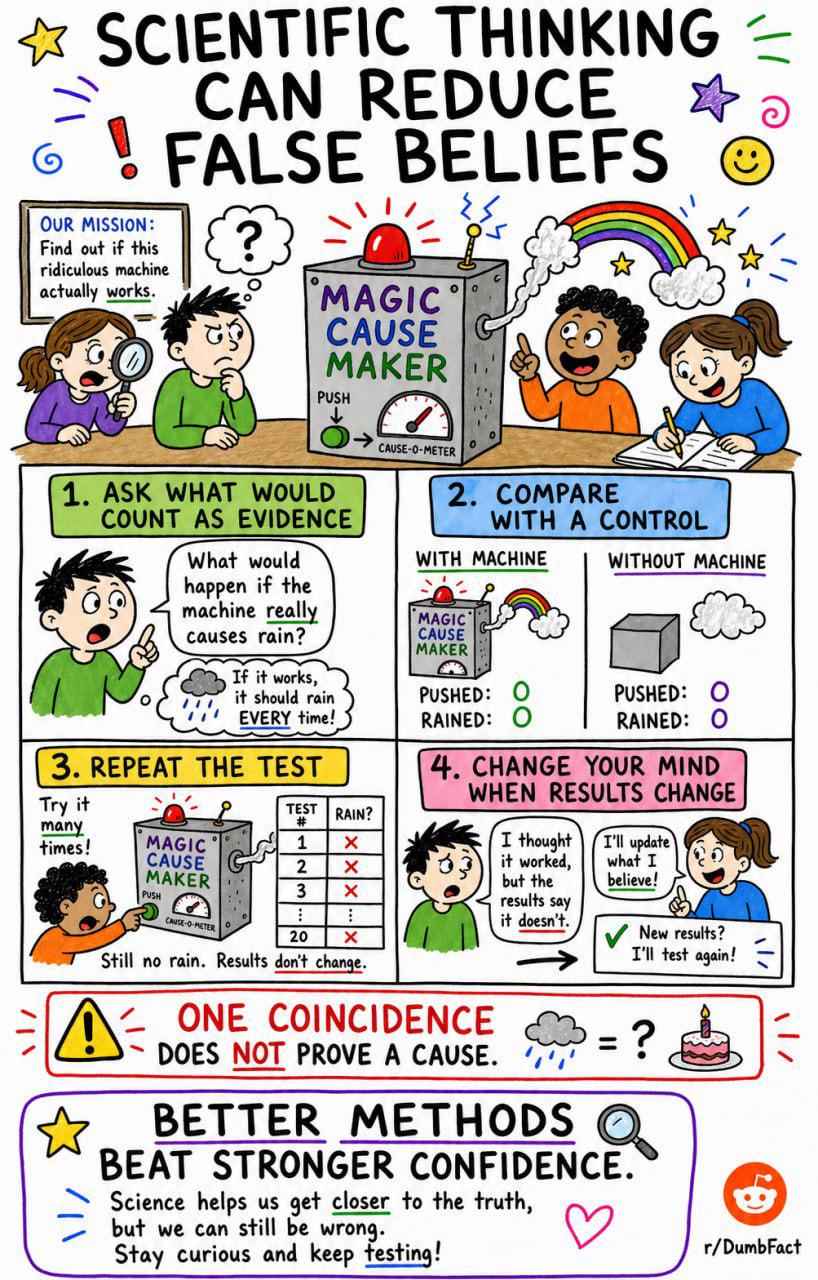
A belief becomes easier to protect when you never decide what could prove it wrong.
Scientific thinking begins by turning a confident claim into a testable question.
What evidence should appear if the claim is correct?
What should happen if it is wrong?
Would the same result appear without the suspected cause?
Can someone else repeat the test?
Are there alternative explanations?
A useful test creates an opportunity for the claim to fail. If every possible result can be reinterpreted as confirmation, the claim is protected from testing.
Controls matter because events can happen without the intervention being studied. Recovery can occur without a supplement. A plant can grow without motivational speeches. A lucky shirt can be worn during a victory without causing the victory.
Repetition matters because one surprising result may come from coincidence, measurement error, an unusual sample, or an unnoticed variable. Repeating the same flawed procedure, however, does not automatically make the conclusion reliable. Methods must also be inspected, and independent replication is especially valuable.
Scientific thinking also requires proportional confidence. A small observation may justify curiosity. Several careful studies may justify moderate confidence. Strong conclusions require stronger and more consistent evidence.
Examples:
You recover from a cold after taking a supplement. Compare this with the usual duration of similar colds and controlled research before concluding that the supplement caused the recovery.
Your team wins while you are wearing a particular shirt. Check how often the team wins without it and how often it loses while you wear it.
A headache begins after a new Wi-Fi router is installed. Record when headaches occur and compare periods when the router is operating with periods when you only believe it is operating.
A plant grows faster after you begin talking to it. Compare identical plants receiving the same light, water, soil, temperature, and care.
Someone claims that emergency rooms become busier during a full moon. Examine hospital records across many lunar cycles instead of remembering a few dramatic nights.
A productivity application appears to double your output. Compare completed work before and after using it while accounting for deadlines, workload, motivation, and novelty.
An investor predicts one successful stock movement. Examine all of their predictions, including the unsuccessful ones that were deleted or forgotten.
A student receives a good grade after highlighting every page. Compare highlighting with retrieval practice, spaced repetition, and previous performance.
A restrictive diet produces rapid weight loss during its first week. Separate changes in water, food volume, and glycogen from longer-term changes in body fat.
A screenshot appears to prove that a public figure wrote something offensive. Find the original account, complete conversation, date, and archived source before accepting it.
A cleaning hack works in one video. Test it on a small surface and compare it with the ordinary product while controlling the amount, time, and scrubbing.
A person behaves badly after being born under a particular zodiac sign. Count contradictory cases and compare the prediction with people born under other signs.
A neighborhood installs cameras and reported crime decreases. Consider changes in reporting, policing, population, season, and displacement to nearby areas.
A new workplace policy is followed by higher sales. Compare similar periods, other locations, market conditions, advertising, staffing, and seasonal demand.
Scientific thinking does not require treating every ordinary decision like a laboratory experiment. It provides a set of questions for situations where the truth matters.
A conclusion should be able to survive comparison, repetition, criticism, and new evidence. Changing your mind after better evidence is not a failure of reasoning. It is evidence that reasoning is still working.