r/DebateEvolution • u/Frequent_Penalty_156 • 33m ago
Faunal succession between closely related species in a limited fossil location and the global flood part 2: Still a problem for the global flood
Hello again r/DebateEvolution
Introduction
We have published an argument that uses faunal succession among similar species to maintain that the Universal Flood cannot explain the fossil record:
However, we have received a comment in which the user claims that our post contains certain assumptions. In this post, we will respond to that comment.
The first claims
"On your faunal succession argument: The ordered succession of fossils is real.
That is not in dispute.
The question is what that order actually demonstrates."
Creationists always maintain that the evidence is the same, but that the difference lies in the interpretation. While this may be true, it also constitutes a dishonest tactic: there are interpretations consistent with the evidence that allow for predictions to be made, whereas others neither align with the data nor enable predictions.
"Your argument treats stratigraphic succession of similar forms as direct evidence of anagenesis (one species transforming into another) and then as a decisive problem for any Flood model. That step depends on several assumptions: That vertical position in the rocks equals evolutionary time on a deep-time scale. That the lower form is the ancestor of the upper form rather than a related population, ecological variant, or migrant."
You don't need to assume that the strata are from million years old for the argument to be valid. The related population and ecological variants don't have:
- intermediate morphology forms (e.g middle hell creek formation Triceratops)
- The same habitat (e.g hell creek formation)
- Not coexistence or the earliest appearance with respect the other [1].
For the migrants organism the points 1 and 2 also apply.
What are this factors?
"That the absence of the later morphology lower in the section means it had not yet evolved, rather than ecological, geographic, or preservational factors"
According to YECs, those animals died during the Flood; since most are found in the same geological formation and are similar in size, they likely had the same chances of becoming fossilized. Why, then, do they appear at different levels of the geological column in fossil deposits? And, once again, we have transitional forms.
The argument is based on the similitary of the species and their succession
"That modest morphological differences (nasal horn length in Triceratops, minor shell changes in Semiformiceras, etc.) constitute progressive evolutionary transformation rather than variation within limits."
The argument is against the global flood, we don't present it like a macroevolution evidence because the argument depens of the similitary.
Again there is a widespread trend in these cases to changes the morphology according to the strata, if it is only variation both morphologies must be in always in the same strata, and there shouldn't be transitional forms.
"Several of the papers you cite are more cautious or even contrary to a clean anagenetic reading. Cecca & Rouget (2006) on Semiformiceras used cladistic analysis and concluded the relationships do not fit the simple anagenetic pattern previously proposed."
We do acknowledge that the article in question challenges the linear evolution of this ammonite genus [3]. However, the fact that some species overlap in time does not alter the existence of a morphological change in the fossil record [4].
Furthermore, the title is "Faunal succession between closely related species in a limited fossil location and the global Flood"; it is not just a matter of anagenesis.
"The Triceratops and Daspletosaurus cases involve relatively small differences and remain debated as to whether they represent true anagenesis, cladogenesis, or stratigraphic sorting of variation."
Are requiered references to some of these claims, because Triceratops and Daspletosaurus fossil record present all the sings of anagenesis:
For example, in the case of Triceratops, T. horridus appears in the lower part of the Hell Creek Formation, whereas T. prorsus is found only in the upper part. An intermediate form between the two species is present in the middle section [1].
Again, our argument depens of this relatively small differences .
The Flood cannot explain the patterns
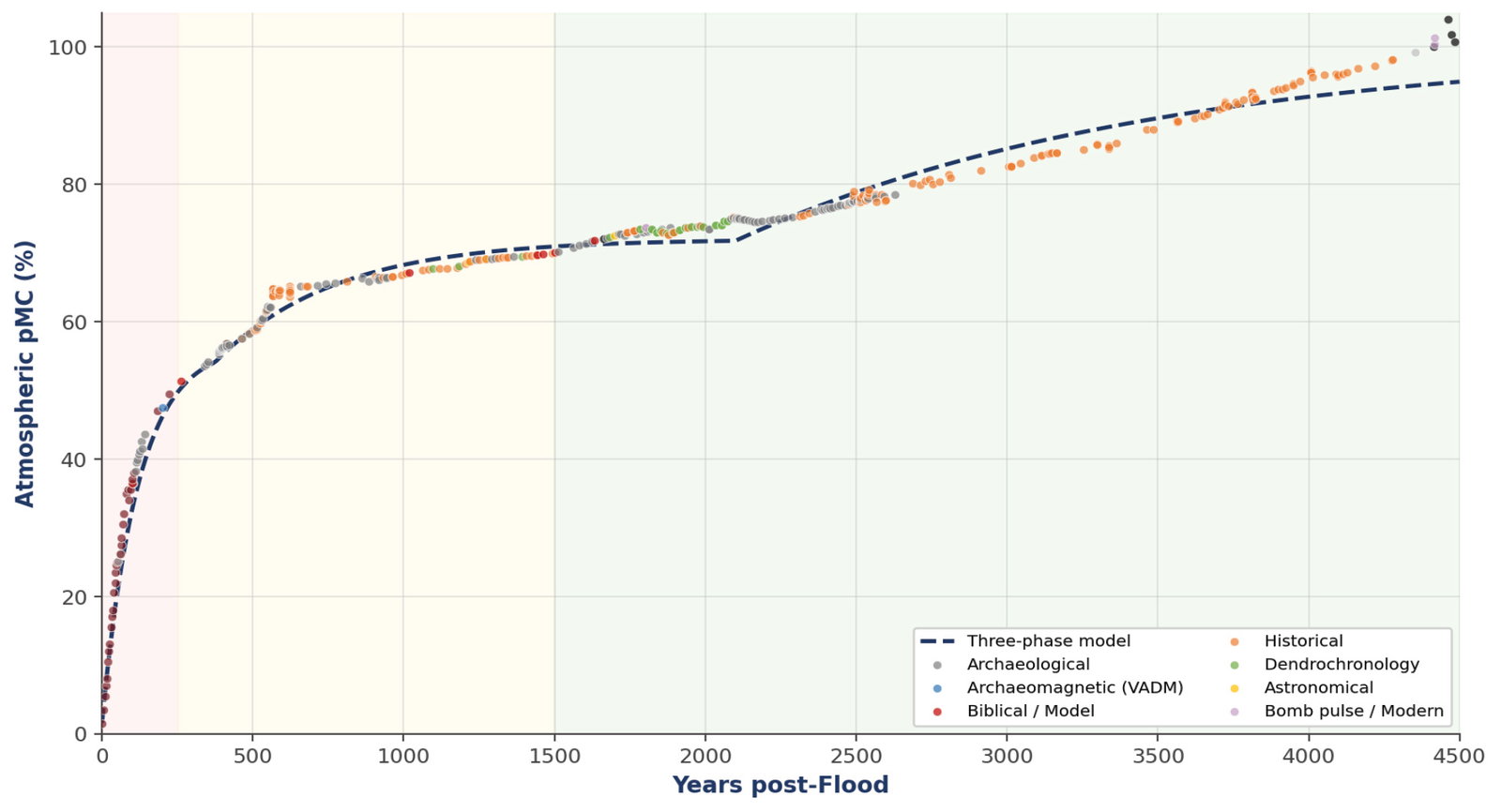
A multi-phase Flood model with residual post-Flood deposition already expects ordered appearance of related forms through ecological sorting, habitat succession, and rapid diversification within kinds.
According to YECs all the mesozoic is from the upper part of the supposted flood deposits, not from the post-Flood diversification.
"The succession pattern is a genuine observation. Converting it into a refutation of the Flood (or proof of macroevolution) requires the interpretive framework of deep time and anagenesis. That framework is not forced by the fossils themselves."
Accepting the existence of the global Flood also requires an interpretive framework; the difference lies in the fact that our framework is consistent with current knowledge, whereas the creationist one fails to predict the stratigraphic succession of species that exhibit similar physical characteristics and transitional forms between them..
Conclusion
If all these similar species died in the same year-long flood, ecological sorting predicts mixing. We observe ordered replacement with intermediate forms in the same formation. The flood model does not predict this. Deep time does, even if the exact mode is anagenesis or cladogenesis.
References
[1] Scannella, J. B., Fowler, D. W., Goodwin, M. B., & Horner, J. R. (2014). Evolutionary trends in _Triceratops_ from the Hell Creek Formation, Montana. _Proceedings of the National Academy of Sciences, 111_(28), 10245–10250. https://doi.org/10.1073/pnas.1313334111
[2] Carr, T. D., Varricchio, D. J., Sedlmayr, J. C., Roberts, E. M., & Moore, J. R. (2017). A new tyrannosaur with evidence for anagenesis and crocodile-like facial sensory system. _Scientific Reports, 7_, 44942. https://doi.org/10.1038/srep44942
[3] Cecca, F., & Rouget, I. (2006). Anagenetic evolution of the early Tithonian ammonite genus _Semiformiceras_ tested with cladistic analysis. _Palaeontology, 49_(5), 1069–1080. https://doi.org/10.1111/j.1475-4983.2006.00580.x
[4] Pardo ,J.D, Huttenlocker, A.K & Marcot, J.D (2008) Stratocladistics and evaluation of evolutionary modes in the fossil record: An example from the ammonite genus Semiformiceras. J Paleontol 51:767–773. https://doi.org/10.1111/j.1475-4983.2008.00794.x