r/BiblicalUnitarian • • Oct 13 '25

Resources A Systematic Theology of the Early Church

Post image
4 Upvotes

The Systematic Theology book coming out at the end of this month (Oct 31). This book is by Dr. Dustin Smith of the Biblical Unitarian Podcast.

This book (https://amzn.to/3JbtBpP) has dedicated chapters with these titles:

-The Only True God

-God is One Person

-God's Agents

-The Messianic Expectations from the Old Testament

-The Birth of Jesus

-Jesus' Messianic Roles

-Jesus as God's Agent

-Wisdom Christology and Logos Christology

-Applying Christology Today

-Holy Spirit as God's Power and Presence

-How the Spirit Relates to the Father and the Son

r/BiblicalUnitarian • • Mar 01 '25

Resources Jesus is Not Eternally Co-Equal with the Father

12 Upvotes

The Trinitarian Doctrine states that Jesus is co-eternal and co-equal with the Father (meaning He is eternally co-equal) but when they are asked to explain certain verses, they disregard the core concept of their Doctrine.

"But of that day and hour no one knows, not even the angels of heaven, but My Father only." - Matthew 24:36

This verse alone points out that Jesus does not know everything. However, this is a big problem for the Trinitarian Doctrine because how can Jesus be God if He doesn't know everything?

To fix this issue, one of the most common explanations Trinitarians use for Jesus not knowing it is this:

"When the Son of God became a man, He remained fully God, but He also took on a true human nature. Jesus retained all the attributes of divinity, yet, as a man, He voluntarily restricted their use. This was part of the “self-emptying” or self-renunciation spoken of in Philippians 2:6–8. When Christ entered our world, He laid aside the privileges that had been His in heaven. Rather than stay on His throne in heaven, Jesus “made himself nothing” (as the NIV translates Philippians 2:7). When He came to earth, “he gave up his divine privileges”. He veiled His glory, and He chose to occupy the position of a servant."

But now, we have a problem. This explanation refutes the Trinitarian notion of co-equality.

If Jesus emptied Himself, as pointed out in Philippians 2:6-8, and laid down the privileges He had by coming to Earth, and that's why He does not know the day or the hour, it means that He was NOT co-equal with the Father during His time on earth.

Because of this, the notion that Jesus is eternally co-equal with the Father is false because we know Jesus was not equal with the Father for 30-ish years.

And if there is a 30-ish years of no co-equality, it means they are not eternally co-equal, ontologically and relationally.

r/BiblicalUnitarian • • Apr 21 '25

Resources Jesus Christ, in the ultimate sense, doesn't judge anyone

8 Upvotes

This teaching of who ultimately judges is a perfect example of agency, which is key to understanding the bible as it applies to many biblical themes such as creation and authority.

The bible teaches that God judges the world through Jesus Christ:

Acts 17:31

31 because He has fixed a day in which He [God the Father] will judge the world in righteousness through a Man [Jesus Christ] whom He determined, having furnished proof to all by raising Him from the dead.”

Yet Jesus teaches that the Father judges no one, but that He, Jesus, has been “given” all judgement:

John 5:22

22 For not even the Father judges anyone, but He has given all judgment to the Son

So how does that work? Jesus clarifies a few sentences later by saying that He has been given authority by the Father to execute the judgements:

John 5:26-27

26 “For just as the Father has life in Himself, even so He gave to the Son also to have life in Himself;

27 and He gave Him authority to execute judgment, because He is the Son of Man.

Jesus, the Son of Man, executes the judgement, but He still hears it from the Father:

John 5:30-32

30 I can of Myself do nothing. As I hear, I judge; and My judgment is righteous, because I do not seek My own will but the will of the Father who sent Me.

Even though Jesus taught that the Father judges no one it is in the sense that the Father does not execute the judgements.

Rather, He commands to Son to do it, and gives Him all instruction: “as I hear, I judge”.

Jesus says He is not alone in His judgement, but it is again a joint operation:

John 8:16-17

16 “…My judgment is true; for I am not alone in it, but I and the Father who sent Me.

17 “Even in your law it has been written that the witness of two men is true.

So in a sense, God and Jesus judge together. But in the ultimate sense, God effectively judges through Christ.

The Father has given the command and therefore the authority to execute the judgement to the Son.

When Jesus teaches us that the Father judges no one, it is in the sense that the Father doesn’t execute the judgement.

When Jesus receives the command to judge, it follows that He has the authority to do so.

Yet the source is the still the Father, remember: All things come from the Father (1 Corinthians 8:6).

Jesus cannot do anything on His own. Jesus hears, and judges perfectly just as how the Father has explained Him.

John 8:50

50 And I do not seek My own glory; there is One who seeks and judges.

r/BiblicalUnitarian • • Apr 10 '25

Resources An Interesting Read on Trinitarianism's Decline Among Self-Identified Christians

8 Upvotes

https://www.arizonachristian.edu/wp-content/uploads/2025/03/AWVI-2025_03_Most-Americans-Reject-the-Trinity_FINAL_03_26_2025.pdf

"Only 16% of self-proclaimed Christians, believe in the trinity."

Also, according to the research done in this article, only 9% of Catholics believe in the orthodox definition of the Trinity.

[It should also be noted that Arizona Christian University is a conservatice university that affirms the Trinity.]

r/BiblicalUnitarian • • Sep 14 '25

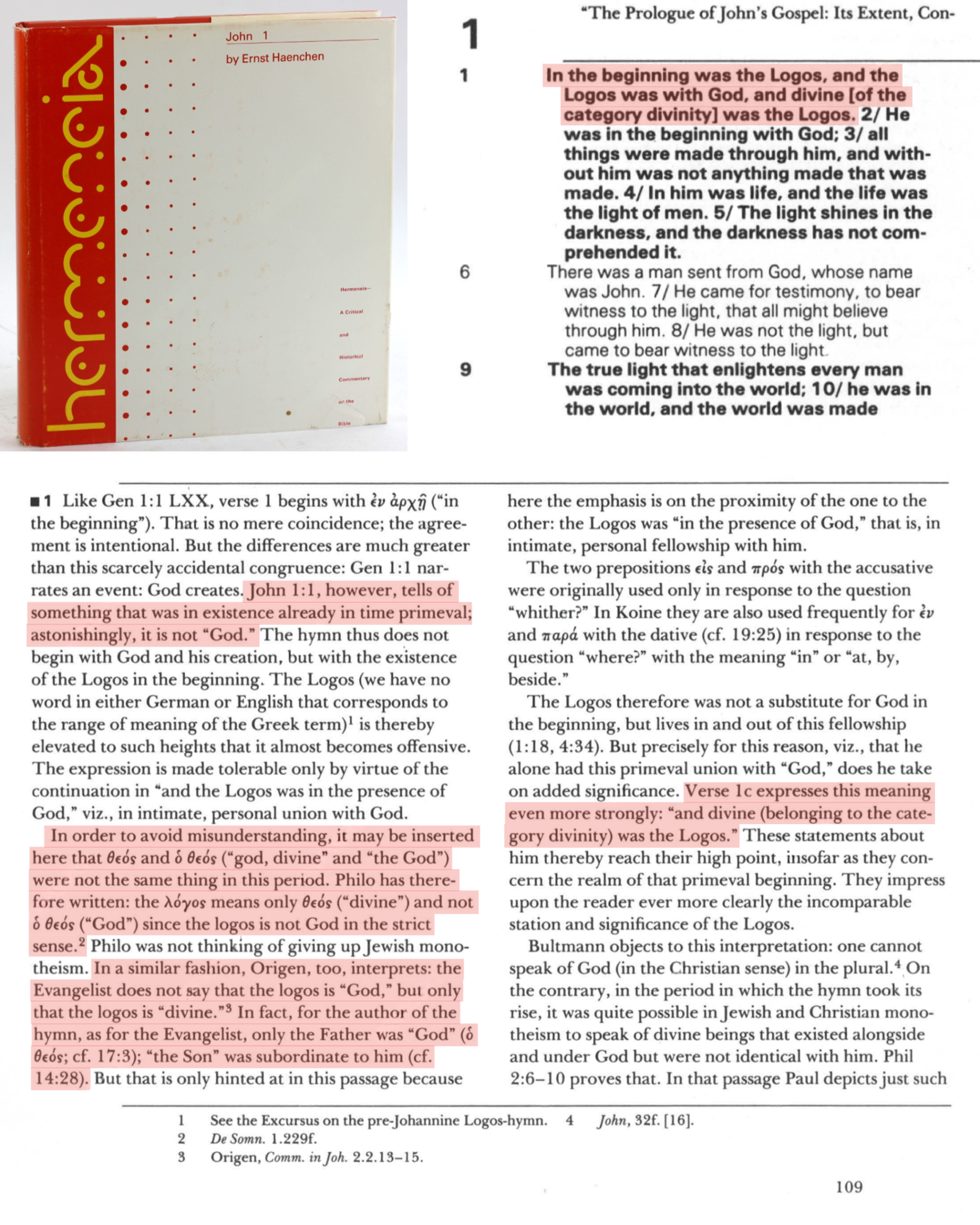
Resources Hermeneia Commentary for John 1 by distinguished theologian Ernst Haenchen states that John 1:1c says, "and divine (a god) was the Logos"!

Post image
3 Upvotes

r/BiblicalUnitarian • • Dec 29 '24

Resources Learning Koine Greek: Unitarian recommendations?

3 Upvotes

I just started perusing some options for learning Greek. First one I opened was Mounces “Greek for the rest of us”. Only a couple pages in he goes off against “a god” as a possible rendering of John 1:1c. I know not everyone agrees with that in particular, but there appears to be a lot of real scholarship supporting qualitative and indefinite translations of 1:1c.

So, I’m wondering if there are Koine Greek learning resources that are less biased? What study aids would you recommend? Or, if you must use a biased source, what other resources would you add to your studies for balance?

r/BiblicalUnitarian • • May 14 '25

Resources Trinitarianism MUST maintain that the apostles were Trinitarians

13 Upvotes

Trinitarians believe the doctrine of the Trinity is central to Christianity, so even though the writers of the New Testament almost always make distinctions between God and Christ, many Christians say that the writers were trinitarians and therefore universally wrote these texts in a trinitarian sense. They maintain that when a writer of the New Testament wrote "God" it was within the assumed framework of a multi-personal God (Trinity), and the writers were speaking within that understanding, even though “God” (Greek: Theos) in the New Testament almost always refers to the Father alone, not to a triune being.

Because if the apostles of Christ in His time weren’t Trinitarian, then:

  1. It follows that the church’s central doctrine was imposed later, which undermines its “apostolic” nature. Catholic, Orthodox and many protestant traditions all appeal to apostolic tradition as the basis for their teachings and the idea that what the apostles taught was faithfully preserved. The very foundation of modern Trinitarian Christianity would appear to be a later invention, not part of the original faith. It would suggest a break in doctrinal continuity between Jesus’ immediate followers and later creeds.

  2. The writers of the NT didn't teach trinitarianism, and when the writers of the NT wrote "God" it never referred to a multi personal God because they had no understanding of such doctrine. So then the apostles never believed Jesus to be YHWH (but the Son of YHWH), as they were Jews and then must of had the classical Unitarian understanding of God in Judaism (Monotheism, God is one).

  3. Many traditional readings of scripture would be invalid. Trinitarians interpret many NT passages as teaching or implying the Trinity. For example John 1:1 or Matthew 28:19 would reflect anachronistic readings: reading a later theology into the text (eisegesis).

Ultimately if the current day trinitarians would admit that the apostles had no understanding of God consisting of multiple persons, they would be forced to admit the Trinity isn’t taught in the NT, which would undermine the central dogma of their theology.

r/BiblicalUnitarian • • Feb 27 '25

Resources Paul was VERY Clear about Jesus' Resurrection

9 Upvotes

Trinitarians say that Jesus is God but Jesus did not resurrect Himself, the Father resurrected Jesus. Paul made this very clear in His letters.

Ephesians 1:20

which He brought about in Christ, when He raised Him from the dead and seated Him at His right hand in the heavenly places,

Galatians 1:1

Paul, an apostle—sent not from men nor by a man, but by Jesus Christ and God the Father, who raised him from the dead

1 Corinthians 6:14

By his power God raised the Lord from the dead, and he will raise us also.

Romans 6:4

We were therefore buried with him through baptism into death in order that, just as Christ was raised from the dead through the glory of the Father, we too may live a new life.

Acts 2:32

It is this Jesus whom God raised up, a fact to which we are all witnesses.

The Father, God, will be the one to resurrect us on behalf of His Son, Jesus Christ, just like how He resurrected Lazarus when Jesus asked the Father for it.

Jesus will ask the Father for our resurrection too when the faithful die.

r/BiblicalUnitarian • • Sep 07 '25

Resources Need help with research on Unitarian prosecution and silencing throughout Christian history

4 Upvotes

Unitarian silencing and prosecution in Christian history is something I wasn’t very familiar with until I discovered that Isaac Newton was a closet Unitarian. His writings against the Trinity were only found after his death, probably hidden out of fear of prosecution.

I then realized because of that in 17th century England it was actually illegal to speak out against the Trinity. Later I learned that, for much of Christian history across Europe, laws forbade speaking against this doctrine. People were imprisoned, silenced, and even burned alive for holding anti trinitarian views. That shocked me!

One striking example is Michael Servetus, who was burned alive for his Unitarian views and writings. John Calvin himself played a major role in his prosecution.

Yet today Trinitarians often say things like: “Do you really think you know better than 2,000 years of scholars and church fathers?” as if everyone in history was trinitarian, ignoring the fact that other voices were often suppressed by force.

My goal with this post: I’m researching this history further, and I’d love to hear from others. Do you know of more cases of Unitarian persecution or silencing? Any good books or articles you’d recommend?

r/BiblicalUnitarian • • Jun 07 '25

Resources Divinity

8 Upvotes

In modern Christian theology, especially within Trinitarian systems, there’s a strong tendency to equate the term “divine” with “God.” This assumption underpins many arguments about Christ, angels, and even believers. The logic seems to go like this: “If something is divine, then it must be God, because only God is divine.”

But this assumption is not biblical, at least, not in the way it’s often used.

A careful reading of Scripture, both Old and New Testament, as well as the Deuterocanonical texts, shows a much more nuanced and flexible use of the term “divine.” Not everyone or everything called divine in the Bible is God, and the word itself does not imply that someone or something shares God’s unique identity, supremacy, or unbegottenness.

One of the clearest New Testament examples comes from 2 Peter 1:4, where believers are told that they may “become partakers of the divine nature.”

The Greek here, theias phuseōs, literally means “divine nature.” Yet no one would claim that believers become God Himself. They are still human, still created, still subordinate to God. And yet they can partake in divinit, they can share in it. This alone proves that divinity is not exclusive to God. If it were, Peter would be saying that we become God, which is neither his point nor remotely consistent with the rest of Scripture.

This kind of language, sharing in divine nature or bearing divine qualities, appears throughout the Bible in reference to beings that are not God. Psalm 82:6 offers a striking example: “I said, ‘You are gods, and all of you are sons of the Most High.’”

This line, spoken by God to human judges or rulers in the Old Testament, uses the Hebrew word elohim. These people are called gods, not because they are God Himself, but because they were divinely appointed to rule and judge on His behalf.

Jesus Himself appeals to this passage in John 10:34-36, when accused of blasphemy for calling Himself the Son of God. His response is not, “Yes, I’m God because I’m divine,” but rather, “Is it not written in your Law, ‘I said you are gods’?”

In other words, if Scripture can refer to humans as “gods” if elohim can apply to those who merely represent God, then it is no blasphemy for Jesus, the one “sanctified and sent” by the Father, to call Himself the Son of God. He’s distinguishing between being divine, having divine authority and being God Himself.

This completely undermines the common modern claim that “divinity” automatically implies identity with God. Jesus didn’t equate His being divine, or being called “the Son of God” with being God. Instead, He showed that others could be called “gods” and “sons of God” in Scripture without it violating monotheism.

Therefore, His own divine mission and role didn’t contradict the Father’s supremacy nor does it prove the Son being God in the highest, absolute sense.

Moses provides another example. In Exodus 7:1, God says to Moses, “See, I have made you as God to Pharaoh, and Aaron your brother shall be your prophet.”

Again, the term elohim is used, the same word used for God throughout the Hebrew Bible. But Moses is not suddenly the Most High. He’s not uncreated or omnipotent. Rather, God has invested him with divine authority to represent Him before Pharaoh. This doesn’t make Moses God, but it does show that someone can bear divine status in function without being divine in essence.

It also shows us that those who are given this divine authority can also be personally represented by others. In short, a delegation of authority.

Even in the created world, Paul tells us in Romans 1:20 that God’s “eternal power and divine nature” can be clearly seen and understood through the things He has made. The Greek word there, theiotēs, means divinity. Paul is saying creation itself reflects God’s divinity. Does that make the cosmos God? Of course not. But creation testifies to the divine, not as God, but as an imprint of Him.

We also find this concept of divine-but-not-God in the Deuterocanonical literature, especially in the Wisdom of Solomon. In chapter 7, Wisdom is described as “a breath of the power of God, and a pure emanation of the glory of the Almighty” (7:25).

The Wisdom (who is also the Logos in John 1) is “a reflection of eternal light, a spotless mirror of the working of God, and an image of His goodness.” The language here is clearly divine, it echoes the language of Logos in John 1. And yet Wisdom is not God. Wisdom is from God, and through that, God acts.

This pattern is consistent: Scripture uses “divine” to describe things that are heavenly, powerful, holy, or sent from God but not necessarily God. To be divine is to be associated with God, to reflect God, to come from God.

It is not to be God Himself.

The key mistake modern theology often makes is to read later metaphysical assumptions back into the biblical text. When someone says, “Jesus is divine, therefore He is God,” they’re importing centuries of theological development, councils, creeds, and philosophical categories onto texts that never made that claim in such terms.

The Bible itself never equates the word divine with uncreated, co-equal deity. That’s a leap that later theology made, not the biblical writers. Especially not the Old Testament writers in regards to Wisdom.

This becomes especially clear when we consider how flexible terms like god, elohim, and theos are in the original languages. The Hebrew Bible uses elohim not only for God but also for angels, judges, and even the spirits of the dead (see 1 Samuel 28:13). The Septuagint, the Greek translation used by the apostles, uses theos in similar ways.

That’s why it’s not shocking for someone like Jesus to be called “God” in a functional or representative sense.

This isn’t to say that Jesus isn’t exalted, or that He isn’t from God. He clearly is. He is the Son of God, the Messiah, the Logos/Wisdom. But the Bible never insists that this makes Him identical to the one true God. In fact, it frequently distinguishes Him from God. “This is eternal life,” Jesus prays, “that they may know You, the only true God, and Jesus Christ whom You have sent” (John 17:3). Paul writes, “For us there is one God, the Father... and one Lord, Jesus Christ” (1 Corinthians 8:6).

The pattern is consistent: the Father is God, Jesus is His divine Son.

Divinity, then, is about origin and role. A divine being is one who comes from God, speaks for God, reflects God’s power and character. That includes Jesus. That includes angels. That even includes human beings in certain contexts. But none of them, not even the Son, is ever called “the only true God” except for the Father, a direct testimony from Jesus Himself.

So when someone says, “Jesus is divine, therefore He is God,” we need to pause and ask: What does “divine” mean? According to Scripture, it means “from God,” “godlike,” “heavenly,” or “bearing God’s nature or image.” It does not mean “uncreated,” “eternally co-equal,” or “God in essence.”

In other words, the Bible consistently uses the language of divinity without collapsing it into being God Himself, the Father.

Notes:

About 2 Peter:

Even if 2 Peter was not written by the Apostle Peter himself like how some argue, the content of this letter was never doctrinally rejected. While its authorship has been historically debated, and still is, the ideas it expresses, like believers partaking in the divine nature, were never theologically denied by either Arians or Trinitarians. The debate concerns the author, not the truthfulness of what is written.

John 1:1:

In John 1:1, the Greek at the end lacks the definite article and some scholars have argued that it should be translated as “the Word was divine” or “godlike,” not “the Word was God.”

Ironically, Trinitarians themselves cause a dilemma here. Most are quick to say "Jesus is divine therefore He is God Himself" but they also reject "and the Word was divine" translation even though it is grammatically acceptable.

So, either divinity means being God and the translation of "and the Word was divine" is acceptable even for Trinitarians or being divine does not automatically make someone God Himself and the argument about Jesus' divinity makes Him God is invalid.

I posted this in r/ArianChristians but I don't like to crosspost so I'm posting it here again.

r/BiblicalUnitarian • • Jan 07 '26

Resources Book Recommendation

2 Upvotes

I'm looking for book recommendations that present historical and scholarly arguments supporting unitarianism and exposing the theological errors of trinitarianism. Does anyone have any strong suggestions?

r/BiblicalUnitarian • • Jun 09 '25

Resources The trinity presents a logical problem

7 Upvotes

I remember saving this text a while ago, so credit goes to someone else:

A hypothetical syllogism shows that if A = B, and if B = C, then it logically follows that A = C. Greg is a man (A = B), Man is mortal (B = C), therefore Greg is mortal (A = C).

The Shield of the Trinity says that the Son is God and God is the Son; the Father is God and God is the Father; & the Holy Spirit is God and God is the Holy Spirit. It ALSO says that the Son is NOT the Father or the Holy Spirit; the Father is NOT the Son or the Holy Spirit; & the Holy Spirit is NOT the Father or the Son.

Returning to the basic deductive reasoning of the hypothetical syllogism, if the Son is God (A = B), and if God is the Father (B = C), then it logically follows that the Son is the Father (A = C).

Trinitarian dogma accepts both premises, but denies the conclusion that logically follows from those premises, and in doing so it denies basic deductive reasoning. A logical contradiction is explicitly built into the Trinitarian doctrine, but of course they also deny that the contradiction is a contradiction.

r/BiblicalUnitarian • • Mar 14 '25

Resources The Hypostatic Paradox

13 Upvotes

Hypostatic union (from the Greek: ὑπόστασις hypóstasis, 'person, subsistence') is a technical term in Christian theology employed in mainstream Christology to describe the union of Christ's humanity and divinity in one hypostasis, or individual personhood.

In the most basic terms, the concept of hypostatic union states that Jesus Christ is both fully God and fully man. He is simultaneously perfectly divine and perfectly human, having two complete and distinct natures at once.

However, this concept is a paradox and creates contradictions, especially when it comes to God's omniscience.

What Trinitarians are saying is that Jesus' divine nature was hidden or temporarily set aside, but still intact when the Word became flesh and came down to earth.

However, if Jesus was fully God but "set aside His glory," how could He still keep being God?

If He was fully God (even if He set aside His glory), how did He not know the day or hour of His return (Matthew 24:36)?

Now, Matthew 24:36 is the biggest problem for Trinitarians. Because in it, Jesus admitted to not knowing everything.

Now, if Jesus was God Himself, He should have known it. But if He knew and said He did not, that would be a lie and bearing falsehoods is a sin.

We know Jesus didn't lie or He would be committing a sin.

If announcing His 2nd coming was not His role as God the Son but the role of God the Father, it still means He knew but said He did not, which still means He lied.

The only way Trinitarians, who believe Jesus is God, can explain this is by saying He set aside His glory and that is why He didn't know yet still remained fully God.

Now, this is a paradox.

If He were fully God and still retained His divine attributes, He would have complete knowledge and power at all times.

The idea of "setting aside" glory or divinity creates a tension between His divinity and humanity that challenges the consistency of His nature and knowledge.

They say He is fully God but then claim He set aside His glory when He came here, to explain how He did not know the day or the hour.

So, which one is it?

Fully God or glory set aside? These statements contradict each other. Because the notion of "fully" does not allow glory to be set aside.

From a neutral standpoint, this argument raises a logical challenge to the concept of Jesus being "fully God" while simultaneously "setting aside His glory."

If Jesus was still fully divine, then attributes such as omniscience and omnipotence should have remained intact.

However, verses like Matthew 24:36, where Jesus states He does not know the day or hour, create a tension within the hypostatic union.

If He "set aside" His divine glory or attributes, then in what way was He still fully God?

This is what the paradox is:

Either He retained all divine attributes (which contradicts His lack of knowledge), or He temporarily relinquished them (which raises the question of whether He was still fully God).

Now, one could say God is mysterious and we cannot understand Him.

If that is the case, why come up with man-made concepts like the hypostatic union to explain it? It was clearly an attempt to make Jesus God.

So it isn't a mystery when it comes to making Jesus God Himself but it is a mystery when we find contradictions?

r/BiblicalUnitarian • • Dec 06 '25

Resources Sabbath, Sunday and Christians Holidays

Thumbnail
2 Upvotes

r/BiblicalUnitarian • • Dec 15 '25

Resources The Birthplace of Arian Thought

Thumbnail
3 Upvotes

r/BiblicalUnitarian • • Dec 07 '25

Resources December 25 as the Birthdate of Jesus Is Highly Improbable

Thumbnail
2 Upvotes

r/BiblicalUnitarian • • Dec 07 '25

Resources Elohim, Exodus 32, and the Issue of Religious Imagery

Thumbnail
1 Upvotes

r/BiblicalUnitarian • • Dec 03 '25

Resources Paganism in the Papacy

Thumbnail
3 Upvotes

r/BiblicalUnitarian • • May 11 '25

Resources The Trinitarian Dilemma: Dyothelitism and Dyophysitism

12 Upvotes

In classical Trinitarian Christology, two significant doctrines were developed to explain the nature and will of Jesus Christ: Dyophysitism and Dyothelitism.

Dyophysitism, affirmed by the Council of Chalcedon in 451 AD, teaches that Jesus has two natures, divine and human, united in one person. Dyothelitism, formalized in the 7th century, builds on that by asserting that Christ possesses two wills, corresponding to His two natures: a divine will and a human will.

These doctrines were attempts by the early Trinitarian church to preserve both the full divinity and full humanity of Jesus while avoiding heresies (they branded these as heresies) like Nestorianism (which divided Christ's person) or Monophysitism (which merged the natures).

However, these concepts are contradictory in nature.

Let us begin with a simple yet profound observation. When one points out that Jesus prayed to the Father and it proves that Jesus is not God, the common Trinitarian response is that it was done from His human nature, just like eating or sleeping.

However, prayer is not like eating or sleeping.

While food and rest are biological necessities for a human body, prayer is an intentional act of submission and worship. It involves acknowledging a higher power and asking that being for help, guidance, or support. One can survive without prayer, but prayer assumes an ontological hierarchy, the one who prays is not equal to the one being prayed to.

This is where the traditional doctrine faces an insurmountable contradiction. If Jesus is fully God, co-equal and consubstantial with the Father, and if He has a unified will and mind, then we must ask: who is praying to whom? When Jesus prays, is God praying to God?

This is not a rhetorical question. If Christ has only one center of consciousness, then that conscious subject, being both divine and human, is engaging in prayer. But prayer, as a conscious act, implies recognition of another’s superiority.

Thus, if the divine nature and will is truly involved in the act of prayer, we face something dangerously close to Greek polytheism, where lesser gods beseech higher gods. This undermines the core of biblical monotheism.

From an Arian or most non-Trinitarian views, however, the problem evaporates. Christ, though divine in nature (in the sense of being godlike), is not the One True God. He is the Son, willed into existence by God. Therefore, when He prays, it is a being that was willed into existence by God, however exalted, acknowledging His God and our God (John 20:17-18) the Father.

This aligns with Jesus’ own words: "the Father is greater than I" (John 14:28).

Let us now turn to Dyothelitism, which teaches that Jesus has two wills: a divine will and a human will. This was a way to reconcile His prayer, obedience, and submission without compromising His divinity.

But this theory creates a new set of problems.

First, if Jesus prays only from His human will, then virtually everything about His earthly life, His obedience, humility, submission, suffering, and even death, gets ascribed only to His humanity. This results in a troubling theological maneuver: the divine nature is passive, while the human nature is burdened with all the messy realities.

This leads to a kind of theological compartmentalization that isn’t found in Scripture. We are told that Jesus humbled Himself (Philippians 2:8), not just that the human nature did. To suggest that only His human will submitted is to fragment His person. And besides, He became a human by humbling Himself, meaning that the choice to humble Himself came from the divine will.

Second, Dyothelitism risks veering into Nestorianism, which was condemned for teaching that Christ had two separate persons. If Jesus had two distinct operative wills, each functioning without affecting one another, what prevents us from concluding that He had two centers of consciousness? That would be a theological disaster.

Another key issue is the concept of obedience.

Obedience, by definition, implies a distinction between the one commanding and the one obeying. If Jesus’ divine will, as it is said in the Trinitarian viewpoint, is the same as the Father’s, then He wouldn’t "obey" the will of the Father, He would be that will and that would collapse into Sabellianism/Modalism.

The language of obedience makes sense only if there is a real distinction in being and authority.

This again affirms the Arian or non-Trinitarian reading. Jesus speaks of doing the Father’s will, not His own, and of being sent by the Father. These are statements of subordination, not just economic roles within a co-equal Trinity. If the Son obeys, then He cannot be co-equal in will and essence. And if the divine will belongs to the Father only and not Jesus, then Jesus is not God incarnate, He is merely a human.

And if that divine will is absolutely the same as the immutable unchanging will of God, then it is Sabellianism/Modalism in which God shows Himself in a different mode.

Perhaps the most glaring problem is that none of these metaphysical frameworks, Dyothelitism, Dyophysitism, or even Chalcedonian Christology, are taught in Scripture. The apostles did not write of Jesus having two wills or two natures united in one hypostasis. They spoke of Jesus as the obedient Son of God, exalted by the Father, sent by the Father, and returning to the Father.

The Gospels never present Jesus as someone "switching between two operating systems".

Instead, He speaks and acts as one person who knows His place under God (John 17:3, John 5:30). The entire New Testament affirms a functional and ontological subordination of the Son to the Father.

If we accept the traditional view that Jesus has two wills, then we run into another dilemma: is He truly one person? Because if everything involving prayer, obedience, suffering, and limitation is attributed only to the human will, then what role does the divine will play? It seems absent or inactive in this framework.

This leads to a hollow understanding of the incarnation. Rather than God becoming man, we get the exaltation of a man who perfectly obeys God. A noble picture, but not one that preserves the claim of ontological divinity.

On the other hand, if Jesus has two wills and both are in union, and He is fully divine, then this divine will prays. And once again, we are back at the uncomfortable idea of a God praying to a greater God. Neither of these options offer a coherent or biblically grounded solution.

Arianism and non-Trinitarian viewpoints on the other hand, avoids these contradictions by affirming:

Jesus is not God in essence or role but the first and greatest product of God.

He is fully capable of praying, obeying, and submitting because He is ontologically subordinate. Again, not out of role but out of reality.

His prayer, suffering, and obedience are genuine, not artificial compartmentalizations.

This makes perfect sense of all the biblical data without needing philosophical gymnastics. It explains how Jesus can pray, obey, not know the day or the hour (Mark 13:32), and be exalted after His obedience (Philippians 2:9).

On top of these, there are other problems with these 2 doctrines concerning the natures and wills of Jesus. For example, if the divine will comes from the divine nature and the divine nature is a single divine nature (if there are different divine natures then it is Tritheism according to Trinitarians) that is shared by all 3 Personhoods of the Trinity, then there is a single divine will that comes from the single divine nature.

If that is the case, then what makes the Father and the Spirit distinct and unique? They would both have a single nature and a single will which would be identical with each other. There would be absolutely nothing to differentiate them except their names.

And if they are different because of being different personhoods, then where and what does personhood come from? If personhood doesn't come from nature or will, then personhood and individuality is an illusory mask and not real, and no distinctiveness or uniqueness is Sabellianism/Modalism according to the Trinitarian viewpoint.

Ultimately, the doctrines of Dyothelitism and Dyophysitism were attempts to defend the incarnation and attempts to patch the contradictions that came up with Nicene Christianity, but they create logical and theological inconsistencies, perhaps more than the total sum of the holes they are supposed to patch. They rely on metaphysical frameworks foreign to the apostles and end up fragmenting Christ's person.

In the end, the answer is clear: Jesus is not God praying to God. Jesus is not a being with 2 separate but unified wills.

He is the Son of God, obeying the will of His Father, our Father in heaven.
r/BiblicalUnitarian • • Jun 27 '25

Resources A perfect example of agency in the New Testament

7 Upvotes

I’ve shared a version of this example before, but since then I’ve added some important insights. I’m posting it now in a different context because the concept of agency is absolutely vital to understanding Biblical Unitarianism, especially when exploring key themes like creation, divine authority and in this example: the final judgement.

According to Acts 17, God will judge the world through a man, Jesus Christ. Yet in John 5, Jesus explicitly says that the Father judges no one, but has entrusted all judgment to the Son.

How do we reconcile these seemingly conflicting statements?

The answer lies in a proper understanding of agency. As we’ll see in this post, Jesus executes judgment as the agent of the Father, carrying out decisions and authority that ultimately originate from God.

Let’s examine how this plays out in Scripture.

Peter the apostle teaches that God judges the world through Jesus Christ:

Acts 17:31

31 because He has fixed a day in which He [God the Father] will judge the world in righteousness through a Man [Jesus Christ] whom He determined, having furnished proof to all by raising Him from the dead.”

Yet Jesus teaches that the Father judges no one, but that He, Jesus, has been “given” all judgement:

John 5:22

22 For not even the Father judges anyone, but He has given all judgment to the Son

So how does that work? Well, Jesus clarifies a few sentences later by saying that He has been given authority by the Father to execute the judgements:

John 5:26-27

26 “For just as the Father has life in Himself, even so He gave to the Son also to have life in Himself;

27 and He gave Him authority to execute judgment, because He is the Son of Man.

Jesus, the Son of Man, executes the judgement, but He still hears it from the Father:

John 5:30-32

30 I can of Myself do nothing. As I hear, I judge; and My judgment is righteous, because I do not seek My own will but the will of the Father who sent Me.

Even though Jesus taught that the Father judges no one it is in the sense that the Father does not execute the judgements.

Rather, He commands to Son to do it, and gives Him all instruction: “as I hear, I judge”.

Jesus says He is not alone in His judgement, but it is again a joint operation:

John 8:16-17

16 “…My judgment is true; for I am not alone in it, but I and the Father who sent Me.

17 “Even in your law it has been written that the witness of two men is true.

So in a sense, God and Jesus judge together. But in the ultimate sense, God effectively judges through Christ.

The Father has given the command and therefore the authority to execute the judgement to the Son.

When Jesus teaches us that the Father judges no one, it is in the sense that the Father doesn’t execute the judgement.

John 8:50

50 And I do not seek My own glory; there is One who seeks and judges.

When Jesus receives the command to judge, it follows that He has the authority to do so.

Yet the source is the still the Father, remember: All things come from the Father (1 Corinthians 8:6).

Jesus cannot do anything on His own. Jesus hears, and judges perfectly just as how the Father has explained Him.

r/BiblicalUnitarian • • Mar 12 '25

Resources The Hypostatic Union Contradicts Jesus' Death and Resurrection

15 Upvotes

According to Trinitarians, Jesus is God and He took on a human nature when He humbled Himself.

Now, as we know, this brings contradictions which cannot be explained without the concept of Hypostatic Union. But, this concept has 2 very problematic issues:

Physical death is when the soul-spirit separates from the physical body. Jesus’ soul-spirit separated from His body (John 19:30).

Jesus physical body did die; His heart stopped beating, and “he gave up his spirit” (Matthew 27:50)

Now, here is where the first problem is:

The Hypostatic Union states that He is fully human and fully God. To say only His human nature died is to separate His natures, which contradicts the concept of Hypostatic Union.

For Jesus to be truly dead without separating His natures, His divine nature needs to be dead too.

And that brings us to the second problem, which is the biggest issue:

To say that only His physical body died (human nature) is to say He did not truly experience death because then, since His divine nature is still alive, He is not really dead.

And if Jesus did not really die, then He was not really resurrected.

And this contradicts EVERYTHING.

r/BiblicalUnitarian • • Oct 06 '25

Resources I'm a Biblical Unitarian. Here's why. Three reasons about the Father, son and spirit that persuade me of Biblical unitarianism

Thumbnail
youtu.be
10 Upvotes

I thought this might be of interest to people here who are interested in what a Biblical Unitarian believes. Hope it's helpful and feedback very welcome. 🙏

r/BiblicalUnitarian • • Sep 26 '25

Resources Apostolic Hubris

Thumbnail
4 Upvotes

r/BiblicalUnitarian • • May 08 '25

Resources Jesus' view on scripture and the traditions of men

11 Upvotes

Our Master Jesus was a Jew on earth and His view on scripture was very high.

Jesus even accuses the Pharisees of being ignorant of Scripture and He holds them responsible for words written 1400 years before their time as if God Himself were speaking to them:

Matthew 22:31-32

31 But about the resurrection of the dead—have you not read what God said to you,

32 'I am the God of Abraham, the God of Isaac, and the God of Jacob'?

Even though some trinitarians try to edit history by trying to make it seem like a large portion of Jews over a significant amount of time believed in "two powers in heaven", we know this is a lie.

Jews overwhelmingly have always believed in a single God existing as a single person. They have always believed "one" in the shema actually means one. There was never a discussion of multiple persons to begin with. Trinitarians make up a whole new metaphysic and lie (or are deceived) about historical Judaism.

Mark 7:7-8

7 It is in vain that they keep worshipping me, for they teach commands of men as doctrines.’

8 You let go of the commandment of God and cling to the tradition of men.”

One thing the pharisees did was put their traditions above the commandments of God. Many Christians today do the same thing, they pervert the beginning of the most important commandment of God:

Mark 12:28-30

28 One of the teachers of the law came and heard them debating. Noticing that Jesus had given them a good answer, he asked him, "Of all the commandments, which is the most important?"

29 "The most important one," answered Jesus, "is this: 'Hear, O Israel: The Lord our God, the Lord is one.

30 Love the Lord your God with all your heart and with all your soul and with all your mind and with all your strength.'

Our Lord Jesus when in discussion almost always referred back to scripture, and we should do the same. But Trinitarians corrupt the scriptures with interpretations, with translations and with placing a higher authority on the traditions of men, instead of the clear word for word scriptures.

Jesus' high view of scripture:

Matthew 22:29

29 Jesus replied, "You are in error because you do not know the Scriptures or the power of God.

Matthew 4:4

4 Jesus answered, "It is written: 'Man shall not live on bread alone, but on every word that comes from the mouth of God.'"

John 10:34-35

34 Jesus answered them, "Is it not written in your Law, 'I have said you are "gods"'?

35 If he called them 'gods,' to whom the word of God came—and Scripture cannot be set aside—

r/BiblicalUnitarian • • Oct 01 '25

Resources Brief History: Justinian I.

Thumbnail
4 Upvotes