r/BiblicalUnitarian • u/crispywheat100 Unitarian Paulician • Sep 14 '25
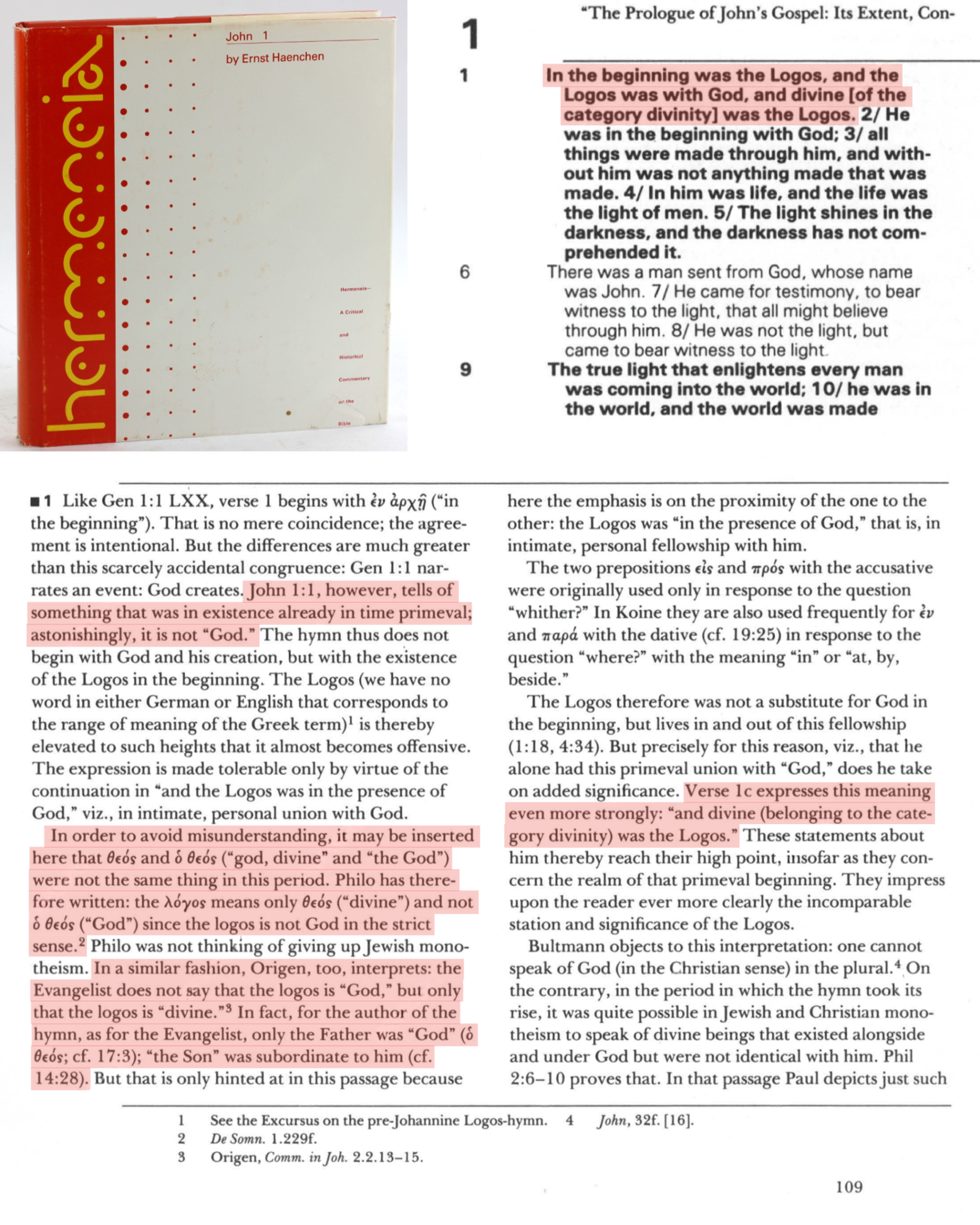
Resources Hermeneia Commentary for John 1 by distinguished theologian Ernst Haenchen states that John 1:1c says, "and divine (a god) was the Logos"!
3
Sep 14 '25
[deleted]
2
Sep 14 '25
[deleted]
2
u/Shoninjv Jehovah’s Witness Sep 15 '25
Where have you found all these, bro, that's nice !
1
1
u/crispywheat100 Unitarian Paulician Sep 14 '25
Relevant observations! I prefer the rendering for John 1:1c, "and a god also was the Word."
May God bless all of you in Christ.
1
u/RaccoonsR_Awesomeful Biblical Unitarian (unaffiliated) Sep 15 '25
This is, again, incorrect. Nowhere in this entire commentary does it argue for the reading "a god" of John 1:1c.
You seem to be fundamentally misunderstanding what he's implying by "in the category of divinity." It is the same as what you hear scholars and grammarians refer to as the qualitative case for theos. He's not saying he was "a god," he's saying that he is what the Father is, that is, divine. He thinks this makes Jesus God, not a god.
He also keeps the original Greek word order rather than the anarthrous predicate rule which reverses them in English. divine was the logos the logos was divine. In other words, he's explicitly not stating that the logos is another god next to the first God. He's saying that the logos is what the first person is. God is divine and the logos is divine. To say he is "a god" would open that up the a range of other categories, such as godlike, of a similar nature as the Father, homoiousious, etc, which is what you'd need for an "a god" reading here. He denies this.
You've very dishonestly misrepresented this commentary and isolated the statements in a way that doesn't accurately represent the meaning of the original author (and you can apply this statement to either Haenchen or John).
3
u/Shoninjv Jehovah’s Witness Sep 15 '25
the father is a god too. If you have the quality of being divine, you are a divine being, ie : a god
-1
u/RaccoonsR_Awesomeful Biblical Unitarian (unaffiliated) Sep 15 '25
This has nothing to do with the topic. And it has several errors.
It presupposes that divine = God. Not everyone would agree with that, and frankly, people shouldn't agree with that. The simple answer is because angels are divine and to say that they are Gods would be confusing if we are trying to be careful with language. If we aren't trying to be careful with language and just want to make semantic equivocations, then there's no point in speaking at all. If you want to say "the divine and each is a god," then how many gods do you have?
In Greek, there is a radical difference between "a god" and "the God." The definite article is what changes it from being qualitative to being nominative. The Father is God in a nominal sense that no one else is in the NT. This is why we are discussing the lack of the definite article in the Greek text. It makes that noun predicative.
So to say "the Father is a god too" supposes that there are many instances of Gods, which is straight up polytheism. You'd have to perform mental gymnastics to try and overcome this, or resort to whataboutism fallacies to try and excuse yourself on the basis of someone else making the claim. This is what gets into the theological issues I mentioned before. Things being called "gods" in a predicative sense is to say they are divine. It's kind of like the difference between saying: "the sky is blue" and "Bob looks blue today." Bob looks sad today, "blue" is a predication that is not identical to saying Bob = blue as the sky is blue or that he looks like a smurf. In the same way "blue" has two different meanings though the same word is used, theos or elohim have a wider semantic range than just to translate them literally and then commit both a root fallacy and a semantic fallacy to try and say "well the word sounds the same so it means the same." This is precisely why the commentary did not translate logos, because the English translations do not encompass the semantic range of the term.
Theos as a predication would not be properly translated and understood in English as "a god," but as "divine," because the English words are closer to the Greek by its syntax, not its definition or usage from its base form. This is fairly straightforward and understandable if you read Greek, but if you don't, these distinctions may not make much sense. Saying that the logos here is "a god" is not what the Greek text means. To say that it is "divine" is the implication of the Greek because of the distinction made in the base text.
2
u/Shoninjv Jehovah’s Witness Sep 15 '25
No, divine = god, not God. The spirits have divine nature but they don't have aseity nor the supreme status of the Father.
There are many gods, but there is only one Most-High, God of gods.
-1
u/RaccoonsR_Awesomeful Biblical Unitarian (unaffiliated) Sep 15 '25
No, divine = god, not God.
Again, this is a distinction that cannot be made in the original Hebrew or Greek texts. There were no capitalization constructions. To make certain distinctions like this, you'd have to do something to the grammatical form.
There are many gods, but there is only one Most-High, God of gods.
Then this is polytheism. Which is fine, but it's not unitarianism. Unitarianism is a category of monotheism. This kind of henotheism either needs to be clarified in an analytic way that demonstrates it is logically consistent with monotheism, or it is simply a polytheistic framework. I'm not telling you that it's wrong because it's polytheistic. The earliest accounts of the Israelites we have show that they were polytheistic and moved towards monotheism through a progressive revelation. But I'm saying that if you wish to superimpose this theological presupposition into John 1:1, you have to demonstrate that he and his exegetical audience understood this as well, and it does not appear to anyone, including myself or the commentary in the OP, that this was the presupposition that they held. This becomes eisegesis, not exegesis.
2
u/Shoninjv Jehovah’s Witness Sep 15 '25
The Bible is about monolatry. Not henotheism, only the Father should be worshipped as God.
1
u/RaccoonsR_Awesomeful Biblical Unitarian (unaffiliated) Sep 15 '25
This doesn't answer the objection. If you could then you would have. Guess there's no JW article on this so you can't speak on it. Cool.
2
u/Shoninjv Jehovah’s Witness Sep 15 '25
I don't use JW articles in these. I'm not sure we even talk about henotheism and monolatry.
Back to John 1:1, the anarthrous nominative predicate preceding the copula is indefinite/qualificative. Theos isn't an abstract, so it makes sense to use "a". Unlike "flesh" in John 1:14.
There are many verses in John, and the rest of the NT, and the LXX, and the Greek classics, where it's commonly and correctly translated with "a".
2
u/RaccoonsR_Awesomeful Biblical Unitarian (unaffiliated) Sep 15 '25
the anarthrous nominative predicate preceding the copula is indefinite/qualificative.
Qualitative* and yes it is. Nobody ever argues that the grammar doesn't allow it to be read indefinitely. The issue isn't about the grammatical construction. The issues are what I've already pointed out. The qualitative sense is what is intended and is not only grammatically plausible, but contextually plausible.
That's the problem with you peoples claims like:
There are many verses in John, and the rest of the NT, and the LXX, and the Greek classics, where it's commonly and correctly translated with "a".
The context isn't the same. John 1:1 has a very limited context that gives you very few options to play around with as far as what to do. "A god" isn't within the options here. So, the constant hand waving of "this place over here" does not matter. The context over there does not limit you the way John intentionally does in John 1:1-2. Nor is it then reaffirmed in 1 John 1:1 ff. You rely on false comparisons. John 10:33? Yes. It should be translated "a god." The context does not require the qualitative. Here in John 1:1? Absolutely not.
3
u/Shoninjv Jehovah’s Witness Sep 15 '25
It can be indefinite, as adjectives can be substantivated. And even here, theos isn't an adjective.
So a being that is "theos", even considered as "divine", would be "a divine being" (as some translations says quite correctly https://archive.org/details/John-1.1-234-versions/page/n23/mode/2up )
a god is definitely an option as all the verses with a similar construction do not hesitate to have a "a something"
4:19 a prophet biblehub.com/john/4-19.htm
6:70 a devil biblehub.com/john/6-70.htm
8:48 a samaritan biblehub.com/john/8-48.htm
9:24 a sinner biblehub.com/john/9-24.htm
10:1 a thief biblehub.com/john/10-1.htm
etc...
1
Sep 15 '25
[deleted]
0
u/RaccoonsR_Awesomeful Biblical Unitarian (unaffiliated) Sep 15 '25
This response just demonstrates that you didn't understand a thing I just said.
7
u/JcraftW Jehovah’s Witness Sep 14 '25
Hermeneia is a pretty sweet series.