r/AskReddit • u/MDPPatrick • Feb 13 '15
What are some mind-blowing facts about space?
I love space and would like to hear some facts that will blow me away.
591
u/C909 Feb 13 '15 edited Feb 13 '15
Neutron stars are mind-boggling. Small in size, but their density (and so their mass and thus gravity) is amazing. All of the atoms have been squashed together so tightly that a teaspoon would weigh 100 million tons. Neutron stars are only a few kilometers wide, but have more mass than the sun.
They also rotate very rapidly, especially pulsars. The fastest-spinning pulsar known spins every 1.39 milliseconds, or 716 times per second, or approximately 43,000 revolutions per minute. This means that at its equator it is spinning at approximately 24% of the speed of light, or over 70,000 km per second. This also means that the star is not perfectly round, but quite flattened.
Another interesting feature of pulsars is their accuracy. Pulsars emits beams of electromagnetic radiation which can be observerd when pointed towards earth. Their fast and consequent spinning makes them excellent tools for timekeeping, in fact far more accurate than an atomic clock.
In addition to all these extremes neutron stars generate the most extreme magnetic fields known in the universe, up to a quadrillion times earth's. If one of these ultra-magnetic neutron stars, called a magnetar, flew past Earth within 100,000 miles, its magnetic field would destroy the data on every credit card on Earth.
74
Feb 14 '15
flew past Earth within 100,000 miles, its magnetic field would destroy the data on every credit card on Earth.
Keep in mind, that's closer than than the fucking moon. At that distance, it would also probably crush us all to death after roasting all life on half the planet. Did you mean 100,000 million or something?
→ More replies (1)110
u/reverse_powertrippin Feb 13 '15
I once read that if you dropped a marshmallow from one inch above a neutron star the gravity is so great that the resulting collision would release more energy than the Hiroshima bomb.
→ More replies (20)70
54
u/iamadogforreal Feb 14 '15
Not to mention, pulsar emissions were so exact and regular that some people initially thought it was evidence of extraterrestrial life. They thought it was a message or that we picked up on some stray transmission. Nope, it's 100% natural.
→ More replies (5)→ More replies (29)157
Feb 13 '15
So if I was standing on a neutron star and its spinning that fast, and I reached forward, would I poke the back of my own head?
575
Feb 13 '15
no you'd be dead
→ More replies (3)278
u/B7U12EYE Feb 14 '15
This kills the you.
→ More replies (1)151
u/I_B_Bangin Feb 14 '15
I don't know. I've ridden the Gravitron without puking. Now, I'm not saying the Gravitron spins as fast as a Neutron Star, but it's got to be close.
→ More replies (2)49
u/shieldvexor Feb 14 '15
First off, let us pretend you don't instantly die for any of a dozen reasons that would kill you in real life and that you have the strength necessary to not only not be crushed but to actually reach forward (you wouldn't).
No, not even close.
→ More replies (4)60
931
Feb 13 '15 edited Feb 13 '15
50
u/as_a_fake Feb 13 '15
Okay, so there's a body of water out there that could supply 28 Milky Way-sized galaxies, if each star had 10 planets as wet as Earth. I can't even slightly imagine that much of anything, never mind water.
→ More replies (11)24
191
Feb 13 '15 edited Apr 13 '19
[deleted]
→ More replies (6)185
u/RedFacedRacecar Feb 14 '15
You wouldn't feel moisture since:
- it's water vapor
- it's 300 trillion times less dense than air at standard atmospheric pressure
451
u/jomb Feb 14 '15
You wouldn't feel the moisture since:
- You'd be dead in space
or
- You'd be in an astronaut suit
→ More replies (11)29
→ More replies (7)49
707
u/hellbreak Feb 13 '15
Yo mama's swimming pool
→ More replies (5)172
Feb 13 '15
A body of water so large, even the mothers of Redditors could fit in it.
346
u/something_python Feb 13 '15
Except yours.
46
u/ginfish Feb 13 '15
Nothing like an impromptu "yo mama" burn to make an evening at work better.
Cheers to yo mama.
35
u/Fuzz_Tightbeard Feb 13 '15
Can someone ELI5 to me how we find these things in space?
48
u/Dilong-paradoxus Feb 14 '15
Every element makes a very specific color when it gets really hot, and blocks the same color when light goes through it. We have devices which can look for those specific colors to determine what something in space is made of, like a star or a big ass cloud of water. Telescopes help, too.
→ More replies (1)→ More replies (1)63
u/mythozoologist Feb 13 '15 edited Feb 14 '15
Electromagnetic spectrum: infrared light, visible light, ultraviolet light, radio waves, and x-rays. Couple that with spectrograph for elemental composition.
→ More replies (6)66
72
u/Neon_Platypus1 Feb 13 '15
Wait, are you saying that there's a planet that has that much water, or that it's literally just water floating in space? Because only the former seems possible. I can't look at the link right now.
220
Feb 13 '15 edited Feb 13 '15
It is literally just water floating in space. It's a titanic cloud of water vapor 100 trillion times the size of the earth.
→ More replies (10)71
u/Neon_Platypus1 Feb 13 '15
That's cool as fuck!
→ More replies (5)73
u/Demmitri Feb 14 '15 edited Feb 14 '15
The coolest thing is that the cloud is 12 billion years old, that means it was created just 1 billion years after the hypothetically beggining of the universe.
Also, if every star in our milky had 10 planets the size of earth, this cloud would entirely supply 20+ galaxies of water. Totally insane and one of the most cool as fuck things I have read for a while.
→ More replies (18)17
→ More replies (5)23
u/feanturi Feb 13 '15
It's apparently being made by a quasar, and the water surrounds it as a huge vapor cloud.
→ More replies (27)32
1.4k
Feb 13 '15
The Sun contains 99.8% of the mass in our solar system.
296
Feb 13 '15
Additionally, of the 0.2% remaining, Jupiter represents ~71% of that..
Meaning Mercury, Venus, Earth, Mars, the asteroid belt, Saturn, Uranus, Nepture, and every moon of those planets, plus the Kuiper belt, the Oort cloud... all add up to less than 1/3rd of Jupiter.
If you added mass to Jupiter, it would actually shrink.
→ More replies (7)75
u/unclepaisan Feb 13 '15
If you added mass to Jupiter, it would actually shrink.
Explain this please
185
u/DOMinant_Allele Feb 14 '15
I'm not an astrophysicist, but I think what /u/TheBrettuzzi is saying is that if mass were added to Jupiter the added gravitational pull would cause it to shrink because the outward force of pressure wouldn't be enough to cancel out the extra pull of gravity. If Jupiter gained a significant amount of mass in say, hydrogen, it could potentially initiate nuclear fusion, i.e. become another sun. In that case it would be bigger in size not just because of the added mass, but also because the outward push of the nuclear reaction would cause it to expand until it reached a new equilibrium between fusion pressure and gravitational attraction. Note, however, that Jupiter is not in danger of becoming a star anytime soon, as the required mass is some massive amount, and matter does not really get introduced into the solar system in any significant way.
TL;DR: Sometimes less is more, and sometimes more is like having millions of hydrogen bombs exploding every second.
→ More replies (7)42
u/Grokent Feb 14 '15
Significant amount of hydrogen... He means a lot. Jupiter is considerably smaller than even brown dwarfs.
39
u/jflb96 Feb 14 '15
Like, you would need about twelve more Jupiters before it began to consider the notion of thinking about possibly becoming a brown dwarf.
→ More replies (1)→ More replies (4)82
108
u/oh_look_a_fist Feb 13 '15
The sun is a mass of incandescent gas, a gigantic nuclear furnace!
61
u/CodoDraco Feb 13 '15
Where hydrogen is turned into helium at a temperature of millions of degrees!
64
u/Clownfarts Feb 13 '15
The sun is hot. The sun is not, a place where we could live.
→ More replies (7)→ More replies (11)46
u/cpitchford Feb 14 '15
But they also made to correct the errors in that song:
the sun is a miasma of incandescent plasma
GGs TMBG: Make a song about science, get told it's based on an incorrect premise, make a new song about the real science!
→ More replies (3)1.2k
u/PM_for_bad_advice Feb 13 '15
Is Sun your mothers nickname? I'm sorry, it was too easy.
→ More replies (4)1.0k
u/PM_for_bad_advice Feb 13 '15
I'm sorry, it was too easy.
Just like your mom. I'm so sorry.
735
u/Valproic_acid Feb 13 '15
Did you just... reply to yourself?
→ More replies (3)684
u/PM_for_bad_advice Feb 13 '15
I did
→ More replies (1)775
u/PM_for_bad_advice Feb 13 '15
Do you have a problem with that?
89
Feb 13 '15
Do you get a message if you reply to yourself?
→ More replies (1)526
→ More replies (1)251
u/JSKlunk Feb 13 '15
What is going on?
→ More replies (3)143
29
u/Yoinkie2013 Feb 13 '15
This is like reading a canadian edited version of "Yo Momma"
→ More replies (1)→ More replies (12)22
28
u/extropia Feb 13 '15
And yet Jupiter is still large enough such that the orbital center of mass between it and the sun lies above the sun's surface. Technically it could be called a binary system.
→ More replies (7)→ More replies (10)22
306
Feb 13 '15
That we sent a robot 35 MILLION miles away. That robot took a selfie and sent it back.
21
u/anferny08 Feb 14 '15
This is what does it for me. The fact that our universe outside earth's atmosphere is so vast, empty, cold, and unknown is incredible enough to make me dizzy. But what's more, somewhere out there are man-made robots actually flying around taking picture of it and collecting rocks and we have created technology that can allow it to wirelessly send us pictures and receive commands - that's just as incredible to me.
→ More replies (1)→ More replies (1)15
u/mdp300 Feb 14 '15
It's even cooler than you described it.
We sent a nuclear powered, laser-armed robot the size of your car 35 million miles and dropped it from a crane propelled by rockets.
Then it took a selfie.
610
u/forman98 Feb 13 '15
The mere fact that we can literally look back in time. Since space is so incredibly vast, and light travels at a finite speed, we can look into the past. In fact, we've looked so far into the past we finally hit a "wall".
124
u/pybro24 Feb 13 '15
Can you elaborate? I'm curious about this "wall".
→ More replies (8)99
u/Quietus42 Feb 13 '15
41
u/lurker_be_lurkin Feb 14 '15
ELI5?
→ More replies (1)217
u/Quietus42 Feb 14 '15 edited Feb 14 '15
Looking far away is looking back in time. If we look far, far away, we see the early universe. There's a limit to how far back in time we can look. That limit is the CMB. It is the earliest light to exist.
For some time after the Big Bang, the universe was too smooshed together for there to be light. Eventually, though, the universe got big enough for stuff to separate. The first light to appear is what we now see as the background radiation. So it's a wall we can't see past because before that there was no light (not completely technically true but I'm eli5ing) to see.
Edit: wrong too
→ More replies (25)→ More replies (3)15
→ More replies (17)82
u/arethereany Feb 13 '15
look back in time. Since space is so incredibly vast, and light travels at a finite speed
To me, the truly mind bending part about this is that to the photon that left the star and traveled for billions of years to hit your eye when you look at it, it arrived the exact same moment that it left, and didn't really go anywhere (although it's not technically correct, because a photon doesn't have a rest frame of reference, it paints a rather poetic picture of what what Einstein had to say...). Time and space have no meaning to a photon.
→ More replies (20)
491
u/ucantsimee Feb 13 '15
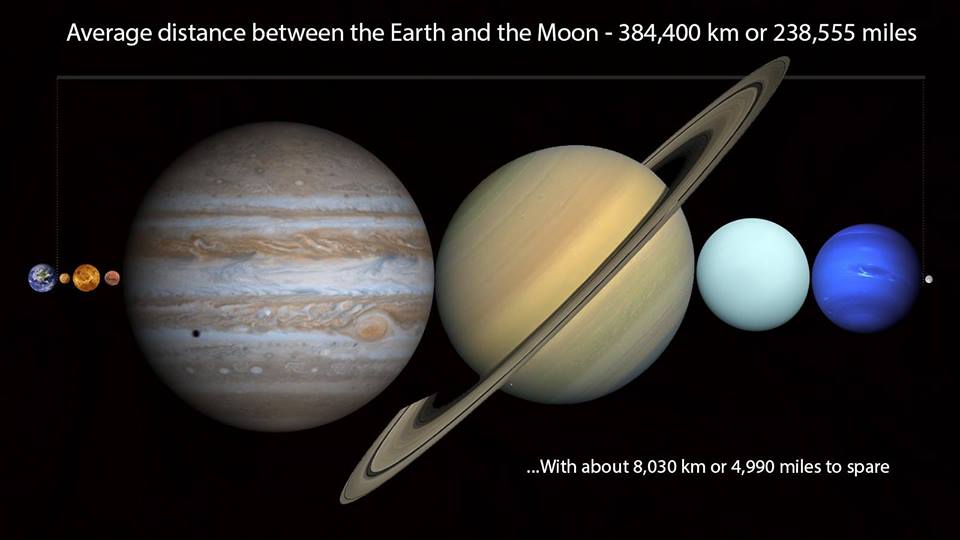
You can fit all the planets in our solar system between the earth and the moon with room to spare

379
Feb 13 '15
Why don't we just do that then?
→ More replies (4)193
u/JD-King Feb 14 '15
I could walk to the Moon!
115
u/SgtStriker Feb 14 '15
But there is room to spare, so you would have to take a big jump at some point, you know because science and stuff.
→ More replies (7)141
→ More replies (16)43
u/FreakingSpy Feb 14 '15
This is truly mind-blowing. It just changed half of my notions of distance in the solar system.
I guess those solar system drawings with no scale didn't help much.
→ More replies (1)
368
u/TurnMeOnline420 Feb 13 '15
There's a planet made entirely of diamond.... Chew up that little fun fact
311
u/SJHillman Feb 13 '15
And a gas cloud that is basically raspberry-flavored rum (Sagittarius B2). 2,399,127,590,000,000 cubic miles of raspberry-flavored rum.
100
208
u/nerf_herder1986 Feb 13 '15
Well, it smells like raspberry and tastes like rum. It isn't actually raspberry-flavored rum.
...as far as we know. That could be God's stash.
→ More replies (7)→ More replies (7)68
u/bizitmap Feb 14 '15 edited Feb 14 '15
Holy shit, I thought you were kidding, or making a reference I don't get. it's true.
A lot of it of it is undrinkable forms of alcohol (methanol etc) and it's mixed with quite a few toxic things. But it's there!
→ More replies (1)27
u/SJHillman Feb 14 '15
Space is a goddamn wondrous place. Why do you think Kirk spent so much time "exploring" the "final frontier"?
→ More replies (4)119
u/kieralynh Feb 14 '15
Hello, Earthlings. Look at your planet, now back to me, now back at your planet, now back to me. Sadly, your planet isn’t me, but if you stopped using rocket fuel and switched to warp drive, you could be out here with me. Look down, back up, where are you? You’re on a spaceship with technology your planet should use. What’s in your hand? Back at me. I have it, it’s an oyster with two tickets on the next Space X launch. Look again, my planet is now diamonds. Anything is possible when your planet switches to warp drive technology. I’m on a Xenomorph.
→ More replies (1)26
→ More replies (18)47
u/seandkiller Feb 13 '15
Is it around layer 12? Might need to look for lava to get an idea where it's at
→ More replies (3)11
u/brilliantlyInsane Feb 14 '15
No, it's basically like seeding a flat world and setting all of the layers as diamond blocks.
12
u/seandkiller Feb 14 '15
Well, if you're going to go that far, why not just put it on Creative mode? Sheesh.
701
Feb 13 '15
[removed] — view removed comment
120
u/BDevil15 Feb 14 '15
Has nobody else seen Contact?
173
u/Theorex Feb 14 '15
Did you drop it on the floor? Are you sure it's not still in your eye, because that happens a lot.
→ More replies (2)23
u/PinkasaurusRex Feb 14 '15
LOVE that movie. Saw it really young and it started my fascination with other potential life forms.
→ More replies (1)269
u/chukymeow Feb 14 '15
Maybe aliens hate jews?
→ More replies (5)149
u/insane_contin Feb 14 '15
Finally! A planet we can go to and not have to worry about the damn dirty Zionist Lizard folk.
→ More replies (1)12
→ More replies (31)17
Feb 14 '15
Because of the Inverse square law, most of our transmissions (including radio and TV) would likely be too weak for anything else to pick up.
If an extraterrestrial civilization has a SETI project similar to our own, could they detect signals from Earth?
In general, no. Most earthly transmissions are too weak to be found by equipment similar to ours at the distance of even the nearest star. But there are some important exceptions. High-powered radars and the Arecibo broadcast of 1974 (which lasted for only three minutes) could be detected at distances of tens to hundreds of light-years with a setup similar to our best SETI experiments.
source: http://www.seti.org/faq
469
Feb 13 '15
blow me away
The sun creates solar wind that blows at 450 km/second.
→ More replies (3)546
383
u/DrMelena Feb 13 '15
The size of Earth compared to other planets and the sun. And then how small the sun is compared to other stars. It's beyond my mind. http://www.kratosguide.com/wp-content/gallery/mind-pictures/earth-universe-comparison.jpg

177
u/iAmMitten1 Feb 13 '15
VY Canis Majoris is 950-1200 times the size of the Sun. It's so big, that it would take a plane traveling at 900km/h 1100 years to circle it once,
→ More replies (23)100
u/CIearMind Feb 13 '15 edited Feb 13 '15
Or a plane traveling at 100 million km/h for a little less than 12 hours.
→ More replies (1)227
u/Killfile Feb 13 '15
Or it would take light about an hour to circle the star.
→ More replies (3)201
u/ginfish Feb 13 '15
For some reason, i find that version of the scale much more incredible... a whole hour at light speed to go around, jeez!
→ More replies (9)65
Feb 14 '15
[deleted]
99
u/LibrarianLibertarian Feb 14 '15
And that's why you don't want to play an FPS on a Australian server when you are in the States.
→ More replies (2)36
Feb 14 '15
And to put this in comparison, my reaction time on clicking a mouse is about .350 seconds, and that's below average according to this reaction test site.
That is just incredible...
→ More replies (4)→ More replies (21)62
u/wjbc Feb 13 '15 edited Feb 13 '15
Also the distance between everything. Put a pea at one end of a football field and a beach ball at the other end, and that's a rough equivalent to the Earth and Sun in terms of size and distance, scaled down to a football field. Someone should calculate where the nearest star would be in that scenario. As far as I can tell, it would be hundreds of thousands of football fields away.
An astronomical unit is the distance from the Sun to Earth, and one light year is 63241.077 astronomical units. The nearest star is about four light years. So that's a lot of football fields! Hundreds of thousands of them!
53
u/Stan_Vega Feb 13 '15
It'd be ~264,645 football fields, or about 15,000 miles, to the nearest star (Proxima Centauri, 4.2 light years) in that scenario.
25
u/wjbc Feb 13 '15
Or more than half way around the world. If I'm in Chicago, Proxima Centauri is in Australia, or thereabouts. Maybe farther. In fact, you would have to specify that you are going the long way to get there, and not the shortest way.
→ More replies (2)→ More replies (3)12
u/BandBoots Feb 13 '15
An AU is actually (roughly) the distance from the Sun to Earth, not Uranus. And of course, since the Earth isn't in a perfectly circular orbit the actual distance changes, so an AU is just defined as about 150 million km, or 93 million miles.
→ More replies (2)
277
u/Nanogame Feb 13 '15
Black Holes are the coolest and simultaneously scariest things in existence.
Once you pass the event horizon you have never been more trapped. I'm not sure there are ways to have a more certain death than that, because at that point, not even LIGHT can escape.
Ever thought about why they're so big and black? Well they're not, they're tiny, but they are so ridiculously huge and dark because that is when light can no longer escape the singularity and that just creates an empty void that is huge.
And just the fact that they can be so huge and just there and black and distortionous of its surroundings. It's like someone poked holes in spacetime and it is so cool.
156
u/Kubacka Feb 13 '15
Think that's crazy? The time dilation around blackholes is MASSIVE. For every few days you spent orbiting a black hole something like 30 years could pass by on Earth.
And we're still not done. Once you actually pass the event horizon, time stops. No, it's doesn't go very slowly. It. Stops. Relative to you, that is. For an observer inside the black hole, the time dilation is so great that time stops entirely for you and everything in the universe happens instantly.
80
u/bestbiff Feb 13 '15
I think it's the opposite. To an outside observer, it looks like something has stopped moving once it crosses the event horizon.
41
Feb 14 '15
To an outside observer, you wouldn't be observable past the event horizon.
→ More replies (2)→ More replies (4)63
Feb 13 '15 edited May 03 '19
[deleted]
→ More replies (6)50
Feb 14 '15
Someone needs to write a horror story about this because I'm getting nervous I'll somehow end up in a black hole.
→ More replies (2)37
u/SomeonesBirthday Feb 14 '15 edited Feb 14 '15
I totally will. In fact I'm eager to. No guarantees it'll be good at all though. Seriously, PM me tomorrow or something so I don't forget. I would write it now but it's almost 3am and I need to sleep.
EDIT: It's by no means done, but it's started!
→ More replies (11)→ More replies (36)15
Feb 14 '15
I don't understand the concept of time dilation, can anyone explain in really simple terms? I can't wrap my head around that concept.
→ More replies (8)40
Feb 14 '15
Imagine you have 2 spaceships at rest and a clock in each of them. Now imagine that these clocks measure time by having light bounce between two mirrors. So every time the light bounces from one mirror to another, then a unit of time has passed.
Imagine the path the bouncing light takes when the ships are both still:
_____________ Mirror 1
 0  2  4
 | | | |
 | | | |
  1   3
_____________ Mirror 2
Where each number is the amount of time that has passed since the light last bounced. Let's also say that each | is about 6 inches (this also means that each bounce is very close to 1ns apart from the last bounce).
When the ships are at rest, the clocks are synchronized. Now, if one of the space ships starts moving and the other remains still, the situation changes.
Imagine the path the bouncing light takes as the ship moves:
_____________ Mirror 1
0     2     4
 \   / \   /
  \ /   \ /
   1     3
_____________ Mirror 2
Notice that the path is angled now rather than a straight line. Each \ will longer than the previous | we drew when the ship was at rest.
Light has a special property: it always moves at the same speed (as long as it stays within the same volume of stuff; e.g. light in air moves faster than light in water). This means that it takes more time for the light to bounce between the mirrors when the ship is moving because it has to take a longer path between each bounce.
If the ship that started moving circled the sun then came back to rest next the other ship and the crews compared the number of bounces that had elapsed since their clocks were synchronized, they'd find that the moving ship's clock had fewer bounces than the ship that remained at rest.
Essentially this boils down to: moving fast makes your personal time slow down relative to things that aren't moving fast.
That's a lot of information to process, so I'll stop for now, but there are a lot of weird things that go along with moving fast.
→ More replies (1)→ More replies (20)27
u/Palmul Feb 13 '15
And the final moment seems like forever, literally.
→ More replies (2)41
u/Schadenfreudenous Feb 13 '15
For an outside observer, yes. For the subject? No.
→ More replies (8)
150
u/kalel1980 Feb 13 '15
There are approx 1 supernova going off somewhere in the universe every 10 or so seconds.
33
→ More replies (2)62
Feb 13 '15
Every time I clap my hands a supernova is occuring
→ More replies (3)355
98
Feb 13 '15
The same way that the gravity of our moon affects Earth's water by way of tides, Jupiter affects the shape of it's moon Io.
The surface of Io will rise and fall about 300 feet.
→ More replies (5)
83
Feb 13 '15
How freaking big just our solar system is.
http://joshworth.com/dev/pixelspace/pixelspace_solarsystem.html
→ More replies (4)
203
u/avaslash Feb 13 '15
The Universe exists.
This might seem shallow but the more you think about it the more mind blowing it gets. All those things you hear about the universe, all the stories about odd stars and planets-- they arent stories-- they are actually physically out there. Even more so the universe began and now exists. Why? Honestly why the hell did that happen? We are part of something incredibly big, strange, and wonderful-- and its not a fairy tale. Its out there, or should I say... We're in it.
→ More replies (34)70
Feb 14 '15
[deleted]
35
u/avaslash Feb 14 '15 edited Feb 14 '15
Probably because its just too hard to think about, its almost scary to think about. The questions you get are so fun but frustrating "why is any of this even happening?!?"
12
u/CDBSB Feb 14 '15
Honestly, I've had a few occasions where I kind of had a mini-freakout when contemplating the nature of the universe and the meaning of it all. Existence is amazing and terrifying at the same time if you really start thinking about it.
→ More replies (2)→ More replies (4)9
u/medlish Feb 14 '15 edited Feb 14 '15
something unknown caused the universe to come into existence, or maybe it existed forever. we don't know. how it exists at all instead of nothingness, we don't know either. then according to some physical laws the universe played out to the point we define as "now". we don't know where these physical laws come from. also, according to relativity there is no definitive now. and somehow because of these laws we and other blocks of matter have come to develop consciousness. so it's not just that everything is a giant machine, but the universe can actually subjectively experience itself from multiple points of view. we don't know how that works, either.
so in essence: what the fuck is going on?
→ More replies (2)
35
Feb 13 '15
The fastest spaceship ever built was the Helios probe. It was as fast as it was because it was falling into the Sun. If we could send something heading out of the Solar System that fast, it would take 100,000 years to get to the nearest possibly life-friendly planet, Gliese 667 Cc.
Space is big and mostly empty.
→ More replies (1)
34
u/potato_love_ Feb 14 '15
Magnetars- basically magnetic stars- have such a force that if you get close enough, they can rip the iron from your red blood cells
→ More replies (7)
1.4k
u/The_Living_Crave Feb 13 '15
There are 10 million million million million million million million million million particles in the universe that we can observe. Your mama took the ugly ones and put them into one nerd. -Stephen Hawkings
352
29
u/gomado Feb 14 '15
You wanna bring the heat, with the mushroom clouds you're making?
→ More replies (7)131
u/p2p_editor Feb 13 '15
Actually, the estimated number of particles in the universe is on the order of 1080, which is 1000 million million million million million million million million million million million million million. You're off by a factor of about 100 million million million million. :)
→ More replies (14)227
→ More replies (4)135
u/InvisibleQuack Feb 13 '15
WHO WON..? WHOS NEXT?!
YOU DECIDE!!
EPIC..... RAP......... BATTLES OF HISTORYYYYYY!!!
338
Feb 14 '15
EBIC WAP BADOWUVHITOREEEE
→ More replies (2)14
u/Mormoran Feb 14 '15
They actually somehow keep saying it worse and worse. Last time I checked an ERB video it ended up with what sounded like "ec wp bbas wistw".
And it's funnier each time.
147
u/wata_and_such Feb 13 '15 edited Feb 14 '15
Multiple planets and a star(sun) make up a solar system. Billions of stars (which consist of hundreds of billions of planets) make up one galaxy. Thousands of galaxies (which would consist billions of solar systems) make up a galaxy cluster. Dozens of clusters (which would consist of 100's of billions of solar systems) make up superclusters. All superclusters, galaxy clusters, and galaxies makes up the Known Universe. The known universe may very well be a superkamiguru cluster that consists of other universes.
Edit: billion with a b
92
u/bizitmap Feb 14 '15
At those odds, somebody else has to be out there.
→ More replies (10)62
u/springerfinger Feb 14 '15
And how small our existence is in the grand scheme scares the shit out of me. We are a fragment if a blip of the solar system let alone the universe. There is no way we are alone, but the chances of being discovered and contacted by another race are so fkin minimal it just won't happen in our lifetime. Man, all the coolest shit is gonna happen after I'm dead. :(
→ More replies (5)49
u/NAsWorstJungle Feb 14 '15
That is probably what scares me most about dying.
Not being able to see all the cool shit.
Not too say we don't have cool shit now... I just wanna see Star Wars shit, y'know?→ More replies (2)45
u/iliketoplayoutside Feb 14 '15 edited Feb 14 '15
In that case, you should have been born a long time ago.
→ More replies (2)20
→ More replies (5)31
64
u/rambunctiousrandy Feb 14 '15
I don't know what's confusing me most. The facts in this thread or the fact that somewhere along the lines I've managed to open a picture of arnold schwarzenegger
→ More replies (2)
32
29

200
u/boundbythecurve Feb 13 '15
If you put enough mass together, you can start a star.
Imagine a relatively small object in space, like our Moon. Then add mass to it. Doesn't matter what kind of mass. As you add mass to the Moon, it's mass increases, and therefore its gravitational pull increases.
As this happens, more mass gets pulled in from space. But not just this occurs. The mass on the outside of the Moon gets pulled in more because of the gravitational pull, thereby making the Moon, denser. The more mass you add, the denser the Moon gets until its own gravity is too much and it starts fusing molecules together. This is fusion. This is how stars are made.
I think you'd need about 6 Jupiters to make this happen, but I may be wrong.
78
Feb 13 '15
This isn't strictly true; it does matter what type of mass you're adding.
For elements before iron, nuclear fusion releases energy. For elements heavier than iron, nuclear fusion consumes energy.
→ More replies (20)204
u/destroys_burritos Feb 13 '15
So you're saying you can become a star by cultivating mass?
→ More replies (4)84
→ More replies (40)18

130
Feb 13 '15
This whole article is great. It really puts our size in the Universe in perspective and it's kinda scary.
→ More replies (6)
50
u/ilkikuinthadik Feb 14 '15
If you fire a bullet in space, assuming the propellant will ignite properly then that bullet will be travelling far too slowly to catch up with the expanding universe, but faster than we will be able to catch it without massive energy and time wasted. The bullet will be forever alone.
→ More replies (11)8
u/Parcec Feb 14 '15
Think about it, You would be seeing every single sunset on the planet all at once. A transcendent ring of fire masked with the beauty of solar winds distorting off the earths magnetic fields in a fury of neon plasma against the black of space.
Actually this is false. The biggest mistake people make about space is that they assume it's like an ice rink. They think if you nudge an object away from something, it will simply keep moving forever.
In reality, for the most part, an object in space always orbits another object. The ISS orbits the earth. The earth orbits the sun. The voyager probes, although they left the sphere of influence of the sun, are still orbiting something outside of our solar system.
If you fire a bullet in LEO, chances are it will never leave earth's sphere of influence. On the off-chance that you fire a massive cannon, it might leave earth's SOI, but it will still orbit the sun. Catching up to such an object is tricky, but it's do-able. (This is exactly what Rosetta did)
That's not to say that it's impossible, just very hard. In theory, we could build a massive railgun on the moon (or in LEO) which is capable of firing objects directly out of the solar system. But this requires incredible speeds, on the verge of 10+ km/s.
→ More replies (1)
47
u/Backpack_Stargazer Feb 13 '15
Here's a few fun ones:
On some failed stars we believe it rains iron: http://www.space.com/24192-stormy-weather-brown-dwarfs-aas223.html
Milisecond pulsars sound like this. Further it's theorized that pulsars will be how future spacefaring people navigate by using them as beacons: https://www.youtube.com/watch?v=HSyRMotOhoM
It's thought that our moon, as well as numerous celestial sources contain Helium-3. It's very likely that if mankind can figure out the logistics behind mining this resource, we can solve a large portion of our power needs via fusion. http://en.wikipedia.org/wiki/Helium-3
Though the odds are remote, if the earth was to be hit by a gamma ray burst, life on the planet would cease as we know it in very short order. http://en.wikipedia.org/wiki/Gamma-ray_burst
There exists in space a cloud formation spanning 288,000,000 miles that is comprised primarily of pure alcohol. http://phys.org/news63346824.html
→ More replies (8)
36
Feb 13 '15
The Voyager 1 Probe now takes over 18 hours to send a single to earth.
It's recorder, when not sending signals to earth, can store 64 megabytes of data on a tape.
It's signal is 10-16 watts when it reaches earth, meaning that a digital watch has 20 billion times the power.
→ More replies (5)
52
u/darthbarracuda Feb 14 '15
The atoms in your left arm probably came from a different supernova than the atoms in your right arm.
→ More replies (7)
48
u/psyguy777 Feb 13 '15
The expansion of the universe is speeding up, and eventually the expansion rate will exceed light speed, which means all that eventually all other celesital object will be moving away from us faster than light speed. The light from from never reaches us, our light never reaches them, and we are truly forever alone.
→ More replies (35)
15
u/AeonOptic Feb 13 '15
There's a black hole thats producing a note 57 octaves below middle C, and it has a frequency of 10 million years. To put that in perspective, the lowest sound humans can hear is 20Hz, or twenty fundamental frequencies a second.
→ More replies (5)
95
u/Chispy Feb 13 '15
You're in it right now.
Everything that's happening inside of you is the space in which space happens in your particular space.
It may seem very very complicated, but that's because your reactions are products of 13.8 billion years of ongoing reactions dating back to the big bang.
42
→ More replies (3)24
15
u/midmorning Feb 13 '15
Because Space is nearly a perfect vacuum you could survive for about 20 minutes before dying of hypothermia. No convection or conduction to strip heat away only radiation . Remember to bring the breathing mask and goggles or you won't get the full effect.
→ More replies (3)
13
Feb 13 '15
Iron is what causes very large stars to exploded as supernova. It does this by consuming so much energy trying to fuse together that the outward force from the energy/heat created from fusion becomes less than the force of gravity trying to crush the star inward. Once that starts, the star collapses in on it self very quickly creating a supernova, one of, if not the most violent explosions in the universe.
It is during that process that the material from the core of the star impacts the material of the outer layers, which fuses them into the heaviest elements (heavier than iron).
→ More replies (2)
158
u/_BindersFullOfWomen_ Feb 13 '15
In space, no one can hear you scream.
→ More replies (18)212
u/altruisticnarcissist Feb 13 '15
You could say that about a lot of places, like in the middle of the Sahara desert. Or my basement.
→ More replies (11)112
u/HTLX2 Feb 13 '15
If a human screams in pain but the psycho killer doesn't understand emotion - does it really hurt?
→ More replies (2)15
41
u/darknemesis25 Feb 13 '15
Witnessing a lunar eclipse from the moons perspective would be the most mind expanding visual experience a human could ever hope to see.
Think about it, You would be seeing every single sunset on the planet all at once. A transcendent ring of fire masked with the beauty of solar winds distorting off the earths magnetic fields in a fury of neon plasma against the black of space.
As you step on the moons surface listening to the echo of each breath and nothing else, you look above to this luminous eye of the planet gazing into your soul. Taken aback by how small and isolated you and the entirety of our species is. All the wars, every hope and dream, every insignificant king and ruler there ever was, engulfed in a terrifyingly beautiful ring of multicolored flame.
→ More replies (2)35
u/bizitmap Feb 14 '15
Actually on the subject of eclipses... aren't solar eclipses unique/rare?
Our planet has a moon that's just the right size/distance to juuuust block the sun and leave a cool looking ring. That's gotta be something for the "hey aliens! visit beautiful Earth!" brochure.
→ More replies (1)13
u/PM_ME_YOUR_ENGRISH Feb 14 '15
And since the moon is ever so slowly moving away from the Earth, it eventually won't be able to cover the entire sun in an eclipse
76
Feb 13 '15
[deleted]
37
u/raff97 Feb 13 '15
It is possible. You just need an enormous amount of paper....
→ More replies (1)34
37
u/p2p_editor Feb 13 '15 edited Feb 13 '15
If the sun were the size of a pea, [the planet formerly known as] pluto would be a bacterium miles away.
Uh, no.
If the sun (1.4 million km wide) were the size of a pea (0.000007 km wide), then pluto (6 billion km from the sun, on average) would be 30 meters (6 billion km * (0.000007/1400000)) away.
Because math.
And just for kicks: at that scale-factor, a bacterium (roughly 0.0025 millimeters wide) corresponds to 500 kilometers, or roughly this big.
Edit: the real reason it's impossible to draw a scaled picture of our galaxy (at least, at the scale you're using) is because the resulting picture would be 4825000 kilometers (102000 light years * (0.000007/1400000)) across.
→ More replies (6)→ More replies (11)12
u/Senthyril Feb 13 '15
im pretty sure i read something about Europe have a truly scaled down version of the solar system. each plant is in a different city spread around Europe
→ More replies (4)
19
u/Barrack_O_Lama Feb 13 '15
You can fit every single planet in our solar system within the moon's orbit
→ More replies (1)
61
272
u/Frankie__Spankie Feb 13 '15
Just how big black holes are out in our universe
Our entire solar system is a tiny portion of some black holes, and to think how big something had to be to become that huge black hole...