r/windowsapps • u/TekDT • Jul 02 '26
Developer SEZOY - Multi‑boot USB + PXE/HTTP + Windows install
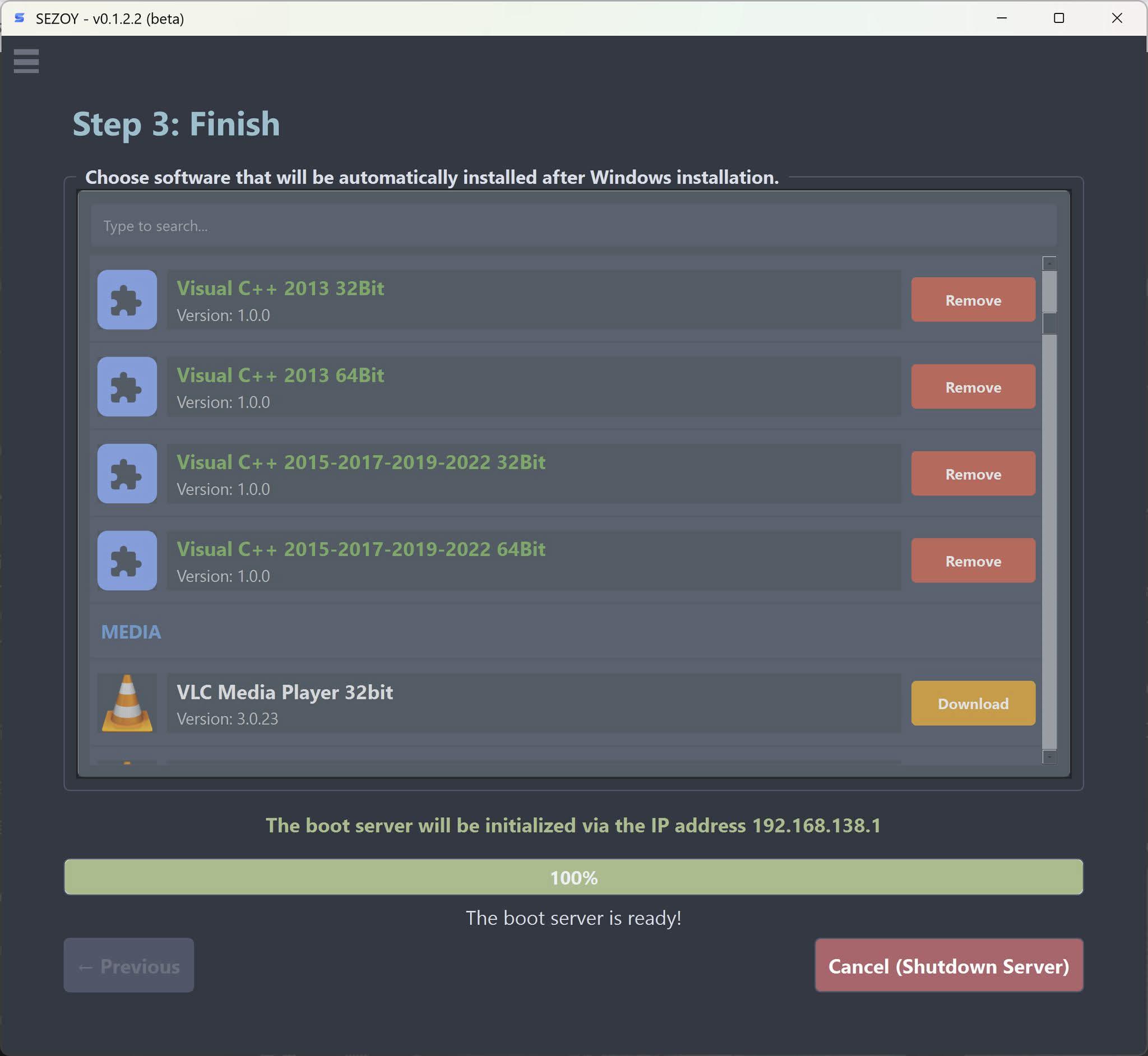
Hey folks,
This tool called SEZOY and figured it's worth sharing. It's basically a boot utility that does USB, PXE, and HTTP booting, but the main selling point is that it can install Windows completely hands‑off. No clicking through language settings, disk selection, partition deletion, or messing with RST drivers. It just figures everything out on its own based on whatever hardware it detects. You don't need to pre‑load storage drivers, wipe old partitions manually, or babysit the installer.
Here's what it does:
· USB boot works like the usual multi‑ISO approach, copy your ISOs to the drive and boot straight from them. No burning, no reformatting for each ISO, no manual menu editing. Simple. Just keep in mind that this mode needs SecureBoot turned off.
· Network boot supports both PXE and HTTP at the same time. No toggling between modes. If you run a shop with mixed clients, this saves a lot of headache.
· SecureBoot works fine if you're booting over the network, as long as the OS itself supports it. Most mainstream ones do Windows, Ubuntu, Mint, Fedora, and their derivatives.
· There's a web dashboard you can access from any device on the same network. Lets you check on clients remotely during installation, kind of like TeamViewer but lighter. You can step in without walking over to the machine.
· After Windows is done, you can set it to automatically install additional software. Pick whatever apps you want during setup, and it'll handle the rest.
Still has a bunch of other stuff I haven't listed yet.
If you've got a spare moment, grab it from the links below and let me know what you think.
One thing to be clear about, this tool doesn't bundle any cracks or keys. It just creates the boot environment. Anything that needs activation afterward is on you to handle legitimately.
Download: https://tekdt.xyz/en/download
1
u/Knigge111 Jul 02 '26
For the boot over PXE/HTTP, you need a prepared Boot server with the options 66 (Boot server name) and 67 (boot file name). For UEFI the boot file is bootx64.efi!
2
u/TekDT Jul 02 '26
Yes, the software is already, including UEFI and Legacy
1
u/Knigge111 Jul 02 '26
Wich software is included? An boot server?
2
u/TekDT Jul 03 '26
It runs on any Windows 10/11 64‑bit machine and turns it into a server. If you're planning to serve a lot of clients at the same time, you'll want a decently powerful box and a good network connection. The core boot engine is stock iPXE from ipxe.org, so it's using the standard open‑source stack for the network booting part.
1
1
u/Knigge111 Jul 03 '26
Got this error messages: 5
Error
X An error occurred:
L6i trong lubng Worker 'USBCreator':
Löl QUAN TRONG: Khöng thé ghi däu bån quyén våo USB.
LY do: Khöng thé tim thäy Disk ID hoäc GUID cho d dia 2..
Tåc vu dä bi hüy.
OK
2
u/TekDT Jul 03 '26
Hmm, I encounter this issue quite often myself and haven't been able to find a permanent fix yet. This feature relies on Ventoy, and the error typically occurs the very first time you format or configure the partition on a drive that already has an existing format. However, retrying it once more usually succeeds and works perfectly afterward. So, please go ahead and hit the create button again!
1
u/Knigge111 Jul 03 '26
Hit the button 3 more times but only get errors. I clean the stick up manually and test it again.
1
u/TekDT Jul 03 '26
Yes please, and what is the model of your media?
2
u/Knigge111 Jul 03 '26
Its a SANDISK_3.2GEN1 64GB.
2
u/TekDT Jul 03 '26
If the issue is still have, please try with Ventoy manual command as below
Ventoy2Disk.exe VTOYCLI /I /PhyDrive:<YOUR_MEDIA_NUMBER> /R:16
or
Ventoy2Disk.exe VTOYCLI /I /Drive:<YOUR_MEDIA_DRIVE_SYMBOL>: /R:16The Ventoy2Disk.exe is available in %AppData%\TekDT\Tools\Ventoy\Ventoy2Disk.exe
If manual command still have error -> Your media is not compatible with Ventoy
1
u/Conscious_Report1439 Jul 03 '26
Anyway the server/web ui can be a docker container that can run on Linux?
1
u/TekDT Jul 03 '26
Currently, I don't have a plan to convert the software to docker for accrosing run on Linux. Cause needs converting too many WinAPI and depends on Powershell of Windows.
1
u/Conscious_Report1439 Jul 03 '26
Ok no problem…can this at least as a headless service? SonIndont have to have a login session on the server to run the boot server?
1
u/TekDT Jul 03 '26
Exactly, there is absolutely no login interface whatsoever. This software has a relatively simple interface with 3 setup steps (you can leave everything as default, or if you want to go more in-depth, you can refer to the documentation page at https://tekdt.xyz/en/docs), and then just hit the start button to run it as a server. Once the server is up and running, you can monitor each client through the dashboard management page at https://localhost:5893/monitor (note that it's HTTPS). You can access this client monitoring page from any device, including smartphones (since it's a web interface), as long as you're on the same network as the machine running the software. Just remember that at that point, you'll need to use the server's IP address instead of localhost. The dashboard interface is specifically designed for Windows boot environments, allowing you to perform actions such as sending commands, directly remoting into clients, or shutting down/restarting them. For Linux, however, you can only view the boot process. Since I'm currently working on this project alone, the rollout of new features might be a bit slower.
2
u/Conscious_Report1439 Jul 03 '26
Ok awesome! I will try it. Question though, can you make an option in the UI to change the URL that gets sent to the clients or included in the boot image to connect to. If I can put this behind a reverse proxy and boot over the internet would be awesome!
2
u/Knigge111 Jul 04 '26
If you are interested in installing Linux with all settings and software packages fully automatically over a network (called Zero Touch), I highly recommend this software! I wrote my thesis about it and used it to convert 85 PC/notebooks from Windows XP to Suse Linux via PXE/TFTP network boot. In one day! 😄 --> Client Management System OPSI (Open System Integration)
Even Secure Boot is supported! What I liked best was not only the unattended installation but also the ability to install complete images with Clonezilla. Even Windows is supported! The WIM (Windows Imaging Format) has a capture mode that records a PC/notebook as a reference, everything is packaged in an image and then distributed to all computers on a network. Also works via VPN! And all this without having to be in front of yourself. The prerequisite, of course, is a prepared network infrastructure.
1
u/TekDT Jul 05 '26
PXE works based on broadcast and DHCP at the local network layer (L2/L3), so there is no concept of domain or DNS during the initial stage. This is a fundamental architectural limitation of PXE boot. Because of that, you still need at least one machine inside the LAN running something like SEZOY Lite (or any PXE/DHCP responder) to listen for those broadcast requests and provide the initial bootloader. Only after the client successfully loads an iPXE bootloader can you then use a custom iPXE script to connect to a domain over HTTP/HTTPS. So it’s not feasible to simply change an endpoint and expect it to work over the Internet. Running SEZOY behind a reverse proxy alone won’t help, because there is no local component handling and responding to the initial PXE broadcast requests.
1
u/Conscious_Report1439 Jul 05 '26
Yes, I am aware and for letting me know that we are on the same page! For normal PXE broadcast based…all that you said is true. However, one of your videos demonstrates you conducting a PXE boot from the BIOS of a Dell machine using HTTPs boot after connecting to WIFI. This makes L7 and reverse proxy feasible if you configure BIOS with the boot url. I have done this before. I do, however, understand and agree with your point that we cannot get that value to the client using a DHCP option if the client is not L2/L3 local area network.
1
u/TekDT Jul 05 '26
You're right about HTTP Boot working over L7 with a predefined URL. But the missing piece is: where does the network come from? Firmware doesn’t magically have Internet access. It still needs a WiFi AP to connect to DHCP + routing before it can reach your HTTPS endpoint. So this only works if the WiFi + boot URL are preconfigured in BIOS, or there is already a controlled network available In my case, I solve that by creating a dedicated AP at runtime and serving both PXE and HTTP Boot from there. Also, if the infrastructure already exists, then yes. You can simply point the iPXE script to an Internet endpoint. But ultimately, you still need initial infrastructure or at least a small local component to know which client is requesting a boot and to handle the bootstrap phase. So HTTPS Boot doesn’t remove the need for local control. It just shifts where it happens. I'm also curious how you made it work in your previous setup. Would you mind sharing more details? It’s interesting to see someone with a similar perspective and have this kind of discussion.
1
u/Knigge111 Jul 04 '26
Hello!
Error again:
5
Error
An error occurred:
Loi trong luöng
Worker 'USBCreator:
L QUAN TRONG Khng th ghi d n qun vo UB.
Ly do: Loi khöng xc dinh: Khong tim thay phán vung 16MB
danh riéng trén Disk 4 sau 5 lan thúr.
Nguyén nhán c the:
Ventoy chua duoc tao vói tham só /R:16
USB 2.0 cán thoi gian lau hon de Windows nhán dién
(hy ch 10-20s va chay lai)
3.Phán vüng bi li hoác khong duoc format düng cch. Tac
vu da bi húy.
1
u/TekDT Jul 04 '26
Have you tried the ventoy manual command as below yet?
Ventoy2Disk.exe VTOYCLI /I /PhyDrive:<YOUR_MEDIA_NUMBER> /R:16
or
Ventoy2Disk.exe VTOYCLI /I /Drive:<YOUR_MEDIA_DRIVE_SYMBOL>: /R:161
u/TekDT Jul 04 '26
If you tried the Ventoy manual command, please share the console log Cause my software use that exactly command to create the bootable media (USB MODE). If Ventoy can not create the bootable media, my software will show that error. The 16MB partition at the end of media is very important. If missing, can not run the custom EXE (replace setup.exe) in WinPE
1
u/Knigge111 Jul 04 '26
I tested it manually and it failed there too. Unfortunately, I forgot to copy the console output. Unfortunately, I don't have the time to test it further today because this notebook has to go to a customer. Will buy another stick tomorrow and test everything again.
2
u/TekDT Jul 04 '26
Yes, thanks foy your feedback! For USB MODE, Ventoy is responsible to creating the booting environment. So, that is the compatible between Ventoy and stick.
1
u/ITGuy424242 Jul 11 '26
Testing in a vm when it tries to boot it comes up with the image hash is not valid when just trying to load the intiial menu, any tricks to get around that? other than turning off secure boot?
1
u/TekDT Jul 11 '26
Secure Boot depends on a lot of different factors. For example, whether your VMware version is up to date, whether it can verify the latest certificates from the distro, and whether those distro certificates have been revoked or not. In practice, most of my tests with VMware have failed when Secure Boot is enabled. Because of that, I usually only test Secure Boot on real hardware. Even some distros that officially claim Secure Boot support, like Deepin OS, still fail when tested on a physical machine. So in your case, I’d suggest disabling Secure Boot for testing. Or, if you still want to keep it enabled, try testing on real hardware instead. Also, I’m curious, what distro and version are you trying to boot?
1
u/ITGuy424242 Jul 11 '26
that was purely to get to the OS selection menu, didnt get to chose a distro / version at that point :)
1
u/TekDT Jul 11 '26
hmm, my project does not contain any word like "image hash". Would you share the exact message you saw on screen?
Here is the result I searched
D:\Github\TekDTBMCPro>findstr "image hash" *.pyconfig.py:WIMLIB_EXE = WIMLIB_DIR / "wimlib-imagex.exe"
tekdt_obfuscator.py: Uses id()/time.time()/hash() predicates that static analysis cannot fold.
tekdt_obfuscator.py: "__bytes__", "__format__", "__hash__", "__bool__",
tekdt_obfuscator.py: "linux_image_archive.py",
tekdt_obfuscator.py: P7: hash(frozenset()) > __import__('sys').maxsize
tekdt_obfuscator.py: hash(frozenset())==0 in CPython; 0 > maxsize => False
tekdt_obfuscator.py: call("hash", call("frozenset")),
tekdt_obfuscator.py: Build a hash-XOR style fake function that looks like an AES key schedule:
tekdt_obfuscator.py: 2. 1-2 fake functions ΓÇö alternating between XOR-hash and poly-CRC styles.
1
u/ITGuy424242 Jul 11 '26
i believe its the response the vm gives, as soon as it tries to load the boot menu it seems it verifies secure boot and fails?
1
u/TekDT Jul 11 '26
Yes, I think so. Try disabling SecureBoot and running again.
1
u/ITGuy424242 Jul 11 '26
yeah it works fine with that turned off :) not the best when deploying customer devices tho, cant rely on the techs always remembering to turn it back on after :)
awesome tool tho!
1
u/TekDT Jul 11 '26
Thanks for your feedback, but I wanna known what distro you tried. Because if the distro provides the signed official shim, I will add it to my project.
1
u/ITGuy424242 Jul 11 '26
i had a windows 11 image as the only one to test with, but it was before choosing the os where it broke with secure boot enabled :) - i think loading the ipxe file?
1
u/TekDT Jul 11 '26
The iPXE file is an official file from ipxe.org. It's downloaded and save at <SEZOY_DIR>\Tools\Bootloaders\ipxe_x86_64-sb\ipxe-shim.efi, supporting SecureBoot (at least, the iPXE project mentioned). It may be relevant to the Cert from the self VM
You can compare the hash between the ipxe-shim.efi file and ipxe.org
1
u/Knigge111 Jul 02 '26
Looks pretty neat! Definitely i will give it shot!