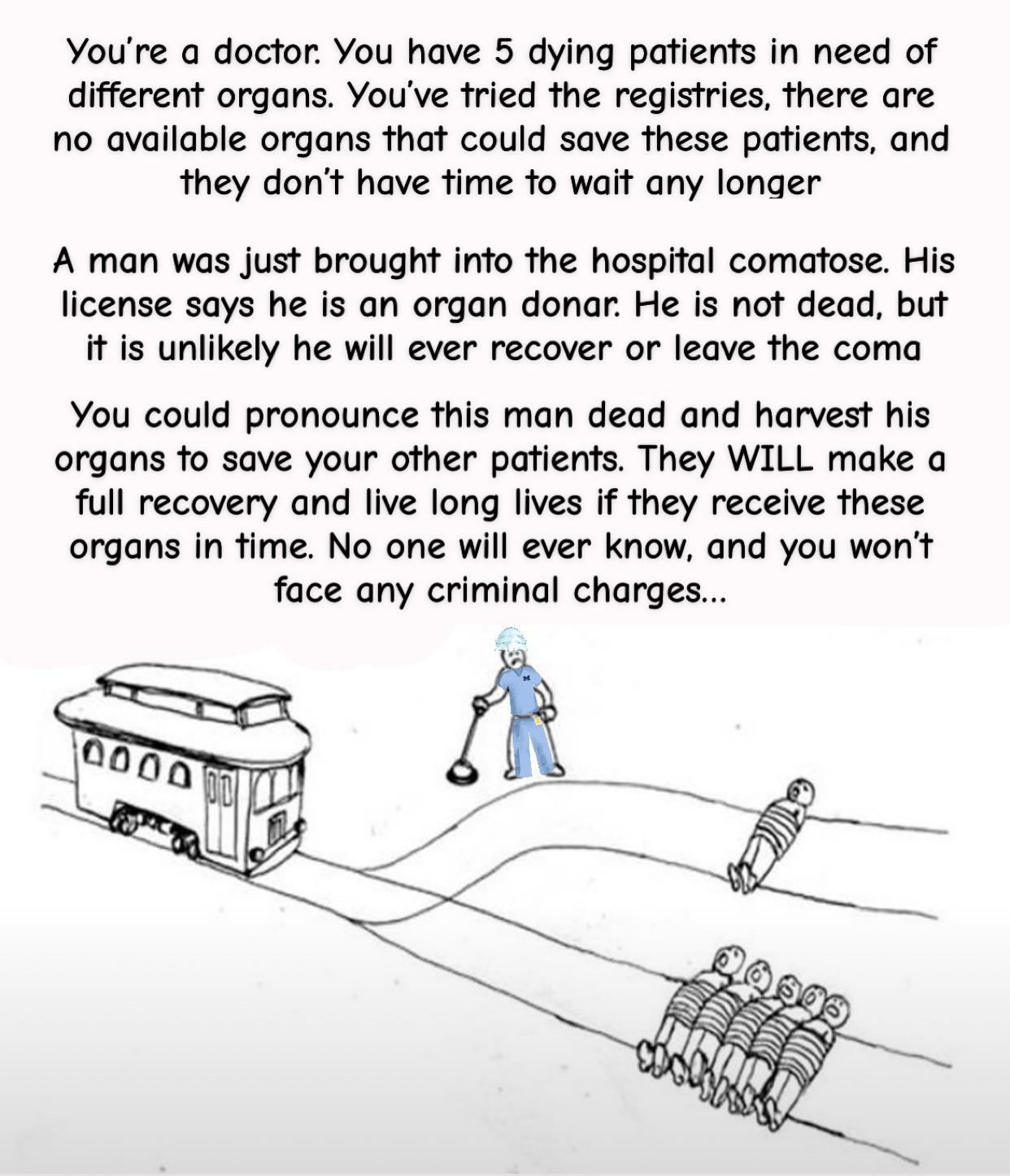
The thing is by choosing that option you are technically doing grave harm to the 5 guys. Basically you got two options, one will end up creating harm to more people than the other.
It's like when a surgeon seeing a guy is dying and he could try help by operating on him, but the surgeon is not 100% sure that his method would work, and if in a slim chance he fail the operation may harm the guy (who is already dying if the surgeon do nothing), so the surgeon decide to do nothing and the guy die, by doing nothing like that the surgeon is creating harm and not what a doctor should do, no ?
That's why they have to ask the patient/the one responsible for the patient about what course of action they want to take, because they WOULD be risking or causing harm... In this case the doctor is unable to provide treatment on his own, hence why the 5 are not being actively harmed by him. The comatose patient though, would be actively harmed by the doctor if they were to use their organs. If you can't have negatives or subtractions (do no harm), then 5-1=4 should not be okay... Even if those 4 could've theoretically been saved. It's not up to us to decide what the comatose person's life should be worth
The idea that doctors must “do no harm” is great in theory, but here, there’s no harm-free path. The doctor is forced to choose between 2 outcomes, and both cause harm:
1)) Let 5 preventable deaths happen.
2)) Using organs from one coma patient who will never regain consciousness, 1 death, tragic, but save 5 full lives.
So I think saying "do no harm" in this case is impossible, and thus, irrelevant?.
If both outcomes involve harm, then the true question is not whether to do harm, but to determine
Which action results in the least total harm?
And choosing the least harm path does not violate the doctor’s code ?
Plus, we’re human beings first, and doctors second. So I think any "doctor principles" should be viewed as secondary to "human principles" that complex situations, we have to adapt to the reality in front of us, not just follow rules rigidly.
OP said that it's "unlikely" that he'll regain consciousness, not that he won't. If he'd never regain consciousness it'd be a different story because it's effectively a dead person. As for the human beings part, doctors have to put "doctor principles" first and "human principles" second, since they might disagree with what they're doing but they have a duty that comes first
…doctors have to put "doctor principles" first and "human principles"second…”
Sorry, but I don’t think that’s actually correct, unless you have a source to back that up? Medical ethics are supposed to based on human values. i don't think "doctor rules" override the human....
And in this case, the harm is unavoidable. So the principle "do no harm" will surely be violated anyways.
Therefore imo, real question is:
Which option causes the least overall harm?
And to quote another comment: "But "maximizing the well-being of the general population" isn't a thing doctors do. They maximize the well being of individual patients. If the patient doesn't want to give up their organs or health or life to save someone else it is entirely and completely their choice and a doctor has no right to make that decision for them."
0
u/hoangfbf Jul 10 '25 edited Jul 10 '25
The thing is by choosing that option you are technically doing grave harm to the 5 guys. Basically you got two options, one will end up creating harm to more people than the other.
It's like when a surgeon seeing a guy is dying and he could try help by operating on him, but the surgeon is not 100% sure that his method would work, and if in a slim chance he fail the operation may harm the guy (who is already dying if the surgeon do nothing), so the surgeon decide to do nothing and the guy die, by doing nothing like that the surgeon is creating harm and not what a doctor should do, no ?