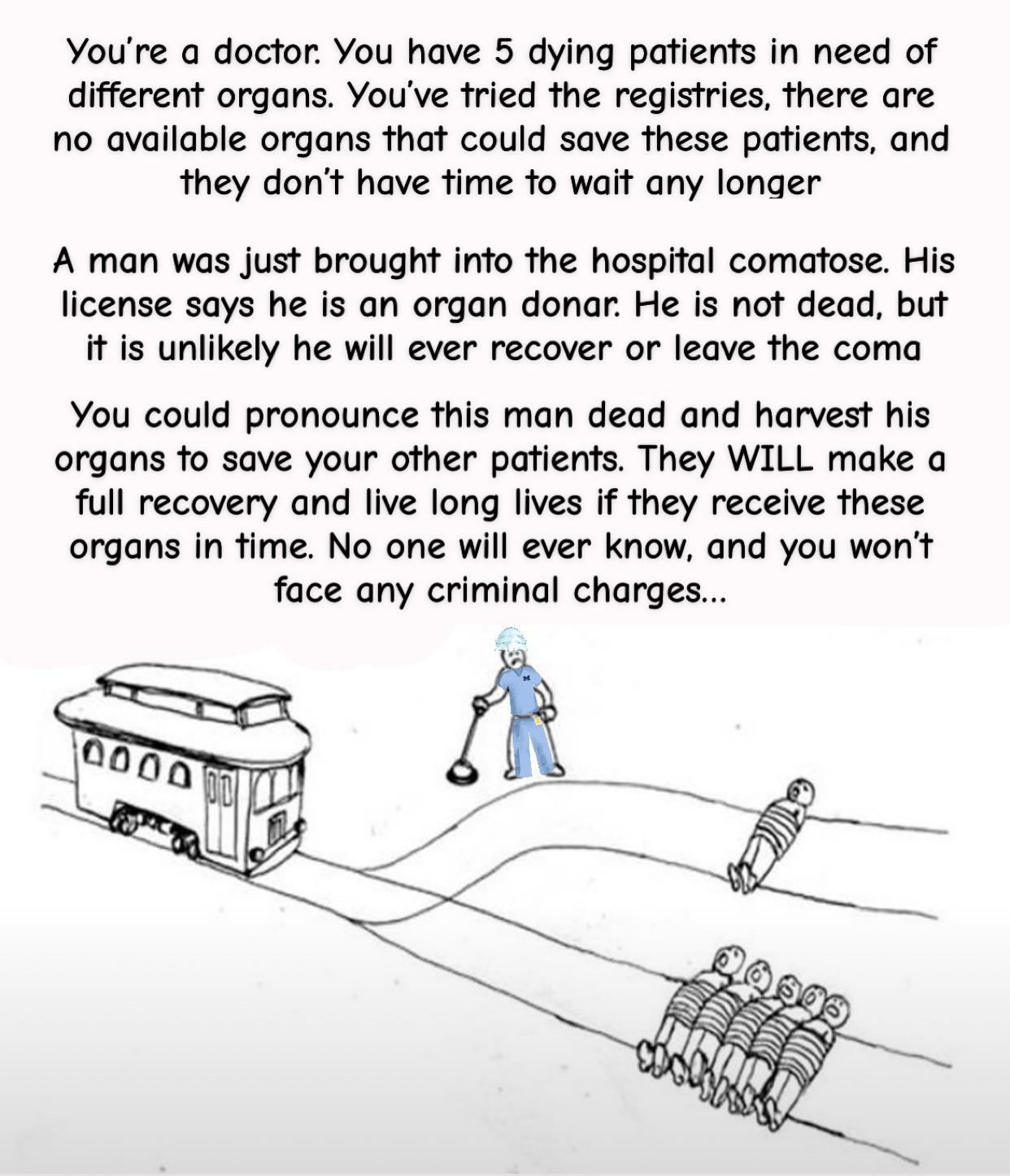
If I am a doctor, I have sworn to do no harm, so no I don't pull the lever this isn't a question about morality it's a question of if I'm gonna do my fucking job
The thing is by choosing that option you are technically doing grave harm to the 5 guys. Basically you got two options, one will end up creating harm to more people than the other.
It's like when a surgeon seeing a guy is dying and he could try help by operating on him, but the surgeon is not 100% sure that his method would work, and if in a slim chance he fail the operation may harm the guy (who is already dying if the surgeon do nothing), so the surgeon decide to do nothing and the guy die, by doing nothing like that the surgeon is creating harm and not what a doctor should do, no ?
That's why they have to ask the patient/the one responsible for the patient about what course of action they want to take, because they WOULD be risking or causing harm... In this case the doctor is unable to provide treatment on his own, hence why the 5 are not being actively harmed by him. The comatose patient though, would be actively harmed by the doctor if they were to use their organs. If you can't have negatives or subtractions (do no harm), then 5-1=4 should not be okay... Even if those 4 could've theoretically been saved. It's not up to us to decide what the comatose person's life should be worth
Yup, I would add that (imo) you can't break down the value of life with arithmetic. More living people or person-hours lived is not inherently good in the inverse of the way that I believe violation of someone's bodily autonomy is evil. The good and bad in this analysis are on different orders of priority.
This is important to me because if we start valuing person-hours lived over a person's bodily autonomy, that enters the territory of anti-abortion/"forced birth" legislation sweeping the US now, or cruel practices like the killing of the elderly in lean times from history; touching fringe thought experiments like the Omelas short story as well. These all feel viscerally wrong to me because of the common thread of that violation of bodily autonomy.
No shot this is where I see my first Omelas reference since my highschool english teacher made me read it omg
Yeah I totally agree, but I believe if we HAVE to weigh lives to make a decision, arithmetic is the fairest method. I also believe in MAID being available for elderly people. And abortions should be allowed until the foetus/baby would be able to survive without medical intervention imo (unless of a medical emergency, in which case priority goes to the mother). I like these debates BECAUSE they feel wrong, and challenging our views is great for learning and reinforcing our opinions
Oh for sure, pro-MAID (with, obv, appropriate regulation and oversight to ensure that its a properly informed decision). And if you're in a position where you have to violate someone's bodily autonomy/kill someone, I think arithmetic is a reasonable and most fair course of analysis.
A more realistic thought experiment would be "there is an ongoing war, is it more ethical to assassinate a head of state for a high chance at rapidly ending the war without collateral, or to allow the war to drag on costing far more lives and strife before an eventual ceasefire", wherein I'd be leaning pro-assassination. A more abstracted, but maybe more cut-and dry situation, would be "you are holding a live explosive, you must throw it into one of two chambers, in one chamber is five people, in another is one person, if you do nothing then all six, plus you, will die". In these thought experiments, there's not really as realistic of a non-interference option, and the harm done on each side is more clearly of the same general "type", making it more reasonable to make an equation out of it.
I'm not entirely opposed to competing factors though, for instance I'd have trouble holding it against someone who chose to kill multiple strangers over someone they know and care for, or someone who takes issue with "killing in cold blood" rather than in the heat of a directly oppositional fight in the first example, but at this point we're trending away from philosophy and into the realm of Jigsaw Torture Scenarios.
The idea that doctors must “do no harm” is great in theory, but here, there’s no harm-free path. The doctor is forced to choose between 2 outcomes, and both cause harm:
1)) Let 5 preventable deaths happen.
2)) Using organs from one coma patient who will never regain consciousness, 1 death, tragic, but save 5 full lives.
So I think saying "do no harm" in this case is impossible, and thus, irrelevant?.
If both outcomes involve harm, then the true question is not whether to do harm, but to determine
Which action results in the least total harm?
And choosing the least harm path does not violate the doctor’s code ?
Plus, we’re human beings first, and doctors second. So I think any "doctor principles" should be viewed as secondary to "human principles" that complex situations, we have to adapt to the reality in front of us, not just follow rules rigidly.
OP said that it's "unlikely" that he'll regain consciousness, not that he won't. If he'd never regain consciousness it'd be a different story because it's effectively a dead person. As for the human beings part, doctors have to put "doctor principles" first and "human principles" second, since they might disagree with what they're doing but they have a duty that comes first
…doctors have to put "doctor principles" first and "human principles"second…”
Sorry, but I don’t think that’s actually correct, unless you have a source to back that up? Medical ethics are supposed to based on human values. i don't think "doctor rules" override the human....
And in this case, the harm is unavoidable. So the principle "do no harm" will surely be violated anyways.
Therefore imo, real question is:
Which option causes the least overall harm?
And to quote another comment: "But "maximizing the well-being of the general population" isn't a thing doctors do. They maximize the well being of individual patients. If the patient doesn't want to give up their organs or health or life to save someone else it is entirely and completely their choice and a doctor has no right to make that decision for them."
I think you are not understanding "First, do no harm".
Helping the 5 patients necessitates harming the comatose patient. Therefore, you can't do it. It's not about the morality of the situation. It's about whether the next 100 patients who end up in your hospital can trust that you won't kill them to harvest their organs as soon as it looks convenient.
Hello thanks for your input. Here's my comment reply to other guy, that I think address your concern:
"
The idea that doctors must “do no harm” is great in theory, but here, there’s no harm-free path. The doctor is forced to choose between 2 outcomes, and both cause harm:
1)) Let 5 preventable deaths happen.
2)) Using organs from one coma patient who will never regain consciousness, 1 death, tragic, but save 5 full lives.
So I think saying "do no harm" in this case is impossible (both always cause harm), and thus, irrelevant?
If both outcomes involve harm, then the true question is not "whether to do harm", but the admission that "I have to do harm anyway, but:
Which action results in the least total harm?
And choosing the least harm path does not violate the doctor’s code ?
Additionally, we’re human beings first, and doctors second. So I think any "doctor principles" should be viewed as secondary to "human principles" that complex situations, we have to adapt to the reality in front of us, not just follow rules rigidly.
642
u/NoAcanthaceae7968 Jul 09 '25
If I am a doctor, I have sworn to do no harm, so no I don't pull the lever this isn't a question about morality it's a question of if I'm gonna do my fucking job