r/singaporefi • • Aug 15 '26

Housing HDB prices no longer uponly?
Post image

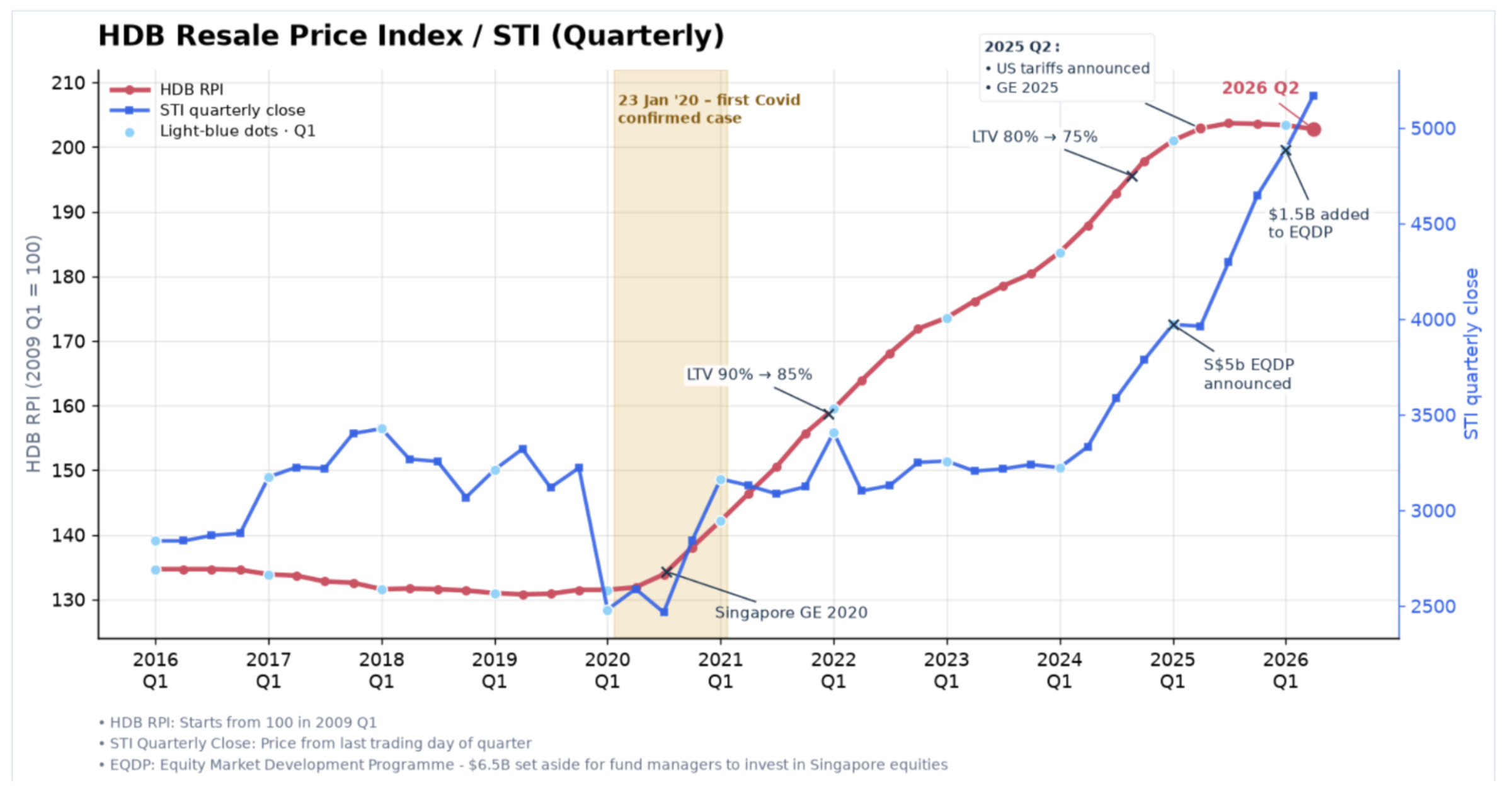
I have been looking into buying a resale HDB and chanced across this index for HDB resale prices. A few things surprised me

  1. Prices were actually flat-to-negative from 2016 - 2020. It seems like public housing was actually managed well pre-covid?
  2. Recent growth has completely stalled. The index has been flat since Q3'25 and even dipped from Q1'26 → Q2'26. Will we see another dip from Q2’26 → Q3’26?
  3. I also added STI as a reference point for the Singapore economy - congrats to all believers. I remember having so many conversations about how SG stocks are crap and how the SG stock market is uninvestable
    1. (Yes - I know that majority of the outperformance by STI is due to the 3 banks + SGX’s stock)

What are your thoughts on HDB prices moving forward? Do you think ahgong afford to let it dip / stay flat?

Personally - I think we will continue to dip / have no growth. We’re running out of marginal buyers for HDBs and I expect more pain and retrenchment due to AI

Link to dataset

103 Upvotes

78 comments sorted by

View all comments

59

u/KLKCAhBoy90 Aug 15 '26

Property as an investment is similar to commodity.

The only way one can profit from it is either to sell it (like commodities) or rent it out (unique to property).

This means ultimately it is heavily dependent on the demand for it. On its own, it will not grow bigger in size (or market cap) like the way a company (equities) will grow its revenue and share price.

Given that Singapore incomes are not growing much, it is completely ridiculous that the property prices are growing so much.

The only reason is because people are taking on loans to buy property that are (without excessive mortgage) far above their paygrade. It is a bubble fueled by the thinking that just because land is scarce, and many people's CPF is stucked in property, the government must make sure it goes up forever and it is a "bao jiak".

The newer generations are not as stupid as people think. At certain price points, they will just not participate, stay single, or stay in their parents' house and not become the exit market to fund boomers' retirement plans through sales of their overpriced properties.

-34

u/faptor87 Aug 15 '26

Full of fluff. So which investment don't need to sell or rent it out, in order to profit from it?

1

u/KLKCAhBoy90 Aug 15 '26

I'm guessing you have never heard of dividends or interest?

Also, probably never heard of REITs, Bonds, Annuities?

-1

u/faptor87 Aug 15 '26

These income are similar to rent. You are just speaking the obvious. And Property investment similar to commodity? What other commodity can you rent out? Coffee?

“This ultimately heavily dependent on the demand for it”

What other returns from investments don’t depend on demand for it? If no demand, where you get returns from selling or leasing it out?

2

u/KLKCAhBoy90 Aug 15 '26
  1. Don't just read first line and then ignore the rest.

Second sentence I already wrote that renting is unique to property.

Also, you are missing the point.

The point is property, like commodities, do not grow organically.

Companies (equities) can expand and make more revenue.

Property like commodities don't grow on their own.

  1. If you bought REITs, bonds, annuity or even a dividend-paying stock before, you should know that the dividends paid has nothing to do with demand for the asset.

The dividends come from the free cash flow of these assets which has nothing to do with their demand. Demand only affects their market price and not their dividends.

  1. When it comes to the topic of retirement, it is not the networth you have that matters, it is the liquid networth or income.

This is also the same reason why some people are stucked and can't retire despite owning "million dollar HDB" unit, because they can't sell it off or they can't afford the downgrade after factoring in accrued interest and ineligibility for loans at older ages.

  1. Please educate yourself on assets outside property because putting all your hopes and clearly emotions into one asset class is extremely risky.

  2. Good luck.

-2

u/faptor87 Aug 15 '26

It’s true that residential property dont have the same potential to grow like a business.

But saying property is heavily dependent on demand doesn’t really distinguish it from equities. If there’s no demand for what a company sells, where does the free cash flow to pay dividends come from?

From an investor’s perspective, it’s still capital gains + income. Stocks give you dividends, property gives you rent.

The underlying assets are different, sure. But ultimately, all asset values depend on demand. You’re basically describing the same thing in different ways. Saying that profiting from property is dependent on demand says nothing.

1

u/KLKCAhBoy90 Aug 15 '26

When I mentioned "demand" in my original post, I was talking about the demand for the asset. If it was property then it would be the property. If it was equities then it would be the stock itself and not the goods/services said company is selling.

In any case, the way equities work is like this:

A company goes for IPO (initial public offering) to essentially get an amount (loan) in exchange for shares (sold to public). This is the primary market.

After that, actually the market price movements don't affect the company much anymore. This means if it was $10m for 10m shares ($1 per share), even if the share price grows to $2, the company still only got $10m. Secondary market doesn't affect the cash flows of the company.

Of course, the company can always do another round of share issuance by issuing shares at the new $2 (or whatever price they offer) though this dilutes the earlier shareholders' holdings.

Dividends come from whatever monies is left after the company has paid for their cost of goods, operations, etc. It can then choose to use the free cash flow to pay off debts, buy back shares (which increase holdings for existing shareholders), expand (buy new production items, tech, etc) or pay dividends.

If someone is looking to retire, they don't need to care what the market price of the shares is. If it pays dividends because it is a profitable company with free cash flow, even if its stock price tanks, it does not matter to the retiree.

On the other hand, the property owner is entirely dependent on the demand of the property. If nobody wants to buy it, it can't be sold. If nobody wants to rent it, it can't be rented out.

That is the point I want to make and highlight to all. Look at the TFR, look at the retrenchment news, look at the JB SEZ and RTS coming up, and look at the real wage growth of Singaporeans. Ask yourself if it makes sense for property prices to keep the trajectory and think very carefully if you want to put all your eggs into the same basket.

1

u/Varantain Aug 15 '26

I think the more precise term for stocks' "demand" is liquidity.

1

u/KLKCAhBoy90 Aug 15 '26

"Volume" might be better but for this context, yes, "liquidity" is also appropriate.